
Description
PrymaLab · Research use only
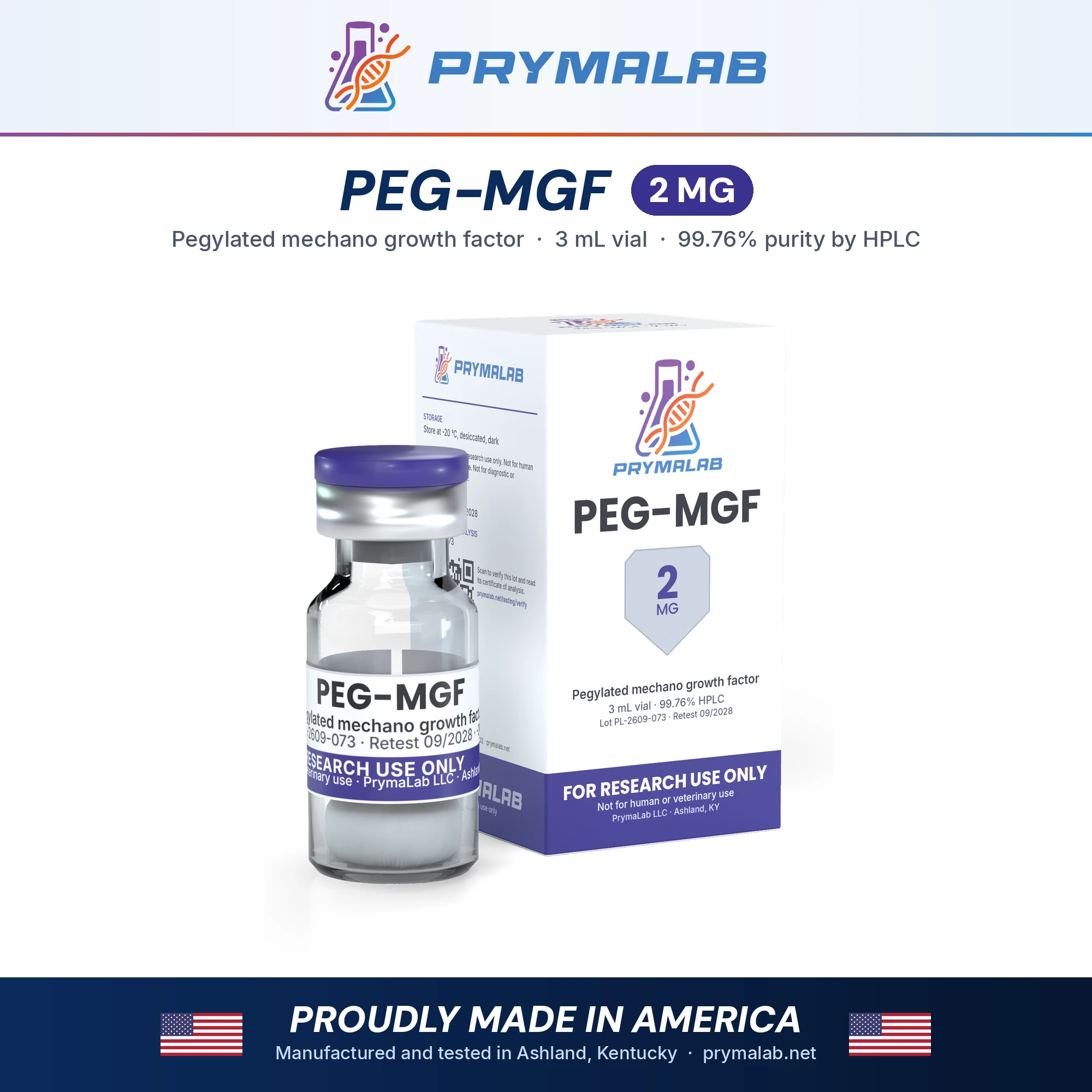
PEG-MGF (Mechano Growth Factor) 2mg
PEGylated 24-residue MGF E-domain peptide, freeze-dried, 2 mg per vial
PEG-MGF is the 24-residue E-domain peptide of mechano growth factor, a splice variant of the IGF-1 gene, carrying a polyethylene glycol chain at its N-terminus and an amide at its C-terminus. This listing is a sealed vial of 2 mg of freeze-dried powder. The research behind the name concerns how muscle changes its IGF-1 splicing after stretch or damage; none of the cited papers tested the synthetic peptide or a PEGylated form of it.
Specifications
| Property | Value |
|---|---|
| Compound | PEG-MGF PEGylated mechano growth factor: the IGF-1Ec E-domain 24-mer carrying a polydisperse PEG |
| CAS number | Not assigned |
| Molecular formula | C 121 H 200 N 42 O 39 (core 24-mer before PEGylation) |
| Theoretical mass | 2867.2 Da core peptide; the conjugate carries a polydisperse PEG (nominal 2–5 kDa) |
| Sequence / structure | PEG-YQPPSTNKNTKSQRRKGSTFEERK-NH₂ (24-residue human MGF E-domain peptide; C-terminal amide; PEG attached at the N-terminus). Identity is reported on the core-peptide basis. |
| Label claim | 2 mg/vial |
| Form | Lyophilized (freeze-dried) powder or cake in a sealed glass vial with a rubber stopper and aluminium crimp cap |
| Storage, sealed | −20 °C, desiccated, dark |
| Purity specification | 99.0% or higher by RP-HPLC |
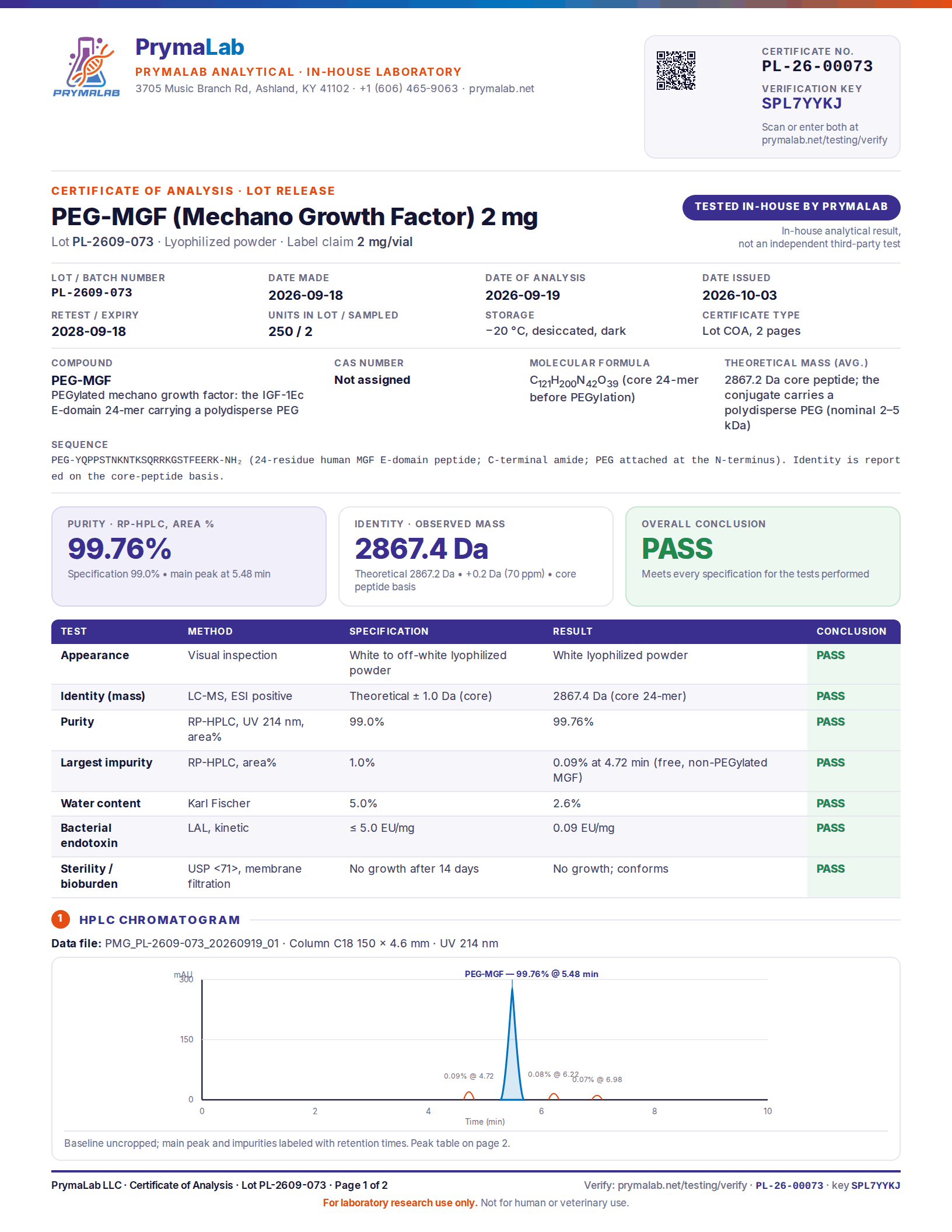
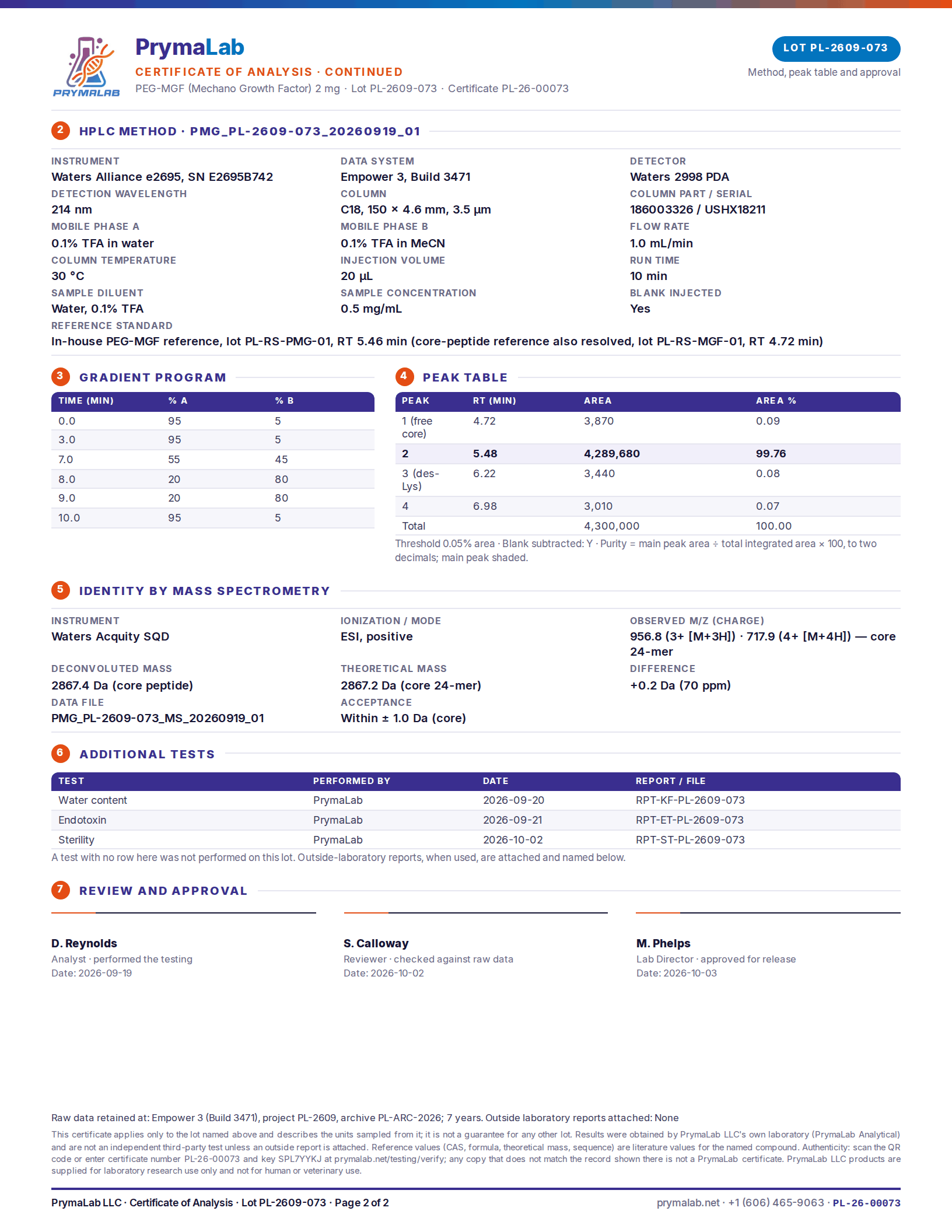
| Lot certificate | Results for the lot now shipping are in the certificate panel on this page |
| Safety data sheet | PL-SDS-127 |
What the PEG chain changes
The peptide core is defined exactly. The certificate gives the structure as PEG-YQPPSTNKNTKSQRRKGSTFEERK-NH2, the 24-residue human MGF E-domain with the polymer on the N-terminus, and gives the core formula before PEGylation as C121H200N42O39 with a theoretical mass of 2867.2 Da. The polymer is not defined that exactly. It is polydisperse, a mix of chain lengths with a nominal size of 2 to 5 kDa, so the conjugate has no single mass and no CAS number has been assigned. That is why identity on the certificate is reported on the core-peptide basis, with the LC-MS result compared against 2867.2 Da. It also means a molar amount cannot be worked out from the 2 mg label claim as precisely as for an unmodified peptide, since a chain of that size adds a large share of the weight. Peptide purity testing explains what the HPLC and mass spectrometry results on a certificate each show.
What the research covers
A splice variant found in stretched muscle
The IGF-1 gene gives rise to more than one precursor, and the variants differ in the E domain at the carboxyl end. Yang and colleagues looked at IGF-1 expression in rabbit muscle made to undergo rapid hypertrophy by active stretch1. Two types of IGF-1 mRNA were strongly expressed in the stretched muscle, and in situ hybridisation located the expression in the muscle fibres themselves1. Resting muscle yielded a single cloned isoform, IGF-1Ea1. Stretched muscle also expressed a second isoform, which the authors called IGF-1Eb, whose E domain differed from the liver form by a 52 base pair insert that shifts the reading frame and so changes the carboxyl-terminal sequence1. They proposed it as the isoform behind local growth regulation in muscle under mechanical load1. Later work from Goldspink’s group called the muscle splice variant mechano growth factor2. Naming of the E-domain isoforms is not uniform: the rabbit paper used IGF-1Eb, while the certificate for this product names the human sequence after IGF-1Ec.
Mechanical signals and muscle damage
Goldspink’s 1999 review set this work within a broader question, how cells convert mechanical strain into changes in gene expression3. It described muscle as one of the best tissues for studying that link, because the mechanical activity generated by and imposed on muscle can be controlled and measured in vitro and in vivo, and it summarised evidence that stretch signals the production of new actin and myosin filaments and new sarcomeres3. Hill and Goldspink then followed two IGF-1 splice variants in rat tibialis anterior muscle after local damage, caused either by electrical stimulation of the stretched muscle or by bupivacaine2. Using real-time RT-PCR, they found that MGF mRNA rose quickly and declined within a few days after both kinds of damage, while the systemic variant IGF-1Ea rose more slowly, its increase matching the decline in MGF2. The paper links that splicing pattern to satellite (stem) cell activation, which the study tracked with markers including M-cadherin and MyoD2.
Why the peptide is PEGylated
PEGylation is the linking of one or more polyethylene glycol chains to a protein, peptide or other molecule4. Veronese and Pasut described the polymer as non-toxic, non-immunogenic, non-antigenic and highly soluble in water, and listed the main advantages of conjugates as longer residence in the body, less breakdown by metabolic enzymes and reduced or eliminated immunogenicity4. That review deals with PEGylation in general. None of the abstracts here measured what a PEG chain does to the MGF E-domain peptide, so the case for attaching one to this sequence rests on the general argument.
What is not established
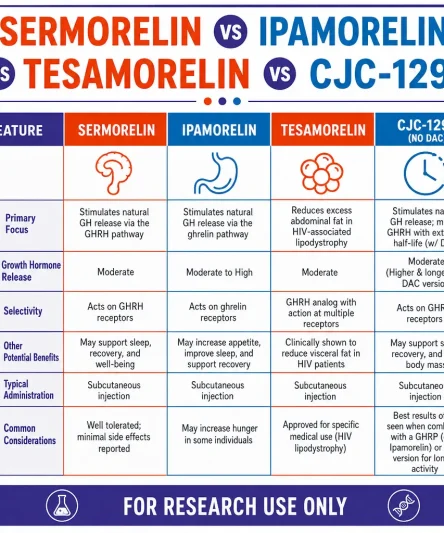
The MGF papers cited here measured messenger RNA for a splice variant in rabbit and rat muscle. None of them made the 24-residue E-domain peptide, applied it to cells or animals, or identified a receptor for it, and none involved a PEGylated form. Two of the three come from Goldspink’s group. Statements that PEG-MGF itself acts on muscle cells go beyond these sources. For the growth hormone and IGF-1 axis more broadly, PrymaLab’s sermorelin, ipamorelin and tesamorelin comparison covers the GHRH analogues and secretagogues that act upstream of IGF-1, and an overview of peptides studied in muscle research places the IGF-1 analogues among them.
How each lot is tested
Every lot is tested in PrymaLab’s own laboratory in Ashland, Kentucky before release: RP-HPLC for purity, LC-MS for identity, Karl Fischer titration for water, LAL for endotoxin and USP <71> for sterility. The results for the lot now shipping are in the certificate panel on this page, and the certificate number, key and QR code can be checked on the verify page. These are in-house results from PrymaLab Analytical, not an independent test, and the lab is not accredited to ISO 17025. The third-party testing guarantee on this page still applies: if any independent laboratory finds the wrong compound, or less than the stated purity or amount, the order is refunded and the cost of the test is reimbursed.
Frequently asked questions
Is PEG-MGF the same as IGF-1?
No. It is the 24-residue E-domain from the MGF splice variant of the IGF-1 gene, the part of the precursor that follows the mature IGF-1 sequence, with a PEG chain attached. IGF-1 analogues such as IGF-1 LR3 and IGF-1 DES are built on the mature IGF-1 protein and are separate products.
Why is identity reported for the core peptide only?
The attached PEG is polydisperse, a mixture of chain lengths with a nominal size of 2 to 5 kDa, so the conjugate has no single mass to confirm. The 24-residue core does, with a theoretical mass of 2867.2 Da, and the LC-MS identity result on the certificate is compared with that figure.
How should the vial be stored?
Sealed at −20 °C, desiccated and protected from light, as the certificate specifies. Let the vial reach room temperature before it is opened so condensation does not form on the powder. A reconstituted solution should be kept at 2 to 8 °C, out of the light, within the period your laboratory has established.
Has PEG-MGF itself been studied?
Not in the papers cited here. They measured MGF messenger RNA in rabbit and rat muscle after stretch or damage, and a separate review covered PEGylation in general. What the PEGylated peptide does in cells or animals is not shown by these sources.
Is PEG-MGF for human use?
No. It is sold only for laboratory research and is not approved by the FDA or any comparable authority for human or veterinary use. It must not be given to people or animals.
References
- Yang S, Alnaqeeb M, Simpson H, et al. Cloning and characterization of an IGF-1 isoform expressed in skeletal muscle subjected to stretch. J Muscle Res Cell Motil. 1996;17(4):487-95. DOI · PubMed
- Hill M, Goldspink G. Expression and splicing of the insulin-like growth factor gene in rodent muscle is associated with muscle satellite (stem) cell activation following local tissue damage. J Physiol. 2003;549(Pt 2):409-18. DOI · PubMed
- Goldspink G. Changes in muscle mass and phenotype and the expression of autocrine and systemic growth factors by muscle in response to stretch and overload. J Anat. 1999;194 ( Pt 3)(Pt 3):323-34. DOI · PubMed
- Veronese FM, Pasut G. PEGylation, successful approach to drug delivery. Drug Discov Today. 2005;10(21):1451-8. DOI · PubMed
Research use only
For laboratory research use only. PEG-MGF (Mechano Growth Factor) 2mg is not a drug, food, cosmetic or dietary supplement, is not approved by the FDA or any comparable authority for human or veterinary use, and must not be given to people or animals. It is sold to qualified researchers and institutions, and the buyer is responsible for lawful handling and disposal.









8 reviews for PEG-MGF (Mechano Growth Factor) 2mg