Description
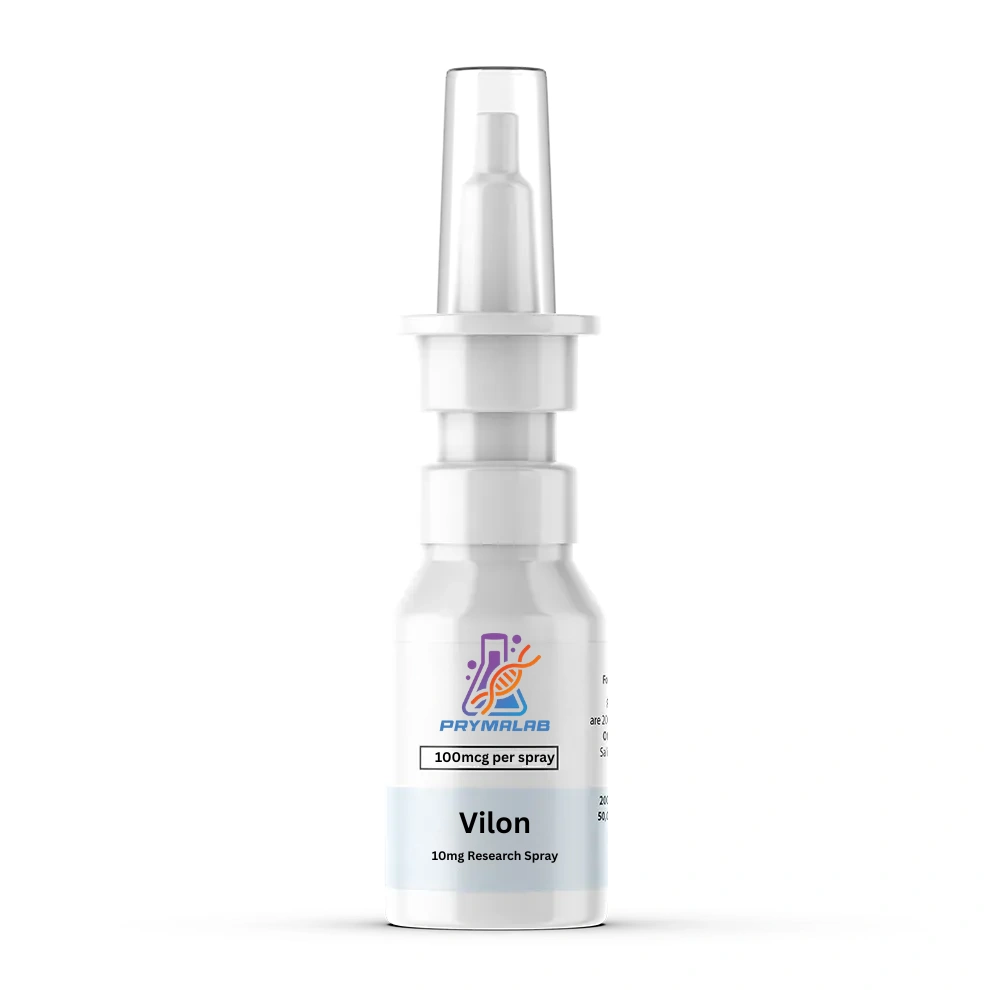
This vilon nasal spray supplies Vilon, a synthetic dipeptide with the sequence Lys-Glu, abbreviated KE. It is the smallest compound in the Khavinson short peptide series from the St Petersburg Institute of Bioregulation and Gerontology, and within that framework it is associated with thymic and immune tissue. Two amino acids is as small as a peptide can be while still being one, and that fact governs almost everything practical about working with it. Supplied for laboratory research use only.
This is not an allergy or sinus product
Search results for anything described as a nasal spray are dominated by the pharmacy aisle, so it is worth stating plainly what this is not before going any further.
The over the counter category covers a few distinct things. Saline solution and simple saline rinses flush the nasal passages. A decongestant shrinks swollen tissue. Nasal steroids reduce inflammation in the nasal lining over days of repeated use. Antihistamines address allergies triggered by pollen and other airborne material, with sneezing, a runny nose, a stuffy nose and sore throat as the symptoms they target. Products in that aisle compete on formulation claims: alcohol-free, chemical free, gluten-free, USDA certified organic, non-drowsy, sometimes built around probiotic strains, a probiotic blend or a proprietary probiotic blend, with an oral probiotic version alongside. Their packaging tells you to prime the pump before first use of the applicator.
None of that describes this material. Vilon peptide is a two-residue research compound, not sinus medicine, not an allergy treatment, and not a nasal care or nasal health product. It has no role in nasal congestion, chronic sinusitis or nasal polyps, and no claim is made here about any of them. It is likewise not a remedy for nausea or dizziness, symptoms that appear in this search space because they are listed as side effects of the pharmacy products rather than because they connect to peptide research.
If you need a nasal symptom treated, the pharmacy aisle or a clinician is the right destination. What follows is about a research compound and the difficulty of verifying it.
Verifying a two-residue peptide is genuinely hard
This is the part I would want to know before buying, and it is not covered anywhere else I have looked.
Reversed-phase HPLC, the standard purity method for peptides, separates molecules by hydrophobic interaction with the column. Lys-Glu is two residues, one basic and one acidic, and it is extremely polar. A molecule like that has almost nothing for a C18 column to hold on to, so it tends to elute at or very near the void volume, unretained, alongside salts and buffer components. A purity percentage generated by an unsuitable reversed-phase method on a compound like this can be close to meaningless, because the peak may not have been separated from anything.
The methods that do work are different: hydrophilic interaction chromatography, ion-pairing reagents added to the mobile phase to increase retention, ion exchange, or LC-MS with an appropriate column. Mass spectrometry helps with identity, though at low mass you are working in a region with more chemical background than a 3 kDa peptide would produce.
So the question to ask about any dipeptide, from any supplier, is not what the purity number is but what method produced it. A high number from an unsuitable method is worse than no number, because it looks like assurance. This applies to Vilon, to any KE material, and to every dipeptide in this class.
What the literature actually contains
Vilon has been studied since the 1990s within the Khavinson programme. Published work includes a 2000 report by Khavinson and colleagues describing the synthetic dipeptide inhibiting growth of spontaneous tumours and increasing lifespan in mice, and the compound appears across the group’s immune and gerontology work.
The honest reading of that body of evidence is the same as for the rest of this class. It is preclinical, it is concentrated within one research lineage, and independent replication outside that lineage is limited. Lifespan claims in particular deserve caution, because lifespan studies are difficult, expensive and sensitive to husbandry conditions, and a single-group result is not the same as a replicated one. There are no human clinical trials and no FDA or EMA approval.
The mechanistic proposal is shared across the series: short peptides entering cells, reaching the nucleus and interacting with DNA promoter regions or chromatin-associated histones to change gene accessibility, argued in Short Peptides Regulate Gene Expression. Docking models have been built for a set of these peptides, with KE among those modelled. It remains a hypothesis without high-resolution structural confirmation.
Vilon nasal spray specifications
| Compound |
Vilon, synthetic short peptide bioregulator |
| Sequence |
Lys-Glu (KE) |
| Molecular formula |
C11H21N3O5 (approximately 275.3 Da) |
| Naming |
Trade name Vilon; the IUPAC name describes the lysyl-glutamic acid dipeptide |
| Length |
Dipeptide (two residues), the smallest in the series |
| Charge character |
One basic residue and one acidic residue; highly polar |
| Origin |
St Petersburg Institute of Bioregulation and Gerontology |
| Tissue association |
Thymic and immune tissue within the Khavinson framework |
| Proposed mechanism |
Peptide-DNA or peptide-histone interaction altering gene accessibility (hypothesis) |
| Analytical note |
Poorly retained on standard reversed-phase columns; method choice is critical |
| Evidence status |
Preclinical, single research lineage, limited independent replication |
| Regulatory status |
No FDA or EMA approval |
| Format |
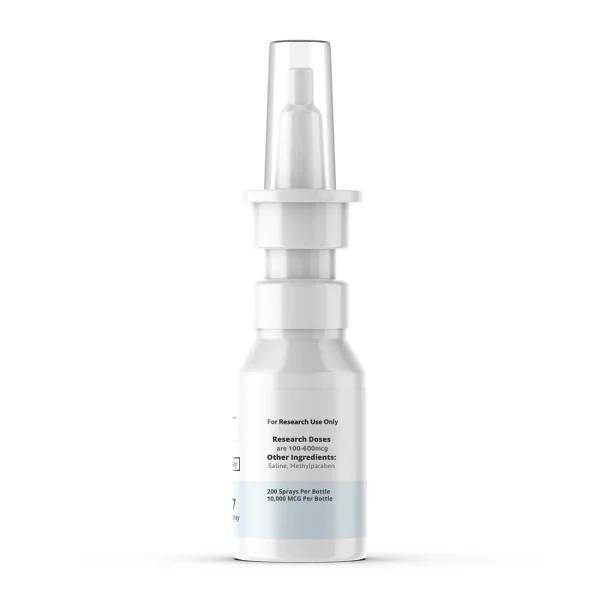
Metered spray bottle [CONFIRM: fill volume, mg per bottle, concentration] |
| Classification |
Research chemical. In-vitro laboratory use only. Not for human or veterinary use. |
In-vitro considerations for intranasal vilon research
Given the immune association, lymphocyte cultures, thymocyte preparations and monocyte or macrophage lines are the models that fit, with proliferation, cytokine output by ELISA or multiplex, and surface marker expression by flow cytometry as readouts. Because the proposed mechanism is transcriptional, qPCR or RNA-seq belongs in the panel too.
Two cautions specific to a dipeptide. Peptidases in serum will consume a two-residue peptide readily, so long incubations in serum-containing medium give a poorly defined exposure. And the constituent amino acids matter as a control: lysine and glutamate are both ordinary nutrients, so an effect from a dipeptide that is rapidly hydrolysed could reflect amino acid delivery rather than any action of the intact molecule. A free amino acid control at matched concentration is the comparison that separates those, and its absence is the most common gap in intranasal vilon research and cell work with this compound.
That control has extra weight here because glutamate is a neurotransmitter in its own right. Releasing free glutamate into a culture is not a neutral act in any system that responds to it, which is a further reason not to attribute an observed effect to the intact dipeptide without checking. Where immune endpoints are the question, immune modulation and immune cell differentiation are the readouts the Khavinson framework points at, measurable by flow cytometry and cytokine panels rather than assumed from the tissue association.
One term worth deflating: bioavailability. It describes how much of a compound reaches systemic circulation after administration to an organism, which is not a quantity that exists in a dish. In cell work the equivalent question is how much intact peptide survives your medium and reaches the cells, and that is answered by measuring it, not by inferring it from a delivery format. Epithalon, the tetrapeptide from the same programme, faces the identical problem and is worth reading alongside this one for that reason.
Vilon nasal spray storage and handling
KE contains no cysteine, no methionine and no tryptophan, so oxidation, disulfide chemistry and photodegradation are not the issues here. Its practical vulnerabilities are enzymatic and physicochemical.
Charge state and solubility shift with pH because the molecule carries both a basic and an acidic side chain, which makes buffer control more consequential than it looks. And as the smallest peptide in the series it is the most readily hydrolysed. Sensible vilon nasal spray storage is cold, sealed, single-use aliquots rather than repeated freeze-thaw, and low-binding plasticware, though adsorption is less of a problem for a small highly polar molecule than for a large hydrophobic one.
How research grade vilon spray is characterized
Everything in the first section applies here. For a research grade vilon spray, ask what analytical method produced the purity figure, because a standard reversed-phase method is not appropriate for a molecule this polar and a number generated that way can be misleading. Hydrophilic interaction chromatography, ion-pairing or ion exchange, paired with mass spectrometry for identity, is what a dipeptide needs. This material is supplied under the same verification PrymaLab applies across its research peptides, HPLC and MS confirmation plus independent third-party testing. No specific lot figures are asserted here; request the certificate of analysis for the lot you receive, and read the method line as carefully as the number.
For related bioregulator research, see the PrymaLab Research Library.
Frequently asked questions
What is Vilon?
Vilon is a synthetic dipeptide, Lys-Glu (KE), the smallest of the Khavinson-class short peptide bioregulators, associated with thymic and immune tissue in that framework. Material supplied here is a research chemical for in-vitro laboratory use only.
Why is a dipeptide hard to analyse?
Because it is extremely polar and barely interacts with a standard reversed-phase column, so it can elute unretained near the void volume alongside salts. A purity number from an unsuitable method may not reflect a real separation. Hydrophilic interaction, ion-pairing or ion exchange methods are appropriate.
How strong is the evidence for Vilon?
Preclinical and concentrated in one research lineage, including a 2000 report on tumour growth and lifespan in mice. Independent replication outside that lineage is limited, lifespan results in particular warrant caution, and there are no human clinical trials or regulatory approvals.
What control does a Vilon experiment need?
A free amino acid control at matched concentration. A dipeptide hydrolysed by serum peptidases delivers lysine and glutamate, both ordinary nutrients, so without that control an apparent effect of the intact peptide cannot be distinguished from amino acid delivery.
Is Vilon nasal spray approved for human use?
No. This material is a research chemical for in-vitro laboratory use only, has no FDA or EMA approval, and is not intended for human or veterinary use. Nothing here is medical advice.
Ordering and compliance
Every PrymaLab research compound ships from the United States and is sold research-use-only. This vilon nasal spray is supplied for in-vitro laboratory research, is not intended for human or veterinary use, is not a drug or supplement, and has not been evaluated by the FDA for the research-chemical context. Verify the legal status of any research compound in your jurisdiction before ordering. Certificates of analysis are available on request for the lot you receive.












Reviews
There are no reviews yet.