Description
PrymaLab · Research Use Only
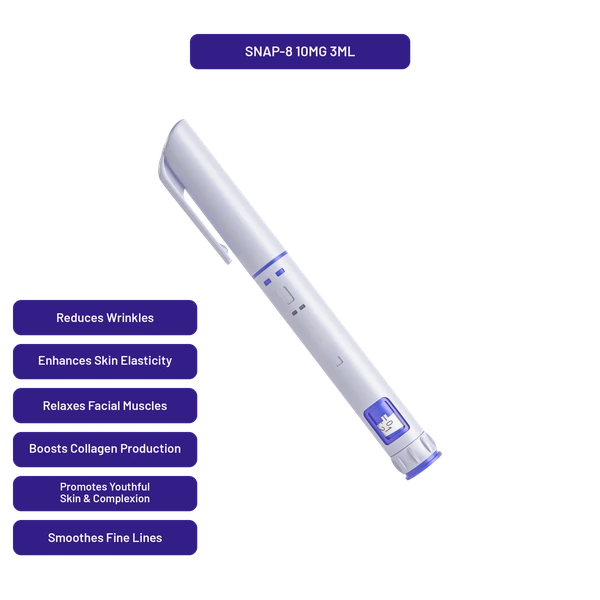
Preloaded Autoinjector | SNAP-8 | 3ml Pen | 10mg
Acetyl octapeptide-3 in solution · 3ml at 3.33mg/ml · No reconstitution step
The SNAP-8 pen is a preloaded 3ml research autoinjector holding acetyl octapeptide-3 in solution at 3.33 mg/ml, giving 10mg of total peptide. Both termini of this octapeptide are blocked, so the shelf-life question narrows to three side chains, and the first of them is a methionine that oxidises before anything else does.
Specification Table
| Property | Value |
|---|---|
| Device format | Preloaded autoinjector pen, glass cartridge |
| Fill volume | 3 ml |
| Concentration | 3.33 mg/ml |
| Total compound in device | 10 mg |
| Molar concentration | 3.10 mM |
| Compound | Acetyl octapeptide-3 (INCI name); SNAP-8 is a trade mark of the original manufacturer |
| CAS number | 868844-74-0; UNII 8K14HJF88S |
| Molecular formula | C41H70N16O16S |
| Molecular weight | 1075.2 g/mol average; 1074.49 Da monoisotopic (calculated) |
| Amino acid sequence | Ac-Glu-Glu-Met-Gln-Arg-Arg-Ala-Asp-NH2, N-terminal acetyl and C-terminal primary amide |
| Solution appearance | Clear and colourless expected; not published on the product record |
| Reconstitution required | None. Supplied as solution |
| Excipient system | Not published on the product record. Confirm against certificate of analysis |
| Solution pH | Not published on the product record |
| Storage | 2-8°C, protect from light, do not freeze once in solution |
| Light sensitivity | No direct chromophore above about 220 nm; light matters indirectly through photosensitised oxidation of Met3 |
| Solution stability | No published study for this compound in solution |
| Oxidation site | Met3 thioether, to the sulfoxide and then the sulfone under forcing conditions |
| Deamidation site | Gln4, via a glutarimide intermediate; slow relative to Asn deamidation |
| Net charge at pH 7.4 | About -1; calculated pI approximately 4.4 |
| Solubility reference | At least 10 mg/ml in PBS pH 7.2 and 10 mg/ml in DMSO (Cayman) |
| Purity | Per lot-specific certificate of analysis |
| Regulatory status | No approved drug product in any jurisdiction. Acetyl octapeptide-3 is a cosmetic ingredient with an INCI name and an EU CosIng listing under CAS 868844-74-0 |
What Changes When The SNAP-8 Pen Ships An Octapeptide In Solution?
The degradation clock starts at the fill line, and for this molecule it runs through side chains rather than through the ends of the chain. The N-terminus is acetylated and the C-terminus is a primary amide, so there is no free amine for aminopeptidases, no pyroglutamate route from the N-terminal glutamate, and no diketopiperazine formation. Three side chains carry the whole risk.
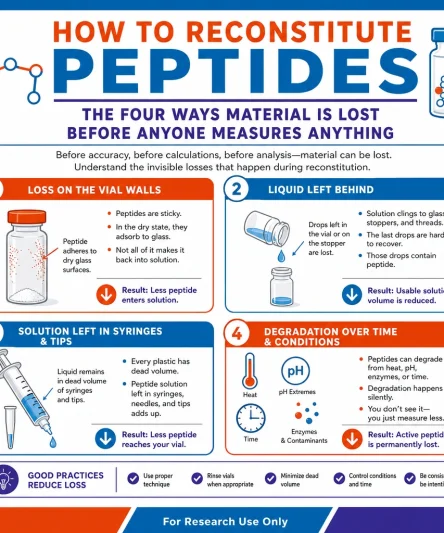
Met3 is first and by a wide margin. The thioether oxidises to methionine sulfoxide, and under forcing conditions on to the sulfone. Dissolved oxygen drives it, peroxide traces carried in by excipients accelerate it, trace metal ions catalyse it, and light-generated reactive oxygen species do the same by a different path. A dry cake in a freezer at -20°C has almost none of those inputs available. A 3 ml aqueous fill in a cartridge with a headspace has all four.
The mass consequence is the useful part. Sulfoxide formation adds 16 daltons to the 1074.49 monoisotopic parent, which is a shift any bench mass spectrometer resolves. That makes this the rare solution-state change that is loud rather than quiet.
Gln4 is second and much quieter. Glutamine deamidates to glutamate through a glutarimide intermediate, and the mass change is 0.98 daltons, which is close to invisible at low resolution and easy to miss entirely in an average-mass readout. Glutamine deamidation is far slower than asparagine deamidation, so at 2-8°C this is a minor route rather than the dominant one, but the peptide contains no asparagine at all, which is why glutamine gets to be second on the list.
Asp8 is third. The C-terminal aspartamide can close to a succinimide-type ring and release ammonia, leaving the free-acid peptide and iso-aspartate forms. The Ala7-Asp8 pair is not an Asp-Gly or Asp-Pro hot spot, so this is slow, and its mass signature is the same near-silent 0.98 daltons.
Charge is the other property worth stating, because it runs against the pattern for injectable research peptides. Three acidic groups (Glu1, Glu2, Asp8) against two arginines give a net charge of about -1 at pH 7.4 and a calculated isoelectric point near 4.4. Most peptides in a pen catalogue are cationic and adsorb to anionic glass; this one is anionic and should not. The trade-off is that a formulation drifting toward pH 4.4 approaches the point of minimum net charge, where solubility is lowest and self-association most likely. No measurement of that has been published for this peptide.
Fibrillation is not the concern here. The molecule is eight residues, highly hydrophilic, and carries no aromatic residue to stack, so amyloid-type assembly is not expected. That inference has never been tested.
What Is Snap 8 Peptide, And Where Did It Come From?
Acetyl octapeptide-3 is an eight-residue synthetic peptide, Ac-Glu-Glu-Met-Gln-Arg-Arg-Ala-Asp-NH2, of 1075.2 g/mol, designed to mimic the N-terminal region of SNAP-25 and interfere with assembly of the SNARE complex. SNAP-8 is the trade mark under which the original manufacturer sold it as a cosmetic raw material.
The lineage is short and specific. Blanes-Mira and colleagues published the parent hexapeptide, Ac-EEMQRR-NH2, in 2002; it interferes with SNAP-25, syntaxin and VAMP assembly and inhibits calcium-dependent catecholamine release from chromaffin cells, with potency described in that assay as comparable to botulinum toxin A. The octapeptide adds Ala-Asp to the same sequence. The manufacturer describes it as the more potent version; that comparison has never appeared in a peer-reviewed journal.
Anyone asking what is snap 8 peptide should also know what the public record does not contain. A PubMed search on the INCI name returns zero indexed records. There is no pharmacokinetic data in any species, no plasma half-life, and no systemic exposure measurement after any route.
What Is Known About Snap-8 Solution Stability?
Nothing specific has been published. No stability study, no forced-degradation profile and no formulation paper for acetyl octapeptide-3 exists in the indexed literature; manufacturer stability data live in supplier documentation that has not been independently reviewed.
What can be said is mechanistic and comes from the general protein-stability literature, of which Manning and colleagues 2010 is the standard reference. Methionine oxidation, glutamine deamidation and C-terminal amide loss are all characterised chemistries with known dependence on pH, temperature, oxygen and metal content. Applying them to this sequence gives a rank order and a set of expected mass shifts, which is more than a vendor sheet usually offers and less than a real snap-8 solution stability study would.
The practical consequence for a device is that time in solution is an experimental variable that nobody has calibrated for this peptide. Record the fill date, record the date of first actuation, and treat a cartridge that has been open for weeks as a different sample from the one that arrived. General handling principles are set out in the peptide storage and stability notes.
Concentration And Increment Arithmetic For The SNAP-8 Pen
Ten milligrams in 3 ml gives 3.33 mg/ml, and dividing that by the 1075.2 g/mol average mass gives 3.10 mM. Per-increment delivery follows: 0.033 mg in 0.01 ml, which is 33 micrograms, and 0.33 mg in 0.1 ml.
Set that against the only published human concentration for the family and the gap is instructive. The Blanes-Mira 2002 emulsion carried 10 percent of the hexapeptide, which is 100 mg/ml, roughly 30 times the concentration in this cartridge, and it was spread across skin rather than delivered into it. Finished cosmetics use far less than that, in the low-parts-per-million to 0.1 percent range, though published use levels for this specific octapeptide were not located.
For in vitro work the arithmetic runs the other way. Reaching 10 micromolar in an assay from a 3.10 mM stock needs a 310-fold dilution, which is a two-step series rather than the six-step series that a 50 mg/ml pen would force. That is the one place where a dilute fill is an advantage.
Snap-8 Pen Vs Vial: What The Format Suits
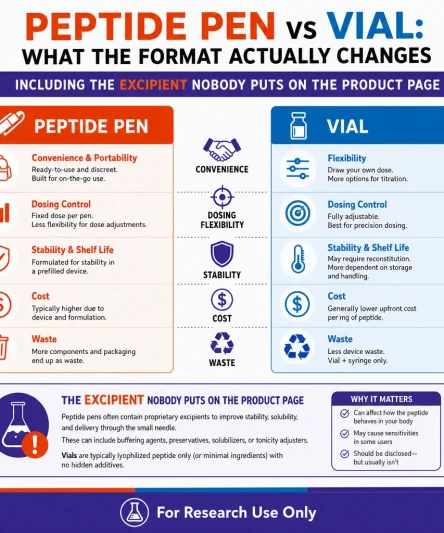
The snap-8 pen vs vial question turns on oxygen exposure more than on convenience. A lyophilized vial keeps Met3 away from dissolved oxygen until the moment of reconstitution; a preloaded cartridge has already made that introduction at the fill line and cannot undo it. Everything else in the comparison is the standard argument covered in the pen versus vial article and across the preloaded autoinjector range.
What the format does suit is repeated equivalent draws from one lot at a fixed concentration, with no diluent measurement and no dissolution step between sessions. For a peptide whose main degradation route produces a clean 16 dalton mass shift, that also means a single well-defined sample to track over time rather than a new one each session.
What it does not suit is anyone who wants the oxidation clock stopped. The 10mg lyophilized presentation is the option that keeps the material dry until use, and for a methionine-containing peptide that is a real difference rather than a preference.
What The Product Record Does Not State
Four values, and one of them decides whether the Met3 chemistry is being managed at all.
The excipient system is unpublished. Whether any antioxidant or metal chelator is present is the difference between a formulation designed around methionine oxidation and one that ignores it. Peroxide traces in polysorbates and polyethylene glycols are a documented source of oxidation in protein products, so the identity of the surfactant is not a trivial question.
Solution pH is unpublished. With a calculated pI near 4.4, a formulation sitting close to that value is at the peptide’s point of minimum charge.
Salt form is unpublished. Research suppliers sell acetate or trifluoroacetate salts, and a nominal 10 mg differs in peptide content between them.
Fill date and stability across shelf life are unpublished, which for a compound with no stability literature at all is the value most worth requesting.
Verifying The Device And Confirming The Contents Are Intact
Start with a warning about the analytical method rather than the device. This peptide contains no tryptophan, tyrosine, histidine or cysteine, so it has no absorbance above about 220 nm. A certificate of analysis reporting HPLC purity at 254 nm or 280 nm is not measuring this molecule. That pushes purity work onto 210 to 220 nm detection or onto mass spectrometry.
Inspect the solution against a white background before each draw and look for haze or particulate. Let the device reach ambient temperature before actuating, since a cold solution is more viscous and viscosity changes delivered volume in a spring-driven mechanism. Verify delivered mass gravimetrically once per device against a tared vessel.
For contents, mass spectrometry answers the question that absorbance cannot. The 1074.49 monoisotopic parent plus 16 daltons is the sulfoxide, and that peak is the single most useful number a laboratory can generate about a stored cartridge of this compound. Plus 0.98 daltons covers both the Gln4 deamidation product and loss of the C-terminal amide, which need chromatographic separation or high-resolution work to tell apart.
One identity check is worth running once. The PubChem record for acetyl octapeptide-3, CID 71587832, draws a chemically incorrect structure: its formula reads C42H72N16O15S with a mass of 1073.2, and its systematic name contains an enamine that cannot come from this sequence. The correct values are C41H70N16O16S and 1075.2. A certificate quoting 1073.2 has copied the database rather than measured the peptide, and that mismatch is a fast way to grade a supplier.
What The Snap 8 Peptide Injection Literature Actually Reports
It reports nothing, because there is none. No injectable, subcutaneous, intradermal or systemic study of this octapeptide has been published in humans or in animals. There is no pharmacokinetic data, no toxicology, no immunogenicity work and no local-tolerance study for a snap 8 peptide injection by any route.
Every published human result for this compound is topical. Avcil 2020 in the Journal of Cosmetic Dermatology ran a 12-week single-centre study of hyaluronic-acid microneedle patches that combined acetyl octapeptide-3 with an arginine and lysine polypeptide, palmitoyl tripeptide-5, adenosine and seaweed extracts, and reported fine lines down 25.8 percent and hydration up 15.4 percent. Because five actives were in the patch, none of that can be attributed to this peptide alone. Shin 2024 in Annals of Dermatology tested a dissolving microneedle patch containing acetyl octapeptide-3 and ascorbic acid 2-glucoside in 24 subjects over 28 days at the periocular site, reporting wrinkle, elasticity and transepidermal water loss changes with no adverse reactions.
The one clean mechanistic result belongs to the hexapeptide rather than to this molecule. Blanes-Mira 2002 applied a 10 percent emulsion of Ac-EEMQRR-NH2 for 30 days in healthy women and measured wrinkle depth by silicone replica, reporting a reduction of up to 30 percent, alongside the chromaffin-cell work on SNARE assembly.
Kraeling and colleagues published the skin-penetration counterpart in 2015 from an FDA laboratory, measuring in vitro human-skin penetration of the hexapeptide from a cosmetic formulation and finding only a small fraction reaching the deeper layers. That paper is the origin of the market’s argument that topical peptides do not penetrate and should therefore be injected. No injection study has ever followed it.
Safety And Regulatory Position
Acetyl octapeptide-3 is a cosmetic ingredient, not a drug. It holds an INCI name and an EU CosIng listing under CAS 868844-74-0, and no FDA, EMA, PMDA, TGA or Health Canada drug approval exists in any jurisdiction. Marketing an injectable version of it for human cosmetic use in the United States would make it an unapproved new drug.
It is not named on the FDA Category 2 bulk-substance page for substances presenting significant safety risks, and no import alert was located. It has not been located in the FDA 503A bulk-substance categories. There is no individual WADA entry, though the S0 clause on non-approved pharmacological substances covers compounds of this kind in sport.
On safety, the honest position is an absence rather than a reassurance. The topical studies reported no primary irritation in 2002 and no adverse reactions in 2024, which are findings about creams and patches on intact skin. Nothing is known about the injected route because nothing has been measured. The device reaches the buyer as laboratory research supply, and it is not offered for administration to humans or animals.
What Was Acetyl Octapeptide-3 Designed to Do?
To reduce the depth of expression lines by interfering with the machinery that produces facial muscle contractions. Expression lines are the target the whole category was built around. Lipotec developed it as an extension of argireline, acetyl hexapeptide-8, by adding two residues to the same N-terminal fragment of SNAP-25. SNAP-25 is one of three SNARE proteins that assemble to dock a synaptic vesicle against the membrane before its contents are released, and a peptide mimicking its N-terminus is proposed to compete for a place in that complex, destabilise it, and reduce the acetylcholine released at the neuromuscular junction.
Less acetylcholine means weaker muscle contractions, weaker muscle movement in the muscles of facial expression, and less repeated folding of the overlying skin. Dynamic wrinkles are the ones produced by that folding, as opposed to static lines present at rest, and they are what this class targets. Expression lines is the everyday name for them, and expression lines around the eyes and across the forehead are where the category concentrates. Crow’s feet around the eyes and forehead lines are the two sites cited most often, since both are driven by muscles that contract constantly during ordinary facial expressions. Crow’s feet in particular are almost entirely dynamic in origin before middle age.
The comparison to botox is where the marketing overreaches. Botulinum toxin is a protein enzyme that enters the nerve terminal and cleaves SNAP-25 catalytically, destroying it outright. This is an eight-residue peptide applied to the skin surface that is proposed to compete non-catalytically. The phrase non-invasive alternative to botox appears throughout the category and describes an aspiration rather than a demonstrated equivalence: no head-to-head trial exists, and the effect sizes reported for the peptide are a fraction of what injected toxin produces.
How Is This Ingredient Normally Used, and Why Does That Matter Here?
Topically, as one active ingredient among several in a finished cosmetic. Supplied to formulators as an aqueous solution at low percentage, it is typically used at 3 to 10 per cent of that solution in a serum, and serums, gels and creams are the usual vehicles. A finished formula will normally pair it with humectants, with a moisturizer base for skin barrier support, and with a preservative system, caprylyl glycol being one of the common choices for that role alongside phenoxyethanol.
Formulators frequently combine it with other peptide actives. Matrixyl 3000, a blend of two signal peptides aimed at collagen production, and copper peptide preparations built on GHK-Cu are the two most often used alongside it, on the reasoning that a muscle-directed peptide and a matrix-directed one address different causes of the same visible result. A humectant serum is the standard hydration layer in the same routine, since hydration and skin barrier condition affect how any topical performs. Skincare routines built around retinoids often add a peptide serum on alternate nights, because retinoids and low-pH actives can degrade peptides. Skincare formulation is a compatibility problem as much as an ingredient-selection one, which is why a skincare product built around this active tends to keep its pH near neutral.
That formulation context is exactly why an injectable research device deserves a caution. Every published claim for this molecule concerns topical application to intact skin, where penetration is limited and systemic exposure is negligible by design. There is no published work on injecting it, no pharmacokinetic data by any parenteral route, and no safety assessment for that use. The cosmetic ingredient safety literature evaluated a topical exposure scenario and cannot be read across to a subcutaneous one. This device is supplied for laboratory research and the injectable route is uncharacterised.
What Does the Published Evidence Actually Show?
Manufacturer studies rather than independent trials, and that distinction carries most of the weight here. The commonly quoted figure, a reduction in wrinkle depth of around 63 per cent, comes from a supplier study on a small panel over a short period using a topical formulation at a stated concentration. It has not been reproduced by an independent laboratory, was not placebo-controlled in the way a drug trial would be, and was measured by profilometry rather than by clinician rating.
Independent work on this specific octapeptide is sparse. Reviews of cosmetic peptides generally place this mechanism in the weakest evidence tier of the three peptide classes, behind signal peptides aimed at collagen production and carrier peptides such as the copper complex. Claims about skin elasticity, skin texture and firming are secondary observations from the same manufacturer studies. No study has examined this anti-aging peptide for wrinkles over the timescale on which anyone actually uses one, and the anti-aging label attaches to the whole cosmetic peptide category on mechanism rather than on outcome.
Two practical notes for anyone working with the material. Argireline and this compound share their mechanism and their evidence problems, so a comparison between them is a comparison of two similar claims rather than of two established effects. And the identity of what is in a given sample matters: acetyl octapeptide-3 is sold under several names and at several concentrations in different solvent systems, so a CoA should state the peptide content of the solution rather than the purity of the peptide alone.
Published Literature
Each entry below was confirmed against Crossref, a PubMed listing or the publisher’s own page before inclusion.
- Blanes-Mira C, Clemente J, Jodas G, et al. A synthetic hexapeptide (Argireline) with antiwrinkle activity. Int J Cosmet Sci. 2002;24(5):303-310. DOI: 10.1046/j.1467-2494.2002.00153.x. PMID: 18498523
- Avcil M, Akman G, Klokkers J, et al. Efficacy of bioactive peptides loaded on hyaluronic acid microneedle patches: a monocentric clinical study. J Cosmet Dermatol. 2020;19(2):328-337. DOI: 10.1111/jocd.13009. PMID: 31134751
- Shin JY, Han D, Yoon KY, et al. Clinical safety and efficacy evaluation of a dissolving microneedle patch having dual anti-wrinkle effects with safe and long-term activities. Ann Dermatol. 2024;36(4):215-224. DOI: 10.5021/ad.23.136. PMID: 39082657
- Kraeling MEK, Zhou W, Wang P, et al. In vitro skin penetration of acetyl hexapeptide-8 from a cosmetic formulation. Cutan Ocul Toxicol. 2015;34(1):46-52. DOI: 10.3109/15569527.2014.894521
- Manning MC, Chou DK, Murphy BM, et al. Stability of protein pharmaceuticals: an update. Pharm Res. 2010;27(4):544-575. DOI: 10.1007/s11095-009-0045-6
- PubChem. Acetyl octapeptide-3, CID 71587832 (CAS 868844-74-0, UNII 8K14HJF88S). National Library of Medicine, accessed for identity and the structural discrepancy noted above.
Frequently Asked Questions
What is the SNAP-8 pen?
A preloaded 3ml research autoinjector holding acetyl octapeptide-3 in solution at 3.33 mg/ml, giving 10mg in total, with no reconstitution step. It is supplied strictly for laboratory research. No approved drug product containing this peptide exists in any jurisdiction; it is registered as a cosmetic ingredient.
What is snap 8 peptide?
An eight-residue synthetic peptide, Ac-Glu-Glu-Met-Gln-Arg-Arg-Ala-Asp-NH2, of 1075.2 g/mol, sold under the INCI name acetyl octapeptide-3. It mimics the N-terminal region of SNAP-25 and interferes with SNARE complex assembly. SNAP-8 is a trade mark of the original manufacturer rather than a chemical name.
Which residue degrades first in solution?
Met3. The thioether oxidises to methionine sulfoxide, driven by dissolved oxygen, peroxide traces in excipients, trace metals and photosensitised reactive oxygen species. Both termini are blocked and there is no asparagine, so oxidation of that single methionine outranks every other route available to this sequence.
What is known about snap-8 solution stability?
Nothing published. No stability study, forced-degradation profile or formulation paper for acetyl octapeptide-3 appears in the indexed literature, and manufacturer data sit in supplier documentation. The expected routes and their rank order come from general peptide chemistry, not from a snap-8 solution stability measurement on this material.
How does the snap-8 pen vs vial choice look for this molecule?
It turns on oxygen. A lyophilized vial keeps Met3 away from dissolved oxygen until reconstitution; a cartridge has already made that contact at the fill line. The pen buys fixed concentration and repeated equivalent draws. The vial keeps the oxidation clock stopped until the moment of use.
What concentration does the device hold?
3.33 mg/ml, from 10 mg in a 3 ml fill, which is 3.10 mM against the 1075.2 g/mol average mass. That is a dilute fill by pen standards, and it shortens rather than lengthens the serial dilution needed to reach in vitro working concentrations.
How much peptide is in one 0.01 ml increment?
0.033 mg, or 33 micrograms, and 0.33 mg in 0.1 ml. Graduation resolution sets the floor on the smallest quantity the device can deliver reproducibly, so increments below that figure are not addressable from this format regardless of what the scale markings suggest.
How does the fill compare with the concentration used in the published studies?
The Blanes-Mira 2002 emulsion held 10 percent of the parent hexapeptide, which is 100 mg/ml, about 30 times this cartridge, applied to skin rather than delivered through it. Finished cosmetics use far less. No published concentration exists for any injected route, so no comparison can be drawn there.
Does this peptide need protection from light?
Indirectly. There is no chromophore above about 220 nm, so direct photolysis is not the mechanism. Light matters because photosensitised singlet oxygen accelerates Met3 oxidation. Storing at 2-8°C in the original packaging removes that input at no cost. Do not freeze a solution once filled.
Why does the certificate of analysis wavelength matter here?
Because the peptide has no tryptophan, tyrosine, histidine or cysteine and therefore no absorbance above roughly 220 nm. HPLC purity reported at 254 nm or 280 nm is measuring something other than this molecule. Ask instead for a method run at 210 to 220 nm, or for mass spectrometric confirmation.
What mass shifts should be looked for?
Plus 16 daltons on the 1074.49 monoisotopic parent is the Met3 sulfoxide, and it is the most informative single measurement on a stored cartridge. Plus 0.98 daltons covers Gln4 deamidation and loss of the C-terminal amide together; separating those two needs chromatography or high-resolution instrumentation.
Is there a known problem with the public database entry?
Yes. PubChem CID 71587832 draws an incorrect structure, giving C42H72N16O15S and 1073.2 rather than the correct C41H70N16O16S and 1075.2. A certificate quoting 1073.2 has copied the database rather than measured the material, which makes the number a quick supplier check.
What is not published on the product record?
Excipient system, solution pH, salt form and fill date. The excipient answer matters most, since the presence or absence of an antioxidant or metal chelator decides whether the methionine oxidation route is being managed. Request all four against the lot-specific certificate of analysis.
Does a snap 8 peptide injection have any published evidence?
None. No injectable, subcutaneous, intradermal or systemic study exists in humans or animals, and there is no pharmacokinetic, toxicology, immunogenicity or local-tolerance data for any injected route. Every published result for this compound comes from creams, serums or dissolving microneedle patches applied to skin.
What did the microneedle patch studies find?
Avcil 2020 ran 12 weeks of hyaluronic-acid patches carrying five actives and reported fine lines down 25.8 percent and hydration up 15.4 percent, with no attribution possible to one ingredient. Shin 2024 tested a periocular dissolving patch in 24 subjects over 28 days and reported no adverse reactions.
Where does the botulinum comparison come from?
From a single 2002 in vitro assay on the parent hexapeptide, where catecholamine release from chromaffin cells was inhibited with potency described as comparable to botulinum toxin A. That is a cell assay, not a clinical comparison, and it was run on a different peptide from the one in this device.
Why is skin penetration part of the argument for injecting it?
Because an FDA laboratory measured it. Kraeling 2015 studied in vitro human-skin penetration of the hexapeptide from a cosmetic formulation and found only a small fraction reaching deeper layers. That result is used to argue for injection, yet no injection study has been published in the decade since.
What is the regulatory position?
No drug approval anywhere. Acetyl octapeptide-3 holds an INCI name and an EU CosIng listing under CAS 868844-74-0 as a cosmetic ingredient. Neither the FDA Category 2 bulk-substance page nor the WADA list carries it by name. Background on the compound sits in the site article on this octapeptide.
How is SNAP-8 supposed to work?
By mimicking the N-terminus of SNAP-25, one of three SNARE proteins that dock a synaptic vesicle before neurotransmitter release, competing for a place in that complex and reducing acetylcholine release at the neuromuscular junction. Less acetylcholine means weaker facial muscle contractions and less repeated folding of the skin above them.
Is it comparable to botox?
No. Botulinum toxin is an enzyme that enters the nerve terminal and cleaves SNAP-25 catalytically. This is an eight-residue peptide applied to the skin surface, proposed to compete non-catalytically. The phrase non-invasive alternative to botox is an aspiration: no head-to-head trial exists and the reported effect sizes are a fraction of injected toxin’s.
How is this ingredient normally formulated?
Topically, as an aqueous solution used at roughly 3 to 10 per cent in a serum, gel or cream, with a moisturizer base and a preservative system such as caprylyl glycol. Formulators pair it with Matrixyl 3000 or a copper peptide, and a hyaluronic acid serum supplies the hydration layer in the same routine.
Does the topical evidence apply to an injectable device?
No. Every published claim concerns topical application to intact skin, where penetration is limited and systemic exposure negligible by design. There is no published work on injecting this peptide, no pharmacokinetic data by any parenteral route, and no safety assessment for that use. The injectable route is uncharacterised.
How strong is the wrinkle evidence?
Weak. The commonly quoted 63 per cent reduction in wrinkle depth comes from a supplier study on a small panel over a short period, measured by profilometry, never independently reproduced. Reviews of cosmetic peptides place this mechanism in the weakest of the three evidence tiers, behind signal peptides aimed at collagen production and carrier peptides.
Compliance Statement
The SNAP-8 pen is sold exclusively for laboratory research use. It is not a drug, food, or cosmetic product, and it is not a dietary product of any kind. It is not approved by the FDA or any comparable authority for human or veterinary use. This product is not intended to diagnose, treat, cure, or prevent any disease. It must not be given to humans or animals. Purchase is restricted to qualified researchers and institutions operating within applicable laws. All handling is the responsibility of the purchasing laboratory.


Reviews
There are no reviews yet.