

Snap-8 Peptide: A Breakthrough in Anti-Aging?
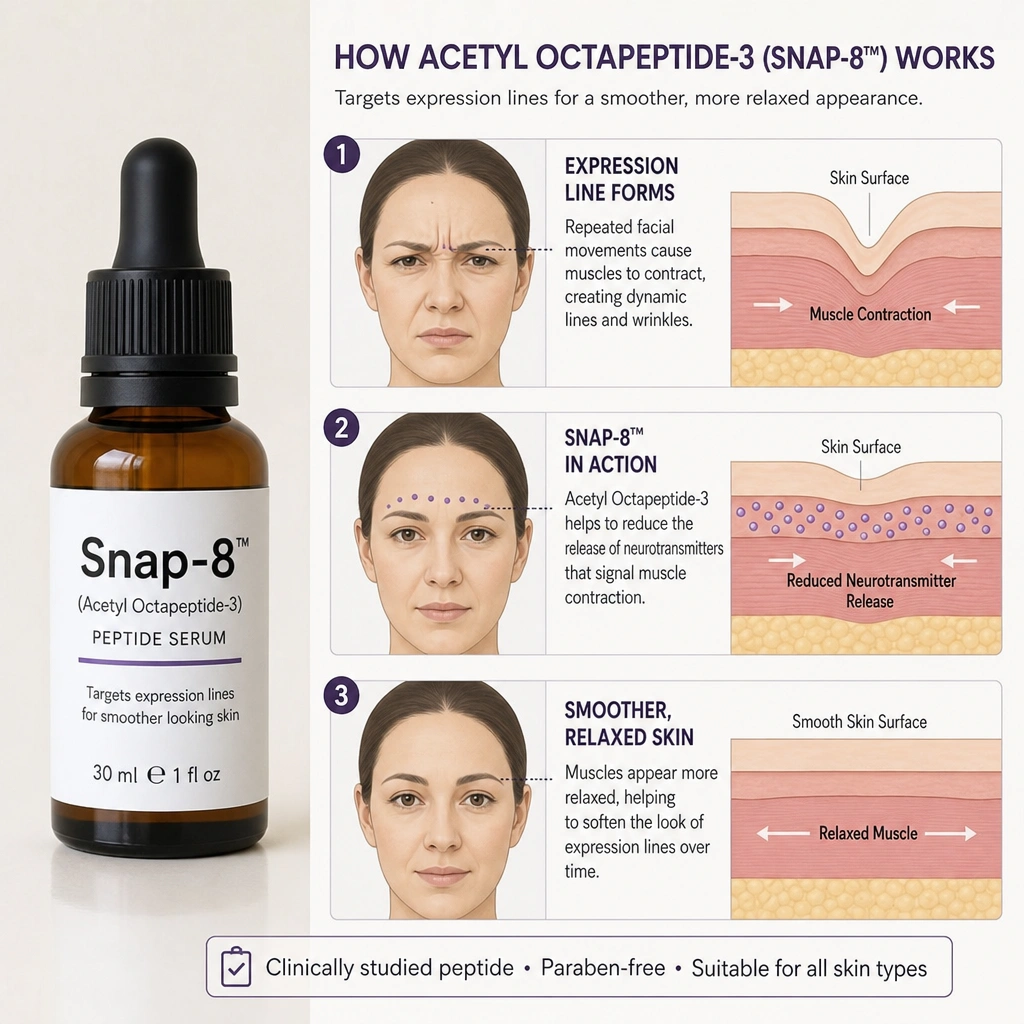
Snap-8 (acetyl octapeptide-3) is a topical cosmetic peptide marketed as a gentler, non-invasive alternative to botox and “Botox-in-a-bottle” style approach to softening expression lines. This guide explains how Snap-8 actually works at the neuromuscular junction, how it differs from Argireline and from injectable botulinum toxin, how it is formulated, what the published studies tested, and what is known about safety.
Editorial & research disclaimer: This article is for educational and cosmetic-information purposes only and is not medical advice. Snap-8 is a topical cosmetic peptide ingredient; it is not a drug and is not a substitute for treatments such as botulinum toxin. Research-grade peptides sold by PrymaLab are for laboratory research use only.

Quick Answer
What is Snap-8? Snap-8 is acetyl octapeptide-3, an eight-amino-acid topical peptide that mimics the N-terminal end of the SNAP-25 protein. By competing within the SNARE complex, it is proposed to modestly reduce the neurotransmitter release that drives repetitive facial muscle contraction — the contractions that etch expression lines over time.
Snap-8 is a cosmetic topical that works alongside collagen boosting ingredients that support collagen production, such as Matrixyl 3000 or GHK-Cu, not an injectable and not botulinum toxin. Reported effects are subtle and gradual, and every published study tested it alongside other actives.
Snap-8 = acetyl octapeptide-3, a topical peptide and an extended relative of Argireline (acetyl hexapeptide).
Mechanism: mimics SNAP-25 to compete in the SNARE complex, modestly reducing the signaling behind repetitive expression-line muscle movement.
Not Botox: topical peptides do not paralyze muscle; effects are subtle, gradual, and reversible.
Studied for fine expression lines (forehead lines, frown lines, crow's feet), always within multi-ingredient products.
Source carefully: concentration and formulation quality matter; verify ingredient grade and supplier transparency.
What Is Snap-8 and How Does It Work?
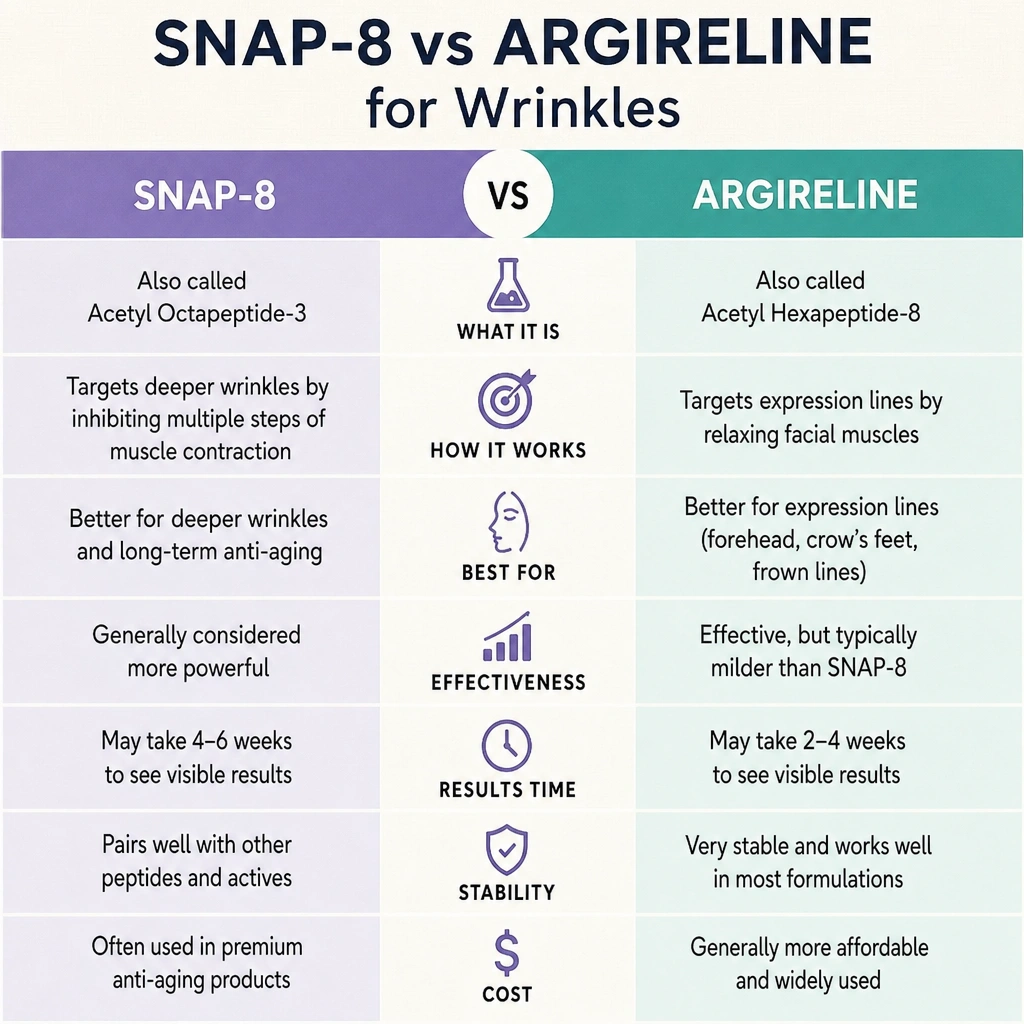
Snap-8 is the trade name for acetyl octapeptide-3, a synthetic peptide used as a topical cosmetic ingredient. It is an eight-amino-acid molecule that extends the design concept behind Argireline (acetyl hexapeptide-3/8), one of the best-known “neurocosmetic” peptides.
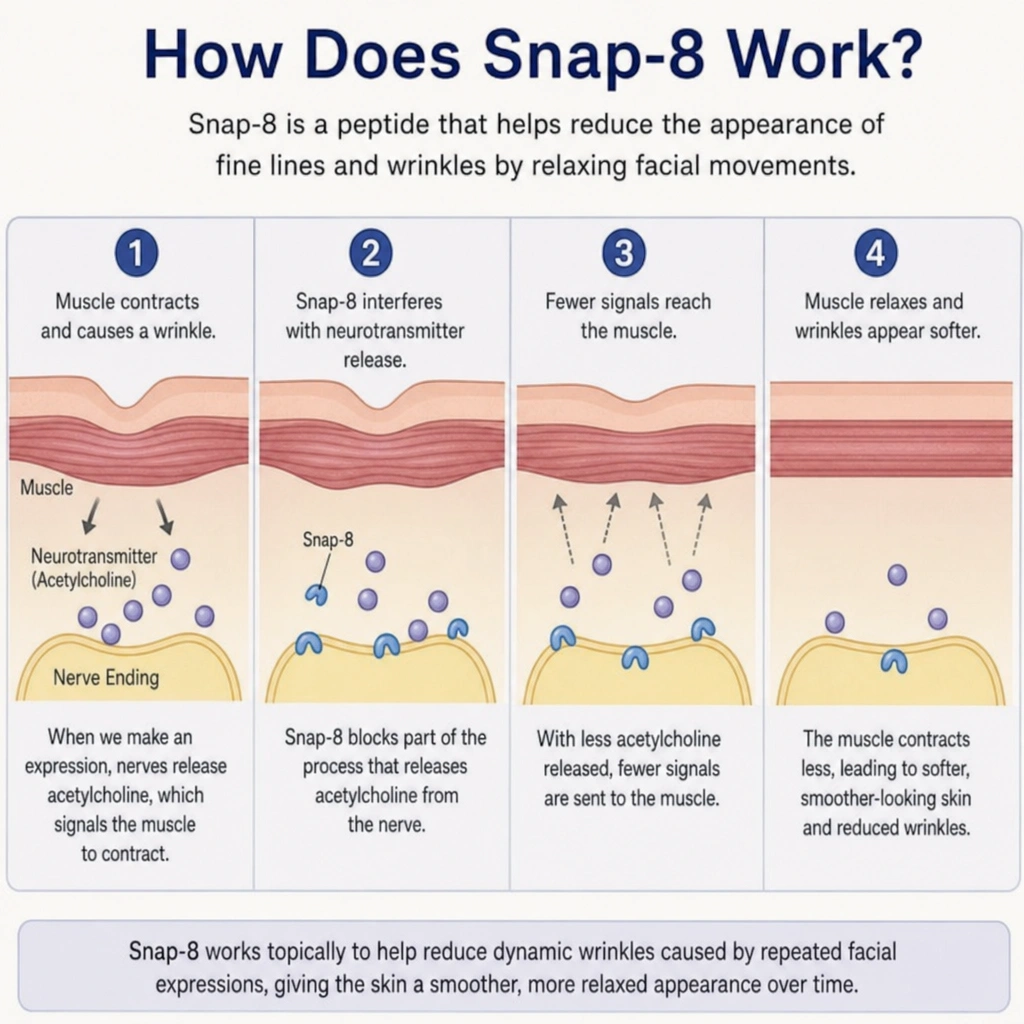
Facial expression lines form because muscles repeatedly contract when we frown, squint, and smile. That contraction depends on neurotransmitter release at the neuromuscular junction, which in turn relies on the SNARE complex (a group of proteins including SNAP-25). Snap-8 is designed to mimic the N-terminal segment of SNAP-25 and compete within that complex, modestly dampening the signal that triggers contraction.
The practical implication: with consistent topical use, muscles may contract slightly less forcefully, so dynamic expression lines and wrinkle depth can appear softer over time. The effect is subtle and temporary — nothing about a topical peptide paralyzes muscle the way an injection can.
Snap-8 vs Argireline vs Botox: What's the Difference?
All three are discussed in the same “relax-the-muscle” category, but they are very different tools with different delivery, strength, and expectations.
| Factor | Snap-8 (Acetyl Octapeptide-3) | Argireline (Acetyl Hexapeptide) | Botulinum Toxin (Injectable) |
|---|---|---|---|
| Type | Topical cosmetic peptide | Topical cosmetic peptide | Prescription injectable drug |
| Delivery | Applied to skin | Applied to skin | Injected by a clinician |
| Strength of effect | Subtle, gradual | Subtle, gradual | Strong, clinically proven |
| Onset | Weeks of consistent use | Weeks of consistent use | Days |
| Reversibility | Fully reversible | Fully reversible | Wears off in ~3–4 months |
| Best for | Maintenance of fine lines | Maintenance of fine lines | Moderate-to-deep dynamic wrinkles |
Bottom line: Snap-8 and Argireline are complementary skincare ingredients for maintenance; botulinum toxin is a medical procedure. They are not interchangeable, and topical peptides will not replicate injectable results.
How Snap-8 Is Formulated
Snap-8 is water-soluble and typically formulated into serums at modest percentages, often alongside hyaluronic acid, niacinamide or copper peptides like GHK-Cu. The published studies tested it inside multi-ingredient products, described below.
Studies that included acetyl octapeptide-3
The clinical record for acetyl octapeptide-3 is short, and every study in it tested a multi-ingredient product. Avcil and colleagues ran a monocentric 12-week trial of hyaluronic acid microneedle patches that combined acetyl octapeptide-3 with an arginine/lysine polypeptide, palmitoyl tripeptide-5, adenosine and seaweed extracts, in healthy subjects with aged skin (Avcil et al. 2020). No subject reported a primary or cumulative skin reaction, and instrumental measurements showed a 25.8% decrease in fine lines and wrinkles (Avcil et al. 2020). Shin and colleagues built a dissolving microneedle patch from hyaluronic acid, acetyl octapeptide-3, L-ascorbic acid 2-glucoside and sodium cyclic lysophosphatidic acid, and compared it with a hyaluronic-acid-only placebo patch in 24 healthy subjects for 28 days; the active patch gave more improvement in eye wrinkles (Shin et al. 2024). Because several actives were present in each patch, neither study shows what SNAP-8 contributes on its own.
Penetration is a separate question. Kraeling and colleagues measured how far acetyl hexapeptide-8 (Ac-EEMQRR-amide, the Argireline sequence) travelled into hairless guinea pig and human cadaver skin from an oil-in-water cosmetic emulsion, using diffusion cells and LC-MS/MS on the separated skin layers (Kraeling et al. 2015). The study was prompted by concern that such peptides might reach deep layers of the skin and act there (Kraeling et al. 2015). It concerned the hexapeptide, not SNAP-8.
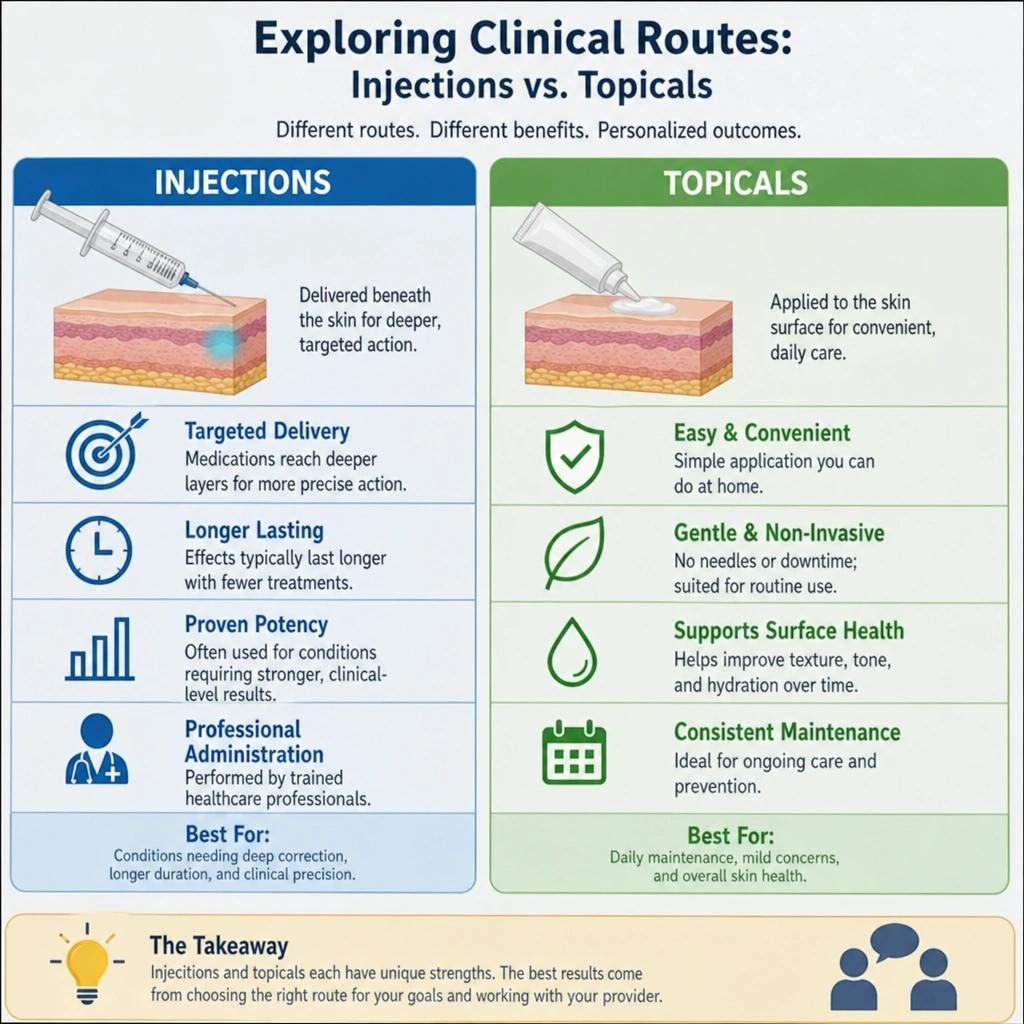
Snap-8 Is a Topical Ingredient
Snap-8 is designed and tested as a topical ingredient, and that is how it is used in cosmetics. There is no established case for injecting it. Wrinkle relaxation by injection uses clinician-administered botulinum toxin, a prescription drug, not a cosmetic peptide.
How Large and Lasting Are the Effects?
The effects reported for topical neurocosmetic peptides are subtle, and the mechanism is reversible, so any effect fades when application stops. The two microneedle studies above measured fine lines and eye wrinkles over 28 days to 12 weeks, in products that combined several actives.
Safety Profile and Sourcing
In the Avcil microneedle trial no subject reported a primary or cumulative skin reaction, and topical Snap-8 is generally described as well tolerated, though any new product can irritate sensitive skin. The bigger variable is product quality: concentration, formulation pH, stabilizers like caprylyl glycol, and ingredient purity determine whether a serum can actually deliver across the skin barrier.
- Concentration: effective serums disclose their acetyl octapeptide-3 percentage.
- Sourcing: transparent suppliers publish ingredient sourcing and testing.
- Identity: for research-grade Snap-8, check that the certificate of analysis matches the lot number on the vial and can be verified.
Researching cosmetic peptides?
Explore PrymaLab's research-grade peptide catalog and education hub to source and learn with confidence.
Explore PrymaLab Research PeptidesFrequently Asked Questions
What is Snap-8 peptide?
Snap-8 is the trade name for acetyl octapeptide-3, an eight-amino-acid topical cosmetic peptide. It mimics the N-terminal end of the SNAP-25 protein to modestly reduce the neurotransmitter signaling behind repetitive facial muscle contraction, which is what etches expression lines over time. It is a cosmetic ingredient, not a drug.
Is Snap-8 the same as Botox?
No. Botulinum toxin is a prescription injectable that strongly and temporarily blocks muscle contraction. Snap-8 is a topical peptide with a subtle, gradual, fully reversible effect that does not paralyze muscle. They are not interchangeable, and Snap-8 will not replicate injectable results.
How is Snap-8 different from Argireline?
Both are topical neurocosmetic peptides that target the SNARE complex. Argireline is acetyl hexapeptide (six amino acids); Snap-8 is acetyl octapeptide-3 (eight amino acids), an extended version designed for a similar but reformulated effect, often compared to Leuphasyl. In practice they are often used similarly and sometimes together.
Over what period have Snap-8 products been studied?
The published studies ran for 28 days to 12 weeks, using multi-ingredient microneedle patches. Peptide effects are described as cumulative and reversible.
Can Snap-8 be injected?
Snap-8 is designed and tested as a topical cosmetic ingredient, and that is its evidence-supported use. There is no established cosmetic rationale for injecting it. For injectable wrinkle relaxation, the appropriate option is a clinician-administered botulinum toxin product, not a cosmetic peptide.
Is Snap-8 safe?
Topical Snap-8 has a favorable cosmetic safety profile and is generally well tolerated. As with any new skincare ingredient, sensitive users can experience irritation. Quality and concentration of the finished product matter more than the peptide alone.
What have studies of Snap-8 products measured?
Fine lines and wrinkles, measured instrumentally in a 12-week trial of a multi-ingredient microneedle patch (a 25.8% decrease), and eye wrinkles in a 28-day placebo-controlled patch study in 24 subjects. Because several actives were present in each patch, neither study shows what Snap-8 contributes on its own.
How is Snap-8 quality judged?
By disclosed acetyl octapeptide-3 concentration, formulation details and ingredient testing. For research-grade material, check that the certificate of analysis matches the lot number on the vial and can be verified.
References & Further Reading
- Blanes-Mira, C., et al. (2002). A synthetic hexapeptide (Argireline) with antiwrinkle activity. International Journal of Cosmetic Science, 24(5), 303–310.
- Lim, S.H., et al. (2018). Cosmeceutical peptides and the skin: mechanisms and evidence. Cosmetics / dermatology review literature.
- Reddy, B., et al. Topical peptides in cosmetic dermatology (review).
- Manufacturer technical data on acetyl octapeptide-3 (SNAP-8) cosmetic ingredient specifications.
PrymaLab resources: Research peptides · Skin, hair & beauty peptides · Research Hub · FAQ · About PrymaLab.
Final disclaimer: This article is for educational and cosmetic-information purposes only. Snap-8 (acetyl octapeptide-3) is a topical cosmetic ingredient, not a drug, and statements about its effects have not been evaluated by the FDA. It is not a substitute for medical treatments such as botulinum toxin.
Verify the intended use and quality of any product before purchase. PrymaLab does not endorse any specific third-party vendor mentioned in this article.
Formats stocked for the compounds in this article
Snap-8: Snap-8 10mg and SNAP-8 10mg preloaded 3ml pen. Every listing is supplied for laboratory research use with a batch certificate of analysis.