Description
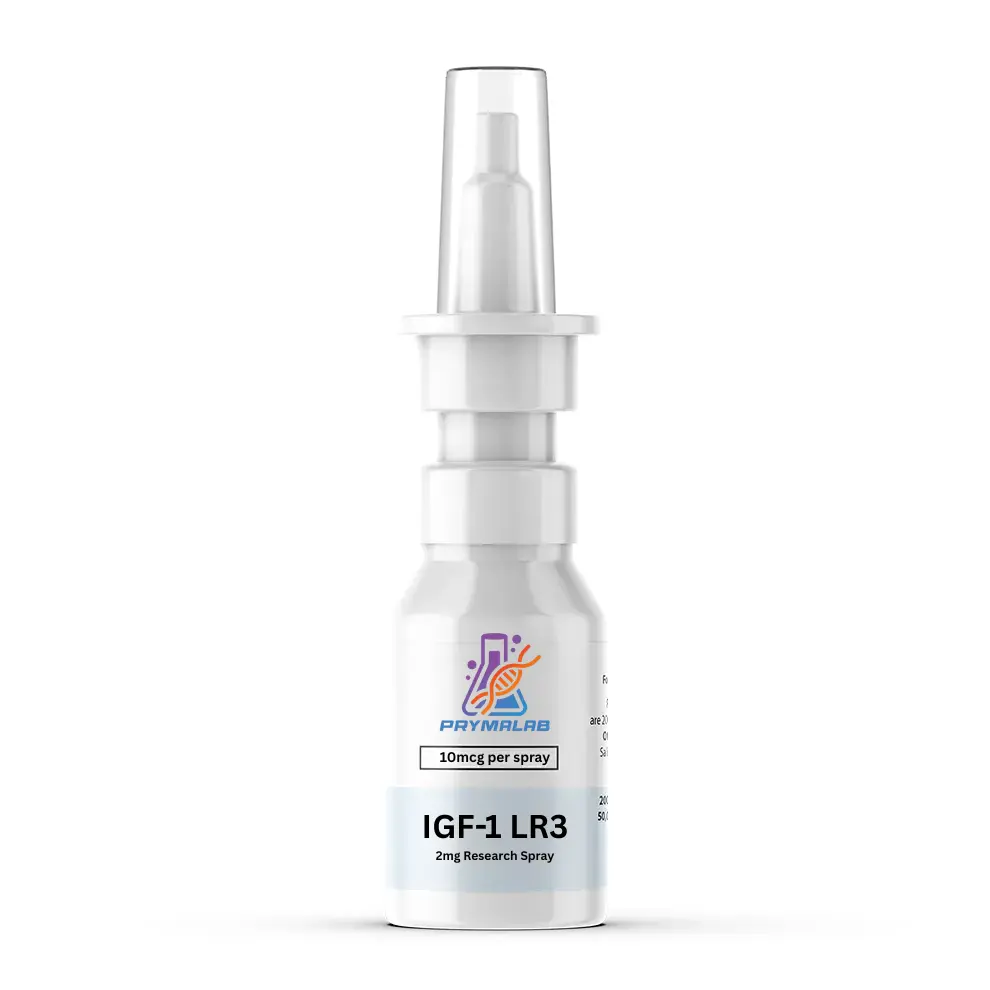
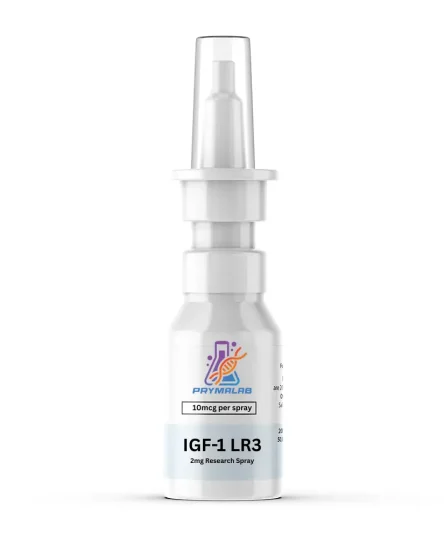
This IGF-1 LR3 nasal spray supplies Long R3 IGF-1, formally insulin-like growth factor 1 long R3 and abbreviated IGF-LR3 in some listings, a recombinant analog of human insulin-like growth factor 1. The IGF-1 LR3 peptide is also catalogued elsewhere as an IGF1-LR3 nasal spray. It runs to 83 amino acids against the 70 of the native protein, carries an arginine in place of glutamate at position 3, and adds a 13-residue extension at the N-terminus. Molecular formula C400H625N111O115S7, molecular weight 9111.00 Da, CAS 946870-92-4. Both modifications exist for one reason, and understanding that reason is what separates a well-designed experiment with this material from a wasted one. Supplied for laboratory research use only.
The binding protein problem this molecule was built to solve
Native IGF-1 does not circulate freely. It travels bound to a family of six IGF binding proteins, IGFBP-1 through IGFBP-6, and the overwhelming majority of IGF-1 in circulation is complexed rather than free. Those binding proteins are not passive carriers. They control how much growth factor is available to reach a receptor, they extend its lifetime in circulation, and they can be regulated independently of the growth factor itself.
That system is elegant physiology and an obstacle for anyone trying to study or apply the growth factor, because the concentration you add is not the concentration that reaches a receptor. Long R3 IGF-1 attacks that problem from two directions at once.
The arginine substitution at position 3 replaces a glutamate that sits in the region contacting IGFBPs, disrupting a contact the binding proteins rely on. The 13-residue N-terminal extension adds bulk in the same neighbourhood, sterically interfering with binding protein access. Together these reduce IGFBP binding dramatically, with reported reductions on the order of three orders of magnitude, and the practical result is a molecule that stays free rather than sequestered, with an extended half-life reported in hours rather than the minutes typical of native IGF-1.
Worth being clear about what those modifications do not change. Neither alters the receptor-binding surface, so this is not a more potent agonist at the IGF-1 receptor. It is the same agonist made more available. That distinction matters enormously for interpreting a result.
What gets claimed for this molecule, and where it comes from
IGF-1 LR3 attracts a particular kind of writing, and the reasoning behind it is worth unpacking rather than dismissing.
Growth hormone, often written HGH, drives hepatic production of IGF-1, and IGF-1, written IGF-I in the older literature, genuinely produces anabolic signaling. It activates cell proliferation and cell division, contributes to satellite cell activation in muscle where each satellite cell can fuse into existing fibres, supports protein synthesis and collagen synthesis, and influences glucose uptake and insulin sensitivity. From that, the marketing follows a chain: muscle growth, muscle mass and muscle development, hypertrophy, shifts in body composition sometimes called recomposition or nutrient partitioning, fat loss, weight loss and altered fat metabolism, faster injury recovery, tissue repair, regenerative properties, anti-aging claims, metabolic health framed as metabolic optimization or metabolic regulation, and neuroprotection. Athletes and athletic performance appear throughout, as do compounds sold to be stacked with it, including CJC-1295, ipamorelin, sermorelin and the GHRP family on the secretagogue side, or BPC-157, a BPC-157 nasal spray, thymosin beta-4 and GHK-Cu on the repair side.
Two things are missing from that chain. The endpoints are organism-level and require controlled human trials, most of which do not exist for this analog. And the argument runs from a hormone’s physiology to a modified analog’s effects without testing the step in between. None of those outcomes is established for research material and none is claimed here.
Two further points that responsible pages should carry. IGF-1 and its analogs are prohibited in sport, and WADA lists this class among prohibited substances at all times, so anyone competing under anti-doping rules should understand that before handling it. And because IGF-1 retains meaningful activity at the insulin receptor, hypoglycemia is the documented hazard associated with this family, which is a genuine safety consideration rather than a formality. Water retention is another effect commonly reported in that setting. Discussion of dosing precision, insulin syringes, subcutaneous injection or a preferred intranasal delivery method belongs to a context this material is not sold for, and calling any of it peptide therapy imports a clinical frame that does not apply. Research peptides, including this one, are supplied for laboratory work.
In serum-free culture, the entire design advantage disappears
Here is the point I would most want a buyer to read, and I have not seen it stated on a vendor page.
Long R3 IGF-1 is engineered to evade IGF binding proteins. If there are no IGF binding proteins present, that engineering does nothing at all. And in a serum-free culture there are, for practical purposes, none: IGFBPs come from serum, and cells secrete only modest amounts of their own.
So a comparison of native IGF-1 against LR3 in serum-free medium is testing two molecules whose only meaningful difference has been removed from the system. Any difference you observe under those conditions is more likely to reflect the modification affecting receptor binding slightly, or the two preparations differing in specific activity, than the advantage the molecule was designed around. Reporting LR3 as more potent on that basis would be an artefact.
The corollary is that serum-containing medium is where the difference should appear, because the serum brings IGFBPs with it. And that introduces its own problem, because serum IGFBP content varies between lots and between suppliers, which means the size of the LR3 advantage in your system depends on which bottle of serum you opened. If you are running this comparison seriously, fix the serum lot for the whole study, state it in your methods, and consider adding defined recombinant IGFBP to a serum-free system instead so the variable is controlled rather than inherited.
None of this makes LR3 a poor reagent. It makes it a reagent whose advantage is conditional, and knowing the condition is the difference between a defensible experiment and a confusing one.
Receptor targets, and the specificity problem
IGF-1 acts at the type 1 IGF receptor, IGF-1R, a receptor tyrosine kinase structurally related to the insulin receptor. Ligand binding triggers autophosphorylation and recruits signalling through the PI3K/AKT and MAPK/ERK pathways, which is why almost any IGF experiment ends up measuring phospho-AKT or phospho-ERK.
The complication is family resemblance. IGF-1R and the insulin receptor are close relatives, they form hybrid receptors containing one half of each, and IGF-1 has measurable affinity for the insulin receptor while insulin has measurable affinity for IGF-1R. In a cell expressing both, which is most cells, an observed response cannot be assigned to IGF-1R on the basis of adding IGF-1 alone.
The controls that resolve this are a selective IGF-1R inhibitor or blocking antibody, and confirmation of which receptors your line expresses rather than assuming from the catalogue. For intranasal IGF-1 LR3 research and cell work generally, this is the difference between a result about IGF-1R and a result about growth factor receptor signalling in general.
IGF-1 LR3 nasal spray specifications
| Compound |
Long R3 IGF-1, recombinant analog of human IGF-1 |
| Length |
83 amino acids (native IGF-1 is 70) |
| Modification 1 |
Arginine substituted for glutamate at position 3 |
| Modification 2 |
13-residue N-terminal extension |
| Purpose of both |
Reduce binding to IGF binding proteins (IGFBP-1 to IGFBP-6) |
| Reported IGFBP reduction |
On the order of three orders of magnitude |
| Molecular formula |
C400H625N111O115S7 |
| Molecular weight |
9111.00 Da |
| CAS number |
946870-92-4 |
| Structural class |
Folded protein with three disulfide bonds, not a linear peptide |
| Primary receptor |
IGF-1R (receptor tyrosine kinase); cross-reactivity at insulin receptor and hybrids |
| Format |
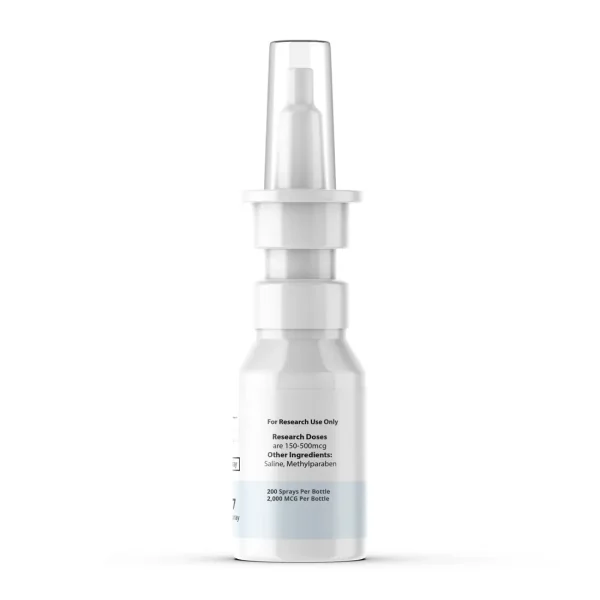
Metered spray bottle [CONFIRM: fill volume, mg per bottle, concentration] |
| Classification |
Research chemical. In-vitro laboratory use only. Not for human or veterinary use. |
This is a protein, and that changes verification
Almost everything else in this catalogue is a short synthetic peptide where a purity percentage and a mass confirmation tell you most of what you need. Long R3 IGF-1 is different in kind. At 83 residues with three disulfide bonds it is a folded protein, produced recombinantly rather than by solid-phase synthesis, and its activity depends on tertiary structure.
Two consequences follow. First, mass spectrometry confirms the molecule is the right size and composition, and says nothing about whether it is folded correctly. A misfolded or disulfide-scrambled preparation has an identical mass to a correctly folded one, or differs by only a few units, while being biologically inert. Reversed-phase HPLC can separate some misfolded species because they expose different surfaces, which is one reason the chromatographic method matters here beyond generating a number.
Second, recombinant production brings contaminants that synthesis does not. Host cell proteins and host DNA are the standard concerns, and endotoxin is the one that will silently wreck a cell experiment, since bacterial endotoxin activates inflammatory signalling at concentrations far below where anyone would think to look for it. If your readout touches NF-kB, cytokines or anything immune-adjacent, endotoxin content is a required line on the certificate rather than a nice-to-have.
The honest question to ask about a research grade IGF-1 LR3 spray is therefore broader than purity: what expression system, what endotoxin level, and is there any functional confirmation that the material is active. A bioassay, such as phospho-AKT induction in a responsive line, is the only measurement that confirms folding.
IGF-1 LR3 nasal spray storage and handling
Proteins are more fragile than short peptides and fail in different ways. [CONFIRM: whether this SKU ships pre-filled in solution or as lyophilized material with an applicator.]
Freeze-thaw is the main enemy. Each cycle risks partial unfolding and aggregation, and aggregated protein is both inactive and capable of producing odd results rather than simply no result. Single-use aliquots are not a nicety here, they are the difference between a usable vial and a degraded one by week three.
Adsorption is worse than for small peptides. At the low nanomolar concentrations typical of growth factor work, a meaningful fraction of protein can be lost to tube and plate surfaces, which reads as reduced potency. Low-binding plasticware helps, and a carrier protein in the buffer, typically bovine serum albumin at 0.1 percent, is standard practice for growth factors where the assay tolerates it.
A word on format claims. Peptide nasal sprays are marketed on the argument that the nasal cavity offers absorption across the nasal mucosa without an injection, and that this improves bioavailability. Whether a nine-kilodalton folded protein crosses that barrier intact is a separate question from whether a small peptide does, and the answer is not established for this molecule. Bioavailability is in any case an organism-level measurement with no counterpart in cell culture, so treat the format as packaging rather than as pharmacology.
The three disulfide bonds mean reducing agents are prohibited: dithiothreitol, beta-mercaptoethanol and TCEP will unfold the protein irreversibly. Sensible IGF-1 LR3 nasal spray storage otherwise means cold, sealed, out of light, and avoiding prolonged time at room temperature or vigorous agitation, since shear and air-liquid interfaces promote aggregation in proteins in a way they do not in short peptides.
How LR3 differs from IGF-1 DES
Both analogs solve the same problem and they do it by opposite strategies. LR3 adds material, an extension and a substitution, to obstruct binding protein access. DES(1-3)IGF-1 removes material, deleting the first three residues that form part of the binding interface. One builds a shield, the other deletes the handle.
The other difference is provenance. LR3 is entirely synthetic in concept, with an extension derived from a sequence that has nothing to do with human IGF-1 physiology. DES(1-3)IGF-1 occurs naturally, generated by local proteolytic processing in tissues including brain and gastrointestinal tract. If your question concerns a physiologically occurring species, they are not interchangeable.
For related growth factor research, see the PrymaLab Research Library.
Frequently asked questions
What is IGF-1 LR3?
Long R3 IGF-1 is an 83-residue recombinant analog of human IGF-1 (CAS 946870-92-4, 9111.00 Da) with arginine substituted at position 3 and a 13-residue N-terminal extension. Both modifications reduce IGF binding protein binding. Material supplied here is a research chemical for in-vitro laboratory use only.
Why does LR3 have a longer half-life?
Because reduced IGFBP binding is only half the story: the modifications keep it from being sequestered, so more remains free. Reported reductions in IGFBP binding are on the order of three orders of magnitude, with circulating half-life reported in hours rather than minutes.
Does LR3 outperform native IGF-1 in serum-free culture?
It should not, and that is the key design point. Its advantage exists only where IGF binding proteins are present, and serum-free medium contains essentially none. A difference observed under serum-free conditions is more likely an artefact of preparation or specific activity than the engineered advantage.
Why can mass spectrometry not confirm this material is active?
Because it is a folded protein with three disulfide bonds, and a misfolded or disulfide-scrambled preparation has essentially the same mass as a correctly folded one while being biologically inert. Only a functional bioassay, such as phospho-AKT induction, confirms folding.
Is IGF-1 LR3 nasal spray approved for human use?
No. This material is a research chemical for in-vitro laboratory use only, is not an approved drug, and is not intended for human or veterinary use. Nothing here is medical advice.
Ordering and compliance
Every PrymaLab research compound ships from the United States and is sold research-use-only. This IGF-1 LR3 nasal spray is supplied for in-vitro laboratory research, is not intended for human or veterinary use, is not a drug, supplement or sports product, and has not been evaluated by the FDA for the research-chemical context. Verify the legal status of any research compound in your jurisdiction before ordering. Certificates of analysis are available on request for the lot you receive.













6 reviews for IGF-1 LR3 Nasal Spray