
Description
PrymaLab · Research use only
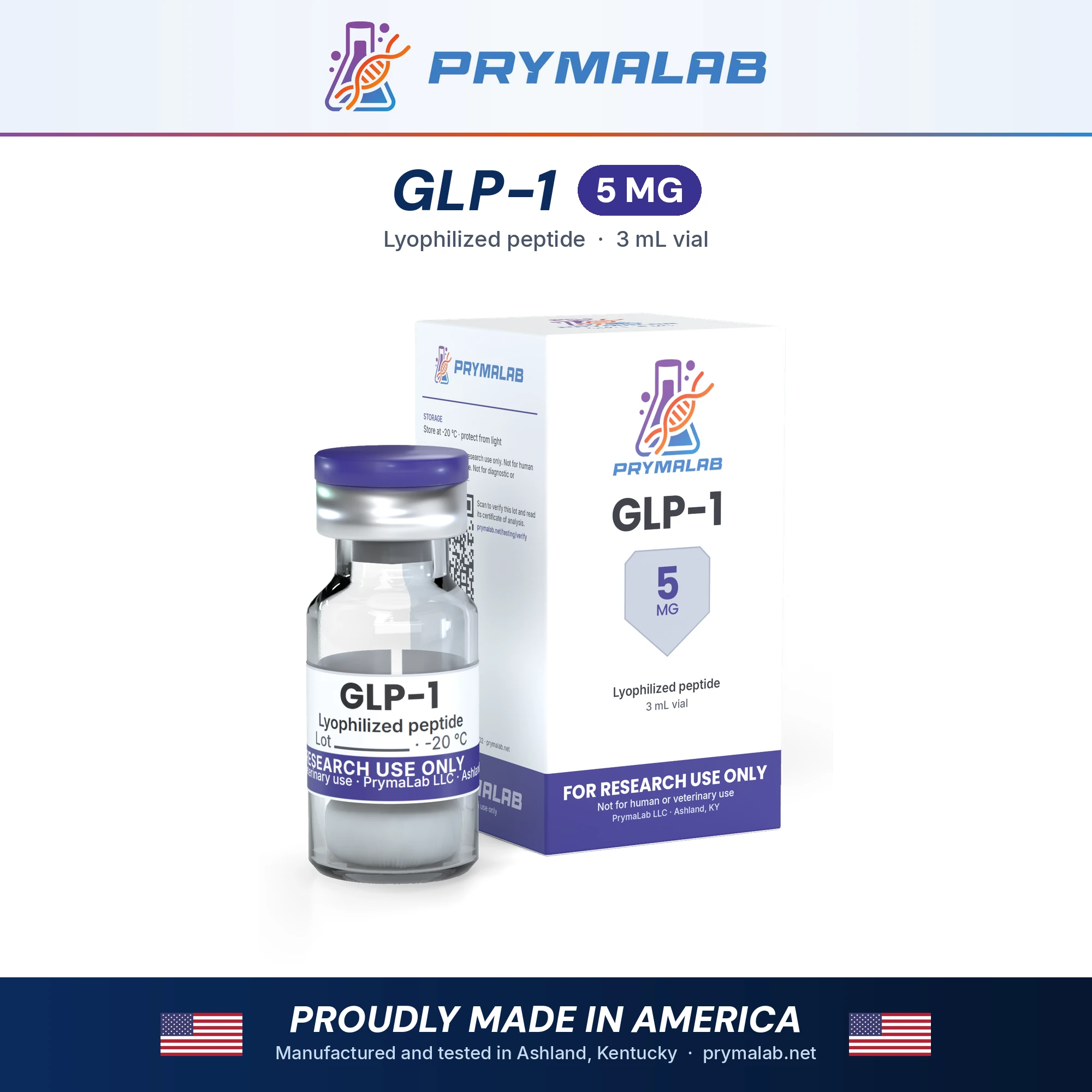
GLP-1 5mg
Native glucagon-like peptide-1 (7-36) amide, freeze-dried, 5 mg per vial
GLP-1 is the incretin hormone that intestinal L-cells release after meals. According to its safety data sheet, this vial holds 5 mg of native glucagon-like peptide-1 (7-36) amide as freeze-dried powder: the unmodified 30-residue hormone, not semaglutide or another long-acting analogue. Research on native GLP-1 covers its effects on insulin and glucagon secretion, its rapid cleavage by dipeptidyl peptidase IV and the structure of its receptor.
Specifications
| Property | Value |
|---|---|
| Compound | GLP-1 (7-36) amide (Glucagon-like peptide-1 (7-36) amide, native sequence) |
| CAS number | 107444-51-9 |
| Molecular formula | C149H226N40O45 |
| Label claim | 5 mg per vial |
| Form | Lyophilized (freeze-dried) powder or cake in a sealed glass vial with a rubber stopper and aluminium crimp cap |
| Safety data sheet | PL-SDS-071 |
Which GLP-1 this vial contains
The name GLP-1 is used for the natural hormone and, loosely, for drugs built from it. For this product the safety data sheet names glucagon-like peptide-1 (7-36) amide, native sequence, with CAS number 107444-51-9 and molecular formula C149H226N40O45. That is the amidated form of the hormone, 30 residues numbered 7 to 36 and starting His-Ala1. It carries none of the changes that make the long-acting analogues last, no substitution at position 8 and no fatty acid side chain, so dipeptidyl peptidase IV cleaves it just as it cleaves the hormone in the body1.
The lot certificate, listed on the testing results page, is the document that confirms identity for a given lot. Its LC-MS identity result should match the mass calculated from C149H226N40O45, which is far below the mass of an acylated analogue such as semaglutide.
Handling notes
Native GLP-1 does not survive long in biological samples. Dipeptidyl peptidase IV removes the N-terminal His-Ala, and incubating GLP-1 (7-36) amide in human serum produced the same fragments as the purified enzyme1. Holst pointed out that measurements therefore need to distinguish the intact hormone from the sum of intact hormone and its metabolites2. Experiments in serum, plasma or cells that express the enzyme should allow for this cleavage, both in the design and in the choice of assay. Sealed vials are stored as the safety data sheet sets out, typically at −20 °C for a peptide, desiccated and dark, and brought to room temperature before opening. Reconstituted solution is kept at 2 to 8 °C, protected from light, for a period your laboratory has established.
What the research covers
Where GLP-1 comes from
GLP-1 is made in the endocrine L-cells of the intestinal epithelium by differential processing of proglucagon and is released in response to meals2. It is also secreted by alpha cells in the pancreas and within the central nervous system3. GLP-1 and GIP both appear within minutes of nutrient ingestion and help the body dispose of the nutrients quickly4.
What it does
The main actions of GLP-1 are to stimulate insulin secretion, which makes it an incretin, and to inhibit glucagon secretion, which together limit the rise in glucose after a meal2. Activation of the incretin receptors leads to glucose-dependent insulin secretion and, in beta cells, has been linked to proliferation and resistance to apoptosis4. GLP-1 also slows gastric emptying and gastrointestinal secretion, part of the mechanism known as the ileal brake2, and it promotes satiety4. Baggio and Drucker wrote that sustained GLP-1 receptor activation was associated with lower body weight in preclinical and clinical studies4. Drucker’s 2018 review mapped the receptor-positive cell types and pathways behind these actions and others on islet function, appetite, inflammation and the cardiovascular system, and separated the circuits used by the endogenous hormone from those engaged by pharmacological agonists5.
Cleavage by dipeptidyl peptidase IV
In 1993 Mentlein and colleagues showed that dipeptidyl peptidase IV purified from human placenta hydrolysed GLP-1 (7-36) amide to its des-His-Ala derivative, and that human serum produced the same fragments1. They measured Km values of 4 to 34 µM for the peptides studied and concluded that the enzyme could degrade them at physiological, nanomolar concentrations1. Holst later described GLP-1 as inactivated so rapidly that much of it is cleaved before it leaves the gut, which raised the possibility that some of its actions travel through sensory neurons in the intestine and liver that express the receptor2. That instability is why drug development moved to degradation-resistant GLP-1 receptor agonists and to DPP-4 inhibitors4.
The receptor
The GLP-1 receptor is a class B G protein-coupled receptor3. Studies with truncated, chimeric and mutated peptides and receptor variants, together with crystal structures of the extracellular domain and the first three-dimensional structures of a class B transmembrane domain, support a two-domain binding mechanism for GLP-13. Small-molecule modulators have been used alongside peptide analogues to study ligand-directed biased signalling at the receptor3.
What is not established
Four of the five references are reviews, and all of them describe GLP-1 in the body rather than in a research vial. How long native GLP-1 stays intact in a reconstituted solution is not covered by these abstracts, and none of the work used PrymaLab material. The semaglutide guide covers the long-acting GLP-1 receptor agonists built on this hormone.
How each lot is tested
Every lot is tested in PrymaLab’s own laboratory in Ashland, Kentucky before release: RP-HPLC for purity, LC-MS for identity, Karl Fischer titration for water, LAL for endotoxin and USP <71> for sterility. Published certificates are listed on the results page and can be checked by number and key on the verify page. These are in-house results from PrymaLab Analytical, not an independent test, and the lab is not accredited to ISO 17025. The third-party testing guarantee on this page still applies: if any independent laboratory finds the wrong compound, or less than the stated purity or amount, the order is refunded and the cost of the test is reimbursed.
Frequently asked questions
Is this native GLP-1 or an analogue such as semaglutide?
Native. The safety data sheet identifies it as glucagon-like peptide-1 (7-36) amide, native sequence, CAS 107444-51-9, formula C149H226N40O45. It has no position 8 substitution and no fatty acid chain, so it behaves like the natural hormone, including its rapid cleavage by DPP-IV.
What does 7-36 amide mean?
The numbers give the residue range of this form of the hormone, from the histidine at position 7 to position 36, thirty residues in all. Amide means the C-terminus is amidated rather than a free acid. It is the form whose cleavage by DPP-IV to a des-His-Ala fragment was characterised in human serum.
How should the vial be stored?
Keep it sealed, cold, dry and dark; the safety data sheet gives −20 °C as typical for peptides. Let it warm to room temperature before opening. Once dissolved, hold the solution at 2 to 8 °C away from light and use it within the period your lab has set.
How do I confirm the identity of a lot?
Match the lot number on the vial to its certificate on the testing results page and compare the LC-MS identity result with the mass for C149H226N40O45. An acylated analogue such as semaglutide would come in far heavier, so the mass separates native GLP-1 from long-acting products at once.
Can it be used in people or animals?
No. Native GLP-1 (7-36) amide is sold here for laboratory research only. It is not a drug product, is not approved for human or veterinary use and must not be given to people or animals.
References
- Mentlein R, Gallwitz B, Schmidt WE. Dipeptidyl-peptidase IV hydrolyses gastric inhibitory polypeptide, glucagon-like peptide-1(7-36)amide, peptide histidine methionine and is responsible for their degradation in human serum. Eur J Biochem. 1993;214(3):829-35. DOI · PubMed
- Holst JJ. The physiology of glucagon-like peptide 1. Physiol Rev. 2007;87(4):1409-39. DOI · PubMed
- Graaf Cd, Donnelly D, Wootten D, et al. Glucagon-Like Peptide-1 and Its Class B G Protein-Coupled Receptors: A Long March to Therapeutic Successes. Pharmacol Rev. 2016;68(4):954-1013. DOI · PubMed
- Baggio LL, Drucker DJ. Biology of incretins: GLP-1 and GIP. Gastroenterology. 2007;132(6):2131-57. DOI · PubMed
- Drucker DJ. Mechanisms of Action and Therapeutic Application of Glucagon-like Peptide-1. Cell Metab. 2018;27(4):740-756. DOI · PubMed
Research use only
For laboratory research use only. GLP-1 5mg is not a drug, food, cosmetic or dietary supplement, is not approved by the FDA or any comparable authority for human or veterinary use, and must not be given to people or animals. It is sold to qualified researchers and institutions, and the buyer is responsible for lawful handling and disposal.







Reviews
There are no reviews yet.