Description
PrymaLab · Research Use Only
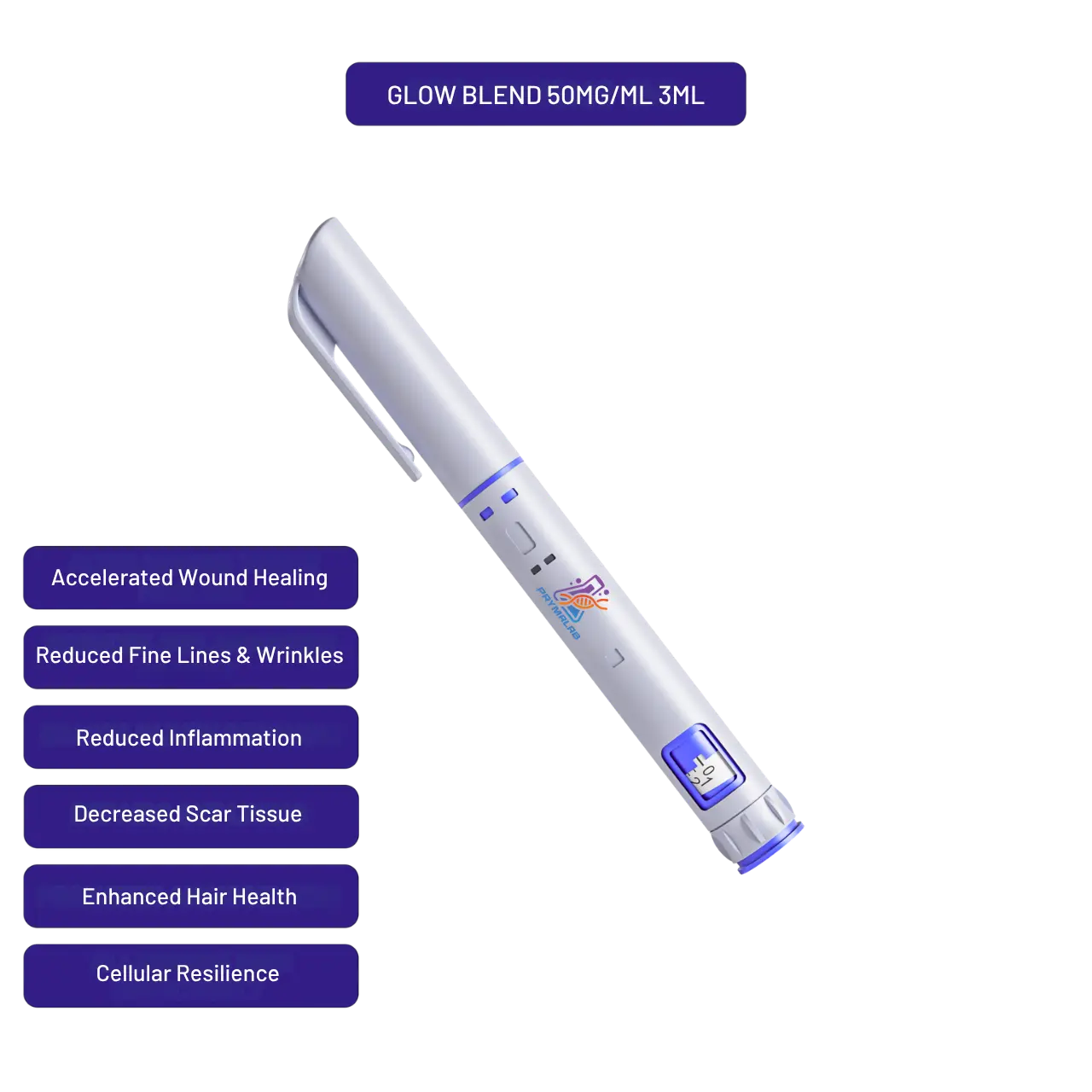
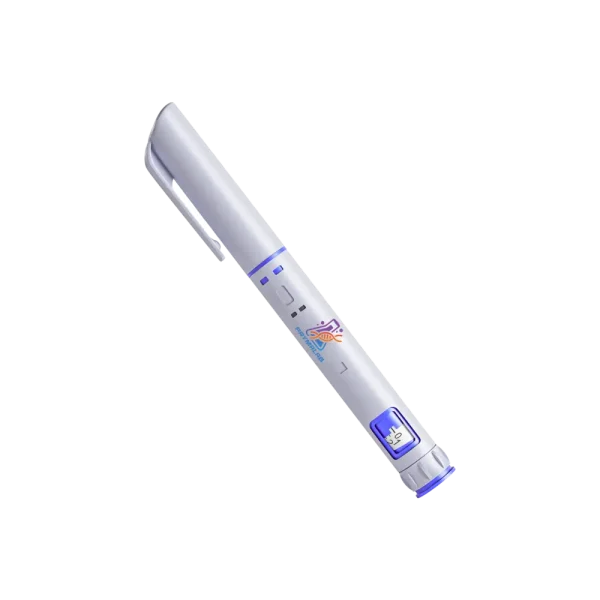
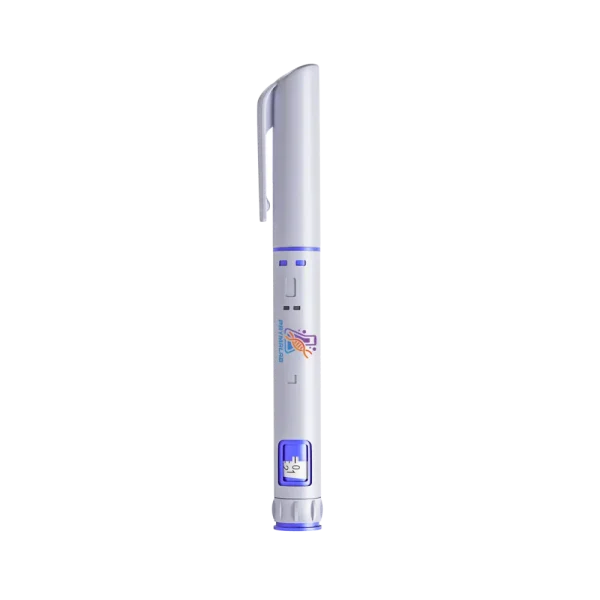
Preloaded Autoinjector | GLOW BLEND | 3ml Pen | 50mg/ml
Three peptides in solution · 3ml at 50mg/ml · copper-containing device
The GLOW blend autoinjector is a preloaded 3ml research device holding BPC-157, TB-500 and GHK-Cu in solution at 50mg/ml. That comes to 150mg of peptide in total. Supplying three chemically unrelated peptides together as a ready-made solution, one of them carrying a redox-active metal, is the most demanding storage arrangement in this catalogue.
Specification Table
| Property | Value |
|---|---|
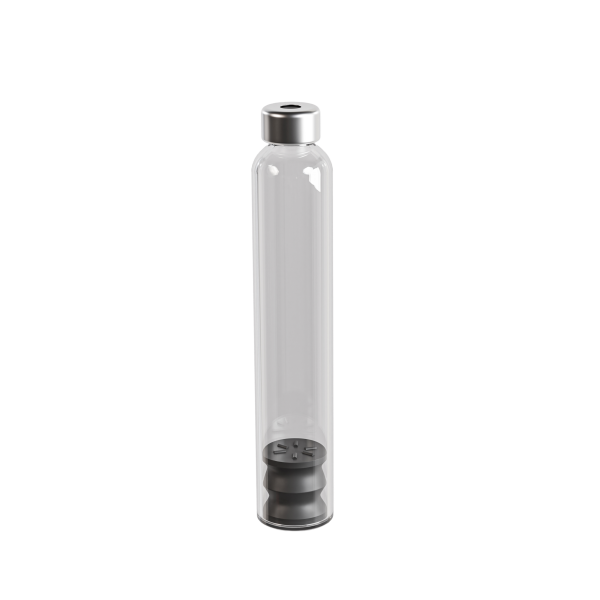
| Device format | Preloaded autoinjector pen, glass cartridge |
| Fill volume | 3 ml |
| Concentration | 50 mg/ml total peptide |
| Total peptide in device | 150 mg |
| Components | BPC-157, TB-500 (thymosin β4), GHK-Cu |
| Component ratio | Not published on the product record |
| CAS, GHK-Cu | 89030-95-5 |
| CAS, BPC-157 | 137525-51-0 |
| CAS, TB-500 / thymosin β4 | 77591-33-4 |
| CAS, KPV | 67727-97-3 |
| MW, GHK-Cu | 401.91 g/mol |
| MW, BPC-157 | 1419.55 g/mol |
| MW, thymosin β4 | 4963.55 g/mol |
| MW, KPV | 342.43 g/mol |
| Solution appearance | Clear blue to blue-violet |
| Reconstitution required | None. Supplied as solution |
| Excipient system | Not published on the product record |
| Solution pH | Not published on the product record |
| Solution stability | Not established over device shelf life |
| Photosensitivity | High, from the copper(II) component |
| Oxidation-sensitive residue | Methionine within thymosin β4 |
| Storage | 2-8°C, protected from light |
| Purity | Per lot-specific certificate of analysis |
| Regulatory status | No approved human or veterinary formulation for any component |
Why This Is the Hardest Solution to Hold Stable
Three peptides sharing one aqueous environment, one of them carrying copper(II), is a combination that concentrates several degradation routes in a single cartridge.
Copper is redox-active, and that is the root of the problem. Under illumination and in the presence of dissolved oxygen it can shift oxidation states and generate reactive oxygen species. Those species are indiscriminate.
Thymosin β4 contains a methionine, and methionine is precisely the residue that chemistry attacks first. In a lyophilized cake, low water activity and restricted molecular mobility suppress the reaction substantially. In solution neither constraint applies.
BPC-157 fares better on composition grounds, containing none of the five residues most vulnerable to metal-catalysed oxidation. Hydrolysis and aspartate-related routes still apply.
None of this establishes that the product is unstable. It establishes that the stability question here is more layered than for a single-component device, and that the manufacturer stability data is the thing worth having.
What Should Be Requested Before Quantitative Work?
Four values, and none appears on the product record.
Component ratio sets the molar composition, and through that every downstream calculation. With molecular weights spanning 401.91 to 4963.55, mass and moles diverge sharply, and the label total of 150mg says nothing about how many molecules of each are present.
Solution pH governs copper coordination equilibrium as well as peptide degradation rates, and the two move together. GHK-Cu binding is pH-dependent, so the fraction of material present as the intact complex varies with formulation pH.
The excipient system enters every downstream assay. Some antioxidants and chelators used in peptide formulations would themselves interact with the copper component, which is a formulation choice worth knowing about rather than discovering.
Shelf-life stability data is the most valuable of the four values, and simultaneously the one hardest to infer from anything else on the record. Ask for it by name.
How Should the GLOW Blend Autoinjector Be Verified?
Start with colour, which costs nothing and tells you a surprising amount. The solution should be clear and blue to blue-violet. Fading toward colourless indicates copper loss from the GHK-Cu component. A shift toward green or brown indicates chemistry nobody has characterised for this formulation.
Inspect against a dark background as well as a light one. Aggregation in peptide solutions typically presents as faint opalescence before it becomes obvious turbidity, and a dark background makes that early stage visible when a light background will not.
Gravimetric verification establishes what the device delivers rather than what it claims. Actuate onto a tared weighing vessel, record the mass, convert using solution density, and repeat across several actuations to capture accuracy and precision together. Run it at the temperature of intended use, since cold solution is more viscous and viscosity affects delivery in a spring-driven mechanism.
Treat the first actuation after any rest period as unreliable. Air ingress and seal relaxation both cause under-delivery on first use, and unless a priming step is specified and followed the first draw should be discarded rather than measured.
When Is a Device Better Than a Vial Here?
The argument for it is real and specific. Reconstituting a three-component lyophilized cake introduces several invisible failure modes: incomplete dissolution leaving one component under-represented, shear from over-agitation, adsorptive loss during transfer, and variable time between preparation and use. A device eliminates all four.
That matters more for a mixture than for a single compound. If one of three components dissolves incompletely, the findinging solution has a different composition from the label and nothing about its appearance will indicate it.
The argument against is the cumulative time in solution described above. A lyophilized vial reconstituted fresh has been in aqueous conditions for minutes. A device on its fourth week of use has been in solution since manufacture.
The practical resolution depends on study length. Short intensive programmes favour the device. Work spread across many months favours lyophilized vials reconstituted as needed.
What Would Confirm the Device Contents?
The GLOW blend autoinjector offers no dry cake to inspect, so verification has to work from the solution, and for this formulation two independent checks are available.
Visible absorbance addresses the copper component. Drawing a small volume and running a spectrum between roughly 500 and 700 nanometres should show the characteristic copper(II) band. Position reports coordination geometry and intensity reports how much intact complex remains, both against a freshly prepared reference measured the same day.
Reversed-phase chromatography addresses all three components at once. A well-resolved gradient separates the peptides by hydrophobicity, and the relative peak areas report composition. Comparing a chromatogram from a device in its fourth week against one taken on first opening detects change that no visual inspection would.
Neither check is routine for most purchases. Both become worth running when a device has been in use for an extended period and an experiment depends on knowing what remains in it.
For laboratories without chromatography access, the pragmatic alternative is to limit device lifetime by policy rather than by observation. Deciding in advance that a device is retired after a set number of weeks substitutes a conservative assumption for a measurement.
What Determines Device Lifetime?
No published shelf-life data exists for this formulation. That leaves the question to be settled either by policy or by measurement.
The measurement approach means periodic chromatographic analysis of drawn solution, comparing composition against a first-opening baseline. It is the rigorous option and it requires instrument access most laboratories using pen devices do not routinely have.
The policy approach means fixing a retirement interval in advance and applying it regardless of how the solution looks. Four weeks after first actuation is a common convention for refrigerated peptide solutions, and it errs conservative for a formulation whose behaviour is unknown.
Whichever route a laboratory takes, the interval should be written down before the first draw rather than decided when the device looks questionable. A rule applied retrospectively is not a rule.
Recording the date of first actuation on the device itself, in marker, costs nothing and removes any ambiguity about how long it has been in service.
Handling the Device in Laboratory Practice
Store at 2-8°C and return the device to its packaging between sessions. Light exclusion is not a general precaution here, it addresses a specific photochemical route through the copper component.
Allow the device to reach ambient temperature before actuating, then inspect before each draw. Both steps take seconds and both remove a known source of error.
Record device lot, date of first actuation, storage conditions and volume drawn per session. Given unpublished solution stability, the interval between first use and each later draw is an experimental variable rather than a logistics detail, and for a three-component solution that variable applies to all three components at once.
A Note on What the Format Cannot Fix
The GLOW blend autoinjector removes preparation variance and nothing else, which is worth saying plainly so the format is not credited with more than it does.
It does not resolve the unpublished component ratio, which affects every molar calculation regardless of how the material is stored.
It does not address adsorptive loss downstream, since the drawn solution enters whatever plasticware the assay uses.
It does not substitute for stability data, and a device four weeks into service is a different preparation from the same device on day one whether or not that difference has been measured.
What it does deliver is consistency between draws, and for a three-component solution that is genuinely valuable.
Published Literature
Traced to publisher records or primary indexes. All concern individual components, and none concerns this delivery format or the combination held in it.
- Maquart FX, Pickart L, Laurent M, Gillery P, Monboisse JC, Borel JP. FEBS Letters. 1988;238(2):343-346.
- Pickart L, Margolina A. International Journal of Molecular Sciences. 2018;19(7):1987. PMID: 29986520
- Hsieh MJ, Liu HT, Wang CN, et al. Journal of Molecular Medicine. 2017;95(3):323-333.
- Chang CH, Tsai WC, Lin MS, Hsu YH, Pang JH. Journal of Applied Physiology. 2011;110(3):774-780. PMID: 21030672
- Huff T, Müller CS, Otto AM, Netzker R, Hannappel E. International Journal of Biochemistry and Cell Biology. 2001;33(3):205-220.
- Dalmasso G, Charrier-Hisamuddin L, Nguyen HT, Yan Y, Sitaraman S, Merlin D. Gastroenterology. 2008;134(1):166-178.
Frequently Asked Questions
What is the GLOW blend autoinjector?
A preloaded 3ml research device holding BPC-157, TB-500 and GHK-Cu in solution at 50mg/ml, which comes to 150mg in total across the three components. Nothing requires reconstituting. Supplied for laboratory research use only, and not approved for human or veterinary use anywhere.
Why is this combination hard to hold stable?
Three peptides share one aqueous environment and one of them carries redox-active copper(II). Under illumination with dissolved oxygen present, copper generates reactive oxygen species, and those do not distinguish between the peptide holding the metal and the two beside it.
Which component is most vulnerable?
Thymosin beta 4, because it contains a methionine and methionine is the residue most readily oxidised by metal-catalysed chemistry of exactly the kind copper drives. BPC-157 contains none of the five vulnerable residues. On composition grounds it should fare comparatively better in the same solution.
What should be requested from the certificate of analysis?
Four values: component ratio, solution pH, the excipient system and shelf-life stability data, none of which appears on the product record. Ratio determines molar composition. pH governs copper coordination equilibrium, and excipients enter every downstream assay the drawn solution eventually joins.
How can the device be verified?
Colour first, which should be clear blue to blue-violet, with fading indicating copper loss. Inspect against a dark background too, since aggregation shows as faint opalescence before turbidity. Then verify delivered volume gravimetrically across several actuations.
Why check delivery volume at room temperature?
Cold solution is more viscous, and viscosity affects delivered volume in a spring-driven mechanism, so a check run straight from refrigeration describes a condition that will not apply in use. Let it equilibrate first. The numbers then describe what the device actually does.
When is a device better than a vial for this blend?
For short intensive programmes. Reconstituting a three-component cake risks leaving one component under-represented with no visible sign. A device removes that risk along with shear, adsorptive loss and variable time-to-use.
When is a vial better?
For work spread across many months, where cumulative time in solution becomes the dominant concern rather than preparation variance. A lyophilized vial reconstituted fresh has been aqueous for minutes. A device in its fourth week has been in solution continuously since the day it was manufactured.
Does the colour confirm all three components are intact?
No. Colour reports only on the GHK-Cu component, since neither BPC-157 nor thymosin beta 4 absorbs visibly. A device with perfect colour could still contain degraded material from the other two, which is why colour works as a negative indicator rather than a positive one.
What should be recorded per session?
Device lot, date of first actuation, storage conditions and volume drawn. With solution stability unpublished, the interval between first use and each subsequent draw is an experimental variable, and for a three-component solution it applies to all three at once.
How can device contents be verified?
Two independent checks. Visible absorbance between roughly 500 and 700 nanometres reports on the copper component, with position indicating coordination geometry and intensity indicating how much intact complex remains. Reversed-phase chromatography addresses all three components and reports composition.
What if chromatography is unavailable?
Limit device lifetime by policy rather than by observation. Deciding in advance that a device is retired after a set number of weeks substitutes a conservative assumption for a measurement, which is imperfect but better than assuming indefinite stability.
Why compare against a same-day reference?
Because absorbance band position depends on the local chemical environment, so a literature value obtained under unknown buffer conditions is a poor comparator. Reconstituting a small quantity from a lyophilized vial the same day gives a reference measured under matching conditions.
Compliance Statement
The GLOW blend autoinjector is sold exclusively for laboratory research use. It is not a drug, food, or cosmetic product, and it is not a dietary product of any kind. It is not approved by the FDA or any comparable authority for human or veterinary use. This product is not intended to diagnose, treat, cure, or prevent any disease. It must not be given to humans or animals. Purchase is restricted to qualified researchers and institutions operating within applicable laws. All handling is the responsibility of the purchasing laboratory.


14 reviews for Preloaded Autoinjector | GLOW BLEND | 3ml Pen | 50mg/ml