


Description
.pl-doc{–pl-ink:#15191e;–pl-mute:#5b6672;–pl-line:#dde3ea;–pl-accent:#0b5c4d;–pl-warn:#8a5a00;–pl-warn-soft:#fdf6e7;max-width:820px;margin:0 auto;padding:0;color:var(–pl-ink);font:16px/1.65 -apple-system,BlinkMacSystemFont,”Segoe UI”,Roboto,Helvetica,Arial,sans-serif;-webkit-font-smoothing:antialiased}
.pl-doc *{box-sizing:border-box}
.pl-schema{display:none}
.pl-doc .pl-masthead{border-bottom:3px solid var(–pl-accent);margin:0 0 2rem;padding:0 0 1.25rem}
.pl-doc .pl-eyebrow{font-size:.72rem;letter-spacing:.14em;text-transform:uppercase;color:var(–pl-accent);font-weight:700;margin:0 0 .6rem}
.pl-doc h2.pl-title{font-size:1.95rem;line-height:1.22;margin:0 0 .5rem;padding:0;border:0;font-weight:700;letter-spacing:-.015em;color:var(–pl-ink)}
.pl-doc .pl-subtitle{color:var(–pl-mute);font-size:1.02rem;margin:0}
.pl-doc>h2{font-size:1.28rem;line-height:1.3;margin:2.6rem 0 .85rem;font-weight:700;letter-spacing:-.01em;padding-top:1.4rem;border-top:1px solid var(–pl-line);color:var(–pl-ink)}
.pl-doc>h2:first-of-type{border-top:0;padding-top:0;margin-top:0}
.pl-doc h3{font-size:1.02rem;margin:1.7rem 0 .5rem;font-weight:700;color:var(–pl-ink)}
.pl-doc p{margin:0 0 1.05rem}
.pl-doc a{color:var(–pl-accent)}
.pl-doc strong{font-weight:650}
.pl-doc .pl-lede{font-size:1.09rem;line-height:1.6}
.pl-doc table{width:100%;border-collapse:collapse;margin:1.2rem 0 1.6rem;font-size:.9rem;background:transparent}
.pl-doc caption{text-align:left;font-size:.75rem;letter-spacing:.1em;text-transform:uppercase;color:var(–pl-mute);font-weight:700;padding:0 0 .6rem}
.pl-doc th,.pl-doc td{text-align:left;padding:.58rem .75rem;border:0;border-bottom:1px solid var(–pl-line);vertical-align:top}
.pl-doc thead th{background:#f5f8fa;font-weight:650;font-size:.78rem;letter-spacing:.05em;text-transform:uppercase;color:var(–pl-mute);border-bottom:2px solid var(–pl-line)}
.pl-doc tbody tr:hover{background:#fafcfd}
.pl-doc td:first-child{font-weight:600;width:38%;color:#2b3540}
.pl-doc .pl-spec td:last-child{font-variant-numeric:tabular-nums}
.pl-doc .pl-faq{margin-top:.6rem}
.pl-doc .pl-faq details{border:1px solid var(–pl-line);border-radius:7px;margin:0 0 .6rem;background:#fff}
.pl-doc .pl-faq details[open]{border-color:#c6d8d3;box-shadow:0 1px 3px rgba(11,92,77,.07)}
.pl-doc .pl-faq summary{cursor:pointer;padding:.85rem 2.6rem .85rem 1.1rem;margin:0;font-weight:650;list-style:none;position:relative}
.pl-doc .pl-faq summary::-webkit-details-marker{display:none}
.pl-doc .pl-faq summary::after{content:”+”;position:absolute;right:1.1rem;top:.78rem;font-size:1.2rem;color:var(–pl-accent);font-weight:400}
.pl-doc .pl-faq details[open] summary::after{content:”2212″}
.pl-doc .pl-faq .pl-ans{padding:0 1.1rem 1.05rem;color:#2b3540}
.pl-doc .pl-faq .pl-ans p{margin:0}
.pl-doc ol.pl-refs{font-size:.88rem;padding-left:1.3rem;margin:1rem 0 0;list-style:decimal}
.pl-doc ol.pl-refs li{margin-bottom:.6rem;color:#2b3540}
.pl-doc ol.pl-refs em{color:var(–pl-ink)}
.pl-doc .pl-compliance{margin-top:3rem;border:1px solid #e2c9a0;background:var(–pl-warn-soft);border-radius:8px;padding:1.35rem 1.5rem;font-size:.88rem;line-height:1.6;color:#4a3a1c}
.pl-doc .pl-compliance h2{margin:0 0 .7rem;padding:0;border:0;font-size:.8rem;letter-spacing:.12em;text-transform:uppercase;color:var(–pl-warn)}
.pl-doc .pl-compliance p{margin:0}
@media (max-width:600px){.pl-doc h2.pl-title{font-size:1.55rem}.pl-doc td:first-child{width:44%}}
@media print{.pl-doc .pl-faq details{border:0}.pl-doc .pl-faq summary::after{display:none}.pl-doc .pl-faq details>.pl-ans{display:block!important}}
PrymaLab · Research Use Only
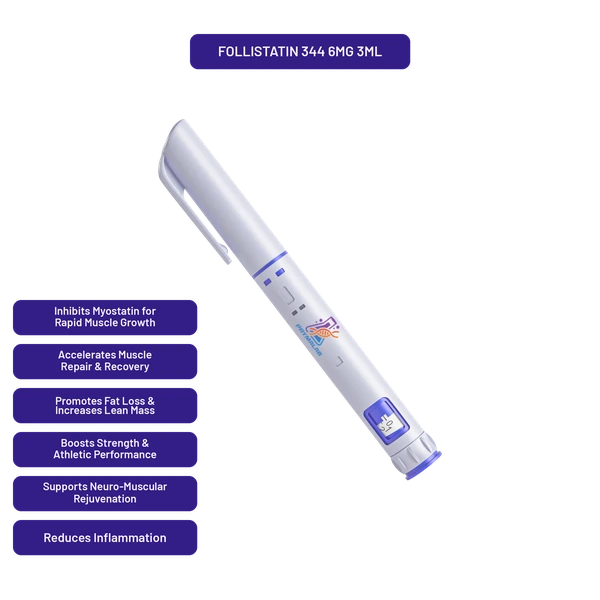
Preloaded Autoinjector | Follistatin 344 | 3ml Pen | 6mg
Recombinant glycoprotein in solution · 3ml at 2mg/ml · No reconstitution step
The follistatin 344 pen is a preloaded 3ml autoinjector holding recombinant follistatin in solution at 2 mg/ml, 6 mg in total, roughly 52.6 µM, with 20 µg in each 0.01 ml graduation. This is a 38 kDa glycoprotein held together by 18 disulfide bonds across 36 cysteines, not a small peptide, and scrambled disulfides weigh exactly what correct ones do.
Specification Table
| Property | Value |
|---|---|
| Device format | Preloaded autoinjector pen, glass cartridge |
| Fill volume | 3 ml |
| Concentration | 2 mg/ml (6 mg in 3 ml) |
| Total compound in device | 6 mg nominal. Protein content per certificate of analysis |
| Molar concentration | 52.6 µM using the 38,007 Da precursor mass; 57.5 µM using the 34,754 Da secreted chain |
| Compound | Recombinant follistatin, gene FST, UniProt P19883. Activin-binding protein |
| CAS number | None confirmed against a primary registry. Unverified. Do not rely on vendor-quoted numbers |
| Molecular formula | Not meaningfully expressible for a glycoprotein and not published here |
| Molecular weight | 38,007 Da precursor unglycosylated; 34,754 Da mature chain unglycosylated and reduced; 38-45 kDa apparent on SDS-PAGE for glycosylated material |
| Structure and amino acid content | 344 residues, too long to print. Signal peptide 1-29, mature chain 30-344. An N-terminal TB domain, three follistatin domains and a disordered acidic C-terminal tail |
| Solution appearance | Clear and colourless. Opalescence indicates aggregation and is the failure signal for a protein at this strength |
| Reconstitution required | None. Supplied as solution, ready to draw |
| Excipient system | Not published on the product record. Whether a non-ionic surfactant is present is the question that matters most |
| Solution pH | Not published on the product record |
| Storage | 2-8°C, protected from light, never frozen, minimal agitation and headspace |
| Light sensitivity | Moderate. Six tryptophans and nine tyrosines, plus near-UV absorption by cystine bonds |
| Solution stability | No forced-degradation, photostability, freeze-thaw or excipient study exists for this protein |
| Disulfides | 18 intrachain bonds across 36 cysteines, listed in UniProt from 32-55 through 284-316. No free cysteine |
| Glycosylation | Two N-linked sites, Asn124 and Asn288. Occupancy depends on expression host; E. coli material is aglycosylated |
| Net charge and pI | Approximately -7 at pH 7.0, pI near 5.1 for the mature chain. Anionic at physiological pH |
| Purity | Per lot-specific certificate of analysis. Chromatographic purity does not report disulfide pairing |
| Regulatory status | No approved product anywhere in any form, protein, fusion or gene therapy. Absent from FDA Category 2 and from the nominated-but-withdrawn list. WADA prohibited at all times under S4.3, myostatin inhibitors |
What Does the Follistatin Protein in This Device Actually Weigh?
The number 344 names a transcript, not the molecule in the cartridge. Those 344 residues include a 29-residue signal peptide that is removed during secretion, so the follistatin protein that leaves a cell is the 315-residue chain, and the precursor mass of 38,007 Da is not the mass of the secreted product.
The mature chain calculates to about 34,754 Da unglycosylated and reduced. Add the two N-linked glycans at Asn124 and Asn288 and mammalian material runs at an apparent 38 to 45 kDa on a gel, while material expressed in E. coli is aglycosylated and runs lower. The shorter alternative isoform, FST288, is the one that sits near 31.5 kDa; that figure belongs to a different protein and turns up regularly on listings for this one.
The name has a specific origin worth knowing. AAV1-FS344 is the vector used in the Becker muscular dystrophy gene therapy trial, and the 344 in that construct name is the cDNA it carries. A product name inherited from a viral vector is not a statement about the protein inside a pen.
What separates the isoforms is electrostatic rather than functional potency. The last thirty residues of the long form are a run of acid, and deleting that tail raises the calculated isoelectric point from about 5.1 to 7.6, flipping net charge at pH 7 from roughly -7 to +4.7. The acidic tail is why the long form circulates while the short form binds cell-surface heparan sulfate. Which form the device holds is not on the product record.
What Changes When a 38 kDa Glycoprotein Ships in Solution?
Every generic argument about peptides in solution applies weakly here and a different set applies strongly, because this molecule holds a fold together with 18 disulfide bonds and carries a folded structure that a hexapeptide does not have to protect.
Thirty-six cysteines is more than one residue in ten. Correct pairing across those 18 bonds is the entire basis of the fold, and above pH 8 thiolate formation accelerates disulfide scrambling, as do trace metals and any reductant that finds its way in. The consequence is the central analytical problem with this product: a scrambled molecule has the same mass, the same amino acid composition and often the same chromatographic retention as a correctly folded one, and no binding activity at all. A purity percentage on a certificate of analysis reports how much of the material is this protein. It reports nothing about whether the protein is folded.
At 2 mg/ml the interfacial risks are severe rather than theoretical. Proteins denature at the air-liquid interface, against silicone oil on a cartridge barrel, and under shear during actuation, and each of those routes produces aggregates that seed further aggregation. Real biologic formulations at this strength carry a non-ionic surfactant for exactly this reason, and whether this one does is unpublished. Freeze-thaw is the other major route, which is why a protein cartridge must never be frozen: ice formation concentrates solutes, shifts pH as buffer salts crystallise, and creates a new interface for the protein to unfold against.
The chemical liabilities are ordinary but numerous at this size. There are 17 asparagines and 9 glutamines, with Asn-Gly at positions 39 and 82, the fastest-deamidating context. Asp-Gly appears at 135 and 210, which is the backbone cleavage motif; no Asp-Pro is present. Three methionines, six tryptophans and nine tyrosines make oxidation and photo-oxidation real, and near-UV absorption by the cystine bonds homolyses S-S directly, feeding the scrambling described above (Kerwin 2007). Glycan heterogeneity at the two sites adds a further population of species before any degradation has happened at all.
Charge behaves in the opposite direction from every small peptide in this catalogue. A calculated pI near 5.1 and a net charge around -7 at pH 7.0 make the protein anionic at physiological pH, so adsorption to ionised glass silanols is less of a problem than for cationic peptides. Interfacial adsorption is more of one. At pH 5 to 5.5 the protein sits at its own isoelectric point, where solubility is at its lowest, which makes a mildly acidic formulation a poor choice for reasons that have nothing to do with chemical degradation.
One further point belongs to the format rather than to the molecule. A surfactant-free, preservative-free protein solution in a multi-draw device is a microbiological question as well as a chemical one, and the product record does not say whether a preservative is present.
Follistatin 344 Solution Stability: What Is Actually Known?
Follistatin 344 solution stability has never been studied. No forced-degradation, photostability, freeze-thaw or excipient study of this protein has been published, and no aggregation data exist at injectable concentrations, so every statement about its behaviour at 2 mg/ml is inference from protein formulation literature (Manning et al. 2010).
The gap is more consequential here than for a small peptide. For a hexapeptide the failure modes are chemical and each one changes the mass. For an 18-disulfide protein the dominant failure modes are conformational and covalent rearrangement, and neither changes the mass at all, so an absence of stability data cannot be compensated for by careful mass spectrometry on receipt.
Refrigerated dark storage at 2-8°C, never frozen, with minimal agitation and headspace, follows from the disulfide and interfacial chemistry rather than from any manufacturer instruction, because none exists for this material. Follistatin 344 pen stability across a device shelf life is unknown, and the storage and stability article covers the general handling principles.
Concentration and Increment Arithmetic for the Follistatin 344 6mg Pen
The follistatin 344 6mg fill in 3 ml gives 2.0 mg/ml, which is 52.6 µM using the 38,007 Da precursor mass, and each 0.01 ml graduation carries 20 µg, about 0.53 nmol.
The working is short and the ambiguity is instructive. 6 mg divided by 3 ml is 2.0 mg/ml. Divided by 38,007 g/mol and multiplied by 1,000 that is 0.0526 mM, or 52.6 µM. Repeat with the mature secreted chain at 34,754 g/mol and the same solution is 57.5 µM, a 9 percent spread that turns entirely on whether the device holds the precursor mass or the secreted protein. If the material is glycosylated, true molarity is lower again, because the glycans add mass without adding binding sites. One 0.01 ml graduation on a U-100 scale holds 20 µg or 0.53 nmol; 0.1 ml holds 200 µg or 5.3 nmol. The peptide calculator reproduces these for any fill.
The comparison with the assays that define this protein’s activity is the number worth carrying away. Activin and myostatin neutralisation operates in the low nanomolar to sub-nanomolar range in the binding work that established what follistatin does. Reaching 10 nM from 52.6 µM requires a 5,260-fold dilution, and a single 0.01 ml graduation contains enough protein to saturate 10 nM binding sites in 53 millilitres of buffer. The device sits roughly four orders of magnitude above the concentration at which the defining activity is measured, which is a dilution problem rather than a supply problem.
Follistatin 344 Pen vs Vial: What Does the Format Suit?
The follistatin 344 pen vs vial question is decided by aggregation rather than by convenience, because a protein at 2 mg/ml in a cartridge is exposed to air-liquid interface, silicone oil and shear for the whole shelf life, and a lyophilized cake is exposed to none of them.
The format suits work needing many equivalent draws from one lot inside a short window. Reconstituting a protein is harder than reconstituting a peptide: over-agitation shears it, incomplete dissolution goes unnoticed, and each transfer adds another interface. A device removes all of that and fixes concentration at manufacture. The preloaded autoinjector category page covers the general case for the format.
It suits long-running or binding-dependent work less well. Where the experiment depends on correctly paired disulfides and a monomeric population, the follistatin 344 solution vs lyophilized comparison favours the dry form, since a lyophilized vial dissolved on the day of use has spent minutes rather than months in water and allows the buffer, the surfactant and the pH to be chosen deliberately. A follistatin 344 pen used across many weeks accumulates interfacial history that nobody has characterised.
The follistatin 344 pen or vial decision otherwise follows the general trade-offs in the pen versus vial article. The difference from every small molecule on this site is that the degradation of interest here is physical, and physical degradation leaves no mass signature to audit afterwards.
What the Follistatin 344 Pen Record Does Not State
The product record does not state the expression host, the isoform, the excipient system, the solution pH or the fill date, and for a recombinant protein the first two decide what the material is before any of the others matter.
Expression host comes first. E. coli material is aglycosylated and refolded in vitro; CHO or HEK material is secreted with glycans at Asn124 and Asn288 and folded by the cell. Those are different molecules by mass, by glycan population and, potentially, by disulfide fidelity, and no salt form question substitutes for this one. Ask for the host, and ask what method established the disulfide pairing rather than the purity.
Isoform comes second: the precursor mass and the secreted chain mass differ by about 3,250 Da, which is 9 percent of the molarity. Then the formulation questions. Whether a non-ionic surfactant is present is the single most useful excipient fact for a protein at 2 mg/ml in a cartridge, and whether a preservative is present decides whether a multi-draw device is microbiologically sensible. Solution pH matters twice over, since the exchange rate rises above pH 8 and solubility falls near pH 5.1. Request all five from the certificate of analysis before quantitative work rather than after an unexplained result.
Verifying the Device and Confirming the Contents Are Intact
Inspect the solution against a white background before each draw. Opalescence, not colour change, is the failure signal for a protein at this concentration, and visible particulate means aggregation has already progressed well beyond what light scattering would have caught earlier.
Aggregation is the measurement to prioritise. Size exclusion chromatography separates monomer from dimer and higher oligomer and is the standard method; dynamic light scattering catches sub-visible particles earlier and needs very little material. Non-reducing gel electrophoresis run alongside a reduced sample shows whether any oligomer present is covalently disulfide-linked or merely associated, which are different problems with different causes.
Fold, unlike purity, needs a functional measurement. The only assay that reports whether the disulfides are correctly paired is a binding assay against activin or myostatin, because a scrambled molecule has the correct mass and the correct composition and binds nothing. Absorbance at 280 nm gives concentration reliably enough, since six tryptophans and nine tyrosines make the extinction coefficient large, but concentration and activity are independent questions here in a way they are not for a small peptide.
Allow the device to reach ambient temperature before actuating, since cold solution is more viscous and a spring mechanism delivers less per stroke. Verify delivered volume gravimetrically once per device, and handle the cartridge gently: for a protein at 2 mg/ml, shaking and repeated inversion are damage rather than mixing.
What Does the Literature Actually Report?
The literature reports muscle-mass findings from gene therapy, transgenic mice and an engineered fusion protein, and it contains no study in which recombinant follistatin protein was injected into a human by any systemic route.
Follistatin was identified as an activin-binding protein from rat ovary by Nakamura et al. in Science in 1990, seven years before myostatin was described at all. It has no receptor; it is a secreted ligand trap that binds TGF-beta superfamily ligands directly and prevents them reaching their type II receptors. Amthor et al. 2004 showed it complexes myostatin and antagonises myostatin-mediated inhibition of myogenesis, and Sidis et al. 2006 mapped how the isoforms differ in cell-surface binding and ligand specificity. The myostatin inhibitor research overview covers that field more widely.
The human work is two programmes and neither injected the protein. Mendell et al., Mol Ther 2015;23(1):192-201, ran a phase 1/2a trial of AAV1-FS344 gene therapy in Becker muscular dystrophy by direct intramuscular delivery, with improved six-minute walk distance reported in the same cohort. Glasser et al., Muscle Nerve 2018;57(6):921-926, reported that ACE-083, an Fc fusion, increased muscle volume after intramuscular injection in healthy volunteers. Lee and McPherron in PNAS 2001 reported large increases in skeletal muscle mass in transgenic mice overexpressing the protein. Conflating a virus carrying the FS344 gene with a protein solution is the central misrepresentation in this market, and the article on this protein family sets out the distinction.
Two independent clinical programmes decided not to inject the protein itself: one delivered the gene by virus into muscle, the other engineered an Fc fusion to extend circulation and was designed for local intramuscular delivery. That pair of engineering decisions is the most useful thing the literature says about giving this molecule systemically. No human pharmacokinetic study of the recombinant protein exists, so no half-life figure appears on this page.
What Is the Safety and Regulatory Position?
No follistatin product holds a marketing authorisation anywhere in any form, protein, Fc fusion or gene therapy, from FDA, EMA, PMDA Japan, TGA or Health Canada. AAV1-FS344 remains investigational and ACE-083 was never approved.
The compounding position is empty rather than restrictive: it appears neither on FDA’s Category 2 list of bulk drug substances that may present significant safety risks nor on the nominated-but-withdrawn list, because it has never been nominated. There is no 503A or 503B pathway and no USP monograph.
WADA prohibits it at all times under section S4.3, myostatin inhibitors, which names “myostatin-binding proteins (e.g. follistatin, myostatin propeptide)” explicitly. Any claim that this material is not a banned substance is false against the list text.
On safety there is no human adverse-event table for the protein, because no human has received it by injection. What can be said factually is that systemic activin blockade is not an inert intervention: activin regulates FSH secretion, erythropoiesis, wound repair and inflammation, and ACE-083 was deliberately engineered for local intramuscular delivery to limit systemic exposure. There is no repeat-dose toxicology and no published stability data. This device is supplied for laboratory research only and is not for administration to humans or animals.
What Does Follistatin Do, and What Is the Myostatin Connection?
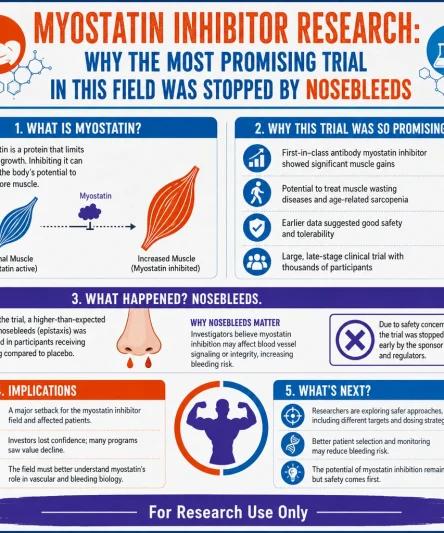
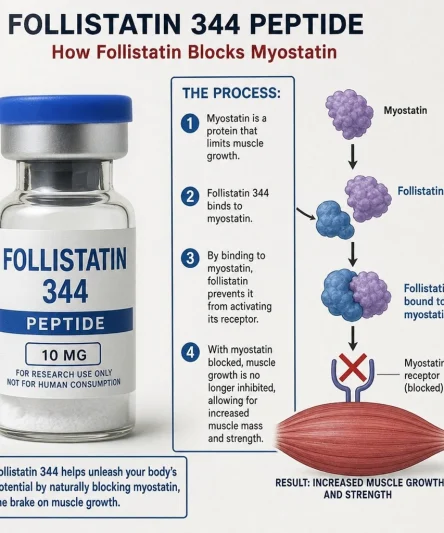
Follistatin binds and neutralises members of the TGF-β superfamily, and the two that matter for the claims attached to this protein are activin A and myostatin, also written GDF-8. It is the negative regulator of skeletal muscle mass: animals lacking a working copy develop double muscling, and the cattle breeds carrying natural GDF-8 mutations are the standard illustration. Myostatin inhibition therefore removes a brake on muscle development, which is where every muscle growth claim for this molecule begins. Inhibiting myostatin with an antibody has also been tried as a drug strategy, and those programmes largely failed on functional endpoints despite adding muscle mass.
The FST gene produces two main isoforms by alternative splicing. One is the circulating form, follistatin-315, and follistatin 344 is the precursor whose processed product FS-288 carries a heparin-binding domain that keeps it bound to cell surfaces. That difference is functional rather than cosmetic: the tissue-bound form acts locally where it is made, and the circulating form does not, so a systemically administered protein does not reproduce what local expression does.
Follicle-stimulating hormone is the other half of the biology and the reason for the name. Follistatin was identified in ovarian follicular fluid as the factor that suppressed FSH secretion from pituitary cells, and it does so by sequestering the activator. Anyone searching for follistatin because of muscle will find the reproductive literature attached, and the two are the same mechanism operating on different activin targets.
What Has Actually Been Tested, and In What?
The striking muscle results come from follistatin gene therapy rather than from injected protein. Follistatin gene delivery using adeno-associated viral vectors produced sustained local overexpression and durable muscle growth in mice and in non-human primates, and small human trials in Becker muscular dystrophy and inclusion body myositis used the same approach. Those are gene therapy trials. The vector puts a gene into muscle where it keeps producing protein locally for months.
Injected recombinant protein is a different proposition and has almost no supporting data. Circulating follistatin has a short half-life, the tissue-bound isoform is the one that acts locally, and no controlled trial has tested injected follistatin protein for muscle growth, muscle recovery or lean muscle mass in humans. Resistance training remains the intervention with actual evidence for muscle hypertrophy, and bodybuilding interest in this protein runs well ahead of anything published. There is no trial in bodybuilders and no dose-response data in any species for the injected protein.
Other reported effects sit in the same position. Fibrosis reduction has been reported in animal models, again mostly with gene delivery. Changes in LDL cholesterol and in IGF-1 appear in some of the gene therapy reports as secondary observations, and growth hormone is not part of this pathway at all despite the two being sold together as muscle options alongside secretagogues such as ipamorelin. Sarcopenia is the condition this class is most often nominated against and the one with no completed positive trial behind it. None of this research peptide’s claims has a controlled human study using the injected protein.
What Should the Certificate Show for a 38 kDa Protein?
Different questions from a short peptide, and a certificate written for one will not answer the other. Ask whether the follistatin 344 peptide in the device is the full-length recombinant protein or a fragment, which expression system produced it, and whether it is glycosylated, since the glycosylation state differs between bacterial and mammalian expression and affects both activity and solubility. Ask for purity by SDS-PAGE and by size-exclusion chromatography rather than by reversed-phase HPLC alone, because aggregation is the failure mode that matters for a protein and reversed-phase methods can miss it.
Endotoxin should be stated for anything expressed in bacteria. A vial of lyophilised protein reconstituted with bacteriostatic water at the bench allows the buffer to be chosen; this device fixes it, and the excipient system and pH are unstated on the record. For a protein rather than a peptide, those two numbers govern aggregation, and subcutaneous injections of an aggregated protein preparation are the classic route to injection site reactions and to immunogenicity. Nothing about this is peculiar to follistatin; it is true of any protein given by subcutaneous injection. Side effects have never been catalogued for injected follistatin in humans, because the studies that would catalogue them have not been run.
Published Literature
Each entry was traced to a publisher record or a primary database. All concern the protein, its ligands or the clinical programmes built around the gene; nothing has been published on this delivery format.
- UniProt Consortium. P19883 (FST_HUMAN), Follistatin. 344-residue precursor, 38,007 Da, chain 30-344, 18 disulfide bonds, glycosylation at Asn124 and Asn288.
- Nakamura T, Takio K, Eto Y, et al. Science. 1990;247(4944):836-838. DOI: 10.1126/science.2106159
- Amthor H, Nicholas G, McKinnell I, et al. Dev Biol. 2004;270(1):19-30. DOI: 10.1016/j.ydbio.2004.01.046
- Sidis Y, Mukherjee A, Keutmann H, et al. Endocrinology. 2006;147(7):3586-3597. DOI: 10.1210/en.2006-0089
- Mendell JR, Sahenk Z, Malik V, et al. Mol Ther. 2015;23(1):192-201. DOI: 10.1038/mt.2014.200
Frequently Asked Questions
What is the follistatin 344 pen?
A preloaded 3ml autoinjector containing recombinant follistatin in solution at 2 mg/ml, 6 mg in total, roughly 52.6 micromolar. No reconstitution step is needed. It is supplied strictly for laboratory research, and no product of this protein is approved anywhere in any form.
Is this a peptide or a protein?
A protein. The follistatin protein is a 344-residue precursor of 38,007 Da whose secreted chain runs near 34,754 Da unglycosylated, with two N-linked glycans that push apparent mass to 38-45 kDa on a gel. Nothing about a hexapeptide product applies to it.
What does the 344 in the name refer to?
A transcript, not the circulating molecule. Those 344 residues include a 29-residue signal peptide removed during secretion, so the protein outside the cell is the 315-residue chain. The name also comes from AAV1-FS344, the vector used in the Becker muscular dystrophy gene therapy trial.
Why do the 18 disulfide bonds matter so much?
Because correct pairing across 36 cysteines is the entire basis of the fold, and a scrambled molecule has the same mass, the same amino acid composition and no binding activity. Above pH 8, thiolate formation accelerates scrambling, as do trace metals and any reductant present.
What is known about follistatin 344 solution stability?
Nothing measured. No forced-degradation, photostability, freeze-thaw or excipient study has been published, and no aggregation data exist at injectable concentrations. The gap matters more than usual because the dominant failure modes for a disulfide-rich protein are conformational and leave no mass signature to audit.
Why must a protein cartridge never be frozen?
Because ice formation concentrates solutes into a shrinking liquid phase, shifts pH as buffer salts crystallise at different points, and creates a new interface for the protein to unfold against. Freeze-thaw is one of the main aggregation routes for proteins at this strength, alongside shear and silicone oil.
What does the follistatin 344 6mg fill deliver per increment?
20 micrograms in each 0.01 ml graduation, about 0.53 nanomoles at the 38,007 Da precursor mass, and 200 micrograms or 5.3 nanomoles in 0.1 ml. Total concentration is 2.0 mg/ml, which is 52.6 micromolar on the precursor mass and 57.5 micromolar on the secreted chain.
Why does the molar concentration depend on which mass is used?
Because the precursor and the secreted chain differ by about 3,250 daltons, a 9 percent spread in molarity. Glycosylation lowers true molarity further, since the glycans add mass without adding binding sites. The product record does not state which form the device holds.
Is aggregation the main risk at 2 mg/ml?
Yes. Proteins denature at the air-liquid interface, against silicone oil on a cartridge barrel, and under shear during actuation, and each route seeds further aggregation. Real biologic formulations at this strength carry a non-ionic surfactant for that reason, and whether this one does is unpublished.
Does this protein adsorb to glass like the peptides do?
Less so, because it is anionic rather than cationic. A calculated pI near 5.1 and net charge around -7 at pH 7.0 reduce binding to ionised glass silanols. Interfacial adsorption at the air-liquid boundary is the greater problem, and solubility is lowest near pH 5.1.
Follistatin 344 pen vs vial: which format suits which work?
The pen suits many equivalent draws from one lot inside a short window, since reconstituting a protein risks shear and incomplete dissolution. The lyophilized vial suits binding-dependent work, because the buffer, the surfactant and the pH can be chosen rather than inherited from an unpublished formulation.
How should the follistatin 344 pen be stored?
At 2-8°C, protected from light, never frozen, with minimal agitation and headspace and the device returned to its carton between draws. Shaking and repeated inversion are damage rather than mixing for a protein at this strength. No manufacturer storage data exist for this material.
What is not stated on the product record?
The expression host, the isoform, the excipient system, the solution pH and the fill date. Host matters most: E. coli material is aglycosylated and refolded in vitro, while CHO or HEK material carries glycans at Asn124 and Asn288 and was folded by the cell.
Does a high purity figure mean the protein works?
No. Chromatographic purity reports how much of the material is this protein, not whether its 18 disulfides are correctly paired. Only a binding assay against activin or myostatin reports fold, because a scrambled molecule has the correct mass, the correct composition and no activity.
How can aggregation be measured in the device contents?
Size exclusion chromatography separates monomer from dimer and higher oligomer and is the standard method. Dynamic light scattering catches sub-visible particles earlier on very little material. Non-reducing gel electrophoresis run beside a reduced sample shows whether oligomers are covalently disulfide-linked or merely associated.
Has recombinant follistatin protein been injected into humans?
Not by any systemic route in a published study. The human work is AAV1-FS344 gene therapy delivered intramuscularly in Becker muscular dystrophy (Mendell 2015) and ACE-083, an Fc fusion, injected intramuscularly in healthy volunteers (Glasser 2018). Neither administered the protein itself.
Is there a published half-life for this protein?
No human pharmacokinetic study of the recombinant protein was located, so no half-life or clearance figure appears here. Two mechanistic points stand instead: the acidic C-terminal tail keeps the long isoform in circulation, and ACE-083 was engineered as an Fc fusion rather than given as the bare protein.
Is this material on the WADA prohibited list?
Yes, at all times, under section S4.3, myostatin inhibitors, which names “myostatin-binding proteins (e.g. follistatin, myostatin propeptide)” explicitly. Any claim that this material is not a banned substance is false against the list text as written.
How does follistatin relate to myostatin?
It binds and neutralises GDF-8, also called myostatin, along with activin A and other TGF-β superfamily members. That protein is the negative regulator of skeletal muscle mass, so myostatin inhibition removes a brake on muscle development. That is the whole basis of the muscle growth claim.
What is the difference between follistatin 344 and follistatin-315?
They are isoforms from the FST gene by alternative splicing. Follistatin-315 is the circulating form. The 344 precursor yields FS-288, which carries a heparin-binding domain that holds it on cell surfaces, so it acts locally where it is made. A systemically administered protein does not reproduce what local expression does.
Do the impressive muscle results come from injections?
No. They come from follistatin gene therapy. Follistatin gene delivery by adeno-associated viral vector produced sustained local overexpression and durable muscle hypertrophy in mice and primates, and small human trials in Becker muscular dystrophy and inclusion body myositis used the same approach. No controlled trial has tested injected protein for muscle growth or lean muscle mass in humans.
Why is follicle-stimulating hormone in the literature for a muscle protein?
Because follistatin was discovered in ovarian follicular fluid as the factor suppressing FSH secretion, which it does by sequestering activin. It is the same sequestering mechanism operating on different activin targets, which is why the reproductive literature sits alongside the muscle literature under one name.
What should a certificate show for this protein?
Whether the follistatin 344 peptide is full-length or a fragment, the expression system, and the glycosylation state, which differs between bacterial and mammalian expression. Ask for purity by SDS-PAGE and size-exclusion chromatography rather than reversed-phase HPLC alone, since aggregation is the failure mode that matters, plus endotoxin for anything bacterially expressed.
Compliance Statement
The Follistatin 344 autoinjector is sold exclusively for laboratory research use. It is not a drug, food, or cosmetic product, and it is not a dietary product of any kind. It is not approved by the FDA or any comparable authority for human or veterinary use. This product is not intended to diagnose, treat, cure, or prevent any disease. It must not be given to humans or animals. Purchase is restricted to qualified researchers and institutions operating within applicable laws. All handling is the responsibility of the purchasing laboratory.







Reviews
There are no reviews yet.