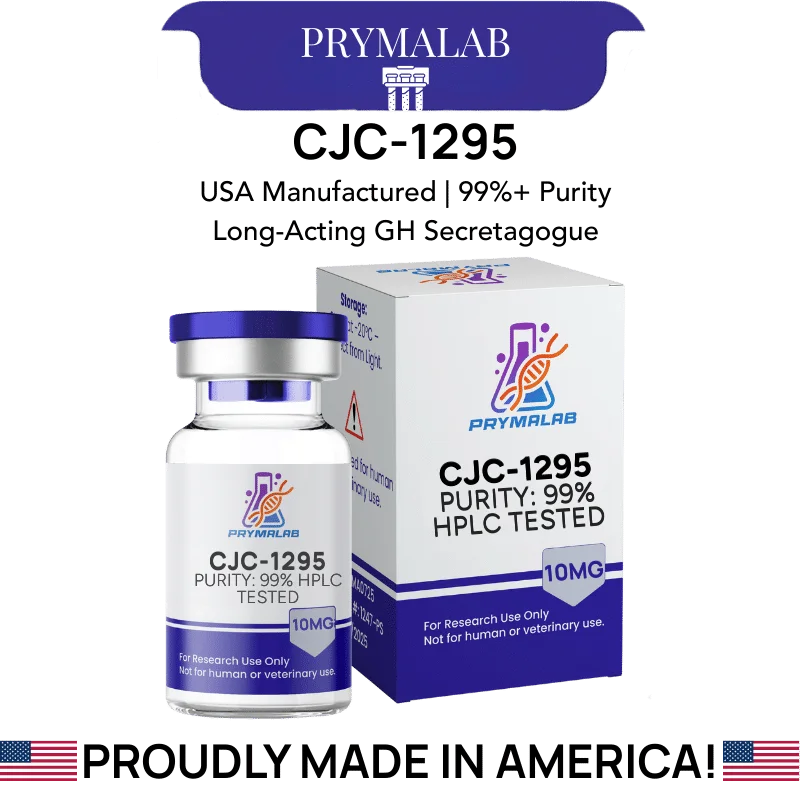
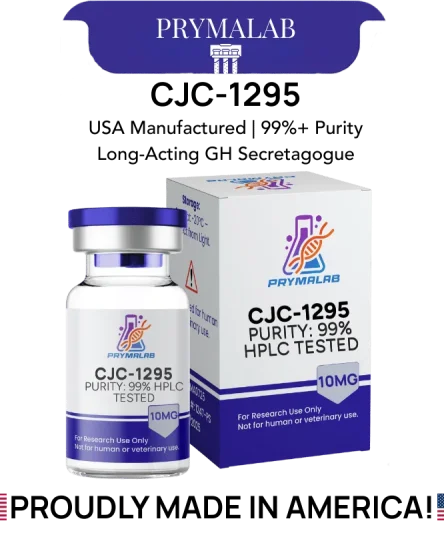
CJC-1295 No DAC 10mg contains Modified GRF (1-29), a synthetic 29-residue analog of growth hormone-releasing hormone bearing four amino acid substitutions that confer resistance to dipeptidyl peptidase-IV. It acts at the GHRH receptor on anterior pituitary somatotrophs, with a reported half-life near 30 minutes.
Specification Table
Modified GRF (1-29) verified chemical and handling data
| Property |
Value |
| Compound |
CJC-1295 without Drug Affinity Complex |
| Alternative names |
Modified GRF (1-29), Mod GRF 1-29, CJC-1295 No DAC |
| CAS number |
863288-34-0 |
| Molecular weight |
Approximately 3367.9 g/mol |
| Residue count |
29 amino acids |
| Parent molecule |
Human GHRH (1-29), the active fragment of the 44-residue native hormone |
| Structural modification |
Four amino acid substitutions conferring resistance to enzymatic degradation |
| Albumin-binding motif |
Absent. This is the defining difference from the DAC form |
| Molecular target |
GHRH receptor (GHRHR), a class B G-protein-coupled receptor |
| Receptor location |
Somatotroph cells of the anterior pituitary |
| Downstream signalling |
Adenylyl cyclase, cyclic AMP, protein kinase A |
| Reported half-life |
Approximately 30 minutes |
| Vial content |
10 mg lyophilized powder |
| Appearance |
White lyophilized cake |
| Purity |
Per lot-specific certificate of analysis |
| Solubility |
Soluble in bacteriostatic water and sterile water |
| Storage, lyophilized |
-20°C, protected from light and moisture |
| Storage, reconstituted |
2-8°C, protected from light |
| Reconstituted stability |
Not established under arbitrary conditions. Determine internally |
| Regulatory status |
No approved human or veterinary formulation in any jurisdiction |
What Are the Four Substitutions and Why Do They Matter?
Native human GHRH is a 44-residue peptide, but the first 29 residues carry essentially all the receptor activity. That fragment, GHRH (1-29), is where every analog in this class starts.
The problem with the unmodified fragment is that it does not survive long in circulation. Dipeptidyl peptidase-IV cleaves the peptide near its amino terminus within minutes, and the resulting fragment is inactive. Any research design needing a measurable window of receptor stimulation runs into that ceiling immediately.
Modified GRF (1-29) addresses it with four substitutions at positions vulnerable to enzymatic attack or prone to chemical instability. The substitutions preserve the receptor-binding face of the molecule while removing the recognition sites that made the native fragment fragile. The functional consequence is a peptide that reaches the pituitary intact and produces a measurable stimulation window.
Thirty minutes is still short by pharmaceutical standards. That is deliberate rather than a shortcoming, and the next section explains why.
Why Would a Short Half-Life Be the Point?
Growth hormone is not secreted continuously. It comes in discrete pulses, largest during slow-wave sleep, shaped by the interplay between GHRH driving release and somatostatin restraining it. That pulsatility is not incidental to the biology. Target tissues respond differently to pulsatile and continuous exposure, and the difference shows up in downstream gene expression.
A long-acting analog flattens the profile. Sustained receptor occupancy produces sustained stimulation, which is useful if the research question concerns chronic elevation of the axis, and unhelpful if the question concerns pulse architecture.
A 30-minute analog does the opposite. It produces a discrete stimulation window that can be timed against sleep onset, feeding, exercise or somatostatin tone, then clears. Researchers studying pulse amplitude, inter-pulse interval, or the interaction between GHRH signalling and somatostatin withdrawal need that temporal resolution, and cannot get it from a compound with multi-day activity.
Choosing between the two forms is a study-design question, not a question of which compound is better.
How Does CJC-1295 No DAC 10mg Differ From the DAC Form?
One structural feature, and it changes everything downstream.
The DAC form carries a Drug Affinity Complex, a maleimide group that forms a covalent bond with cysteine-34 on serum albumin after entering circulation. Albumin is abundant and long-lived, so the bound peptide is shielded from renal clearance and enzymatic breakdown. Reported half-life extends into days.
The No DAC form has no such motif. It circulates free, is cleared on the timescale of the peptide itself, and produces the pulse-like profile described above. Both act at the same receptor through the same signalling pathway. The difference is entirely in duration of exposure.
A practical note on nomenclature that causes real confusion in the literature and in supplier catalogues: strictly speaking, the name CJC-1295 refers to the DAC-bearing molecule. What is sold as CJC-1295 No DAC is more precisely called Modified GRF (1-29). The two names describe the same product, but only one of them is chemically accurate, and search queries reaching this page use both.
What Does the Published Literature Actually Cover?
This deserves a direct answer, because the honest one is not what a product page usually says.
The substantial clinical literature on this compound family covers the DAC form. Teichman and colleagues published single ascending exposure data in human subjects (Teichman et al., Journal of Clinical Endocrinology and Metabolism, 2006), and Alba and colleagues characterised the molecule in GHRH-knockout mice (Alba et al., American Journal of Physiology: Endocrinology and Metabolism, 2006). Both concern CJC-1295 with DAC.
Modified GRF (1-29) as a distinct entity has a much thinner published record. There is no equivalent human pharmacokinetic study, and the 30-minute half-life figure in wide circulation is not traceable to a single definitive published source in the way the DAC half-life figures are.
This matters for how the compound should be used. It is a reasonable tool for studying GHRH receptor signalling and pulse timing, because the receptor pharmacology of the GHRH (1-29) scaffold is well established. It is not a compound with its own validated exposure profile, and any research design should generate its own timing data rather than importing figures from secondary sources.
How Is GHRH Receptor Activity Measured?
The receptor couples to adenylyl cyclase, so the most direct readout is cyclic AMP accumulation in a cell line expressing the receptor. Commercial assay formats using competitive immunoassay or time-resolved fluorescence are widely used, and a concentration-response curve against a native GHRH comparator establishes relative potency.
Growth hormone release from cultured pituitary cells is the next step up in biological relevance. Primary rat pituitary cultures and somatotroph-derived lines both appear in the literature, and both introduce the complication that growth hormone content varies with culture age and passage.
In vivo, the readout is serum growth hormone sampled frequently enough to resolve pulses. This is where a short-acting analog earns its place and also where study design gets demanding, because a 30-minute compound requires sampling intervals short enough to capture a pulse that may last less than an hour. Sparse sampling will miss the event entirely and produce a flat curve that looks like no effect.
IGF-1 is the convenient downstream marker, since it integrates growth hormone exposure over time and does not require frequent sampling. That integration is also its limitation: it cannot distinguish a single large pulse from sustained moderate elevation, which is precisely the distinction a pulsatility study exists to make.
What Somatostatin Does to the Readout
Any experiment stimulating the GHRH receptor is operating against an opposing signal, and ignoring it produces confusing data.
Somatostatin restrains growth hormone release, and its secretion is itself rhythmic. The natural pulse pattern arises from the interaction between rising GHRH drive and falling somatostatin tone, not from GHRH alone. Stimulating the receptor while somatostatin tone is high produces a smaller response than the identical stimulus applied during a trough.
For a short-acting analog this is not a footnote. A 30-minute compound delivered at an unfavourable point in the somatostatin rhythm may produce a barely detectable response, and the same amount delivered 90 minutes later may produce a large one. Neither reading describes the compound accurately in isolation.
Designs that control for this either fix the timing precisely relative to a known rhythm marker, or sample across enough time points to characterise the response envelope rather than a single value. Reporting a single measurement without stating when it was taken relative to the rhythm makes the number difficult for anyone else to use.
Reconstitution and Storage in Laboratory Practice
Supplied as a 10 mg lyophilized cake. Diluent is introduced slowly down the vial wall rather than directed at the cake, and the vial is swirled until clear. Vigorous shaking generates shear and foaming, both of which degrade peptides.
Bacteriostatic water is common for multi-draw preparations, sterile water for single-use. The choice affects working stability, and it should be recorded rather than assumed. At 10 mg the reconstitution volume determines the concentration across every subsequent measurement, so it belongs in the record alongside lot number and date.
Lyophilized material is held at -20°C, protected from light and moisture. Reconstituted solution goes to 2-8°C and should be shielded from light. Peptides of this length are prone to aggregation over repeated freeze-thaw, so aliquoting before freezing is standard practice. Discard any solution showing cloudiness or visible particulate.
Published Literature
Cross-checked against the publisher record or a primary index. Read the clinical entries with the caveat above in mind, since they concern the DAC-bearing molecule rather than the modified fragment supplied here.
- Teichman SL, Neale A, Lawrence B, Gagnon C, Castaigne JP, Frohman LA. Journal of Clinical Endocrinology and Metabolism. 2006;91(3):799-805.
- Alba M, Fintini D, Sagazio A, Lawrence B, Castaigne JP, Frohman LA, Salvatori R. American Journal of Physiology: Endocrinology and Metabolism. 2006;291(6):E1290-E1294.
- Ionescu M, Frohman LA. Journal of Clinical Endocrinology and Metabolism. 2006;91(12):4792-4797.
- Frohman LA, Jansson JO. Endocrine Reviews. 1986;7(3):223-253.
Frequently Asked Questions
What is CJC-1295 No DAC 10mg?
CJC-1295 No DAC 10mg is a lyophilized vial of Modified GRF (1-29), a 29-residue analog of growth hormone-releasing hormone with four amino acid substitutions that resist enzymatic breakdown. It acts at the GHRH receptor on anterior pituitary somatotrophs. Reported half-life is roughly 30 minutes. Laboratory research use only.
Is CJC-1295 No DAC the same as Modified GRF 1-29?
Yes, and Modified GRF (1-29) is the more accurate name. Strictly, CJC-1295 designates the molecule carrying the Drug Affinity Complex. The no-DAC product is chemically the modified GHRH fragment without that albumin-binding motif. Both names appear in supplier catalogues and in search queries, which is why both are used here.
What does the DAC modification actually do?
The Drug Affinity Complex is a maleimide group that forms a covalent bond with cysteine-34 on serum albumin after entering circulation. Albumin is abundant and long-lived, so the bound peptide is shielded from renal clearance and enzymatic degradation. Reported half-life extends into days rather than minutes.
Why choose the shorter-acting form?
Growth hormone is secreted in discrete pulses, and target tissues respond differently to pulsatile versus continuous exposure. A 30-minute analog produces a defined stimulation window that can be timed against sleep onset, feeding or somatostatin tone, then clears. A long-acting form flattens that profile and removes the temporal resolution.
What receptor does it act on?
The GHRH receptor, a class B G-protein-coupled receptor expressed on somatotroph cells of the anterior pituitary. Activation couples to adenylyl cyclase, raising cyclic AMP and activating protein kinase A, which drives growth hormone synthesis and release. It is a different receptor from the one ipamorelin and other ghrelin mimetics act on.
Why does native GHRH need modification?
Dipeptidyl peptidase-IV cleaves native GHRH near its amino terminus within minutes, producing an inactive fragment. The four substitutions in Modified GRF (1-29) remove the enzyme recognition sites and address chemical instability while preserving the receptor-binding face of the molecule.
How much published research covers the no-DAC form specifically?
Considerably less than covers the DAC form. The substantial human and animal literature, including Teichman 2006 and Alba 2006, concerns CJC-1295 with DAC. Modified GRF (1-29) as a distinct entity has no equivalent human pharmacokinetic study, and the widely quoted 30-minute figure is not traceable to a single definitive publication.
What storage conditions apply?
Hold the dry cake at minus 20 Celsius, away from light and moisture, and reconstituted solution between 2 and 8 Celsius in the dark. Peptides at this length aggregate when frozen and thawed repeatedly, which is why aliquoting before the first freeze is routine. Nobody has established reconstituted stability under arbitrary conditions.
What should be recorded when reconstituting?
Lot number, diluent identity, diluent volume, resulting concentration, preparation date and storage location. At 10 mg the reconstitution volume determines concentration across every downstream measurement, so recording it is not optional if the work needs to be reproducible or compared against a later vial.
How is GHRH receptor activity measured?
Cyclic AMP accumulation in a receptor-expressing cell line is the most direct readout, since the receptor couples to adenylyl cyclase. A concentration-response curve against native GHRH establishes relative potency. Growth hormone release from cultured pituitary cells is the next step up in biological relevance.
Why does sampling frequency matter in vivo?
A 30-minute compound requires sampling intervals short enough to capture a pulse that may last under an hour. Sparse sampling misses the event and produces a flat curve resembling no effect. IGF-1 is convenient because it integrates exposure over time, but that integration cannot distinguish one large pulse from sustained moderate elevation.
Compliance Statement
CJC-1295 No DAC 10mg is sold exclusively for laboratory research use. It is not a drug, food, or cosmetic product, and it is not a dietary product of any kind. It is not approved by the FDA or any comparable authority for human or veterinary use, and growth hormone secretagogues are prohibited in competitive sport under World Anti-Doping Agency rules. This product is not intended to diagnose, treat, cure, or prevent any disease. It must not be given to humans or animals. Purchase is restricted to qualified researchers and institutions operating within applicable laws. All handling is the responsibility of the purchasing laboratory.











20 reviews for CJC-1295 (NO DAC) 10MG