

Description
PrymaLab · Research use only
Preloaded Autoinjector | Adipotide (FTPP) | 3ml Pen | 10mg
Adipotide (FTPP) in solution at 0.33% w/v, 10 mg in a preloaded 3 mL pen
Adipotide (FTPP) is an experimental peptidomimetic that joins a prohibitin-homing motif to a proapoptotic domain made of D-amino acids. Here it is supplied in a preloaded pen: 3 mL of sterile solution in bacteriostatic water carrying 10 mg of peptide, with nothing to reconstitute. Everything published on adipotide comes from cell and animal work on targeting the blood vessels of white fat, including a study in obese monkeys.
Specifications
| Property | Value |
|---|---|
| Compound | Adipotide FTPP; prohibitin-targeting proapoptotic peptide CKGGRAKDC-GG-D(KLAKLAK)₂ |
| CAS number | 859216-15-2 |
| Molecular formula | C111H204N36O28S2 |
| Theoretical mass | 2555.2 Da |
| Sequence / structure | H-CKGGRAKDC-GG-klaklakklaklak-OH (25 residues; Cys1–Cys9 disulfide; lower case = D-amino acids; free N- and C-termini) |
| Contents | Adipotide: 10 mg per 3 mL pen (0.33% w/v) |
| Form | Sterile aqueous solution in bacteriostatic water (0.9% benzyl alcohol), supplied in a 3 mL glass cartridge inside a preloaded autoinjector pen fitted with a needle |
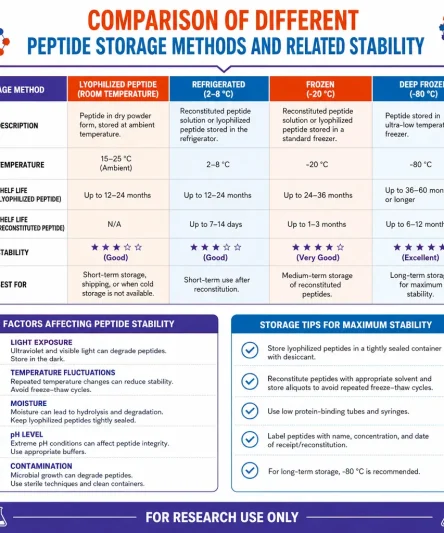
| Storage, sealed | Store at 2–8 °C in the original carton, protected from light |
| Safety data sheet | PL-SDS-008 |
What is in the pen
The pen holds a 3 mL glass cartridge of sterile aqueous solution with adipotide at 0.33% w/v, 10 mg in total. That is about 3.3 mg/mL, or roughly 1.3 µmol/mL (1.3 mM) at the theoretical mass of 2555.2 Da. The solvent is bacteriostatic water with 0.9% benzyl alcohol as an antimicrobial preservative. The safety data sheet does not classify adipotide as hazardous; benzyl alcohol carries statements for harm if swallowed or inhaled, serious eye irritation and possible skin sensitisation.
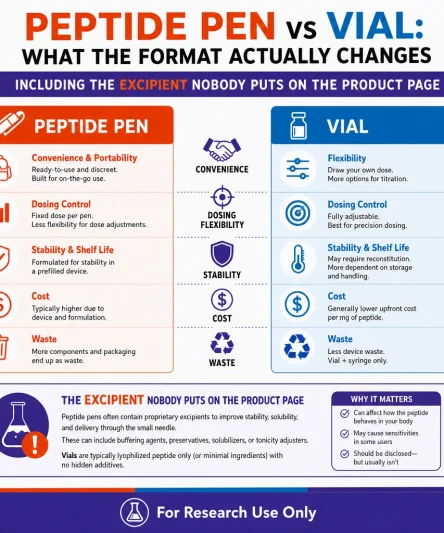
Store the pen at 2 to 8 °C in its original carton, away from light, with the cap on between uses. It must not be frozen, and a pen whose solution has frozen, discoloured or turned cloudy should be thrown away. The Adipotide 5mg vial supplies the same peptide as dry powder, and peptide pen vs vial weighs the two formats against each other.
What the research covers
Adipotide combines two ideas. One is the targeted proapoptotic peptide: a homing domain that carries the molecule to chosen cells, joined to a domain designed to be harmless outside cells but to disrupt mitochondrial membranes once internalised1. Ellerby’s original prototypes were aimed at tumour blood vessels and showed anti-cancer activity in mice1. The other is a vascular address for white fat. Kolonin and colleagues found CKGGRAKDC by in vivo phage display, showed that it associates with prohibitin and reported that aiming a proapoptotic peptide at prohibitin in fat vasculature ablated white fat in their model2.
The fullest study is in primates. In obese Old World monkeys, Barnhart and colleagues found targeted apoptosis in white fat blood vessels, lower body weight, improved insulin resistance and less white adipose tissue on imaging, together with predictable and reversible changes in kidney proximal tubule function across three species3. None of these papers reports a human study or used a pre-dissolved solution, and the abstracts give no data on how long adipotide stays intact in bacteriostatic water.
PrymaLab has no separate guide to adipotide yet. The Adipotide 5mg page carries the full research summary, from the antimicrobial origins of the KLAKLAK sequence to the review literature on targeting fat vasculature.
How each lot is tested
Every lot is tested in PrymaLab’s own laboratory in Ashland, Kentucky before release: RP-HPLC for purity, LC-MS for identity, Karl Fischer titration for water, LAL for endotoxin and USP <71> for sterility. Published certificates are listed on the results page and can be checked by number and key on the verify page. The certificate covers the peptide lot used to fill the pen, not the finished solution. These are in-house results from PrymaLab Analytical, not an independent test, and the lab is not accredited to ISO 17025. The third-party testing guarantee on this page still applies: if any independent laboratory finds the wrong compound, or less than the stated purity or amount, the order is refunded and the cost of the test is reimbursed.
Frequently asked questions
How is the pen different from the adipotide vial?
The pen arrives ready in solution: 10 mg of adipotide in 3 mL of bacteriostatic water, kept at 2 to 8 °C and never frozen. The vial is 5 mg of dry powder held at −20 °C until the lab dissolves it at a concentration of its own choosing.
What is the concentration?
0.33% w/v, which is 10 mg in 3 mL or about 3.3 mg/mL. With adipotide's theoretical mass of 2555.2 Da, that comes to roughly 1.3 mM, or about 3.9 µmol in the whole pen.
What does the certificate cover?
The batch of adipotide peptide that went into the pen. The solution in the cartridge is not certified separately. The testing section on this page explains where published certificates are listed and how to check one by its number and key.
Is the pen for human use?
No. Adipotide is an experimental compound with no approved use, and the pen is sold only for laboratory research. It must not be used in people or animals.
References
- Ellerby HM, Arap W, Ellerby LM, et al. Anti-cancer activity of targeted pro-apoptotic peptides. Nat Med. 1999;5(9):1032-8. DOI · PubMed
- Kolonin MG, Saha PK, Chan L, et al. Reversal of obesity by targeted ablation of adipose tissue. Nat Med. 2004;10(6):625-32. DOI · PubMed
- Barnhart KF, Christianson DR, Hanley PW, et al. A peptidomimetic targeting white fat causes weight loss and improved insulin resistance in obese monkeys. Sci Transl Med. 2011;3(108):108ra112. DOI · PubMed
Research use only
For laboratory research use only. This product is not a drug, food, cosmetic or dietary supplement, is not approved by the FDA or any comparable authority for human or veterinary use, and must not be given to people or animals. It is sold to qualified researchers and institutions, and the buyer is responsible for lawful handling and disposal.







Reviews
There are no reviews yet.