HGH Fragment 176-191: One Atom Away From AOD-9604, and Why Every Human Trial Belongs to the Other Peptide
HGH fragment 176-191 is the last sixteen amino acids of human growth hormone, Phe-Leu-Arg-Ile-Val-Gln-Cys-Arg-Ser-Val-Glu-Gly-Ser-Cys-Gly-Phe, 1,799 Da, CAS 66004-57-7, cut from the C-terminus of the 191-residue hormone and sold as a lipolytic research peptide. It is not the peptide that was tested in people. That peptide is AOD-9604, the same sixteen residues with a tyrosine in place of the first phenylalanine (one extra oxygen atom, 1,815 Da), which Metabolic Pharmaceuticals took through six trials in 925 people before a 536-patient, 24-week Phase 2b found no significant weight loss against placebo and development ended in 2007. The native fragment has no human study at all. Both names appear on the WADA Prohibited List, and AOD-9604 sits in FDA's 503A Category 2. PrymaLab supplies HGH Fragment 176-191 in a preloaded 10 mg autoinjector and AOD-9604 5 mg vials for laboratory research use only.
- Sequence: Native: H-Phe-Leu-Arg-Ile-Val-Gln-Cys-Arg-Ser-Val-Glu-Gly-Ser-Cys-Gly-Phe-OH (FLRIVQCRSVEGSCGF), C78H123N23O22S2, 1,799.1 Da. AOD-9604: Tyr in place of Phe at residue 1 (YLRIVQCRSVEGSCGF), C78H123N23O23S2, about 1,815 Da, disulfide between the two cysteines (hGH 182 and 189).
- Class: C-terminal fragment of a 22 kDa protein hormone. It does not bind the growth hormone receptor and does not raise IGF-1; the lipolytic effect in mice is attributed to beta-3 adrenergic receptor upregulation. Classified by WADA as a growth hormone fragment.
- Studied for: Obesity (AOD-9604, oral, 2004 to 2007), joint cartilage repair in rabbits (AOD-9604 with hyaluronic acid, 2015), and, for the native fragment only, as a targeting peptide on doxorubicin nanoparticles against breast cancer cells in vitro (2022).
- Study designs in the literature: Oral AOD-9604 tablets in a 24-week Phase 2b with three dose arms and placebo, and in an earlier 12-week trial. Mice: 14 days by mini-osmotic pump. Rabbits: intra-articular injection into osteoarthritic joints. Plasma half-life about 3 minutes; intact peptide gone from serum by 56 minutes. Study design facts, not guidance.
- Storage: Lyophilised: 2 to 8 °C short term, -20 °C for months, away from light. In solution: refrigerated, used within weeks. Preloaded pens: refrigerated, capped. The disulfide makes the peptide sensitive to reducing conditions; keep it away from DTT or thiol buffers unless you intend to open it.
- Forms and sizes at PrymaLab: HGH Fragment 176-191 autoinjector, 3 ml pen, 10 mg; AOD-9604 5 mg vial; AOD-9604 autoinjector, 6 mg; AOD-9604 10 mg nasal spray. Sold for laboratory research use only.
- Regulatory: Not approved as a drug anywhere; AOD-9604 development ended in 2007. AOD-9604 holds a self-affirmed conditional GRAS opinion from 2012 as a food and supplement ingredient in the US, which is not an FDA finding. FDA placed AOD-9604 in 503A Category 2 on 4 October 2023, so compounders may not use it. Both 'AOD-9604 and hGH 176-191' are named on the 2026 WADA Prohibited List under S2, prohibited at all times.
| HGH fragment 176-191 (native) | AOD-9604 | Human growth hormone | |
|---|---|---|---|
| Size | 16 residues, 1,799 Da | 16 residues, 1,815 Da | 191 residues, about 22 kDa |
| First residue | Phe (position 176 of hGH) | Tyr (substituted) | n/a |
| GH receptor | Not tested | Does not bind | Binds; drives IGF-1 |
| Effect on glucose | Not tested | None in mice or trials | Raises glucose, lowers insulin sensitivity |
| Human trials | None | Six, 925 people, negative Phase 2b | Approved for GH deficiency and other indications |
| WADA | Named, S2 | Named, S2 | S2 |
| US compounding | Not on any list | 503A Category 2 (Oct 2023) | Approved biologic; not compoundable from bulk |
See the AOD-9604 reference for the modified peptide on its own, the purity testing guide for how mass spectrometry tells the two apart, and the peptide calculator for reconstituting a vial.
Also known as: hGH 176-191, HGH frag 176-191, Frag 176-191, fragment 176-191, growth hormone fragment 176-191, lipolytic fragment, hGH C-terminal fragment, Tyr-hGH 177-191 (AOD-9604 only), AOD9604, AOD 9604.
Somewhere in the last twenty years, two different peptides ended up under one product name. One is the last sixteen amino acids of human growth hormone, exactly as they sit in the hormone. The other is those same sixteen amino acids with a single tyrosine swapped in at the front, which an Australian company called AOD-9604, put through six clinical trials in 925 people, and abandoned in 2007 when a 536-patient study found it did not beat placebo. Almost every claim you will read about 'HGH fragment 176-191' was generated with the second peptide. The first has never been given to a human being in a published study. This reference sets out what each one is, what was actually shown, how to tell which one is in your vial, and where both stand with WADA and the FDA in 2026.
Research-use-only disclaimer: HGH Fragment 176-191 and AOD-9604 supplied by PrymaLab are intended strictly for laboratory research use and are not intended for human or veterinary use. The clinical trials described below were conducted by a pharmaceutical sponsor with an oral drug product under regulatory oversight and do not describe or support any use of research-grade material. Trial designs are reported as study facts. No dosing or administration guidance appears here. Nothing here is medical advice.

TL;DR
HGH fragment 176-191 is the C-terminal sixteen residues of human growth hormone, FLRIVQCRSVEGSCGF, 1,799 Da. AOD-9604 is the same chain with tyrosine replacing the first phenylalanine, 1,815 Da: one oxygen atom apart. In ob/ob mice, 14 days of AOD-9604 cut weight gain and raised fat oxidation without the hyperglycaemia growth hormone causes, and without binding the GH receptor or raising IGF-1. In people, oral AOD-9604 produced about 1.8 to 2 kg over placebo in 12 weeks, then no significant difference in a 536-patient, 24-week Phase 2b, and development ended in 2007. Safety across six trials was 'indistinguishable from placebo'. The native fragment has no human study; its one paper is an in-vitro breast-cancer nanoparticle experiment. AOD-9604 has a 2012 self-affirmed GRAS opinion, a 2023 FDA 503A Category 2 placement, and, with hGH 176-191, a place on the WADA list. Research use only.
Identity: Native fragment: FLRIVQCRSVEGSCGF, 1,799.1 Da, CAS 66004-57-7. AOD-9604: YLRIVQCRSVEGSCGF, about 1,815 Da, CAS 221231-10-3, disulfide Cys182-Cys189. Vendors use the 176-191 label for both.
Mechanism: AOD-9604 does not bind the GH receptor, does not induce cell proliferation and does not raise IGF-1. Its lipolytic effect in mice is attributed to beta-3 adrenergic receptor upregulation. The native fragment's mechanism has not been studied.
Human record: Six AOD-9604 trials, 925 people, oral and intravenous. 12 weeks: about 1.8 to 2 kg over placebo in the reported arm. 24 weeks, 536 adults: no significant difference. Terminated 2007.
Pharmacokinetics: Plasma half-life about 3 minutes intravenously; serum half-life about 4 minutes; intact peptide undetectable at 56 minutes; the main breakdown products lose two and three residues from the end.
Regulatory: No drug approval anywhere. Self-affirmed conditional GRAS (2012) for AOD-9604 as a food ingredient. FDA 503A Category 2 for AOD-9604 (4 Oct 2023). WADA names 'AOD-9604 and hGH 176-191' under S2, prohibited at all times.
Verification: Mass spectrometry separates the two by 16 Da (1,799 vs 1,815) and shows whether the disulfide is closed (a further 2 Da). Ask for the parent-ion mass as well as the HPLC purity figure.
Status: research use only.
Two peptides share one name
Human growth hormone is a single chain of 191 amino acids. Count from the N-terminus and the last sixteen residues, positions 176 to 191, read Phe-Leu-Arg-Ile-Val-Gln-Cys-Arg-Ser-Val-Glu-Gly-Ser-Cys-Gly-Phe, with the two cysteines at 182 and 189 joined by a disulfide bridge in the folded hormone. Cut those sixteen out and you have HGH fragment 176-191: molecular formula C78H123N23O22S2, average mass 1,799.1 Da, CAS number 66004-57-7.[1]
AOD-9604 is that fragment with one change. Its developer replaced the phenylalanine at position 176 with a tyrosine, which adds a single hydroxyl group to the first side chain and raises the formula to C78H123N23O23S2, about 1,815 Da, with the disulfide formed.[2] The sponsor's own safety paper defines it as 'a peptide fragment of the C-terminus of hGH (Tyr-hGH177-191)'.[3] Read that notation carefully: it is residues 177 to 191 with a tyrosine bolted on the front, which is the same thing as 176-191 with position 176 swapped. One oxygen atom separates the two peptides.
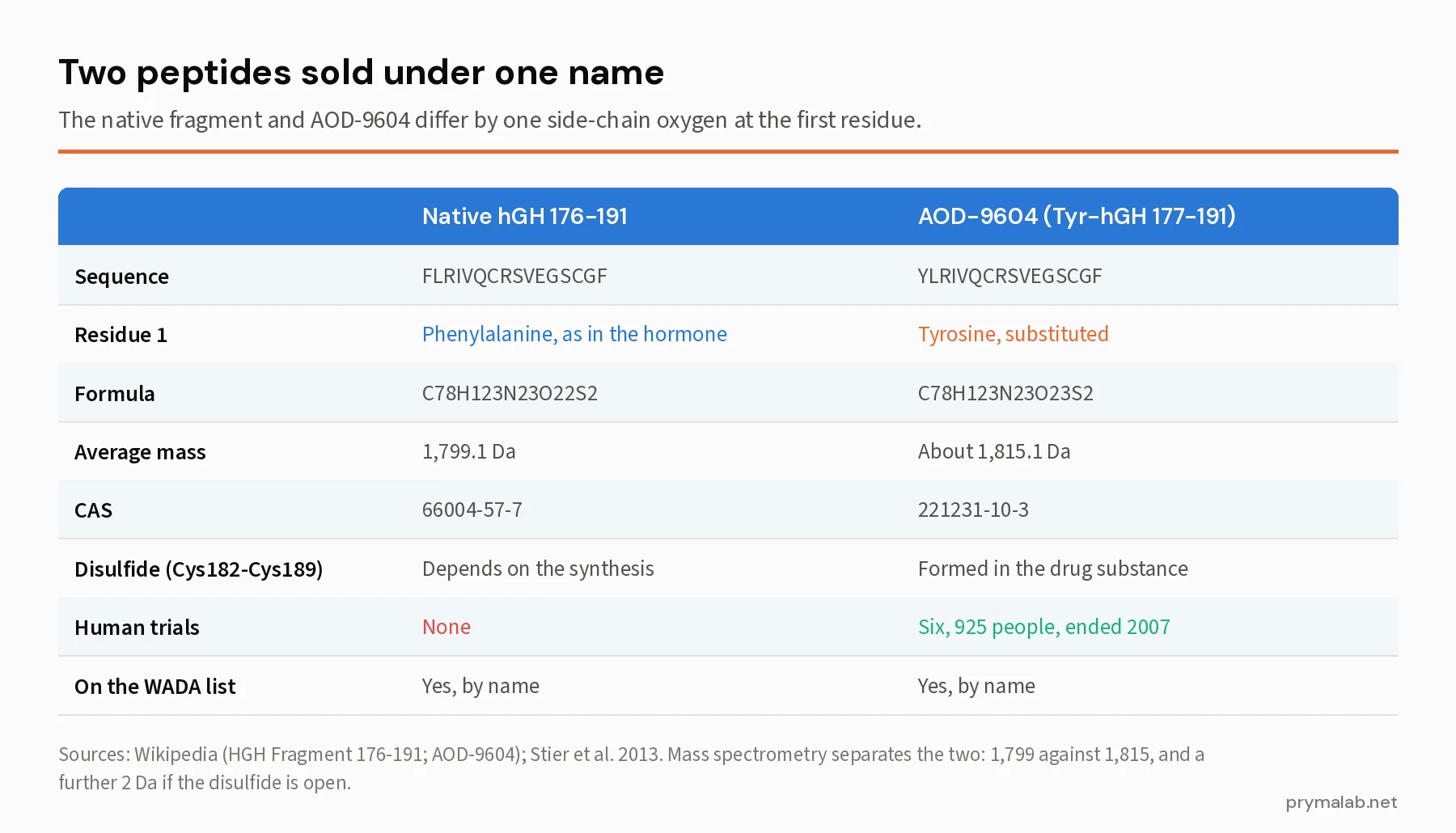
Why does this matter to someone typing 'hgh fragment 176-191' into a search box? Because the research-peptide market uses that name for both molecules, and sometimes for a linear version with the disulfide left open, and the evidence base for the two is not remotely the same. Wikipedia's entry for the native fragment says it plainly: it 'has erroneously been presented as a lipolytic peptide fragment based on extrapolations of clinical data pertaining to AOD9604'.[1] Every human trial, the GRAS opinion, the mouse mechanism work and the pharmacokinetics belong to the tyrosine version. The native fragment has one published study, and it is about breast cancer cells in a dish.
By the definition in the what counts as a peptide reference, both are unambiguously peptides: sixteen amino acids, fifteen amide bonds, made by solid-phase synthesis, destroyed within minutes by serum proteases. That last property turns out to be the most important pharmacological fact about either of them.
Where the lipolytic fragment idea came from
The idea that a piece of growth hormone could carry its fat-burning effect without its other effects came out of Monash University in Melbourne in the 1990s, from the laboratory of Frank Ng. Growth hormone raises lipolysis, but it also raises blood glucose, lowers insulin sensitivity and drives IGF-1, which is why nobody uses it as an obesity drug. The hypothesis was that the hormone behaves as a pro-hormone, with different regions responsible for different effects, and that the C-terminal region was the lipolytic one. Metabolic Pharmaceuticals was formed to develop a synthetic version, and it chose the tyrosine-substituted fragment it called AOD-9604.[2][3]
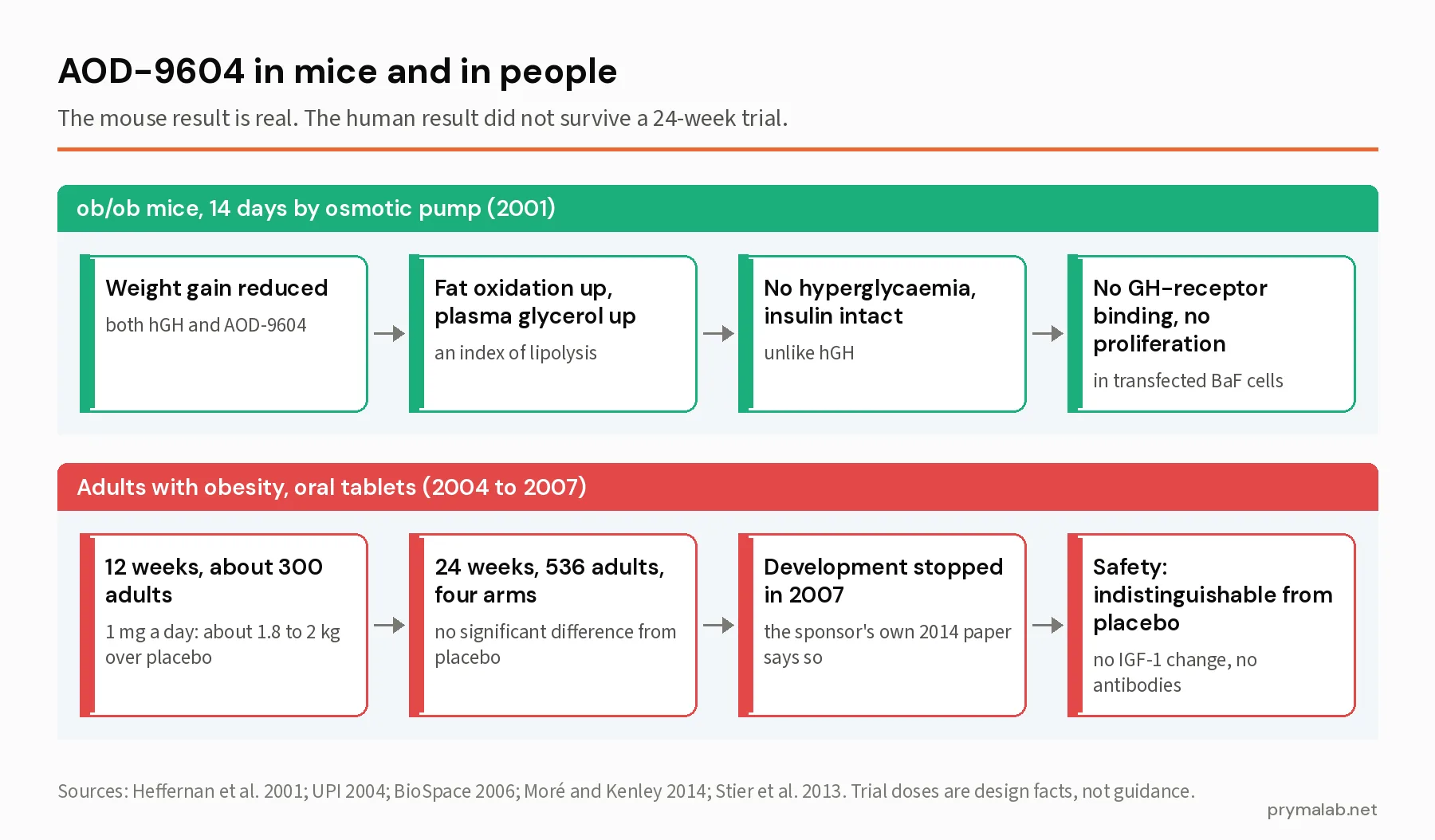
The clearest preclinical demonstration is Heffernan and colleagues, 2001. Obese ob/ob mice and lean C57BL/6J mice were treated for 14 days with human growth hormone, AOD-9604 or saline through mini-osmotic pumps. 'Both hGH and AOD significantly reduced body weight gain in obese mice', with increased in-vivo fat oxidation and raised plasma glycerol, an index of lipolysis. 'Unlike hGH, however, AOD9604 did not induce hyperglycaemia or reduce insulin secretion.' In cells transfected with the growth hormone receptor, 'AOD9604 does not compete for the hGH receptor and nor does it induce cell proliferation, unlike hGH'.[4] The authors concluded that fragments of hGH 'can act in a manner novel to traditional hGH-stimulated pathways'.
That paper is the origin of every 'burns fat without the side effects of growth hormone' sentence on the internet. It is a fourteen-day mouse study of the tyrosine peptide delivered by a surgically implanted pump. The mechanism proposed for the effect, upregulation of beta-3 adrenergic receptors in fat tissue, is also a mouse finding.[2] No receptor for AOD-9604 has been identified in humans, and the native fragment was not in the experiment.
What the beta-3 receptor knockout experiment showed
AOD-9604's effect in mice is often put down to upregulation of the beta-3 adrenergic receptor. The paper behind that statement found something narrower. Heffernan and colleagues treated obese mice with human growth hormone or AOD-9604 for 14 days and recorded lower body weight and body fat, together with beta-3 receptor RNA restored from the depressed levels of obese mice to those of lean mice (Heffernan et al. 2001). They then repeated the long-term treatment in beta-3 receptor knockout mice, where neither compound produced the change in body weight or the rise in lipolysis seen in wild-type controls (Heffernan et al. 2001). In an acute experiment, though, AOD-9604 still raised energy expenditure and fat oxidation in the knockouts (Heffernan et al. 2001). The authors concluded that the lipolytic actions of both compounds were not mediated directly through the beta-3 receptor, even though both raised its expression and that rise might contribute (Heffernan et al. 2001).
An earlier rat study from Frank Ng's laboratory is also relevant. In an oral study lasting 19 days in obese Zucker rats, Ng and colleagues reported body weight gain less than half that of controls, higher lipolytic activity in adipose tissue, and no adverse effect on insulin sensitivity by euglycaemic clamp, in contrast to chronic treatment with intact growth hormone (Ng et al. 2000). It is the animal precedent for the oral route that the later human trials used. Both studies used AOD-9604; neither tested the native phenylalanine fragment.
The human record: six trials, 925 people, one negative Phase 2b
Metabolic Pharmaceuticals took AOD-9604 into people as an oral tablet, which is itself a fact worth pausing on: the peptide sold for injection was tested clinically by mouth. The company began compiling safety data in 1998 and reported spending more than 50 million dollars on the programme.[5]
The result that made the news came in December 2004. In a 12-week trial of about 300 men and women aged 30 to 65, the reported tablet arm produced 'an average weight loss of 6.2 pounds over 12 weeks, more than triple the weight loss achieved by study participants who took a placebo pill', with small improvements in cholesterol and fewer people with impaired glucose tolerance.[6] Other accounts of the same trial give 2.6 kg against 0.8 kg on placebo, which is the source of the '1.8 kg more than placebo' figure that circulates.[2] Call it 1.8 to 2 kg over placebo in three months.
The confirmatory study was called OPTIONS. It enrolled 536 adults with obesity, roughly half men and half women, at 16 sites across Australia, randomised to placebo or one of three oral tablet doses for 24 weeks inside a 32-week study. Enrolment finished in late April 2006 and results were expected in March 2007.[7] The result was that AOD-9604 did not produce a statistically significant weight loss against placebo, and development was terminated in 2007.[2] The sponsor's own 2014 paper records it in one sentence: 'Effects of AOD9604 on weight loss were seen in initial trials but were not seen in the last study in which an intensive diet and exercise regime was incorporated.'[8]
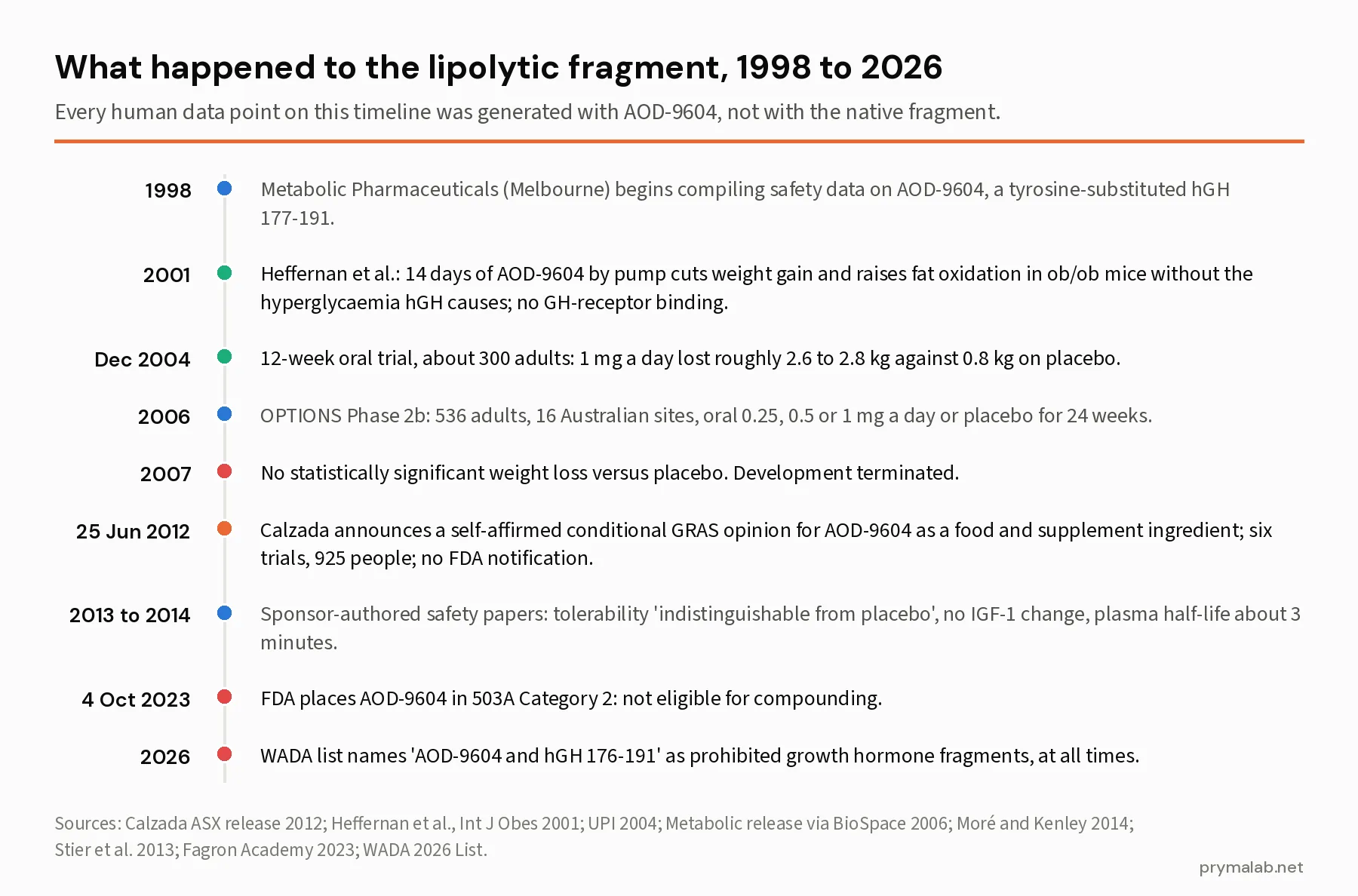
What survived the failure was the safety database. Stier, Vos and Kenley pooled six randomised, double-blind, placebo-controlled trials and reported that AOD-9604 'displayed a very good safety and tolerability profile indistinguishable from placebo', with no detectable anti-AOD9604 antibodies, no treatment-related serious adverse events or withdrawals, 'no negative effect on carbohydrate metabolism' and 'no effect on serum IGF-1 levels'.[3] The company's 2012 announcement put the database at 'six human clinical trials involving 925 humans'.[5] Both papers were written by the sponsor; Kenley was its chief executive.[8] That does not make them wrong, and a 925-person safety record with no IGF-1 signal is a real finding, but the reader should know whose pen it came from.
| Study | n | Design | Result |
|---|---|---|---|
| 12-week trial, 2004 | About 300 adults, 30 to 65 | Oral tablets; one dose arm reported | About 2.6 to 2.8 kg lost vs 0.8 kg on placebo; 'more than triple' |
| OPTIONS Phase 2b, 2006 to 2007 | 536 adults, 16 Australian sites | Oral tablets at three doses or placebo, 24 weeks, with diet and exercise | No statistically significant weight loss vs placebo; development terminated |
| Pooled safety, six trials | 925 people | Oral and intravenous pilot studies plus two Phase 2b studies | Tolerability 'indistinguishable from placebo'; no IGF-1 effect; no antibodies |
| Native fragment 176-191 | 0 | Never given to humans in a published study | No data |
What AOD-9604 does and does not do in the body
The 2014 metabolism paper by Moré and Kenley is the best single source on what happens to the peptide after it is given, and it explains why the clinical programme was built on tablets rather than injections. After intravenous injection the plasma half-life was 'approximately 3 min'; in serum the half-life was about 4 minutes 'with intact AOD9604 undetectable 56 min' later, and the principal fragments observed in vivo were the peptide minus its last two and last three amino acids.[8] A sixteen-residue peptide with no protection at either end is food for carboxypeptidases, and the data show exactly that.
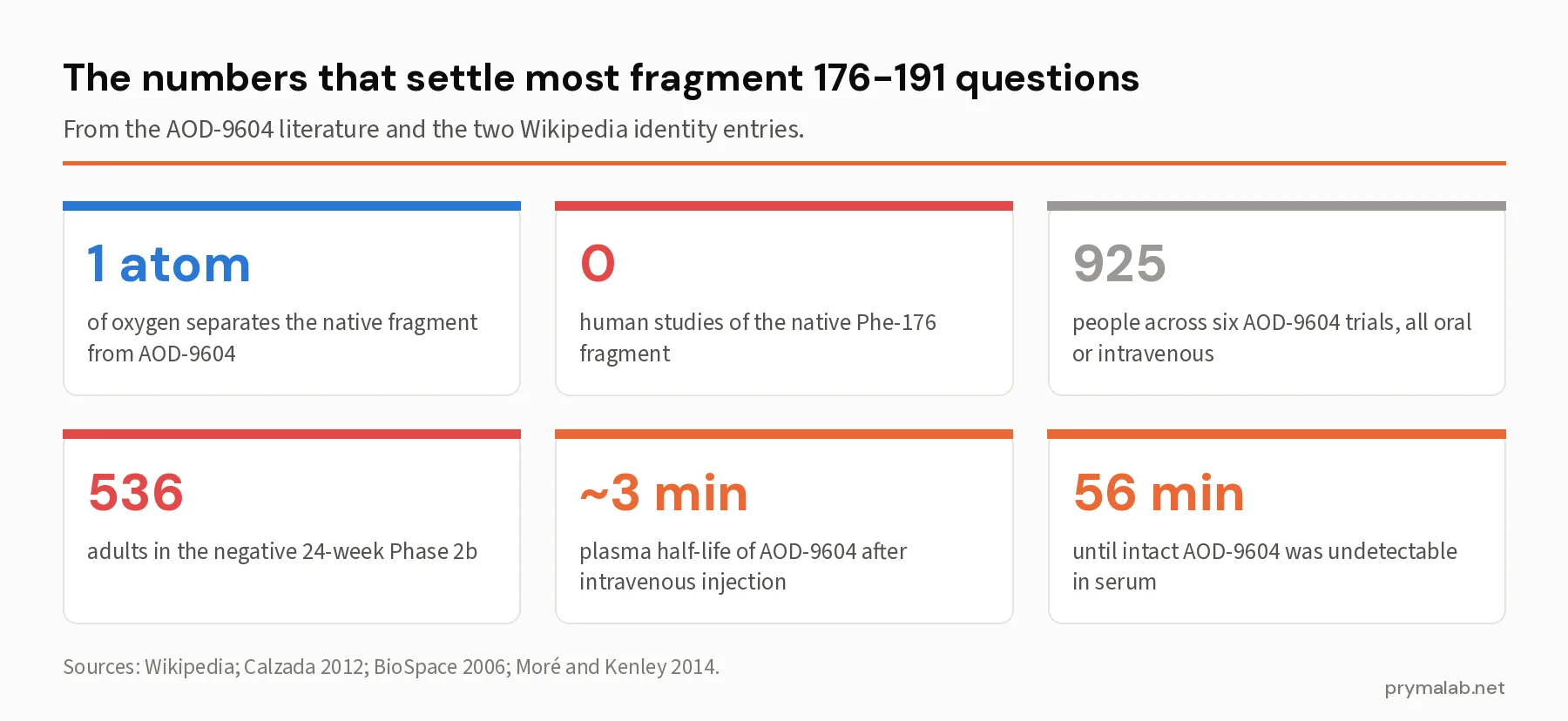
Three things follow. First, whatever either peptide does after injection, it does within the hour, after which the intact molecule is gone. Second, the oral trials imply the sponsor believed a fragment survived digestion in some active form, since the human trials gave it by mouth after an oral study in obese rats; the 2014 paper describes the -2 and -3 residue fragments as the main circulating species, which raises the possibility that a shorter piece carries whatever activity exists.[8] Third, the two claims that actually matter for safety held up across the whole programme: 'AOD9604 did not stimulate the production of IGF-1 in any of the systems studied', and it 'elicited the fat reducing effect without inducing insulin resistance'.[8] Chronic toxicology ran 26 weeks in rats and 39 weeks in cynomolgus monkeys.[8]
What the pharmacology does not include is a human receptor, a human dose-response for lipolysis, or any measurement of fat oxidation in people. The 12-week weight result stands alone as the human efficacy signal, and the 24-week trial did not reproduce it.
What has actually been studied with the native fragment
Strip away everything that belongs to AOD-9604 and the literature on the Phe-176 fragment sold as 'HGH fragment 176-191' comes down to a single paper. Habibullah and colleagues, writing in Drug Design, Development and Therapy in 2022, loaded chitosan nanoparticles with doxorubicin and with hGH fragment 176-191, ran molecular docking simulations against breast-cancer protein targets, and tested the particles on MCF-7 breast cancer cells. The dual-loaded particles showed 'greater anti-proliferative activity against a breast cancer cell line (MCF-7) than doxorubicin-loaded Chitosan', and the authors propose the fragment as a tumour-targeting ligand that might let chemotherapy hit cancer cells harder.[9]
That is the study. It has nothing to do with fat, it was done in a dish, and the peptide's role in it is as a targeting handle on a nanoparticle. There is no animal lipolysis study of the native sequence, no pharmacokinetic study, no receptor study and no human study. Wikipedia's search of PubMed in December 2023 found the same absence.[1]
Is the native fragment likely to behave like AOD-9604? Probably, in most respects: a tyrosine-for-phenylalanine swap at a terminus is a small change, and the sponsor chose it for reasons of synthesis and stability rather than because the native residue was inactive. But 'probably similar' is an inference, not a finding, and a researcher who wants the molecule behind the published trials should work with AOD-9604 and read the AOD-9604 reference, which covers that molecule in its own right.
Frag 176-191 vs AOD-9604: which one is in the vial
Because the two names are used interchangeably, the honest question is not 'which is better' but 'which one do I have'. Three physical facts settle it.
| Test | Native fragment 176-191 | AOD-9604 | What to ask the supplier for |
|---|---|---|---|
| Parent-ion mass by mass spectrometry | 1,799.1 Da | About 1,815.1 Da | The observed [M+H]+ or [M+2H]2+ on the certificate, alongside the purity percentage |
| Disulfide status | Open (linear) or closed depending on synthesis; closed is 2 Da lighter | Closed in the drug substance | Whether oxidation to the cyclic form was done and confirmed |
| First residue on the sequence line | Phe (F) | Tyr (Y) | The full sequence printed on the certificate |
| HPLC purity | Tells you how much of one peak there is | Same | Purity plus identity; purity alone cannot distinguish the two |
The purity testing guide explains why an HPLC trace alone cannot answer an identity question: two peptides 16 Da apart elute close together and both give a clean single peak. Mass spectrometry answers it in one number. When I document our own HGH Fragment 176-191 autoinjector and AOD-9604 vials, the sequence and the observed mass are the two lines I would want any reader to check first, and the same standard applies to any other supplier.
One more practical difference. The disulfide bridge between the cysteines at 182 and 189 forms a loop that the folded hormone has and that AOD-9604 was made with. A linear synthesis that skips the oxidation step yields a peptide with two free thiols, which is more prone to aggregation and to forming dimers on storage. If a certificate says nothing about the disulfide, that is a question worth asking before you buy.
GRAS, WADA and the 503A list: three different answers
Fragment 176-191 gets described online as everything from 'FDA approved' to 'banned', and the confusion comes from three separate regulatory facts that concern different things.
The GRAS opinion. On 25 June 2012, Calzada Limited, the successor to Metabolic Pharmaceuticals, announced that an expert scientific panel convened through GRAS Associates LLC had issued 'a self-affirmed conditional GRAS status' for AOD-9604 'to be added to foods, drinks & dietary supplements in the US', resting on the six-trial, 925-person safety database.[5] The 2014 paper describes it as 'conditional on publication of pre-existing safety data', which the 2013 and 2014 papers then supplied.[8] Self-affirmed GRAS means a company's own panel concluded the ingredient is generally recognised as safe for a stated food use; no notification was filed with FDA, and FDA has made no finding. It says nothing about efficacy, nothing about injection, and nothing about the native fragment.
The FDA compounding list. On 4 October 2023 FDA revised its interim 503A bulk drug substances list and placed AOD-9604 in Category 2, the list of substances that raise significant safety concerns and may not be used in compounding, alongside kisspeptin-10, BPC-157 and ipamorelin.[10] The native fragment is not on any FDA list. Neither peptide is an approved drug anywhere, and no application has been made since development ended in 2007. The legal status guide covers what that means for research-grade material: legal to sell and hold for laboratory research, not for human use.
The WADA list. The 2026 Prohibited List names both peptides in section S2, under growth hormone, its analogues and fragments: 'growth hormone fragments, e.g. AOD-9604 and hGH 176-191', prohibited at all times as non-specified substances.[11] WADA does not care which of the two you have. An athlete holding either is holding a listed substance.
The cartilage detour
After the obesity programme closed, the peptide found a second research life in joints. Kwon and Park, 2015, induced osteoarthritis in 32 New Zealand white rabbits with intra-articular collagenase and then gave intra-articular injections over 4 to 7 weeks of saline, hyaluronic acid, AOD-9604, or both. Days to normal walking were 25 (saline), 15 (hyaluronic acid), 16 (AOD-9604) and 11 (both), and gross and histological cartilage scores were best in the combination group.[12] It is a small animal study with a local injection into the joint, and it has not been followed by a human trial that I could find. It does show that the research interest in the peptide has moved on from fat, which the fragment 176-191 marketing has not caught up with.
Research-grade fragment 176-191: what the certificate must show
Both peptides are legal to sell for laboratory research in the United States and neither is a controlled substance. Both are on the WADA list, and AOD-9604 is on the FDA's Category 2 list for compounders. Within that frame, the buyer's job is identity first and purity second.
Ask for the sequence line and the observed mass. 1,799 means the native Phe-176 fragment; 1,815 means the tyrosine-substituted AOD-9604; anything else means a question. Ask whether the disulfide was formed. Then ask for HPLC purity by lot, not by catalogue. PrymaLab's preloaded 10 mg fragment autoinjector and 5 mg AOD-9604 vials are documented on that basis, and the peptide calculator converts a vial and its diluent into a concentration for bench work. Lyophilised peptide keeps for months refrigerated or frozen; dissolved peptide should be refrigerated and used within weeks, because a peptide that lasts minutes in serum is not going to last indefinitely in solution either.
The version of the story the evidence supports, without the marketing: a C-terminal piece of growth hormone that does something to fat metabolism in obese mice without touching the GH receptor, IGF-1 or blood glucose; a tyrosine-substituted version of it that lost about two kilograms over placebo in twelve weeks and nothing in twenty-four; a clean 925-person safety record written by the sponsor; a food-ingredient opinion the company gave itself; a WADA entry that names both peptides; and a native fragment, the one most often sold, that has never been tested in a person. If you want a broader view of the class, the fat loss peptides overview and the peptides and weight loss guide put it beside the compounds that did clear a Phase 3.
What this article does not settle
Whether the native fragment shares AOD-9604's activity. Nobody has run the mouse experiment with the Phe-176 sequence, so the assumption that one atom makes no difference is untested.
Why the 24-week trial failed. The sponsor attributes it to the intensive diet and exercise regime in the protocol, which is one reading; a 12-week effect of 1.8 kg that disappears under lifestyle intervention is also consistent with a small effect that the larger study had the power to see for what it was. The full OPTIONS data have never been published.
The mechanism in people. Beta-3 adrenergic upregulation is a mouse finding; no human receptor or target has been identified for either peptide.
Anything about injection. Every human trial used oral tablets or an intravenous pilot dose. The subcutaneous injection that the research market assumes has no clinical record, and the 3-minute plasma half-life means whatever it does, it does quickly.
Long-term use. The longest human exposure was 24 weeks by mouth in a supervised trial. The toxicology ran 39 weeks in monkeys. Nothing longer exists.
What is well established: the two sequences, formulas and masses; that AOD-9604 does not bind the GH receptor and does not raise IGF-1; the mouse lipolysis result; the 12-week and 24-week trial outcomes; the pooled safety profile; the plasma half-life; the 2012 GRAS self-affirmation; the 2023 Category 2 placement; and the WADA listing of both names.
hGH 176-191 and AOD-9604: what the numbers and letters refer to
In 'hGH 176-191', hGH is human growth hormone, somatotropin, a 191-residue protein secreted by the pituitary, and 176-191 are the positions of the sixteen C-terminal amino acids counted from the N-terminus, so the fragment is the tail end of the hormone.[1] 'Tyr-hGH 177-191' is the sponsor's notation for AOD-9604: residues 177 to 191 with a tyrosine added at the front, which occupies the position where the hormone has a phenylalanine.[3] AOD is the developer's compound prefix, generally expanded as anti-obesity drug, and 9604 is the series number; neither carries chemical information. Other names for the same two peptides include Frag 176-191, HGH frag, lipolytic fragment, growth hormone fragment 176-191 and, for the tyrosine version, AOD9604 and AOD 9604. The WADA list uses 'AOD-9604 and hGH 176-191' and treats them as the same class of substance.[11]
Frequently asked questions
What is HGH fragment 176-191?
The last sixteen amino acids of human growth hormone (FLRIVQCRSVEGSCGF, 1,799 Da), sold as a lipolytic research peptide. Its reputation rests on data from AOD-9604, a one-residue variant; the native fragment has no human study.
Is HGH fragment 176-191 the same as AOD-9604?
Nearly: AOD-9604 swaps the first phenylalanine for a tyrosine, one oxygen atom, 1,815 Da instead of 1,799. Vendors use the 176-191 name for both, but all the human data belong to AOD-9604.
Does HGH fragment 176-191 reduce body fat in studies?
In mice, AOD-9604 raised fat oxidation and cut weight gain. In people, it beat placebo by about 2 kg at 12 weeks and by nothing at 24 weeks, and development stopped in 2007. The native fragment has never been tested for fat loss.
What are the side effects of HGH fragment 176-191?
No data exist for the native fragment. For AOD-9604, six oral trials in 925 people reported tolerability indistinguishable from placebo, no IGF-1 change and no antibodies, in sponsor-authored papers.
What is the half-life of HGH fragment 176-191?
About 3 minutes in plasma and 4 in serum for AOD-9604, with intact peptide gone by 56 minutes. The native fragment has not been measured but is chemically almost identical.
Is HGH fragment 176-191 FDA approved?
No. Neither is an approved drug. AOD-9604 has a 2012 self-affirmed GRAS opinion as a food ingredient (not an FDA finding) and has sat in FDA's 503A Category 2 since October 2023, which bars it from compounding.
Is HGH fragment 176-191 banned by WADA?
Yes. The 2026 WADA list names both 'AOD-9604 and hGH 176-191' under S2 as growth hormone fragments, prohibited at all times.
Was AOD-9604 tested by injection or by mouth?
By mouth. Both weight-loss trials used oral tablets; the pilot studies were intravenous and oral. No subcutaneous injection trial of either peptide exists.
How do I know whether a vial is fragment 176-191 or AOD-9604?
By mass: 1,799 Da is the native fragment, about 1,815 Da is AOD-9604, and a closed disulfide is 2 Da lighter still. HPLC purity cannot distinguish them; ask for the observed mass on the certificate.
What does '176-191' mean?
Residue positions: growth hormone has 191 amino acids and 176 to 191 are the last sixteen. AOD-9604's notation, Tyr-hGH 177-191, means residues 177 to 191 with a tyrosine added where the hormone has phenylalanine 176.
Does HGH fragment 176-191 raise IGF-1 or growth hormone levels?
No. AOD-9604 did not raise IGF-1 in any system, does not bind the GH receptor, and is not a secretagogue, so it does not raise growth hormone either. The native fragment is untested but structurally the same.
References
- Wikipedia. HGH Fragment 176-191. Sequence FLRIVQCRSVEGSCGF, C78H123N23O22S2, 1799.10 g/mol, CAS 66004-57-7; the statement that it has been erroneously presented as lipolytic by extrapolation from AOD9604; the December 2023 PubMed search. Wikipedia
- Wikipedia. AOD-9604. Residues 176-191 with tyrosine in place of phenylalanine at the N-terminus, C78H123N23O23S2, disulfide; beta-3 adrenergic upregulation in mice; 1.8 kg over placebo at 12 weeks; development terminated in 2007; WADA status. Wikipedia
- Stier H, Vos E, Kenley D. Safety and tolerability of the hexadecapeptide AOD9604 in humans. J Endocrinol Metab. 2013;3(1-2):7-15. doi:10.4021/jem157w. Six randomised, double-blind, placebo-controlled trials; the Tyr-hGH177-191 definition; safety conclusions. Journal of Endocrinology and Metabolism
- Heffernan MA, Thorburn AW, Fam B, Summers R, Conway-Campbell B, Waters MJ, Ng FM. Increase of fat oxidation and weight loss in obese mice caused by chronic treatment with human growth hormone or a modified C-terminal fragment. Int J Obes Relat Metab Disord. 2001;25(10):1442-1449. doi:10.1038/sj.ijo.0801740. PMID 11673763. Abstract quoted. Nature
- Calzada Limited. AOD9604 receives GRAS status. ASX announcement, 25 June 2012. Self-affirmed conditional GRAS by an expert panel convened through GRAS Associates LLC; six trials, 925 humans; more than $50m invested; safety data since 1998. Calzada (PDF)
- United Press International. Obesity drug does well in human trials. 13 December 2004. 300 adults, 12 weeks, oral tablet, 6.2 pounds, more than triple placebo. UPI
- Metabolic Pharmaceuticals. Obesity trial update: first 100 subjects complete the Phase 2B trial of AOD9604. 5 October 2006, via BioSpace. OPTIONS design: 536 subjects, 16 Australian sites, placebo and three oral doses, 24 weeks. BioSpace
- Moré MI, Kenley D. Safety and metabolism of AOD9604, a novel nutraceutical ingredient for improved metabolic health. J Endocrinol Metab. 2014;4(3):64-77. doi:10.14740/jem213w. Six trials including two Phase 2b studies of 300 and 500 obese adults; the weight-loss sentence; half-life, fragments, IGF-1, insulin resistance; chronic toxicology; sponsor disclosure. Journal of Endocrinology and Metabolism
- Habibullah MM, Mohan S, Syed NK, et al. Human growth hormone fragment 176-191 peptide enhances the toxicity of doxorubicin-loaded chitosan nanoparticles against MCF-7 breast cancer cells. Drug Des Devel Ther. 2022;16:1963-1974. doi:10.2147/DDDT.S367586. PMID 35783198. Dove Press
- Taylor S. Industry update: interim 503A and 503B bulks lists, new revisions. Fagron Academy, 4 October 2023. AOD-9604, kisspeptin-10, BPC-157 and ipamorelin placed in 503A Category 2. Fagron Academy
- World Anti-Doping Agency. The 2026 Prohibited List, International Standard. S2: 'growth hormone fragments, e.g. AOD-9604 and hGH 176-191', prohibited at all times. WADA
- Kwon DR, Park GY. Effect of intra-articular injection of AOD9604 with or without hyaluronic acid in rabbit osteoarthritis model. Ann Clin Lab Sci. 2015;45(4):426-432. 32 rabbits, four groups, recovery days and cartilage scores. Annals of Clinical and Laboratory Science
Figures come from the published papers, company disclosures and regulatory documents named above, current to 23 September 2026. Where a figure is reported differently by two sources (the 12-week trial's kilogram loss), both are given.
Final disclaimer: This article is an educational research reference on the chemistry, evidence base and regulatory status of HGH fragment 176-191 and AOD-9604. Compounds supplied by PrymaLab are sold for laboratory research use only and are not approved by any regulator for human or veterinary use. Statements have not been evaluated by the FDA. Nothing here is medical advice or a treatment claim.
Clinical trial designs and outcomes are reported as study facts about an oral pharmaceutical product given under medical supervision, and do not describe or support any use of research-grade material. Always verify the legal status of any research compound in your jurisdiction before purchase or use.