

Cardarine (GW501516): The Lipid Drug GSK Dropped in 2007, the Cancer Studies Behind It, and What the Human Trials Actually Measured
Cardarine (GW501516, GW1516) is a selective PPAR-delta agonist: a 453 Da small molecule, a phenoxyacetic acid carrying a thiazole and a trifluoromethylphenyl ring, that switches on the nuclear receptor which drives fatty-acid oxidation in muscle. It is not a SARM (it does not touch the androgen receptor) and not a peptide. GlaxoSmithKline and Ligand developed it from 1992 as a cholesterol drug; five short human trials raised HDL and lowered triglycerides, and GSK abandoned it in 2007 after two-year rodent studies found tumours in several organs. A 2008 mouse study found it improved endurance only when combined with training. WADA listed it in 2009 and in 2013 issued a rare warning that "clinical approval has not, and will not be given for this substance"; Australia made it Schedule 10 in 2018. PrymaLab supplies GW-501516 (cardarine) for laboratory research use only.
- Structure: 2-methyl-4-[({4-methyl-2-[4-(trifluoromethyl)phenyl]-1,3-thiazol-5-yl}methyl)sulfanyl]phenoxyacetic acid. C21H18F3NO3S2, 453.49 g/mol, CAS 317318-70-0. A small molecule with no amino acids; not a SARM, not a peptide.
- Class: Peroxisome proliferator-activated receptor delta (PPAR-delta) agonist: Ki 1 nM, EC50 1 nM, more than 1,000-fold selective over PPAR-alpha and PPAR-gamma. WADA 2026 List S4.4.1, metabolic modulators, non-specified, prohibited at all times.
- Studied for: Dyslipidaemia and low HDL (GSK, Phase I and II, 2000 to 2007); exercise adaptation and fibre-type switching in mice (2008); in the laboratory, PPAR-delta biology and, since 2018, tumour promotion in colitis models.
- Study designs in the literature: Human trials ran 2 to 12 weeks with lipid endpoints; the rodent carcinogenicity studies were in rats and mice; the 2008 mouse study used oral gavage with and without treadmill training. Study design facts, not guidance.
- Storage: Dry powder or DMSO stock at -20 °C, away from light; a lipophilic acid that dissolves in DMSO and ethanol, poorly in water. Aqueous working solutions are made fresh from stock.
- Forms and sizes at PrymaLab: GW-501516 (cardarine), sold for laboratory research use only. Related nuclear-receptor research compound: SR-9011, a Rev-erb agonist named in the same WADA clause.
- Regulatory: No marketing approval anywhere; development terminated in 2007. Unscheduled in the United States and United Kingdom; Schedule 10 (prohibited from sale, supply and use) in Australia since June 2018. Not a SARM, although FDA's 2023 advisory that no SARM product is legally marketable covers the category it is sold under. Prohibited by WADA at all times since 2009.
| Cardarine (GW501516) | AICAR | Seladelpar (Livdelzi) | |
|---|---|---|---|
| What it is | PPAR-delta agonist, small molecule | AMPK activator prodrug, nucleoside | PPAR-delta agonist, small molecule |
| Developer and status | GSK/Ligand; abandoned 2007 | Gensia to Merck; failed Phase 3 2012 | CymaBay/Gilead; FDA accelerated approval 14 Aug 2024 |
| Human evidence | Five lipid trials, up to 268 people, 12 weeks | Cardiac surgery and leukaemia trials, IV | Phase 3 RESPONSE: 62% vs 20% biochemical response |
| Endurance in the 2008 mouse study | None alone; +68 to 70% with training | +44% alone | Not studied |
| Why it matters here | Rodent cancer findings ended it | Never approved; grade 4 hyperuricaemia at low dose | Shows the class can be approved when the molecule and exposure differ |
| WADA | S4.4.1, at all times | S4.4.1, at all times | Not listed |
See the AICAR reference for the other half of the 2008 paper, the SARMs versus peptides guide for why cardarine is neither, and the purity testing guide for how a small molecule is verified.
Also known as: GW501516, GW-501516, GW 501516, GW1516, GW-1516, GSK-516, Endurobol, cardarine, PPAR-delta agonist, PPARδ agonist.
Cardarine has one of the strangest biographies in the research-compound market. It was a cholesterol drug: GlaxoSmithKline spent fifteen years and five human trials on it, watched it raise HDL and cut triglycerides in 268 patients, and then dropped it without explanation in 2007. Two years later the company's own toxicologists presented the reason at a conference: in rats and mice dosed for two years, it caused tumours in the liver, stomach, tongue, skin, bladder, ovaries, uterus and testes. In between, a mouse study from the Salk Institute found it improved running endurance, but only in animals that were also training, and the compound was reborn on the black market as an endurance pill. WADA banned it in 2009 and in 2013 did something it almost never does: it published a health warning telling athletes the drug will never be approved. This reference sets out all of it, with the trial numbers, the toxicology as far as it is public, and the current legal position.
Research-use-only disclaimer: GW-501516 supplied by PrymaLab is intended strictly for laboratory research use and is not intended for human or veterinary use. The clinical trials described below were conducted by a pharmaceutical sponsor under regulatory oversight and do not describe or support any use of research-grade material. Trial designs and outcomes are reported as study facts. No dosing or administration guidance appears here. Nothing here is medical advice.

TL;DR
Cardarine (GW501516) is a 453 Da selective PPAR-delta agonist, EC50 1 nM with more than 1,000-fold selectivity, developed by GSK and Ligand from 1992 as a lipid drug. In five short human trials it raised HDL up to 16.9% and cut triglycerides 17 to 30%; the largest, 268 adults for 12 weeks, was published in 2012, five years after GSK abandoned it in 2007. The reason surfaced in 2009: two-year rodent studies found tumours in several organs. The 2008 Cell mouse study found no endurance benefit from GW1516 alone and a 68 to 70% gain only with training. WADA listed it in 2009, reclassified it in 2012 and in 2013 warned that approval 'has not, and will not be given'. Athletes from Costa Rican cyclists to Jarrell Miller have tested positive. It is Schedule 10 in Australia and unscheduled in the US. It is not a SARM and not a peptide. Research use only.
Identity: C21H18F3NO3S2, 453.49 g/mol, CAS 317318-70-0. A PPAR-delta agonist, not a SARM (no androgen receptor activity) and not a peptide.
Mechanism: Activates the nuclear receptor PPAR-delta at 1 nM with more than 1,000-fold selectivity, driving genes for fatty-acid oxidation and energy uncoupling in muscle. In mice it shifts fibre type toward slow-twitch only with training.
Human record: Five GSK trials, 2 to 12 weeks: HDL up (to +16.9%), triglycerides down (17 to 30%), LDL and apoB down, liver fat down 20% in one study. No endurance trial. No long-term follow-up.
Why it died: GSK stopped in 2007; the 2009 Society of Toxicology abstracts reported tumours in liver, stomach, tongue, skin, bladder, ovaries, uterus and testes in both rats and mice. A 2018 study found it promoted colitis-associated colorectal cancer in mice.
Doping: WADA 2009 (gene doping section), 2012 (metabolic modulators), 2013 health alert. 2026 List S4.4.1 with SR9009 and SR9011; non-specified, prohibited at all times. Positives from 2012 onward.
Legal: Unscheduled in the US and UK; Schedule 10 in Australia since June 2018. Marketed as a SARM it is not; FDA's 2023 advisory says no SARM product can be legally marketed.
Status: research use only.
What cardarine is: a PPAR-delta agonist, not a SARM and not a peptide
Cardarine's chemical name is 2-methyl-4-[({4-methyl-2-[4-(trifluoromethyl)phenyl]-1,3-thiazol-5-yl}methyl)sulfanyl]phenoxyacetic acid: molecular formula C21H18F3NO3S2, molecular weight 453.49 g/mol, CAS number 317318-70-0.[1] Read the structure and two market labels fall off it immediately. It contains no amino acids, so it is not a peptide, and it has no activity at the androgen receptor, so it is not a selective androgen receptor modulator, whatever the shelf it is sold from says. The SARMs versus peptides guide draws that line for the whole category; cardarine is a third thing.
What it is, is a ligand for a nuclear receptor. The peroxisome proliferator-activated receptors are three transcription factors, alpha, gamma and delta, that sit in the nucleus and switch metabolic genes on when a fatty acid or a drug binds them. Fibrates act on alpha; the glitazones act on gamma; delta, the least understood in the 1990s, is expressed heavily in skeletal muscle and controls genes for fatty-acid uptake, oxidation and energy uncoupling. GW501516 binds PPAR-delta with a Ki of 1 nM and an EC50 of 1 nM, with more than 1,000-fold selectivity over the alpha and gamma isoforms.[1][2] In cultured muscle cells it turns on the lipid-catabolism programme directly.[1] That selectivity is why it was interesting to a lipid company and why it later interested an exercise laboratory.
Four names circulate. GW501516 is GSK's compound code, also written GW-501516 or GW 501516; GW1516 is a shortened form the WADA list uses alongside it; GSK-516 appears in older literature; cardarine is the market name; Endurobol was a brand the black market attached to it around 2013.[1] All refer to the same 453 Da molecule.
A GSK lipid drug, 1992 to 2007
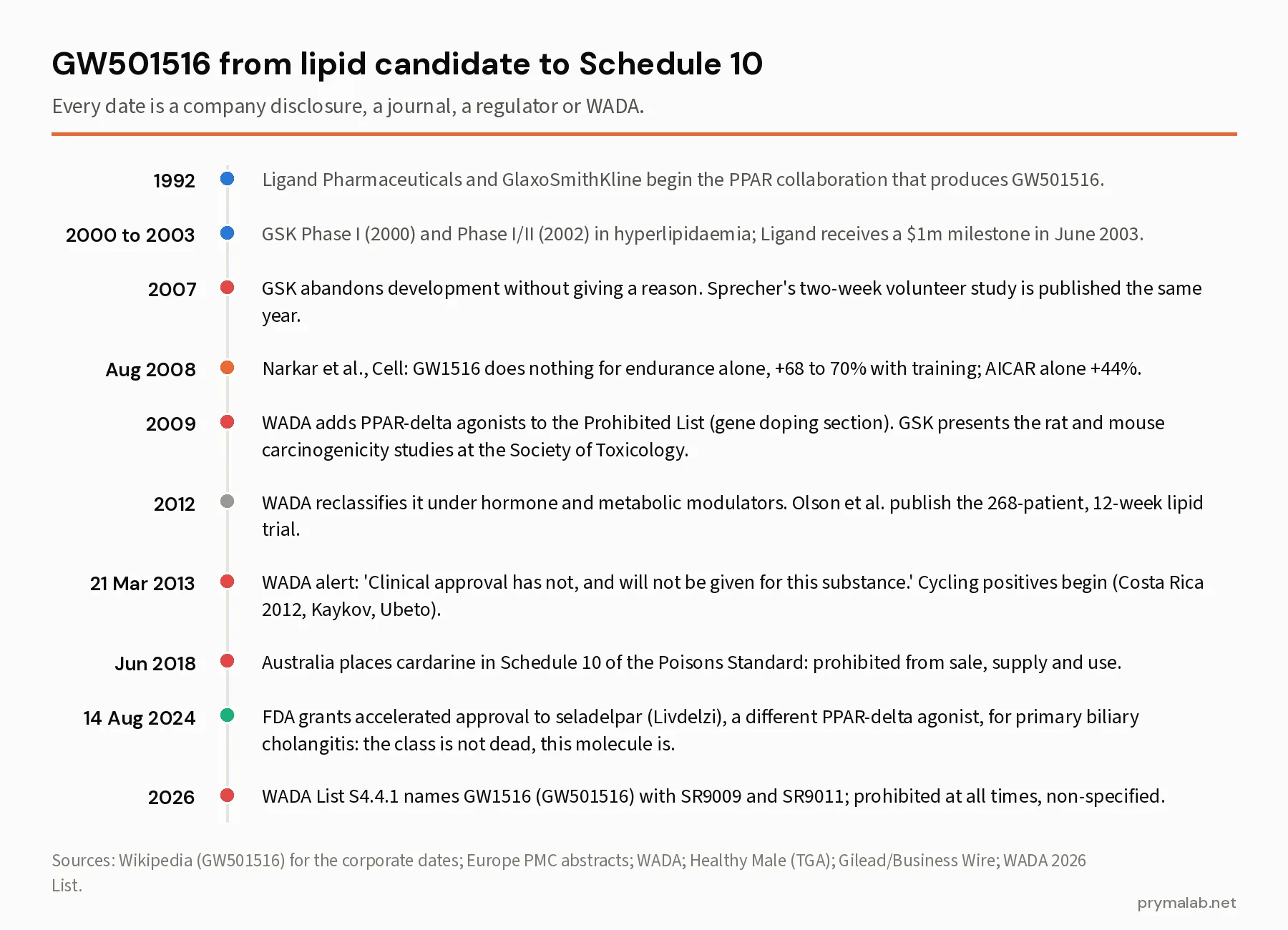
Ligand Pharmaceuticals and GlaxoSmithKline began the collaboration that produced GW501516 in 1992. GSK took it into Phase I in 2000 for hyperlipidaemia, into Phase I/II in 2002, and paid Ligand a one-million-dollar milestone in June 2003 to keep going.[1] The human data that programme generated are the only human data on cardarine that exist, and every one of them is a lipid study.
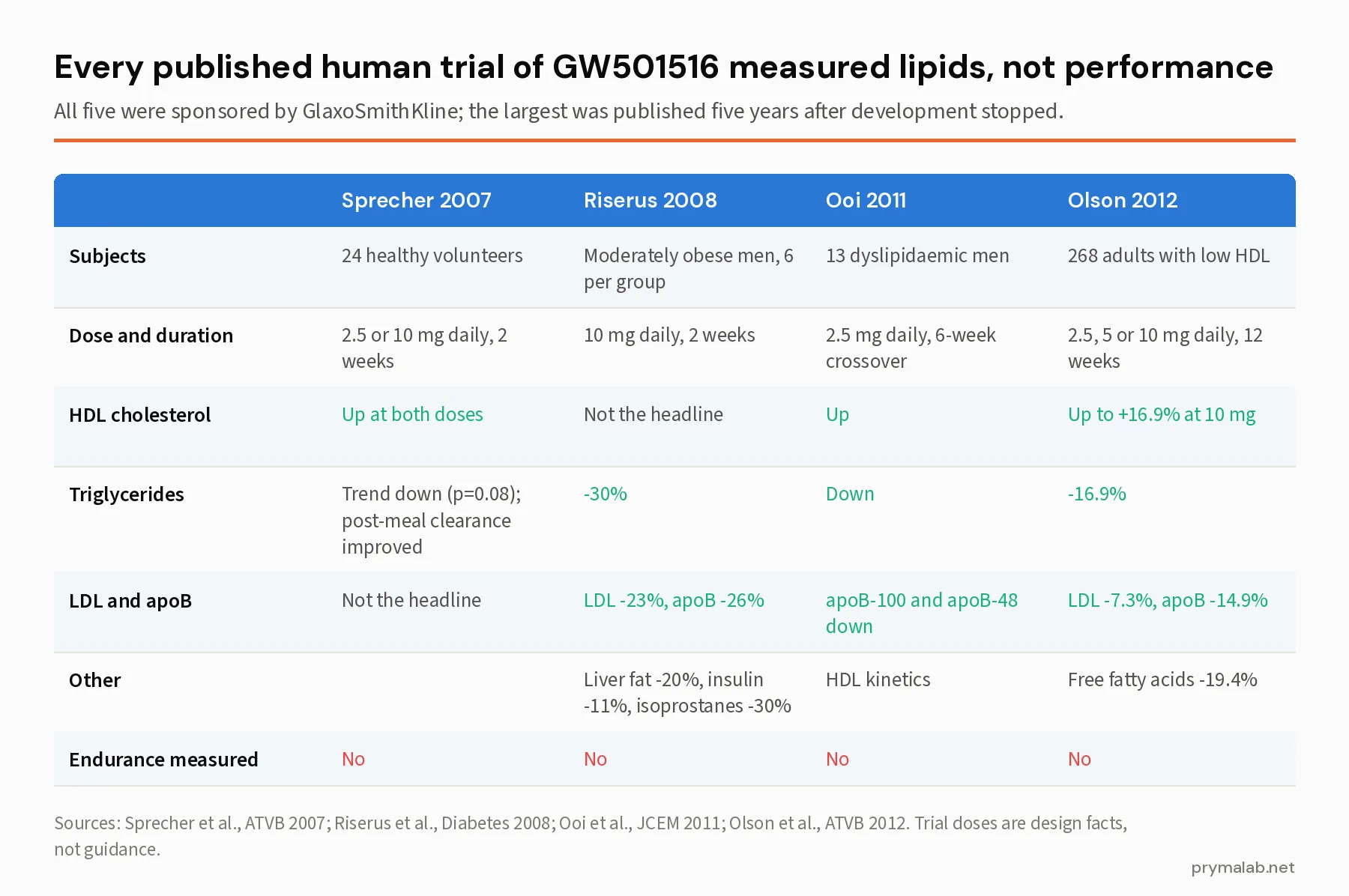
Sprecher and colleagues ran a two-week placebo-controlled study in 24 healthy volunteers with two active arms. Triglycerides trended down in the higher arm (p=0.08), clearance of triglycerides after a fat-rich meal improved (p=0.02), and HDL cholesterol rose in both active arms (p=0.004 and p<0.001).[3] Risérus and colleagues studied moderately obese men over two weeks, six per group, and reported fasting triglycerides down 30%, apolipoprotein B down 26%, LDL cholesterol down 23%, insulin down 11%, liver fat down 20% and urinary isoprostanes, a marker of oxidative stress, down 30%, with increased fat oxidation.[4] In the same two-week design, Christo
The largest trial is the one that matters. Olson, Pearce, Jones and Sprecher randomised 268 patients with low HDL cholesterol to one of three GW501516 arms or placebo for 12 weeks. HDL cholesterol rose up to 16.9% in the highest arm and apoA-I up to 6.6%; LDL cholesterol fell 7.3%, triglycerides 16.9%, apoB 14.9% and free fatty acids 19.4%.[7] Those are respectable numbers for a lipid drug. The paper appeared in 2012. GSK had abandoned the compound in 2007, initially without saying why.[1]
Why development stopped: the rodent carcinogenicity studies
At the 48th Annual Meeting of the Society of Toxicology in Baltimore in 2009, GSK scientists presented two posters: Geiger and colleagues, 'Rat carcinogenicity study with GW501516, a PPAR delta agonist', and Newsholme and colleagues, 'Mouse carcinogenicity study with GW501516, a PPAR delta agonist'.[8][9] The published summary of those studies is that the drug caused cancer to develop rapidly in several organs in both mice and rats, with tumours in the liver, stomach, tongue, skin, bladder, ovaries, uterus and testes.[1] I could not retrieve the full abstracts from any database; the conference programme lists them on page 105 and the metadata records exist, but the text does not circulate, which is why every account of the finding, including this one, rests on the same summary.
Two-year rodent carcinogenicity studies are a standard part of a drug package. A compound that produces tumours in multiple organs of two species in such a study is, in practice, finished, and that is what happened. WADA's 2013 alert describes it in one sentence: GW501516 was 'withdrawn from research by the pharmaceutical company and terminated when serious toxicities were discovered in pre-clinical studies'.[10]
Later laboratory work points in the same direction. In 2018, Zhou and colleagues reported that GW501516 increased the growth of colitis-associated colorectal cancer in mice by increasing inflammation and the expression of the transporters GLUT1 and SLC1A5.[11] PPAR-delta regulates proliferation as well as lipid metabolism, and the concern that agonists could promote tumours in some tissues predates cardarine.
What is not public is the exposure margin: how plasma levels in the rodent studies compare with those in the human trials, and whether any tumour appeared at lower doses. Without the abstracts, I cannot tell you that, and neither can anyone selling the compound. What can be said is that the human trials ran at most twelve weeks, measured cholesterol, and were never designed to detect a cancer signal; a two-year rodent study was, and did.
The 2008 mouse study, and the half the sellers leave out
Cardarine's second life began with a paper from Ronald Evans's laboratory at the Salk Institute: Narkar and colleagues, 'AMPK and PPAR-delta agonists are exercise mimetics', Cell, August 2008.[12] It is the same paper that made AICAR famous, and both arms need reading, because the market quotes them as if they were one.
GW1516 on its own, given to sedentary mice for four weeks, produced no improvement in endurance. It lowered fatty acids and glucose, as it had in people, and did nothing on the treadmill; Evans called the result 'a spectacular failure'.[13] Combined with four weeks of treadmill training, it produced a large effect: running time up 68% and distance up 70% against trained mice on placebo, with a 38% increase in slow-twitch oxidative fibres.[13][14] The proposed mechanism is that AMPK, activated by exercise, interacts with PPAR-delta in the nucleus and the drug amplifies the training signal; in Evans's phrase, it 'puts a turbo charge on PPAR delta'.[14] AICAR, the AMPK activator in the other arm, improved endurance by 44% without any training at all.[12]
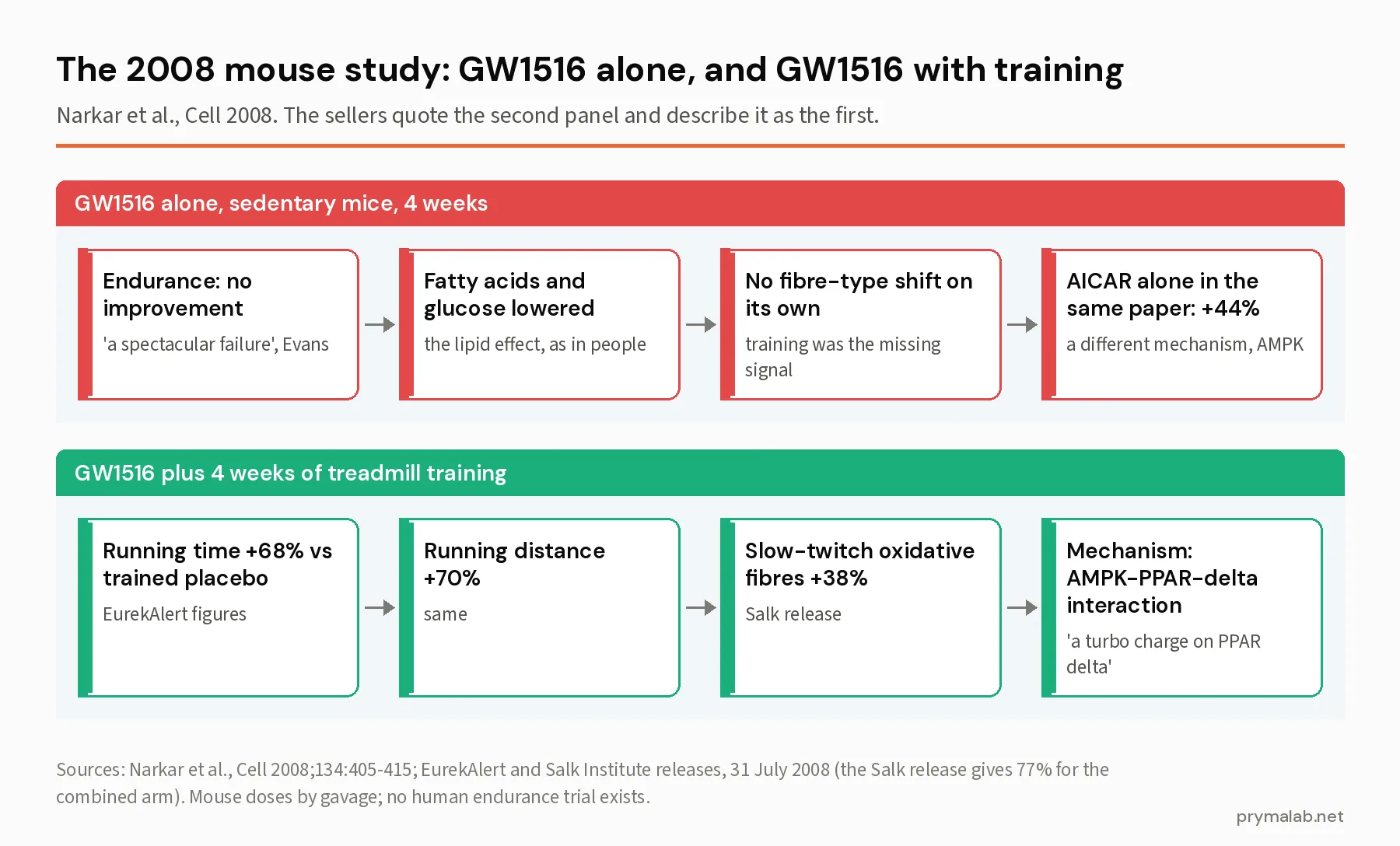
Two things follow for anyone reading a product page. First, the endurance effect required exercise, in mice, at doses given by gavage in a laboratory; the drug was a training amplifier, not a substitute for training. Second, no human endurance trial of GW501516 has ever been run, so the mouse result is the entire performance evidence base. The press materials disagree with each other on the size of the combined effect, 77% in the Salk release against 68% time and 70% distance in EurekAlert the same day; the separable pair is the one to quote.[14][13] The AICAR reference covers the other arm and the AMPK side of the mechanism.
WADA: the 2009 listing, the 2013 alert, and the positives
WADA added PPAR-delta agonists to the Prohibited List in 2009, initially under the gene doping section, and in 2012 reclassified them under hormone and metabolic modulators.[1] On the 2026 List the entry is item S4.4.1: 'Peroxisome proliferator-activated receptor delta (PPARδ) agonists, e.g. ... (GW1516, GW501516)', in the same clause as the Rev-erb agonists SR9009 and SR9011 and next to the AMPK activators AICAR and MOTS-c. Section S4 is prohibited at all times, and classes S4.3 and S4.4 are non-specified substances, which means the standard sanction applies with no reduced-penalty route for inadvertent use.[15]
On 21 March 2013 WADA did something it rarely does for a listed substance: it issued a public health alert. 'Clinical approval has not, and will not be given for this substance', it said; the drug had been 'withdrawn from research by the pharmaceutical company and terminated when serious toxicities were discovered in pre-clinical studies'; the side effects were 'so serious' that the agency was warning athletes about the health risk itself, over and above the sanction, because the compound was available on the black market through the internet and athlete use had been confirmed.[10]
The positives followed. Four Costa Rican cyclists at the Vuelta Ciclista a Costa Rica in December 2012; Valery Kaykov of RusVelo in April 2013, the case often misfiled as an AICAR positive; Miguel Ubeto of Lampre in May 2013; race walker Elena Lashmanova in February 2014; heavyweight boxer Jarrell Miller in April 2019, which cancelled his fight with Anthony Joshua and brought a two-year suspension in December 2020; Olympic 800 m medallist Nijel Amos in July 2022; and sprinter Issam Asinga in August 2023, who attributed a trace finding to contaminated recovery gummies.[1] By 2011 the compound was being trafficked on the internet at about $1,000 for 10 g and promoted on bodybuilding sites, as Thevis and colleagues documented in the anti-doping literature.[16]
| When | Athlete or event | Sport | Outcome |
|---|---|---|---|
| Dec 2012 | Four cyclists, Vuelta Ciclista a Costa Rica | Cycling | Three two-year bans; one twelve-year ban for a repeat violation |
| Apr 2013 | Valery Kaykov (RusVelo) | Cycling | UCI suspension; often misreported as an AICAR case |
| May 2013 | Miguel Ubeto (Lampre) | Cycling | Provisional suspension |
| Feb 2014 | Elena Lashmanova | Race walking | Sanctioned |
| Apr 2019 | Jarrell Miller | Boxing | Anthony Joshua fight cancelled; two-year suspension December 2020 |
| Jul 2022 | Nijel Amos | Athletics, 800 m | Provisional suspension before the World Championships |
| Aug 2023 | Issam Asinga | Athletics, sprint | Trace finding attributed by the athlete to contaminated recovery gummies |
Legal status: unscheduled in the US, Schedule 10 in Australia, marketed as a SARM it is not
Cardarine has no marketing approval anywhere, because no application was ever completed. In the United States and the United Kingdom it is unscheduled: not a controlled substance, not an approved drug, and legal to sell and hold for laboratory research within the framework the legal status guide describes.[1] That is the same category as most research compounds on this site, and it is where the similarity ends.
Australia took a different view. Since June 2018 cardarine has sat in Schedule 10 of the Poisons Standard, the schedule for substances of such danger that they are 'prohibited by law from sale, supply and use', after the Therapeutic Goods Administration concluded on the animal carcinogenicity data that the 'public health risk substantially outweighs the benefit' of any access.[17] Schedule 10 is where Australia puts substances it does not want in the country at all; a search for 'buy cardarine australia' is a search for something no one can lawfully supply there.
In the United States the confusion is about category rather than schedule. Cardarine is sold beside, and often labelled as, a SARM. USADA lists it among the prohibited substances that are 'sometime marketed as SARMs' along with SR9009 and SR9011, none of which act on the androgen receptor.[18] FDA's 2023 advisory on body-building products states that 'SARMs cannot be legally marketed in the U.S. as a dietary supplement or as a drug, and there are currently no FDA-approved SARM products', and lists liver injury, heart attack and stroke among the risks it associates with that category.[19] Cardarine is not named in that advisory and is not a SARM, but a product sold as one is sold into that enforcement environment.
| Jurisdiction or body | Status | Basis |
|---|---|---|
| World Anti-Doping Agency | Prohibited at all times; S4.4.1, non-specified | Listed 2009, reclassified 2012, health alert 2013 |
| United States | Unscheduled; no approved drug; research use only | Development ended 2007; FDA 2023 advisory covers products sold as SARMs |
| United Kingdom | Unscheduled | No approval, no schedule |
| Australia | Schedule 10: prohibited from sale, supply and use | TGA decision, effective June 2018, on the carcinogenicity data |
| PPAR-delta class (seladelpar) | FDA-approved, 14 August 2024 | A different molecule with its own toxicology package |
PPAR-delta after cardarine: the class that did not die
A reader could come away thinking PPAR-delta agonists are all carcinogens. That is not what the record shows, and the distinction matters for how to think about cardarine. On 14 August 2024, FDA granted accelerated approval to seladelpar, brand name Livdelzi, described by its sponsor as 'an oral, peroxisome proliferator activated receptor (PPAR) delta agonist', for primary biliary cholangitis in adults who respond inadequately to ursodeoxycholic acid. In the Phase 3 RESPONSE trial, 62% of patients on seladelpar met the composite biochemical endpoint at month 12 against 20% on placebo; the labelled warnings are fractures (4% versus none on placebo), dose-related liver test abnormalities and biliary obstruction, with no boxed warning.[20]
So a selective PPAR-delta agonist can clear a full toxicology package and an FDA review. What it tells you about cardarine is narrow and useful: the receptor is not the problem by itself; the molecule, its tissue distribution, its exposure and its own two-year rodent data are. GW501516's data are what they are, and no amount of class news changes them. It also means the argument 'PPAR-delta agonists are safe because seladelpar is approved' fails in exactly the same way as 'PPAR-delta agonists cause cancer because cardarine did'. Each molecule carries its own file, and cardarine's file was closed in 2007.
Research-grade GW501516: what to verify
As a small-molecule research compound, cardarine is verified differently from a peptide, and the purity testing guide covers the general principles. Identity is by mass spectrometry against the 453.49 Da parent, or by NMR; the trifluoromethyl group gives a clean fluorine signal that makes the molecule easy to confirm and hard to fake. Purity is by HPLC with a method suited to a lipophilic acid. Solubility is the practical point: it dissolves in DMSO and ethanol and poorly in water, so stock solutions are made in solvent and diluted, and 'water-soluble cardarine' is a claim to question. Storage is as a dry powder or DMSO stock at -20 °C, protected from light.
Three questions for any supplier, including us. The observed mass on the lot certificate, so you know it is GW501516 and not GW0742, a close analogue, or something else in a capsule. The HPLC purity by lot. And whether the product page states plainly that the compound is a PPAR-delta agonist rather than a SARM or a peptide, because a supplier who gets the class wrong has told you something about the rest of the paperwork. PrymaLab's GW-501516 (cardarine) listing is documented on that basis, and the related Rev-erb compound SR-9011, which shares the WADA clause, is documented the same way.
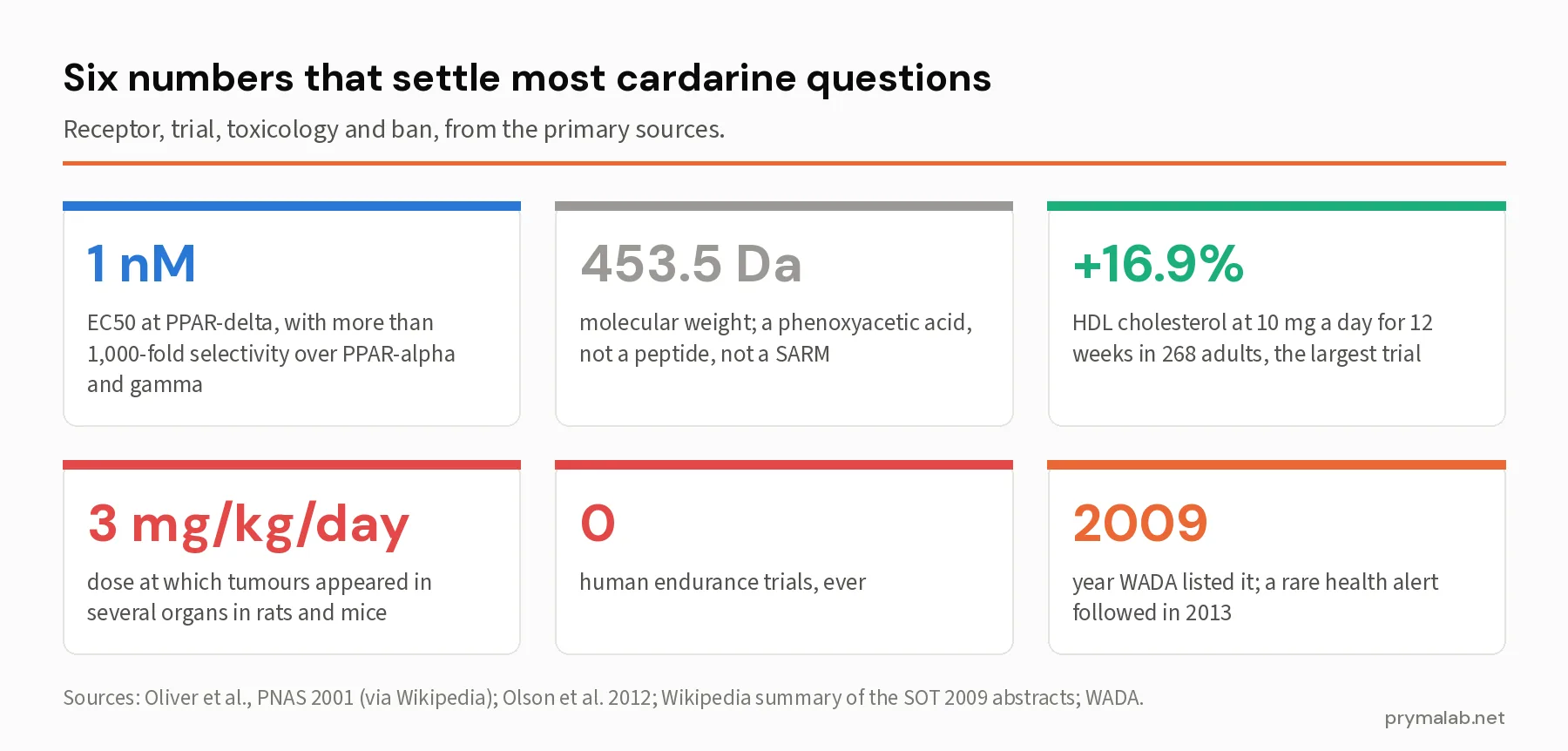
The version of the story the record supports: a potent and selective lipid drug that worked as intended on cholesterol in five short trials; two-year rodent studies, reported only in conference abstracts, that found tumours in eight organs and ended it; a mouse experiment in which it amplified training and did nothing alone; a WADA listing, a rare WADA health warning and a decade of positive tests; Schedule 10 in Australia and no schedule in the US; and a market that sells it as an endurance supplement under a class name that does not apply. For the compounds that share its shelf, the SARMs versus peptides guide is the place to start.
What this article does not settle
The exposure margin. The Society of Toxicology abstracts are not retrievable, so the relationship between the rodent exposures and human plasma levels in the trials is not public. Neither the lowest tumorigenic dose nor the no-effect dose can be stated.
Human cancer risk. No human has been followed long enough on GW501516 to know. The trials ran twelve weeks and measured lipids.
Human endurance. No trial. The mouse effect required training and disappeared without it.
Pharmacokinetics in people. The human trials were pharmacodynamic; a human half-life is not stated in the retrievable abstracts and this article does not invent one.
Whether the lipid effects would have held. Twelve weeks in 268 people is a Phase 2 result. The programme never reached the outcome trials that would have tested whether raising HDL this way reduces cardiovascular events, a question the wider HDL literature has since complicated.
What is well established: the structure, formula and mass; the receptor, potency and selectivity; the five human lipid trials and their numbers; the 2007 termination and the 2009 carcinogenicity abstracts as summarised; the 2008 mouse study in both arms; the WADA listing, reclassification and 2013 alert; the positive cases; Australia's Schedule 10; and seladelpar's 2024 approval as a different molecule in the same class.
GW501516, GW1516, GSK-516, cardarine and Endurobol: what the names refer to
GW501516 is GlaxoSmithKline's compound code: GW for Glaxo Wellcome, the company that began the programme before the 2000 merger, and 501516 a serial number with no chemical meaning. GW1516 is a contraction of the same code and is the form the WADA list uses alongside the full number. GSK-516 appears in some older reviews. Cardarine is the name the grey market gave the compound when it appeared for sale around 2011, and Endurobol was a brand name attached to it by 2013, when The Conversation and WADA reported on the black-market product.[1] PPAR-delta agonist is the pharmacological class, and 'delpar' is the class suffix FDA-approved members such as seladelpar now carry.[20] None of the names denotes a SARM or a peptide; cardarine is neither.
What the bodybuilding vocabulary means, and what the trials measured
Almost everything written about this compound outside the journals uses a vocabulary the trials never used. It is worth setting the two side by side, because the gap is where most of the misinformation lives.
Fat loss, fat burning, body fat and body composition are the headline claims, and none of them was an endpoint in a human trial of GW501516. The five GSK studies measured lipids and liver fat, not fat mass, and ran for two to twelve weeks. The rodent work is where the fat-burning story comes from: a PPARδ agonist drives transcription of genes for fatty-acid oxidation and uncoupling in muscle, which raises energy expenditure in mice. Calling it a fat burner describes a transcriptional programme in a mouse, not a measured change in a person's body composition. No human study of this compound has reported weight loss, and weight loss was never what it was being developed for.
Stamina, cardio and endurance are the other half, and here the primary paper is more useful than any summary of it. The 2008 Cell study by Narkar and colleagues has a section heading that reads: GW1516 increases muscle gene expression but not endurance in sedentary mice. The text is blunter still, noting that running performance was unchanged by treatment and that up to five months of dosing did not change running endurance either. The endurance result came only with four weeks of treadmill training alongside the drug: running time up 68 per cent and distance up 70 per cent against trained controls, with about 38 per cent more type I fibres. The widely repeated figure of a 44 per cent endurance gain without exercise belongs to AICAR, the AMPK agonist tested in the same paper, not to this compound.
Muscle mass and muscle growth do not belong here at all, and the fibre-type story needs a correction that is almost always dropped. PPARδ activation drives an oxidative, slow-twitch gene programme, which is an endurance adaptation rather than a hypertrophic one. But the measured fibre-type switch in the 2004 paper came from transgenic activation of the receptor in skeletal muscle, not from the drug. For the drug, that paper reports only that it elicited a similar type I gene expression profile, which is a transcriptional signature rather than a demonstrated change in fibre composition, and the 2008 paper found increased oxidative myofibres only in combination with training. No published study reports an increase in muscle mass with this compound, and the mechanism gives no reason to expect one.
Why PCT, ostarine and anabolic steroids are a different conversation
This compound is sold next to selective androgen receptor modulators and is routinely listed as one, which USADA has had to correct publicly. The distinction is not pedantic, and it changes what the surrounding advice means.
Ostarine, the most common SARM on the same shelves, binds the androgen receptor. So do anabolic steroids, which is the older class both are measured against. Anything that activates that receptor suppresses the hypothalamic-pituitary-gonadal axis through negative feedback, which is why post cycle therapy exists: post cycle therapy is an attempt to restart endogenous testosterone production after it has been shut down. GW501516 has no androgen receptor activity. It does not suppress that axis, so there is nothing for a PCT to restart, and a PCT protocol carried over from an androgen has no pharmacological rationale applied to a PPARδ agonist. Protocols that bundle this compound into a SARM cycle and a post cycle therapy are grouping by where the products are bought, not by how they work. The side effects that make a PCT necessary after an androgen do not arise here.
Cardarine amount figures that circulate on forums have no trial behind them either. The five GSK studies lasted two to twelve weeks and tested an abandoned investigational drug; their results are reported here so they can be read, not transferred to anything. The compound is supplied as a research chemical, and FDA's position on that labelling is on the record: in a warning letter dated 12 December 2025 the agency named Cardarine GW501516 among unapproved new drugs under section 505(a) and stated that research use only labelling does not change how intended use is determined.
What the human trials did find: lipids, insulin and liver fat
The development programme was a lipid programme, and the lipid results are the only human efficacy data this molecule has. The published human record is four papers reporting five studies, all with GSK co-authors, though two of them were investigator-led academic trials in Oxford and Perth using drug supplied by the company rather than company-run trials. Across them HDL cholesterol rose by up to 16.9 per cent in the largest study, triglycerides fell between 17 and 30 per cent, and LDL cholesterol and apolipoprotein B both came down, by 7.3 and 14.9 per cent in one study and 23 and 26 per cent in another. The spread matters: one two-week study found HDL unchanged, and another found only a non-significant downward trend in triglycerides. A range quoted without that variance makes four small studies sound like one consistent result. That is a lipid profile moving in the direction a dyslipidemia drug is supposed to move it, and it is why the compound was in development for hyperlipidemia and atherosclerosis in the first place. Dyslipidemia, not endurance, was the indication on the file.
Insulin sensitivity is where the summaries overreach, including summaries written by people sympathetic to the compound. No human trial of GW501516 measured insulin sensitivity: there was no clamp and no oral glucose tolerance test. What one two-week study reported was an 11 per cent fall in fasting insulin, alongside a 20 per cent reduction in liver fat. That is consistent with the mechanism, since more fatty-acid oxidation in muscle means less lipid accumulating where it interferes with insulin signalling, but a fasting insulin figure and a measured insulin sensitivity are not the same claim. Those findings are coherent and they are also short. Two to twelve weeks of a surrogate biomarker is what supports a phase two decision, not a cardiovascular disease outcome, and no trial of this compound ever measured heart disease events, type 2 diabetes incidence, blood flow, or anything else a patient would notice.
Liver damage deserves a precise answer because it is a common question. The twelve-week human studies reported no hepatotoxicity signal and liver fat went down rather than up, and no side effects specific to the liver were reported in them. The finding that ended the programme was different in kind: the rodent carcinogenicity work reported tumours, liver among the organs involved, and tumours in a rodent carcinogenicity study are not the same thing as the transaminase rise people mean by that phrase. Those carcinogenicity results exist only as two 2009 Society of Toxicology conference abstracts and have never been published as a peer-reviewed paper, so the dose and the organ list should be cited as conference abstracts rather than as settled literature.
The PPAR-delta class in 2026, and what it is being developed for
The receptor did not turn out to be the problem. Two PPAR agonists now hold accelerated approvals, both for cholestatic liver disease rather than anything metabolic. Seladelpar, marketed as Livdelzi, is a selective PPARδ agonist that received accelerated approval on 14 August 2024 for primary biliary cholangitis, and its label still reads as accelerated approval on alkaline phosphatase reduction, with improvement in survival or prevention of liver decompensation not yet demonstrated. Elafibranor, marketed as Iqirvo, got the same indication on 10 June 2024, and is usually described as a dual PPAR alpha and delta agonist rather than a selective one; its own label says it activates all three PPAR subtypes in vitro. Lanifibranor, a pan-PPAR agonist, is in phase three for MASH.
What none of them is being developed for is athletic performance. Both approved agents treat a rare autoimmune liver disease on a surrogate biomarker, under accelerated approval, which is a long way from the endurance framing this molecule carries. The class is alive. The use case that made this particular compound famous was never a clinical programme at all.
Frequently asked questions
What is cardarine?
GW501516: a 453 Da selective PPAR-delta agonist developed by GSK as a cholesterol drug, abandoned in 2007 after rodent cancers, famous from a 2008 mouse study, and banned by WADA. Not a SARM, not a peptide.
Is cardarine a SARM?
No. It is a PPAR-delta agonist with no androgen receptor activity. It is sold beside SARMs and often mislabelled as one, but it is a different class, like SR9009.
Does cardarine cause cancer?
In rodents, yes: GSK's two-year studies, reported as 2009 conference abstracts, found tumours in eight organs in rats and mice, which ended development in 2007. Human risk has never been studied; the trials lasted twelve weeks.
What did the human trials of cardarine show?
Lipid improvements only: HDL up (to +16.9% in the 268-patient, 12-week trial), triglycerides down 17 to 30%, LDL and apoB down, liver fat down 20% in one study. No trial measured endurance or lasted beyond twelve weeks.
Does cardarine improve endurance?
Not on its own: in the 2008 mouse study GW1516 alone gave no endurance gain; with training it raised running time 68% and distance 70%. No human endurance trial exists.
Is cardarine banned by WADA?
Yes, at all times since 2009; now S4.4.1 on the 2026 List as a non-specified substance. WADA also issued a rare health alert in 2013 saying approval will never be given.
Is cardarine legal?
Unscheduled in the US and UK (research use only, not for human use); Schedule 10 in Australia since June 2018, prohibited from sale, supply and use; banned for athletes worldwide.
Who has tested positive for cardarine?
Costa Rican cyclists (2012), Valery Kaykov and Miguel Ubeto (2013), Elena Lashmanova (2014), Jarrell Miller (2019), Nijel Amos (2022) and Issam Asinga (2023), among others.
What is the difference between cardarine and AICAR?
Two arms of one 2008 study: cardarine (PPAR-delta) helped only with training; AICAR (AMPK) helped alone. Cardarine has lipid trials and rodent cancers; AICAR has failed cardiac trials. Both sit in WADA S4.4.1.
Are PPAR-delta agonists all dangerous?
No. Seladelpar, a different PPAR-delta agonist, was FDA-approved in August 2024 for primary biliary cholangitis. The receptor is not the problem; GW501516's own rodent cancer data are.
How do I verify a cardarine sample?
Mass spectrometry or NMR against the 453.49 Da parent plus HPLC purity by lot. Ask for the observed mass and confirmation it is GW501516, not GW0742. It dissolves in DMSO, not water.
Does cardarine cause fat loss in humans?
No human trial of GW501516 measured fat loss, body fat or body composition. The published human studies measured lipids and liver fat over two to twelve weeks, with side effects recorded over a correspondingly short follow-up. The fat burning story comes from rodent work showing a PPARδ agonist drives fatty-acid oxidation and uncoupling genes in muscle, which raises energy expenditure in mice. No human study has reported weight loss.
Did the famous endurance study work without exercise?
No, and the paper says so in a section heading: GW1516 increases muscle gene expression but not endurance in sedentary mice. Running performance was unchanged by the drug alone, even after five months. With four weeks of treadmill training it raised running time 68 per cent and distance 70 per cent. The 44 per cent figure often quoted for the drug alone belongs to AICAR, tested in the same paper.
Does cardarine need a PCT?
The question does not apply. Post cycle therapy exists to restart endogenous testosterone after an androgen has suppressed the hypothalamic-pituitary-gonadal axis. This compound has no androgen receptor activity and does not suppress that axis, so a PCT has nothing to restart. Protocols that bundle it with ostarine and anabolic steroids group by where products are sold, not by mechanism.
Does cardarine build muscle?
No published study reports an increase in muscle mass with this compound, and the mechanism gives no reason to expect muscle growth. PPARδ activation drives an oxidative slow-twitch gene programme, which is an endurance adaptation rather than a hypertrophic one. The measured fibre-type switch in the 2004 work came from transgenic PPARδ activation; the drug reproduced the type I gene expression profile, and raised oxidative myofibres only alongside training.
What did the human trials actually show?
Lipid changes over two to twelve weeks across four papers reporting five studies: HDL up to 16.9 per cent higher in the largest, triglycerides 17 to 30 per cent lower, LDL cholesterol and apolipoprotein B down, fasting insulin 11 per cent lower and liver fat 20 per cent lower in one two-week study. Insulin sensitivity itself was never measured, by clamp or otherwise. Results were not uniform: one study found HDL unchanged and another only a non-significant triglyceride trend. No trial measured heart disease events, type 2 diabetes incidence or blood flow.
Does cardarine cause liver damage?
The twelve-week human studies reported no hepatotoxicity signal and liver fat fell rather than rose. The liver finding that ended development was different in kind: rodent carcinogenicity work reported tumours with liver among the organs involved. Those results exist only as two 2009 Society of Toxicology conference abstracts and have never been published as a peer-reviewed paper.
Are PPAR-delta agonists still in development?
Yes, for liver disease rather than performance. Seladelpar (Livdelzi), a selective PPARδ agonist, received accelerated approval on 14 August 2024 for primary biliary cholangitis, and elafibranor (Iqirvo), a dual PPAR alpha and delta agonist, the same indication on 10 June 2024. Lanifibranor is in phase three for MASH. No PPAR-delta agonist is in development for endurance.
References
- Wikipedia. GW501516. Identity, development history with Ligand and GSK, potency and selectivity (citing Oliver et al. 2001), the carcinogenicity summary and organs, the 2018 colitis study, WADA history, positive cases, black-market pricing and national scheduling. Wikipedia
- Oliver WR, Shenk JL, Snaith MR, et al. A selective peroxisome proliferator-activated receptor delta agonist promotes reverse cholesterol transport. Proc Natl Acad Sci USA. 2001;98(9):5306-5311. doi:10.1073/pnas.091021198. PMID 11309497. PNAS
- Sprecher DL, Massien C, Pearce G, et al. Triglyceride:high-density lipoprotein cholesterol effects in healthy subjects administered a peroxisome proliferator activated receptor delta agonist. Arterioscler Thromb Vasc Biol. 2007;27(2):359-365. PMID 17110604. ATVB
- Risérus U, Sprecher D, Johnson T, et al. Activation of peroxisome proliferator-activated receptor (PPAR)delta promotes reversal of multiple metabolic abnormalities, reduces oxidative stress, and increases fatty acid oxidation in moderately obese men. Diabetes. 2008;57(2):332-339. PMID 18024853. Diabetes
- Christo
doulides C, Dyson P, Sprecher D, Tsintzas K, Karpe F. Circulating fibroblast growth factor 21 is induced by peroxisome proliferator-activated receptor agonists but not ketosis in man. J Clin Endocrinol Metab. 2009;94(9):3594-3601. PMID 19531592. JCEM - Ooi EM, Watts GF, Sprecher DL, Chan DC, Barrett PH. Mechanism of action of a peroxisome proliferator-activated receptor (PPAR)-delta agonist on lipoprotein metabolism in dyslipidemic subjects with central obesity. J Clin Endocrinol Metab. 2011;96(10):E1568-E1576. PMID 21816786. JCEM
- Olson EJ, Pearce GL, Jones NP, Sprecher DL. Lipid effects of peroxisome proliferator-activated receptor-delta agonist GW501516 in subjects with low high-density lipoprotein cholesterol: characteristics of metabolic syndrome. Arterioscler Thromb Vasc Biol. 2012;32(9):2289-2294. PMID 22814748. doi:10.1161/atvbaha.112.247890. ATVB
- Geiger LE, Dunsford WS, Lewis DJ, et al. PS 895: Rat carcinogenicity study with GW501516, a PPAR delta agonist. 48th Annual Meeting of the Society of Toxicology, Baltimore, 2009, p. 105. Abstract text not retrievable; metadata record only. ScienceOpen record
- Newsholme SJ, Dunsford WS, Brodie T, et al. PS 896: Mouse carcinogenicity study with GW501516, a PPAR delta agonist. 48th Annual Meeting of the Society of Toxicology, Baltimore, 2009, p. 105. Abstract text not retrievable.
- World Anti-Doping Agency. WADA issues alert on GW501516. 21 March 2013. WADA
- Zhou D, Jin J, Liu Q, Shi J, Hou Y. PPAR-delta agonist enhances colitis-associated colorectal cancer. Eur J Pharmacol. 2019;842:248-254. doi:10.1016/j.ejphar.2018.10.050. PMID 30391747. European Journal of Pharmacology
- Narkar VA, Downes M, Yu RT, et al. AMPK and PPAR-delta agonists are exercise mimetics. Cell. 2008;134(3):405-415. doi:10.1016/j.cell.2008.06.051. PMID 18674809. Cell
- EurekAlert. Exercise in a pill. 31 July 2008. GW1516 alone 'a spectacular failure'; 68% running time and 70% distance with training. EurekAlert
- Salk Institute. Exercise in a pill. Press release, 31 July 2008. The 38% fibre-type figure, the 77% variant and the Evans quotations. Salk
- World Anti-Doping Agency. The 2026 Prohibited List, International Standard. S4.4.1 wording; S4 prohibited at all times; S4.3 and S4.4 non-specified. WADA
- Thevis M, Geyer H, Thomas A, Schänzer W. Trafficking of drug candidates relevant for sports drug testing: detection of non-approved therapeutics categorized as anabolic and gene doping agents in products distributed via the Internet. Drug Test Anal. 2011;3(5):331-336. doi:10.1002/dta.283. PMID 21538997. Drug Testing and Analysis
- Healthy Male (Australia). What is cardarine or GW1516 and what are its side effects? Schedule 10 of the Poisons Standard since June 2018; the TGA's public-health-risk conclusion. Healthy Male
- US Anti-Doping Agency. Selective androgen receptor modulators (SARMs): prohibited class of anabolic agents. GW501516, SR9009 and SR9011 'sometime marketed as SARMs'. USADA
- SupplySide Supplement Journal. FDA warns of SARMs sales, trumpets successful prosecution. 2 May 2023. FDA's statement that no SARM product can be legally marketed and its listed risks. SupplySide
- Gilead Sciences. Gilead's Livdelzi (seladelpar) granted accelerated approval for primary biliary cholangitis by U.S. FDA. Business Wire, 14 August 2024. RESPONSE results, dose and warnings. Business Wire
Figures come from the published papers, regulatory documents, WADA notices and company disclosures named above, current to 23 September 2026. The 2009 carcinogenicity abstracts could not be retrieved in full; their findings are reported as summarised in reference 1 and the WADA alert, and the article says so.
Final disclaimer: This article is an educational research reference on the chemistry, pharmacology, clinical record, toxicology and regulatory status of GW501516 (cardarine). Compounds supplied by PrymaLab are sold for laboratory research use only and are not approved by any regulator for human or veterinary use. Statements have not been evaluated by the FDA. Nothing here is medical advice or a treatment claim.
Clinical trial doses and outcomes are reported as study design facts about an investigational drug given under medical supervision, and animal doses as study design facts; they do not describe or support any use of research-grade material. Cardarine is prohibited for athletes at all times under the World Anti-Doping Code and is prohibited from sale, supply and use in Australia. Always verify the legal status of any research compound in your jurisdiction before purchase or use.