

SR9011 and SR9009: What a Rev-erb Agonist Does in Mice, What It Does Off-Target, and Why No Human Has Been Dosed
SR9011 is a synthetic Rev-erb agonist: a 479 Da small molecule designed at Scripps Research Florida in 2012, alongside its better-known sibling SR9009 (sold as stenabolic), to activate the two Rev-erb nuclear receptors that act as the brake in the body's circadian clock. In mice, given by injection, the pair shifted clock-gene rhythms, raised energy expenditure and cut fat mass, blood lipids and glucose in obese animals; in 2018 they were shown to kill cancer cells while sparing normal ones. They are not orally available, which is why every animal study injected them, and in 2019 SR9009 was shown to act on cells that have no Rev-erb at all, so its effects are not what the mechanism promised. No human has been dosed in a published study. SR9009 was named on the WADA list in 2018 and both now sit in S4.4.1, prohibited at all times. PrymaLab supplies SR-9011 for laboratory research use only.
- Structure: SR9011: 3-(((4-chlorobenzyl)((5-nitrothiophen-2-yl)methyl)amino)methyl)-N-pentylpyrrolidine-1-carboxamide, C23H31ClN4O3S, 479.04 g/mol, CAS 1379686-29-9. SR9009: C20H24ClN3O4S, 437.94 g/mol, CAS 1379686-30-2. A nitrothiophene-chlorobenzyl amine; no amino acids, no androgen receptor activity.
- Class: Agonist of Rev-erb-alpha and Rev-erb-beta (NR1D1 and NR1D2), heme-binding nuclear receptors that repress transcription of Bmal1 and metabolic genes. IC50 790 nM (alpha) and 560 nM (beta) for SR9011; 670 and 800 nM for SR9009. WADA 2026 List S4.4.1, with the PPAR-delta agonists; non-specified; prohibited at all times.
- Studied for: Circadian rhythm and metabolism in mice (2012); cancer and oncogene-induced senescence in cell lines and glioblastoma xenografts (2018); microglial inflammation (2020); anti-doping metabolite mapping (2016). Nothing in humans.
- Study designs in the literature: Mouse studies used intraperitoneal injection, including the 2018 glioblastoma work. Cell work used micromolar concentrations (5 uM in microglia). No human dose exists. Study design facts, not guidance.
- Storage: Dry powder or DMSO stock at -20 °C, protected from light. Lipophilic; dissolves in DMSO and ethanol, poorly in water. The nitrothiophene group is light-sensitive; keep stocks dark and remake working solutions fresh.
- Forms and sizes at PrymaLab: SR-9011, sold for laboratory research use only. Related nuclear-receptor research compound: GW-501516 (cardarine), named in the same WADA clause.
- Regulatory: No approval anywhere; no human trial; not a controlled substance in the US; unscheduled research chemical. Indirectly prohibited by WADA as a non-approved substance from 2016, SR9009 named as an example on the 2018 List, both named in S4.4.1 on the 2026 List. Marketed as a SARM, which it is not; FDA's 2023 advisory covers products sold under that label.
| SR9011 / SR9009 | Cardarine (GW501516) | AICAR | |
|---|---|---|---|
| Target | Rev-erb nuclear receptors (clock brake) | PPAR-delta nuclear receptor | AMPK, via the metabolite ZMP |
| Origin | Scripps, Burris lab, 2012; never a drug candidate | GSK/Ligand lipid drug, abandoned 2007 | Gensia cardiac drug, failed Phase 3 in 2012 |
| Best animal result | Fat mass and lipids down in obese mice; glioblastoma shrunk | +68 to 70% endurance with training | +44% endurance without training |
| Human data | None | Five lipid trials, up to 268 people, 12 weeks | Cardiac surgery and leukaemia trials, IV |
| Oral | Not orally available | Oral tablets in trials | Below 5% bioavailability |
| Known problem | Off-target effects; disrupted activity rhythm in mice | Rodent cancer findings | Hyperuricaemia; futility in 3,080 patients |
| WADA | S4.4.1, at all times | S4.4.1, at all times | S4.4.1, at all times |
See the cardarine reference and the AICAR reference for the two compounds that share SR9011's WADA clause, the SARMs versus peptides guide for why it is neither, and the purity testing guide for how a small molecule is verified.
Also known as: SR-9011, SR 9011, SR9011, Rev-erb agonist, Rev-erbα/β agonist, REV-ERB agonist, NR1D1/NR1D2 agonist; SR9009, SR-9009, stenabolic (SR9009's market name, applied loosely to both). Not a SARM, not a peptide.
SR9011 was never meant to be a drug. Thomas Burris's group at Scripps built it and its sibling SR9009 in 2012 as tools to test a question: if you could press harder on the brake in the body's circadian clock, what would happen to metabolism? In mice given the compounds by injection, the answer was interesting: clock genes shifted, energy expenditure rose, and obese animals lost fat and cleared lipids. Within a few years the compounds were being sold online as 'stenabolic', with the mouse results retold as if they were human ones and the word 'exercise in a bottle' attached. What the retellings leave out is that the compounds do not survive the gut, that the mice also lost their normal activity rhythm, that in 2019 SR9009 was shown to act on cells with no Rev-erb receptor at all, and that not one human has been dosed in a published study. This reference sets out what a Rev-erb agonist is, what it has actually done, and the size of the gap between that and the label on the bottle.
Research-use-only disclaimer: SR-9011 supplied by PrymaLab is intended strictly for laboratory research use and is not intended for human or veterinary use. The animal and cell studies described below were conducted in academic laboratories and do not describe or support any use in people. There are no human data. Animal doses are reported as study design facts. No dosing or administration guidance appears here. Nothing here is medical advice.

TL;DR
SR9011 is a 479 Da Rev-erb agonist, designed at Scripps in 2012 with SR9009 (stenabolic) to activate the nuclear receptors that repress Bmal1 and set the circadian clock. In mice, injected, the compounds shifted clock-gene rhythms, raised energy expenditure and cut fat mass, lipids and glucose in obese animals; they also abolished the animals' normal dark-phase activity. In 2018 they killed cancer cells and shrank glioblastoma in mice while sparing normal cells. They are not orally available. In 2019 SR9009 was shown to change viability and metabolism in cells lacking both Rev-erb receptors, so its effects are partly off-target; whether SR9011 does the same is unknown. No human has been dosed. Anti-doping labs mapped 14 SR9011 metabolites in 2016 and found no positive among 1,511 samples; SR9009 was named on the WADA list in 2018 and both sit in S4.4.1. Research use only.
Identity: SR9011: C23H31ClN4O3S, 479.04 g/mol, CAS 1379686-29-9. SR9009: C20H24ClN3O4S, 437.94 g/mol, CAS 1379686-30-2. Small molecules; not peptides, not SARMs. The two CAS numbers are consecutive and often swapped on listings.
Mechanism: Agonists of Rev-erb-alpha and beta, the heme-binding nuclear receptors that repress Bmal1 and metabolic genes. IC50s of 560 to 800 nM. Pressing the clock's brake harder shifts circadian and metabolic gene rhythms.
Mouse record: 2012: altered clock behaviour and hypothalamic clock genes, higher energy expenditure, less fat and better lipids and glucose in obese mice, all by injection. 2020: loss of dark-phase locomotor activity. 2018: cancer cells killed, glioblastoma shrunk in mice.
Off-target: 2019 PNAS: SR9009 still cut viability, rewired metabolism and changed transcription in hepatocytes and stem cells with both Rev-erbs deleted. The 2020 microglia paper calls the same question for SR9011 'currently unknown'.
Human record: None. No trial, no dose, no pharmacokinetics. 'Not orally available', so every animal study injected it. The developer's own line: 'the true test will be getting SR9009 and SR9011 into human trials.'
Regulatory: Unscheduled research chemical in the US; no approval anywhere. WADA: non-approved substance from 2016, SR9009 named in 2018, both in S4.4.1 in 2026, non-specified, at all times. Marketed as a SARM it is not.
Status: research use only.
What SR9011 is: a Rev-erb agonist, not a SARM and not a peptide
SR9011's chemical name is 3-(((4-chlorobenzyl)((5-nitrothiophen-2-yl)methyl)amino)methyl)-N-pentylpyrrolidine-1-carboxamide: molecular formula C23H31ClN4O3S, molecular weight 479.04 g/mol, CAS number 1379686-29-9.[1] Its sibling SR9009 is a slightly smaller molecule of the same design, C20H24ClN3O4S, 437.94 g/mol, CAS 1379686-30-2, and it is the one the market named stenabolic.[2] Both are tertiary amines carrying a chlorobenzyl group and a nitrothiophene, joined to a pyrrolidine carboxamide. Neither contains an amino acid, so neither is a peptide, and neither has any activity at the androgen receptor, so neither is a SARM, however the catalogue files them. The SARMs versus peptides guide draws that line for the whole shelf.
What they are is ligands for a pair of nuclear receptors called Rev-erb-alpha and Rev-erb-beta, gene names NR1D1 and NR1D2. Unlike most nuclear receptors, Rev-erbs are repressors: they bind DNA and switch genes off, and the natural molecule that sits in their ligand pocket is heme. Their best-known target is Bmal1, one of the two master genes of the circadian clock, which is why they are described as the clock's brake. SR9011 activates Rev-erb-alpha with an IC50 of 790 nM and Rev-erb-beta at 560 nM in the assays used to characterise it; SR9009's figures are 670 and 800 nM.[1][2] Those are sub-micromolar, respectable for a tool compound and modest for a drug.
The compounds came out of Thomas Burris's laboratory at Scripps Research Institute Florida in 2012, designed from an earlier GlaxoSmithKline tool compound to have activity in living animals rather than only in a dish.[3][4] They were, and remain, research tools. No company took either into development, and the patents sit with Scripps.[4]
The CAS problem
Because the two compounds were registered together, their CAS numbers are consecutive, 1379686-29-9 for SR9011 and 1379686-30-2 for SR9009, and vendor listings routinely print one under the other's name.[1][2] A listing that gives SR9011 with the mass 437.94, or SR9009 with 479.04, has confused them. The molecular weight on a certificate is the quicker check: 479 is SR9011, 438 is SR9009.
How a Rev-erb agonist works: pressing the clock's brake
The mammalian clock is a feedback loop. The proteins CLOCK and BMAL1 switch on a set of genes, among them the two Rev-erb genes; the Rev-erb proteins then feed back and repress Bmal1, and the cycle takes about a day. Rev-erbs also repress genes in liver, muscle and fat that control lipid and glucose handling, which is how the clock and metabolism are wired together. A Rev-erb agonist makes the repressor repress harder.
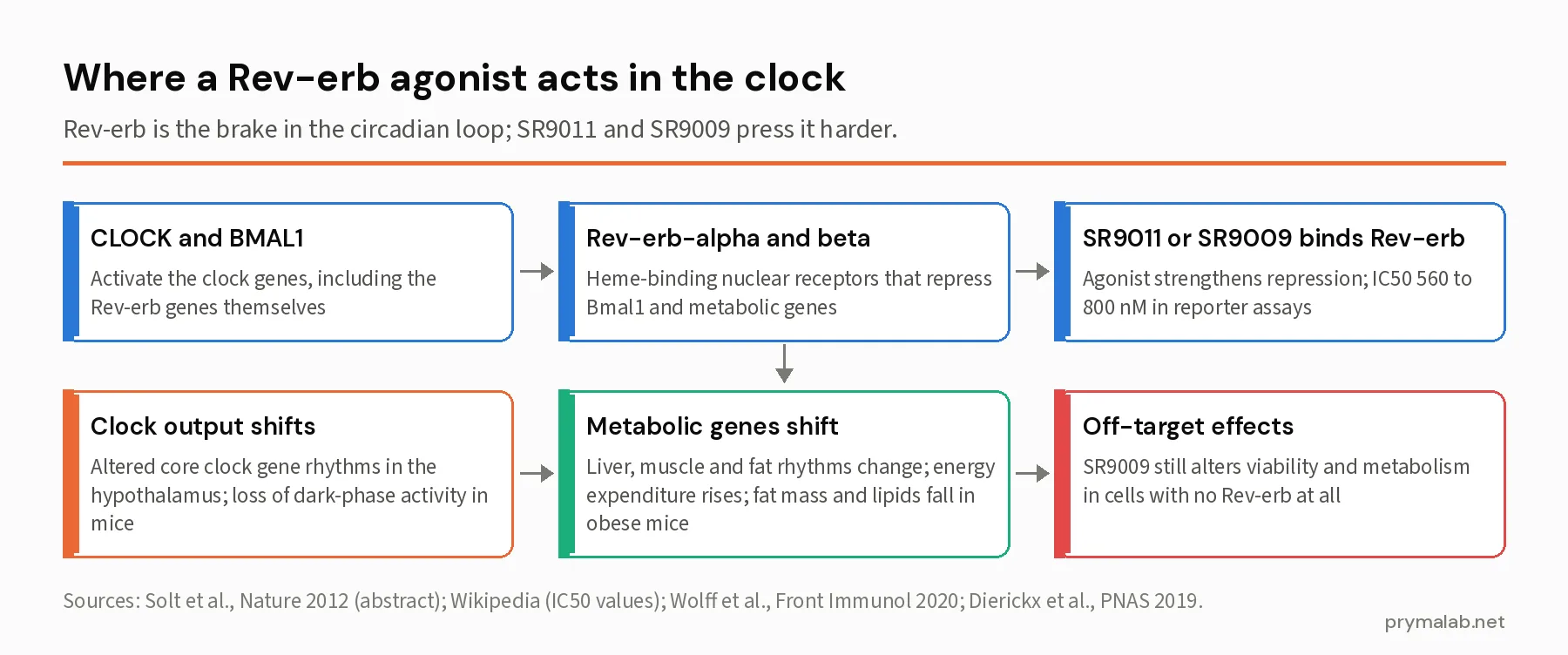
The 2012 Nature paper that introduced the compounds describes the consequence in its abstract: administration of synthetic Rev-erb ligands 'alters circadian behaviour and the circadian pattern of core clock gene expression in the hypothalami of mice', and 'the circadian pattern of expression of an array of metabolic genes in the liver, skeletal muscle and adipose tissue was also altered, resulting in increased energy expenditure'.[3] That sentence is the whole basis of the metabolic claims made for the compounds, and its two halves cannot be separated: the metabolic genes moved because the clock moved.
The clock moving is not free. A 2020 study that used SR9011 in microglia notes, of the systemic mouse work, that the agonist 'disrupted the circadian behavior of mice leading to loss of locomotor activity during the active phase (dark phase)'.[5] A nocturnal animal that stops moving at night has not been given more energy; it has been given a different clock. The product name 'stenabolic' and the phrase 'exercise in a bottle' describe an animal that ran less.
The 2012 mouse study and what it did and did not show
Solt and colleagues treated diet-induced obese mice with the agonists and reported that treatment 'decreased obesity by reducing fat mass and markedly improving dyslipidaemia and hyperglycaemia'.[3] The abstract gives no numbers, and I could not retrieve the full paper, so this reference does not print percentages it has not seen; the finding itself is not in doubt and has been reproduced in spirit by the laboratories that followed. Two features of the design matter more than any percentage.
The first is the route. The compounds were injected into the animals' abdomens, not fed to them, because they do not survive oral administration. As Chemical and Engineering News put it in 2018, SR9009 and SR9011 'both pass the blood-brain barrier, enabling them to reach the brain, but they are not orally available, so researchers had to inject them into the animals'.[4] A capsule or an oral liquid of a compound with no oral availability is a delivery method that has never been shown to deliver anything.
The second is what 'increased energy expenditure' meant in the same animals. The 2012 abstract's own first finding is altered circadian behaviour, and the 2020 follow-up spells out the direction: loss of activity in the dark phase.[3][5] Whatever the compounds did to fat, they did it to mice that had stopped being nocturnal.
The 2019 knockout result: SR9009 works without Rev-erb
The cleanest test of whether a drug acts through its receptor is to remove the receptor. Dierickx, Emmett and colleagues did that in 2019, using a mouse model in which both Rev-erb-alpha and Rev-erb-beta were conditionally deleted, and asked what SR9009 did in cells with neither. It kept working. SR9009 'can decrease cell viability, rewire cellular metabolism, and alter gene transcription in hepatocytes and embryonic stem cells lacking both REV-ERB' proteins, so its effects 'cannot be solely attributed to REV-ERB activation'; the compound, the authors conclude, has pleiotropic effects through other mechanisms, and the paper is titled accordingly: 'SR9009 has REV-ERB-independent effects on cell proliferation and metabolism'.[6]
That result reorganises everything above it. If SR9009 changes metabolism in cells that have no Rev-erb, then some unknown share of the 2012 metabolic findings, and of the 2018 cancer findings below, is not Rev-erb pharmacology at all. The authors' stated purpose was to warn other laboratories that use SR9009 as a Rev-erb probe; for anyone using it as a supplement the warning is larger, because 'off-target' is a euphemism for 'mechanism unknown'.
Whether SR9011 shares the problem has not been tested. The 2020 microglia paper states it plainly: 'SR9009, a REV-ERB agonist similar to SR9011, has been reported to exert Rev-erbα independent side-effects on cell proliferation and metabolism. Whether SR9011 has the same side-effects is currently unknown, and requires further research.'[5] Two molecules of the same design, one shown to act off its target, the other never checked.
The 2018 cancer study
The most striking result on the compounds is not metabolic. Sulli and colleagues, in Nature in 2018, reported that 'pharmacological activation of REV-ERBs is lethal in cancer and oncogene-induced senescence'. SR9009 and SR9011 killed melanoma, breast, lung, leukaemia and glioblastoma cells and oncogene-induced senescent cells, including the cells of melanocytic naevi, by inhibiting autophagy and de novo lipogenesis, two processes cancer cells depend on more than normal cells do; the compounds had 'no effect on the viability of normal cells or tissues'; the effect was independent of p53 and held under hypoxia; and in mice carrying patient-derived glioblastoma, SR9009 'impairs glioblastoma growth in vivo and improves survival without causing overt toxicity'.[7] Chemical and Engineering News noted it 'worked about as effectively as temozolomide', the standard drug, in the mice.[4]
Two things to hold beside that. The amount given to the mice was very large, and the compound is not orally available. And the off-target result arrived a year later: some of the lethality in cancer cells may be the same Rev-erb-independent toxicity that showed up in knockout cells. The senior authors were candid about where the work stood. Burris told the magazine, 'The true test will be getting SR9009 and SR9011 into human trials', and Satchidananda Panda, whose laboratory led the cancer study, said there was 'no immediate commercialization plan'.[4] That was 2018. There is still no trial.
The human record: none
This section is short because its subject is empty. No clinical trial of SR9011 or SR9009 has been registered or published. There is no human pharmacokinetic study, no measured human exposure, no safety database, no dose. The only human material the compounds have touched in the literature is liver microsomes: in 2016 Geldof and colleagues at the Ghent anti-doping laboratory incubated both compounds with human liver microsomes to predict what a urine test should look for, and identified eight metabolites of SR9009 and fourteen of SR9011. The same paper confirmed SR9009 in a black-market product bought over the internet, and reported that in a retrospective look at 1,511 doping-control samples 'the presence of neither the parent compound nor the metabolites could be detected'.[8]
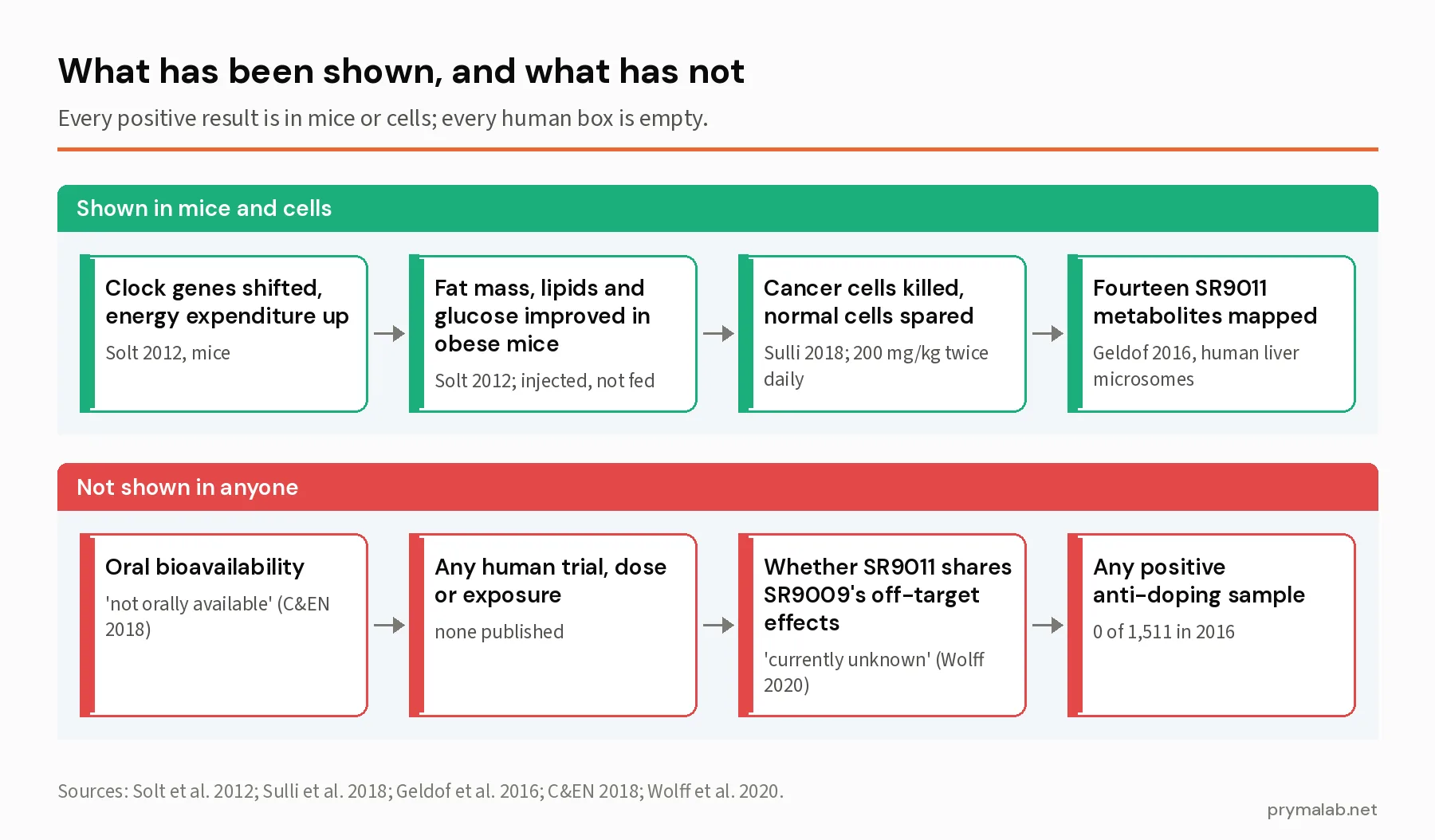
A compound that is being sold to people while its only human data are the breakdown products a laboratory predicted in a test tube is an unusual thing, and the honest description is the one the developers gave: research tools, awaiting a trial that nobody has funded.
WADA: from 'non-approved' to named
Anti-doping caught up with the compounds in stages. In 2016 they were 'indirectly prohibited as non-approved substances (Class S0)', the catch-all for anything with no approval anywhere, with the Ghent group noting they 'could potentially also be classified as metabolic modulators (Class S4)'.[8] The 2018 Prohibited List did exactly that: 'SR9009, a Rev-Erb-α agonist, was added as an example' under S4 metabolic modulators, with 'biological effects similar to AICAR'.[9] On the 2026 List both names appear in item S4.4.1, 'Rev-erbα agonists, e.g. SR9009, SR9011', in the same clause as the PPAR-delta agonists including GW1516 and next to the AMPK activators AICAR and MOTS-c. Section S4 is prohibited at all times, in and out of competition, and S4.4 substances are non-specified, so no reduced-sanction route for inadvertent use applies.[10]
USADA lists SR9009 and SR9011 among the prohibited substances 'sometime marketed as SARMs', alongside GW501516, and the point of that list is the mislabelling: an athlete who believes they are avoiding SARMs by buying 'stenabolic' has bought a listed metabolic modulator instead.[11]
| Year | Status | Basis |
|---|---|---|
| 2012 | Not listed | Compounds published; no market yet |
| 2016 | Prohibited indirectly under S0, non-approved substances | Ghent laboratory maps metabolites and finds SR9009 in an internet product |
| 2018 | SR9009 named as an example under S4 metabolic modulators | 'Biological effects similar to AICAR' |
| 2026 | SR9009 and SR9011 both named in S4.4.1 with the PPAR-delta agonists | Prohibited at all times; non-specified substances |
SR9011 vs SR9009, cardarine and AICAR
Three families of compound share the WADA clause, and the market sells them as if they were one product line. They are three different pharmacologies with three different records.
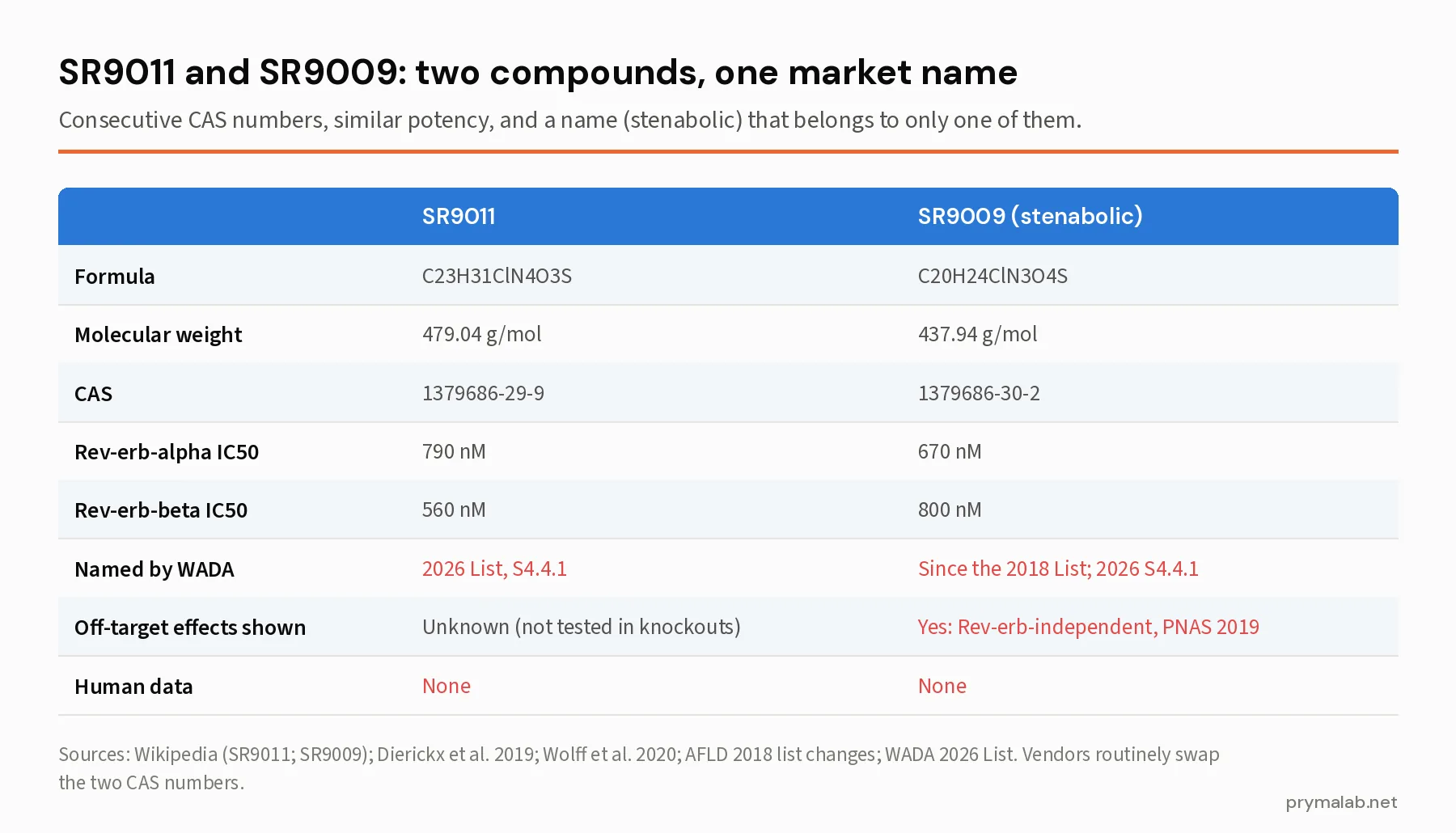
SR9011 against SR9009. Same design, same laboratory, same year. SR9011 is 41 Da heavier and marginally more potent at Rev-erb-beta; SR9009 is marginally more potent at alpha. SR9009 has been shown to act off-target; SR9011 has not been checked. SR9009 was named on the WADA list first and carries the stenabolic name; SR9011 is named alongside it now.[1][2][6][10] Nothing in the literature supports a claim that one is safer or more effective than the other in any animal, and there are no humans to compare.
Against cardarine. GW501516 acts on PPAR-delta, a receptor that turns lipid-oxidation genes on, and it has five human lipid trials and a rodent cancer package that ended it; the cardarine reference covers it. SR9011 acts on the clock's repressor and has no human data of any kind. Against AICAR. AICAR is a nucleoside that activates AMPK through its metabolite ZMP, with three decades of intravenous trials behind it; the AICAR reference covers it. WADA's 2018 note that SR9009 has 'biological effects similar to AICAR' is a statement about endurance-relevant metabolic modulation, not about mechanism; the two share a clause, not a receptor.[9]
Research-grade SR9011: what to verify
SR9011 is a legitimate research tool with a specific job, probing Rev-erb biology, and the verification questions follow from the identity problems above. Mass spectrometry against the 479.04 Da parent settles whether a vial is SR9011 or SR9009 in one number, and the nitro group and chlorine give distinctive fragments. HPLC purity by lot follows. The CAS number on the certificate should be 1379686-29-9, and a listing that pairs the SR9011 name with SR9009's mass or CAS has told you it did not check. The purity testing guide covers the general principles for a small molecule.
| Field | SR9011 | SR9009 | If the listing mixes them |
|---|---|---|---|
| Observed mass | 479.04 Da | 437.94 Da | The mass, not the name, tells you which compound you have |
| Formula | C23H31ClN4O3S | C20H24ClN3O4S | Different nitrogen and oxygen counts |
| CAS | 1379686-29-9 | 1379686-30-2 | Consecutive numbers; swapped on many listings |
| Market name | Sold as SR9011, sometimes as stenabolic | Stenabolic | Stenabolic on an SR9011 listing is a borrowed name |
| Off-target data | None | Rev-erb-independent effects shown (2019) | Neither is cleaner; one is simply untested |
Handling: the compound is lipophilic and dissolves in DMSO and ethanol, not water, so stocks are made in solvent and diluted into medium; the nitrothiophene is light-sensitive, so stocks live dark at -20 °C and working solutions are made fresh. Because it is not orally available and has no human pharmacokinetics, any listing that describes an oral 'half-life' or 'dosing window' is describing something that has never been measured. PrymaLab's SR-9011 listing is documented on the identity basis above; the related nuclear-receptor compound GW-501516 is documented the same way. The legal status guide covers the research-use framework: unscheduled, unapproved, legal to sell and hold for laboratory research and not for human use, and prohibited for athletes at all times.
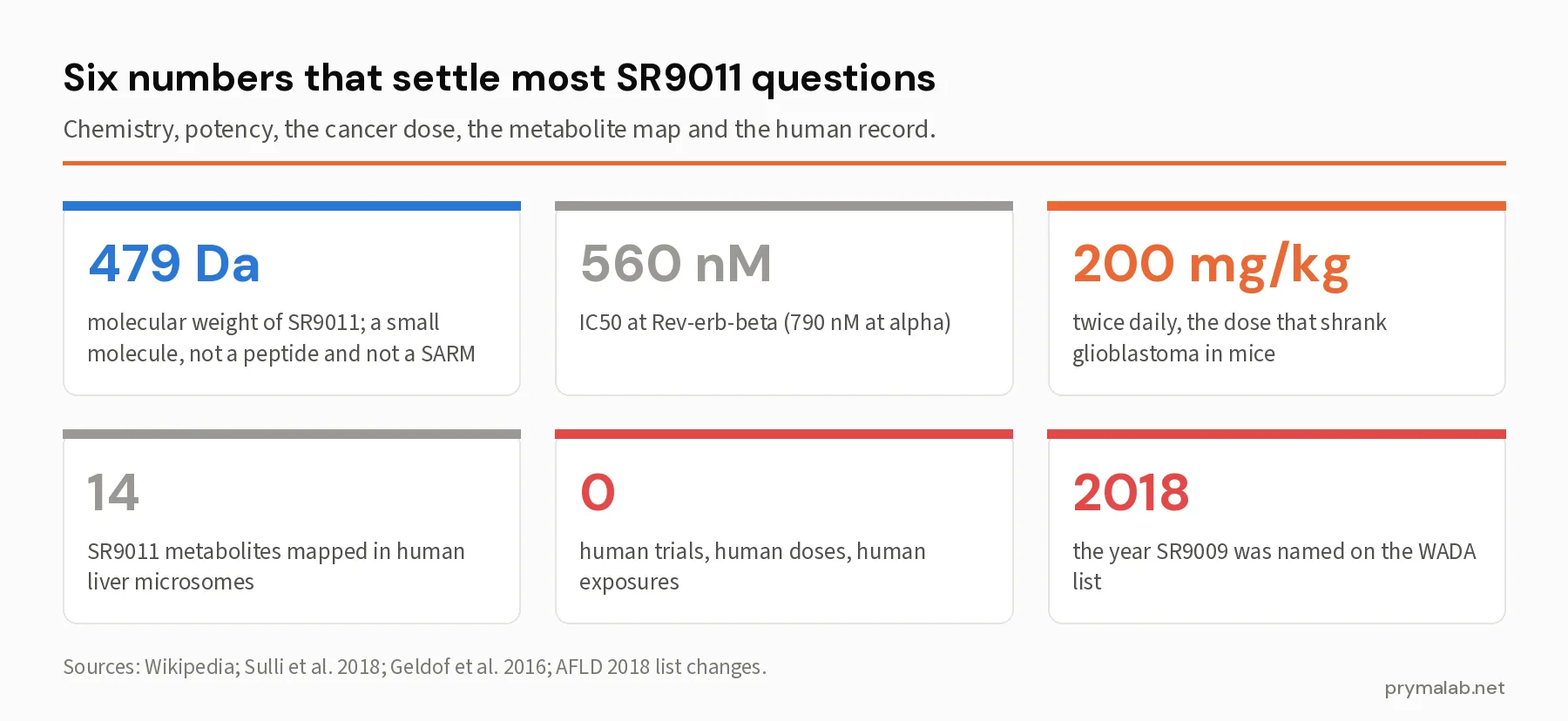
The version of the story the record supports: two clock-setting tool compounds from one Scripps laboratory; a real mouse result in which fat and lipids fell while the animals' activity rhythm collapsed; a cancer result at a heroic injected dose that the developers themselves said needed a human trial; a knockout experiment showing one of the pair works without its receptor and a literature that has not asked about the other; no oral availability; no human data; a WADA listing since 2018; and a market name, stenabolic, that belongs to the sibling and describes neither.
What this article does not settle
The 2012 effect sizes. The abstract reports direction, not magnitude, and the full text was not retrievable; the article does not print percentages for fat loss, lipids or glucose because it has not verified them.
Whether SR9011 acts off-target. Untested. The 2019 knockout work used SR9009 only.
Any human parameter. Bioavailability, half-life, exposure, safety and efficacy are all unmeasured in people.
What the cancer result means. Whether the lethality in cancer cells is Rev-erb pharmacology or the same non-specific toxicity seen in knockout cells is an open question the 2019 paper raised and nobody has closed.
What is well established: the structures, masses, CAS numbers and IC50 values; the Rev-erb mechanism as designed; the 2012 directional findings and the disrupted activity rhythm; the 2018 cancer findings and dose; the 2019 off-target result for SR9009; the 2016 metabolite map and the absence of positive samples; the lack of oral availability; the absence of any human study; and the WADA history from S0 to S4.4.1.
SR9011, SR9009, stenabolic and Rev-erb: what the names refer to
SR is the compound prefix of the Scripps Research Institute Florida chemistry programme, and 9011 and 9009 are consecutive serial numbers with no chemical meaning; the two compounds were made and published together in 2012.[3] Rev-erb is the name of the receptor family, from 'reverse erb', because the gene was discovered on the opposite strand of the thyroid hormone receptor gene ERBA; the formal names are NR1D1 for Rev-erb-alpha and NR1D2 for Rev-erb-beta, and both bind heme as their natural ligand.[1] Stenabolic is a market name coined for SR9009 when it appeared for sale online and is now applied loosely to both compounds; it is not a chemical name and does not appear in any paper.[2] 'Rev-erb agonist' is the pharmacological class and the term WADA uses in S4.4.1.[10] None of the names denotes a SARM or a peptide.
How a Rev-erb agonist represses: RORE sites, NCoR and HDAC3
Rev-erb alpha and Rev-erb beta, gene names NR1D1 and NR1D2, are members of the nuclear hormone receptor superfamily. They are usually introduced as orphan nuclear receptors, which was accurate until heme was identified as their natural ligand; adopted orphans is the more honest label now. What separates them from most of the family is structural: they lack the AF2 helix that other nuclear receptors use to recruit coactivators, so they cannot activate anything. They only repress.
The mechanism is physical and well mapped. A Rev-erb dimer binds DNA at a RORE or RevDR2 element, and genome-wide work has shown its binding sites are strongly enriched for those two motifs. Once bound it holds the NCoR corepressor complex, which brings HDAC3, a histone deacetylase that strips acetyl groups from nearby histones and closes the chromatin. An agonist does not switch this on. It deepens it, by stabilising the receptor in the conformation that holds NCoR more tightly. GSK4112 was the first synthetic compound shown to do that, and SR9009 and SR9011 were both built on its scaffold.
Which genes that silences is worth getting right, because most summaries get it wrong. The direct targets in the molecular clock are Bmal1, Clock, Npas2 and Cry1. Rev-erb alpha is the main regulator of cyclic Bmal1 transcription, and repressing BMAL1 is how a Rev-erb agonist moves circadian rhythm. The Per genes are not on that list. PER1 and PER2 are E-box genes driven by the CLOCK-BMAL1 heterodimer, so they sit downstream of the positive limb rather than under Rev-erb's direct control, and in the 2012 mouse study the agonists actually raised Per2 in the hypothalamus while suppressing Cry2. Anyone reading that a Rev-erb agonist suppresses PER1 has the wiring backwards.
Outside the clock the same repression reaches metabolic genes, including those for fatty acid metabolism in liver and skeletal muscle, which is where the energy-expenditure findings come from. Every biological response attributed to these compounds in the literature traces back through that one lever: more corepressor at the response element, less transcription of whatever it controls.
Agonist, antagonist, inverse agonist: why the labels get swapped
Because Rev-erb is a constitutive repressor, the usual vocabulary inverts, and secondary sources routinely call SR9009 an inverse agonist. No primary paper does. The convention in this field is: an agonist, meaning heme, GSK4112, SR9009 or SR9011, enhances corepressor recruitment and deepens repression. An antagonist relieves it and lets the target genes come back up. SR8278 is the described antagonist, and a selective oxazole-based inverse agonist was developed for the 2018 lung work.
The confusion is not purely sloppiness. Nitric oxide acts like an antagonist of Rev-erb activity in cells and yet increases corepressor binding biochemically, which is agonist behaviour, and reviews have documented that contradiction openly. The practical point for anyone reading around these compounds is that the two labels are not two names for one thing. They are opposite interventions with opposite effects on BMAL1, and a paper describing an inverse agonist is describing a different compound class from the one in this article.
There is also a direction-of-effect result worth knowing. Rev-erb inhibition with SR8278 accelerated microglial clearance of amyloid beta in a 2020 study, which is the reverse of what an agonist would be expected to do. The clock is not a dial where one direction is uniformly good.
The cardiac literature, and the knockout that undid its mechanism
Rev-erb has a real and genetically demonstrated role in the heart. Mice engineered without Rev-erb alpha and beta in cardiac tissue develop progressive dilated cardiomyopathy and lethal heart failure, reported in Circulation in 2022. That establishes the receptor as necessary for normal cardiac function, and it is the strongest heart failure finding in the whole Rev-erb field.
The pharmacology looked consistent with it. SR9009 attenuated cardiac hypertrophy in mice subjected to transverse aortic constriction and lowered heart weight in old animals, published in 2017. A separate 2017 study gave SR9009 intraperitoneally after permanent coronary ligation and reported better survival and left ventricular function, with lower Il6, Mcp1 and Mmp9 and less neutrophil and proinflammatory macrophage infiltration. Read together, those two papers are why heart failure appears in almost every description of this compound, usually without the paragraph that follows.
Then the mechanism came apart. A 2022 study repeated the aortic constriction experiment in cardiac Rev-erb alpha and beta double-knockout mice and found the protection was still there, concluding a Rev-erb-independent cardioprotective effect. A companion paper found SR9009 suppressed cardiac fibroblast activation in the same Rev-erb-independent way. So the honest summary is uncomfortable but short: SR9009 does something useful in several mouse models of cardiac injury, Rev-erb is genuinely required for a healthy heart, and the two facts are not connected by the drug. Whatever is producing the cardiac effect is off-target and unidentified.
What does not exist is any human data. No Rev-erb ligand of any kind has a registered clinical trial, and a ClinicalTrials.gov search for SR9009, SR9011, stenabolic or Rev-erb agonist returns nothing at all. Every heart failure claim attached to these compounds is a mouse claim, and the mouse claim no longer has a mechanism behind it. The same goes for the broader cardiovascular disease framing: no cardiovascular disease endpoint has been measured in a person.
Inflammation: macrophages, lungs and microglia
This is the most reproducible part of the Rev-erb literature and the part least discussed in the places these compounds are sold. The receptor gates innate immunity on a daily cycle, and manipulating it changes how hard the immune system responds.
In macrophages, Rev-erb alpha controls the endotoxin response, and a 2012 study showed that giving a synthetic Rev-erb ligand or knocking down rev-erba both changed production and release of the proinflammatory cytokine IL-6, in human cells as well as mouse. A 2018 study found Rev-erb alpha gates NLRP3 expression and therefore IL-1 beta and IL-18 secretion, with SR9009 reducing those pro-inflammatory cytokines in both mouse and human macrophages and improving survival in fulminant hepatitis.
In the lung, Rev-erb alpha couples the pulmonary clock to innate immune function, and mutating both Rev-erb genes in bronchial epithelium produced a basal inflammatory state on its own. Pulmonary inflammation in these models has a time of day, and airway hyper-responsiveness loses its rhythm when Rev-erb alpha is deleted.
In the brain, deleting Rev-erb alpha caused spontaneous microglial activation and raised pro-inflammatory cytokines and other NF-kB transcripts, and SR9009 suppressed lipopolysaccharide-induced hippocampal neuroinflammation in the same 2019 paper. A 2025 stroke study is a useful corrective on how narrow these effects can be: SR9009 lowered TNF alpha and raised IL-10 in blood and brain in mice dosed at one circadian time point and not at the other, and it did not improve the neurological deficit score either way.
Rev-erb also reaches neurotransmitters. Rev-erb alpha represses the transcription factor Nurr1 and tyrosine hydroxylase, the rate-limiting enzyme for dopamine, which puts midbrain dopaminergic output under clock control. None of this has been studied in a person.
Frequently asked questions
What is SR9011?
A 479 Da Rev-erb agonist designed at Scripps in 2012 with SR9009 (stenabolic) as a research tool. Injected into mice it shifted clock genes and cut fat and lipids; it is not orally available, has no human data, and is WADA-listed.
What is the difference between SR9011 and SR9009?
Same design and paper; SR9011 is 479 Da (CAS 1379686-29-9), SR9009 is 438 Da (CAS 1379686-30-2). SR9009 is 'stenabolic', was WADA-listed first, and is the one shown to act off-target. Neither has human data.
Is SR9011 a SARM?
No. It is a Rev-erb agonist with no androgen receptor activity. It is sold beside SARMs and mislabelled as one, which is why USADA lists it among substances 'sometime marketed as SARMs'.
Does SR9011 work orally?
Not according to the developers: the compounds 'are not orally available', which is why every animal study injected them. No human pharmacokinetics exist.
What did the SR9011 mouse studies show?
Shifted clock genes, higher energy expenditure, and less fat with better lipids and glucose in obese mice, all by injection; the mice also lost their normal night-time activity. The abstract gives no effect sizes.
Does SR9011 fight cancer?
In cells and mice, yes: both compounds killed cancer cells and SR9009 shrank glioblastoma in mice by injection (2018). No human has been treated and the mechanism is complicated by the 2019 off-target finding.
What does 'off-target' mean for SR9009 and SR9011?
SR9009 still changed viability, metabolism and transcription in cells with no Rev-erb at all (PNAS 2019), so its effects are partly not Rev-erb pharmacology. SR9011 has not been tested for this.
Is SR9011 banned by WADA?
Yes, at all times: indirectly since 2016, SR9009 named in 2018, both named in S4.4.1 on the 2026 List as non-specified substances.
Has anyone tested positive for SR9011 or SR9009?
As of the 2016 Ghent study, neither compound nor its metabolites appeared in 1,511 doping-control samples; the test now exists. Later cases are outside what this reference could verify.
Is SR9011 legal?
In the US it is an unscheduled research chemical: legal for laboratory research, not for human use, and banned for athletes at all times. It has no approval anywhere.
How do I verify an SR9011 sample?
Mass spectrometry against 479.04 Da (SR9009 is 437.94) plus HPLC purity by lot, and check the CAS is 1379686-29-9, not SR9009's 1379686-30-2. Store dark at -20 degrees; it does not dissolve in water.
Which genes does a Rev-erb agonist actually repress?
The direct RORE and RevDR2 targets are Bmal1, Clock, Npas2 and Cry1. Not the Per genes: PER1 and PER2 are E-box genes driven by CLOCK-BMAL1, and in the 2012 mouse study the agonists raised Per2 while suppressing Cry2. Repression works by holding NCoR and HDAC3 at the binding site.
Is SR9009 an agonist or an inverse agonist?
An agonist. Rev-erb lacks the AF2 helix and is a constitutive repressor, so an agonist deepens repression by stabilising corepressor recruitment, while an antagonist relieves it. SR8278 is the antagonist. No primary paper describes SR9009 as an inverse agonist, though secondary sources frequently do.
What does the heart failure research on SR9009 show?
Benefit in mouse models and no mechanism. SR9009 attenuated hypertrophy after aortic constriction and improved survival after coronary ligation, and cardiac Rev-erb double-knockout mice develop lethal heart failure on their own. But a 2022 study found the cardioprotection persists in those same knockouts, so the effect is Rev-erb-independent and off-target. There is no human cardiovascular disease data of any kind.
What is the strongest part of the Rev-erb literature?
Inflammation. Rev-erb alpha gates macrophage IL-6 and the NLRP3 pathway for IL-1 beta and IL-18 in human as well as mouse cells, couples the pulmonary clock to innate immunity, and restrains microglial activation, with SR9009 suppressing lipopolysaccharide-induced hippocampal neuroinflammation. A 2025 stroke study found the effect appeared at one circadian time point and not the other, and did not improve neurological outcome.
Has any Rev-erb agonist been tested in people?
No. A ClinicalTrials.gov search for SR9009, SR9011, stenabolic or Rev-erb agonist returns zero registered studies. No Rev-erb ligand of any kind has entered a registered human trial.
References
- Wikipedia. SR9011. IUPAC name, formula, molecular weight, CAS, IC50 values, developer and research uses. Wikipedia
- Wikipedia. SR9009. Formula, molecular weight, CAS, IC50 values, the stenabolic name and the WADA listing. Wikipedia
- Solt LA, Wang Y, Banerjee S, et al. Regulation of circadian behaviour and metabolism by synthetic REV-ERB agonists. Nature. 2012;485(7396):62-68. doi:10.1038/nature11030. PMID 22460951. Abstract quoted; full text not retrieved. Nature
- Chemical and Engineering News. Activating circadian clock kills cancer cells. 2018;96(3). Origin of the compounds, lack of oral availability, the temozolomide comparison, and the Burris and Panda quotations. C&EN
- Wolff SE, Wang XL, Han J, et al. The effect of Rev-erbα agonist SR9011 on the immune response and cell metabolism of microglia. Front Immunol. 2020;11:550145. The dark-phase activity loss and the statement that SR9011's off-target effects are unknown. Frontiers
- Dierickx P, Emmett MJ, Jiang C, et al. SR9009 has REV-ERB-independent effects on cell proliferation and metabolism. Proc Natl Acad Sci USA. 2019;116(25):12147-12152. doi:10.1073/pnas.1904226116. PMID 31127047. PNAS
- Sulli G, Rommel A, Wang X, et al. Pharmacological activation of REV-ERBs is lethal in cancer and oncogene-induced senescence. Nature. 2018;553(7688):351-355. doi:10.1038/nature25170. Nature
- Geldof L, Deventer K, Roels K, Tudela E, Van Eenoo P. In vitro metabolic studies of REV-ERB agonists SR9009 and SR9011. Int J Mol Sci. 2016;17(10):1676. doi:10.3390/ijms17101676. Metabolite mapping, the black-market product, the S0 status and the 1,511 negative samples. MDPI
- Agence Française de Lutte contre le Dopage. Prohibited substances and methods: main changes made to the 2018 List. SR9009 added as an example under S4 with effects similar to AICAR. AFLD
- World Anti-Doping Agency. The 2026 Prohibited List, International Standard. S4.4.1 wording naming SR9009 and SR9011; S4 prohibited at all times; S4.4 non-specified. WADA
- US Anti-Doping Agency. Selective androgen receptor modulators (SARMs): prohibited class of anabolic agents. SR9009, SR9011 and GW501516 'sometime marketed as SARMs'. USADA
Figures come from the published papers, the trade press report, the anti-doping literature and WADA documents named above, current to 23 September 2026. The 2012 Nature paper's full text was not retrievable; only its abstract is quoted, and the article says so.
Final disclaimer: This article is an educational research reference on the chemistry, pharmacology, animal record and anti-doping status of SR9011 and SR9009. Compounds supplied by PrymaLab are sold for laboratory research use only and are not approved by any regulator for human or veterinary use. Statements have not been evaluated by the FDA. Nothing here is medical advice or a treatment claim.
Animal study designs are reported as facts and do not describe or support any use of research-grade material. There are no human data for these compounds. They are prohibited for athletes at all times under the World Anti-Doping Code. Always verify the legal status of any research compound in your jurisdiction before purchase or use.