Description
PrymaLab · Research Use Only
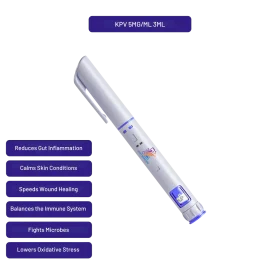
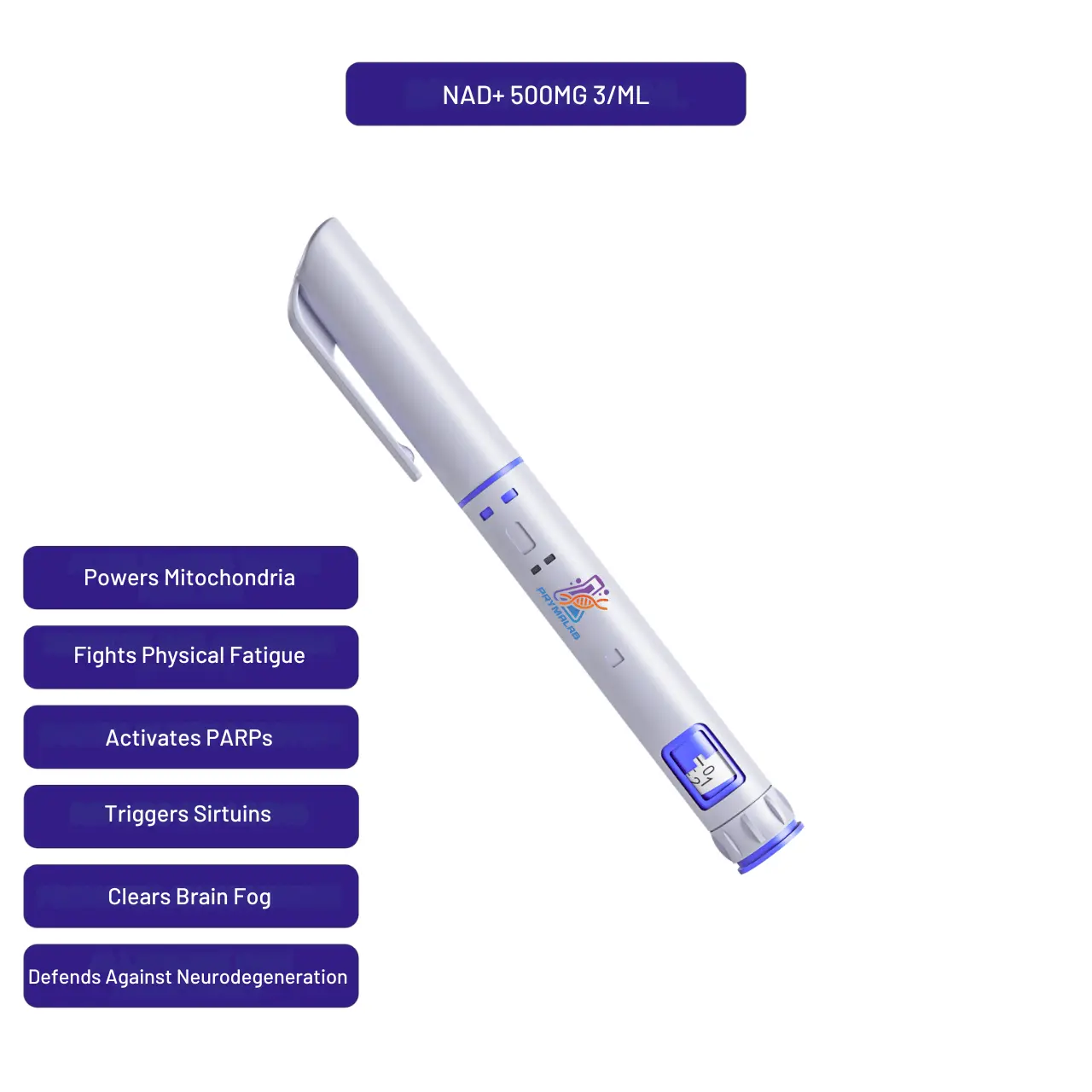
NAD+ Autoinjector 500mg/ml
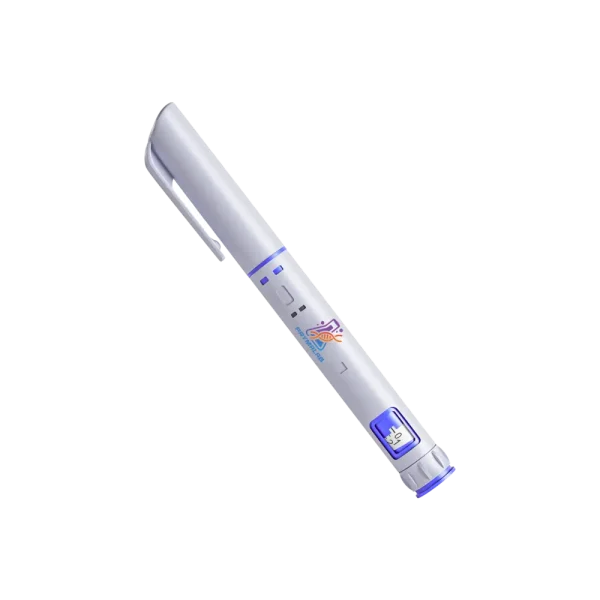
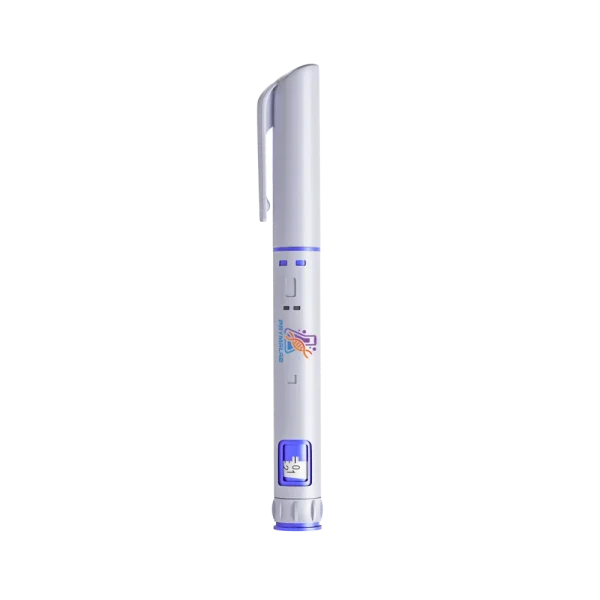
Pre-filled solution-state device · concentration-specified format
NAD+ autoinjector 500mg/ml is a pre-filled device containing nicotinamide adenine dinucleotide in solution at 500 milligrams per millilitre, CAS 53-84-9, molecular weight 663.43. The concentration specification distinguishes it from formats labelled by total content alone.
Specification Table
| Property | Value |
|---|---|
| Compound | Nicotinamide adenine dinucleotide, oxidised form |
| Format | Pre-filled autoinjector device |
| Physical state | Solution, supplied ready-filled |
| Labelled concentration | 500 mg/ml |
| Molar concentration at label | Approximately 754 mM |
| Concentration basis | Mass per unit volume, not total device content |
| Common designation | NAD+ |
| CAS number | 53-84-9 |
| Molecular formula | C21H27N7O14P2 |
| Molecular weight | 663.43 g/mol |
| Compound class | Dinucleotide coenzyme. Not a peptide |
| Structure | Nicotinamide mononucleotide joined to adenosine monophosphate through a pyrophosphate bridge |
| Redox partner | NADH, the reduced form |
| Principal enzyme classes consuming NAD+ | Sirtuins, PARPs, CD38, SARM1 |
| Principal biosynthetic routes | De novo from tryptophan, Preiss-Handler from nicotinic acid, salvage from nicotinamide |
| Rate-limiting salvage enzyme | NAMPT, nicotinamide phosphoribosyltransferase |
| Appearance | White to off-white lyophilized powder |
| Purity | Per lot-specific certificate of analysis |
| Solubility | Freely water soluble |
| Aqueous stability | Degrades in aqueous solution, faster at alkaline pH and at raised temperature |
| Storage, lyophilized | -20°C, protected from light and moisture |
| Storage, reconstituted | 2-8°C, protected from light, short hold only |
| Regulatory status | No approved human or veterinary injectable formulation |
What Does a Concentration Label Specify That a Content Label Does Not?
The distinction between labelling by concentration and labelling by total mass is not cosmetic, and mixing the two is a recurring source of error.
A vial marked 500mg states how much compound is present. What concentration findings depends entirely on how much diluent the researcher adds, which is a decision made downstream.
A device marked 500mg/ml states the ratio directly. The concentration is fixed at manufacture, and total content depends on fill volume, which is a separate specification.
For calculation purposes the concentration form is more immediately useful, since molarity follows from it without any additional information, and five hundred milligrams per millilitre at 663.43 daltons is approximately 754 millimolar, a high concentration by any standard.
Errors arise when someone reads a concentration label as a content label or the reverse, and confirming which convention a given format uses before calculating is worth the few seconds it takes.
Why Does Solution State Matter More for NAD+ Than for Peptides?
Most pre-filled devices in this catalogue contain peptides, and the stability considerations transfer poorly to a dinucleotide coenzyme.
A lyophilized peptide is stable for long periods because the absence of water suppresses hydrolysis, deamidation and most other degradation routes. Reconstituting it starts a clock, but for many peptides that clock runs for weeks under refrigeration.
NAD+ in solution degrades faster than most peptides do, because glycosidic bond hydrolysis proceeds continuously, and alkaline conditions accelerate ring addition reactions. A pre-filled device has, by definition, been in solution since it was manufactured.
This makes storage conditions and elapsed time since manufacture more consequential for this format than for a peptide equivalent. Continuous cold-chain handling matters, and a device that has spent time at ambient temperature cannot be assumed to contain its labelled concentration.
Where a design depends on knowing concentration accurately, measuring it spectrophotometrically before use is more defensible than trusting the label, and NAD+ makes that measurement straightforward through its 260 nm absorbance.
What Can and Cannot Be Verified in a Sealed Device?
A pre-filled sealed format constrains analytical access in ways that are worth understanding before purchase.
Visual inspection is available and worth doing. NAD+ solution should be clear. Discolouration toward yellow or brown suggests degradation, and any visible particulate warrants rejecting the unit rather than investigating it.
Content verification requires withdrawing material, which the sealed format makes awkward and which may compromise the device. Where a programme requires verified concentration, a vial format supports that far better.
Lot documentation is the practical substitute. A certificate of analysis stating measured concentration, purity and the date of manufacture carries the information the sealed format denies the researcher directly.
Manufacture date deserves specific attention for this compound. For a lyophilized peptide it is a minor detail. For a coenzyme supplied in solution, it is the variable that determines how much degradation has already occurred.
Where Does the Device Format Fit in Research Use?
The pre-filled format trades analytical flexibility for handling convenience, and that trade suits some designs and not others.
Consistency of delivered volume is the main advantage. A device that dispenses a fixed volume removes pipetting variation between operators and between occasions, which matters in work where the same measured quantity is delivered repeatedly over an extended schedule.
Reduced handling steps also reduce contamination opportunities, since the material is never exposed to open air between manufacture and delivery.
Against that, the format rules out concentration adjustment, rules out most analytical verification, and commits the researcher to whatever the manufacturer specified. For concentration-response work, cell-culture titration, or any design needing multiple concentrations, a vial is the appropriate format.
For NAD+ specifically, the solution-state stability issue adds a consideration the peptide devices do not carry, and it should weigh in the format decision rather than be discovered afterward.
What Concentration Checks Suit the NAD+ Autoinjector 500mg/ml Format?
Where material can be withdrawn for verification, three measurements between them establish whether a solution-state preparation still matches its label.
Absorbance at 260 nanometres gives total concentration of the oxidised species against a known extinction coefficient near 18,000 per molar per centimetre. It is quick, requires no reagents, and needs only a small volume diluted into buffer.
The ratio of absorbance at 260 to absorbance at 340 reports on redox state. The oxidised form has negligible absorbance at 340 while the reduced form absorbs there strongly, so a rising 340 signal indicates the preparation has partly reduced.
Enzymatic cycling assays distinguish functional coenzyme from degraded material that retains absorbance. Coupling to alcohol dehydrogenase and following the reaction spectrophotometrically measures what is catalytically competent rather than what merely absorbs light.
The third is the most informative and the least often performed, and for a solution-state product where degradation is expected rather than exceptional, it is the measurement that actually answers the question.
A discrepancy between absorbance-derived and enzymatically-derived concentration is itself diagnostic. It quantifies the degraded fraction directly rather than inferring it.
What Documentation Should Accompany This Format?
A sealed solution-state coenzyme product leans on its paperwork more heavily than a lyophilized vial does, and specific fields carry the weight.
Concentration determined analytically at fill, stated with the method used. A nominal figure derived from the mass weighed into a batch is not a measurement of what the device contains.
Date of fill rather than date of packaging or date of release, since degradation runs from the moment the solution exists, and intermediate dates understate the elapsed interval.
Buffer composition and pH, because both determine the degradation rate and neither is deducible from the label. A lightly acidic formulation behaves quite differently from a neutral one over the same interval.
Any stability data the manufacturer holds for this formulation, stated as measured retention over time rather than as an assigned expiry. An expiry date is a conclusion; retention data is evidence.
Where these fields are unavailable, that absence is itself information worth recording in the experimental notes rather than passing over.
How Should the NAD+ Autoinjector 500mg/ml Be Recorded?
A sealed solution-state product shifts the record from what was prepared to what was received.
With a lyophilized vial the laboratory controls the reconstitution and therefore knows the solution history exactly. With the NAD+ autoinjector 500mg/ml that history begins at the manufacturer, and the fields that matter are ones the supplier holds rather than ones the laboratory generates.
Fill date, measured concentration at fill, buffer composition, and cold-chain record during transit are the four. None can be reconstructed afterward.
Once received, the laboratory record adds arrival date, storage location and temperature, any excursion, and the date of each use.
Together those two halves give the elapsed solution age at the moment of each experiment, which for a degrading coenzyme is the single most informative number about the material.
Storage and Handling in Laboratory Practice
Maintain cold storage continuously. For a solution-state coenzyme this is not a precaution, it is the thing stoping measurable degradation.
Protect from light. Keep the device in its original packaging until use, which handles both light exposure and physical protection of the mechanism.
Do not freeze a pre-filled device unless the manufacturer specifies it. Freezing a sealed liquid-filled mechanism risks the container and the seal, and the mechanism is not designed to tolerate the volume change.
Inspect before every use. Clear solution, intact seal, no visible particulate. Record lot, manufacture date where stated, storage history including any ambient excursion, and date of use. For this format the storage history is a substantive part of the record rather than an administrative detail.
One further point applies to any concentration this high. At approximately 754 millimolar the solution is far above the range most designs use, which means every experiment begins with a dilution step and that step is where error enters.
Serial dilution compounds error at each stage. A single large dilution from stock into a well-mixed intermediate is more accurate than three successive small ones, and using a calibrated volumetric approach for the first step is worth the extra minute.
Record the dilution scheme alongside the concentration. A stated final concentration with no route to it cannot be checked afterward.
Published Literature
References verified against the publisher record. They address NAD+ biology rather than the device format, for which no peer-reviewed literature specific to research use exists.
- Cantó C, Menzies KJ, Auwerx J. Cell Metabolism. 2015;22(1):31-53.
- Verdin E. Science. 2015;350(6265):1208-1213.
- Yoshino J, Baur JA, Imai SI. Cell Metabolism. 2018;27(3):513-528.
- Rajman L, Chwalek K, Sinclair DA. Cell Metabolism. 2018;27(3):529-547.
- Cambronne XA, Kraus WL. Trends in Biochemical Sciences. 2020;45(10):858-873.
- Bogan KL, Brenner C. Annual Review of Nutrition. 2008;28:115-130.
Frequently Asked Questions
What is NAD+ autoinjector 500mg/ml?
A pre-filled device containing nicotinamide adenine dinucleotide in solution at 500 milligrams per millilitre, CAS 53-84-9. The concentration specification distinguishes it from formats labelled by total content. Supplied for laboratory research alone. Not for human or veterinary use.
How does a concentration label differ from a content label?
A content label states how much compound is present, with concentration depending on how much diluent is added downstream. A concentration label states the ratio directly, fixed at manufacture, with total content depending on fill volume as a separate specification.
What molarity does 500mg/ml represent?
Approximately 754 millimolar, calculated from the 663.43 dalton molecular weight. That is a high concentration by any standard, and most research designs will dilute substantially from it rather than using it as supplied.
Why does solution state matter more for NAD+?
Because it degrades faster in solution than most peptides do. Glycosidic bond hydrolysis proceeds continuously and alkaline conditions accelerate ring addition. A pre-filled device has by definition been in solution since manufacture, so elapsed time is consequential.
Should the labelled concentration be trusted?
Where a design depends on accurate concentration, measuring spectrophotometrically before use is more defensible than trusting the label. NAD+ absorbs strongly at 260 nanometres, which makes that verification straightforward if material can be withdrawn.
What can be checked in a sealed device?
Visual inspection only, in practical terms. The solution should be clear, and discolouration toward yellow or brown suggests degradation. Any visible particulate warrants rejecting the unit. Content verification requires withdrawing material, which the format makes awkward.
Why does manufacture date matter here?
Because for a coenzyme supplied in solution it determines how much degradation has already occurred before the device reaches the laboratory. For a lyophilized peptide the same field is a minor administrative detail rather than a stability variable.
What does the device format offer?
Consistency of delivered volume, which removes pipetting variation between operators and occasions, and fewer handling steps, which reduces contamination opportunities since the material is never exposed to open air between manufacture and delivery.
When is a vial the better choice?
For concentration-response work, cell-culture titration, or any design needing multiple concentrations. The device format rules out concentration adjustment and most analytical verification, committing the researcher to whatever the manufacturer specified.
Can the device be frozen?
Not unless the manufacturer specifies it. Freezing a sealed liquid-filled mechanism risks both the container and the seal, since the mechanism is not designed to tolerate the volume change that freezing produces. Maintain cold refrigerated storage instead.
Compliance Statement
NAD+ autoinjector 500mg/ml is sold exclusively for laboratory research use. It is not a drug, food, or cosmetic product, and it is not a dietary product of any kind. It is not approved by the FDA or any comparable authority for human or veterinary use, and the device format does not alter that status in any way. This product is not intended to diagnose, treat, cure, or prevent any disease. It must not be given to humans or animals. Purchase is restricted to qualified researchers and institutions operating within applicable laws. All handling is the responsibility of the purchasing laboratory.


19 reviews for Preloaded Autoinjector | NAD+ (injectable) | 3ml Pen | 500mg/ml