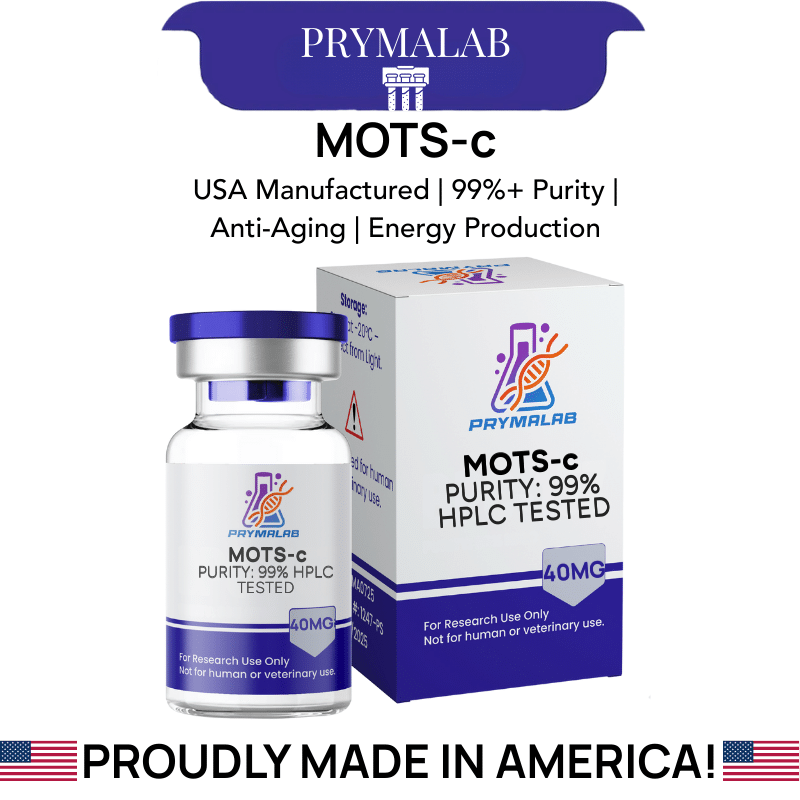
MOTS-C 40mg is an extended-supply lyophilized vial of the mitochondrial-derived peptide, CAS 1627580-64-6, molecular weight 2174.6. Forty milligrams corresponds to approximately 18.4 micromoles, four times the standard fill, which changes how the material should be divided and stored rather than what it does.
Specification Table
MOTS-C 40mg verified chemical and preparation data
| Property |
Value |
| Compound |
MOTS-c |
| Vial content |
40 mg lyophilized powder |
| Molar content of vial |
Approximately 18.4 µmol |
| Stock at 2 ml diluent |
Approximately 9.2 mM |
| Stock at 4 ml diluent |
Approximately 4.6 mM |
| Stock at 8 ml diluent |
Approximately 2.3 mM |
| Full name |
Mitochondrial Open reading frame of the Twelve S rRNA type-c |
| CAS number |
1627580-64-6 |
| Molecular formula |
C101H152N28O22S2 |
| Molecular weight |
2174.6 g/mol |
| Amino acid sequence |
Met-Arg-Trp-Gln-Glu-Met-Gly-Tyr-Ile-Phe-Tyr-Pro-Arg-Lys-Leu-Arg |
| Single-letter sequence |
MRWQEMGYIFYPRKLR |
| Residue count |
16 |
| Genomic origin |
Short open reading frame within mitochondrial 12S rRNA |
| Peptide class |
Mitochondrial-derived peptide (MDP) |
| Discovery |
Lee and colleagues, University of Southern California, 2015 |
| Reported cellular target |
Folate pathway, and de novo purine biosynthesis downstream of it |
| Reported downstream effector |
AMP-activated protein kinase (AMPK) |
| Reported intermediate |
Endogenous AICAR, raised more than twentyfold in the primary study |
| Oxidation-sensitive residues |
Two methionines at positions 1 and 6, one tryptophan at position 3 |
| Appearance |
White lyophilized cake |
| Purity |
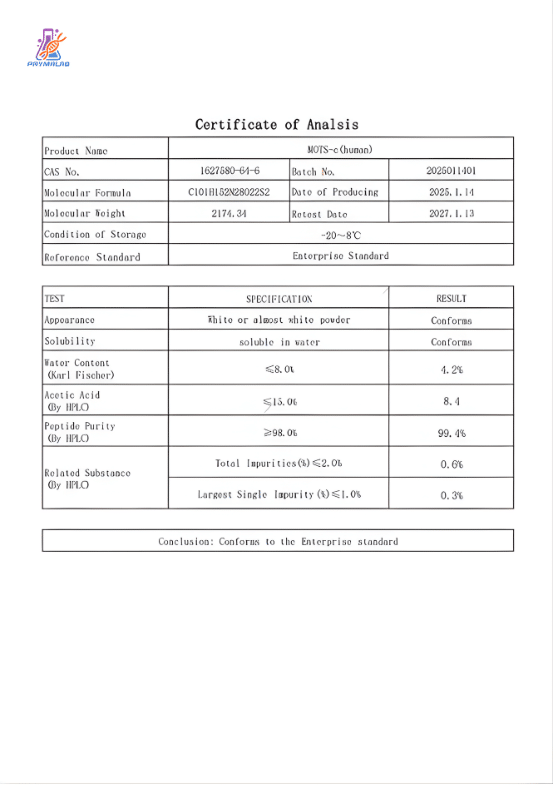
Per lot-specific certificate of analysis |
| Solubility |
Soluble in sterile and bacteriostatic water |
| Storage, lyophilized |
-20°C, protected from light and moisture |
| Storage, reconstituted |
2-8°C, protected from light |
| Regulatory status |
No approved human or veterinary formulation in any jurisdiction |
When Does an Extended-Supply Vial Make Sense?
Choosing MOTS-C 40mg is a logistics decision, and the trade-offs run in both directions rather than favouring the larger format automatically.
The argument for it is lot consistency. Peptide synthesis produces material that varies slightly between lots in purity profile, residual solvent, counterion content and the exact distribution of any oxidised species. A study running across months on a single lot removes that variation as a confounder. Across four separate 10mg vials from different lots, it is present whether or not anyone measures it.
The argument against is exposure. Forty milligrams of an oxidation-sensitive peptide reconstituted at once produces a large volume of solution that then has to survive until the work is finished. Every freeze-thaw, every warming to room temperature, every hour of light exposure accumulates against material that will still be needed in week ten.
The resolution is to treat the vial as a bulk source rather than a working stock, which is the subject of the next section.
How Should 40mg Be Divided?
Reconstitute once, aliquot immediately, freeze the aliquots, and thaw them individually. That sequence is standard practice and it is worth spelling out because the failure mode is doing it in the wrong order.
Aliquot volume should be set by what a single experiment consumes, plus a small margin, not by what fits conveniently in the tubes to hand. An aliquot that gets thawed twice has defeated the purpose. Where experiment size varies, a mix of aliquot sizes is more useful than a uniform set.
Container choice matters more at low concentration than most people expect. Peptides adsorb to polypropylene surfaces, and the proportion lost rises as concentration falls because adsorption depends on surface area rather than solution mass. Low-binding tubes are worth the cost for dilute aliquots. Where the downstream assay tolerates it, a carrier protein reduces the loss substantially.
Label every aliquot with lot, concentration and date. Four milligrams of unlabelled frozen peptide is indistinguishable from any other four milligrams of unlabelled frozen peptide.
Is MOTS-C FDA Approved?
No. No formulation of MOTS-c is approved by the FDA or any comparable regulatory authority, for human or veterinary use, in any jurisdiction.
The compound has not completed an interventional human clinical trial. The published evidence base consists of cell culture work, mouse studies, and observational human research measuring endogenous MOTS-c concentrations in plasma and correlating them with metabolic or fitness variables. Observational association work is not a clinical trial and does not support any approval pathway.
This matters for how the material should be handled and described. It is a research chemical with a genuinely interesting mechanism and a real published literature. It is not an investigational medicine, and it has no approved status anywhere.
What Does the Genomic Origin Actually Mean for MOTS-C 40mg Research?
The peptide is encoded within the mitochondrial 12S ribosomal RNA gene, in a short open reading frame that standard annotation did not identify as coding. That fact has two practical consequences worth understanding.
First, mitochondrial DNA sequence varies between individuals and between populations through haplogroup differences. Where the coding region for MOTS-c differs, the peptide sequence may differ, and at least one polymorphism affecting the peptide has been described in the literature. A study assuming a single canonical sequence across a diverse population is making an assumption.
Second, mitochondria use a slightly different genetic code from the nuclear genome, and the mitochondrial reading of certain codons differs. That is a detail for anyone expressing the peptide recombinantly rather than buying it synthesised, but it is a real trap in construct design.
For work using synthetic material, neither issue affects the compound in the vial. Both affect how findings from it should be generalised.
Analytical Confirmation for a Larger Lot
MOTS-C 40mg justifies more analytical attention than a smaller vial, because more experiments depend on the same material being what the label says.
Mass spectrometry establishes molecular weight against the expected 2174.6. Watch specifically for peaks 16 daltons higher, which indicate methionine oxidation, and 32 higher for both methionines oxidised. Given two oxidation-prone methionines in a sixteen-residue sequence, a small oxidised fraction is common and a large one is a reason to reject the lot.
Reversed-phase chromatography resolves the oxidised species from the parent, since sulfoxide formation changes hydrophobicity enough to shift retention. A single sharp peak indicates a clean preparation. Shoulders on the leading edge typically indicate oxidation.
Absorbance at 280 nm from the tryptophan gives a rapid concentration check that requires no standard curve if the extinction coefficient is known, which is convenient when verifying that aliquots were made at the intended concentration.
How Does Oxidation Show Up in Practice?
Two methionines in sixteen residues make oxidation the dominant degradation route for MOTS-C 40mg for this peptide, and recognising it early saves an experiment.
The chemistry is straightforward. Methionine sulfur oxidises to the sulfoxide, adding exactly 16 daltons per residue. Both methionines oxidising adds 32. Further oxidation to the sulfone adds another 16 per residue, though that is slower and less common under ordinary storage.
In mass spectrometry the signature is unmistakable once you know to look: a satellite peak 16 daltons above the parent, growing over time relative to it. A fresh lot may show a small satellite. A lot that has been stored badly shows a large one.
In chromatography the sulfoxide is more polar than the parent and elutes earlier on a reversed-phase column, typically appearing as a shoulder on the leading edge of the main peak rather than a separate resolved species.
The functional consequence depends on where the methionines sit relative to whatever the peptide needs to do, and for MOTS-c that has not been mapped. Position 1 is the amino terminus, which in many peptides is functionally important. Whether oxidation there reduces activity is unknown for this compound, which is an argument for avoiding it rather than for tolerating it.
What the Larger Format Does Not Change
Fill weight changes logistics and nothing else. MOTS-C 40mg is the same molecule at the same purity specification as the smaller vial, with the same sequence, the same registry number and the same handling requirements.
It is worth saying because bulk formats sometimes carry an implication of different grade or different intended use, and none applies here. A larger vial is more material, not better material.
What it does change is the consequence of a handling error. Ruining 10mg through a bad reconstitution costs one vial. Ruining 40mg costs four times as much material and, more importantly, removes the lot continuity that justified buying the larger format in the first place.
Reconstitution and Storage in Laboratory Practice
Decide the stock concentration before opening the vial. Forty milligrams in 4 ml gives approximately 4.6 mM, matching what a 10mg vial in 1 ml would give, which keeps downstream calculations consistent across formats.
Introduce diluent gently against the wall and swirl until clear. Given the oxidation-sensitive composition, minimise the time the material spends as an open solution in contact with air, and consider purging headspace with inert gas for aliquots intended for long storage.
Lyophilized material at -20°C sealed against light and moisture. Aliquots frozen promptly after reconstitution, thawed once each. Record lot, reconstitution volume, findinging concentration, aliquot volumes and date, because with forty milligrams spread across many tubes the record is the only thing linking a finding in week ten to the material that produced it.
Published Literature
Validated against publisher records or primary indexes. The 2016 Aging paper covers the human association work referenced in the regulatory section.
- Lee C, Zeng J, Drew BG, Sallam T, Martin-Montalvo A, Wan J, Kim SJ, Mehta H, Hevener AL, de Cabo R, Cohen P. Cell Metabolism. 2015;21(3):443-454.
- Kim KH, Son JM, Benayoun BA, Lee C. Cell Metabolism. 2018;28(3):516-524.
- Lee C, Kim KH, Cohen P. Free Radical Biology and Medicine. 2016;100:182-187. PMID: 27216708
- Reynolds JC, Lai RW, Woodhead JST, et al. Nature Communications. 2021;12(1):470.
- Cobb LJ, Lee C, Xiao J, et al. Aging. 2016;8(4):796-809.
Frequently Asked Questions
What is MOTS-C 40mg?
An extended-supply lyophilized vial of the mitochondrial-derived 16-residue peptide, CAS 1627580-64-6, molecular weight 2174.6. Forty milligrams is approximately 18.4 micromoles, four times the standard fill. For laboratory research only. No approved human or veterinary formulation exists.
Is MOTS-C FDA approved?
No. No formulation is approved by the FDA or any comparable authority anywhere, for human or veterinary use. The compound has not completed an interventional human clinical trial. Published human work is observational, measuring endogenous plasma concentrations and correlating them with metabolic variables.
When is the larger vial the better choice?
When a study runs across months and lot consistency matters. Peptide lots vary slightly in purity profile, residual solvent, counterion content and oxidised fraction. Running one lot removes that variation as a confounder, which four separate 10mg vials from different lots would not.
How should 40mg be divided?
Reconstitute once, aliquot immediately, freeze the aliquots, thaw each only once. Aliquot volume should match what a single experiment consumes plus a margin. An aliquot thawed twice has defeated the purpose of aliquoting in the first place.
Why do low-binding tubes matter here?
Peptides adsorb to polypropylene, and the proportion lost rises as concentration falls, because adsorption scales with surface area rather than with solution mass. For dilute aliquots the loss is material. Where the downstream assay permits it, a carrier protein reduces adsorption substantially.
What reconstitution volume keeps calculations consistent?
Four millilitres. That gives approximately 4.6 millimolar, the same stock concentration a 10mg vial reconstituted into 1 ml produces, so dilution calculations transfer between the two formats without adjustment.
What should mass spectrometry show?
A principal peak at 2174.6. Watch for peaks 16 daltons higher, indicating oxidation at one methionine, and 32 higher for both. With two oxidation-prone methionines in sixteen residues a small oxidised fraction is common, and a large one is grounds for rejecting the lot.
Does mitochondrial DNA variation affect the peptide?
It can. Mitochondrial DNA differs between individuals and populations through haplogroup variation, and where the coding region differs the peptide sequence may differ. At least one polymorphism affecting the peptide has been described. Synthetic material is unaffected, but generalising findings across populations involves an assumption.
How is concentration checked quickly?
Absorbance at 280 nanometres, from the tryptophan at position 3. With a known extinction coefficient this needs no standard curve, which makes it convenient for confirming that aliquots were prepared at the intended concentration before an experiment rather than after.
What storage conditions apply?
Dry material belongs at minus 20 Celsius, sealed away from light and moisture. Reconstituted aliquots frozen promptly and thawed once each, held at 2 to 8 Celsius while in use and protected from light. Consider purging headspace with inert gas for aliquots intended for long storage.
How does methionine oxidation appear analytically?
As a satellite peak exactly 16 daltons above the parent in mass spectrometry, growing over time relative to it, with 32 daltons indicating both methionines oxidised. In reversed-phase chromatography the sulfoxide is more polar and elutes earlier, usually as a shoulder on the leading edge of the main peak.
Does oxidation reduce activity?
Unknown for this compound. Position 1 is the amino terminus, which in many peptides is functionally important, but whether oxidation there reduces MOTS-c activity has not been mapped. That uncertainty is an argument for avoiding oxidation rather than for tolerating it.
How much oxidised material is acceptable?
A fresh lot may show a small satellite peak, which is normal for a sequence carrying two methionines. A large satellite indicates poor storage or handling upstream and is grounds for questioning the lot, since the functional consequence has not been characterised.
Compliance Statement
MOTS-C 40mg is sold exclusively for laboratory research use. It is not a drug, food, or cosmetic product, and it is not a dietary product of any kind. It is not approved by the FDA or any comparable authority for human or veterinary use. This product is not intended to diagnose, treat, cure, or prevent any disease. It must not be given to humans or animals. Purchase is restricted to qualified researchers and institutions operating within applicable laws. All handling is the responsibility of the purchasing laboratory.













20 reviews for MOTS-C 40MG