Description
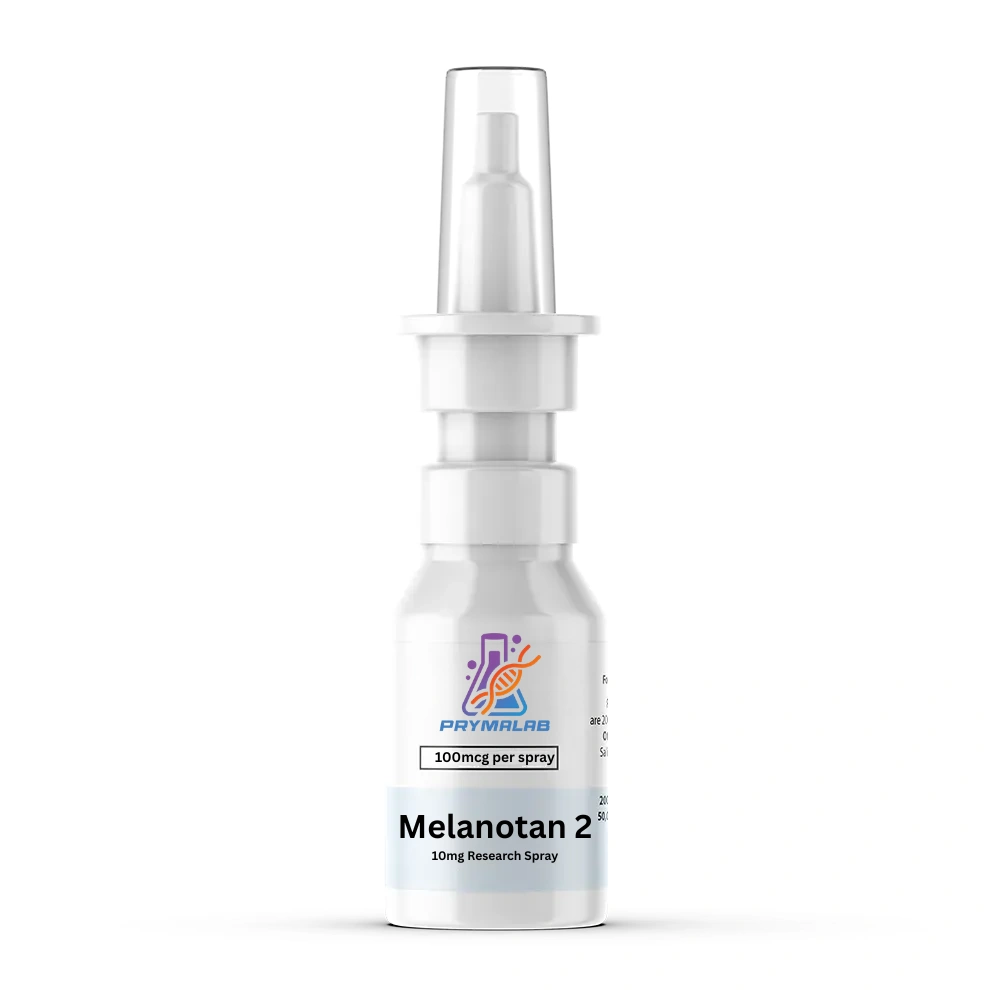
This Melanotan II nasal spray supplies Melanotan II, a synthetic peptide of approximately 1024 Da built as a cyclic lactam heptapeptide, a synthetic analog structurally derived from alpha-melanocyte-stimulating hormone. It is also listed elsewhere as Melanotan 2 nasal spray. It is a non-selective agonist at the melanocortin receptor family. This page covers melanocortin receptor pharmacology in cell models and the compound’s documented safety and regulatory record. It describes no human application of any kind. Supplied strictly for laboratory research use only, and not approved by any regulatory authority anywhere.
What this is sold as online, and why that matters
Being direct about this is more useful than avoiding it. Melanotan II is widely sold online as a tanning nasal spray, and the surrounding market includes nasal tanning sprays, tanning injections and comparisons against tanning beds. It has acquired the nickname the barbie drug in that setting. It has no approval for that use or any other, and the safety reports later on this page track exactly that pattern of use rather than laboratory handling.
The comparison worth drawing is with the products that are actually regulated for appearance. A self-tanner or bronzer works through DHA, dihydroxyacetone, which reacts with dead surface cells and produces colour without touching melanin biology at all, and many are formulated with ingredients such as aloe vera. Those are cosmetics, reviewed as cosmetics. A sunscreen reduces ultraviolet exposure. Neither category involves stimulating melanocytes systemically, and neither is what this compound does. Marketing language around a sun-kissed glow describes an appearance outcome, not a mechanism, and the assumption that induced pigmentation substitutes for sun protection is not supported: sun exposure and sunburn risk are not addressed by having more melanin present, and dermatologists raise the opposite concern, that changed pigmentation makes surveillance harder.
There is also an approved melanocortin agonist, which shows what a regulated version of this pharmacology looks like. Afamelanotide is licensed for a rare photosensitivity disorder under tight specialist control. Melanotan I is the related earlier compound in the same lineage. Melanotan II is neither of those. It is not an FDA-approved product in any form, and the U.S. Food and Drug Administration has taken action against products of this type rather than authorising them.
What the structure does
Alpha-MSH is a 13-residue linear peptide, and its activity depends on a four-residue core sequence, His-Phe-Arg-Trp, which is the recognition motif the melanocortin receptors read. Melanotan II is what happens when medicinal chemists take that core and constrain it.
Two modifications define the molecule. The phenylalanine is replaced by its D-enantiomer, which peptidases do not process in the usual way and which biases the backbone toward a particular conformation. And a lactam bridge is formed between an aspartate and a lysine side chain, cyclizing the peptide into a ring rather than leaving it linear. The systematic description reflects both: an N-acetylated norleucine followed by a cyclized Asp-His-D-Phe-Arg-Trp-Lys sequence with a C-terminal amide.
Cyclization is the important part. A linear peptide samples an enormous number of conformations in solution, and only a small fraction resemble the shape a receptor binds. Locking the backbone into a ring reduces that conformational freedom, so a far larger proportion of molecules present the right shape at any moment, which raises apparent potency without changing the recognition sequence at all. The ring also blocks the exopeptidase routes that degrade linear peptides. Greater potency and greater stability from one structural change, which is why the constrained-cyclic approach recurs throughout peptide medicinal chemistry.
Non-selectivity is the central research limitation
There are five melanocortin receptors in humans, MC1R through MC5R, all Gs-coupled and all signalling through adenylyl cyclase to raise cyclic AMP. They differ in where they are expressed and what they do: MC1R sits on melanocytes, MC2R responds to ACTH in the adrenal cortex, MC3R and MC4R are largely central, and MC5R appears in exocrine tissue.
Melanotan II activates MC1R, MC3R, MC4R and MC5R. It does not distinguish between them meaningfully. For a research tool that is a serious limitation, and it is the single most important thing to understand before designing an experiment with it.
The consequence is direct. In any preparation expressing more than one melanocortin receptor, an observed response cannot be attributed to a specific receptor on the basis of adding this compound. A cAMP increase tells you a Gs-coupled receptor was activated and nothing more. Assigning that to MC4R, or MC1R, requires either a system expressing only one receptor subtype, or selective antagonist controls, or a selective agonist comparator run in parallel.
Selective tools do exist and they make better experiments. Setmelanotide is a selective MC4R agonist that reached regulatory approval for specific rare genetic obesity indications, and it is the appropriate comparator if MC4R is your question. Where a subtype-selective agonist or antagonist is available, using it alongside a non-selective compound is what converts an ambiguous result into an attributable one. Running intranasal Melanotan II research or any cell-based work with this peptide as the sole pharmacological probe produces data that cannot distinguish which receptor did the work.
The relationship to bremelanotide
Worth noting because the two compounds are frequently confused. Bremelanotide, also called PT-141, is a metabolite of Melanotan II lacking the N-terminal acetyl-norleucine, and it carries a somewhat different receptor profile as a result. It emerged from observations made during Melanotan II research and was subsequently developed as a separate compound.
They are not interchangeable in an experiment. If your work concerns bremelanotide, use bremelanotide, because a metabolite with an altered receptor profile is a different pharmacological entity, not a variant of the same one.
The safety and regulatory record, stated plainly
This section exists because leaving it out would be dishonest, and because a page selling a nasal spray that omits the literature about that format would be indefensible.
A 2025 report published in the oral and maxillofacial surgery literature asks directly whether Melanotan II nasal spray is a possible risk factor for oral mucosal malignant melanoma. That is a question about this specific route of exposure, not a general concern extrapolated from injection data, and anyone handling this material in a nasal spray format should know the report exists.
The broader record: case reports document melanoma developing in Melanotan II users, and rapid changes in moles and pigmented lesions that make detecting skin cancer more difficult. The mechanistic concern voiced by dermatologists is not usually that the compound initiates melanoma from nothing, but that stimulating melanocytes may accelerate progression of pre-existing dysplastic or early-mutated lesions toward malignancy. Cases of systemic toxicity have also been reported, including rhabdomyolysis with associated renal infarction and acute kidney injury. Effects described in reports and user accounts include nausea, vomiting, facial flushing, decreased appetite, priapism, an allergic reaction in some cases, and heightened sun sensitivity.
On regulatory status, the Skin Cancer Foundation has issued a public warning about this compound, Australia’s Therapeutic Goods Administration has urged consumers to avoid it, and its sale is illegal in the United Kingdom and restricted in a number of other jurisdictions. It holds no approval from the FDA, the EMA or any comparable authority.
None of that prevents melanocortin receptor pharmacology being a legitimate field, and MC1R signalling in cultured melanocytes is a reasonable thing to study. It does mean this compound carries a documented adverse profile and an adverse regulatory position, and any laboratory handling it should treat it accordingly.
Melanotan II nasal spray specifications
| Compound |
Melanotan II, synthetic cyclic melanocortin receptor agonist |
| Class |
Cyclic lactam heptapeptide, alpha-MSH analog |
| Core motif |
His-Phe-Arg-Trp melanocortin pharmacophore, with D-phenylalanine |
| Cyclization |
Lactam bridge between aspartate and lysine side chains |
| Termini |
N-acetylated norleucine; C-terminal amide |
| Molecular weight |
Approximately 1024 Da |
| CAS number |
[CONFIRM: commonly cited as 121062-08-6; not independently verified here] |
| Receptor targets |
MC1R, MC3R, MC4R, MC5R (non-selective); all Gs-coupled |
| Related compound |
Bremelanotide (PT-141), a metabolite lacking N-terminal acetyl-norleucine |
| Selective comparator |
Setmelanotide (selective MC4R agonist) where MC4R is the question |
| Regulatory status |
No approval from FDA, EMA or comparable authority; sale illegal in the UK; TGA consumer warning |
| Documented concerns |
Melanoma case reports; 2025 report on nasal spray and oral mucosal melanoma; rhabdomyolysis case report |
| Format |
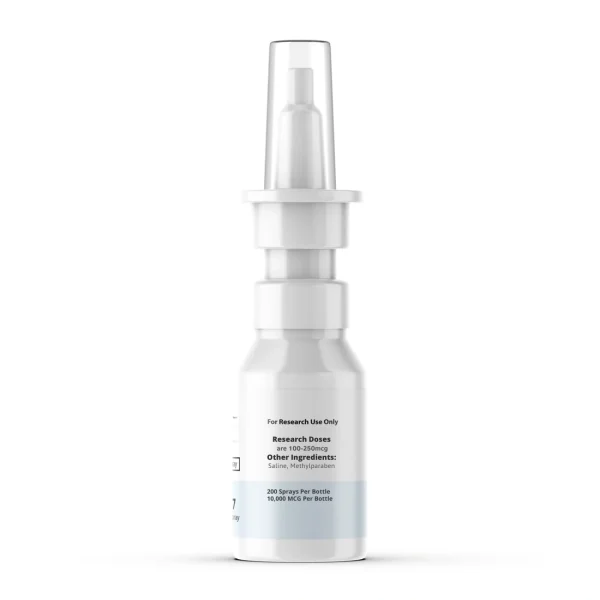
Metered spray bottle [CONFIRM: fill volume, mg per bottle, concentration] |
| Classification |
Research chemical. In-vitro laboratory use only. Not for human or veterinary use. |
In-vitro models and readouts
All melanocortin receptors couple to Gs, so cyclic AMP accumulation is the primary functional readout, measured by competitive immunoassay or a live-cell biosensor. Recombinant lines expressing a single melanocortin receptor subtype are the cleanest system available, and for a non-selective agonist they are close to essential, because they are the only way to attribute a response to one receptor without pharmacological subtraction.
For MC1R specifically, melanocyte and melanoma-derived lines such as B16 are the traditional models. The pathway under study is melanogenesis, and the standard readouts are melanin content, the ratio of eumelanin to the lighter pigment, and tyrosinase activity as the rate-limiting enzyme step. Those measurements describe melanin production and skin pigmentation at the level of a cultured cell. They are cell-biology endpoints, and they say nothing about outcomes in an organism.
Two design points. Because the compound activates four receptor subtypes, any preparation expressing more than one requires selective antagonists to interpret. And because cyclic AMP responses are fast and transient, the timing of your measurement matters as much as the concentration; an endpoint read at the wrong moment can miss a real response entirely.
Melanotan II nasal spray storage and handling
The lactam bridge makes this peptide considerably more stable than a linear equivalent, since the ring blocks exopeptidase access and the D-phenylalanine resists normal proteolytic recognition. It is chemically among the more durable compounds in this catalogue.
The vulnerability is the tryptophan in the core motif. Tryptophan is among the most light-sensitive and oxidation-prone amino acids, so protecting this material from light is a specific requirement rather than generic advice: amber containers or foil covering, short bench time, and discarding solution that has discoloured. Sensible Melanotan II nasal spray storage otherwise means cold, sealed, single-use aliquots rather than repeated freeze-thaw, and low-binding plasticware at low working concentrations.
Given the documented profile above, handle this material with appropriate laboratory precautions, including gloves and eye protection, and avoid skin contact.
How research grade Melanotan II spray is characterized
The tryptophan is analytically useful, absorbing at 280 nm and offering native fluorescence, which allows more specific detection than the 214 nm reading that non-aromatic peptides require. The cyclic structure and the D-residue introduce their own verification questions: mass spectrometry confirms composition but cannot distinguish a D-phenylalanine from an L, since the two are isobaric, and cyclization changes mass by only the loss of water relative to the linear precursor.
So for a research grade Melanotan II spray, the meaningful questions are whether the material is genuinely cyclized rather than linear precursor, whether the stereochemistry at the phenylalanine is correct, and whether an oxidized tryptophan species is present from poor storage. This material is supplied under the analytical verification PrymaLab applies across its research compounds, with HPLC and MS confirmation and independent third-party testing. No specific lot figures are asserted here; request the certificate of analysis for the lot you receive.
Frequently asked questions
What is Melanotan II?
Melanotan II is a synthetic cyclic lactam heptapeptide of approximately 1024 Da, derived from alpha-MSH, acting as a non-selective agonist at MC1R, MC3R, MC4R and MC5R. Material supplied here is a research chemical for in-vitro laboratory use only and is not approved by any regulatory authority.
Why does non-selectivity limit its use as a research tool?
Because it activates four melanocortin receptor subtypes, so in any system expressing more than one, a cyclic AMP response cannot be assigned to a specific receptor. Attribution requires a single-subtype recombinant line, selective antagonist controls, or a selective agonist comparator such as setmelanotide for MC4R.
What is the documented safety record?
Case reports document melanoma in users and rapid changes in pigmented lesions, with a 2025 report specifically questioning whether Melanotan II nasal spray is a risk factor for oral mucosal malignant melanoma. A rhabdomyolysis case has also been reported. The Skin Cancer Foundation has issued a warning and Australia’s TGA has urged consumers to avoid it.
Is Melanotan II the same as bremelanotide?
No. Bremelanotide, or PT-141, is a metabolite lacking the N-terminal acetyl-norleucine and carries a different receptor profile. They are distinct pharmacological entities and are not interchangeable in an experiment.
Is Melanotan II nasal spray approved for human use?
No. It holds no approval from the FDA, EMA or any comparable authority, its sale is illegal in the United Kingdom and restricted elsewhere, and this material is supplied for in-vitro laboratory use only. It is not intended for human or veterinary use. Nothing here is medical advice.
Ordering and compliance
This Melanotan II nasal spray is supplied strictly for in-vitro laboratory research. It is not intended for human or veterinary use, is not a drug, cosmetic, supplement or tanning product, holds no regulatory approval in any jurisdiction, and has not been evaluated by the FDA. Its sale is prohibited in some countries, including the United Kingdom. Purchasers are responsible for verifying the legal status of this compound in their own jurisdiction before ordering, and this listing should not be taken as any representation that purchase or possession is lawful where you are. Handle with appropriate laboratory precautions. Certificates of analysis are available on request for the lot you receive.













Reviews
There are no reviews yet.