Description
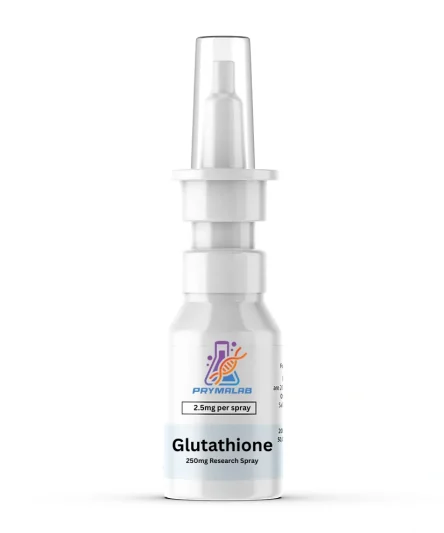
This glutathione nasal spray supplies reduced glutathione, GSH, built from glutamate, cysteine and glycine, molecular formula C10H17N3O6S, molecular weight 307.32 Da, CAS 70-18-8. It is the most abundant low-molecular-weight thiol in most cells and the reference antioxidant of cell biology. Two structural features explain nearly everything about how it behaves and how it must be handled, and neither of them is obvious from the name. Supplied for laboratory research use only.
The wellness category, and where this sits relative to it
Glutathione is sold in more formats than almost any other molecule, and the search space is crowded, so the separation is worth making before the chemistry.
A compounding pharmacy can prepare it as a compounded medication, and clinics offer glutathione injections and IV therapy on the argument that oral supplements are poorly absorbed. Consumer formats include liposomal glutathione, sublingual preparations, glutathione patches and various nasal therapies marketed as nasal glutathione, frequently sold alongside a NAD+ nasal spray. Those listings compete on absorption language: non-invasive delivery, fast absorption into the bloodstream, systemic effects, and a titration schedule to build up exposure. Prescription products in this space carry preservatives and a documented side effects profile, which for nasal formats typically covers nasal irritation, nasal congestion, nosebleeds, headache and occasional allergic reactions, with sinusitis, sinus infections, allergies and upper respiratory tract complaints appearing in longer use. Those listings also lean on bioavailability comparisons between routes, which is an organism-level measurement rather than anything demonstrated in a dish. Marketing claims attached to the category run from immune health, immune system and immune function through cellular energy, increased energy, cellular health, mental clarity and brain fog to longevity, healthy aging, respiratory support, help with chronic illness and, in some markets, skin lightening framed as reduced hyperpigmentation.
This listing is none of that. It is a research chemical supplied for in-vitro laboratory work, it is not compounded, not prescribed, not a supplement, and it carries no health claim in any of those directions. Where the terms above appear on this page, they describe a market rather than this product.
The gamma linkage is why this is not an ordinary tripeptide
Peptide bonds normally form between the alpha-carboxyl group of one amino acid and the amino group of the next. Glutathione breaks that rule at its first junction. The bond between glutamate and cysteine forms through the gamma-carboxyl on the glutamate side chain, not the alpha-carboxyl.
The consequence is that most peptidases cannot touch it. Enzymes that cleave N-terminal residues recognize the alpha-carboxyl arrangement, and the gamma linkage presents a geometry they do not read, so GSH resists non-specific proteolytic cleavage in a way an ordinary tripeptide would not. Its breakdown instead requires a dedicated enzyme, gamma-glutamyl transferase, which is a point that matters for assay design as well as biology.
So the Yoast phrase “glutathione peptide nasal spray” is loosely accurate and technically imprecise at the same time. Three amino acids, yes. A conventional peptide, no. That distinction is the reason cells can maintain millimolar concentrations of it without it being degraded on sight.
The thiol is the whole point, and it oxidizes while you work
The second feature is the free sulfhydryl group on the cysteine. That thiol is what does the chemistry: GSH donates reducing equivalents, and in doing so two molecules join through a disulfide bond to form GSSG, glutathione disulfide.
This reaction does not wait for a biological trigger. GSH autoxidizes on contact with air, which means the material begins converting to GSSG the moment a container is opened, and continues in solution on the bench. It is the defining practical problem with this compound, and it is why the measurement literature is preoccupied with sample handling. The recognized failure mode is systematic: analytical work describes underestimation of GSH and overestimation of GSSG as a direct result of autoxidation during processing.
The established countermeasures are worth knowing because they apply to your own experiments and not only to the assay. Thiol-masking with N-ethylmaleimide caps the free sulfhydryl immediately so it cannot oxidize during processing, and acidifying with sulfosalicylic acid both stabilizes the sample and inhibits gamma-glutamyl transferase, preventing enzymatic loss of GSH. These are described in the HPLC methodology for measuring glutathione in oxidative stress studies. The general principle: if you did not actively prevent oxidation, your GSH number is low and your GSSG number is high, and you cannot correct for it afterwards.
What cell-based assays are used to study oxidative stress reduction via bioactive peptides?
The central measurement is the GSH to GSSG ratio, and it is informative because the numbers move so far. Healthy resting cells maintain a GSH/GSSG ratio above 100. Under oxidative stress that ratio collapses to somewhere between 1 and 10. Few biological readouts shift by an order of magnitude or more in response to the condition they report, which is why this ratio is the standard redox status marker.
The measurement options divide by cost and rigour. Enzymatic recycling assays using glutathione reductase and DTNB are the common plate-based approach, cheap and adequate for relative comparisons. HPLC with electrochemical or fluorescence detection separates GSH and GSSG directly and avoids some recycling-assay artefacts. LC-MS/MS quantifies both species simultaneously with the best specificity and is the method of choice where absolute values matter.
The reason glutathione is called the master antioxidant is quantitative rather than rhetorical: it is present at millimolar concentrations inside cells, far above other small-molecule antioxidants, so it carries much of the load when free radicals are generated. Cellular antioxidant defenses are a system rather than a single molecule, and glutathione is regenerated by glutathione reductase using NADPH, recycled in part by vitamin C, and supplied with cysteine by precursors including NAC, N-acetylcysteine, which is why NAC appears as a comparator in almost every antioxidant support experiment. Its detoxifying role, the basis of the detoxification language used throughout this category, runs through conjugation reactions that tag reactive compounds for export. Note also that its glutamate residue links it to central nervous system biology, since glutamate is a neurotransmitter and glutathione depletion appears in the literature on inflammation and neurodegeneration, including Alzheimer’s, Parkinson’s disease and multiple sclerosis. Those are disease-model contexts, not claims about this material.
The surrounding panel usually includes a general reactive oxygen species probe such as DCFDA, lipid peroxidation measured as malondialdehyde or 4-HNE, and antioxidant enzyme activities for superoxide dismutase, catalase and glutathione peroxidase. Two cautions. DCFDA is not specific to any single reactive species and is prone to artefact, so it belongs alongside a more specific measure rather than alone. And a viability assay in parallel is essential, because a compound that kills cells will change every redox readout you have for reasons unrelated to antioxidant activity.
Claims about intranasal delivery in this category usually rest on the nasal mucosa offering a shorter path than the gut. That is a plausible pharmacokinetic argument for an organism and it is not a cell-culture variable, so treat it as a statement about format rather than about activity.
One design point specific to intranasal glutathione research and to added GSH generally: extracellular glutathione does not cross the plasma membrane efficiently as an intact tripeptide. Cells typically break it down extracellularly and reimport the constituent amino acids, cysteine in particular, for resynthesis inside. So an effect from added GSH may reflect cysteine delivery rather than direct intracellular antioxidant action. Distinguishing those requires an appropriate control, such as N-acetylcysteine or an equimolar amino acid mixture, and the distinction is quietly ignored in a great deal of published work.
Glutathione nasal spray specifications
Core identity data for this glutathione nasal spray. Quote the CAS number and specify the reduced form explicitly in your methods section, since GSH and GSSG are different reagents.
| Compound |
Reduced glutathione (GSH), L-glutathione |
| Composition |
gamma-Glu-Cys-Gly (glutamate, cysteine, glycine) |
| Key structural feature |
Gamma-carboxyl linkage between glutamate and cysteine |
| Consequence |
Resistant to ordinary peptidases; cleaved by gamma-glutamyl transferase |
| Reactive group |
Free cysteine thiol (sulfhydryl) |
| Oxidized form |
GSSG, two GSH joined by a disulfide bond |
| Molecular formula |
C10H17N3O6S |
| Molecular weight |
307.32 Da |
| CAS number |
70-18-8 |
| Reference ratio |
GSH/GSSG above 100 in healthy resting cells; 1 to 10 under oxidative stress |
| Format |
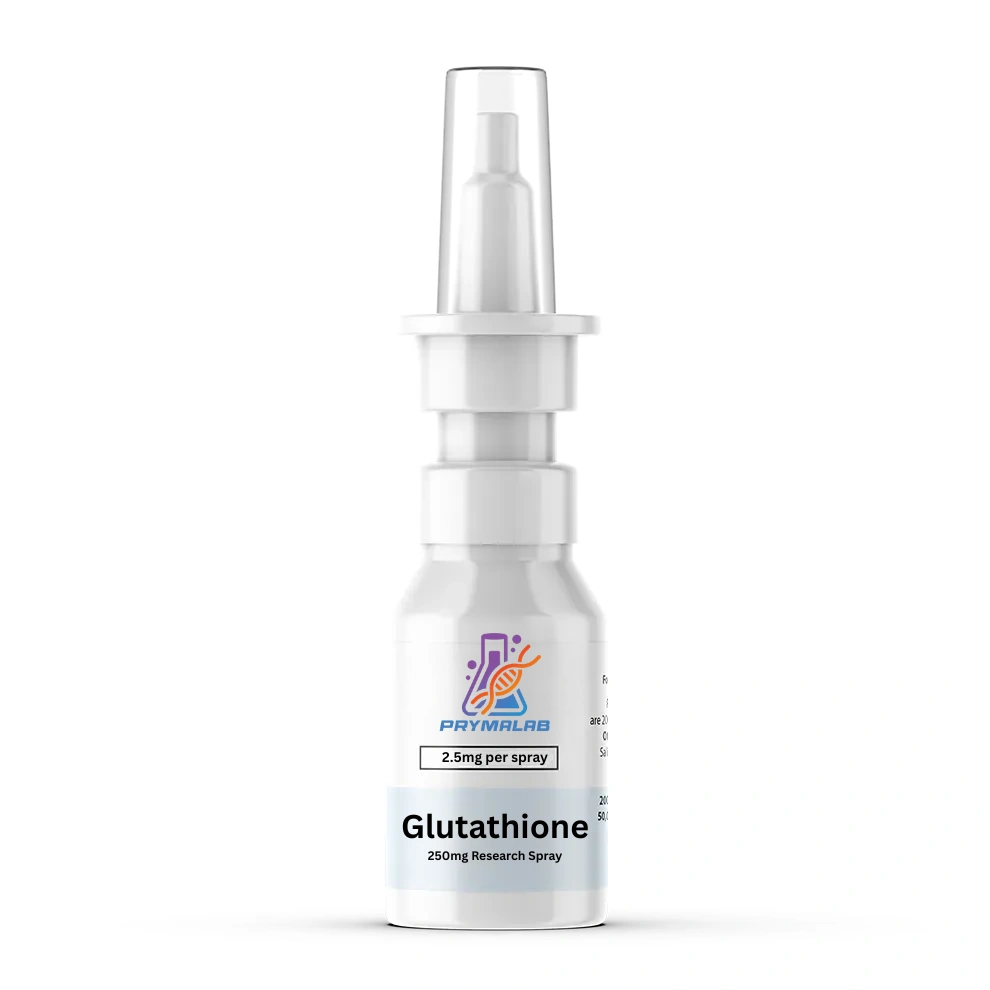
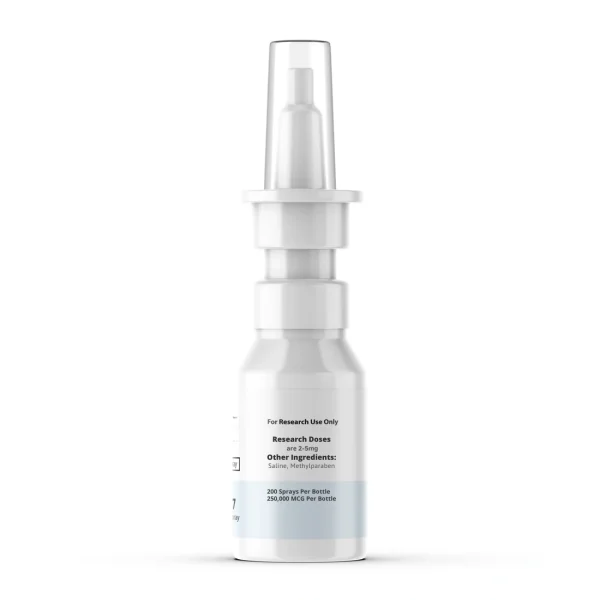
Metered spray bottle [CONFIRM: 250 mg total content, fill volume, concentration] |
| Classification |
Research chemical. In-vitro laboratory use only. Not for human or veterinary use. |
Glutathione nasal spray storage and handling
Handling this compound is a single problem repeated in several forms: keep oxygen away from the thiol.
Minimize air exposure at every step. Open containers briefly, close them promptly, and where the work justifies it, overlay with an inert gas such as nitrogen or argon before sealing. Stability is the property to design around here. Prepare solutions fresh rather than storing them, because GSH in solution oxidizes considerably faster than dry material, and a stock that has sat in a fridge for a fortnight is not the reagent you think it is.
Buffer chemistry matters more here than for most compounds. Thiol oxidation accelerates at alkaline pH, so a neutral to mildly acidic buffer preserves the reduced form better than a basic one. Trace transition metals, copper and iron in particular, catalyse thiol oxidation, so metal contamination in buffers or water is a genuine source of unexplained loss and a chelator in the buffer is sometimes justified. Effective glutathione nasal spray storage means cold, sealed, dark, minimal headspace, and single-use aliquots so that no container is opened twice.
If a result looks like weak antioxidant activity, the first hypothesis should be that a portion of the material had already oxidized before it reached the cells, not that the compound underperformed.
How research grade glutathione spray is characterized
Purity for this compound has an extra dimension that a single percentage will not capture. The relevant question is not only how much glutathione is present, but how much of it is in the reduced form. A material that is 99 percent glutathione by mass could still be substantially GSSG, and for redox work those are different reagents entirely.
Reversed-phase HPLC establishes purity and mass spectrometry confirms identity at 307.32 Da, with GSSG distinguishable at roughly double the mass minus two hydrogens. A research grade glutathione spray is supplied under the same verification PrymaLab applies across its research compounds, HPLC and MS confirmation plus independent third-party testing. No specific lot figures are asserted on this page; request the certificate of analysis for the lot you receive, and if the reduced form is what your experiment depends on, ask for the GSH content specifically rather than accepting total glutathione.
For related research compounds, see the PrymaLab Research Library.
Frequently asked questions
What is glutathione?
Glutathione is a tripeptide of glutamate, cysteine and glycine (307.32 Da, CAS 70-18-8) and the most abundant low-molecular-weight thiol in most cells. Its reduced form is GSH and its oxidized form is the disulfide GSSG. Material supplied here is a research chemical for in-vitro laboratory use only.
Why is glutathione not a conventional peptide?
Because the bond between glutamate and cysteine forms through the gamma-carboxyl of the glutamate side chain rather than the usual alpha-carboxyl. Most peptidases cannot cleave that arrangement, so GSH resists ordinary proteolysis and requires gamma-glutamyl transferase for breakdown.
Why does glutathione oxidize so easily?
Because the free cysteine thiol that does its chemistry also reacts with atmospheric oxygen. Two GSH molecules join into GSSG. Oxidation begins on air contact, accelerates at alkaline pH, and is catalysed by trace copper and iron, which is why fresh preparation and minimal headspace matter.
What GSH to GSSG ratio indicates oxidative stress?
Healthy resting cells hold a ratio above 100. Under oxidative stress it falls to between 1 and 10. The size of that shift is why the ratio is the standard redox status marker, and why sample handling that prevents autoxidation is essential to measuring it correctly.
Is glutathione nasal spray approved for human use?
No. This material is a research chemical for in-vitro laboratory use only and is not intended for human or veterinary use. It is not a drug or supplement in this context. Nothing here is medical advice.
Ordering and compliance
Every PrymaLab research compound ships from the United States and is sold research-use-only. This glutathione nasal spray is supplied for in-vitro laboratory research, is not intended for human or veterinary use, is not a drug or supplement, and has not been evaluated by the FDA for the research-chemical context. Verify the legal status of any research compound in your jurisdiction before ordering. Certificates of analysis are available on request for the lot you receive.










6 reviews for Glutathione 250mg Nasal Spray