Prostamax peptide: the prostate bioregulator explained
Prostamax is a prostate peptide bioregulator, the synthetic tetrapeptide Lys-Glu-Asp-Pro (KEDP), studied in preclinical models for prostate explant growth and for chromatin and gene activity in cells from elderly donors. PrymaLab supplies it as a Prostamax Peptide 20mg vial, Prostamax 20mg Nasal Spray and a preloaded 20mg autoinjector pen for research use.
- Sequence: Lys-Glu-Asp-Pro (KEDP), four residues, calculated mass about 487.5 g/mol; the assignment comes from secondary sources.
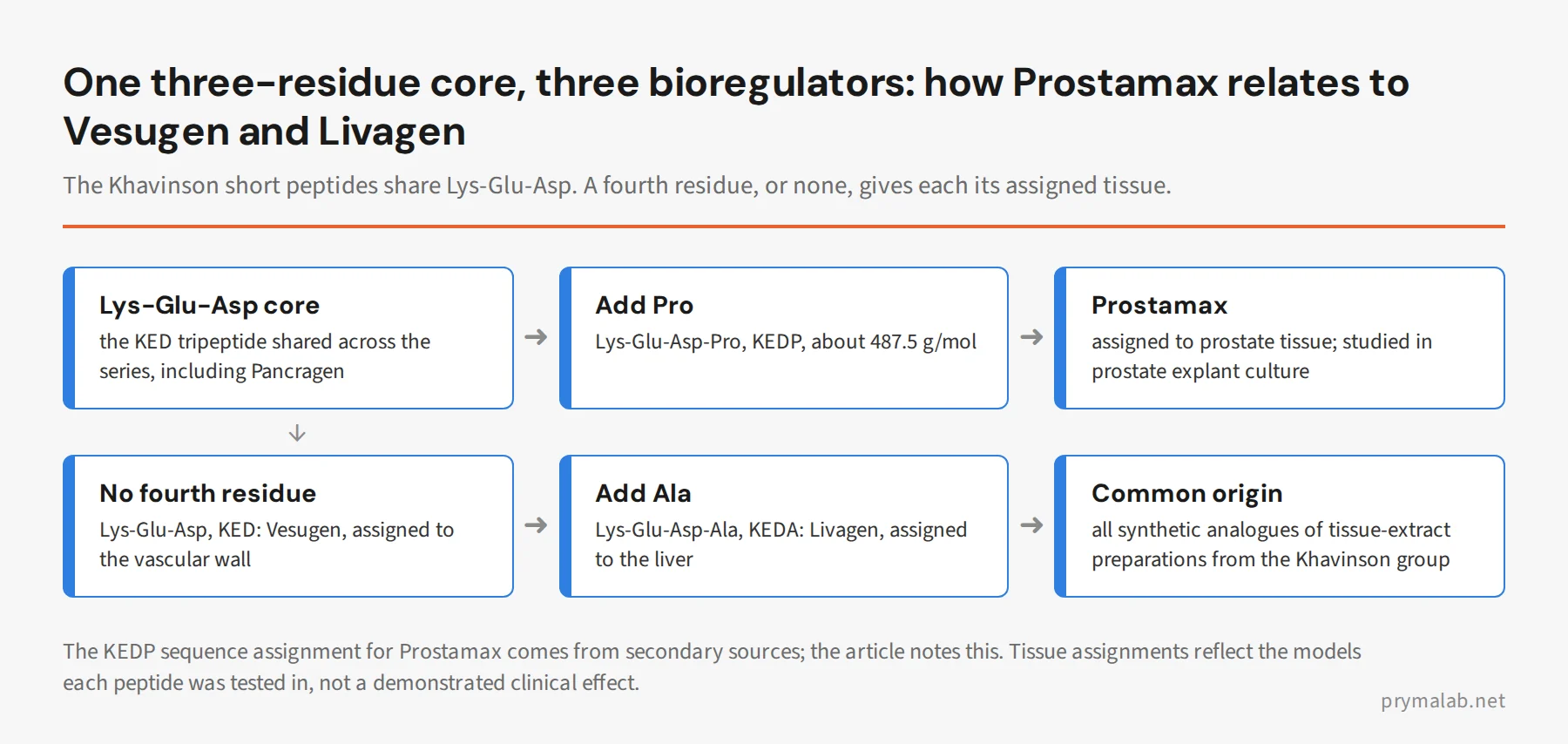
- Class: synthetic short peptide bioregulator of the Khavinson series; shares Lys-Glu-Asp with Vesugen, Livagen and Pancragen.
- Studied for: prostate explant growth in organotypic culture and chromatin activation in lymphocytes from elderly donors, all preclinical or ex vivo.
- Concentration studied: 0.05 ng/mL in organotypic rat prostate explant culture (reference 8); no dose-finding study and no human trial.
- Storage: lyophilised vial sealed at minus 20 °C; reconstituted solution refrigerated at 2 to 8 °C.
- Forms and sizes at PrymaLab: Prostamax Peptide 20mg, Prostamax 20mg Nasal Spray, Prostamax 20mg autoinjector pen.
| Peptide | Sequence | Tissue studied | Forms at PrymaLab |
|---|---|---|---|
| Prostamax | Lys-Glu-Asp-Pro (KEDP) | Prostate | 20 mg vial, 20 mg nasal spray, 20 mg autoinjector |
| Vesugen | Lys-Glu-Asp (KED) | Vascular wall | Vesugen 20mg vial, 20 mg autoinjector |
| Livagen | Lys-Glu-Asp-Ala (KEDA) | Liver | Livagen Peptide 20mg vial, 20 mg nasal spray, 20 mg autoinjector |
Volumes for a 20 mg vial are in the peptide reconstitution calculator; the Vesugen guide covers the tripeptide parent and the bioregulator overview the series.
Also known as: KEDP, Lys-Glu-Asp-Pro, prostate tetrapeptide
What a prostate peptide bioregulator is
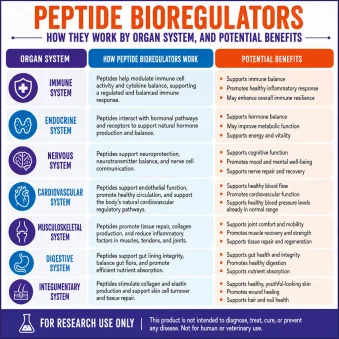
The term comes from the St Petersburg Institute of Bioregulation and Gerontology, where Vladimir Khavinson's group worked on two families of compounds. The first were polypeptide extracts of animal organs, each named for its source tissue: Thymalin from thymus, Epithalamin from pineal gland, Prostatilen from prostate. The second were short synthetic peptides, two to four residues long, designed from the amino acid composition of those extracts; Prostamax is the prostate member. The working hypothesis, set out in Khavinson's monograph Peptides and Ageing (reference 1) and reviewed with Anisimov (reference 2), is that a short peptide enters the nucleus and changes transcription of a subset of genes in the tissue it was derived from; Fedoreyeva and colleagues showed fluorescent-labelled peptides of the series reaching the nucleus of HeLa cells and binding oligonucleotides in vitro (reference 3). None of this is settled outside the group's laboratories, and the prostate work is preclinical.
Prostamax sequence and where it comes from
Product listings and secondary sources give Prostamax as Lys-Glu-Asp-Pro, four residues, calculated mass about 487.5 g/mol. The sequence does appear alongside the name in the peer-reviewed record: Dzhokhadze and colleagues title their 2012 chromatin paper for the oligopeptide bioregulator Lys-Glu-Asp-Pro and identify that bioregulator as Prostamax in the text (reference 9). What PrymaLab has not located is a synthesis or characterisation report for the tetrapeptide, so the assignment still rests on catalogues, reviews and downstream use rather than on a primary chemistry paper. The first three residues recur across the series: Vesugen is the tripeptide on its own, Livagen adds alanine, Pancragen adds tryptophan, Testagen adds glycine and Prostamax adds proline. The Khavinson model attributes tissue specificity to that terminal residue and to the charge pattern of the whole molecule, which the group has modelled against DNA promoter sites (reference 4). A tetrapeptide is easy to confirm analytically: one HPLC peak and an observed mass close to 487.5 settle identity, and a certificate for the vial should show both.
What the research studies Prostamax for
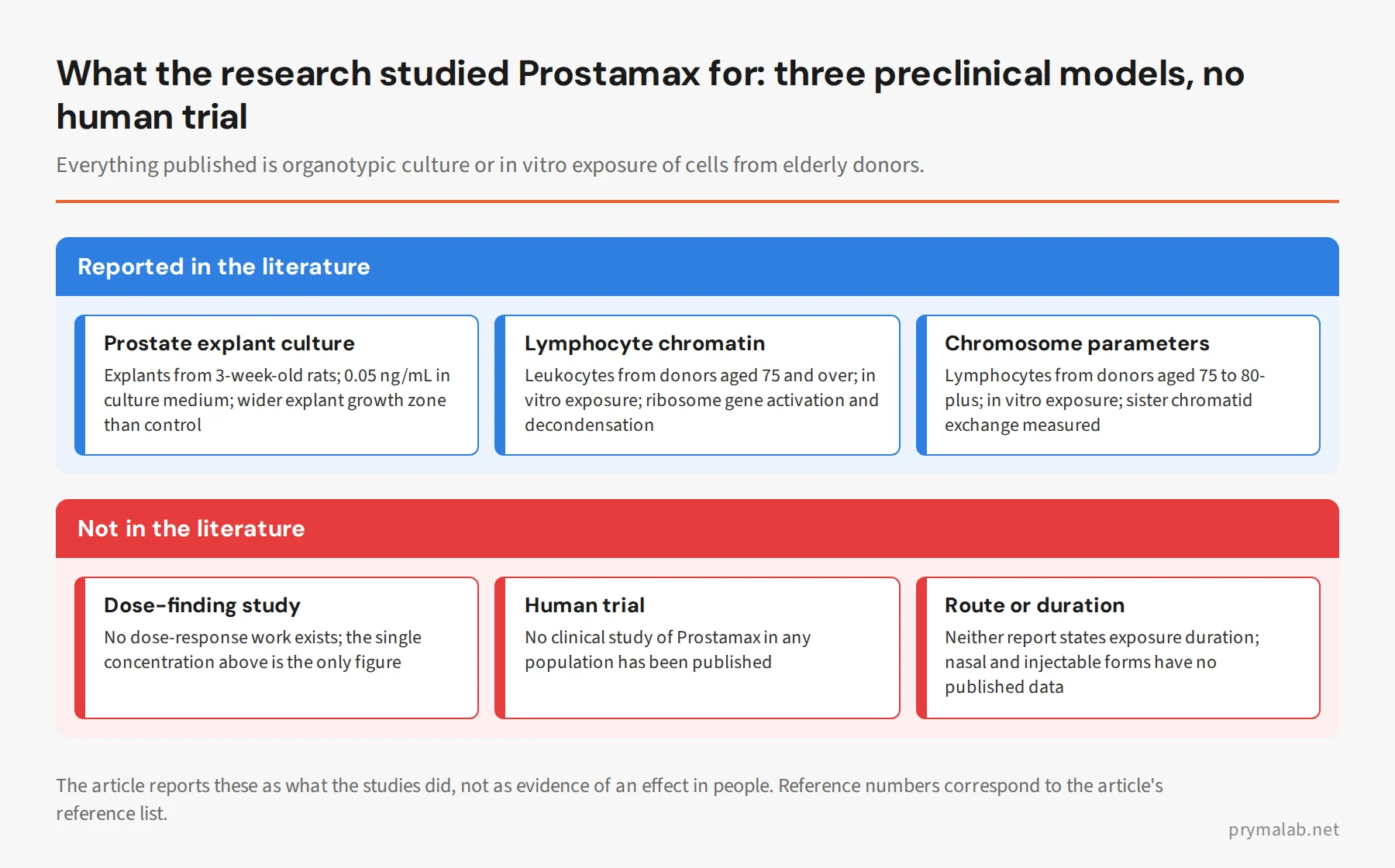
Two lines of work recur. The first is organotypic tissue culture, the group's standard screen: explants of prostate are grown with or without peptide and the growth zone around each explant is measured. Zakutskii and colleagues report that Prostamax at 0.05 ng/mL stimulated growth against control explants in tissue from both 3-week-old and 18-month-old rats, alongside matching results for Cardiogen in heart, Bronchogen in lung and Pancragen in pancreas (reference 8). The second is chromatin structure in human cells. Khavinson, Lezhava and Malinin report that Prostamax, along with Vilon, Epithalon and Livagen, activated ribosome genes and decondensed tightly packed chromatin in leukocytes from subjects aged 75 to 88, and that Prostamax was among the peptides that decondensed pericentromeric chromatin on chromosome 1 (reference 10). Dzhokhadze and colleagues later reported that Prostamax raised sister chromatid exchange frequency to 12.0 per cell against 5.9 in untreated cells, and Ag-positive nucleolar organiser regions to 2.5 per cell against 0.95, in lymphocytes from donors aged 75 to 86 (reference 9). The group's reviews of the class tabulate this and related tissue work (references 6 and 7). All of it is preclinical or ex vivo, most is published in Russian, and the data for the tetrapeptide are thinner than for the parent extract Prostatilen, which has a longer clinical record in Russia. No controlled human trial of Prostamax is indexed.
What the Prostamax studies measured
| Study or model | Subject | Exposure | Duration | Reported outcome |
|---|---|---|---|---|
| Organotypic prostate explant culture (reference 8) | Prostate explants from 3-week-old and 18-month-old rats | 0.05 ng/mL in culture medium | Not stated in the report | Wider explant growth zone than control in both age groups |
| Lymphocyte chromatin (reference 10) | Leukocytes from subjects aged 75 to 88 | In vitro exposure; concentration not stated in the abstract | Not stated in the report | Ribosome gene activation and decondensation of chromosome 1 pericentromeric chromatin |
| Lymphocyte chromosome parameters (reference 9) | Lymphocytes from donors aged 75 to 86 | In vitro exposure; concentration not stated in the abstract | Not stated in the report | Sister chromatid exchange 12.0 per cell against 5.9 untreated; Ag-positive NORs 2.5 against 0.95 |
All three are in-vitro or explant studies. The explant work comes from the originating St Petersburg group; the chromatin work comes from a Tbilisi group that has co-published with Khavinson, so it is not an independent replication either.
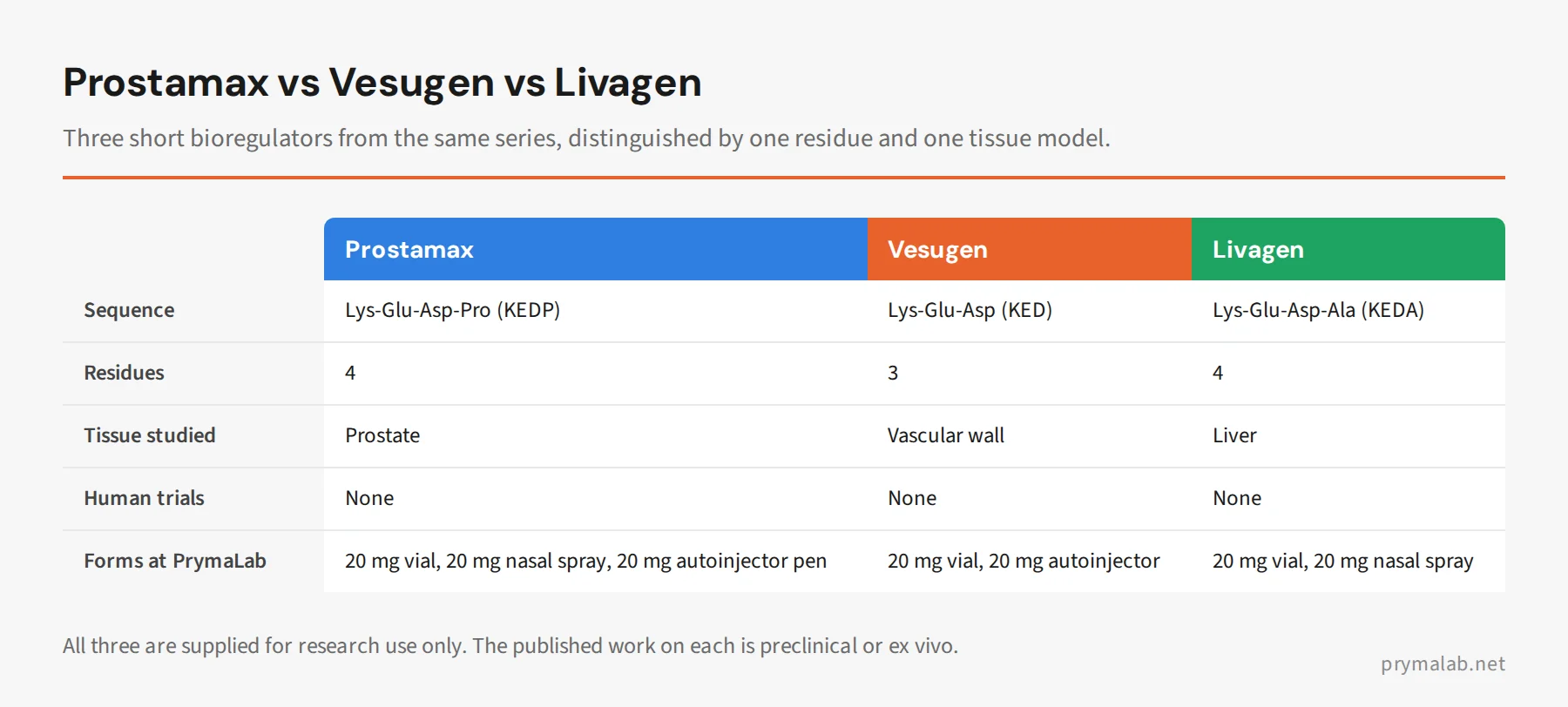
Prostamax vs Vesugen vs Livagen
Vesugen (KED) is the tripeptide core, studied in vascular wall and endothelial models. Livagen (KEDA) and Prostamax (KEDP) each add one residue and are studied in liver and prostate respectively; Pancragen (KEDW) and Testagen (KEDG) complete the set. Because the four tetrapeptides differ by a single residue, a certificate that reports only peptide content cannot tell them apart, but the observed mass can: KEDG is about 447.4 g/mol, KEDA 461.5, KEDP 487.5 and KEDW 576.6. The Testagen guide covers the glycine sibling.
Forms at PrymaLab and handling
The Prostamax Peptide 20mg vial is lyophilised powder for dissolution in a suitable diluent. The Prostamax 20mg Nasal Spray holds the same 20 mg in a metered spray; the evidence on intranasal peptides is in do peptide nasal sprays work. The Preloaded Autoinjector | Prostamax | 3ml Pen | 20mg holds 20 mg in a 3 mL pen. Store the lyophilised vial sealed at minus 20 °C; reconstitute as described in how to reconstitute peptides and keep the solution at 2 to 8 °C. All three formats are for laboratory research use only.
Frequently asked questions
What is Prostamax peptide?
Prostamax is a synthetic tetrapeptide, Lys-Glu-Asp-Pro, from the Khavinson bioregulator series, designed from the amino acid composition of the prostate extract Prostatilen. It is studied in preclinical models for prostate explant growth and in chromatin studies on cells from elderly donors. PrymaLab supplies a 20 mg vial, nasal spray and autoinjector pen for research use.
What is a prostate peptide bioregulator?
A prostate peptide bioregulator is a short peptide, or a polypeptide extract, that the Khavinson school reports as acting on prostate tissue by changing gene expression in its cells. Prostatilen is the extract; Prostamax (KEDP) is the synthetic tetrapeptide derived from it. The evidence is preclinical and largely from one group, so the term describes a hypothesis and a product family, not a drug class.
Is Prostamax the same as Vesugen?
No. Vesugen is the tripeptide Lys-Glu-Asp (KED), studied in vascular models. Prostamax is Lys-Glu-Asp-Pro (KEDP), the same three residues plus a terminal proline, studied in prostate models. They share a motif, a research group and a 20 mg vial format, but they are different molecules, about 390 and 487.5 g/mol, with different tissue targets.
What is the Prostamax peptide sequence?
Secondary sources give the Prostamax sequence as Lys-Glu-Asp-Pro, abbreviated KEDP, with a calculated molecular weight of about 487.5 g/mol. PrymaLab has not found a primary synthesis paper that pairs the name with the sequence, so the assignment rests on catalogues and reviews. A mass spectrum at about 487.5 confirms which tetrapeptide is in a vial.
How is Prostamax stored and reconstituted?
Store the lyophilised 20 mg vial sealed at minus 20 °C, away from light. To reconstitute, let it reach room temperature, add a suitable diluent down the vial wall and let the cake dissolve without shaking, then keep the solution at 2 to 8 °C. The peptide reconstitution calculator gives the concentration for any volume; the spray and pen are supplied ready to use.
Key takeaways
- Prostamax is the tetrapeptide Lys-Glu-Asp-Pro (KEDP), the prostate member of the Khavinson series; the sequence comes from secondary sources.
- It shares Lys-Glu-Asp with Vesugen, Livagen and Pancragen and differs at the terminal proline, so identity rests on the observed mass, about 487.5 g/mol.
- The research is preclinical or ex vivo: rat prostate explant culture at 0.05 ng/mL and chromatin studies in lymphocytes from elderly donors, from the originating group and its collaborators.
- No controlled human trial of the tetrapeptide is indexed; the parent extract Prostatilen has the longer clinical record.
- PrymaLab supplies a 20 mg vial, nasal spray and autoinjector pen, for research use only.
Related products
- Prostamax Peptide 20mg, lyophilised vial, from $45.99
- Prostamax 20mg Nasal Spray, from $101.99
- Preloaded Autoinjector | Prostamax | 3ml Pen | 20mg, from $75.99
- Testagen Peptide 20mg, the Lys-Glu-Asp-Gly sibling, from $33.99
Related reading
- Livagen (KEDA): evidence, mechanism and the Ovagen comparison
- Gonadorelin (GnRH): pulses, half-life and the hCG switch
References
- Khavinson VKh. Peptides and ageing. Neuro Endocrinol Lett. 2002;23 Suppl 3:11-144. PubMed 12374906
- Anisimov VN, Khavinson VKh. Peptide bioregulation of aging: results and prospects. Biogerontology. 2010;11(2):139-149. DOI 10.1007/s10522-009-9249-8
- Fedoreyeva LI, Kireev II, Khavinson VKh, Vanyushin BF. Penetration of short fluorescence-labeled peptides into the nucleus in HeLa cells and in vitro specific interaction of the peptides with deoxyribooligonucleotides and DNA. Biochemistry (Moscow). 2011;76(11):1210-1219. PubMed 22117547
- Khavinson VKh, Tarnovskaya SI, Linkova NS, Pronyaeva VE, Shataeva LK, Yakutseni PP. Short cell-penetrating peptides: a model of interactions with gene promoter sites. Bull Exp Biol Med. 2013;154(3):403-410. PubMed 23484211
- Khavinson V, Linkova N, Diatlova A, Trofimova S. Peptide regulation of cell differentiation. Stem Cell Rev Rep. 2020;16(1):118-125. doi:10.1007/s12015-019-09938-8. PubMed 31808038
- Khavinson VKh, Popovich IG, Linkova NS, Mironova ES, Ilina AR. Peptide regulation of gene expression: a systematic review. Molecules. 2021;26(22):7053. PubMed 34834147
- Khavinson VKh, Kuznik BI, Ryzhak GA. Peptide bioregulators: a new class of geroprotectors. Report 1: results of experimental studies [in Russian]. Adv Gerontol. 2012;25(4):696-708. PubMed 23734519
- Zakutskii AN, Chalisova NI, Ryzhak GA, Aniskina AI, Filippov SV, Zezyulin PN. The tissue-specific effect of synthetic peptides-biologic regulators in organotypic tissue culture in young and old rats [in Russian]. Adv Gerontol. 2006;19:93-96. PubMed 17152728
- Dzhokhadze TA, Buadze TZh, Gaiozishvili MN, Baratashvili NA, Lezhava TA. Deheterochromatinization of the chromatin in old age induced by oligopeptide bioregulator (Lys-Glu-Asp-Pro) [in Russian]. Georgian Med News. 2012;(212):76-82. PubMed 23221144
- Khavinson VKh, Lezhava TA, Malinin VV. Effects of short peptides on lymphocyte chromatin in senile subjects. Bull Exp Biol Med. 2004;137(1):78-81. PubMed 15085253
Everything described on this page is laboratory research. Every compound PrymaLab supplies is for laboratory research use only and is not intended for human or veterinary use. Statements have not been evaluated by the FDA, and nothing here is medical advice.
Mechanistic descriptions are observations from cell and animal models, several from older literature, that may not generalize. Always verify the legal status of any research compound in your jurisdiction before purchase or use.