

Livagen (KEDA): The Liver Bioregulator Whose Only Liver Study Reports No Numbers, and Whose Maker Lists Ovagen Instead
Livagen is sold across the Western research market as the Khavinson liver bioregulator. Two facts sit awkwardly under that label. The first is that the Khavinson organisation's own synthetic peptide catalogue lists Ovagen, a different molecule, as its liver product and does not list Livagen at all. The second is that of the ten papers PubMed returns for Livagen, exactly one concerns the liver, and it reports no species, no sample size and no numbers. What Livagen has actually been studied for is chromatin in cultured lymphocytes and digestive enzymes in rats. I read every abstract I could open while writing this, and the liver story is the thinnest part of the record.
Research-use-only disclaimer: Livagen supplied as a research chemical is intended strictly for in-vitro and laboratory research use and is not intended for human or veterinary use. The studies described below are in vitro and animal experiments from the originating laboratory; no clinical trial of Livagen exists, and nothing here describes or supports any use of research-grade material in people. No dosing or administration guidance appears in this article; where an animal study's design is described, it is reported as a study design fact. Nothing here is medical advice.

TL;DR
Livagen is the synthetic tetrapeptide Lys-Glu-Asp-Ala (KEDA), 461.47 g/mol, one of the Khavinson short peptides. Western suppliers sell it as the liver bioregulator; the Khavinson organisation's own Cytogen catalogue lists Ovagen as the liver product and omits Livagen. PubMed holds ten records naming Livagen, every one from the originating institute or its Tbilisi collaborators, and one of them concerns the liver: a 2002 organotypic culture paper with no species, no n and no numerical result. The substantive work is on chromatin decondensation in cultured lymphocytes from elderly donors, an effect that five structurally unrelated peptides produced in the same assay, and on digestive enzyme activity in rats after two weeks of oral administration. The claimed DNA target, the motif tcct, is a docking prediction with no binding data, and the lab's own 2019 computational study found that DNA selectivity rises with peptide length. No human has been given Livagen in a published study, no trial is registered, and no regulator has approved it. Research use only.
Identity: Lys-Glu-Asp-Ala, a linear tetrapeptide, C18H31N5O9, 461.47 g/mol. No CAS number located.
Catalogue: Khavinson's synthetic Cytogen line lists Ovagen for the liver. Livagen is absent from it.
Liver evidence: One indexed paper, a 2002 organotypic culture with no species, n or numbers. Plus one review sentence citing a patent.
Real evidence: Chromatin decondensation in cultured lymphocytes and digestive enzyme shifts in rats. Neither is hepatic.
Mechanism: The tcct DNA target is a docking prediction with no binding data. The lab's own 2019 study says selectivity rises with length.
Human data: None. No person has been given Livagen in a published study. No registered trial anywhere.
Regulatory: Not approved in any jurisdiction. Sold research-use-only in the US. The distributor's own catalogue calls the products non-medicinal.
Status: research use only.
What Livagen Is, Chemically
Livagen is the linear tetrapeptide Lys-Glu-Asp-Ala, written KEDA in the one-letter code that Khavinson's group uses in its own peptide tables.[1] The sequence is not in dispute. It is stated in the abstract of the 2005 rat study, "Livagen (Lys-Glu-Asp-Ala)", and again in a 2003 enzyme paper from the same institute.[2][3] The free acid has the formula C18H31N5O9 and a molecular weight of 461.47 g/mol. I recomputed that from standard residue masses and got the figure Wikipedia carries.[4] I could not locate a CAS number, and PubChem was unreachable from where I was working, so the formula and mass rest on arithmetic and one secondary source rather than on a database record. That is a small gap, but it is a gap, and I would rather say so than print a registry number I have not seen.
| Field | Value | Status |
|---|---|---|
| Sequence | Lys-Glu-Asp-Ala (KEDA), linear, free acid | Stated in three primary papers and in the lab's own table |
| Length | Tetrapeptide, four residues | Confirmed |
| Formula | C18H31N5O9 | Calculated from the sequence; matches the secondary source |
| Molecular weight | 461.47 g/mol (free acid, average mass) | Calculated; matches the secondary source |
| CAS number | Not located | Unconfirmed |
| Class | Khavinson synthetic short peptide (the Cytogen class) | By origin; there is no pharmacological classification |
One lysine, two acidic residues, no aromatic ring
The composition does more work in this article than the order does. KEDA carries one basic side chain, the lysine, and two acidic ones, glutamate and aspartate. With the N-terminal amine protonated and the C-terminal carboxylate ionised, the free peptide sits at a net charge of about −1 at neutral pH. It has no aromatic residue, no methionine, no cysteine, no asparagine and no tryptophan. Those absences settle several analytical and stability questions that I come to at the end. The lysine comes back sooner than that, because the originating lab's own 2019 computational study found that lysine and arginine are what make very short peptides bind DNA broadly and without selectivity, and Livagen is a very short peptide with a lysine at position 1.
What class it belongs to, and what it is not
Livagen is one of the synthetic short peptides developed at the St Petersburg Institute of Bioregulation and Gerontology, the class its distributors call Cytogens and Western suppliers call peptide bioregulators. It is not a hormone, not a growth factor, not a fragment of any characterised human protein, and not an organ extract. It has no identified receptor. The only receptor-binding experiment on record, from 2003, tested rat brain membranes for mu- and delta-opioid binding and found none.[3] If you have read our overview of peptide bioregulators by organ system, Livagen is the liver entry in the Western version of that list. Whether it belongs in the liver row at all is the subject of the next section.
Where the Livagen Bioregulator Sits in the Khavinson Product Lines
The Khavinson organisation sells three tiers of product for each organ, and Livagen occupies none of the three liver slots. The synthetic tier, the Cytogens, lists Ovagen as its liver product; Livagen does not appear in that catalogue.[5] The liver label attached to Livagen comes from Western research-chemical suppliers, and that includes the product page on this site. I am not going to pretend otherwise.
| Tier | What it is | Liver product | Where Livagen sits |
|---|---|---|---|
| Cytamins | Animal organ extract, tablet | Hepatamin: "liver of young animals", "a complex of proteins and nucleoproteins" | Not listed |
| Cytomaxes | Natural peptide complex, capsule | Svetinorm (code A-7) | Not listed |
| Cytogens | Synthetic short peptides | Ovagen (Glu-Asp-Leu) | Not listed |
| Western research suppliers | Synthetic peptide, research use only | Livagen (Lys-Glu-Asp-Ala) and Ovagen, sold side by side | Sold as the liver bioregulator |
Hepatamin is the extract tier: Geropharm makes it in partnership with the institute, and its own product page describes it as "a complex of proteins and nucleoproteins" from the "liver of young animals".[6] Svetinorm is the natural peptide complex tier. Ovagen is the synthetic one. Three liver products across three tiers, and the tetrapeptide sold in the West as the liver peptide is in none of them.
The descent from a liver extract is asserted, not documented
The standard account, repeated on most pages, is that the synthetic short peptides were identified as the active fragments of the natural organ extracts, so that KEDA is in some sense the essence of Hepatamin. I went looking for the isolation paper: the one that takes a liver extract, fractionates it, sequences a fragment and reports Lys-Glu-Asp-Ala. I did not find it in the lab's own publication list or in the reference lists of its reviews. What exists is a framework claim. That may be a translation and archive problem with 1990s Russian work, and I hold the point loosely. But vendor copy states the lineage as chemical fact, and there is no published chemistry behind it that I can point to.
There is a smaller naming point that catches people. Ovagen's name suggests ovary; it is marketed for the liver and has no ovarian indication. Livagen's name suggests liver; its published work is mostly about lymphocytes and the gut. Reading these names as chemistry is the first mistake most pages make, and it is the one this article is built to undo.
What follows from the catalogue: if someone tells you Livagen is "the Khavinson liver peptide", ask which catalogue. The originating organisation's answer is Ovagen. The published literature's answer, as the next three sections show, is that neither compound has a liver evidence base worth the name, and what little exists sits with Livagen.
The Mechanism as the Evidence Supports It
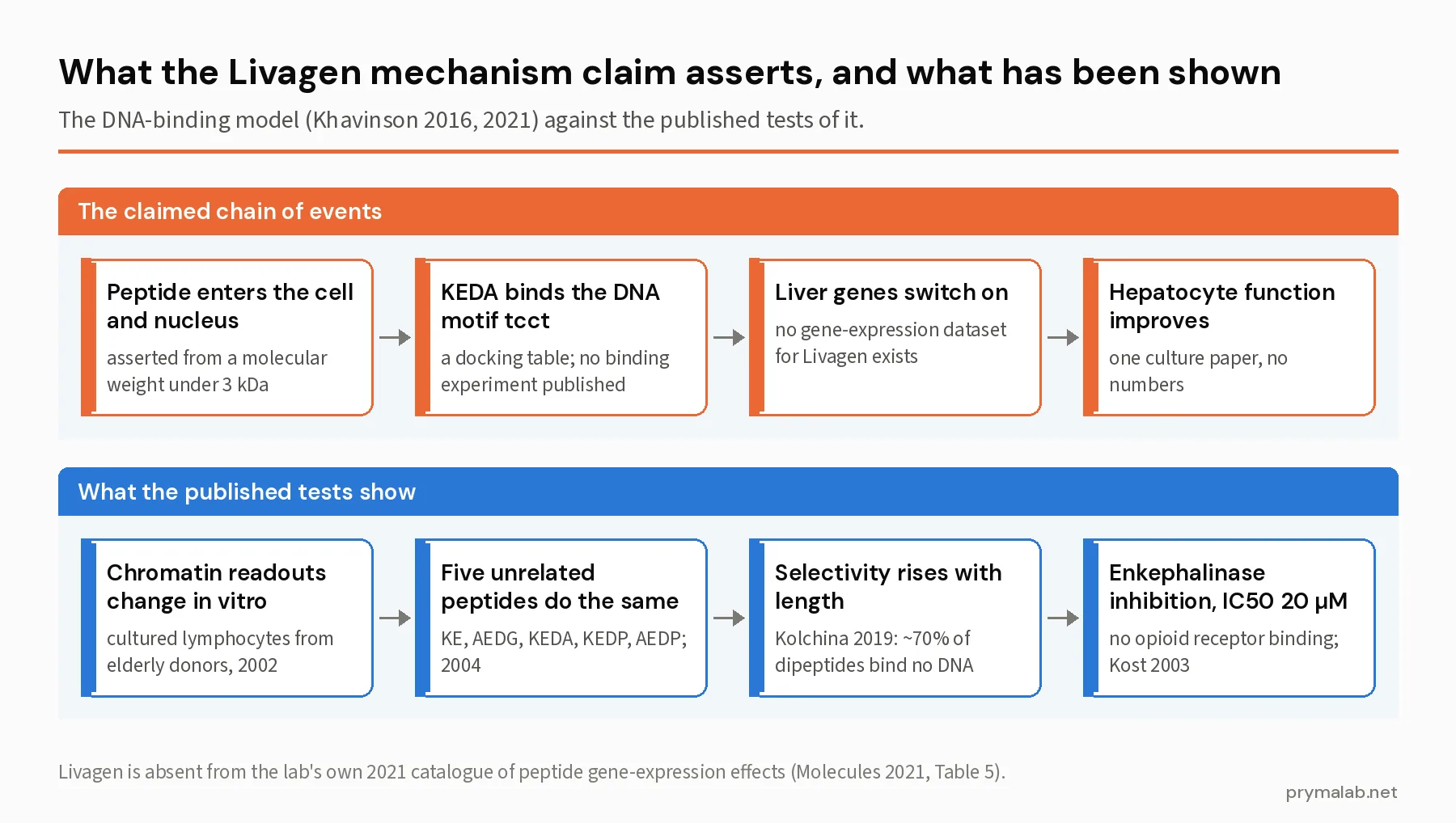
The claimed mechanism is that Livagen crosses the cell and nuclear membranes, binds a four-base motif in gene promoters and switches on liver genes. What has been shown is much narrower. Cytogenetic readouts change in cultured lymphocytes exposed to it; five structurally unrelated peptides produce the same change in the same assay; and the lab's own computational work finds that peptides this short are the least likely to recognise a DNA sequence selectively. There is no gene-expression dataset for Livagen and no binding measurement of any kind.
Where the DNA-binding model comes from
Khavinson's 2021 systematic review in Molecules states the premise: "short peptides with a molecular weight of up to 3 kDa are considered to be especially active in the regulation of gene expression", on the basis that they can pass through cytoplasmic and nuclear membranes. The same review offers a chemical rationale in which acidic residues weaken the hydrogen bonds between DNA strands and basic residues strengthen them.[7] A 2016 paper from the group goes further and assigns each peptide a target tetranucleotide: tcct for Livagen, ctcc for Ovagen.[1]
Those assignments are the output of molecular docking. They are predictions. I could find no gel shift, no footprint, no calorimetry, no reporter assay and no chromatin immunoprecipitation testing KEDA against tcct or against anything else. As far as the published record goes, the target motif printed on supplier pages has never been tested in a tube.
The lab's own best test points the other way
In 2019 Kolchina, Khavinson and colleagues published in Nucleic Acids Research a systematic docking and molecular dynamics search of all 400 dipeptides against all 136 unique tetranucleotide sequences in B-DNA, 108,800 combinations. Fifty-seven low-energy complexes showed high binding selectivity. Roughly 70% of dipeptides showed no DNA-binding capacity at all. Positively charged peptides, the ones containing arginine or lysine, bound DNA broadly but non-selectively. The authors' conclusion, verbatim: "Selective peptide binding to dsDNA can increase dramatically with the peptide length."[8]
Read that as it applies here. The study did not test KEDA or EDL; it tested dipeptides only. But its two findings, that selectivity is a function of length and that lysine and arginine produce broad non-selective binding, both bear directly on a four-residue peptide with a lysine at position 1. The 2016 tcct assignment and the 2019 length finding come from the same laboratory three years apart, and the later paper is in the better journal.
What the chromatin papers demonstrate
The flagship Livagen paper is Khavinson, Lezhava and colleagues in Bulletin of Experimental Biology and Medicine, 2002. In lymphocytes cultured from old people, Livagen was reported to activate ribosomal genes, decondense pericentromeric structural heterochromatin and release genes repressed by age-related condensation. The abstract's conclusion is that "Livagen causes de-heterochromatinization (activation) of chromatin".[9] What the abstract does not contain is any number: no donor count, no ages, no peptide concentration, no control description, no statistics, no effect size. I could not obtain the full text. The paper has been cited five times in the 24 years since, which for a claim of that size is a very small footprint.[10]
Two years later the same group ran the same assay on five peptides at once: Vilon (Lys-Glu), Epithalon (Ala-Glu-Asp-Gly), Livagen, Prostamax (Lys-Glu-Asp-Pro) and Cortagen (Ala-Glu-Asp-Pro), in leukocytes from subjects aged 75 to 88. All five activated ribosomal genes and decondensed chromatin. Epithalon, Livagen and Prostamax changed the structure of chromosome 1; Epithalon and Livagen also affected chromosome 9.[11]
This is the paper the tissue-specificity claim should be tested against, and it fails the test. A dipeptide marketed for the thymus, a tetrapeptide marketed for the pineal gland, one for the prostate, one for the brain cortex and one for the liver all did the same thing in the same cells. An assay that cannot tell five organ-specific peptides apart is not measuring organ specificity. It may be measuring something real about short acidic peptides and chromatin, or it may be measuring an artefact of the culture system, and nothing in either abstract lets me choose.
A 2011 review from the Tbilisi collaborators adds a line I cannot read past. It reports work in which "Co2+ ions alone and in combination with the bioregulator Livagen can reverse the deheterochromatinization".[12] I could not open the review to see the surrounding text, and the sentence can be read as cobalt doing what the peptide does or as cobalt undoing it. Either way, the same readout moves in response to a metal ion in the same laboratory system. That is not what a sequence-specific mechanism looks like.
The other mechanism, the one with a number
The only Livagen paper with a clean quantitative result has nothing to do with the liver or with DNA. Kost and colleagues, 2003, measured inhibition of enkephalin-degrading enzymes in human serum. Livagen inhibited them with an IC50 of 20 µM; Epitalon needed 500 µM, a 25-fold difference. Livagen outperformed puromycin, leupeptin and D-PAM in the same assay. Neither peptide bound mu- or delta-opioid receptors in rat brain membranes, a negative result the authors reported themselves and which deserves credit.[3] An IC50 of 20 µM is weak to moderate for an in vitro enzyme inhibitor, far above any plausible circulating concentration, and the finding has never been followed up.
Then there is the omission. Table 5 of the 2021 Molecules review is the lab's own consolidated catalogue of short-peptide biological effects: ten peptides, from Cartalax to RADA, each with its claimed activities and references. Livagen is not in it.[7] Either the peptide was dropped or it was never considered a gene-expression agent. Either way, the mechanism that Western pages print for Livagen is one the originating laboratory no longer lists against its name.
Every Livagen Study Indexed in PubMed, and What Each One Measured
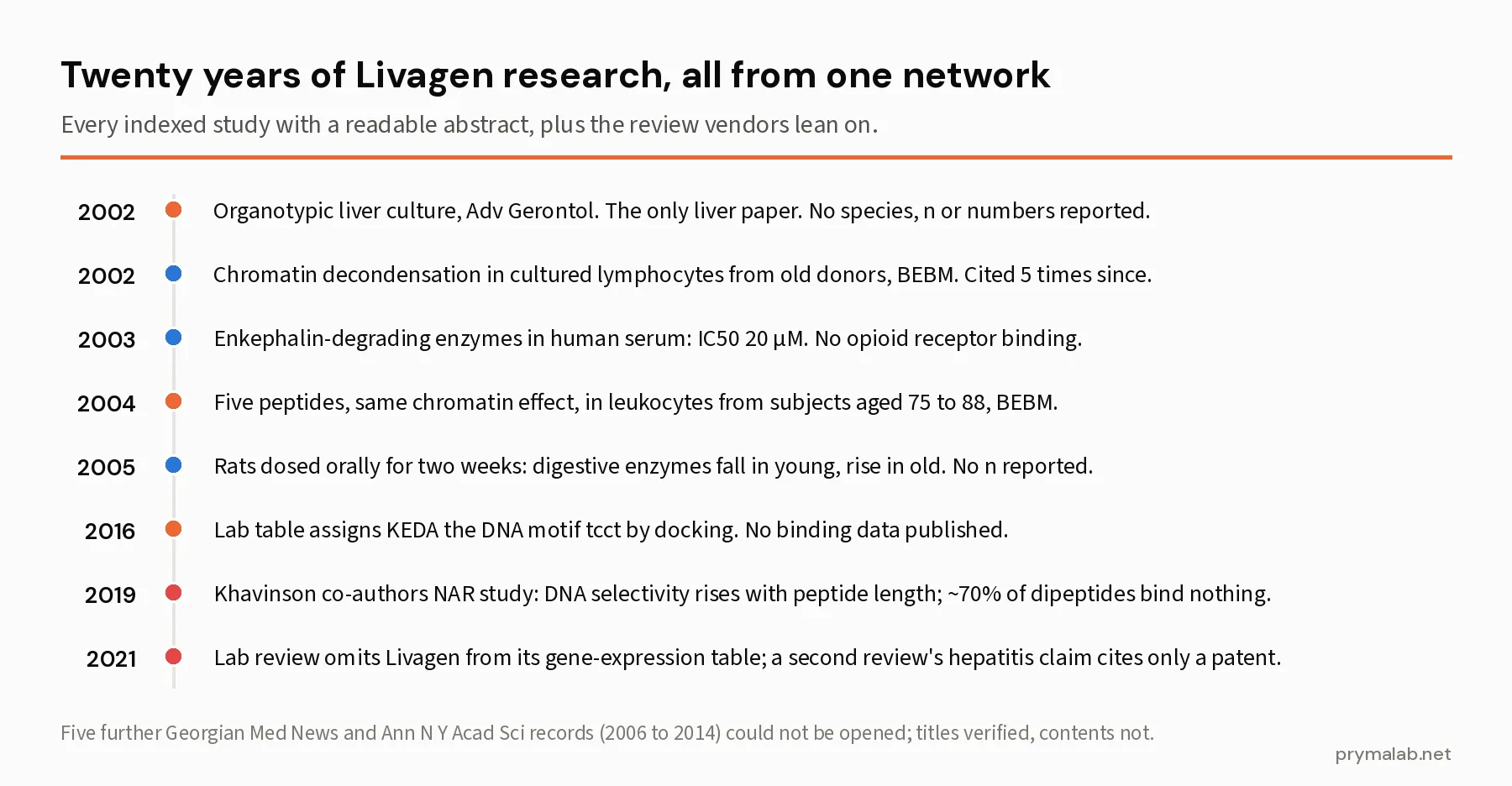
PubMed returns ten records for "Livagen".[13] Every one of them shares authorship with Khavinson's institute, the Tbilisi cytogenetics group, or both; no independent laboratory has published on the peptide. None involved giving Livagen to a person. There is no entry for Livagen, KEDA, Ovagen or Glu-Asp-Leu in ClinicalTrials.gov.[14] One of the ten records concerns the liver, and it reports no numbers.
| Year | Study | Model | n | Endpoint | Result |
|---|---|---|---|---|---|
| 2002 | Riadnova et al., Adv Gerontol | Organotypic liver culture; species not stated | Not stated | Immunocytochemistry and morphometry | Qualitative only; no number of any kind |
| 2002 | Khavinson et al., Bull Exp Biol Med | Cultured lymphocytes from old people | Not stated | Ribosomal gene activity; heterochromatin denaturation and polymorphism | Decondensation reported; no numbers |
| 2003 | Kost et al., Izv Akad Nauk Ser Biol | Human serum in vitro; rat brain membranes | Not applicable | Enkephalinase inhibition; opioid receptor binding | IC50 20 µM; no receptor binding |
| 2004 | Khavinson et al., Bull Exp Biol Med | Leukocytes from subjects aged 75 to 88; five peptides | Not stated | Same chromatin readouts as 2002 | All five peptides active; no numbers |
| 2005 | Timofeeva et al., Adv Gerontol | Rats, two age groups, oral, two weeks | Not stated | Digestive enzyme activity in gut, kidney and liver | 50% fall in glycyl-L-leucine dipeptidase in vitro; opposite directions in young and old rats in vivo |
| 2006 to 2014 | Five Georgian and New York Academy records | Lymphocyte cytogenetics | Not retrieved | Radiation adaptive response; NOR activity; genomic instability | Abstracts not retrievable; unverified |
| 2021 | Trofimova et al., EC Gastroenterol Dig Syst (review, not indexed) | Old-rat liver explants; unnamed toxic hepatitis model | Not stated | Explant area index; bilirubin, cholesterol, ALT, AST | +15 to 16% area index; hepatitis claims with no values, citing a patent |
Five of the ten records, four in Georgian Medical News and one in Annals of the New York Academy of Sciences, I could not open at all. Their titles are verified and their contents are not, and I am flagging them rather than describing them.[15] The remaining five, plus the review, are what the rest of this section is about.
The only liver paper
Riadnova, Filippov and Iuzhakov, Advances in Gerontology, 2002, in Russian. The abstract, in full, says that the tetrapeptide "stimulates structural and functional homeostasis of cell populations in the liver culture" and that its main activity "had been directed to the stabilisation of morphological safety and reinforcement of the processes of cellular and intracellular forms of regeneration".[16] No species. No n. No concentration. No description of the control. No quantitative outcome of any kind. "Stabilisation of morphological safety" is not an endpoint anyone can measure twice and compare.
This is the entire indexed hepatic evidence base for Livagen. I have read it several times looking for a number to report, and there is none.
The only in vivo study, and what it says about the oral claim
Timofeeva and colleagues, Advances in Gerontology, 2005, is the one animal study, and it is the most useful paper in the set. Rats of two age groups received Livagen orally for two weeks; enzyme activities were then measured in the small intestine and in non-digestive organs including kidney and liver. Two findings matter. First, the abstract states that "Peptide hydrolases of small intestine do not hydrolyze Livagen even to a small extent", and calls it "a weakly hydrolyzed peptide". Second, in vitro Livagen reduced glycyl-L-leucine dipeptidase activity in the small intestine by 50%, the one quantified enzyme number in the whole Livagen literature outside the 2003 serum paper.[2]
The in vivo result is directional and it points two ways. After two weeks of oral administration, digestive enzyme activity fell in young animals and rose in old ones. The authors present that as age-adaptive normalisation. It is equally consistent with an unstable or non-specific effect that happens to land on opposite sides of baseline in two small groups. The abstract gives no n, no dose, no strain, no age values and no statistics, so I cannot pick between the readings and neither can you.
The hydrolase-resistance finding is the mechanistic basis for every "orally bioavailable" claim about Livagen. Resistance to gut peptidases is a necessary condition for oral absorption of an intact peptide; it is not a sufficient one. No plasma concentration of Livagen has been published in any species after any route. The general problem is laid out in our reference on oral peptide delivery; for this compound the specific data stop at the intestinal wall.
The review, the explant number and the patent
The liver-specific claims that circulate come from one 2021 review, Trofimova, Khavinson and colleagues in EC Gastroenterology and Digestive System, a journal PubMed does not index, which is why it is not among the ten records above. I read the full text. It is a review, not original research, and it concerns KEDA only; Ovagen is not mentioned.[17]
It contains the only quantified liver-relevant number I found anywhere for Livagen: in organotypic cultures of liver fragments from old rats, KEDA raised the explant area index by 15 to 16%, while the control peptide, Epitalon (Ala-Glu-Asp-Gly), produced no increase. Growth was scored as the ratio of total explant area, including the peripheral growth zone, to the initial fragment area. No n, no replicate count, no statistics and no error bars are given. A 15 to 16% change in an explant index with unreported n is a hint, and I am recording it as a hint.
The same review states that in animals with "acute experimental toxic hepatitis" the peptide "had a protective and therapeutic effect", with normalisation of total bilirubin, cholesterol, ALT and AST, fewer destructive changes in the liver stroma and normalised glycogen-containing cells. That is one sentence. It names no species, no hepatotoxic agent, no n, no dose, no route, no duration and no value for any of the enzymes said to normalise. Its reference is European patent EP1325026, "Tetrapeptide stimulating functional activity of hepatocytes and its therapeutical use", dated 2004 in the review's reference list.[18] I could not retrieve the patent, so I can confirm that it exists and what it is called, and nothing about what its examples contain. A patent is not peer review. Patent examples are written to support a claim and nobody outside the applicant checks them.
The review also reports that KEDA, incubated with a suspension of leukocytes, increased the number of lymphocytes carrying the CD3+, CD4+ and CD8+ markers. That is an immunology observation, not a liver one, and it too comes without numbers.
Papers the trade-name search misses
Ten is a floor, not a ceiling. Papers that name the peptide only by its letter code, or that list it among several peptides, can slip past a search on "Livagen". While assembling our Prostamax reference I came across a 2001 Bulletin of Experimental Biology and Medicine paper on organotypic explants treated with Cortagen, Epithalon, Livagen and Vilon, and a 2023 Georgian Medical News paper that reran the lymphocyte chromatin design with AEDG, KEDA, AEDP and KE.[19][20] Neither changes the picture: same network, same assays, same absence of a liver endpoint.
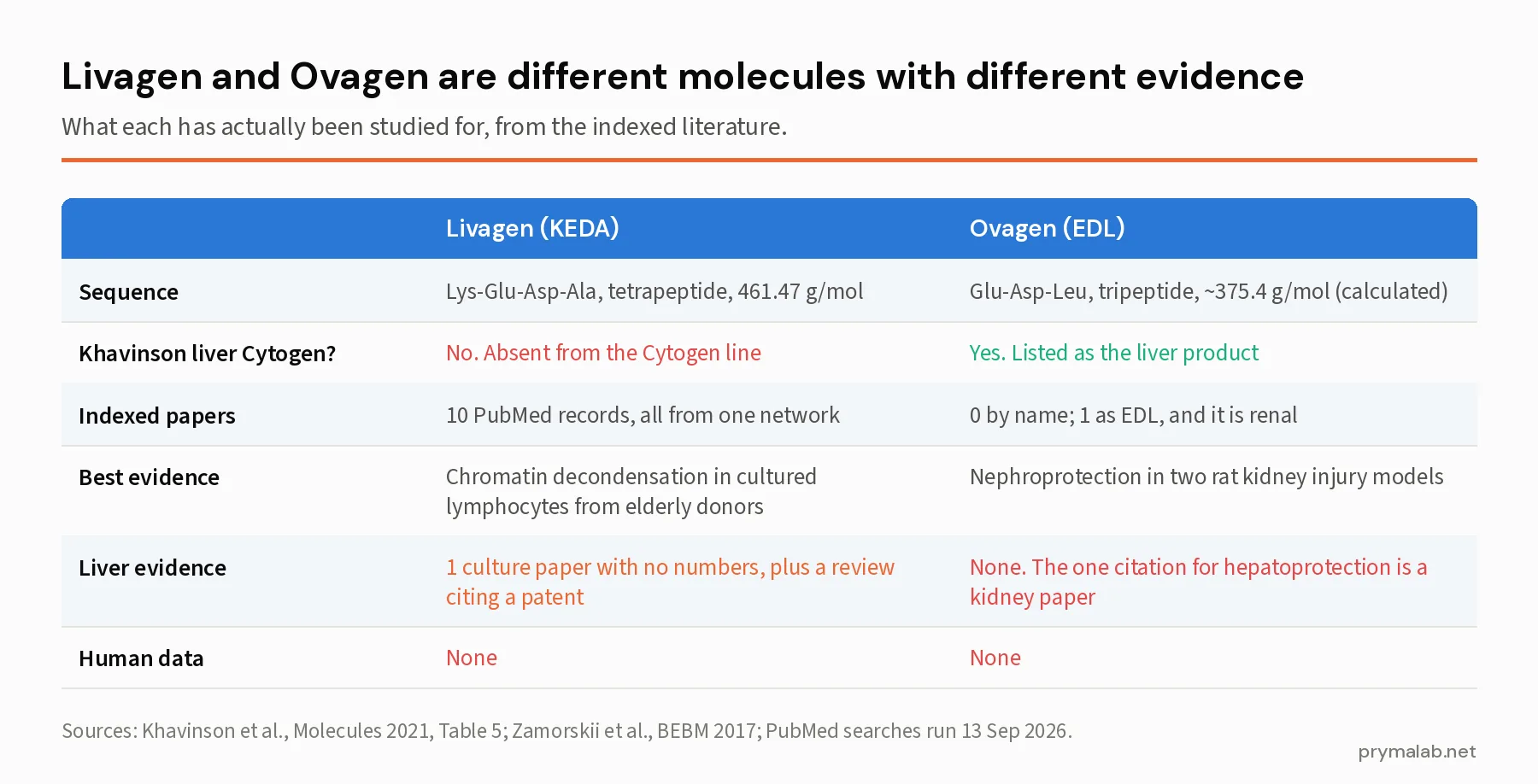
Livagen vs Ovagen: Different Molecules, Different Evidence
Livagen and Ovagen are not two versions of the same thing. They differ in length, four residues against three, and in composition, since Livagen carries a lysine and Ovagen carries none. The larger difference is in what each has been studied for. Livagen's evidence is in chromatin biology and gut enzyme physiology. Ovagen's is renal. Neither has a liver study with numbers, and neither has human data.
| Livagen | Ovagen | |
|---|---|---|
| Sequence | Lys-Glu-Asp-Ala (KEDA) | Glu-Asp-Leu (EDL) |
| Length | Tetrapeptide | Tripeptide |
| Formula and molecular weight | C18H31N5O9; 461.47 g/mol | C15H25N3O8; ~375.4 g/mol (calculated, not database-confirmed) |
| Claimed DNA target (2016 docking table) | tcct | ctcc |
| In the official Khavinson Cytogen line? | No | Yes, listed as the liver product |
| Indexed papers naming it | 10, all from the originating lab or Tbilisi collaborators | 0 by name; 1 as EDL |
| In Molecules 2021 Table 5? | Absent | Present, with one citation, to a kidney cell paper |
| Best-quality evidence | Chromatin decondensation in cultured lymphocytes (2002) | Nephroprotection in two rat kidney injury models (2017) |
| Liver-specific primary evidence | One qualitative culture paper (2002); one review sentence citing a patent | None |
| Best-documented organ effect | Gut digestive enzymes (rat, oral, two weeks); lymphocyte chromatin | Kidney |
| Human data | None | None |
| Independent replication | None | None |
Ovagen's liver credential is one citation, and it is a kidney paper
Row 4 of Table 5 in the 2021 Molecules review is "EDL, Ovagen", with the claimed activity "regulation of renal cells' function, hepatoprotection, DNA binding" and a single supporting reference, number 74.[7] Reference 74 is Khavinson and colleagues, 2014, "Peptides regulate expression of signaling molecules in kidney cell cultures during in vitro aging".[21] A kidney cell culture paper is the only support the lab's own systematic review offers for Ovagen's hepatoprotection. There is no other text about EDL in the review: no mechanism, no gene list, no liver discussion.
The one substantive primary study of EDL is also renal. Zamorskii and colleagues, 2017, reported a nephroprotective effect in two rat models, gentamicin-induced nephropathy and ischaemia-reperfusion kidney injury, with prevention of oliguria, reduced proteinuria and suppressed lipid peroxidation.[22] The methods are behind a paywall, so the doses, n and route are unverified, and the liver is not mentioned anywhere in the paper. Khavinson's own publication list of more than 200 entries contains no title with Ovagen in it and exactly one with EDL.[23]
What the distributor's Ovagen page offers instead is this: "A clinical study has demonstrated that Ovagen works as prevention and treatment for patients with hepatitis of different etiology", with outcomes such as disappearance of weakness and increased appetite.[24] No citation, no registry entry, no journal, no n. I treat it as marketing, because an unreferenced claim on a sales page is marketing.
Two traps when you search for Ovagen
A PubMed search for "Ovagen peptide" returns 19 results and none of them concerns the Khavinson tripeptide. All are about Ovagen, an ovine follicle-stimulating hormone preparation used for superovulation in sheep, goats and cattle.[25] Anyone checking the literature by name lands on veterinary reproduction papers from the early 1990s and may come away thinking the peptide has a research base it does not have.
The second trap is a sequence search. "Glu-Asp-Leu" returns a 2012 Bulletin of Experimental Biology and Medicine paper that is routinely cited as EDL evidence. Its peptides were "pancragen (Lys-Glu-Asp-Trp) in pancreatic cells, bronchogen (Ala-Glu-Asp-Leu) in bronchial epithelial cells, and vesugen (Lys-Glu-Asp) in fibroblasts".[26][27] The string match is on Ala-Glu-Asp-Leu, the Bronchogen tetrapeptide, and the tripeptide is not in the paper. If you see that study offered as Ovagen evidence, the citing page has not read it.
Our Ovagen guide covers that compound on its own terms. This section exists so that the comparison is made from the literature rather than from a product menu, and the literature's answer is that these are two different molecules with two different, and separately thin, evidence bases.
Livagen Peptide Side Effects, Safety Data and Regulatory Status
There is no adverse-event dataset for Livagen. No clinical trial safety data exist because there has been no clinical trial; there is no pharmacovigilance record, and I found no case reports. The only safety statements in the literature are two unreferenced sentences in the 2021 review, both traceable to the patent. No regulator anywhere has approved Livagen for anything, and in the United States it is sold research-use-only.
What the 5000-fold claim is and is not
The review states that a single administration of a KEDA solution to animals "at a dose 5000 times higher than the dose recommended for clinical use does not cause toxic reactions", and separately reports an absence of side effects during long-term use at 100 to 1000 times the therapeutic dose, with no pathological changes in organs, blood parameters or the cardiovascular and respiratory systems.[17]
Take those sentences apart. No LD50 is given. No species is named. No n, no route, no observation period. The "dose recommended for clinical use" is not defined anywhere, which makes the multiplier arithmetic on an unknown. The source is a review citing a patent, so it is not peer-reviewed toxicology. A sentence of that shape is a summary, not a finding.
Absence of reported harm is not evidence of safety. With zero published human exposures and no post-market surveillance, nothing can be said about human safety at any dose, and I am not going to say anything. One further point cuts against the reassurance rather than for it. If the chromatin-decondensation claim were true, it would call for scrutiny rather than comfort: de-repressing heterochromatin is not self-evidently benign, and I found no genotoxicity or carcinogenicity testing for the peptide. For Ovagen, no safety data of any kind were located, not even an assertion.
| Jurisdiction | Status | Basis |
|---|---|---|
| United States | Not approved for any indication; not a recognised dietary ingredient; outside the compounding pathways; sold research-use-only | No record in Drugs@FDA; no FDA or EMA document names the compound |
| European Union | No marketing authorisation | Patent EP1325026 exists; a patent confers no regulatory standing |
| Russia and origin market | Distributed as a non-medicinal product | Distributor catalogue: "parapharmaceutic agents"; "THE PRODUCTS ARE NOT A MEDICINES" |
| Clinical trials | None registered, active or completed | No ClinicalTrials.gov entry for Livagen, KEDA, Ovagen or Glu-Asp-Leu |
Two of those rows deserve a sentence each. Vendor copy sometimes cites the European patent in a way that implies approval; a patent is a property right over a claimed invention and says nothing about whether a regulator has assessed the compound. And the distributor's own catalogue disclaimer, in capitals, that the products are not medicines is the origin market's position stated by the people selling them.[5] Legal status outside the United States varies by country, and I have not surveyed it here.
How Livagen Is Characterised, and Why Mass Alone Does Not Prove the Sequence
A certificate of analysis for Livagen should show two things: a reversed-phase HPLC purity figure and a mass spectrometry identity check. For a tetrapeptide with no aromatic residue the HPLC trace has to be read at low wavelength, around 214 nm, where the peptide bond absorbs; there is no tryptophan, tyrosine or phenylalanine to give a signal at 280 nm. The mass check should find the protonated molecule near m/z 462.2, from a monoisotopic mass of 461.21 and an average mass of 461.47.
The mass check has a limit that matters more for very short peptides than for long ones. A mass spectrum confirms composition, not order. Any tetrapeptide with the same four residues in a different sequence has exactly the same mass, and lysine and glutamine differ by 0.036 Da, close enough that a unit-resolution instrument cannot separate Lys-Glu-Asp-Ala from Gln-Glu-Asp-Ala. Confirming that the vial contains KEDA rather than a sequence isomer needs tandem MS fragmentation, or co-injection against a reference standard on HPLC, or both. Ask which was done.
What mass spectrometry does do cleanly is separate Livagen from Ovagen. They are 86 Da apart, 461.5 against 375.4, so a mislabelled vial of one for the other is trivial to catch, and there is no isobaric collision between the two peptides sold for the liver. The collision risk, such as it is, sits inside Livagen's own composition rather than between the two products.
Degradation chemistry that follows from the structure
Livagen has no methionine or cysteine, so oxidation is not the storage problem. It has no asparagine, so the classic deamidation route is absent, and no tryptophan to photodegrade. What it does have is an aspartate in the third position. Aspartyl residues are the usual site of succinimide-mediated isomerisation to isoaspartate and, under acidic conditions, of chain cleavage; the rate for an Asp-Ala bond is lower than for Asp-Gly, and I have no Livagen-specific stability data, so treat that as what the structure predicts rather than what has been measured. The lyophilised solid is hygroscopic, as short acidic peptides generally are.
The other quantity a COA should state is peptide content. HPLC purity reports the fraction of peptide-related material that is the target peptide; it does not see counterions or water. Livagen has two basic sites, the N-terminal amine and the lysine side chain, each of which can carry a trifluoroacetate counterion from purification. Two TFA molecules add about 228 Da to a 461 Da peptide, so a fully salted, dry lot could be roughly two-thirds peptide by weight before any water is counted, and the real stoichiometry varies from lot to lot. The arithmetic is worked through in our reference on peptide purity testing; the general handling rules are in peptide storage and stability and reconstitution. PrymaLab supplies Livagen for laboratory research use with HPLC purity and mass spectrometry identity on every lot.
Why the Livagen Literature Cannot Be Checked From Outside
Every study located for Livagen originates from Khavinson's institute or the affiliated Tbilisi group. Four of the chromatin papers are in Georgian Medical News, a low-circulation regional journal. The review that carries the liver claims is in a journal PubMed does not index. The abstracts I could open report no n, no doses and no statistics, and the flagship paper has been cited five times in 24 years. None of that is disqualifying on its own. Together it means no unaffiliated laboratory has ever tested any Livagen claim, and a reader cannot check the claims from outside the network that made them.
| Claim | Source type | What is missing |
|---|---|---|
| The liver bioregulator | Western supplier copy; absent from the Khavinson Cytogen line | Any liver study with numbers |
| Isolated from a liver extract | Framework assertion in lab reviews | An isolation and sequencing paper |
| Binds the DNA motif tcct | Molecular docking table, 2016 | Any binding experiment; the 2019 study points the other way |
| Reactivates chromatin in old cells | Two in vitro papers, 2002 and 2004, same network | n, concentrations, statistics; five unrelated peptides did the same |
| Protective in toxic hepatitis | One sentence in a 2021 review citing patent EP1325026 | Species, agent, n, dose, route, any enzyme value |
| Orally bioavailable | Rat gut hydrolase resistance, 2005 | A plasma concentration in any species |
| Non-toxic at 5000 times the dose | Same 2021 review, same patent | LD50, species, n, route, and the dose it is a multiple of |
How I weight this. The chromatin observations are probably real as observations: two papers, one design, consistent direction, and the same group later reproduced it with the peptide list rearranged. What they mean is unknown, and the same readout answered to four other peptides and to cobalt. The gut hydrolase finding is the one result I would carry forward, because it is mechanistically specific and it makes a testable prediction that nobody has tested. The liver claims I would not build anything on. There is no controlled hepatotoxicity model, no enzyme value, no dose-response and no independent group, and the one primary liver paper does not contain a number.
What would change my mind is specific: a plasma concentration after oral administration in any species; a gel shift or calorimetry result for KEDA against tcct; a carbon tetrachloride or acetaminophen model with reported n and ALT values from a laboratory that has never published with the institute; or an isolation paper showing KEDA recovered from a liver extract. None of those exists as of September 2026.
What This Article Does Not Settle
Whether Livagen came from a liver extract. The descent from Hepatamin or Svetinorm is a framework assertion. No published isolation-and-sequencing paper shows Lys-Glu-Asp-Ala recovered from any liver preparation, and the organisation's own synthetic liver product is Ovagen.
Whether KEDA binds tcct, or any DNA sequence, selectively. The assignment is a docking output. No gel shift, calorimetry, footprint or reporter data exist for the peptide, and the lab's own 2019 study found selectivity rising with length and lysine driving non-selective binding. Whether the peptide reaches a nucleus at any physiological concentration is asserted from its molecular weight alone.
Whether chromatin decondensation in a dish means anything for a liver. Nothing downstream was measured in either chromatin paper, four other peptides and cobalt ions moved the same readout, and no gene-expression dataset for Livagen exists. Livagen is absent from the lab's own 2021 gene-expression review.
Whether Livagen does anything in a liver injury model. No carbon tetrachloride, acetaminophen or alcohol model has been published for either peptide. The hepatitis claim is one review sentence citing a patent, with no species, agent, n, dose, route or enzyme value. No effect on fibrosis, steatosis, viral hepatitis or cirrhosis has been reported by anyone.
Whether it is orally bioavailable, and whether it is safe at any dose. Resistance to rat gut hydrolases is the best mechanistic datum available and no plasma concentration exists in any species. No pharmacokinetic parameter of any kind has been published. No LD50, genotoxicity, carcinogenicity or reproductive toxicity data exist, and there have been zero published human exposures.
What is well established: the sequence, formula and molecular weight; the count and shared authorship of the indexed papers; the absence of Livagen from the Khavinson Cytogen line and from the lab's 2021 table; the absence of any human study or registered trial; and the regulatory position in the United States. Those are checkable in the linked records.
Frequently Asked Questions
What is Livagen and what is its sequence?
A synthetic tetrapeptide, Lys-Glu-Asp-Ala (KEDA), 461.47 g/mol, from the Khavinson short-peptide family. It is sold in the West as a liver bioregulator; the originating catalogue does not list it as one.
Is Livagen FDA approved?
No. Not approved anywhere, not in Drugs@FDA, no registered trial. In the United States it is sold research-use-only, and the European patent is not an authorisation.
What is the difference between Livagen and Ovagen?
Livagen is Lys-Glu-Asp-Ala; Ovagen is Glu-Asp-Leu. Livagen's evidence is chromatin and gut enzymes with one qualitative liver paper; Ovagen's is renal, with no liver study at all. Neither has human data.
Does Livagen work orally?
Unknown. Rat gut hydrolases reportedly do not break it down, which is necessary for oral absorption but not sufficient. No plasma concentration has been published in any species.
Is there a published Livagen peptide dosage?
No. No human dose has ever been studied and the animal papers do not report theirs. This article gives no dosing guidance; the compound is research use only.
What are the known Livagen peptide side effects?
None are documented, because no human has been studied. The only safety claim is an unreferenced review sentence citing a patent. Absence of reported harm is not evidence of safety.
Does Livagen protect the liver?
No controlled evidence. One qualitative culture paper, a 15 to 16% explant figure without n, and a hepatitis sentence citing a patent. No hepatotoxicity model and no enzyme values have been published.
Does Livagen bind DNA and change gene expression?
Not demonstrated. The tcct target is a docking prediction with no binding data, the lab's own 2019 study says selectivity rises with length, and its 2021 review omits Livagen.
Has Livagen ever been tested in humans?
No. Donated cells and serum were exposed in vitro; the only in vivo study is in rats. No trial is registered anywhere.
Was Livagen isolated from a liver extract?
Not in any published paper. The descent from a liver extract is a framework assertion; no isolation-and-sequencing study exists, and the organisation's synthetic liver product is Ovagen.
References
- Khavinson VKh, Lin'kova NS, Tarnovskaya SI. Short Peptides Regulate Gene Expression. Bull Exp Biol Med. 2016;162(2):288-292. The lab's own peptide table listing Livagen as KEDA and Ovagen as EDL, with docking-derived DNA targets tcct and ctcc. Lab PDF
- Timofeeva NM, Khavinson VKh, Malinin VV, Nikitina AA, Egorova VV. Effect of peptide Livagen on activity of digestive enzymes in gastrointestinal tract and non-digestive organs in rats of different ages. Adv Gerontol. 2005;16:92-96. PMID 16075683. The only in vivo study; hydrolase resistance and the 50% dipeptidase figure. PubMed
- Kost NV, Sokolov OIu, Gabaeva MV, Zolotarev IuA, Malinin VV, Khavinson VKh. Effect of new peptide bioregulators livagen and epitalon on enkephalin-degrading enzymes in human serum. Izv Akad Nauk Ser Biol. 2003;(4):427-429. PMID 12942748. IC50 values and the negative opioid receptor result. PubMed
- Wikipedia. Livagen. Formula C18H31N5O9 and molecular weight 461.472 g/mol; used only to corroborate the calculated mass. Wikipedia
- Cytogens (synthesised peptides) catalogue, Khavinson-affiliated distributor. Lists Ovagen as the liver product and omits Livagen; describes the line as "parapharmaceutic agents" and carries the disclaimer "THE PRODUCTS ARE NOT A MEDICINES". Catalogue
- Hepatamin (Cytamins, Geropharm) product page. The extract-tier liver product: "liver of young animals", "a complex of proteins and nucleoproteins". Product page
- Khavinson VK, Popovich IG, Linkova NS, Mironova ES, Ilina AR. Peptide Regulation of Gene Expression: A Systematic Review. Molecules. 2021;26(22):7053. The DNA-binding premise, and Table 5, which omits Livagen and supports Ovagen's hepatoprotection with reference 74 only. MDPI and lab PDF
- Kolchina N, Khavinson V, Linkova N, Yakimov A, Baitin D, Afanasyeva A, Petukhov M. Systematic search for structural motifs of peptide binding to double-stranded DNA. Nucleic Acids Res. 2019;47(20):10553-10563. DOI 10.1093/nar/gkz850. All 400 dipeptides against all 136 tetranucleotides; selectivity rises with length. OUP
- Khavinson VKh, Lezhava TA, Monaselidze JG, Dzhokhadze TA, Dvalishvili NA, Bablishvili NK, Ryadnova IY. Effects of Livagen Peptide on Chromatin Activation in Lymphocytes from Old People. Bull Exp Biol Med. 2002;134(4):389-392. DOI 10.1023/A:1021924702103. PMID 12533768. The flagship chromatin paper; abstract carries no numbers. Springer
- CoLab citation record for the 2002 chromatin paper: five citing publications. CoLab
- Khavinson VKh, Lezhava TA, Malinin VV. Effects of short peptides on lymphocyte chromatin in senile subjects. Bull Exp Biol Med. 2004;137(1):78-81. PMID 15085253. Five peptides, one assay, one result. PubMed
- Lezhava T, Monaselidze J, Jokhadze T, Kakauridze N, Khodeli N, et al. Review of gerontology research in Georgia, including the Tbilisi chromatin work with Khavinson and the cobalt ion sentence quoted in the text. Biogerontology. 2011;12. DOI 10.1007/s10522-010-9283-6. Full text not retrieved. Springer
- PubMed search for "Livagen", ten records, run 13 September 2026. PubMed
- ClinicalTrials.gov, searched 13 September 2026 for Livagen, KEDA, Ovagen and Glu-Asp-Leu; no matching studies. ClinicalTrials.gov
- Georgian and New York Academy cytogenetics records naming Livagen; titles verified in PubMed, abstracts not retrieved: Lezhava T, et al. Georgian Med News. 2006, PMID 16705247; Lezhava T, Jokhadze T. Ann N Y Acad Sci. 2007;1100:387-399, PMID 17460203; Dzhokhadze TA, Buadze TZh, Dvalishvili NA, Lezhava TA. Georgian Med News. 2007, PMID 17921545; Dzhokhadze TA, et al. Georgian Med News. 2014, PMID 25541832; no authors listed. Georgian Med News. 2014, PMID 25341254.
- Riadnova IIu, Filippov SV, Iuzhakov VV. Functional morphology of an organotypic liver culture exposed to the peptide livagen. Adv Gerontol. 2002;10:88-94. PMID 12577697. The only indexed liver study; qualitative abstract quoted in the text. PubMed
- Trofimova SV, Khavinson VKh, Trofimov AV, Dudkov AV, Attich K. Role of Short Peptides in Maintaining Liver Functional Activity. EC Gastroenterology and Digestive System. 2021;8(11):43-47. Not PubMed-indexed. Source of the explant figure, the hepatitis sentence and the toxicity sentences. Lab PDF
- Khavinson VKh. Tetrapeptide stimulating functional activity of hepatocytes and its therapeutical use. European patent EP1325026, 2004. Existence and title verified from the 2021 review's reference list; contents not retrieved and not independently reviewed.
- Khavinson VKh. Organotypic explant study with Cortagen, Epithalon, Livagen and Vilon. Bull Exp Biol Med. 2001;132:807-808. PMID 11713572. Noted as a Livagen paper not returned by a trade-name search. PubMed
- Lezhava T, et al. Lymphocyte chromatin design repeated with AEDG, KEDA, AEDP and KE. Georgian Med News. 2023. PMID 37042594. PubMed
- Khavinson VK, Lin'kova NS, Polyakova VO, Durnova AO, Nichik TE, Kvetnoi IM. Peptides regulate expression of signaling molecules in kidney cell cultures during in vitro aging. Bull Exp Biol Med. 2014;157:261-264. Reference 74 of the 2021 review, the sole citation for Ovagen's hepatoprotection.
- Zamorskii II, Shchudrova TS, Lin'kova NS, Nichik TE, Khavinson VKh. Nephroprotective Effect of EDL Peptide at Acute Injury of Kidneys of Different Genesis. Bull Exp Biol Med. 2017;163(3):389-393. DOI 10.1007/s10517-017-3811-1. The one substantive EDL primary study; methods paywalled. Springer
- Khavinson VKh, publication list, more than 200 entries; no title containing Ovagen, one containing EDL. khavinson.info
- Ovagen product page, Khavinson-affiliated distributor. Composition given as "Peptide complex AC-3 (leucine, glutamic acid, aspartic acid)", and the uncited hepatitis claim quoted in the text. Product page
- PubMed search for "Ovagen peptide", 19 records, all concerning the ovine FSH preparation, for example Batt PA, et al. Reprod Fertil Dev. 1993, PMID 8234893, and Henderson KM, et al. Reprod Fertil Dev. 1990, PMID 2128901. PubMed
- Khavinson VKh, Linkova NS, Polyakova VO, Kheifets OV, Tarnovskaya SI, Kvetnoy IM. Peptides tissue-specifically stimulate cell differentiation during their aging. Bull Exp Biol Med. 2012;153(1):148-151. DOI 10.1007/s10517-012-1664-1. Pancragen, Bronchogen and Vesugen; often miscited as EDL evidence. Springer
- PubMed search for "Glu-Asp-Leu", 38 records, including substring matches on Ala-Glu-Asp-Leu. PubMed
Study details are taken from PubMed abstracts, the originating laboratory's own PDFs and distributor pages as cited, current to 13 September 2026. Where an abstract could not be opened, or a figure is calculated rather than read from a database, that is stated in the text. Regulatory positions described are United States federal positions and should not be assumed to apply elsewhere.
Final disclaimer: This article is an educational research reference on the chemistry, proposed mechanism and published evidence for the tetrapeptide Livagen. Compounds supplied by PrymaLab are sold and studied for laboratory research use only and are not approved by any regulatory authority for human or veterinary use. Statements have not been evaluated by the FDA. Nothing here is medical advice, administration guidance, or a treatment claim.
The in vitro and animal studies described are reported for scientific context only, and their inclusion does not describe or support any use of research-grade material. Study designs are reported as facts about those studies. Always verify the legal status of any research compound in your jurisdiction before purchase or use.