

Do peptide nasal sprays work? Which peptides are sold as sprays
Peptide nasal sprays are research-use solutions that deliver a peptide across the nasal epithelium instead of by injection. Absorption is set mainly by molecular size, so small peptides such as Semax, Selank and oxytocin have the most published intranasal data. PrymaLab supplies 37 research sprays, including BPC-157 Peptide Nasal Spray, Semax 10mg Nasal Spray and GHK-Cu Nasal Spray.
- Route: Intranasal; absorbed across the nasal epithelium, with olfactory and trigeminal nerves as a possible path to the brain.
- What limits absorption: Molecular size, enzymes in nasal mucus, and mucociliary clearance, which sweeps solution away within minutes.
- Approved nasal peptides: Desmopressin, salmon calcitonin and nafarelin; the Miacalcin label puts the bioavailability of the salmon calcitonin nasal spray at 3 to 5 percent of an intramuscular dose.
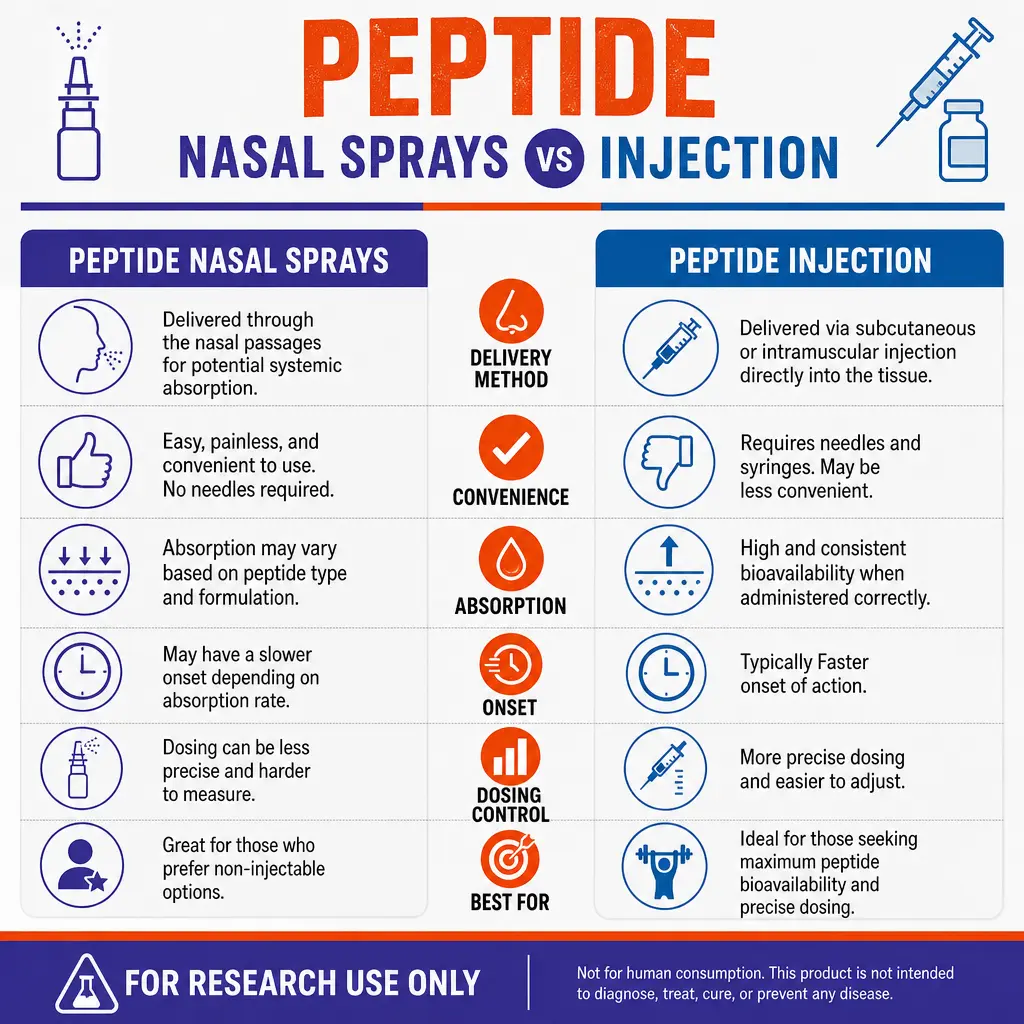
- Compared with injection: Lower, more variable bioavailability; no needle or reconstitution step; large peptides gain little from the route.
- Studied for: Nose-to-brain delivery of Semax, Selank, oxytocin and insulin; systemic delivery of small hormone analogues.
- Handling: Solution is refrigerated, kept from light, and discarded if it turns cloudy or passes its stability window.
- Forms at PrymaLab: 37 sprays, from Oxytocin 2mg Nasal Spray to Glutathione 250mg Nasal Spray, plus vials.
| Question | Nasal spray | Lyophilised vial |
|---|---|---|
| Preparation | Ready solution with a metered pump | Dissolved in a suitable diluent before use |
| Route studied | Nasal mucosa; olfactory and trigeminal paths toward the brain | Subcutaneous or intramuscular injection |
| Bioavailability | Low and variable; falls as molecular size rises | Higher and more predictable |
| Best-supported peptides | Oxytocin, Semax, Selank and small hormone analogues | Almost every peptide in the catalogue |
| Storage | Refrigerated solution with a fixed stability window | Powder stays stable frozen for months; solution refrigerated after mixing |
Related: the Semax nasal spray guide, the NAD+ delivery routes comparison, and the peptide reconstitution calculator for vial work.
The nasal route is not a shortcut around pharmacology. It is a real absorption surface with real limits, and those limits are mostly set by one number: how big the peptide is. This research-use-only reference covers what crosses the nasal epithelium, what the approved intranasal peptide drugs tell us about realistic bioavailability, and which compounds in a research catalogue sit inside the size range where the route has any published support.
Research-use-only disclaimer: Peptide nasal spray preparations supplied as research chemicals are intended strictly for in-vitro and laboratory research use and are not intended for human or veterinary use in that context. This article describes absorption mechanisms and published pharmacokinetics. It contains no administration instructions, no dosing guidance, and no medical advice.

TL;DR
The nasal cavity presents about 150 cm² of thin, densely vascularised epithelium that drains directly into systemic circulation and skips first-pass liver metabolism. Peptides cross mainly by the paracellular route, which is size-restricted, so passive permeation falls off steeply above roughly 1 kDa. Several small peptides have approved intranasal formulations, including desmopressin, oxytocin, nafarelin, buserelin and salmon calcitonin, and their reported bioavailability sits in the low single-digit percent range rather than anywhere near injection. Mucociliary clearance removes deposited material with a half-time near 15 to 20 minutes, and nasal aminopeptidases degrade peptides in place. For most research peptides, no intranasal bioavailability figure has been published at all. Research use only.
Absorption surface: roughly 150 cm², thin epithelium, dense subepithelial vasculature, no first-pass hepatic metabolism.
Dominant route for peptides: paracellular, through tight junctions, size-restricted.
Practical size ceiling: passive permeation falls sharply above about 1 kDa, with exceptions.
Realistic bioavailability: low single-digit percent for unmodified peptides that have been measured.
Two clearance problems: mucociliary transit near 15 to 20 minutes, plus mucosal aminopeptidases.
Status: preclinical and formulation science. Research use only.
Why the Intranasal Route Gets Studied
Peptides are difficult to deliver by any route other than injection. They are large, water-soluble, and enzymatically fragile, which rules out ordinary oral dosing for most of them. The nasal cavity is attractive because it sidesteps two of those problems at once: the epithelium is thin and heavily vascularised, and anything absorbed there enters systemic circulation without first passing through the liver.[1]
The surface available is larger than it looks. Turbinate folding gives an adult nasal cavity on the order of 150 square centimetres, and blood flow per gram of tissue there is high relative to most mucosal surfaces.[1] That combination is why the route works for small molecules and why formulation scientists keep returning to it for peptides.
The honest counterweight is that a good absorption surface does not make a molecule absorbable. Everything below is about which molecules the surface actually admits.
What Actually Crosses the Nasal Epithelium
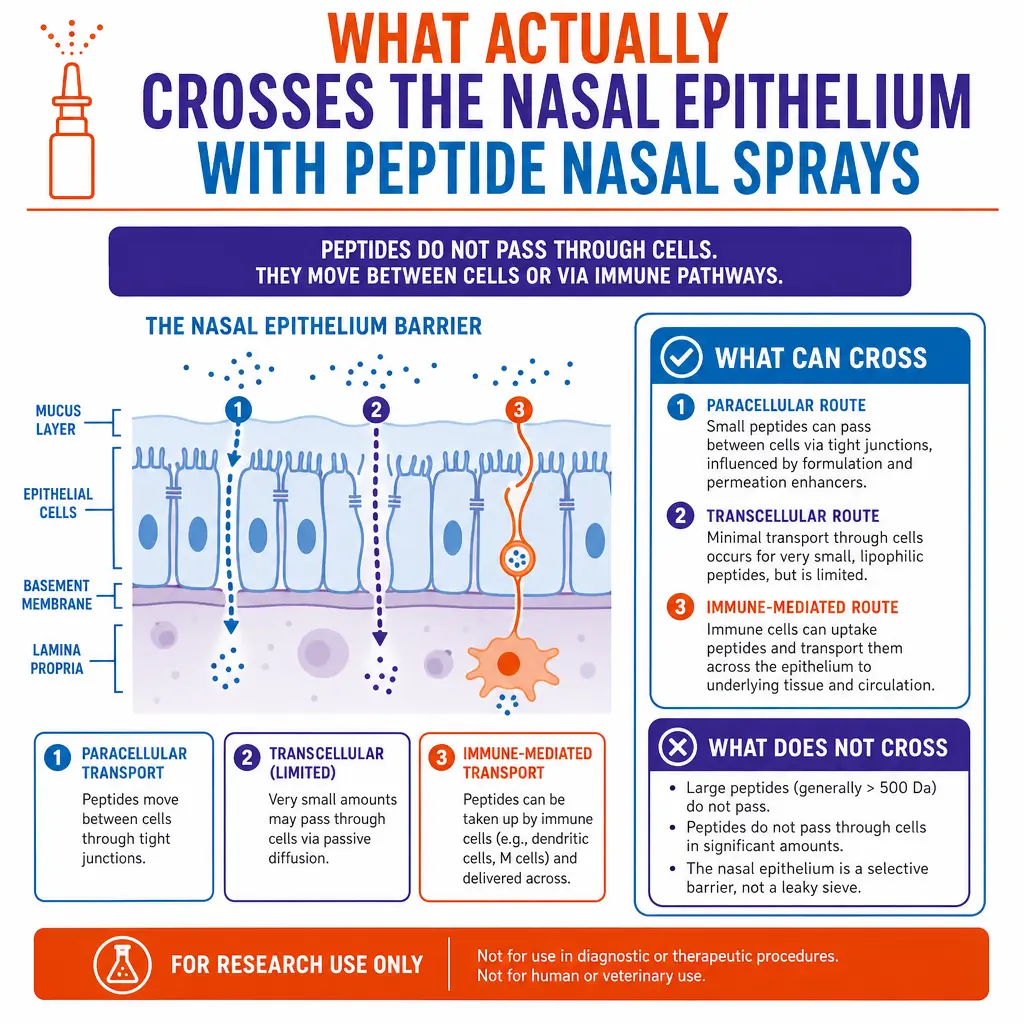
Two routes matter. Transcellular transport moves lipophilic molecules through the cell membranes themselves, and it handles small lipid-soluble compounds well. Paracellular transport squeezes hydrophilic molecules between adjacent cells, through the tight junctions.[1]
Peptides are hydrophilic. They take the paracellular route, and tight junctions are physically narrow. That is the whole reason molecular weight dominates this topic. A tripeptide and a 43-residue protein are not making the same journey with different efficiency. They are effectively facing different doors, and only one of them fits.
Molecular Size, and Where Each Compound Sits
Passive paracellular permeation for hydrophilic compounds declines steeply somewhere around 1 kDa.[1] That figure is a working rule rather than a wall, and there is a well-known exception discussed further below. Here is roughly where common research peptides fall.
| Size band | Compounds | Approx. mass |
|---|---|---|
| Very small (<500 Da) | Vilon (Lys-Glu), Thymogen (Glu-Trp), Glutathione, KPV, GHK, Epitalon, Pinealon | 275 to 419 Da |
| Small (500 to 1,000 Da) | NAD+, Ipamorelin, Selank, Semax, GHRP-2, DSIP, GHRP-6, Hexarelin | 663 to 887 Da |
| Around the 1 kDa line | Oxytocin, Melanotan II, PT-141 (bremelanotide) | 1,007 to 1,025 Da |
| Above the line | Gonadorelin, ARA-290, Kisspeptin-10, Triptorelin, BPC-157 | 1,182 to 1,419 Da |
| Well above | AOD9604, VIP, Thymosin beta-4 (full 43-mer), IGF-1 LR3 | 1,815 to 9,111 Da |
A few notes that matter more than the table itself.
The Khavinson bioregulators are the smallest things here by a wide margin. Vilon is a dipeptide at roughly 275 Da. Thymogen is 333 Da. If molecular size were the only variable, these would be the most plausible intranasal candidates in the entire catalogue, and it is worth noting that the bioregulator literature is also the thinnest and most geographically concentrated. Size and evidence quality are independent problems.
"TB-500" is ambiguous and the ambiguity is a size problem. Some material sold under that name is the short thymosin beta-4 fragment 17 to 23, which is under 900 Da. Some is full-length thymosin beta-4, 43 residues and close to 4,963 Da. Those two are on opposite sides of the permeation question. Anyone comparing intranasal preparations should establish which one they have. See the TB-500 spray reference material listing and its certificate of analysis for the specific sequence supplied.
IGF-1 LR3 is an outlier. At roughly 9,111 Da it is an order of magnitude past the passive permeation range. Any nasal delivery of a molecule that size would depend on formulation enhancement, on paracellular junction modulation, or on routes other than simple diffusion, and published data specific to that compound intranasally is scarce.
The Nose-to-Brain Question
The most cited reason for interest in intranasal peptides is not systemic absorption at all. It is the possibility of direct transport from the nasal cavity to the central nervous system along the olfactory and trigeminal nerves, bypassing the blood-brain barrier entirely.[2][3]
The anatomy is real. Olfactory sensory neurons project through the cribriform plate directly into the olfactory bulb, and trigeminal branches innervate the nasal mucosa and reach the brainstem. Both provide a physical path that does not require crossing the blood-brain barrier.[3]
The caveats are substantial. The olfactory region is a small fraction of the total nasal surface in humans, on the order of 10 square centimetres in the upper cavity, and ordinary spray devices deposit most of their volume on the lower respiratory epithelium rather than up there.[2] The fraction of an applied dose that reaches the CNS by this route in humans has been contested for two decades, and the strongest evidence remains in rodents, whose nasal anatomy allocates far more relative area to olfactory epithelium than ours does.
Intranasal oxytocin is the best-studied case and remains genuinely debated, with a large literature and persistent methodological argument about whether measured central effects reflect direct nose-to-brain transport, systemic absorption with subsequent CNS entry, or peripheral effects interpreted centrally.[4] That a compound this small and this heavily studied is still contested says something useful about how much weight to place on the pathway for anything larger or less studied.
What Limits Absorption
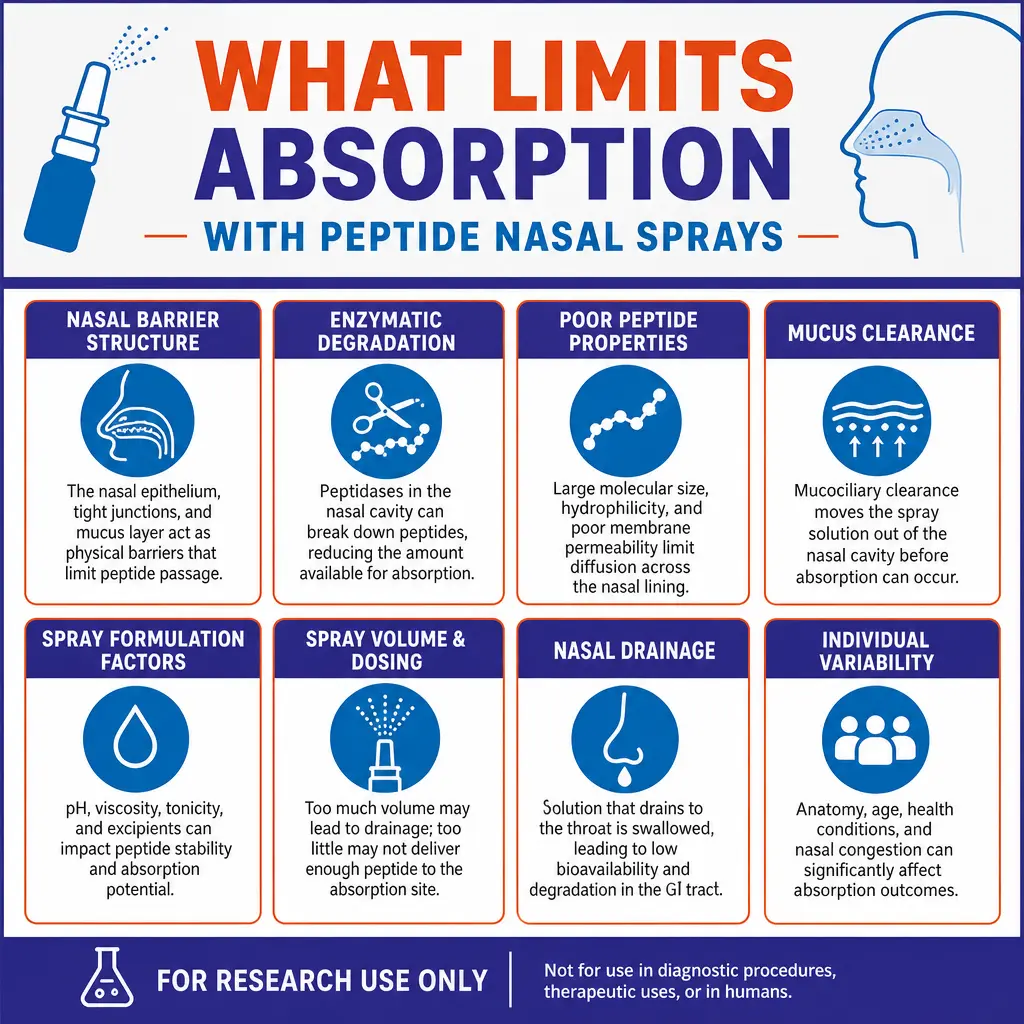
Three mechanisms cap how much of an applied peptide gets anywhere.
Mucociliary clearance. The nasal mucosa continuously moves its mucus layer toward the nasopharynx, and deposited material goes with it. Clearance half-time in healthy adults is commonly reported near 15 to 20 minutes.[1] That sets a hard ceiling on residence time, which is why mucoadhesive formulations exist.
Enzymatic degradation. Nasal mucosa contains aminopeptidases and other proteases. A peptide is being cleaved while it is trying to cross, and shorter sequences with unprotected termini are the most exposed. N-acetylation and amidation, which appear on several research peptides, are partly about this.
Tight junction restriction. Covered above. This is the dominant term for anything above about 1 kDa.
Formulation science has answers to all three: permeation enhancers, chitosan and other mucoadhesive polymers, cyclodextrins, enzyme inhibitors, and particle engineering to target the upper cavity.[1] Whether any given research preparation uses any of them is usually not disclosed, and a plain aqueous solution in a spray bottle uses none of them.
What the Approved Intranasal Peptides Tell Us
The most useful evidence in this whole area comes from peptides that went through formal development. Several have approved intranasal formulations, which means their bioavailability was measured properly rather than assumed.
| Peptide | Approx. mass | Note |
|---|---|---|
| Desmopressin | ~1,069 Da | Long-established nasal formulation |
| Oxytocin | ~1,007 Da | Nasal formulations marketed in several territories |
| Buserelin | ~1,239 Da | GnRH analogue |
| Nafarelin | ~1,322 Da | GnRH analogue |
| Salmon calcitonin | ~3,432 Da | The size exception, at roughly 3% bioavailability |
Two things stand out. First, four of the five sit between roughly 1,000 and 1,350 Da, which is where the size rule predicts marginal but workable permeation. Second, salmon calcitonin at 3,432 Da breaks the rule, and it does so at about 3 percent bioavailability. That is the honest shape of the exception: much larger peptides can be delivered nasally, at a delivered fraction low enough that it only makes sense when the compound is potent and the formulation is engineered for it.
There is also an instructive negative result. PT-141 (bremelanotide) was originally developed as an intranasal product. Development moved to subcutaneous administration after blood pressure increases were observed in intranasal trials.[5] The nasal route was not abandoned because the peptide failed to absorb. It was abandoned because it absorbed in a way that produced an unacceptable effect. Anyone reasoning about PT-141 intranasal reference material should know that history.
Intranasal Compared With Injection
No published head-to-head pharmacokinetic comparison exists for the research peptides in this category. What exists is the general pattern from developed drugs, and that pattern is consistent: intranasal bioavailability for unmodified peptides lands in the low single digits against subcutaneous or intravenous reference.[1]
Framed usefully, the nasal route trades delivered fraction for two things. One is avoiding an injection. The other is a possible direct CNS pathway that injection does not offer. Whether either trade is worth making depends entirely on the research question, and neither is a claim that the two routes are equivalent.
Any source stating that a peptide nasal spray delivers comparably to injection should be asked for the study. For most of these compounds there is not one.
Handling and Stability of Solution Reference Material
This section covers laboratory handling of reference material. It is not administration guidance.
Peptides are markedly less stable in solution than as lyophilised powder. Hydrolysis, oxidation of methionine and cysteine residues, deamidation of asparagine and glutamine, and adsorption to container surfaces all proceed faster in aqueous phase. The practical implications for a solution-format reference material are that it is generally held refrigerated and protected from light, that freeze-thaw cycling is avoided, and that a working solution has a shorter useful life than the lyophilised source material.
Specifics vary by sequence, buffer composition, pH and whether a preservative is present, so the storage guidance and certificate of analysis supplied with a particular lot supersede any general rule. At PrymaLab, every lot is tested in PrymaLab's own laboratory (RP-HPLC purity, LC-MS identity), certificates can be checked at https://prymalab.net/testing/verify/, and the third-party testing guarantee refunds the order and reimburses the test if any independent laboratory finds the wrong compound or less than the stated purity or amount.
What Research Has Not Established
For the overwhelming majority of research peptides supplied in spray format, no intranasal bioavailability figure has been published. Not a low one, not a disputed one. None. That absence is the single most important fact in this article and it is the one most often glossed over.
Also unestablished: what fraction of an applied dose reaches the human CNS by the olfactory route for any specific research peptide; whether spray devices used outside formal drug development deposit material where the olfactory pathway could use it; and whether the size rule that works for well-characterised peptides transfers cleanly to modified analogues with acetylation, amidation or non-natural residues.
What is reasonably well established is the mechanism, the anatomy, the clearance kinetics, and the bioavailability range for the handful of peptides that went through formal development. That is a real body of knowledge. It is just narrower than the confidence with which this topic is usually discussed.
Where the individual compounds are covered
This reference is deliberately about the route rather than any single peptide. Compound-specific mechanism references live in the PrymaLab Research Hub, and the spray-format reference materials are listed under peptide nasal sprays.
Which peptides are sold as nasal sprays?
The best nasal spray peptides for a given research question are the small ones with published intranasal data, but the catalogue is wider than that short list. Every peptide nose spray below is a ready-to-use research solution, supplied for research use only, and most have a vial equivalent on the same product page. The groups follow the research area each compound is studied in, not any claim about how well it crosses the nasal epithelium.
Recovery and tissue
- BPC-157 Peptide Nasal Spray: studied for tendon, gut and vascular repair in rodents.
- TB-500 Peptide Nasal Spray: thymosin beta-4 product studied for cell migration and wound closure.
- KPV 10mg Nasal Spray: alpha-MSH tripeptide studied for inflammatory signalling.
- GHK-Cu Nasal Spray: copper tripeptide studied for collagen synthesis and tissue remodelling.
- ARA-290 10mg Nasal Spray: erythropoietin-derived peptide studied for small-fibre neuropathy.
Growth-hormone axis
- GHRP-2 Nasal Spray: ghrelin-receptor agonist studied for growth hormone release.
- GHRP-6 10mg Nasal Spray: secretagogue studied for growth hormone pulses and appetite.
- Hexarelin 5mg Nasal Spray: hexapeptide secretagogue studied for growth hormone and cardiac tissue.
- Ipamorelin 10mg Nasal Spray: selective growth hormone secretagogue studied in animal models.
- IGF-1 LR3 Nasal Spray: long-acting IGF-1 analogue studied for muscle cell growth.
- IGF-1 DES Nasal Spray: truncated IGF-1 studied for local tissue growth signalling.
Cognition and mood
- Semax 10mg Nasal Spray: ACTH(4-7) analogue studied for attention and BDNF expression.
- Selank 10mg Nasal Spray: tuftsin analogue studied for anxiety-related behaviour in rodents.
- Cerebrolysin 120mg Nasal Spray: porcine brain peptide mixture studied in stroke and dementia.
- DSIP 10mg Nasal Spray: delta sleep-inducing peptide studied for sleep architecture and stress.
- Pinealon 10mg Nasal Spray: Khavinson tripeptide studied for neuronal aging and cognition.
- Cortagen 20mg Nasal Spray: Khavinson tetrapeptide studied for cortical neuron recovery.
Bioregulators
- Vilon 10mg Nasal Spray: Lys-Glu dipeptide studied for thymic and immune regulation.
- Thymogen 10mg Nasal Spray: Glu-Trp dipeptide studied for T-cell maturation.
- Bronchogen 20mg Nasal Spray: bioregulator studied for bronchial epithelium gene expression.
- Chonluten 20mg Nasal Spray: bioregulator studied for lung and bronchial mucosa.
- Cardiogen 20mg Nasal Spray: tetrapeptide studied for cardiomyocyte and fibroblast regulation.
- Ovagen 20mg Nasal Spray: liver bioregulator studied for hepatocyte gene expression.
- Livagen 20mg Nasal Spray: bioregulator studied for liver cell repair and detoxification.
- Testagen 20mg Nasal Spray: bioregulator studied for testicular and thyroid regulation.
- Prostamax 20mg Nasal Spray: bioregulator studied for prostate tissue regulation.
Metabolic and longevity
- AOD9604 10mg Nasal Spray: modified growth hormone fragment studied for fat metabolism.
- NAD+ Nasal Spray: coenzyme, not a peptide, studied for cellular energy and DNA repair.
- Epitalon 10mg Nasal Spray: AEDG tetrapeptide studied for telomerase activation.
- Glutathione 250mg Nasal Spray: tripeptide antioxidant studied for oxidative stress.
Reproductive and other
- Gonadorelin 10mg Nasal Spray: GnRH decapeptide studied for LH and FSH release.
- Kisspeptin-10 10mg Nasal Spray: decapeptide studied for GnRH pulse generation.
- Triptorelin 2mg Nasal Spray: GnRH agonist studied for gonadotropin suppression.
- Oxytocin 2mg Nasal Spray: nonapeptide with the largest intranasal trial literature.
- PT-141 Peptide Nasal Spray: bremelanotide, melanocortin agonist studied for arousal pathways.
- Melanotan II 10mg Nasal Spray: cyclic melanocortin agonist studied for pigmentation.
- VIP 10mg Nasal Spray: vasoactive intestinal peptide studied for airway and immune signalling.
Size still decides how much of each reaches the blood. The dipeptides and tripeptides in the bioregulator group sit at the small end of the range, Cerebrolysin and the IGF-1 analogues at the large end, and the earlier sections of this article explain why that gap matters more than the label on the bottle.
Frequently Asked Questions
Do peptide nasal sprays work?
For small peptides, yes, within limits. Approved nasal peptide drugs such as desmopressin and salmon calcitonin show that the route delivers measurable blood levels, but bioavailability is a fraction of injection and falls as molecular size rises. In research models, Semax, Selank and oxytocin are the best-documented intranasal peptides. Large peptides gain little from the route.
Which peptides are best as a nasal spray?
The strongest intranasal evidence belongs to small, water-soluble peptides: oxytocin (nine residues), Semax and Selank (seven residues each), and the dipeptide to tetrapeptide bioregulators such as Vilon and Epitalon. Growth hormone secretagogues have some animal intranasal data. IGF-1 analogues and Cerebrolysin sit at the large end, where absorption across the nasal epithelium is weakest.
How much of a peptide nasal spray is absorbed?
Less than from an injection, and the figure varies by molecule. Labels for approved nasal peptides report single-digit percentages: the Miacalcin label puts the salmon calcitonin nasal spray at 3 to 5 percent of an intramuscular dose. Absorption drops further for larger peptides and with mucociliary clearance, which moves solution out of the nasal cavity within minutes. Research sprays should be assumed to sit in this range.
Is a peptide nasal spray better than injection?
Not in general. Injection gives higher and more predictable exposure and is the route used in most published animal work. The nasal route trades that for needle-free handling and, for some CNS-active peptides, a nose-to-brain path shown in rodent models. Which is better depends on the research question, the size of the peptide and the exposure the study needs.
How should a peptide nasal spray be stored?
As a solution rather than a lyophilised powder, so it has a shorter stability window. Research sprays are kept refrigerated, protected from light, and discarded if the solution turns cloudy or changes colour. Repeated warming to room temperature shortens shelf life. Vials of the same peptide stay stable longer as powder and are reconstituted only when needed.
Do peptide nasal sprays work?
It depends almost entirely on the peptide. Several small peptides have approved intranasal formulations, so the route demonstrably works for some sequences. Absorption falls off sharply with molecular size, and for most research peptides no intranasal bioavailability figure has been published at all.
How does intranasal peptide absorption actually happen?
Through roughly 150 cm² of thin, densely vascularised epithelium that drains straight into systemic circulation and skips first-pass liver metabolism. Peptides cross mainly by the paracellular route between cells, which is size-restricted. A separate olfactory and trigeminal pathway may carry some material toward the CNS.
Why does molecular weight matter so much?
Because paracellular transport through tight junctions is physically size-limited. Passive permeation drops steeply above about 1 kDa. Salmon calcitonin at 3,432 Da is the well-known exception, approved intranasally at roughly 3 percent bioavailability.
Are peptide nasal sprays as effective as injections?
No published comparison supports equivalence for research peptides. Measured intranasal bioavailability for developed peptide drugs typically sits in the low single digits against injection.
What limits how much peptide is absorbed nasally?
Mucociliary clearance with a half-time near 15 to 20 minutes, mucosal aminopeptidases that degrade peptides in place, and size restriction at the tight junctions.
Do peptide nasal sprays need to be refrigerated?
Solution-format material is generally held refrigerated and protected from light, with lyophilised material frozen for long-term storage. Specifics vary by sequence and buffer, so follow the storage guidance supplied with the lot.
Is intranasal peptide material approved for human use?
No. These are laboratory reference materials for in-vitro and research use only, not drugs, and not approved by any regulatory authority for human or veterinary use.
References
- Illum L. Nasal drug delivery: possibilities, problems and solutions. Journal of Controlled Release. 2003.
- Illum L. Is nose-to-brain transport of drugs in man a reality? Journal of Pharmacy and Pharmacology. 2004.
- Lochhead JJ, Thorne RG. Intranasal delivery of biologics to the central nervous system. Advanced Drug Delivery Reviews. 2012.
- Reviews of intranasal oxytocin pharmacokinetics and central penetration, including methodological critiques.
- Clinical development history of bremelanotide (PT-141), including the transition from intranasal to subcutaneous administration following blood pressure findings.
Molecular masses in Table 1 and Table 2 are nominal average values for the free peptide, rounded, and are given for size comparison rather than as analytical specifications. Lot-specific mass is confirmed by mass spectrometry on the certificate of analysis.
Final disclaimer: This article is an educational research reference about a delivery route. Peptide nasal spray preparations are sold and studied for laboratory research use only and are not approved by any regulatory authority for human or veterinary use. Statements have not been evaluated by the FDA. Nothing here is medical advice, administration guidance, or a treatment claim for any condition.
Mechanistic and pharmacokinetic descriptions are drawn from published literature on drug delivery and from formal development programmes for unrelated approved products. They may not generalise to any specific research compound. Always verify the legal status of any research compound in your jurisdiction before purchase or use.