

Gonadorelin (GnRH) Peptide: Pulsatile Physiology, a Half-Life Measured in Minutes, and the hCG Switch Nobody Explains Properly
Gonadorelin is the synthetic form of gonadotropin-releasing hormone (GnRH), the native ten-amino-acid signal the hypothalamus sends to the pituitary. Sequence pGlu-His-Trp-Ser-Tyr-Gly-Leu-Arg-Pro-Gly-NH2, molecular weight 1,182.3 g/mol, CAS 33515-09-2. It binds the GnRH receptor on pituitary gonadotroph cells and triggers release of luteinising hormone (LH) and follicle-stimulating hormone (FSH), which in turn drive testosterone, estradiol, sperm and follicle production. Its initial half-life is two to ten minutes, and its effect depends entirely on timing: hourly pulses switch the axis on, continuous exposure switches it off. It has been used as a single-dose pituitary diagnostic (Factrel) and as a pulsatile pump for ovulation induction (Lutrepulse), both since discontinued in the US, and since October 2023 it sits in FDA's 503B Category 1 for outsourcing facilities. PrymaLab supplies gonadorelin 2 mg lyophilised vials and a gonadorelin 10 mg nasal spray for laboratory research use only.
- Sequence: pGlu-His-Trp-Ser-Tyr-Gly-Leu-Arg-Pro-Gly-NH2: ten residues, a pyroglutamate at the N-terminus and a glycinamide at the C-terminus, identical to native human GnRH. Supplied as the acetate (CAS 71447-49-9) or hydrochloride (CAS 51952-41-1) salt of the free peptide (CAS 33515-09-2).
- Class: GnRH receptor agonist, the native ligand. Unlike leuprolide, triptorelin or nafarelin it carries no D-amino-acid substitution and no half-life extension, which is why it behaves as a pulse rather than a blockade.
- Studied for: Pituitary function testing; ovulation induction and hypogonadotropic hypogonadism by pulsatile pump; cattle reproduction (ovarian cysts, timed artificial insemination), where it holds veterinary approvals; and, since compounded hCG ended in March 2020, as a compounded pituitary stimulant in US clinics.
- What the literature measured: the LH response to a single diagnostic dose, with a rise above 10 mIU/mL read as a normal pituitary response; ovulation induction by pulsatile pump; pituitary and testosterone responses to a pulsatile pump in the 2021 congenital hypogonadotropic hypogonadism study; pulsatile versus continuous delivery in the 1978 monkey experiment; and the nasal versus intramuscular response in the 1977 nasal study. Label regimens and study amounts are not reproduced here.
- Storage: Lyophilised: 2 to 8 °C short term, -20 °C for months, away from light. Reconstituted: refrigerated, used within weeks. The nasal spray: refrigerated, upright, cap on. A 1,182 Da peptide degrades in minutes in blood but is stable for months as a dry powder.
- Forms and sizes at PrymaLab: Gonadorelin 2 mg lyophilised vial and gonadorelin 10 mg nasal spray, both at 99%+ HPLC purity with per-lot testing. Sold for laboratory research use only.
- Regulatory: No human gonadorelin product is currently marketed in the US; Factrel and Lutrepulse were FDA-approved and later discontinued. Gonadorelin acetate has been in 503B Category 1 (interim) since 4 October 2023, so outsourcing facilities may compound it while FDA's evaluation continues. Veterinary approvals exist for cattle. Not a controlled substance. Named on the WADA Prohibited List under S2.2.1, testosterone-stimulating peptides in males, alongside CG, LH, the GnRH agonist analogues and kisspeptin.
| Gonadorelin (GnRH) | hCG | Kisspeptin-10 | |
|---|---|---|---|
| What it is | Native 10-residue hypothalamic peptide | Placental glycoprotein hormone, about 37 kDa | 10-residue fragment of the kisspeptin precursor |
| Acts on | Pituitary GnRH receptor | LH/hCG receptor on Leydig or theca cells | KISS1R on GnRH neurons, upstream of GnRH |
| Raises | LH and FSH (ratio set by pulse timing) | Testosterone directly; no FSH | GnRH, then LH and FSH |
| Half-life | 2 to 10 minutes | About a day or more | Minutes |
| Continuous exposure | Suppresses the axis | Sustained stimulation of the gonad | Desensitises |
| US compounding status | 503B Category 1 (interim, Oct 2023) | Not permitted since 23 March 2020 (biologic) | 503A Category 2 (Oct 2023) |
Use the peptide reconstitution calculator to convert a 2 mg vial into a concentration, the kisspeptin reference for the signal one step upstream, and the hCG guide for the hormone gonadorelin replaced in clinic protocols.
Also known as: GnRH, LHRH, LH-RH, luteinising hormone-releasing hormone, LRF (luteinising hormone-releasing factor), gonadoliberin, gonadorelin acetate, gonadorelin hydrochloride, Factrel, Lutrepulse, Kryptocur, Relefact, Cystorelin, Fertagyl, OvaCyst.
Gonadorelin is the one research peptide whose mechanism is mostly a question of timing. The molecule is a copy of a hormone every human body already makes, ten amino acids long, gone from the blood within minutes. Delivered as a pulse it turns the reproductive axis on. Delivered without a gap it turns the same axis off, which is exactly how the GnRH agonist drugs used to suppress testosterone work. That single fact explains why the compounded product that replaced hCG in American clinics after March 2020 is nothing like hCG, why the injection schedules that circulate online have no published rationale, and why the honest literature on 'gonadorelin for testosterone' is thinner than the marketing suggests. I have gone back to the 1978 monkey experiment, the 1977 nasal study, the 2021 pump trial and the FDA compounding notices to lay it out.
Research-use-only disclaimer: Gonadorelin supplied by PrymaLab is intended strictly for laboratory research use and is not intended for human or veterinary use. The clinical studies described below were conducted with pharmaceutical or compounded products under medical supervision and do not describe or support any use of research-grade material. Trial regimens are not reproduced. No dosing or administration guidance appears here. Nothing here is medical advice.

TL;DR
Gonadorelin is synthetic GnRH, the native decapeptide pGlu-His-Trp-Ser-Tyr-Gly-Leu-Arg-Pro-Gly-NH2, 1,182 Da, sequenced in 1971. It acts on the pituitary, not the testis, releasing LH and FSH through a Gq-coupled receptor, and it is cleared in two to ten minutes. Timing is the mechanism: in the 1978 rhesus experiment, one pulse per hour restored gonadotropins while continuous infusion shut them down. In the only modern human study, 28 men with congenital hypogonadotropic hypogonadism on a pulsatile pump all showed a pituitary response by day 7, but testosterone did not rise for more than 30 days. Gonadorelin became a clinic staple because compounded hCG ended on 23 March 2020 when hCG became a biologic; FDA placed gonadorelin acetate in 503B Category 1 on 4 October 2023. The two are different molecules acting on different organs on different timescales. Research use only.
Identity: Native human GnRH decapeptide, 1,182.3 g/mol, CAS 33515-09-2 (free), 71447-49-9 (acetate), 51952-41-1 (hydrochloride). Sequenced 1971; Nobel Prize 1977.
Mechanism: Agonist at the pituitary GnRH receptor, a Gq-coupled GPCR driving phospholipase C, calcium and protein kinase C. Faster pulses favour LH, slower pulses favour FSH; continuous exposure desensitises the receptor and suppresses both.
Half-life: Distribution 2 to 10 minutes, terminal 10 to 40 minutes. One bolus is one pulse; intermittent bolus use has no published rationale.
Human data: Factrel single-dose diagnostic test; Lutrepulse pulsatile pump for ovulation induction; 2021 study of 28 CHH men on a 90-minute pump, 100% pituitary response at day 7, delayed testosterone rise, sperm in 1 of 6 assessed at six months. No controlled trial in men with a working axis.
The hCG switch: Compounded hCG lost 503A/503B eligibility on 23 March 2020 under the BPCIA. Gonadorelin acetate entered 503B Category 1 on 4 October 2023, in the same notice that put kisspeptin-10, BPC-157, AOD-9604 and ipamorelin in 503A Category 2.
Nasal route: In 1977, a nasal dose about 30 times the intramuscular amount produced a similar LH/FSH response. No modern human pharmacokinetics exist for nasal gonadorelin.
Status: research use only.
What gonadorelin is: native GnRH, synthesised
Gonadorelin is not an analogue, a fragment or a modified version of anything. It is the hypothalamic hormone itself, made by solid-phase synthesis rather than by neurons. The sequence is pGlu-His-Trp-Ser-Tyr-Gly-Leu-Arg-Pro-Gly-NH2: ten residues, opening with a pyroglutamate and closing with a glycinamide, and it is the same in humans, pigs, sheep and cattle. Matsuo, Baba and colleagues reported the porcine structure in 1971, and the mammalian sequence has not needed revising since.[1] Roger Guillemin and Andrew Schally shared the 1977 Nobel Prize in Physiology or Medicine 'for their discoveries concerning the peptide hormone production of the brain', and this decapeptide was the centrepiece of that work.[2]
The free peptide has a molecular weight of 1,182.3 g/mol and CAS number 33515-09-2. Research and pharmaceutical material is supplied as a salt, usually the acetate (CAS 71447-49-9) or the hydrochloride (CAS 51952-41-1).[3] By the definition in the what counts as a peptide reference, gonadorelin is a peptide without any asterisk: amino acids, amide backbone, made in a synthesiser, destroyed by proteases.
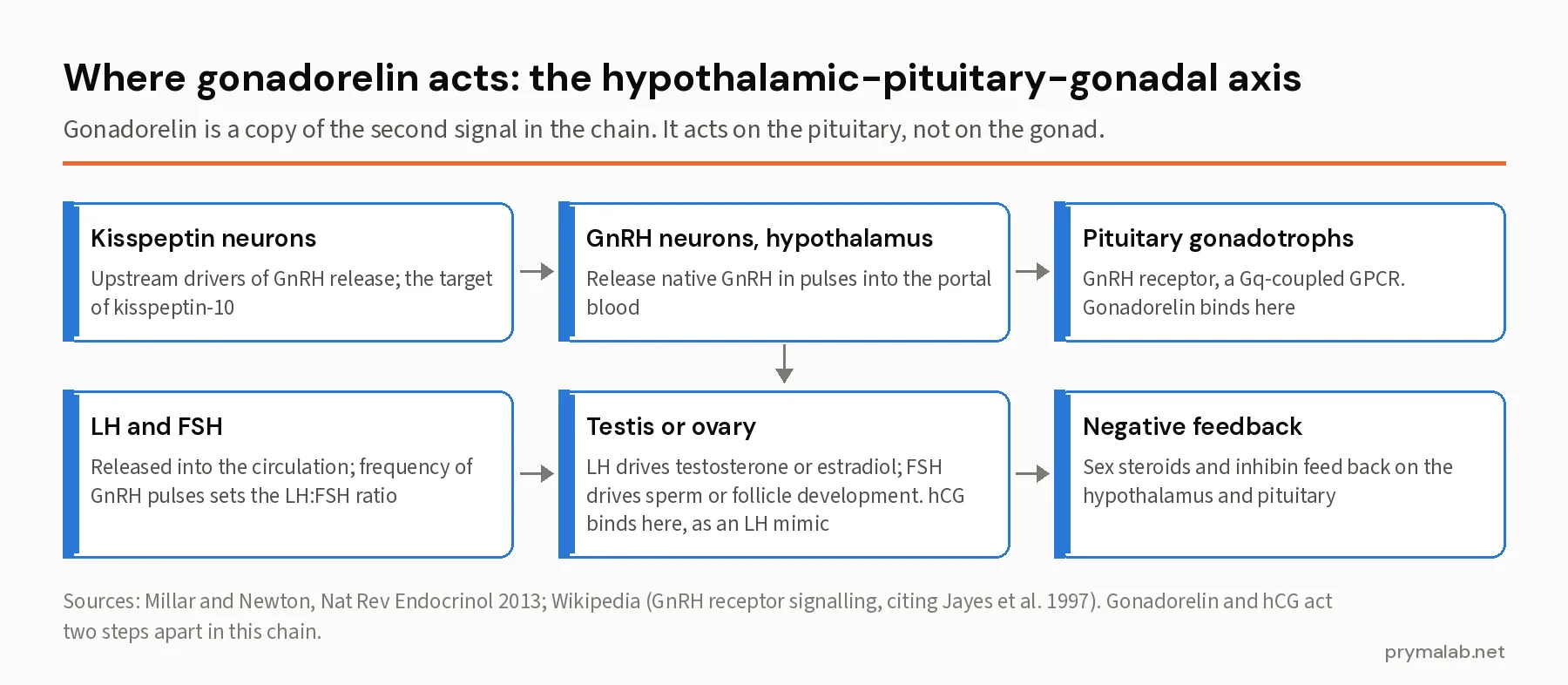
Its receptor is the GnRH receptor on pituitary gonadotroph cells, a seven-transmembrane G-protein-coupled receptor that signals through Gq, stimulates the beta isoform of phospholipase C, and mobilises calcium and protein kinase C.[4] That signalling cascade releases luteinising hormone and follicle-stimulating hormone into the blood, and those two hormones do the downstream work: LH drives the Leydig cells of the testis to make testosterone and the theca cells of the ovary to make androgens for estradiol; FSH drives spermatogenesis and follicle growth. Gonadorelin never touches the gonad. It acts two steps upstream of the organ people usually have in mind when they search for it.
Gonadorelin acetate versus gonadorelin hydrochloride
The two salts are the same peptide with a different counter-ion. Factrel, the diagnostic product, was the hydrochloride; Lutrepulse, the pump product, and the material FDA placed on the 503B list in 2023 are the acetate.[3] For a research buyer the salt matters in one place only: the peptide content of a labelled milligram. Acetate adds mass, so 2 mg of gonadorelin acetate contains slightly less than 2 mg of gonadorelin. Good documentation states the net peptide content and the salt; PrymaLab's 2 mg vials are labelled on that basis.
The GnRH receptor and how it signals
Gonadorelin acts on the GnRH receptor of the pituitary gonadotrope, and Millar and colleagues' 2004 review set out what was known about how that receptor binds its ligand and passes the signal on. Across protochordates and vertebrates, 23 structural variants of GnRH have been identified, and many vertebrates carry three GnRHs with three matching receptors, each with its own distribution and functions (Millar et al. 2004). In humans, hypothalamic GnRH regulates gonadotropin secretion through the pituitary type I receptor, which signals mainly by activating the G protein Gq (Millar et al. 2004). Studies have identified amino acid residues in both the hormone and the receptor that are involved in binding, in receptor activation and in translating activation into intracellular signalling (Millar et al. 2004).
The review also described signalling beyond Gq. The type I receptor can couple to other G proteins and possibly signal independently of G proteins, and the authors suggested that variations in ligand structure may direct which intracellular pathway is selected (Millar et al. 2004). A second form of the hormone, GnRH II, is conserved in all higher vertebrates including humans and is present outside the hypothalamus (Millar et al. 2004). The review placed this receptor work in a clinical context: GnRH and its analogues are used extensively for hormone-dependent diseases and in assisted reproduction, and have potential as contraceptives in men and women (Millar et al. 2004).
Why timing decides everything: the 1978 monkey experiment
If you understand one experiment about gonadorelin, make it this one. In 1978 Belchetz, Plant, Nakai, Keogh and Knobil worked with rhesus monkeys in which the arcuate nucleus, the part of the hypothalamus that produces GnRH, had been destroyed, so the animals made none of their own. Given GnRH as a continuous infusion, the monkeys' LH and FSH could not be sustained. Given the same hormone as a pulse once every hour, gonadotropin secretion was restored.[5][6] Same molecule, same total amount, opposite result.
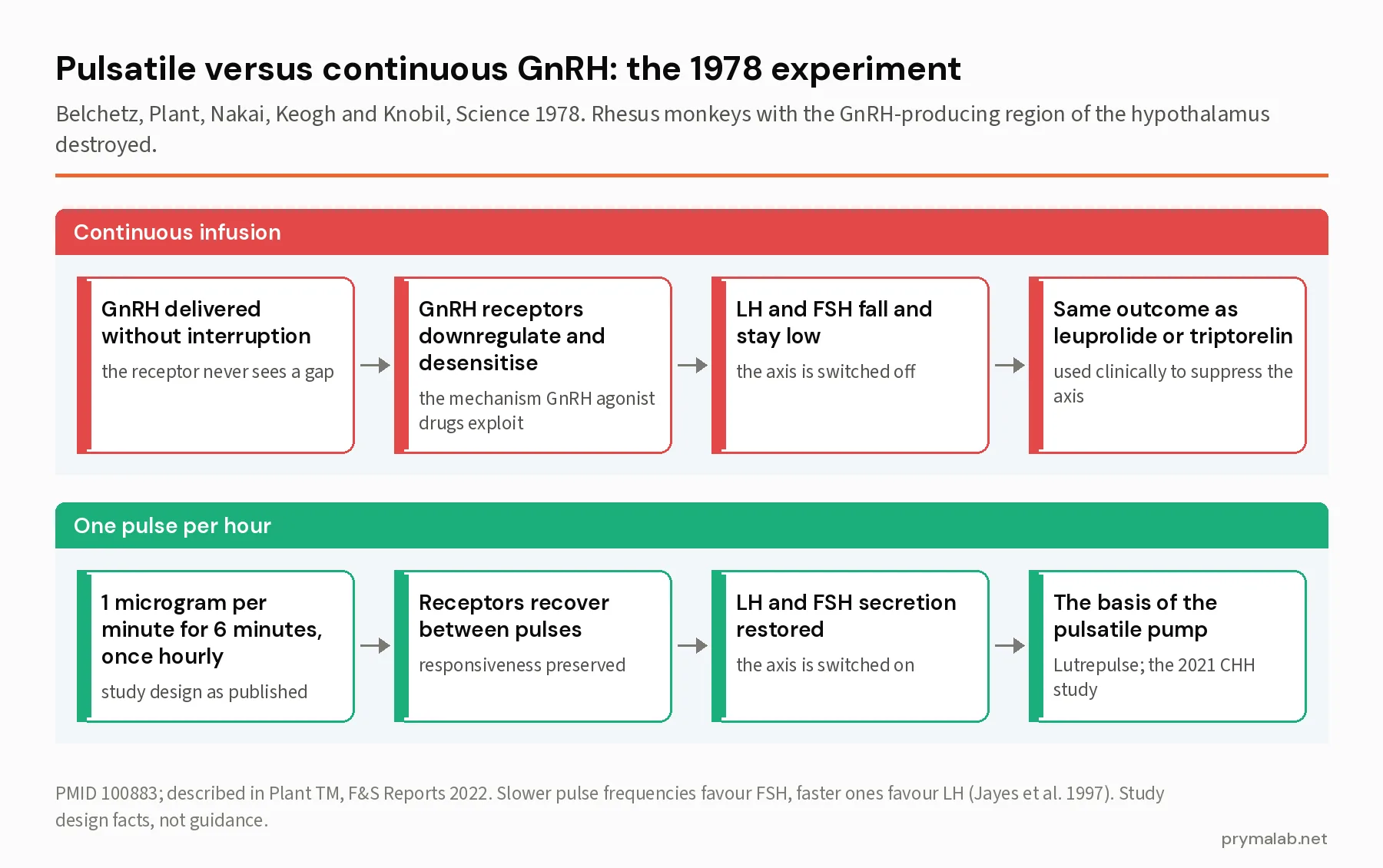
The mechanism is receptor desensitisation. Continuous occupancy of the GnRH receptor leads to downregulation and loss of responsiveness, whereas pulsatile exposure lets the receptor recover between signals.[1] Pulse frequency does more than switch the axis on: low-frequency pulses are required for FSH release, while high-frequency pulses stimulate LH pulses in a one-to-one manner.[4] The hypothalamus tunes the LH-to-FSH ratio by changing how often it fires, which is how one hormone can run both the follicular and luteal phases of a cycle and both halves of testicular function.
This is also why the GnRH agonist drugs exist, and why they do the opposite of what a newcomer expects. Leuprolide, triptorelin, goserelin and nafarelin are GnRH analogues engineered with D-amino-acid substitutions and other changes to resist breakdown and bind harder. Delivered as depots, they give the receptor no gap. After an initial surge, LH, FSH and the sex steroids fall to castrate levels, and that suppression treats prostate cancer, endometriosis and central precocious puberty.[1] Gonadorelin, with the native sequence and a half-life of minutes, cannot easily be made into a continuous signal by injection, which is the single most important difference between it and the agonists that share its name.
A half-life measured in minutes, and what that means for pulse timing
The Lutrepulse product monograph gives initial and terminal half-lives after intravenous injection of 2 to 10 minutes and 10 to 40 minutes.[7] Stovall and Strauss put the effective half-life at two to four minutes.[8] Native GnRH is degraded by proteolysis within a few minutes of release.[4] For a peptide, that is fast even by peptide standards; kisspeptin-10 is in the same range, semaglutide is measured in days.
Work through what that means for a single bolus. The peptide enters the blood, reaches the pituitary, binds the receptor, triggers one release of LH and FSH, and is gone: one bolus is one pulse. The native hypothalamus fires roughly every sixty to ninety minutes in a man, which is why the pump products and the 2021 study delivered pulses close to that rhythm, and the 1978 monkeys got a pulse every hour.[7][9][5] Intermittent bolus use produces far fewer pulses than that physiological background, and I could not find a published study, in any population, that tested bolus gonadorelin against an endpoint. Bolus use was inherited from the hCG injections gonadorelin replaced, and hCG has a half-life of a day or more, which is a different pharmacology entirely.
The nasal route: what the 1977 data say
Potashnik, Ben-Adereth, Lunenfeld and Rofe gave five men with fertility problems, three oligospermic and two azoospermic, GnRH as an intranasal solution and compared the LH and FSH response with an intramuscular injection. The nasal dose, about thirty times the intramuscular amount, 'produced a pituitary response pattern similar to that produced by the intramuscular injection', and 'no technical difficulties or side effects were observed'.[10] That thirty-fold ratio for an equivalent response fits what is known about nasal absorption of a hydrophilic 1.2 kDa peptide: some gets across, most does not. The authors do not state a bioavailability percentage, and no modern human pharmacokinetic study of intranasal gonadorelin exists that I could locate. A 1988 rat study found bacitracin increased nasal absorption of gonadorelin and buserelin, which tells you the barrier is enzymatic as well as physical.[11]
For the 10 mg nasal spray, the 1977 numbers are the only human comparison on record, and they indicate that most of a nasally applied dose was not absorbed.
What the human literature shows
The human record for gonadorelin is old, small and specific. It divides into a diagnostic use, a pump use, and one modern study.
The diagnostic test. Factrel, gonadorelin hydrochloride, was approved as a single-dose test of whether the pituitary can respond: an LH rise above 10 mIU/mL after the injection is read as a normal pituitary, and a flat response points to a pituitary or hypothalamic cause of low gonadotropins. It was available from about 1978.[3] This is the use that generated most of the human safety experience with gonadorelin, one dose at a time.
The pump. Lutrepulse, gonadorelin acetate for injection in 0.8 mg and 3.2 mg vials, delivered pulses through a portable infusion pump to induce ovulation in women with primary hypothalamic amenorrhea. The monograph lists superficial thrombophlebitis and injection-site irritation as the main adverse effects, with one case of moderate ovarian hyperstimulation in its trials.[7] It is no longer marketed in the United States.[3] The same approach is used in specialist centres for hypogonadotropic hypogonadism in men.
The 2021 study. Hao and colleagues treated 28 men with congenital hypogonadotropic hypogonadism, a condition in which the hypothalamus never produces adequate GnRH, with pulsatile gonadorelin through a pump. By day 7, all 28 showed a pituitary response: mean LH rose from 0.20 to 2.66 IU/L and FSH from 0.53 to 5.05 IU/L. Testosterone did not follow for more than 30 days; by six months it had risen from a median of 0.37 to a mean of 2.50 ng/mL, and sperm was detected in one of the six men assessed at that point. Two adverse events were recorded, an upper respiratory infection and mild nausea, both judged unrelated to the treatment.[9]
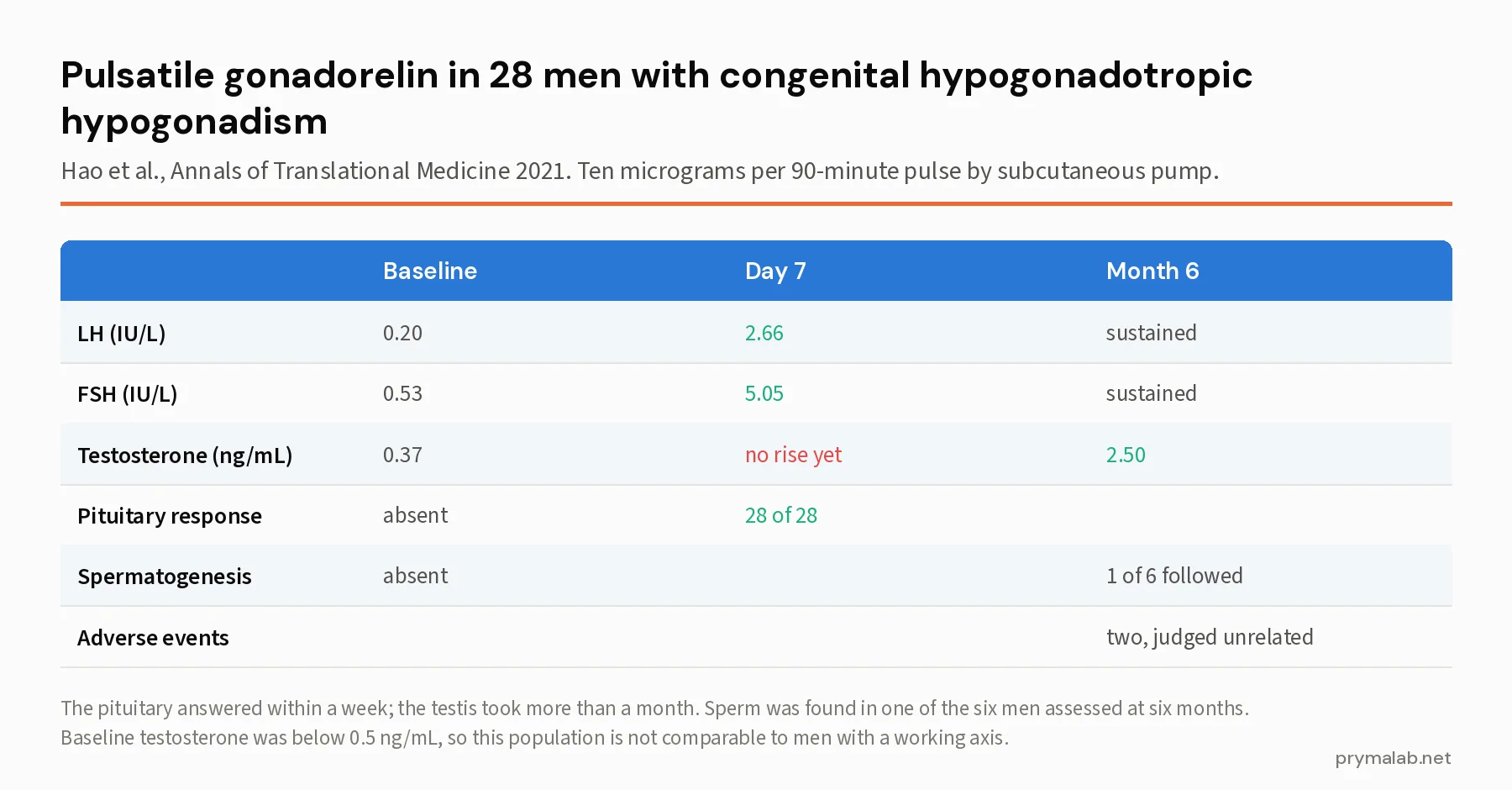
Read the population before reading the numbers. These men started with a median testosterone of 0.37 ng/mL and gonadotropins near zero because their hypothalamus was silent. A pulsatile pump replaced the missing signal, and the axis below it, which had never been switched on, took weeks to respond. That is a strong demonstration of the physiology and a weak basis for any claim about men whose axis already works. There is no controlled trial of gonadorelin in eugonadal men, no trial of gonadorelin added to testosterone therapy, and no trial of bolus injections at any schedule against a fertility or testosterone endpoint.
| Use | Product or study | Design | What it showed |
|---|---|---|---|
| Pituitary diagnostic | Factrel (gonadorelin HCl) | Single-dose diagnostic test | LH above 10 mIU/mL indicates a responsive pituitary |
| Ovulation induction | Lutrepulse (gonadorelin acetate) | Pulsatile pump | Ovulation in primary hypothalamic amenorrhea; discontinued in the US |
| Congenital hypogonadotropic hypogonadism, men | Hao et al., 2021, n=28 | Pulsatile pump | 100% pituitary response by day 7; testosterone rise delayed beyond 30 days; sperm in 1 of 6 assessed at six months |
| Nasal delivery | Potashnik et al., 1977, n=5 | Intranasal vs intramuscular, single doses | Similar LH/FSH response; no side effects observed |
| Pulse versus continuous | Belchetz et al., 1978, rhesus | Hourly pulses vs continuous infusion | Pulses restore gonadotropins; continuous infusion suppresses them |
Does gonadorelin increase testosterone? What the evidence supports
The question behind most searches for gonadorelin is whether it raises testosterone, usually in a man who is on or considering testosterone therapy and has read that gonadorelin 'keeps the testes working'. The literature supports a narrower statement than the marketing.
Gonadorelin raises LH and FSH when the pituitary can respond and the signal is pulsed. That is settled physiology, demonstrated in the 1978 monkeys and the 2021 men.[5][9] Whether LH then raises testosterone depends on the testis, and on how much LH there is and how often. In the 2021 study the LH rise was immediate and the testosterone rise took more than a month, in men whose testes had never been stimulated.[9] In a man with a normal axis, exogenous testosterone suppresses his own GnRH and LH through negative feedback; the theory behind adding gonadorelin is to replace the suppressed pulses. No published study has tested that theory with gonadorelin. The compounding pharmacy monograph I read states that gonadorelin stimulates LH more than FSH and describes its use for hypogonadism as off-label; it makes no claim about testosterone outcomes on any schedule.[12]
The comparison people are really making is with hCG, which does raise testosterone directly and reliably, because it is an LH mimic acting on the Leydig cell with a half-life long enough to keep the receptor occupied for days.[13] Gonadorelin is not an LH mimic. It asks the pituitary to make LH, in a pulse that lasts minutes. The two are being used interchangeably in clinic protocols because of a regulatory event, not because of a pharmacological equivalence, and that event is worth setting out in full.
The 2020 hCG switch and the 2023 503B listing
The Biologics Price Competition and Innovation Act of 2009 set a ten-year deadline after which certain protein products approved as drugs under the Federal Food, Drug, and Cosmetic Act would be deemed biologics licensed under the Public Health Service Act. That deadline was 23 March 2020. FDA's notice to compounders spelled out the consequence: 'beginning on March 23, these transitioning biological products will not be eligible for the exemptions for compounded drugs under sections 503A and 503B of the FD&C Act'. Four bulk substances used by outsourcing facilities were named: human chorionic gonadotropin, hyaluronidase, follicle-stimulating hormone and menotropins.[14] Compounded hCG, which had been the standard adjunct in testosterone-therapy protocols for a decade, ended that day. Clinics described the change to their patients in exactly those terms.[13]
Gonadorelin filled the gap because it was the one pituitary-axis peptide with a prior FDA approval. On 4 October 2023 FDA published an interim revision to the list of bulk drug substances that 503B outsourcing facilities may use. Gonadorelin acetate was placed in Category 1, meaning it may be compounded by outsourcing facilities while FDA's evaluation continues, with the agency noting it was 'previously FDA approved as LutrePulse' and is 'sometimes used off label for conditions such as hypogonadism'. The same notice placed kisspeptin-10, BPC-157, AOD-9604 and ipamorelin in 503A Category 2, the list of substances FDA considers to present significant safety risks, and added GHK-Cu to 503A Category 1 for non-injectable routes while keeping VIP there.[15]
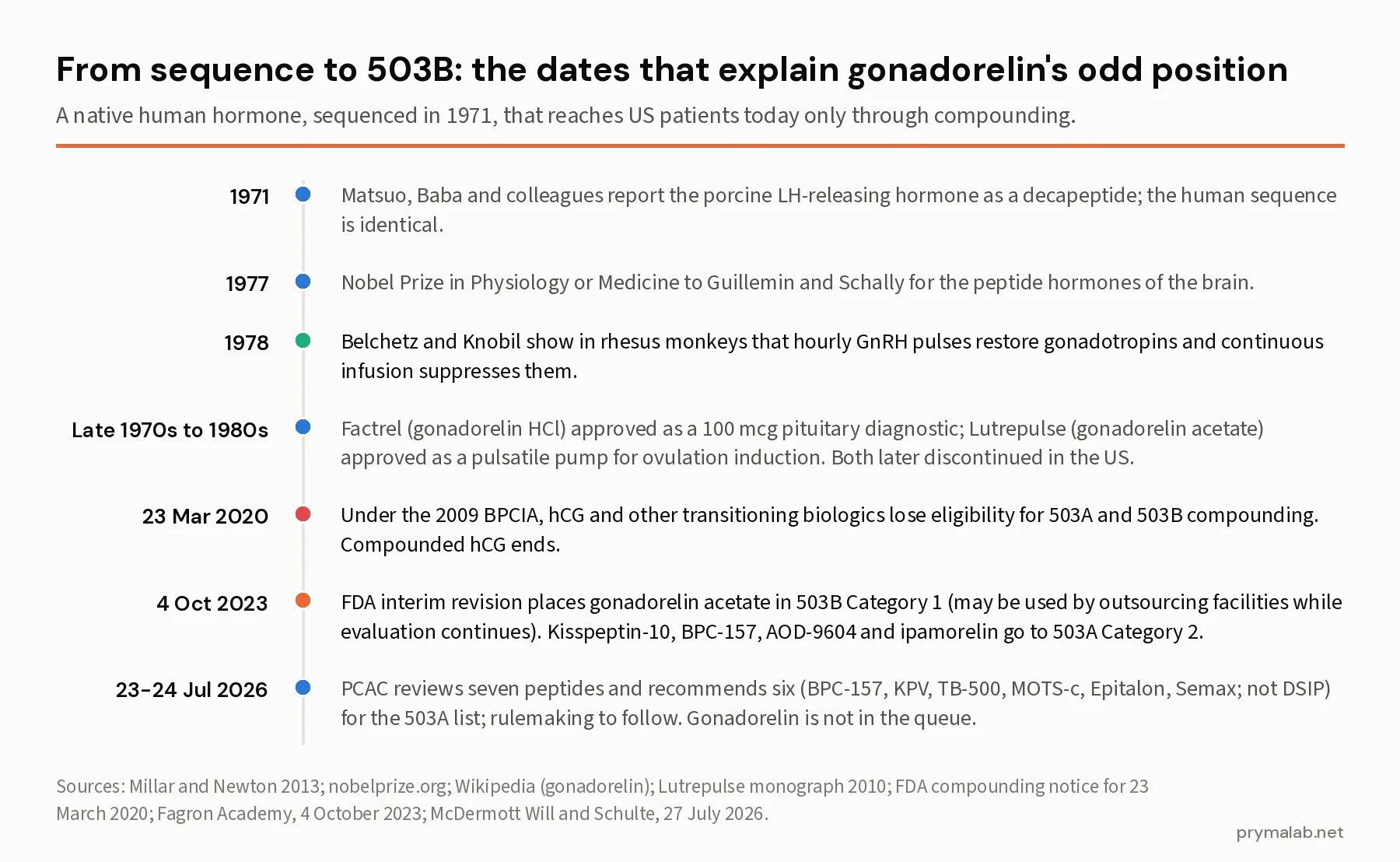
Two things about that placement are worth being precise about. Category 1 is interim. It means FDA has not finished evaluating the substance and is not enforcing against outsourcing facilities that use it in the meantime; it is not an approval and not a finding of safety or efficacy. And it is specific to 503B outsourcing facilities. The advisory-committee process that has been working through the popular research peptides in 2026 does not have gonadorelin on its docket. At its 23 and 24 July meeting the Pharmacy Compounding Advisory Committee reviewed seven peptides and voted to recommend six of them for the 503A bulks list: BPC-157, KPV, TB-500, MOTS-c, Epitalon and Semax, with DSIP the one rejection. FDA must now run notice-and-comment rulemaking, which could land in 2027 or take longer. GHK-Cu, Melanotan II, LL-37, Dihexa and PEG-MGF are queued for review before February 2027.[16][17] It does not need to: gonadorelin's evaluation sits on a different track because it was once an approved drug.
What a 503B product looks like in practice: a compounding monograph I reviewed describes gonadorelin acetate at 1 mg/mL in a 5 mL multi-dose vial, prepared by an outsourcing facility for prescribers.[12] That is the material a US clinic is dispensing when it says 'gonadorelin'. It is the same peptide as research-grade material; the difference is the facility, the sterility standard, the prescriber and the label.
Gonadorelin vs hCG: different receptor, different organ, different timescale
Because clinic protocols swapped one for the other, the two get described as alternatives. They are not. The table sets out the differences that matter.
| Gonadorelin | hCG (human chorionic gonadotropin) | |
|---|---|---|
| Molecule | 10-amino-acid peptide, 1,182 Da | Glycoprotein hormone, two subunits, about 37 kDa |
| Receptor | GnRH receptor on the pituitary | LH/hCG receptor on Leydig cells (testis) and theca cells (ovary) |
| What it raises | LH and FSH, then whatever the gonad makes in response | Testosterone or ovarian steroids directly; FSH unaffected |
| Half-life | 2 to 10 minutes | About a day or more; one injection stimulates for days |
| Needs a working pituitary | Yes; useless if the pituitary cannot respond | No; bypasses the pituitary entirely |
| Effect of continuous exposure | Continuous signal suppresses the axis | Sustained gonadal stimulation |
| FSH and spermatogenesis | Raises FSH; pulsatile use restores spermatogenesis in some men | No FSH; hCG alone does not supply the FSH signal |
| US compounding | 503B Category 1, interim, since October 2023 | Not compoundable since 23 March 2020 |
The last two rows explain most of the confusion. A man reading that gonadorelin 'does what hCG does' is being told that a pituitary stimulant with a ten-minute half-life is equivalent to a gonadal stimulant with a multi-day one. In one respect gonadorelin does something hCG cannot: it raises FSH, which hCG does not touch, and FSH is the spermatogenesis signal. In every other respect the two are different tools, and the switch between them in 2020 was regulatory. If you want the hCG side in depth, the hCG guide covers it; the peptides for men overview puts both in the wider context.
Gonadorelin vs kisspeptin and the GnRH agonists
Three families of molecule act on this axis, one step apart, and the names get mixed up.
Kisspeptin acts above gonadorelin. Kisspeptin neurons drive the GnRH neurons; loss-of-function mutations in kisspeptin signalling cause hypogonadotropic hypogonadism, and kisspeptin-10 raises GnRH, then LH and FSH, by stimulating the KISS1R receptor on GnRH neurons.[1] It depends on intact GnRH neurons, which gonadorelin does not. FDA placed kisspeptin-10 in 503A Category 2 in the same 2023 notice that placed gonadorelin acetate in 503B Category 1.[15] The kisspeptin reference covers that signal on its own.
GnRH agonists (leuprolide, triptorelin, goserelin, nafarelin, buserelin) act at the same receptor as gonadorelin but are engineered for persistence, and as depots they suppress rather than stimulate.[1] Nafarelin is a nasal spray, which is sometimes cited as precedent for nasal gonadorelin; it is a different molecule with a different purpose, used to shut the axis down in endometriosis and precocious puberty. GnRH antagonists (ganirelix, cetrorelix, degarelix, elagolix) block the receptor outright and suppress without the initial surge.
Gonadorelin is the native ligand, unmodified, with the shortest half-life of the three. It is the only one of them that can deliver a physiological pulse, and the only one that turns the axis on rather than off when used as its pharmacology dictates. That is its entire selling point, and it is also the reason bolus use that ignores pulse physiology does not match its pharmacology.
Where gonadorelin is actually approved: cattle
The place gonadorelin is used at scale, under regulatory approval, is the dairy and beef industry. Veterinary gonadorelin products, sold under names including Cystorelin, Fertagyl, OvaCyst and a veterinary Factrel, are approved under 21 CFR 522.1077 for the treatment of ovarian follicular cysts in dairy and beef cattle and for synchronising the oestrous cycle for fixed-time artificial insemination, where a GnRH injection lines up ovulation across a herd. The regulation specifies 43 or 100 mcg of gonadorelin acetate, or 50 mcg of the diacetate tetrahydrate or hydrochloride, per millilitre, and restricts use to the order of a licensed veterinarian.[3][18] Older human and veterinary brands in Europe included Kryptocur, Relefact and Lutrelef.[3]
Why this matters to a research buyer: the veterinary market is where most of the world's gonadorelin is manufactured and consumed, so the peptide is inexpensive, well characterised and available at high purity. It also means a fair amount of what is sold online as research gonadorelin originates from veterinary supply chains, with veterinary documentation. A veterinary certificate of analysis is not worthless, but it is not the same as per-lot HPLC and mass spectrometry on the vial in your hand, which is the standard I describe in the purity testing guide.
Research-grade gonadorelin: the 2 mg vial and the 10 mg nasal spray
Gonadorelin is not a controlled substance, and it sits in FDA's 503B Category 1 as a compounding substance. Research-grade material is legal to sell and hold for laboratory research and not legal to market for human use; the legal status guide sets out that framework and it applies here without exception. Athletes should know that the 2026 WADA Prohibited List names gonadorelin by name under S2.2.1, testosterone-stimulating peptides in males, in the same clause as chorionic gonadotrophin, LH, the GnRH agonist analogues and kisspeptin, prohibited at all times.[19]
PrymaLab supplies two presentations. The gonadorelin 2 mg lyophilised vial is the standard research format: a dry powder that is stable for months refrigerated or frozen and is dissolved in a suitable diluent for bench work. The peptide reconstitution calculator converts the vial and diluent volume into a concentration. The gonadorelin 10 mg nasal spray is a pre-measured solution. The 1977 human comparison found the nasal route roughly thirty-fold less potent than injection.[10]
What to verify on any gonadorelin lot, in order. Identity by mass spectrometry, because the 1,182 Da parent ion is easy to confirm and a wrong or truncated sequence is easy to catch. Purity by HPLC, stated as a percentage of the peptide peak. Net peptide content, because acetate and water add mass and a 2 mg label can mean 1.6 mg of peptide if the supplier does not correct for them. And the salt form, so the stated mass means the same thing across lots. A supplier who prints a CAS number with the hyphens in the wrong place, as I found on one of our own product pages while writing this, has at least earned a second look at the rest of the paperwork.
On the compound itself, the version of the story the record supports: a native hormone with a Nobel Prize behind it, whose effect is set by the timing of exposure more than by the amount, which two approved human products once delivered as a diagnostic pulse or a programmed pump, and which became a clinic staple in 2020 for a reason that had nothing to do with its pharmacology and everything to do with hCG's paperwork.
What this article does not settle
Whether gonadorelin does anything useful alongside testosterone therapy. No controlled trial has tested it in that setting, at any schedule. The physiological argument is reasonable and the evidence for it is absent.
What intermittent bolus use achieves. I found no study of any bolus schedule against an LH, testosterone or fertility endpoint. Every human efficacy result comes from a pulsatile pump or a single diagnostic dose.
Nasal pharmacokinetics. The only human comparison is five men in 1977, nasal against intramuscular, with no bioavailability figure. Modern spray strengths have no published human absorption data.
Long-term safety of intermittent use. The safety record comes from single diagnostic doses and from pump treatment of GnRH-deficient patients. It is reassuring within those uses and silent outside them.
How long Category 1 lasts. The 503B placement is interim. FDA has not published a timetable for finishing the gonadorelin acetate evaluation.
What is well established: the sequence, molecular weight and salts; the receptor and its signalling; the two-to-ten-minute half-life; the pulsatile-versus-continuous rule from 1978 and its pulse-frequency refinements; the 2021 pump results in congenital hypogonadotropic hypogonadism; the 23 March 2020 end of compounded hCG; and the 4 October 2023 placement of gonadorelin acetate in 503B Category 1.
GnRH (gonadotropin-releasing hormone): what the abbreviation refers to
GnRH stands for gonadotropin-releasing hormone, the hypothalamic decapeptide that releases the two gonadotropins, LH and FSH, from the pituitary. The same molecule was called LHRH or LH-RH (luteinising hormone-releasing hormone) and LRF (luteinising hormone-releasing factor) in the 1970s literature, before it was clear that one peptide released both gonadotropins; older papers, including the 1977 nasal study, use those names.[10] Gonadoliberin is the systematic name used in some pharmacopoeias. Gonadorelin is the international non-proprietary name for the synthetic peptide, with gonadorelin acetate and gonadorelin hydrochloride naming the salts. Factrel and Lutrepulse were the two US human brands, and Cystorelin, Fertagyl and OvaCyst are the veterinary ones.[3] None of these names refers to a different sequence. When a supplier lists 'GnRH peptide', 'LHRH' and 'gonadorelin' as separate products, they are selling the same ten amino acids three times.
Frequently asked questions
What is gonadorelin?
Synthetic GnRH: the native ten-amino-acid hypothalamic peptide that makes the pituitary release LH and FSH. 1,182 Da, half-life two to ten minutes, formerly sold as Factrel and Lutrepulse, now a 503B Category 1 compounding substance.
Is gonadorelin the same as GnRH or LHRH?
Yes. GnRH, LHRH, LRF and gonadoliberin are all the same ten-residue peptide; gonadorelin is its drug name. The acetate and hydrochloride are salts of the same molecule. Leuprolide and the other agonists are modified analogues, not the same thing.
How is gonadorelin different from hCG?
Different receptor, organ and timescale. Gonadorelin stimulates the pituitary to release LH and FSH for minutes; hCG stimulates the gonad directly as an LH mimic for days and does nothing to FSH. The 2020 clinic switch was regulatory, not pharmacological.
Does gonadorelin increase testosterone?
Indirectly, by raising LH, and in the only modern study (28 hypogonadal men on a pulsatile pump) the testosterone rise took more than 30 days. No trial exists in men with a working axis, on testosterone therapy, or on bolus injection schedules.
What is the half-life of gonadorelin?
Two to ten minutes (distribution), ten to forty minutes terminal. One bolus is one pulse, which is why the studied uses are a single diagnostic dose or a pulsatile pump.
Why does pulsatile versus continuous GnRH matter?
The same molecule switches the axis on as hourly pulses and off as a continuous signal, because continuous exposure desensitises the receptor. That is the 1978 monkey result and the basis of both pulsatile pumps and suppressive GnRH agonist depots.
What are the side effects of gonadorelin in the literature?
Two adverse events among 28 men in the 2021 pump study, both judged unrelated; injection-site irritation and superficial thrombophlebitis on the Lutrepulse label; none observed in the 1977 nasal study. The main pharmacological risk is mistimed exposure, which suppresses the axis instead of stimulating it. No long-term data outside the studied regimens.
Is gonadorelin FDA approved or legal in the US?
It was approved (Factrel, Lutrepulse) and both products were discontinued. Since October 2023 it is a 503B Category 1 compounding substance, interim and not an approval. Not controlled. Research-grade material is for laboratory research only.
Does the gonadorelin nasal spray work?
The one human study (1977, five men) found that a nasal dose about thirty times the intramuscular amount gave a similar LH/FSH response. No modern nasal pharmacokinetics exist.
How does gonadorelin compare with kisspeptin?
Kisspeptin stimulates the GnRH neurons; gonadorelin is the GnRH those neurons release, acting on the pituitary. Kisspeptin needs intact GnRH neurons, gonadorelin does not. FDA put kisspeptin-10 in 503A Category 2 and gonadorelin in 503B Category 1 in October 2023.
Why does this article not give a gonadorelin dose?
Because the material is sold for laboratory research only, and because the literature has no bolus-injection regimen to report: the studied uses are a single diagnostic dose and a pulsatile pump. Bolus use was inherited from hCG and has never been tested.
How should gonadorelin be stored?
Lyophilised: refrigerated short term, frozen at -20 for months, away from light. Reconstituted: refrigerated and used within weeks. Nasal spray: refrigerated, upright, capped.
References
- Millar RP, Newton CL. Current and future applications of GnRH, kisspeptin and neurokinin B analogues. Nat Rev Endocrinol. 2013;9(8):451-466. doi:10.1038/nrendo.2013.120. Sequence and 1971 isolation, receptor desensitisation under continuous exposure, agonist and antagonist pharmacology, kisspeptin upstream of GnRH. Nature Reviews Endocrinology
- The Nobel Prize in Physiology or Medicine 1977. Roger Guillemin and Andrew V. Schally, 'for their discoveries concerning the peptide hormone production of the brain'. NobelPrize.org
- Wikipedia. Gonadorelin. Molecular weight, CAS numbers, salts, half-life (distribution 2 to 10 min, terminal 10 to 40 min, citing DrugBank), Factrel and Lutrepulse, US availability, and veterinary brands. Wikipedia
- Wikipedia. Gonadotropin-releasing hormone. Receptor signalling (Gq, phospholipase C beta, calcium, protein kinase C), proteolytic degradation within minutes, and pulse-frequency dependence of LH and FSH release, citing Jayes FC, Britt JH, Esbenshade KL, 1997, PMID 9096885. Wikipedia
- Belchetz PE, Plant TM, Nakai Y, Keogh EJ, Knobil E. Hypophysial responses to continuous and intermittent delivery of hypothalamic gonadotropin-releasing hormone. Science. 1978;202(4368):631-633. PMID 100883. PubMed
- Plant TM. Recognition that sustained pituitary gonadotropin secretion requires pulsatile GnRH stimulation: a Pittsburgh saga. F&S Rep. 2023;4(2 Suppl):3-7. doi:10.1016/j.xfre.2022.09.005. PMID 37223769. Retrospective on the 1978 arcuate-lesion experiments by one of the authors. F&S Reports
- Ferring Inc. Lutrepulse (gonadorelin acetate for injection) 0.8 mg and 3.2 mg per vial, product monograph, 17 August 2010. Indication, 5 mcg every 90 minutes by SC or IV pump, initial and terminal half-lives of 2 to 10 and 10 to 40 minutes, adverse effects. Ferring (PDF)
- Stovall DW, Strauss JF. Gonadotropin-releasing hormone half-life of 2 to 4 minutes. In: Pharmacology and Therapeutics, 2009, as summarised by ScienceDirect Topics (Gonadorelin). ScienceDirect Topics
- Hao M, Mao JF, Guan QB, et al. Efficacy and safety of pulsatile gonadotropin-releasing hormone therapy in patients with congenital hypogonadotropic hypogonadism: a multicentre clinical study. Ann Transl Med. 2021;9(12):962. doi:10.21037/atm-21-1632. PMC8267282. 28 men, 10 mcg per 90 minutes; LH 0.20 to 2.66 IU/L and FSH 0.53 to 5.05 IU/L at day 7; testosterone 0.37 to 2.50 ng/mL at six months; sperm in 1 of 6; two adverse events judged unrelated. Annals of Translational Medicine
- Potashnik G, Ben-Adereth N, Lunenfeld B, Rofe C. Assessment of pituitary response to nasal application of synthetic gonadotropin-releasing hormone in men. Fertil Steril. 1977;28(6):650-654. Intranasal versus intramuscular GnRH in five men. ScienceDirect
- The adjuvant effect of bacitracin on nasal absorption of gonadorelin and buserelin in rats. 1988. PMID 3150047. PubMed
- Empower Pharmacy. Gonadorelin acetate injection monograph, 1 mg/mL, 5 mL vial (503B outsourcing facility). States LH is stimulated more than FSH; hypogonadism use described as off-label. Empower Pharmacy
- Defy Medical. Industry changes to HCG access. 2022. A clinic's account of the 23 March 2020 reclassification of hCG as a biologic and the end of compounded hCG; hCG described as mimicking LH at the testis. Defy Medical
- US Food and Drug Administration. Notice to compounders: changes that affect compounding, March 23, 2020. Transition of biological products to PHS Act licensure; hCG, hyaluronidase, FSH and menotropins no longer eligible for 503A and 503B exemptions. FDA
- Taylor S. Industry update: interim 503A and 503B bulks lists, new revisions. Fagron Academy, 4 October 2023. Gonadorelin acetate to 503B Category 1 ('previously FDA approved as LutrePulse ... sometimes used off label for conditions such as hypogonadism'); kisspeptin-10, BPC-157, AOD-9604 and ipamorelin to 503A Category 2; GHK-Cu added to 503A Category 1 for non-injectable routes; VIP retained. Fagron Academy
- FDA Law Blog (Hyman, Phelps & McNamara). FDA's Pep(tide) Rally! What compounders and industry need to know, post 1 of 2. April 2026. PCAC schedule: BPC-157, KPV, TB-500 and MOTS-c, then DSIP, Semax and Epitalon in July 2026; GHK-Cu, Melanotan II, LL-37, Dihexa and PEG-MGF queued before February 2027. FDA Law Blog
- McDermott Will & Schulte. Bulk-list bound? PCAC backs majority of peptides in two-day public meeting. 27 July 2026. Votes on the seven peptides and the rulemaking timeline. McDermott
- World Anti-Doping Agency. The 2026 Prohibited List, International Standard. S2.2.1 testosterone-stimulating peptides in males, naming GnRH (gonadorelin), its agonist analogues, CG, LH and kisspeptin. WADA
- 21 CFR 522.1077, Gonadorelin. Veterinary approvals: specifications per millilitre, treatment of ovarian follicular cysts in dairy and beef cattle, fixed-time artificial insemination synchronisation, veterinarian-only restriction. eCFR
Figures come from the published papers, regulatory notices and product documents named above, current to 23 September 2026. Where a primary paper could not be retrieved in full and a figure was taken from a secondary summary, the reference says so.
Final disclaimer: This article is an educational research reference on the chemistry, physiology, clinical record and regulatory status of gonadorelin. Compounds supplied by PrymaLab are sold for laboratory research use only and are not approved by any regulator for human or veterinary use. Statements have not been evaluated by the FDA. Nothing here is medical advice or a treatment claim.
Clinical regimens and outcomes are reported as study design facts about pharmaceutical or compounded products given under medical supervision, and do not describe or support any use of research-grade material. Always verify the legal status of any research compound in your jurisdiction before purchase or use.