Description
PrymaLab · Research Use Only
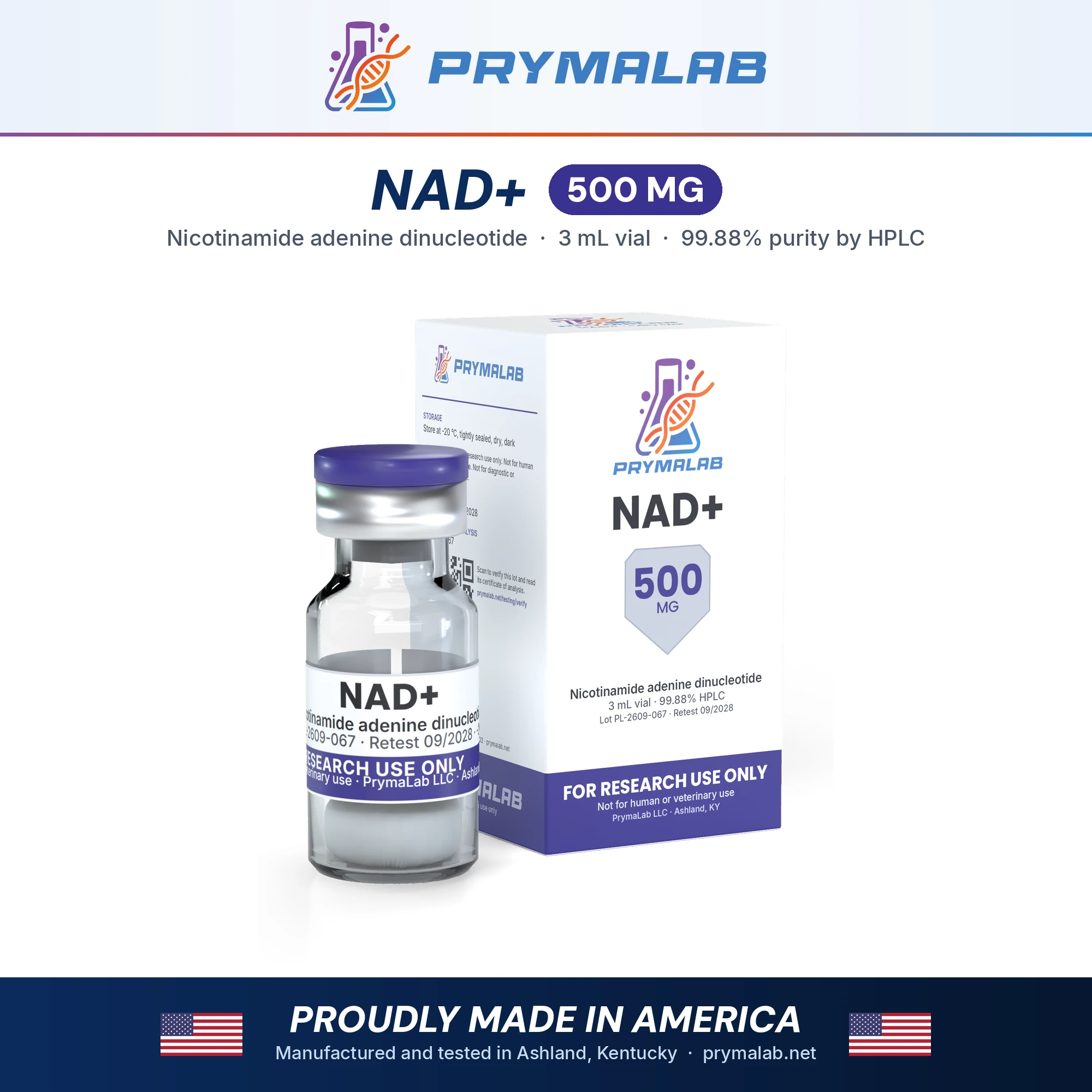
NAD+ 500mg
Nicotinamide adenine dinucleotide · CAS 53-84-9 · 663.43 Da
NAD+ 500mg is a lyophilized vial of nicotinamide adenine dinucleotide in its oxidised form, CAS 53-84-9, molecular formula C21H27N7O14P2, molecular weight 663.43. It is a dinucleotide coenzyme, not a peptide, and its handling requirements differ accordingly.
Specification Table
| Property | Value |
|---|---|
| Compound | Nicotinamide adenine dinucleotide, oxidised form |
| Vial content | 500 mg lyophilized powder |
| Molar content of vial | Approximately 754 µmol |
| Stock at 10 ml diluent | Approximately 75.4 mM |
| Common designation | NAD+ |
| CAS number | 53-84-9 |
| Molecular formula | C21H27N7O14P2 |
| Molecular weight | 663.43 g/mol |
| Compound class | Dinucleotide coenzyme. Not a peptide |
| Structure | Nicotinamide mononucleotide joined to adenosine monophosphate through a pyrophosphate bridge |
| Redox partner | NADH, the reduced form |
| Principal enzyme classes consuming NAD+ | Sirtuins, PARPs, CD38, SARM1 |
| Principal biosynthetic routes | De novo from tryptophan, Preiss-Handler from nicotinic acid, salvage from nicotinamide |
| Rate-limiting salvage enzyme | NAMPT, nicotinamide phosphoribosyltransferase |
| Appearance | White to off-white lyophilized powder |
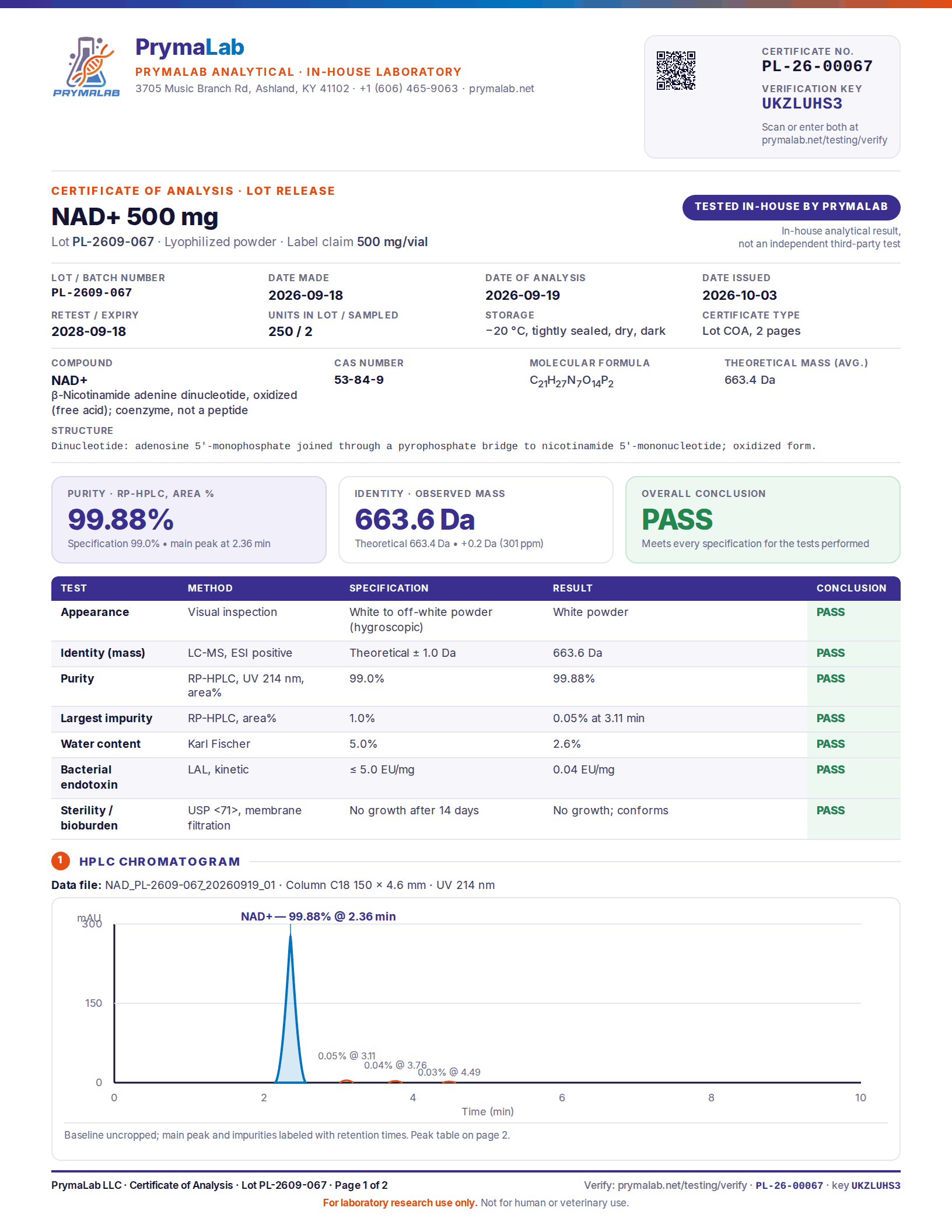
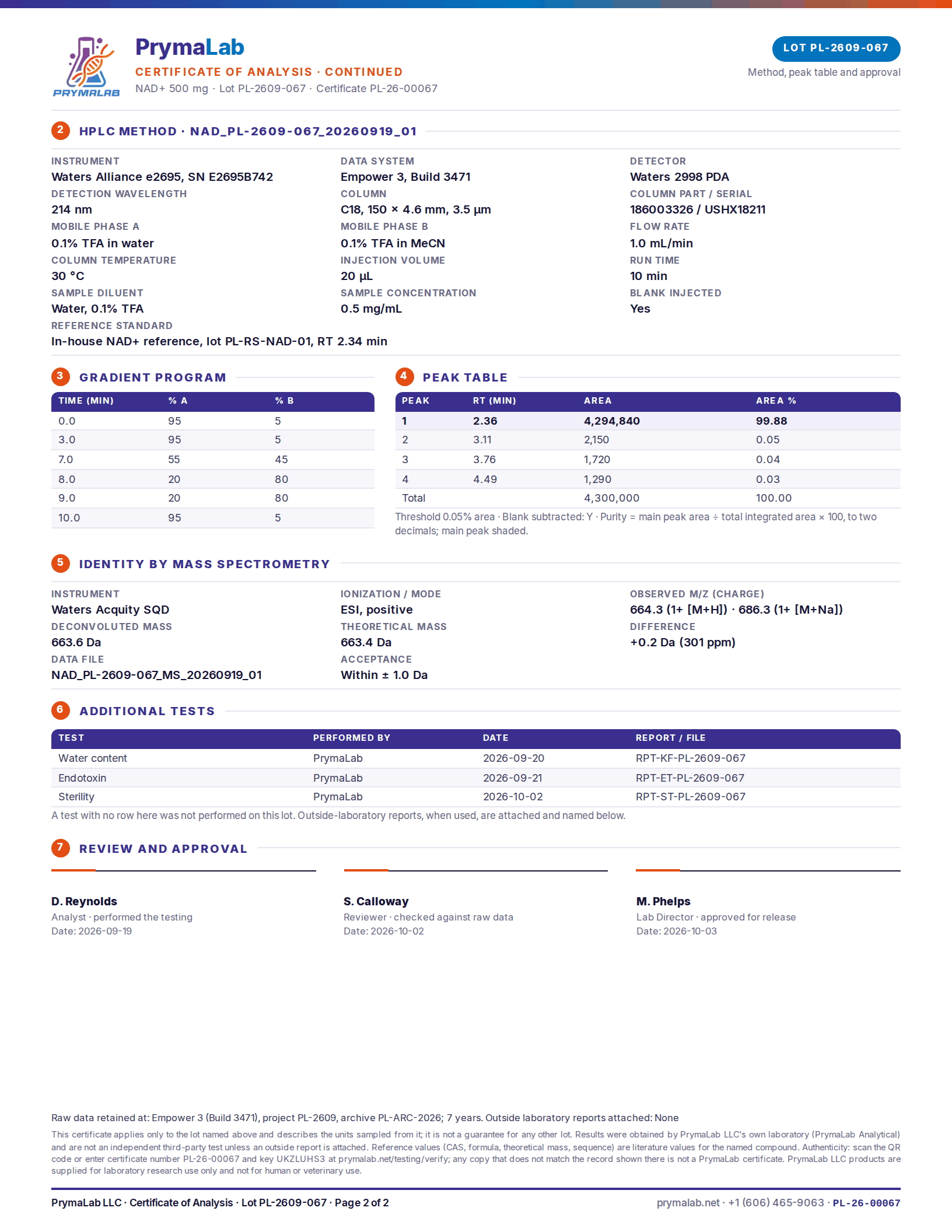
| Purity | Per lot-specific certificate of analysis |
| Solubility | Freely water soluble |
| Aqueous stability | Degrades in aqueous solution, faster at alkaline pH and at raised temperature |
| Storage, lyophilized | -20°C, protected from light and moisture |
| Storage, reconstituted | 2-8°C, protected from light, short hold only |
| Regulatory status | No approved human or veterinary injectable formulation |
What Does the Redox Couple Actually Do?
NAD+ and NADH are the same molecule in two oxidation states, and the pair functions as an electron shuttle throughout metabolism. Understanding which form does what clarifies why the oxidised form is the one supplied.
In its oxidised state, NAD+ accepts a hydride ion, two electrons and a proton, at the C4 position of its nicotinamide ring. That converts it to NADH. Reactions that oxidise a substrate, stripping electrons from it, hand those electrons to NAD+.
Glycolysis, the citric acid pathway and fatty acid oxidation all generate NADH this way. The reduced form then delivers its electrons to complex I of the electron transport chain, regenerating NAD+ and driving proton pumping.
The ratio between the two forms is the variable that matters biologically, more than the absolute quantity of either. That ratio differs between cellular compartments, with cytosolic and mitochondrial pools maintained separately because the membrane is impermeable to both forms.
Compartment separation is why measuring whole-cell NAD+ can obscure what is happening. A change in one pool can be masked by stability in the other.
Which Enzymes Consume NAD+ Rather Than Reshift It?
The redox function that NAD+ 500mg material supports is catalytic, meaning the molecule rounds without being used up. A separate set of enzymes cleaves NAD+ and destroys it, and that consumption is what creates demand.
Sirtuins are the most discussed. This family of deacylases removes acetyl and other acyl groups from protein lysines, consuming one NAD+ per reaction and releasing nicotinamide plus O-acetyl-ADP-ribose. Their activity is therefore coupled to NAD+ availability.
PARPs, poly-ADP-ribose polymerases, consume considerably more. PARP1 activation in response to DNA strand breaks can deplete cellular NAD+ substantially, since polymer synthesis uses many NAD+ molecules per event.
CD38 is an ectoenzyme with high NAD+ turnover, and SARM1 is a NAD+ hydrolase activated in axonal injury. Both consume rather than reshift.
Every one of these releases nicotinamide, which the salvage pathway recovers through NAMPT. The system is a loop of destruction and resynthesis rather than a static pool, which is why turnover rate rather than concentration is often the more informative measurement.
Why Is Aqueous Stability the Practical Constraint?
This is the handling fact that most distinguishes NAD+ from the peptides in this catalogue, and getting it wrong invalidates measurements quietly.
NAD+ degrades in aqueous solution through hydrolysis of the glycosidic bond and, under alkaline conditions, through addition at the nicotinamide ring. Degradation accelerates markedly above neutral pH and with raised temperature.
The practical consequence is that a stock solution held at room temperature at pH 8 loses meaningful content over hours, not days. A solution prepared on Monday and used on Friday is not the concentration written on the tube.
Slightly acidic conditions favour the oxidised form. Preparing stocks in a lightly acidic buffer rather than water alone extends usable life considerably, and many published methods do exactly that.
Prepare fresh where the design permits. Where it does not, aliquot immediately, freeze, thaw once, and verify concentration spectrophotometrically rather than assuming the nominal value. NAD+ absorbs at 260 nm, and the difference between the oxidised and reduced forms at 340 nm makes the ratio measurable directly.
What Does 500mg Represent in Molar Terms?
NAD+ 500mg at 663.43 daltons is approximately 754 micromoles, a large molar quantity by the standards of this catalogue and one that changes how the vial should be approached.
Reconstituted into 10 ml that gives roughly 75.4 mM. Into 50 ml, roughly 15.1 mM. Cell-culture work typically operates several orders of magnitude below either figure, so this vial supplies far more than most in vitro designs consume.
That abundance argues strongly for dividing the powder before reconstitution rather than after. Weighing out portions of dry material, which is stable at -20°C for extended periods, avoids the aqueous stability problem entirely for the unused fraction.
Weighing dry powder accurately requires an analytical balance and attention to static, which fine lyophilized material attracts, and an anti-static device or a grounded weighing vessel makes the difference between a defensible weight and a rough one.
Where dry division is impractical, reconstitute in a lightly acidic buffer, aliquot into single-use volumes and freeze immediately.
What Should NAD+ 500mg Purity Documentation Show?
Certificate content for a coenzyme differs from what a peptide certificate carries, and knowing the difference makes the document useful rather than decorative.
Assay by ultraviolet absorbance or by enzymatic determination is the primary figure. A purity value from chromatographic peak area alone can overstate content, because degradation products of this molecule retain ultraviolet absorbance and some co-elute under fast gradients.
Water content by Karl Fischer titration matters because the material is hygroscopic. A lyophilized powder that has taken up several percent water by mass weighs correspondingly more than the coenzyme it contains, and the error propagates into every calculation downstream.
Free nicotinamide content is worth asking for specifically. It is the principal degradation product, it is biologically active in its own right, and it inhibits sirtuins, so a preparation carrying a significant fraction is not a clean reagent for sirtuin work.
The reduced form should be quantified or its absence stated. NADH is a distinct chemical species with different absorbance and different reactivity, and a preparation containing an unstated fraction of it behaves unpredictably in redox-sensitive assays.
Where a certificate reports only a single purity percentage with no method stated, treating the figure as unverified is more honest than treating it as data.
How Should Cell-Free Assays Be Set Up?
Biochemical assays are where a coenzyme preparation of this scale earns its place, and several setup choices determine whether the numbers mean anything.
Buffer pH deserves deliberate choice rather than default. The oxidised form is more stable below neutral, while many enzymes using it prefer conditions closer to neutral or slightly above, so the working pH is a compromise and should be recorded as such.
Coenzyme concentration relative to the enzyme Michaelis constant determines what the assay measures. Well above it, the assay reports maximal velocity and is insensitive to coenzyme availability. Near it, the assay reports on availability directly, which is the more informative regime for questions about supply.
Product inhibition is a real factor for several enzyme classes here. Nicotinamide released during a sirtuin reaction inhibits the same enzyme, so extended incubations become progressively non-linear and initial-rate measurement is necessary rather than convenient.
A no-enzyme control run for the full incubation quantifies spontaneous degradation under the exact assay conditions, which is the only way to separate chemical loss from enzymatic consumption.
How Should NAD+ 500mg Be Logged Across a Programme?
Record-keeping for a degrading reagent is not administrative overhead, and it is part of the measurement.
A peptide vial needs a lot number and a date. NAD+ 500mg needs more, because the same lot behaves differently depending on how long it has been in solution and under what conditions, and a concentration written on a tube last week is not a concentration today.
The fields worth capturing are the mass weighed, the diluent and its pH, the concentration measured spectrophotometrically rather than calculated, the date the solution was made, and the number of freeze-thaw events each aliquot has seen.
Where a finding later looks anomalous, those fields are what allow the material to be ruled in or out as the cause. Without them the anomaly is unresolvable.
Dry portions weighed from a NAD+ 500mg vial should also carry the weighing date, since ambient humidity exposure accumulates across repeated openings.
Reconstitution and Storage in Laboratory Practice
Decide the approach before opening a NAD+ 500mg vial: dry division for the bulk, or full reconstitution with immediate aliquoting.
NAD+ is freely water soluble and dissolves quickly. Speed of dissolution is not the constraint here. Time spent in solution is.
Use a lightly acidic buffer where the downstream assay tolerates it. Protect from light. Keep the solution cold from the moment it is made, and return it to cold storage between uses rather than leaving it on the bench.
Verify concentration spectrophotometrically before critical work rather than relying on the nominal figure. Record lot, diluent identity and pH, volume, measured concentration, and the date the solution was made. For a compound that degrades on the timescale of an experiment, the date the solution was prepared is as important as the lot number.
Published Literature
The references below are peer-reviewed reviews and primary papers on NAD+ biology, verified against the publisher record. This is a large and well-established literature, unlike several compounds in this catalogue.
- Cantó C, Menzies KJ, Auwerx J. Cell Metabolism. 2015;22(1):31-53.
- Verdin E. Science. 2015;350(6265):1208-1213.
- Yoshino J, Baur JA, Imai SI. Cell Metabolism. 2018;27(3):513-528.
- Rajman L, Chwalek K, Sinclair DA. Cell Metabolism. 2018;27(3):529-547.
- Cambronne XA, Kraus WL. Trends in Biochemical Sciences. 2020;45(10):858-873.
- Bogan KL, Brenner C. Annual Review of Nutrition. 2008;28:115-130.
Frequently Asked Questions
What is NAD+ 500mg?
A lyophilized vial of nicotinamide adenine dinucleotide in oxidised form, CAS 53-84-9, molecular weight 663.43. Five hundred milligrams is approximately 754 micromoles. It is a dinucleotide coenzyme rather than a peptide. Laboratory research use only.
What does the redox couple do?
NAD+ and NADH are the same molecule in two oxidation states, functioning as an electron shuttle. The oxidised form accepts a hydride ion at the C4 position of its nicotinamide ring, becoming NADH, which then delivers electrons to complex I.
Why does the ratio matter more than the amount?
Because the ratio is what determines the thermodynamic direction of the reactions using it. That ratio also differs between cellular compartments, with cytosolic and mitochondrial pools maintained separately since the membrane is impermeable to both forms.
Which enzymes consume NAD+?
Sirtuins, which release nicotinamide and O-acetyl-ADP-ribose per deacylation. PARPs, which consume considerably more during polymer synthesis after DNA strand breaks. CD38, a high-turnover ectoenzyme. And SARM1, a hydrolase activated in axonal injury.
How is consumed NAD+ replaced?
Through the salvage pathway. Every consuming enzyme releases nicotinamide, which NAMPT converts back toward NAD+. The system is a loop of destruction and resynthesis rather than a static pool, which makes turnover rate often more informative than concentration.
How stable is NAD+ in solution?
Considerably less stable than the peptides in this catalogue. It degrades through glycosidic bond hydrolysis and, under alkaline conditions, addition at the nicotinamide ring. A stock at room temperature at pH 8 loses meaningful content over hours rather than days.
What conditions extend usable life?
Slightly acidic conditions favour the oxidised form, so preparing stocks in a lightly acidic buffer rather than water alone extends life considerably. Keeping the solution cold and protected from light throughout matters as much as the buffer choice.
How should concentration be verified?
Spectrophotometrically rather than by assuming the nominal figure. NAD+ absorbs at 260 nanometres, and the difference between oxidised and reduced forms at 340 nanometres makes the ratio measurable directly, which is useful for checking degradation.
Should the whole vial be reconstituted?
Usually not. Five hundred milligrams far exceeds what most in vitro designs consume, and dry powder is stable at minus 20 Celsius for extended periods. Weighing out portions of dry material avoids the aqueous stability problem entirely for the unused fraction.
What complicates weighing the dry powder?
Static. Fine lyophilized material attracts it readily, which makes accurate transfer difficult on an analytical balance. An anti-static device or a grounded weighing vessel is the difference between a defensible weight and a rough approximation.
Compliance Statement
NAD+ 500mg is sold exclusively for laboratory research use. It is not a drug, food, or cosmetic product, and it is not a dietary product of any kind. It is not approved by the FDA or any comparable authority for human or veterinary use, and no approved injectable formulation of this compound exists. This product is not intended to diagnose, treat, cure, or prevent any disease. It must not be given to humans or animals. Purchase is restricted to qualified researchers and institutions operating within applicable laws. All handling is the responsibility of the purchasing laboratory.
Other formats of NAD
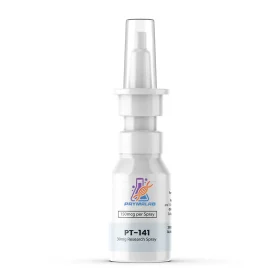
NAD is also stocked as NAD+ Nasal Spray, NAD+ (injectable) 500mg/ml preloaded 3ml pen, NAD+ 100mg/ml preloaded 3ml pen and NAD+ 1000mg. Each listing states its own quantity and concentration, and the pen and vial comparison explains what changes between formats.









20 reviews for NAD+ 500mg