Description
PrymaLab · Research use only
NAD+ 1000mg
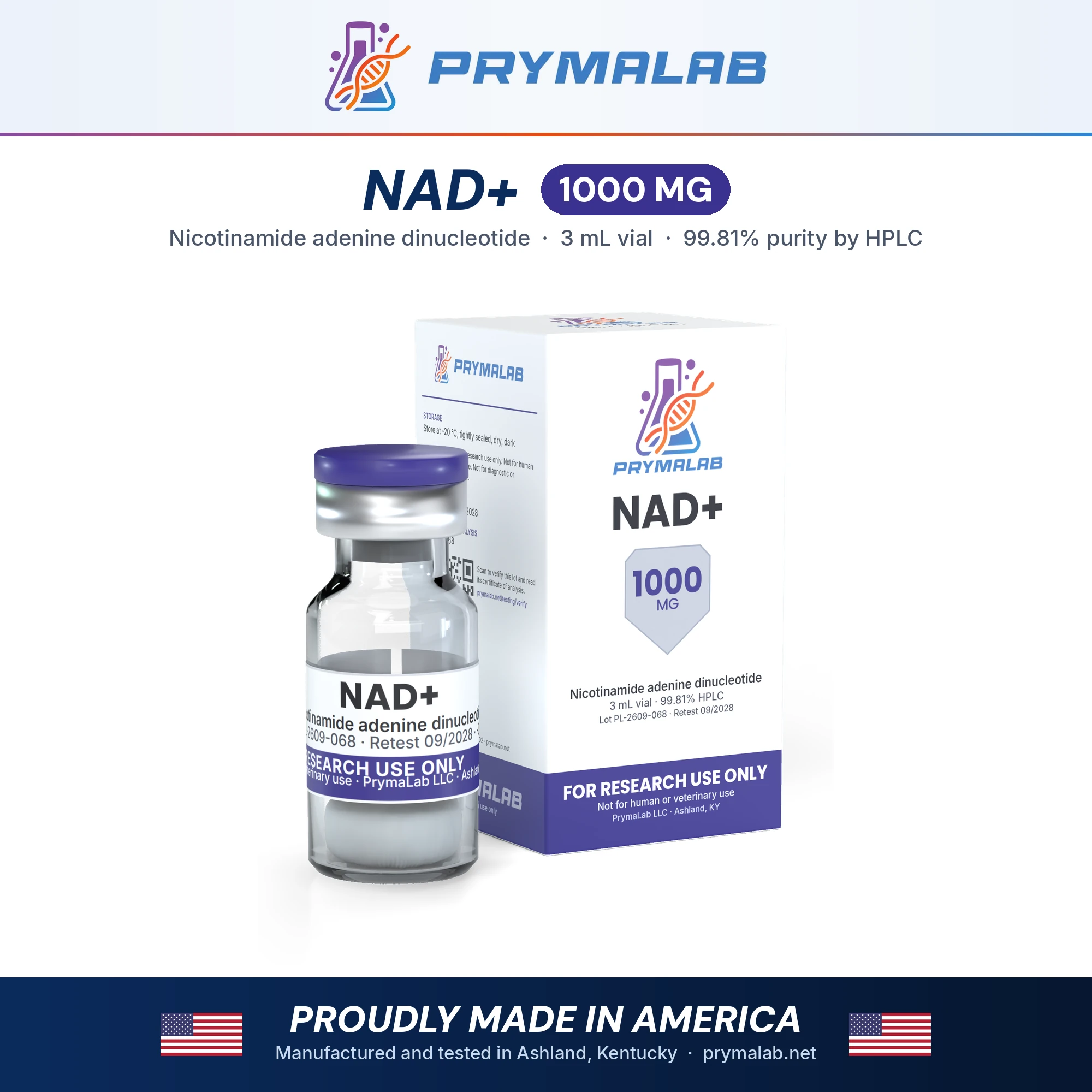
Oxidized NAD+ free acid, 1,000 mg of white powder in a 10 mL glass vial
NAD+ (β-nicotinamide adenine dinucleotide, oxidized form) is a coenzyme, not a peptide: a dinucleotide present in every living cell, where it carries electrons and feeds several enzyme families. This listing is the main NAD+ vial, 1,000 mg of the free acid as a dry white powder in a 10 mL glass vial, with a 500 mg fill also sold. Research on NAD+ deals with redox metabolism, the sirtuin and PARP enzymes that consume it, its fall with age in animals and the precursors used to raise it.
Specifications
| Property | Value |
|---|---|
| Compound | NAD+ β-Nicotinamide adenine dinucleotide, oxidized (free acid); coenzyme, not a peptide |
| CAS number | 53-84-9 |
| Molecular formula | C21H27N7O14P2 |
| Theoretical mass | 663.4 Da |
| Sequence / structure | Dinucleotide: adenosine 5′-monophosphate joined through a pyrophosphate bridge to nicotinamide 5′-mononucleotide; oxidized form. |
| Label claim | 1000 mg/vial |
| Form | Crystalline or amorphous powder in a sealed glass vial |
| Storage, sealed | −20 °C, tightly sealed, dry, dark |
| Purity specification | 99.0% or higher by RP-HPLC |
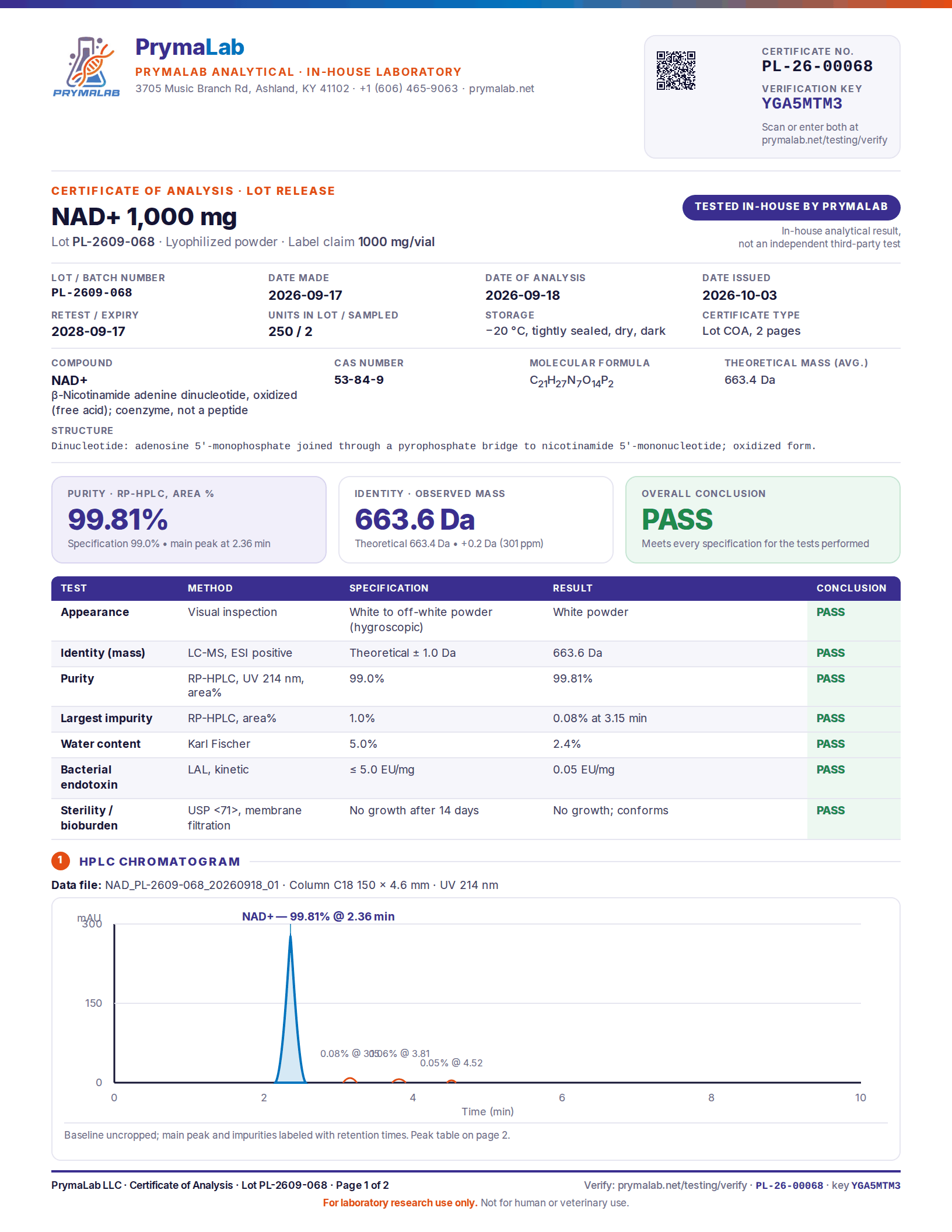
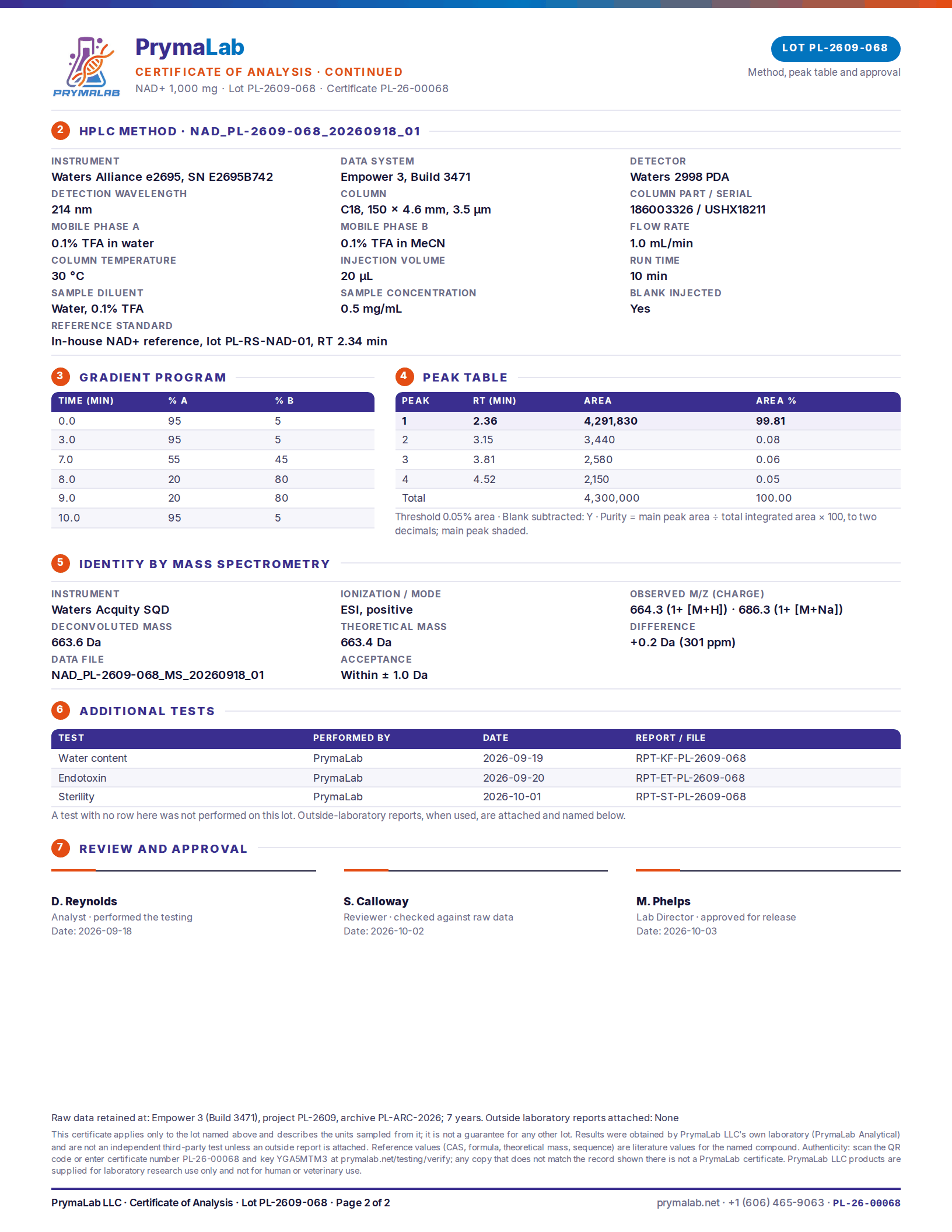
| Lot certificate | Results for the lot now shipping are in the certificate panel on this page |
| Safety data sheet | PL-SDS-114 |
Fills in this range
NAD+ is sold in 2 fills. The compound and the testing are the same in every fill; only the amount in the vial changes.
| Fill | Listing |
|---|---|
| 500 mg | NAD+ 500mg |
| 1000 mg | NAD+ 1000mg (this page) |
What the vial holds
The certificate identifies the contents as β-nicotinamide adenine dinucleotide in its oxidized form, supplied as the free acid: CAS 53-84-9, formula C21H27N7O14P2, theoretical mass 663.4 Da. Structurally it is two nucleotides, adenosine 5′-monophosphate and nicotinamide 5′-mononucleotide, joined through a pyrophosphate bridge. It is not NADH, the reduced partner, and it is not one of the precursors such as NMN or nicotinamide riboside that cells convert into NAD+. With no amino acid sequence to confirm, identity on the certificate comes down to a single LC-MS mass, read against 663.4 Da.
A gram of NAD+ is about 1.51 mmol, a little less once the residual water on the certificate is allowed for. The same compound is sold as a NAD+ 500 mg vial and in solution in the NAD+ 100 mg/mL pen and the NAD+ 500 mg/mL pen.
Handling notes
The certificate gives the storage condition as −20 °C, tightly sealed, dry and dark, and the safety data sheet repeats the instruction to keep it cool, dry and protected from light. A gram-scale vial tends to be opened more than once, so let the sealed vial come to room temperature before the cap comes off, which stops moisture condensing on cold powder, and reseal it promptly. Once dissolved, keep the solution refrigerated and out of the light, and use it within a period your laboratory has validated. The safety data sheet lists NAD+ as not classified under GHS.
What the research covers
One molecule, two kinds of work
Verdin’s 2015 review in Science described NAD+ as a coenzyme found in all living cells that does two separate jobs1. For redox enzymes it carries electrons from one reaction to the next, cycling between NAD+ and NADH, while for the sirtuins and the poly(ADP-ribose) polymerases (PARPs) it is a cosubstrate, consumed in the reaction rather than recycled1. Rajman, Chwalek and Sinclair described the shift in emphasis in 2018: long known as the cell’s hydrogen carrier, NAD+ had more recently emerged as a signalling molecule whose sensing enzymes control hundreds of processes, from energy metabolism to cell survival2. Its level is not fixed. The same review described it rising and falling with food intake, exercise and the time of day2.
Where cells get it
Cells make NAD+ from several dietary starting points. Bogan and Brenner reviewed them in 2008: baseline needs can be met from the amino acid tryptophan or from niacin, the collective name for nicotinic acid and nicotinamide, and nicotinamide riboside had then recently been identified as a further precursor3. Each precursor has its own tissue-specific biosynthetic and ligand activities, which the authors held responsible for the effects and side effects peculiar to each vitamin form3. They also proposed that nicotinamide riboside may be the only vitamin precursor that supports NAD+ synthesis in neurons3. Ten years later Yoshino, Baur and Imai reviewed the two intermediates that had drawn the most work, nicotinamide mononucleotide (NMN) and nicotinamide riboside (NR), and noted that the fate of each depends on a tissue’s biosynthetic enzymes, nucleotidases and presumed transporters4.
Decline with age: the animal evidence
Verdin reported that cellular NAD+ concentrations change during aging1, and Rajman’s review described a steady decline that alters metabolism and raises susceptibility to disease2. In old or diseased animals, restoring NAD+ was reported to promote health and extend lifespan, which set off a search for molecules that raise it2. Cantó, Menzies and Auwerx linked NAD+ metabolism to sirtuin activation and to mitochondrial fitness, through mechanisms such as the mitochondrial unfolded protein response, and described renewed interest in raising NAD+ in conditions ranging from diabetes to cancer5. Yoshino’s review reported that NMN and NR supplements had prevented or improved age-associated conditions in preclinical models4.
What is not established
Most of this evidence concerns precursors given to animals, not NAD+ itself, and the reviews leave the human question open. Yoshino and colleagues wrote in 2018 that the stage was set to test whether the preclinical results could be translated to people, and that the pharmacokinetics of NMN and NR were still under intensive investigation4. None of the abstracts cited here reports a controlled human trial of NAD+ as such. How NAD+ supplied from outside a cell compares with the precursors is a separate question that these abstracts do not answer. These papers describe the biology of the coenzyme, and none of them tested PrymaLab material. The NAD+ guide covers the individual studies.
How each lot is tested
Every lot is tested in PrymaLab’s own laboratory in Ashland, Kentucky before release: RP-HPLC for purity, LC-MS for identity, Karl Fischer titration for water, LAL for endotoxin and USP <71> for sterility. The results for the lot now shipping are in the certificate panel on this page, and the certificate number, key and QR code can be checked on the verify page. These are in-house results from PrymaLab Analytical, not an independent test, and the lab is not accredited to ISO 17025. The third-party testing guarantee on this page still applies: if any independent laboratory finds the wrong compound, or less than the stated purity or amount, the order is refunded and the cost of the test is reimbursed.
Frequently asked questions
Is NAD+ a peptide?
No. NAD+ is a dinucleotide coenzyme: two nucleotides joined by a pyrophosphate bridge, with no amino acids at all. PrymaLab lists it beside its peptides for convenience, and the certificate checks it the same way, by HPLC purity and an LC-MS mass compared with the theoretical 663.4 Da.
How do the 1,000 mg and 500 mg vials differ?
In the amount of NAD+ and the size of the vial. The 1,000 mg fill comes in a larger 10 mL glass vial. The compound is identical, and each fill is made as its own lot with its own certificate.
How do I check the certificate for my vial?
Find the lot number printed on the vial label and compare it with the certificate panel on this page. If they differ, the results page lists earlier lots, and the verify page confirms any certificate from its number and key.
How should NAD+ be stored?
Sealed, at −20 °C, dry and protected from light, as the certificate states. Warm the closed vial to room temperature before opening so condensation does not reach the powder. After dissolving, keep the solution cold and dark and use it within a period your laboratory has established.
What does the published research show, and what does it not?
Reviews describe NAD+ as an electron carrier and a substrate for sirtuins and PARPs, report that levels fall with age in animals, and summarise preclinical work in which raising NAD+, mostly through precursors, improved age-related measures. The papers cited here report no controlled human trial of NAD+ itself, and none used this product.
Is this product for human use?
No. NAD+ from PrymaLab is sold for laboratory research only. It is not a drug or a dietary supplement, is not approved by the FDA or any comparable authority for human or veterinary use, and must not be given to people or animals.
References
- Verdin E. NAD⁺ in aging, metabolism, and neurodegeneration. Science. 2015;350(6265):1208-13. DOI · PubMed
- Rajman L, Chwalek K, Sinclair DA. Therapeutic Potential of NAD-Boosting Molecules: The In Vivo Evidence. Cell Metab. 2018;27(3):529-547. DOI · PubMed
- Bogan KL, Brenner C. Nicotinic acid, nicotinamide, and nicotinamide riboside: a molecular evaluation of NAD+ precursor vitamins in human nutrition. Annu Rev Nutr. 2008;28:115-30. DOI · PubMed
- Yoshino J, Baur JA, Imai SI. NAD(+) Intermediates: The Biology and Therapeutic Potential of NMN and NR. Cell Metab. 2018;27(3):513-528. DOI · PubMed
- Cantó C, Menzies KJ, Auwerx J. NAD(+) Metabolism and the Control of Energy Homeostasis: A Balancing Act between Mitochondria and the Nucleus. Cell Metab. 2015;22(1):31-53. DOI · PubMed
Research use only
For laboratory research use only. NAD+ 1000mg is not a drug, food, cosmetic or dietary supplement, is not approved by the FDA or any comparable authority for human or veterinary use, and must not be given to people or animals. It is sold to qualified researchers and institutions, and the buyer is responsible for lawful handling and disposal.
Other formats of NAD
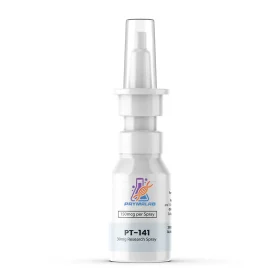
NAD is also stocked as NAD+ Nasal Spray. Each listing states its own quantity and concentration, and the pen and vial comparison explains what changes between formats.







Reviews
There are no reviews yet.