
Description
PrymaLab · Research Use Only
5-Amino-1MQ Autoinjector
NNMT inhibitor · quinolinium iodide · CAS 42464-96-0
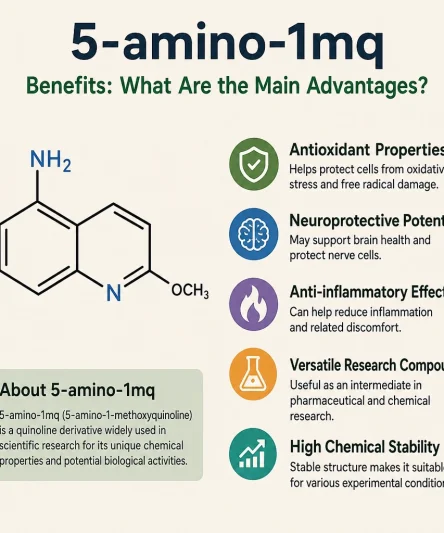
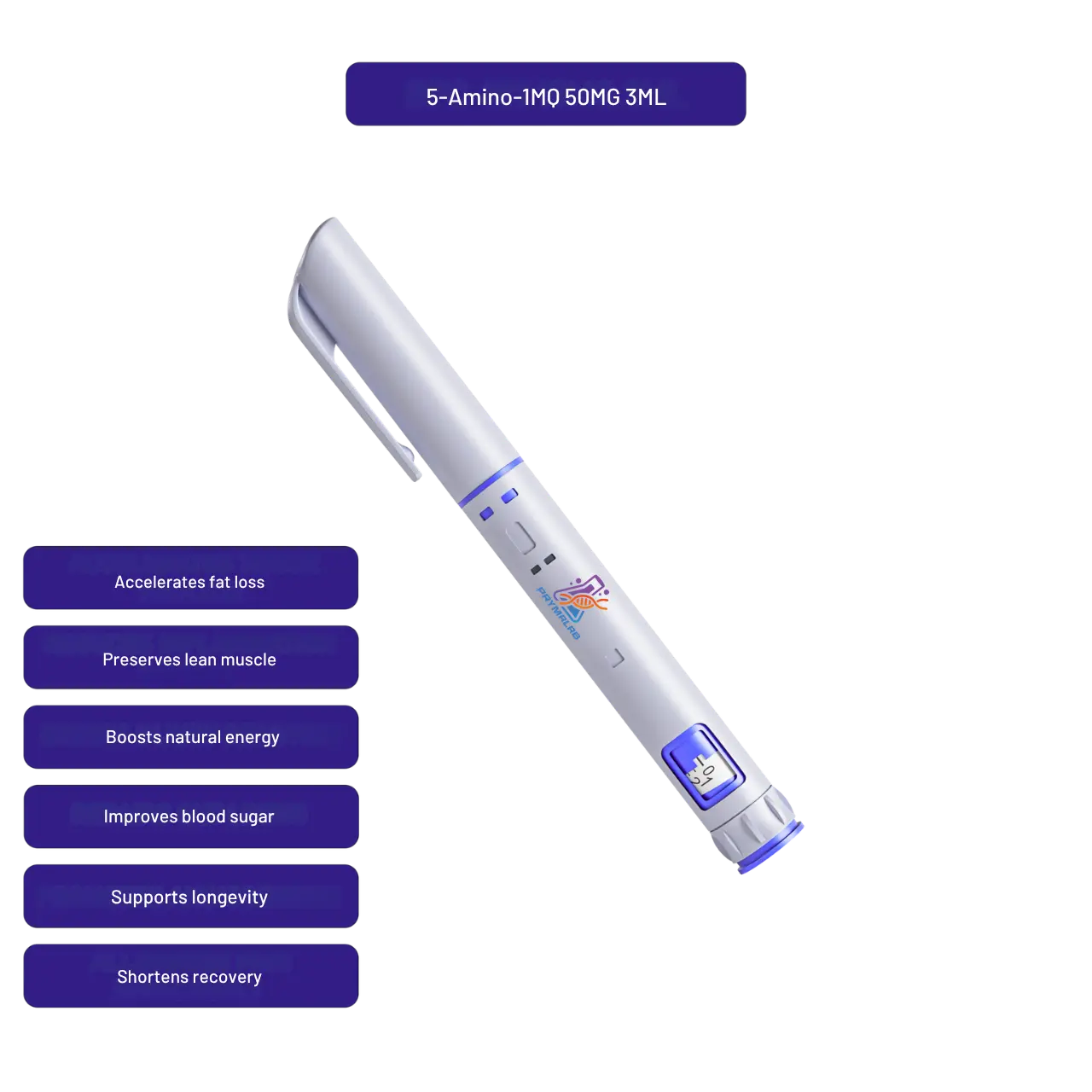
5-Amino-1MQ autoinjector is a pre-filled device supplying 5-amino-1-methylquinolinium, CAS 42464-96-0, a small-molecule inhibitor of nicotinamide N-methyltransferase. It is supplied as the iodide salt, C10H11IN2, formula weight approximately 286.11.
Specification Table
| Property | Value |
|---|---|
| Compound | 5-Amino-1-methylquinolinium |
| Common designation | 5-Amino-1MQ |
| CAS number | 42464-96-0 |
| Molecular formula, iodide salt | C10H11IN2 |
| Formula weight, iodide salt | Approximately 286.11 g/mol |
| Cation mass | Approximately 159.2 Da |
| Counterion | Iodide |
| Compound class | Quaternary heteroaromatic cation. Not a peptide |
| Charge state | Permanently cationic, independent of pH |
| Molecular target | Nicotinamide N-methyltransferase (NNMT) |
| Enzyme reaction inhibited | Transfer of a methyl group from S-adenosylmethionine to nicotinamide |
| Enzyme products when uninhibited | 1-methylnicotinamide and S-adenosylhomocysteine |
| Scaffold | 1-methylquinolinium with an amino substituent at position 5 |
| Structural relationship to substrate | Mimics the methylated pyridinium product |
| Format | Pre-filled autoinjector device |
| Physical state | Solution, supplied ready-filled |
| Purity | Per lot-specific certificate of analysis |
| Storage | 2-8°C, protected from light |
| Regulatory status | No approved human or veterinary formulation in any jurisdiction |
What Does NNMT Do?
Nicotinamide N-methyltransferase catalyses a single, simple reaction, and the consequences of that reaction reach further than its simplicity suggests.
The enzyme transfers a methyl group from S-adenosylmethionine to the ring nitrogen of nicotinamide, producing 1-methylnicotinamide and S-adenosylhomocysteine. That is the whole reaction.
Two separate pools are affected. Nicotinamide is the substrate for NAD+ salvage through NAMPT, so methylating it diverts material away from that route. S-adenosylmethionine is the universal methyl donor for DNA, histone and protein methylation, so consuming it draws on a shared resource.
A single enzyme therefore sits at the intersection of two major metabolic systems, coenzyme salvage and cellular methylation capacity. That intersection is what has made NNMT a subject of sustained research interest.
1-methylnicotinamide, the product, is not simply waste. It has its own reported activities in the literature, which means inhibiting the enzyme changes both what is consumed and what is produced.
Why Is the Permanent Positive Charge Significant?
The compound in a 5-Amino-1MQ autoinjector carries a quaternary nitrogen, and that structural feature determines much of its behaviour.
A quaternary ammonium nitrogen has four bonds and no lone pair available for protonation or deprotonation. Its positive charge is fixed regardless of pH, which distinguishes it from an amine that gains and loses charge as conditions change.
The permanent charge makes the compound highly water soluble, which simplifies formulation considerably compared with the neutral small molecules elsewhere in this catalogue requiring DMSO stocks.
It also limits passive membrane permeation. Uncharged molecules diffuse across lipid bilayers; permanently charged ones do not, and generally require a transporter. For a compound intended to inhibit an intracellular enzyme, that is a real consideration rather than an academic one.
Organic cation transporters are the plausible route, and their expression varies between cell types and tissues. A design should establish uptake in the specific system used rather than assume it, since a compound that cannot enter the cell cannot inhibit an enzyme inside it.
The structural logic is nonetheless sound: the enzyme methylates a pyridine nitrogen to produce a permanent cation, so a permanently cationic quinolinium resembles the product the enzyme makes.
What Does the Salt Form Mean for Concentration?
The compound is supplied as an iodide salt and the arithmetic consequences are worth stating plainly.
The formula weight of the iodide salt is approximately 286.11. The cation itself, which is the species that inhibits the enzyme, has a mass of approximately 159.2. Iodide accounts for the remaining 127 or so.
That means iodide represents roughly 44 percent of the weighed mass. A calculation using the cation mass against a weight of salt overstates molar concentration by a factor of nearly 1.8, which is a large error by any standard.
The convention in most published work and most supplier documentation is to state concentration on the basis of the salt, but the convention is not universal and it is not always stated. Confirming which basis a given figure uses is worth doing before comparing across sources.
For a pre-filled device the same question applies to the labelled concentration. Whether the stated figure refers to the salt or the cation changes the molar concentration substantially, and the certificate of analysis should specify it.
What Should Work With This Compound Control For?
5-Amino-1MQ autoinjector work has well-established requirements, and several are specific to this target.
Cellular uptake should be established rather than assumed, for the reasons described above. Measuring intracellular compound concentration, or demonstrating target engagement directly, addresses the permeability question that the permanent charge raises.
Target engagement is measurable through the reaction product. If NNMT is inhibited in cells, 1-methylnicotinamide production falls, and that metabolite is quantifiable by mass spectrometry. It is a more direct readout than any downstream phenotype.
Methyltransferase selectivity deserves attention. Many enzymes use S-adenosylmethionine, and a compound resembling a methylated product could plausibly affect others. A selectivity panel across related methyltransferases strengthens any mechanistic claim considerably.
An iodide control is worth considering at higher concentrations, since iodide is not biologically inert and a salt applied at high concentration delivers a substantial iodide load alongside the cation.
Genetic confirmation through NNMT knockdown provides the strongest test. An effect persisting in cells lacking the enzyme is not mediated by inhibiting it.
Where Does the 5-Amino-1MQ Autoinjector Sit Among NNMT Inhibitors?
Several chemical approaches to this enzyme exist, and this compound occupies a specific and comparatively early position among them.
Product-mimetic inhibitors, the class this compound belongs to, resemble the methylated pyridinium the enzyme produces. They are structurally simple, synthetically accessible, and generally modest in potency, since a small product analogue occupies only part of the active site.
Bisubstrate inhibitors take the opposite approach, linking a nicotinamide-like element to an adenosine-like element so that a single molecule spans both the substrate and cofactor pockets. They achieve substantially greater potency and are correspondingly larger and harder to deliver into cells.
Cofactor-competitive compounds target the S-adenosylmethionine site directly, which raises an obvious selectivity problem, since that cofactor is shared across a large enzyme family.
The practical trade is between potency and tractability. A bisubstrate inhibitor gives a cleaner biochemical answer while a small product mimetic is easier to apply in a cellular system, subject to the transporter question the permanent charge raises.
For work where potency matters more than convenience, the more elaborate chemistry is the better tool, and reporting which class was used lets a reader calibrate how much of an observed effect to attribute to on-target inhibition.
How Should Methyl Donor Effects Be Separated?
Inhibiting this enzyme changes S-adenosylmethionine consumption, and that touches every methyltransferase in the cell, which creates an attribution problem.
The enzyme is a significant consumer of the methyl donor in tissues where it is highly expressed. Inhibiting it leaves more available for other methyltransferases, so DNA methylation, histone methylation and protein methylation can all shift as a secondary consequence.
Those secondary changes are real effects of the inhibitor and they are not effects of inhibiting the target enzyme in any direct sense. Distinguishing the two requires measuring the methyl donor pool alongside whatever endpoint is of interest.
The ratio of S-adenosylmethionine to S-adenosylhomocysteine is the conventional index of methylation capacity, and both species are quantifiable by mass spectrometry in the same run.
Where that ratio shifts, downstream methylation changes should be attributed to the shift rather than to the target enzyme specifically, and the distinction changes what a study can claim.
A methionine-restricted or methyl-donor-preparationed condition provides an orthogonal manipulation that helps separate the two, by moving the pool independently of enzyme inhibition.
What Concentration Basis Should a 5-Amino-1MQ Autoinjector State?
This is the one field on the certificate that changes every downstream number, and it is frequently left implicit.
A concentration stated as milligrams per millilitre of the iodide salt describes something 1.8 times less concentrated in active cation than the same figure would if it described the cation alone. That is not a rounding difference.
Where a 5-Amino-1MQ autoinjector certificate states a concentration without specifying the basis, the safest assumption is that it refers to the salt, since that is the more common convention, but assuming is worse than asking.
Molar concentration sidesteps the ambiguity entirely, which is why stating it in molar terms is the better practice for both suppliers and researchers.
Record whichever basis the certificate used, verbatim, rather than converting it and recording only the converted figure.
Storage and Handling in Laboratory Practice
A 5-Amino-1MQ autoinjector holds a chemically stable small molecule, and the handling requirements are correspondingly modest.
A quaternary heteroaromatic cation has no oxidation-prone thiols, no hydrolysable amide bonds and no fold to lose. Solution-state storage carries far less risk here than for the peptides and proteins in this catalogue.
Light protection is worth maintaining. Iodide salts can undergo photochemical oxidation to iodine, which discolours the solution toward yellow or brown, and while that affects the counterion rather than the active cation, discolouration signals that the preparation has been mishandled.
Refrigerate the device and keep it in original packaging until use, and do not freeze, on mechanical grounds relating to the sealed liquid-filled mechanism.
Inspect before use for clarity and colour. Record lot, the concentration basis stated on the certificate, whether that basis is salt or cation, manufacture date, storage history and dates of use. The concentration basis is the field most worth recording explicitly here.
A final consideration concerns the iodide counterion at higher working concentrations. Iodide is not biologically inert, and a compound applied at high micromolar concentration delivers a comparable iodide load.
Thyroid tissue and cells expressing the sodium-iodide symporter are the obvious cases where that load matters, but iodide also participates in redox chemistry more generally and can interfere with peroxidase-based assay readouts.
A sodium iodide control at matched concentration settles the question in an afternoon and it is worth running once per system rather than once per experiment.
Published Literature
References verified against the publisher record. NNMT enzymology rests on an independent literature, though work on this specific inhibitor is more limited.
- Aksoy S, Szumlanski CL, Weinshilboum RM. Journal of Biological Chemistry. 1994;269(20):14835-14840.
- Neelakantan H, Vance V, Wetzel MD, Wang HL, McHardy SF, Finnerty CC, Hommel JD, Watowich SJ. Biochemical Pharmacology. 2018;147:141-152.
- Kraus D, Yang Q, Kong D, Banks AS, Zhang L, Rodgers JT, Pirinen E, Pulinilkunnil TC, Gong F, Wang YC, Cen Y, Sauve AA, Asara JM, Peroni OD, Monia BP, Bhanot S, Alhonen L, Puigserver P, Kahn BB. Nature. 2014;508(7495):258-262.
- Pissios P. Trends in Endocrinology and Metabolism. 2017;28(5):340-353.
- van Haren MJ, Gao Y, Buijs N, Campagna R, Sartini D, Emanuelli M, Mateuszuk L, Kij A, Chlopicki S, Escudé M, Cuevas O, Martin-Diaz J, Martin NI. Biomolecules. 2021;11(9):1357.
Frequently Asked Questions
What is the 5-Amino-1MQ autoinjector?
A pre-filled device supplying 5-amino-1-methylquinolinium, CAS 42464-96-0, a small-molecule inhibitor of nicotinamide N-methyltransferase supplied as the iodide salt. It is not a peptide. A laboratory research reagent, supplied for no other use.
What reaction does NNMT catalyse?
Transfer of a methyl group from S-adenosylmethionine to the ring nitrogen of nicotinamide, producing 1-methylnicotinamide and S-adenosylhomocysteine. That single simple reaction is the whole of the enzyme activity.
Why does that reaction matter?
Because it touches two systems at once. Nicotinamide is the substrate for NAD+ salvage through NAMPT, so methylating it diverts material from that route. S-adenosylmethionine is the universal methyl donor, so consuming it draws on cellular methylation capacity.
Is the product inert?
No. 1-methylnicotinamide has its own reported activities in the literature, which means inhibiting the enzyme changes both what is consumed and what is produced. Both sides of that ledger are worth considering in a study design.
What is a permanent positive charge?
A quaternary nitrogen has four bonds and no lone pair available for protonation or deprotonation, so its positive charge is fixed regardless of pH. That distinguishes it from an amine which gains and loses charge as conditions change.
How does the charge affect cell entry?
It limits passive membrane permeation considerably. Uncharged molecules diffuse across lipid bilayers while permanently charged ones generally require a transporter, and organic cation transporters vary in expression between cell types and tissues.
Why is the structure nonetheless logical?
Because the enzyme methylates a pyridine nitrogen to produce a permanent cation. A permanently cationic quinolinium therefore resembles the product the enzyme makes, which is a conventional route to designing an inhibitor.
How much of the weighed mass is iodide?
Roughly 44 percent. The salt formula weight is approximately 286.11 while the active cation is approximately 159.2. Calculating molar concentration using the cation mass against a weight of salt overstates it by a factor near 1.8.
How is target engagement measured?
Through the reaction product. If NNMT is inhibited in cells, 1-methylnicotinamide production falls, and that metabolite is quantifiable by mass spectrometry. It is a considerably more direct readout than any downstream phenotype.
Why protect from light?
Because iodide salts can undergo photochemical oxidation to iodine, which discolours the solution toward yellow or brown. That affects the counterion rather than the active cation, but discolouration signals the preparation has been mishandled.
Compliance Statement
5-Amino-1MQ is sold exclusively for laboratory research use. It is not a drug, food, or cosmetic product, and it is not a dietary product of any kind. It is not approved by the FDA or any comparable authority for human or veterinary use, it is an enzyme inhibitor supplied as a laboratory reagent, and no approved formulation exists in any jurisdiction. This product is not intended to diagnose, treat, cure, or prevent any disease. It must not be given to humans or animals. Purchase is restricted to qualified researchers and institutions operating within applicable laws. All handling is the responsibility of the purchasing laboratory.


19 reviews for Preloaded Autoinjector | 5-Amino-1MQ | 3ml Pen | 50mg/ml