Description
PrymaLab · Research use only
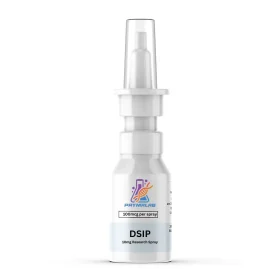
P21 (P021) 10mg
P021: an acetylated DGGL tetrapeptide with an adamantane cap, 10 mg freeze-dried
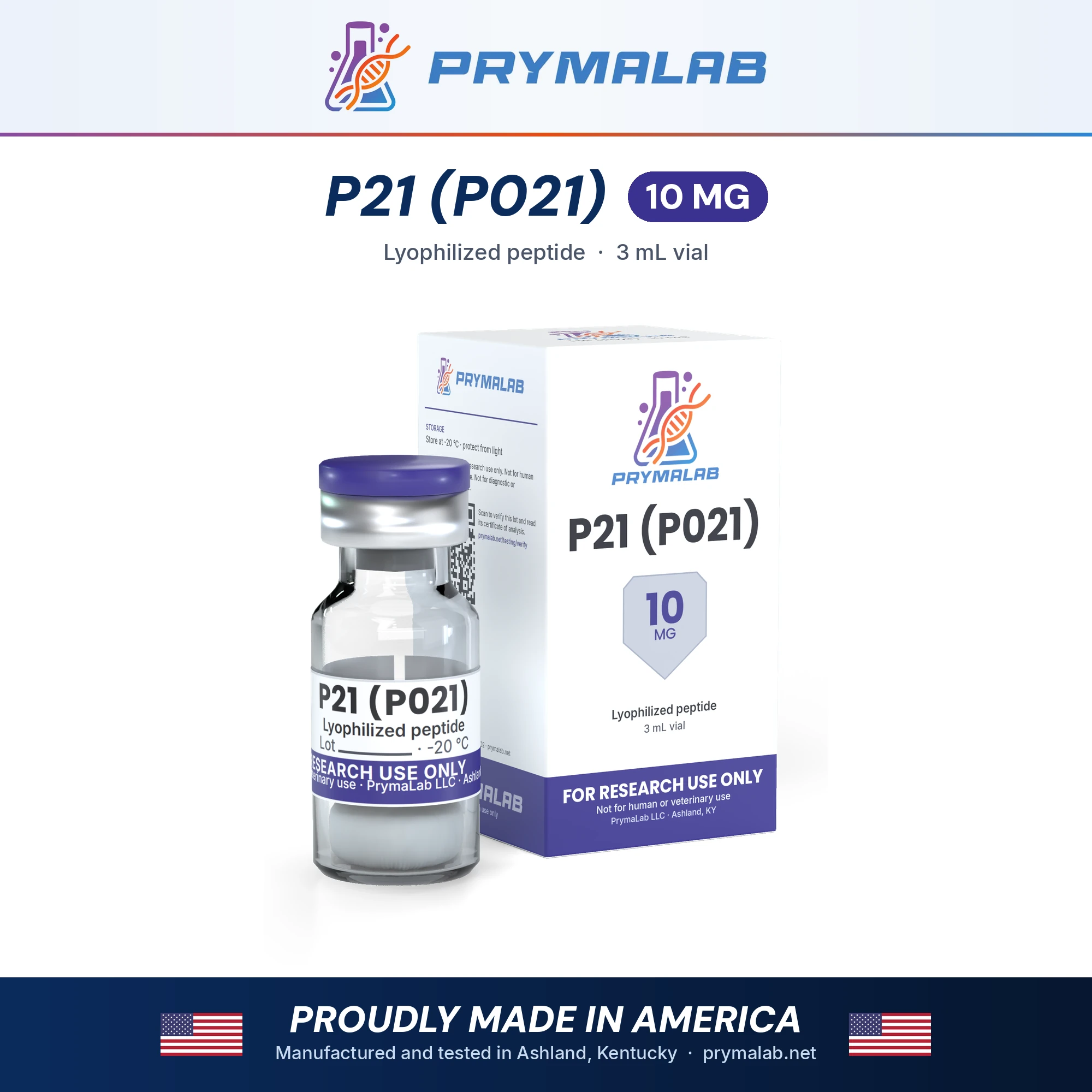
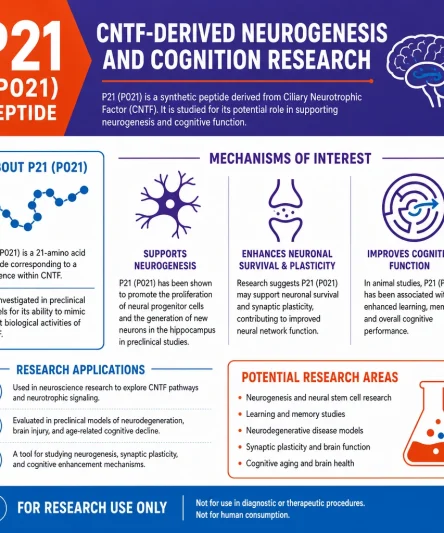
P21, usually written P021 in the literature, is a small synthetic compound derived from ciliary neurotrophic factor (CNTF): the acetylated tetrapeptide Asp-Gly-Gly-Leu linked at its C-terminus to an adamantane-based amide. This listing is the 10 mg vial of freeze-dried powder, the main fill; a 5 mg vial is also sold. Research on P021, all of it from one New York laboratory, has looked at neurogenesis, BDNF and tau pathology in aged rats and in Alzheimer’s model mice.
Specifications
| Property | Value |
|---|---|
| Compound | P21 (P021) Ac-DGGL coupled to 3-aminoadamantane-1-carboxamide; CNTF-derived peptidomimetic |
| CAS number | 1246751-68-7 |
| Molecular formula | C27H42N6O8 |
| Theoretical mass | 578.7 Da |
| Sequence / structure | Ac-DGGL-NH-(3-carbamoyladamantan-1-yl): the tetrapeptide Ac-Asp-Gly-Gly-Leu amidated at its C-terminus with 3-aminoadamantane-1-carboxamide; N-acetyl; no disulfides. |
| Label claim | 10 mg per vial |
| Form | Lyophilized (freeze-dried) powder or cake in a sealed glass vial with a rubber stopper and aluminium crimp cap |
| Storage, sealed | −20 °C, desiccated, dark |
| Purity specification | 99.0% or higher by RP-HPLC |
| Safety data sheet | PL-SDS-124 |
Fills in this range
P21 (P021) is sold in 2 fills. The compound and the testing are the same in every fill; only the amount in the vial changes.
| Fill | Listing |
|---|---|
| 5 mg | P21 (P021) 5mg |
| 10 mg | P21 (P021) 10mg (this page) |
What the structure is
The certificate describes the compound as the tetrapeptide Ac-Asp-Gly-Gly-Leu amidated at its C-terminus with 3-aminoadamantane-1-carboxamide: an N-acetyl group at one end, a rigid adamantane cage carrying a carboxamide at the other, and no disulfide bonds. The formula is C27H42N6O8 and the theoretical mass 578.7 Da, which is the figure to compare with the LC-MS identity result on the certificate. Papers from the developing group abbreviate the compound as Ac-DGGL(A)G-NH21 or DGGLAG2; the certificate defines the C-terminal adamantane unit exactly. Being part peptide and part adamantane, it is classed as a peptidomimetic. In molar terms 10 mg is about 17.3 µmol, slightly less after the water content on the certificate is allowed for.
P021 is not Peptide 6. That earlier design, by overlapping authors, was an 11-residue peptide designed from a biologically active region of CNTF3, and descriptions of P21 as an 11-residue peptide mix the two compounds up.
What the research covers
From CNTF to a small mimetic
The developing group’s first CNTF-based design was Peptide 6, an 11-residue peptide. In normal adult mice it increased the proliferation, survival and maturation of neural progenitor cells into neurons in the dentate gyrus and raised MAP2 and synaptophysin immunoreactivity there3. Peptide 6 had a plasma half-life of over six hours, crossed the blood-brain barrier and acted by competitively inhibiting leukaemia inhibitory factor (LIF) signalling3. Those properties were measured for Peptide 6. The abstract does not describe P021, and the P021 papers cited below do not repeat the half-life or LIF measurements for it.
Alzheimer’s model mice
In a 12-month dietary study, Kazim and colleagues gave P021 to female 3xTg-AD mice, a triple transgenic Alzheimer’s model, from 9 to 10 months of age, when pathology is moderate to severe1. They reported significantly less abnormal hyperphosphorylation and accumulation of tau at sites of neurofibrillary pathology. The effect on amyloid-beta was limited to lower soluble Aβ and a trend toward less plaque in hippocampal CA1, consistent with reduced Aβ production, not clearance1. The authors linked these changes to raised BDNF and lower GSK-3β activity, and reported that deficits in cognition, neurogenesis and synaptic plasticity were rescued1. A follow-up began P021 in 3-month-old female 3xTg-AD mice, before overt pathology, and assessed them 9, 15 and 18 months later; the group reported prevention of neurodegeneration and of Aβ and tau pathology, rescue of episodic memory on a novel object recognition task, and a marked reduction in mortality4.
Aged rats
In 22 to 24-month-old Fisher rats, long-term P021 significantly reduced the age-related decline in learning and memory, prevented the fall in neurogenesis, increased BDNF expression and reversed synaptic deficits in cortex and hippocampus5. Magnetic resonance spectroscopy showed raised hippocampal myo-inositol in the old rats, which P021 lowered5. In another aged-rat study P021 crossed the blood-brain barrier and lowered total brain tau; cerebrospinal fluid tau, raised in old animals, returned to young-adult levels while CSF Aβ/AβPP did not, and no immune reaction was detected2.
What is not established
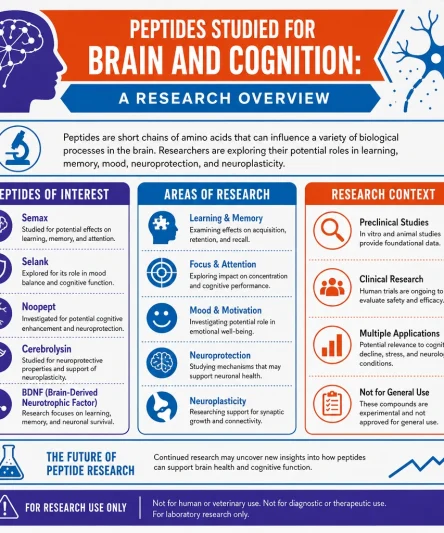
Every P021 paper cited here comes from one research group, with Khalid Iqbal as senior author on the prevention study4, and none reports replication by another laboratory. The models are transgenic mice and aged rats; no human data are among these references. The molecular target is not settled: the LIF result belongs to Peptide 6, while the P021 papers point downstream, to BDNF and GSK-3β1. A lower death rate in one mouse cohort is a single finding. None of the work used PrymaLab material. The overview of peptides studied for brain and cognition places P021 among related compounds.
The P21 Peptide (P021) guide covers the literature in more depth.
How each lot is tested
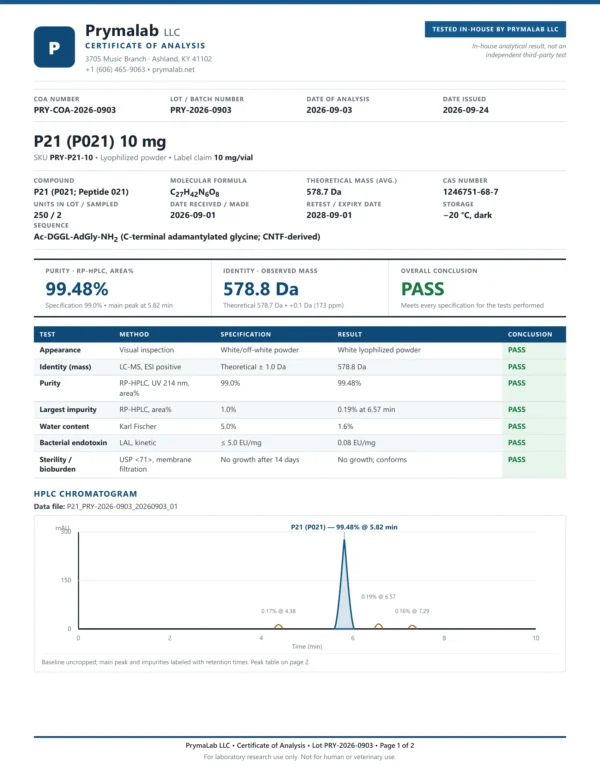
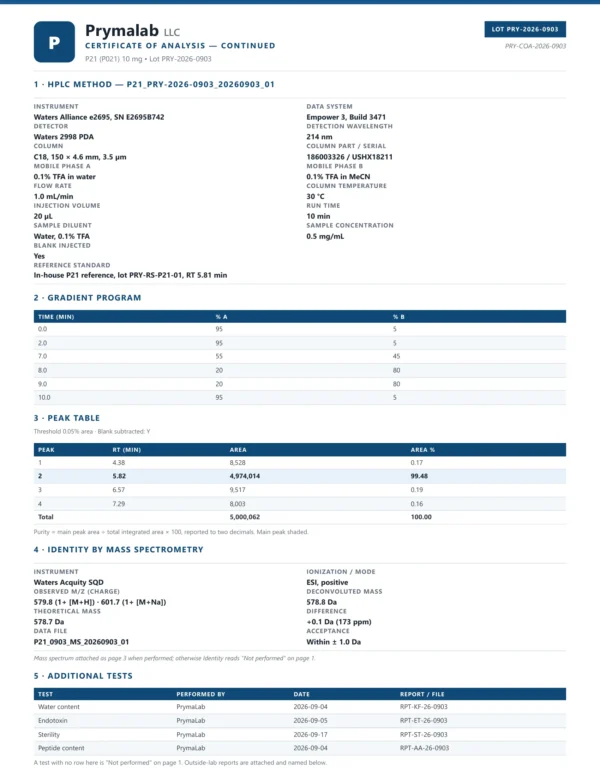
Every lot is tested in PrymaLab’s own laboratory in Ashland, Kentucky before release: RP-HPLC for purity, LC-MS for identity, Karl Fischer titration for water, LAL for endotoxin and USP <71> for sterility. Published certificates are listed on the results page and can be checked by number and key on the verify page. These are in-house results from PrymaLab Analytical, not an independent test, and the lab is not accredited to ISO 17025. The third-party testing guarantee on this page still applies: if any independent laboratory finds the wrong compound, or less than the stated purity or amount, the order is refunded and the cost of the test is reimbursed.
Frequently asked questions
Is P21 a peptide?
Partly. It is a four-residue peptide, Ac-Asp-Gly-Gly-Leu, joined at the C-terminus to an adamantane carboxamide, so the certificate classes it as a peptidomimetic. The formula is C27H42N6O8 and the theoretical mass 578.7 Da.
How is P021 related to Peptide 6?
Peptide 6 is an earlier 11-residue CNTF-derived peptide from overlapping authors, and the half-life, blood-brain barrier and LIF findings in its paper belong to it. P021 is the much smaller adamantane-capped compound sold here. Sources describing P21 as 11 residues are mixing the two.
How do the 5 mg and 10 mg vials differ?
Only in the amount: about 8.6 µmol in the 5 mg vial and 17.3 µmol in this one. Both contain the same freeze-dried compound, and each fill is made and tested as its own lot with its own certificate.
Where is the certificate for this vial?
Match the lot number on the vial to its certificate on the testing results page, then confirm the certificate by number and key on the verify page. The 5 mg page shows its current lot in a certificate panel.
How should P21 be stored?
Sealed, at −20 °C, desiccated and dark, and warmed to room temperature before the vial is opened. Reconstituted solution belongs at 2 to 8 °C, protected from light, for a period your laboratory has established.
Has P21 been tested in people?
Not in any study cited here. The work is in transgenic mice and aged rats from a single research group. P21 is sold for laboratory research only and must not be given to people or animals.
References
- Kazim SF, Blanchard J, Dai CL, et al. Disease modifying effect of chronic oral treatment with a neurotrophic peptidergic compound in a triple transgenic mouse model of Alzheimer's disease. Neurobiol Dis. 2014;71:110-30. DOI · PubMed
- Khatoon S, Chalbot S, Bolognin S, et al. Elevated Tau Level in Aged Rat Cerebrospinal Fluid Reduced by Treatment with a Neurotrophic Compound. J Alzheimers Dis. 2015;47(3):557-64. DOI · PubMed
- Chohan MO, Li B, Blanchard J, et al. Enhancement of dentate gyrus neurogenesis, dendritic and synaptic plasticity and memory by a neurotrophic peptide. Neurobiol Aging. 2011;32(8):1420-34. DOI · PubMed
- Baazaoui N, Iqbal K. Prevention of Amyloid-β and Tau Pathologies, Associated Neurodegeneration, and Cognitive Deficit by Early Treatment with a Neurotrophic Compound. J Alzheimers Dis. 2017;58(1):215-230. DOI · PubMed
- Bolognin S, Buffelli M, Puoliväli J, et al. Rescue of cognitive-aging by administration of a neurogenic and/or neurotrophic compound. Neurobiol Aging. 2014;35(9):2134-46. DOI · PubMed
Research use only
For laboratory research use only. P21 (P021) 10mg is not a drug, food, cosmetic or dietary supplement, is not approved by the FDA or any comparable authority for human or veterinary use, and must not be given to people or animals. It is sold to qualified researchers and institutions, and the buyer is responsible for lawful handling and disposal.






Reviews
There are no reviews yet.