

$41.99 / month – $355.99
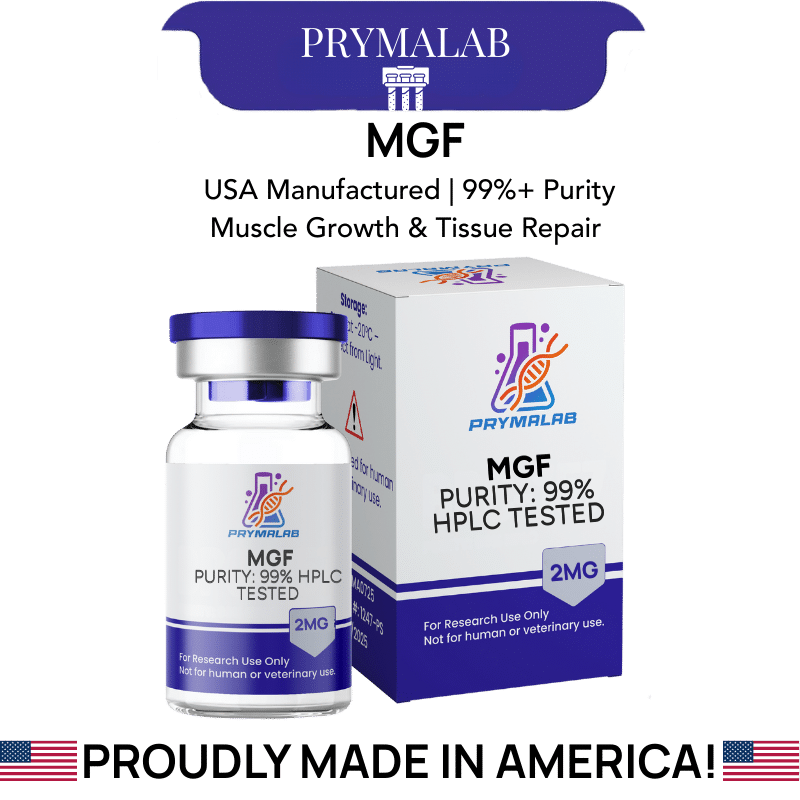
Buy MGF peptide 2mg – mechano growth factor for muscle-specific growth and repair research. Activates satellite cells locally. 99% purity, USA-made, Same Day Shipping, 3 day delivery anywhere in the United States, 5 day guaranteed delivery abroad.
When researchers seek to buy MGF peptide for advanced muscle growth and repair studies, they’re accessing a unique muscle-specific growth factor that operates through fundamentally different mechanisms than systemic growth factors. MGF (Mechano Growth Factor) represents a splice variant of the IGF-1 gene that is produced locally in muscle tissue in response to mechanical stress, making it invaluable for studying exercise-induced muscle adaptation, satellite cell start, and localized muscle repair mechanisms. This MGF growth factor acts mainly at the site of production, recruiting and starting satellite cells (muscle stem cells) to promote muscle fiber repair and growth.
Unlike systemic growth factors such as mature IGF-1 that circulate throughout the body, MGF peptide provides researchers with a tool for studying local, muscle-specific growth signaling. The bio peptide MGF is produced when muscle fibers experience mechanical stress (such as during exercise or injury), triggering other splicing of the IGF-1 gene to produce the MGF isoform with its unique C-terminal E-peptide sequence. This localized production and action make MGF muscle growth research very valuable for grasp how muscles adapt to mechanical stress and repair themselves following injury.
PrymaLab’s MGF 2mg peptide delivers pharmaceutical-grade purity (99%) with full third-party testing, ensuring researchers get authentic mechano growth factor with verified quality and consistency. Each vial contains precisely 2mg of research-grade MGF peptide, manufactured in USA facilities following strict GMP standards for reliable, reproducible results in muscle growth research, satellite cell studies, and tissue repair studies. Whether researchers buy MGF for basic muscle biology studies or buy growth factor for applied muscle regrowth research, PrymaLab provides the highest quality MGF for sale available.
MGF peptide (Mechano Growth Factor) is a splice variant of the IGF-1 gene that is produced locally in muscle tissue in response to mechanical stress. The MGF growth factor contains a unique 24-amino acid C-terminal extension called the E-peptide, which distinguishes it from mature, systemic IGF-1. This structural difference gives MGF protein its muscle-specific properties and local action, making it fundamentally different from circulating IGF-1.
The bio peptide MGF is produced through other splicing of the IGF-1 gene when muscle fibers experience mechanical stress, such as during resistance exercise, eccentric contractions, or muscle injury. This mechanical stress triggers a cascade of cellular signals that alter IGF-1 gene splicing, producing the MGF isoform instead of mature IGF-1. The result is a growth factor that acts locally at the site of production rather than systemically throughout the body.
Grasp the relationship between IGF 1 MGF is essential for researchers studying growth factor biology. The IGF-1 gene can be spliced in multiple ways, producing different isoforms with distinct properties:
This MGF IGF relationship through other splicing allows muscle tissue to respond to mechanical stress with localized growth factor production, independent of systemic growth hormone and liver-derived IGF-1. The MGF peptide represents the muscle’s intrinsic repair and adaptation mechanism.
The defining feature of MGF growth factor is its unique C-terminal E-peptide sequence (24 amino acids) that is not present in mature IGF-1. This E-peptide gives MGF its distinct natural properties:
Research into MGF muscle growth mechanisms focuses heavily on this E-peptide sequence and its role in satellite cell biology.
The mechano growth factor name reflects its production mechanism – mechanical stress on muscle fibers triggers MGF production. Research shows that:
This mechanosensitive production makes MGF peptide a key mediator of exercise-induced muscle adaptation and injury-triggered muscle repair.
The main mechanism through which MGF peptide produces MGF muscle growth effects is through start of satellite cells – the muscle stem cells responsible for muscle repair and growth. Grasp this mechanism is essential for researchers studying muscle biology and regrowth.
Satellite cells are muscle-specific stem cells that:
The bio peptide MGF is one of the most potent known activators of satellite cells, making it invaluable for satellite cell research.
When MGF peptide is produced locally in muscle tissue following mechanical stress, it starts a cascade of events:
1. MGF Binding to Receptors: Mechano growth factor binds to receptors on satellite cells (likely IGF-1 receptors, though the exact receptor is still debated in research). This binding is the first signal that awakens quiescent satellite cells.
2. Satellite Cell Start: Receptor binding triggers satellite cells to exit their quiescent state and enter the cell cycle. Started satellite cells begin expressing markers of start and preparing for proliferation.
3. Satellite Cell Proliferation: Started satellite cells proliferate, producing a population of muscle stem cells. Some daughter cells return to quiescence to keep the satellite cell pool, while others continue to differentiate.
4. Myoblast Differentiation: Proliferating satellite cells differentiate into myoblasts – committed muscle precursor cells that will fuse with existing muscle fibers or form new fibers.
5. Muscle Fiber Fusion: Myoblasts fuse with existing muscle fibers, donating their nuclei to support muscle fiber growth (hypertrophy), or fuse with each other to form new muscle fibers (hyperplasia).
6. Muscle Growth and Repair: The addition of new nuclei to muscle fibers supports increased protein synthesis and muscle fiber growth. In injury scenarios, this process repairs damaged muscle tissue.
This satellite cell start mechanism is the main pathway through which MGF muscle growth effects occur, distinguishing MGF protein from other growth factors that may work through different mechanisms.
A key feature of MGF peptide is its local action at the site of production:
This localized mechanism contrasts with systemic growth factors like mature IGF-1 that circulate throughout the body. The MGF growth factor represents a muscle-intrinsic adaptation mechanism.
One of the most common questions researchers face is MGF or PEG MGF – which form is appropriate for their research? Grasp the differences between native MGF peptide and PEG MGF peptide is essential for protocol design.
Native MGF growth factor as produced naturally in muscle tissue has specific characteristics:
Very Short Half-Life: Native MGF peptide has an extremely short half-life measured in minutes. The unique C-terminal E-peptide that gives MGF its natural activity also makes it highly susceptible to enzymatic breakdown. This rapid breakdown limits the research utility of native MGF.
Local Action: The short half-life means native MGF for sale acts mainly at the site of use or production, with minimal systemic distribution. This can be advantageous for studying local effects but challenging for practical research uses.
Frequent Dosing Needed: Due to rapid breakdown, research protocols using native MGF peptide would need very frequent use (possibly multiple times per hour) to keep activity, which is impractical for most research designs.
Authentic Natural Activity: Native MGF growth factor represents the authentic form produced in muscle tissue, making it valuable for studying natural MGF biology and mechanisms.
PEG MGF peptide is a modified form of MGF where polyethylene glycol (PEG) molecules are attached to the peptide. This pegylation dramatically alters the peptide’s properties:
Extended Half-Life: PEG MGF has a greatly extended half-life measured in hours rather than minutes. The PEG change protects the peptide from enzymatic breakdown, providing sustained activity. This makes PEG MGF for sale much more practical for research uses.
Improved Shelf life: Pegylation improves shelf life in solution, making PEG MGF peptide easier to work with in research settings. The peptide keeps activity longer after mixing.
Less Frequent Dosing: The extended half-life means researchers using PEG MGF can give doses less often (often once or twice daily) while keeping consistent activity. This is a major practical advantage for research protocols.
Systemic Distribution: The longer half-life and improved shelf life mean PEG MGF peptide can distribute more systemically than native MGF. This may be advantageous or disadvantageous depending on research goals.
Modified Natural Activity: While pegylation extends half-life, it may also alter some aspects of natural activity. The PEG change could affect receptor binding, cellular uptake, or other natural properties. Researchers should consider whether they need authentic MGF biology or practical sustained activity.
Grasp how to use PEG MGF versus native MGF depends on research objectives:
Choose Native MGF Peptide When:
Choose PEG-MGF Peptide When:
For most practical research uses, PEG MGF for sale offers major benefits for shelf life, convenience, and sustained activity. However, researchers studying basic MGF biology may prefer native MGF peptide for its authentic natural properties.
When assessing PEG MGF review literature and planning research protocols, consider:
Benefits of PEG-MGF:
Possible Limitations of PEG-MGF:
Research Uses: PEG MGF peptide is very valuable for:
Most researchers find that buy PEG-MGF offers the best balance of natural activity and practical utility for muscle growth research.
Grasp MGF vs IGF differences is basic to growth factor biology and essential for researchers selecting appropriate compounds for specific research questions. While MGF peptide and IGF-1 are related through other splicing of the same gene, they have fundamentally different properties and mechanisms.
The IGF 1 MGF relationship begins with the IGF-1 gene, which can be spliced in multiple ways to produce different protein isoforms:
Mature IGF-1 (Systemic):
MGF (Mechano Growth Factor – Local):
This other splicing allows the same gene to produce both a systemic growth factor (IGF-1) and a local, muscle-specific growth factor (MGF growth factor).
Site of Production:
Trigger for Production:
Distribution:
Main Target Tissues:
Main Mechanism:
Half-Life:
Natural Role:
Choose MGF Peptide When Researching:
Choose IGF-1 When Researching:
For researchers mainly interested in muscle growth, MGF peptide offers unique insights into local, muscle-intrinsic growth mechanisms that complement but differ from systemic IGF-1 effects. The bio peptide MGF represents a specialized tool for muscle-specific research.
Interestingly, MGF IGF effects may be combined in muscle tissue:
This synergy highlights the paired roles of local and systemic growth factors in muscle biology.
The unique properties of MGF peptide make it valuable for diverse muscle research uses:
MGF muscle growth research focuses on grasp how muscles increase in size:
Satellite Cell-Mediated Hypertrophy: Mechano growth factor starts satellite cells, which proliferate and fuse with existing muscle fibers, donating nuclei to support increased protein synthesis and fiber growth. Research uses include:
Exercise Adaptation Research: MGF peptide is produced in response to resistance exercise, making it valuable for studying:
Anabolic Signaling Pathways: Research into how MGF growth factor starts anabolic signaling:
MGF peptide plays a key role in muscle repair following injury:
Injury-Induced MGF Production: Muscle injury triggers robust mechano growth factor production as part of the repair response. Research uses include:
Satellite Cell Start in Repair: MGF growth factor starts satellite cells to repair damaged muscle tissue:
Regrowth Medicine Uses: Bio peptide MGF research for treatment uses:
MGF peptide is one of the most potent known satellite cell activators, making it invaluable for stem cell research:
Satellite Cell Start Mechanisms:
Satellite Cell Proliferation:
Satellite Cell Differentiation:
Satellite Cell Aging:
Mechano growth factor is a key mediator of mechanotransduction – how cells sense and respond to mechanical forces:
Mechanical Stress Detection:
MGF Gene Control:
Mechanical Adaptation:
MGF peptide research extends to conditions involving muscle loss:
Sarcopenia (Age-Related Muscle Loss):
Cachexia (Disease-Related Muscle Wasting):
Disuse Atrophy:
Muscular Dystrophies:
Grasp how to use PEG MGF and native MGF peptide is essential for effective research protocols. While specific protocols vary based on research objectives, general rules help researchers design effective studies.
MGF 2mg peptide arrives as freeze-dried powder needing mixing:
Mixing Solvent: Use sterile water (0.9% benzyl alcohol) for mixing. Sterile water prevents bacterial growth and extends the usable life of mixed peptide.
Mixing Volume: For MGF peptide 2mg vial, typical mixing volumes are 1-2 mL, depending on desired level. Use PrymaLab’s Peptide Calculator for precise calculations.
Mixing Technique:
Storage After Mixing:
Research protocols using native MGF peptide:
Dosing Factors: Native MGF for sale has a very short half-life (minutes), needing special protocol factors:
Research Uses: Native MGF peptide is most appropriate for:
Typical Research Ranges: Research literature suggests doses ranging from 100-500 mcg per use, though best doses vary by research model and objectives.
How to use PEG MGF for practical research uses:
Dosing Frequency: PEG MGF peptide extended half-life allows practical dosing schedules:
Dosing Ranges: Research literature suggests PEG MGF doses ranging from 100-400 mcg per use, with specific doses depending on:
Use Timing: For exercise-related research:
Protocol Duration: PEG MGF for sale shelf life allows extended research protocols:
MGF peptide can be combined with other research compounds:
MGF + Growth Hormone Secretagogues: Combining MGF growth factor with growth hormone secretagogues like Ipamorelin, GHRP-6, or GHRP-2 provides paired mechanisms:
MGF + GHRH Analogs: Combining MGF peptide with GHRH analogs like Sermorelin, Tesamorelin, or CJC-1295:
MGF + IGF-1: Combining local MGF muscle growth effects with systemic IGF-1:
For precise MGF peptide dosing calculations, researchers should use:
This online peptide mixing calculator provides:
Assessing MGF peptide review literature helps researchers understand current knowledge and design effective studies:
Satellite Cell Start: Multiple studies show MGF growth factor potently starts satellite cells:
Muscle Repair Boost: Research shows mechano growth factor accelerates muscle repair:
Exercise-Induced MGF Production: Studies document MGF production in response to exercise:
Age-Related Changes: Research reveals age-related alterations in MGF biology:
Native MGF Shelf life: The very short half-life of native MGF peptide presents challenges:
PEG-MGF Changes: While PEG MGF for sale offers practical benefits, pegylation may alter biology:
Dose-Response Relationships: Best MGF peptide doses are not fully set up:
Mechanism Debates: Some aspects of MGF growth factor mechanisms remain debated:
When assessing PEG MGF review literature for research planning:
Benefits Confirmed:
Practical Recommendations:
Quality Factors: When researchers buy MGF peptide or buy PEG-MGF, quality is key:
When researchers choose to buy MGF or buy growth factor from PrymaLab, they get the highest quality mechano growth factor available with full quality assurance:
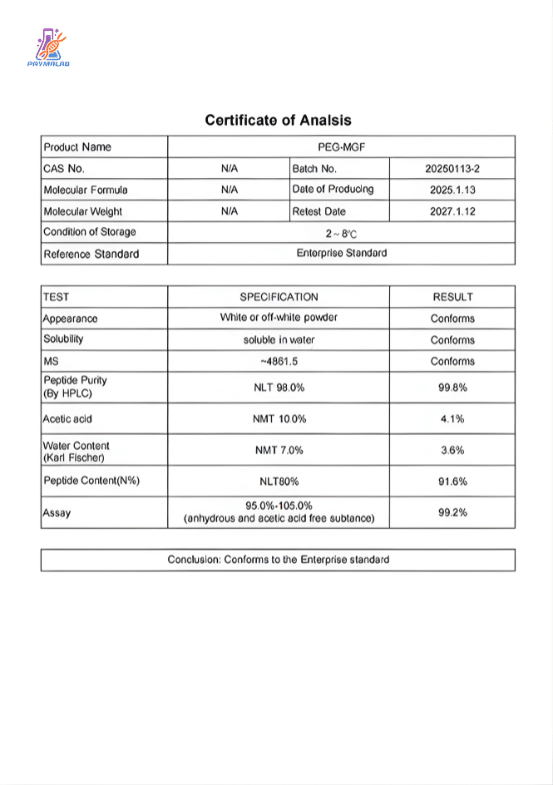
Every batch of MGF peptide undergoes rigorous testing to confirm 99% purity:
Independent laboratory testing validates MGF growth factor through:
All PrymaLab peptides, including MGF for sale, are manufactured in USA facilities following:
MGF peptide is stored and shipped under best conditions:
Each vial contains precisely 2mg of MGF peptide:
Orders are processed quickly with:
PrymaLab provides knowledgeable customer support:
Each MGF peptide order includes:
MGF for sale at PrymaLab offers:
Researchers who buy MGF peptide from PrymaLab have access to a complete portfolio of research peptides:
Proper storage ensures MGF peptide keeps its potency, shelf life, and research-grade quality:
Unopened vials of MGF growth factor in freeze-dried form:
Once mixed with sterile water, MGF peptide:
When working with mechano growth factor:
For best MGF peptide mixing:
To keep MGF growth factor quality throughout research:
Researchers ready to buy MGF peptide for muscle growth, satellite cell start, or muscle repair research can order with confidence from PrymaLab. Each vial contains 2mg of pharmaceutical-grade mechano growth factor with 99% purity, third-party testing, and full quality records.
MGF peptide represents a unique muscle-specific growth factor that operates through local satellite cell start mechanisms distinct from systemic growth factors. Whether conducting muscle hypertrophy research, satellite cell biology studies, muscle repair studies, or mechanotransduction research, MGF growth factor provides a specialized tool for grasp muscle-intrinsic growth and adaptation mechanisms backed by extensive scientific literature.
The bio peptide MGF offers researchers insights into local growth factor signaling, satellite cell biology, and muscle-specific adaptation that complement but differ from systemic growth factors like IGF-1. For researchers seeking growth factor for sale with muscle-specific properties, MGF for sale at PrymaLab provides pharmaceutical-grade quality with verified purity and full records.
Whether researchers choose to buy MGF in its native form for authentic natural studies or buy PEG-MGF for practical extended-activity research, PrymaLab provides the highest quality MGF peptide for sale available. Combined with PrymaLab’s USA manufacturing, expert support, and complete research peptide portfolio including growth hormone secretagogues and GHRH analogs, researchers get full support for their muscle growth and repair research.
Order your MGF 2mg peptide today and experience the PrymaLab difference: pharmaceutical-grade purity, authentic mechano growth factor, full quality records, fast shipping, and expert support for your research success.
IMPORTANT NOTICE:
For Research Use Only: This MGF (Mechano Growth Factor) 2mg peptide is intended strictly for laboratory research purposes only. It is not intended for human consumption, medical use, or any diagnostic or treatment uses.
Not for Human Use: MGF 2mg peptide is not approved by the FDA for human use. It is not a medication, supplement, or food product. Any discussion of research findings or possible uses refers solely to laboratory and scientific research contexts.
Professional Use Only: This product should only be handled by qualified researchers in appropriate laboratory settings with proper safety equipment and protocols.
Age Restriction: Buy is restricted to people 21 years of age or older for legitimate research purposes only.
No Medical Claims: No statements on this page should be construed as medical advice or claims about treating, preventing, or curing any disease or medical condition. All data is provided for research and educational purposes only.
Consult Professionals: Researchers should consult with qualified professionals about proper handling, storage, and research protocols for peptide compounds.
Legal Compliance: Purchasers are responsible for ensuring their research activities comply with all applicable local, state, and federal regulations.
By buying MGF 2mg peptide, you acknowledge that you are a qualified researcher and agree to use this product only for legitimate research purposes in accordance with all applicable laws and regulations.
Product Name: MGF (Mechano Growth Factor) 2mg Chemical Name: Mechano Growth Factor Other Names: MGF, IGF-1Ec Sequence: IGF-1 with C-terminal E-peptide extension (24 amino acids) Cell-level Formula: C121H200N42O39 Cell-level Weight: ~2,888 Da (approximate, includes E-peptide) Purity: ≥99% (HPLC) Form: Freeze-dried powder Vial Size: 2mg per vial Storage: 2-8°C (refrigerated), protect from light Shelf Life: 24 months (freeze-dried), 7-14 days (mixed, native MGF) Solubility: Soluble in sterile water Manufacturing: USA, GMP facilities Testing: Third-party verified (HPLC, MS)
Researchers interested in MGF peptide may also consider:
Q: What makes MGF peptide different from IGF-1? A: MGF is a splice variant of the IGF-1 gene that is produced locally in muscle tissue in response to mechanical stress, while mature IGF-1 is produced systemically (mainly in the liver) in response to growth hormone. MGF acts locally to start satellite cells, while IGF-1 circulates systemically producing widespread anabolic effects. MGF contains a unique C-terminal E-peptide that gives it muscle-specific properties.
Q: Should I choose native MGF or PEG-MGF for my research? A: For most practical research uses, PEG-MGF offers major benefits due to its extended half-life (hours vs minutes), improved shelf life, and practical dosing schedules. Native MGF is most appropriate for studies needing authentic MGF biology or studying acute, localized effects. PEG-MGF is recommended for sustained activity research protocols.
Q: How does MGF start satellite cells? A: MGF binds to receptors on satellite cells (likely IGF-1 receptors), triggering them to exit their quiescent state and enter the cell cycle. Started satellite cells proliferate, producing a population of muscle stem cells that differentiate into myoblasts and fuse with existing muscle fibers or form new fibers, supporting muscle growth and repair.
Q: Can MGF peptide be combined with growth hormone secretagogues? A: Yes, MGF can be combined with growth hormone secretagogues like Ipamorelin, GHRP-6, GHRP-2, or Hexarelin for paired effects. MGF provides local satellite cell start while GH secretagogues produce systemic GH rise and IGF-1 production, possibly creating combined effects on muscle growth and repair.
Q: What is the difference between MGF and PEG-MGF? A: Native MGF has a very short half-life (minutes) and acts locally, while PEG-MGF (pegylated MGF) has an extended half-life (hours) due to polyethylene glycol change. PEG-MGF offers improved shelf life, practical dosing schedules, and sustained activity, making it more suitable for most research uses.
Q: How should MGF peptide be stored? A: Store freeze-dried MGF at 2-8°C (refrigerated) protected from light. Once mixed with sterile water, store at 2-8°C and use within 7-14 days for native MGF (PEG-MGF may be stable longer). Do not freeze mixed solutions. Long-term storage of freeze-dried powder can be at -20°C.
Q: What purity level does PrymaLab’s MGF peptide have? A: PrymaLab’s MGF 2mg peptide is pharmaceutical-grade with ≥99% purity, verified through third-party testing using HPLC and mass spectrometry. Each batch includes a Certificate of Test (COA) documenting purity and quality.
Q: What research uses is MGF peptide best suited for? A: MGF is ideal for muscle growth and hypertrophy research, muscle repair and regrowth studies, satellite cell biology research, mechanotransduction studies, exercise adaptation research, muscle wasting condition studies, and any research needing muscle-specific local growth factor effects.
Q: How do I calculate the correct dose for my research? A: Use PrymaLab’s Peptide Calculator for accurate dosing calculations. Input your vial size (2mg), mixing volume, and desired dose to calculate the exact injection volume needed. Research literature suggests doses ranging from 100-500 mcg per use, though best doses vary by research model.
Q: Is MGF the same as IGF-1? A: No, MGF is a splice variant of the IGF-1 gene, not mature IGF-1. While they share some sequence similarity, MGF contains a unique 24-amino acid C-terminal E-peptide that gives it distinct properties. MGF is produced locally in muscle tissue in response to mechanical stress and acts mainly on satellite cells, while mature IGF-1 is produced systemically and has widespread effects throughout the body.
| Weight | 0.1 lbs |
|---|---|
| Dimensions | N/A |
Only logged in customers who have purchased this product may leave a review.

support@prymalab.net info@prymalab.net

30 Day return window. Satisfaction guaranteed or your money back.

All orders over %150 in value will receive free shipping.
1 review for PEG-MGF (Mechano Growth Factor) 2mg