Description
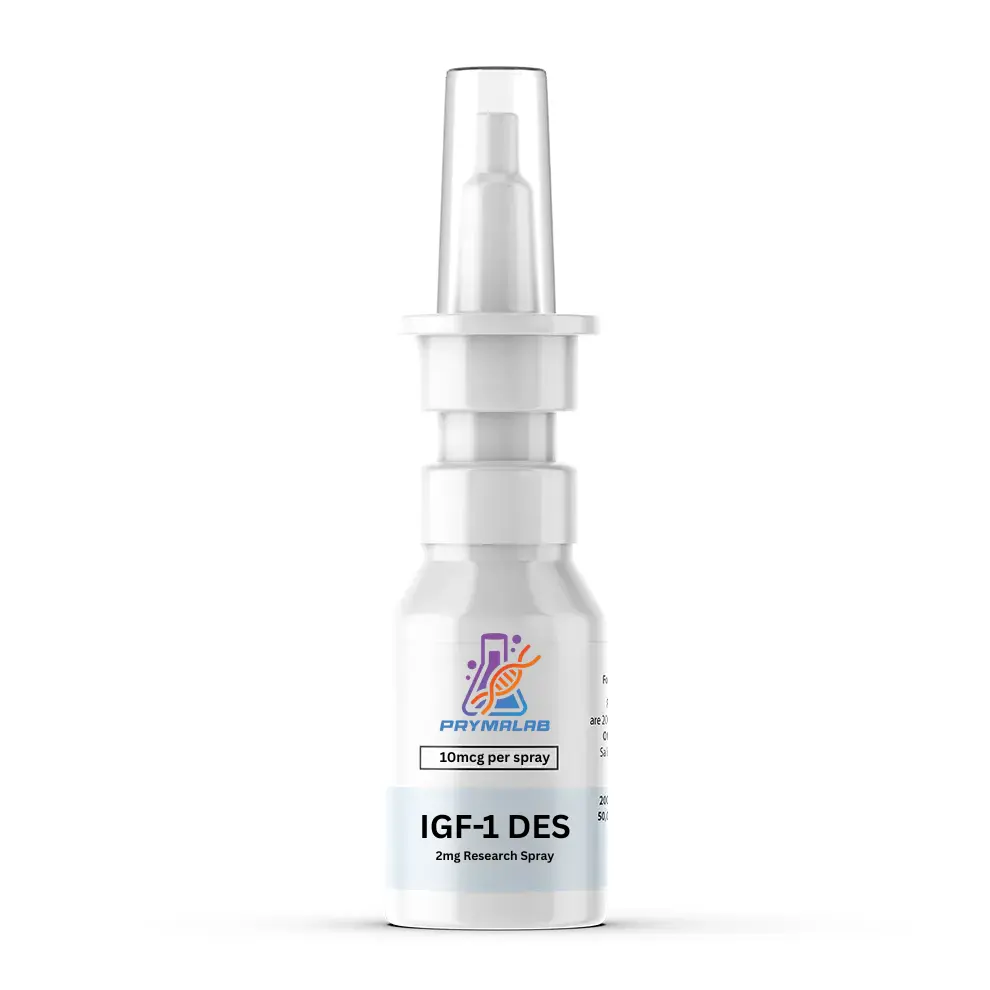
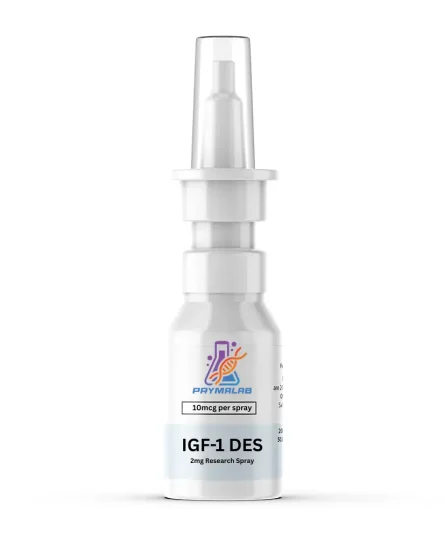
This IGF-1 DES nasal spray supplies DES(1-3) IGF-1, an analog of human insulin-like growth factor 1 with the first three N-terminal residues removed. Native IGF-1 begins Gly-Pro-Glu; this form begins at residue four, giving 67 amino acids against the native 70. Molecular formula C319H501N91O96S7, molecular weight 7371.48 Da, CAS 112603-35-7. It is catalogued variously as DES(1-3) IGF-1, as insulin-like growth factor-1 des(1-3), and as an IGF-1 DES nasal spray, and this synthetic peptide is the counterpart to the other common analog, insulin-like growth factor-1 long R3, sold as the IGF-1 LR3 peptide or an IGF-1 LR3 nasal spray. Three residues is a small edit, and it produces two consequences that are worth understanding separately: what it does to the growth factor, and what the deleted fragment turns out to be on its own. Supplied for laboratory research use only.
Deleting the handle the binding proteins hold
IGF-1 in circulation is almost entirely bound to the six IGF binding proteins rather than free. Those proteins control availability, and any attempt to work with IGF-1 runs into the fact that the concentration added is not the concentration that reaches a receptor.
The N-terminal tripeptide Gly-Pro-Glu is a major part of the surface the binding proteins recognize. Remove it and their grip largely fails. DES(1-3) IGF-1 shows considerably reduced affinity for IGFBPs as a direct result, and reports place its in-vivo potency at roughly ten-fold that of native IGF-1.
That ten-fold figure deserves care. It is not a ten-fold increase in receptor affinity. Removing three residues at the N-terminus does not improve how the molecule engages IGF-1R. What it does is stop the growth factor being sequestered, so far more of it stays free and reaches receptors. The observed potency difference is an availability effect, and it should be described that way rather than as a more powerful agonist.
Set against Long R3 IGF-1, the design contrast is neat. LR3 adds a 13-residue extension and a charge substitution to obstruct binding protein access, building a shield around the interface. DES deletes part of the interface itself. Two opposite solutions to the same problem, and either can be the right choice depending on whether your question is better served by a molecule that is larger than native IGF-1 or smaller.
The fragment that was deleted is itself a research compound
This is the part of the DES story that almost nobody selling it mentions, and it is genuinely interesting.
Gly-Pro-Glu, the tripeptide removed to make DES, is not biological waste. It is cleaved from IGF-1 endogenously in the brain, and under the name GPE, also called Glypromate, it has been studied in its own right as a neuroprotective agent. Work in the quinolinic acid lesion model of Huntington’s disease reported that the IGF-1 amino-terminal tripeptide GPE is neuroprotective to striatum, and a body of medicinal chemistry followed, generating analogues designed for better stability and bioavailability.
The best known of those is NNZ-2566, produced by alpha-methylation of the proline, which improved elimination half-life and oral bioavailability over the parent tripeptide. It was evaluated in brain injury models, including reports that NNZ-2566 improves functional recovery and attenuates apoptosis and inflammation in a rat model of penetrating ballistic-type brain injury, with related work on inhibition of neuroinflammation and pro-inflammatory cytokine expression in the same model.
So the cleavage of IGF-1 into DES(1-3) and GPE produces two biologically active species, not one active molecule and one offcut. For a researcher this raises a question that is rarely asked: in a tissue where this processing occurs naturally, are observed effects attributable to the truncated growth factor, to the liberated tripeptide, or to both acting together? Working with purified DES isolates one arm of that pair, which is a strength of the reagent and also a reason not to treat DES results as a complete account of what endogenous processing does.
Naturally occurring, which matters for interpretation
DES(1-3) IGF-1 is not purely a laboratory construct. It is generated endogenously by local proteolytic processing, and has been identified in tissue environments including brain and gastrointestinal tract, as well as in fetal tissue and serum fractions. Bovine colostrum is another reported source.
That distinguishes it from Long R3 IGF-1, whose N-terminal extension has no counterpart in human physiology. If your research question concerns a species that actually exists in tissue, DES is the physiologically relevant analog and LR3 is not. If your question is purely about maximizing free growth factor availability in an experimental system, either will serve and the choice becomes practical.
The receptor, and the claims built on top of it
DES(1-3) IGF-1 acts at the same target as the native protein: the IGF-1 receptors, written IGF-1R, a receptor tyrosine kinase whose principal route is PI3K/AKT. Downstream that supports cell proliferation and, in some tissues, hyperplasia, alongside protein synthesis, collagen synthesis, angiogenesis and cellular regeneration. Sustained exposure to any receptor agonist raises the possibility of receptor downregulation, which is worth designing for in longer experiments.
Upstream of all of it sits growth hormone, written HGH in most consumer material, which drives hepatic output of natural IGF-1 and produces the anabolic signaling the whole category is built on. IGF-1 also influences insulin sensitivity, which is part of why its analogs behave differently from a simple growth factor.
That biology is the foundation for a large amount of consumer writing. Bodybuilders and bodybuilding forums discuss this analog in terms of muscle growth, muscle mass and muscle development, muscle hypertrophy and simple hypertrophy, muscle repair, muscle recovery and shorter recovery time, muscle density, tissue repair, fat metabolism, anti-aging and neuroprotection, with stacking strategies pairing it against CJC-1295, ipamorelin, tesamorelin, other GH secretagogues or BPC-157, and a durable myth about body part specialization from local administration. Water retention appears among reported effects. Some of that starts from real receptor biology and all of it ends well past what the evidence supports for a modified analog. None of those outcomes is established for research material or claimed here.
Two safety and compliance points belong on this page. IGF-1 and its analogs are prohibited in sport at all times under the WADA list. And because IGF-1 has appreciable activity at the insulin receptor, hypoglycemia is the recognised hazard for this family, which makes systemic effects a genuine concern rather than a theoretical one. Discussion of dosing, oral administration, subcutaneous injection, an intranasal delivery method or any other delivery method framed as a non-invasive method describes a use this material is not supplied for, and peptide therapy is a clinical term that does not apply to a research chemical. Claims that the nasal cavity and nasal mucosa offer a shortcut for a seven-kilodalton folded protein are not established.
The serum-free caveat applies here too
The same design logic that makes DES useful also constrains where its advantage shows up. Its distinguishing feature is reduced IGFBP binding. In a serum-free culture there are essentially no IGF binding proteins, because they come from serum, so the feature has nothing to act against.
A comparison of native IGF-1 against DES in serum-free medium therefore tests two molecules whose meaningful difference has been removed from the system, and any gap you measure is more likely to reflect differences in specific activity or preparation than the ten-fold availability effect reported in vivo. Serum-containing medium is where the difference should appear, with the caveat that serum IGFBP content varies between lots, so fixing the serum lot across a study is what keeps the comparison honest. Adding defined recombinant IGFBP to a serum-free system is the more controlled alternative for intranasal IGF-1 DES research and cell work where the binding protein variable needs to be deliberate rather than inherited.
IGF-1 DES nasal spray specifications
| Compound |
DES(1-3) IGF-1, truncated analog of human IGF-1 |
| Length |
67 amino acids (native IGF-1 is 70) |
| Modification |
Deletion of N-terminal Gly-Pro-Glu |
| Purpose |
Removes a major part of the IGF binding protein recognition surface |
| Reported potency |
Approximately ten-fold that of native IGF-1 in vivo, via availability rather than receptor affinity |
| Molecular formula |
C319H501N91O96S7 |
| Molecular weight |
7371.48 Da |
| CAS number |
112603-35-7 |
| Natural occurrence |
Generated by local proteolytic processing; reported in brain, gastrointestinal tract, fetal tissue |
| Deleted fragment |
Gly-Pro-Glu (GPE / Glypromate), itself a studied neuroprotective compound |
| Structural class |
Folded protein with three disulfide bonds, not a linear peptide |
| Primary receptor |
IGF-1R; cross-reactivity at insulin receptor and hybrid receptors |
| Format |
Metered spray bottle [CONFIRM: fill volume, mg per bottle, concentration] |
| Classification |
Research chemical. In-vitro laboratory use only. Not for human or veterinary use. |
Receptor specificity, and the control that settles it
IGF-1R is a receptor tyrosine kinase closely related to the insulin receptor, and the two form hybrid receptors combining one half of each. IGF-1 has measurable affinity for the insulin receptor and insulin for IGF-1R, so in any cell expressing both, and most do, a response to added growth factor cannot be assigned to IGF-1R on that basis alone.
Downstream the signalling runs through PI3K/AKT and MAPK/ERK, which is why phospho-AKT and phospho-ERK are the near-universal readouts. Those readouts do not distinguish which receptor produced them. A selective IGF-1R inhibitor or blocking antibody does, and confirming receptor expression in your specific line rather than trusting a catalogue description is the other half of the job.
Verification for a folded protein
DES(1-3) IGF-1 is a 67-residue protein with three disulfide bonds, produced recombinantly, and its activity depends on tertiary structure. That changes what a certificate of analysis can tell you.
Mass spectrometry confirms size and composition and says nothing about folding, because a disulfide-scrambled preparation has essentially the same mass while being inactive. Reversed-phase HPLC can resolve some misfolded species by their exposed surfaces, so the chromatographic method matters beyond the number it produces. Recombinant production also brings host cell protein, host DNA and endotoxin as realistic contaminants, and endotoxin is the one that will quietly ruin an experiment with an inflammatory or immune readout.
For a research grade IGF-1 DES spray, the questions worth asking are therefore what expression system was used, what the endotoxin result is, and whether any functional confirmation exists. A bioassay such as phospho-AKT induction in a responsive line is the only measurement that demonstrates the protein is folded and active. That standard is what separates usable preclinical research from peptide science conducted on an unverified reagent. This material is supplied under the analytical verification PrymaLab applies across its research compounds, with independent third-party testing. No specific lot figures are asserted here; request the certificate of analysis for the lot you receive.
IGF-1 DES nasal spray storage and handling
Protein handling rules apply, and they are stricter than for short peptides. [CONFIRM: whether this SKU ships pre-filled in solution or as lyophilized material with an applicator.]
Freeze-thaw cycles risk partial unfolding and aggregation, and aggregated protein is inactive and capable of producing misleading results rather than none, so single-use aliquots are essential rather than advisable. Adsorption to plasticware is significant at the low nanomolar concentrations growth factor work uses, so low-binding surfaces and a carrier protein such as 0.1 percent bovine serum albumin are standard where the assay tolerates it.
If your material arrives lyophilized, reconstitution with bacteriostatic water is the usual step, and reconstituted peptides should be aliquoted immediately rather than stored as a single working stock. The three disulfide bonds mean no reducing agents: dithiothreitol, beta-mercaptoethanol and TCEP will unfold the protein irreversibly. Avoid vigorous agitation and prolonged room-temperature exposure, since shear and air-liquid interfaces drive protein aggregation in ways they do not affect short peptides. Sound IGF-1 DES nasal spray storage otherwise means cold, sealed and out of light.
For related growth factor research, see the PrymaLab Research Library.
Frequently asked questions
What is IGF-1 DES?
DES(1-3) IGF-1 is a 67-residue analog of human IGF-1 lacking the N-terminal tripeptide Gly-Pro-Glu (CAS 112603-35-7, 7371.48 Da). The deletion sharply reduces IGF binding protein affinity. Material supplied here is a research chemical for in-vitro laboratory use only.
Why is DES reported as more potent than IGF-1?
Because it evades IGF binding proteins rather than because it binds the receptor better. Reports place in-vivo potency at roughly ten-fold that of native IGF-1, and that difference reflects greater free availability, not improved receptor engagement.
What happens to the removed tripeptide?
Gly-Pro-Glu is itself biologically active. Cleaved from IGF-1 endogenously in the brain and known as GPE or Glypromate, it has been studied as a neuroprotective agent, and the analogue NNZ-2566 was developed from it with improved half-life and oral bioavailability.
How does DES differ from IGF-1 LR3?
They solve the same problem in opposite directions. LR3 adds a 13-residue extension and a position 3 substitution to block binding protein access. DES deletes part of the binding interface. DES also occurs naturally in tissue, while LR3’s extension has no physiological counterpart.
Is IGF-1 DES nasal spray approved for human use?
No. This material is a research chemical for in-vitro laboratory use only, is not an approved drug, and is not intended for human or veterinary use. Nothing here is medical advice.
Ordering and compliance
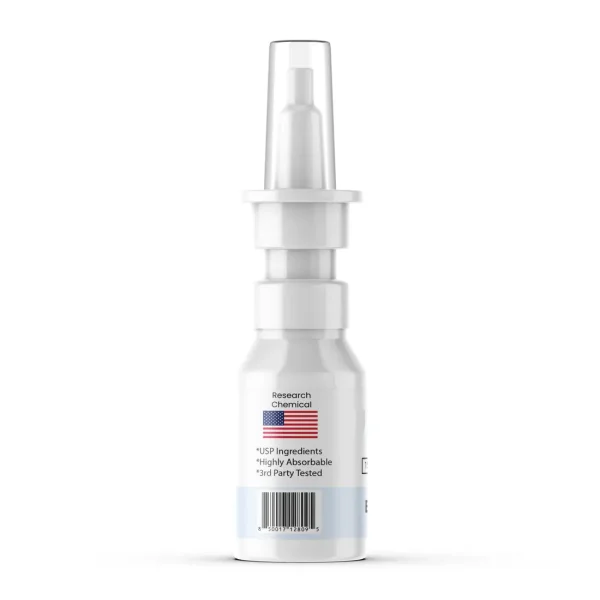
Every PrymaLab research compound ships from the United States and is sold research-use-only. This IGF-1 DES nasal spray is supplied for in-vitro laboratory research, is not intended for human or veterinary use, is not a drug, supplement or sports product, and has not been evaluated by the FDA for the research-chemical context. Verify the legal status of any research compound in your jurisdiction before ordering. Certificates of analysis are available on request for the lot you receive.












6 reviews for IGF-1 DES Nasal Spray