
Description
PrymaLab · Research use only
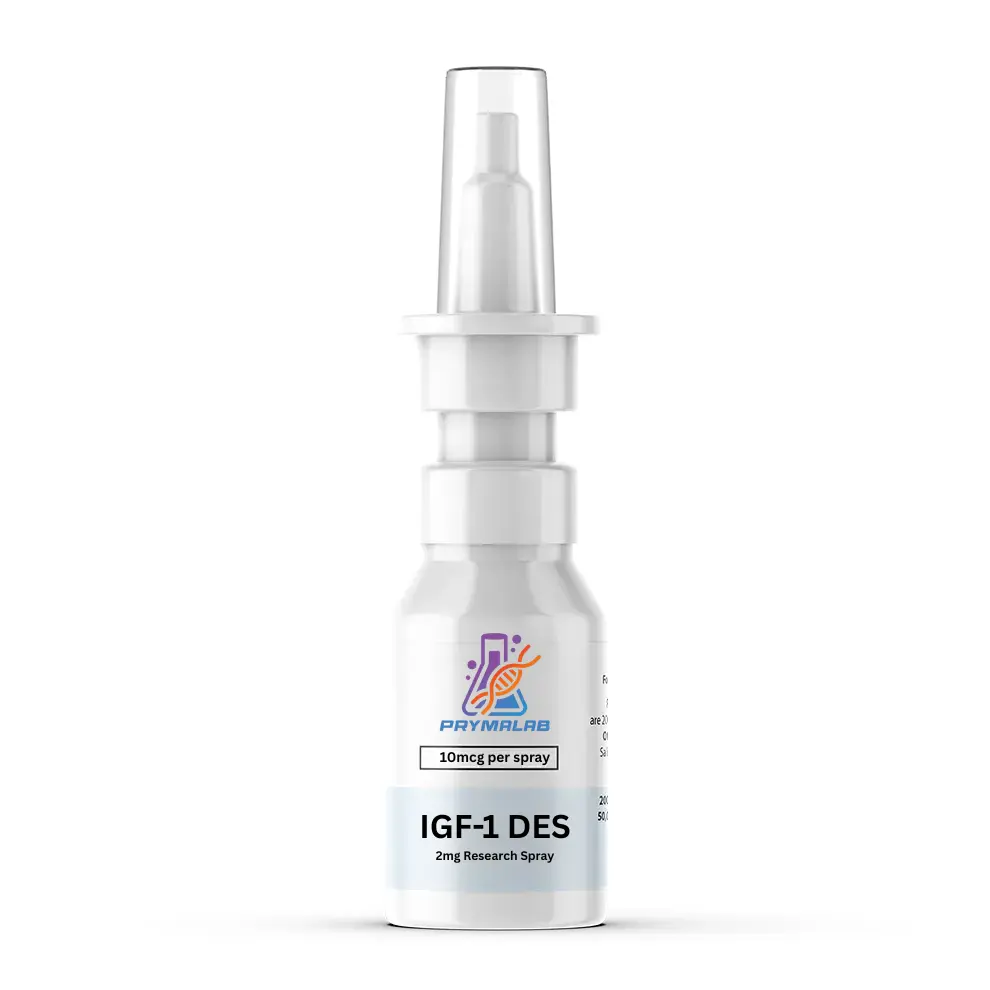
IGF-1 DES Nasal Spray
Des(1-3)IGF-1 as a sterile solution in a metered nasal spray bottle
IGF-1 DES is des(1-3)IGF-1: the human IGF-1 sequence without its N-terminal Gly-Pro-Glu, 67 residues folded around three disulfides. This listing supplies it as a sterile solution in bacteriostatic water in a metered nasal spray bottle; the label gives the amount and concentration. Research on the truncated protein covers its binding-protein behaviour and potency in cells and rats, and the removed tripeptide has been studied separately in brain tissue.
Specifications
| Property | Value |
|---|---|
| Compound | IGF-1 DES(1-3) Des(1-3)-IGF-1; recombinant human IGF-1 lacking the N-terminal Gly-Pro-Glu |
| CAS number | 112603-35-7 |
| Molecular formula | C 319 H 501 N 91 O 96 S 7 (reduced-chain calculation) |
| Theoretical mass | 7371.5 Da (reduced-chain calculation; 7365.4 Da with the three disulfides formed) |
| Sequence / structure | H-TLCGAELVDALQFVCGDRGFYFNKPTGYGSSSRRAPQTGIVDECCFRSCDLRRLEMYCAPLKPAKSA-OH (67 residues; three intrachain disulfides; free N- and C-termini) |
| Form | Sterile aqueous solution in bacteriostatic water (0.9% benzyl alcohol), supplied in a metered nasal spray bottle |
| Storage, sealed | Store at 2–8 °C, protected from light; do not freeze |
| Safety data sheet | PL-SDS-086 |
What is in the bottle
The bottle holds IGF-1 DES dissolved in bacteriostatic water with 0.9% benzyl alcohol. Its amount and concentration are printed on the label; the safety data sheet records them only as labelled, under 10% w/v. Benzyl alcohol is the hazardous component, harmful if swallowed or inhaled, irritating to the eyes and able to sensitise skin, and the protein itself is not classified. Store the bottle upright with its cap on at 2 to 8 °C, shielded from light and never frozen. When a laboratory needs a stated mass of protein to work from, the IGF-DES 2 mg vial supplies it freeze-dried; peptide storage and stability covers solutions in general.
What the research covers
Removing Gly-Pro-Glu from IGF-1 changes how the protein meets the IGF-binding proteins more than how it meets its receptor. Bagley and colleagues compared IGF-1 with versions truncated by one to five residues and found des(1-3) the most potent in L6 myoblasts, with receptor competition at 3 °C close to that of IGF-11. A binding protein secreted by the myoblasts recognised the three longest peptides at least 60-fold better than the shorter ones, which accounted for the gain in potency1. Binding proteins of this kind sequester IGFs away from the type I IGF receptor, though proteolysis or association with cells and matrix can change that2.
The missing tripeptide has its own literature. Sara and colleagues reported a truncated IGF-1 lacking GPE in human brain; GPE made synthetically blocked glutamate binding at NMDA receptors and strongly increased potassium-evoked acetylcholine release in slices of rat cortex3. That work concerns GPE, which this product does not contain, and none of the references studied IGF-1 DES delivered through the nose. The IGF-1 LR3 guide compares the IGF-1 analogues in more depth.
How each lot is tested
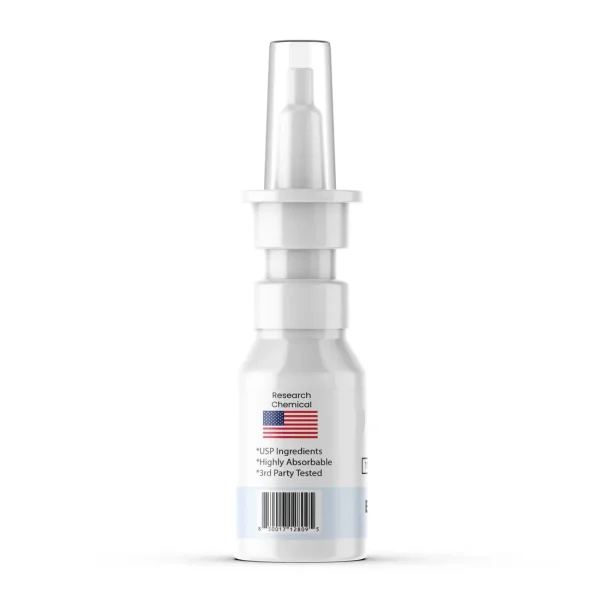
Every lot is tested in PrymaLab’s own laboratory in Ashland, Kentucky before release: RP-HPLC for purity, LC-MS for identity, Karl Fischer titration for water, LAL for endotoxin and USP <71> for sterility. Published certificates are listed on the results page and can be checked by number and key on the verify page. The certificate covers the peptide lot used to fill the bottle, not the finished solution. These are in-house results from PrymaLab Analytical, not an independent test, and the lab is not accredited to ISO 17025. The third-party testing guarantee on this page still applies: if any independent laboratory finds the wrong compound, or less than the stated purity or amount, the order is refunded and the cost of the test is reimbursed.
Frequently asked questions
How much IGF-1 DES does the bottle contain?
The amount and concentration are on the bottle label; the safety data sheet lists them as labelled, below 10% w/v. For a fixed starting mass of dry protein, the 2 mg vial is the format whose fill is stated on its certificate.
Has IGF-1 DES been studied as a nasal spray?
Not in any study cited here. The research used cultured cells, rat plasma and whole rats, and the brain studies concerned the GPE tripeptide that IGF-1 DES lacks, so nothing published here describes this format.
Does the spray contain GPE?
No. GPE is the Gly-Pro-Glu tripeptide removed to make des(1-3)IGF-1, and it has been studied separately as a neuroactive peptide. The spray contains the 67-residue protein that remains after that cut.
Is the spray for human use?
No. It is sold for laboratory research only and is not approved by any regulator for human or veterinary use. It must not be given to people or animals.
References
- Bagley CJ, May BL, Szabo L, et al. A key functional role for the insulin-like growth factor 1 N-terminal pentapeptide. Biochem J. 1989;259(3):665-71. DOI · PubMed
- Firth SM, Baxter RC. Cellular actions of the insulin-like growth factor binding proteins. Endocr Rev. 2002;23(6):824-54. DOI · PubMed
- Sara VR, Carlsson-Skwirut C, Bergman T, et al. Identification of Gly-Pro-Glu (GPE), the aminoterminal tripeptide of insulin-like growth factor 1 which is truncated in brain, as a novel neuroactive peptide. Biochem Biophys Res Commun. 1989;165(2):766-71. DOI · PubMed
Research use only
For laboratory research use only. IGF-1 DES Nasal Spray is not a drug, food, cosmetic or dietary supplement, is not approved by the FDA or any comparable authority for human or veterinary use, and must not be given to people or animals. It is sold to qualified researchers and institutions, and the buyer is responsible for lawful handling and disposal.
Other formats of IGF-1 DES
IGF-1 DES is also stocked as IGF-DES 1mg/ml preloaded 3ml pen, IGF1 LR3 1MG, IGF1 LR3 1mg/ml preloaded 3ml pen and IGF-1 LR3 Nasal Spray. Each listing states its own quantity and concentration, and the pen and vial comparison explains what changes between formats.







Reviews
There are no reviews yet.