CJC-1295 + Ipamorelin blend: why they are combined, DAC vs no-DAC, and research
CJC-1295 and Ipamorelin blend is a two-peptide combination: CJC-1295, a 29-amino-acid GHRH(1-29) analogue with four amino-acid substitutions, paired with Ipamorelin, a pentapeptide growth hormone secretagogue that activates the ghrelin receptor, studied together in research on pulsatile GH release. PrymaLab supplies it as a CJC-1295 (no DAC), Ipamorelin 10mg (Blend) vial and a preloaded 15mg 3ml pen for research use.
- Size: CJC-1295 is 29 residues (GHRH 1-29 with D-Ala2, Gln8, Ala15, Leu27); Ipamorelin is a pentapeptide of about 712 Da.
- Class: GHRH-receptor agonist (CJC-1295) paired with a GHS-R1a ghrelin-receptor agonist (Ipamorelin); both act on pituitary somatotrophs.
- Studied for: pulsatile GH and IGF-I release, secretagogue selectivity, longitudinal bone growth in rats, postoperative ileus in humans.
- Studies in the literature: CJC-1295 DAC single-dose trials in healthy adults (Teichman 2006, Ionescu and Frohman 2006); Ipamorelin potency and selectivity in rats and swine (Raun 1998).
- Half-lives reported: CJC-1295 DAC 5.8 to 8.1 days in healthy adults (Teichman 2006); Ipamorelin terminal half-life about 2 hours in human volunteers (Gobburu 1999). No human half-life for the no-DAC form has been published.
- Storage: lyophilized vials at -20°C long term or 2 to 8°C short term; reconstituted solution refrigerated and used within weeks.
- Forms and sizes at PrymaLab: blend vial 10mg, blend pen 15mg, CJC-1295 (NO DAC) 5MG and 10MG, Ipamorelin 5mg and 10mg, Ipamorelin 10mg Nasal Spray.
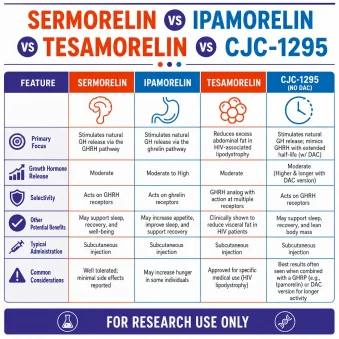
Concentrations for either format can be checked with the peptide reconstitution calculator. For how these two compounds compare with sermorelin and tesamorelin, see the Sermorelin vs Ipamorelin vs Tesamorelin vs CJC-1295 guide.
Why the two are combined
Growth hormone leaves the pituitary in pulses, and two hypothalamic peptides set the rhythm: growth-hormone-releasing hormone (GHRH) opens each pulse and somatostatin closes it. A third input entered the literature by a roundabout route. Bowers and colleagues built GHRP-6, a synthetic hexapeptide that released GH from rat pituitary cells and in live animals (Endocrinology, 1984), a decade before anyone knew what it bound to. Howard et al. cloned the receptor in 1996 and named it GHS-R1a, and Kojima et al. isolated its natural ligand, ghrelin, from rat stomach in 1999. Ipamorelin belongs to this second family; CJC-1295 belongs to the GHRH family.
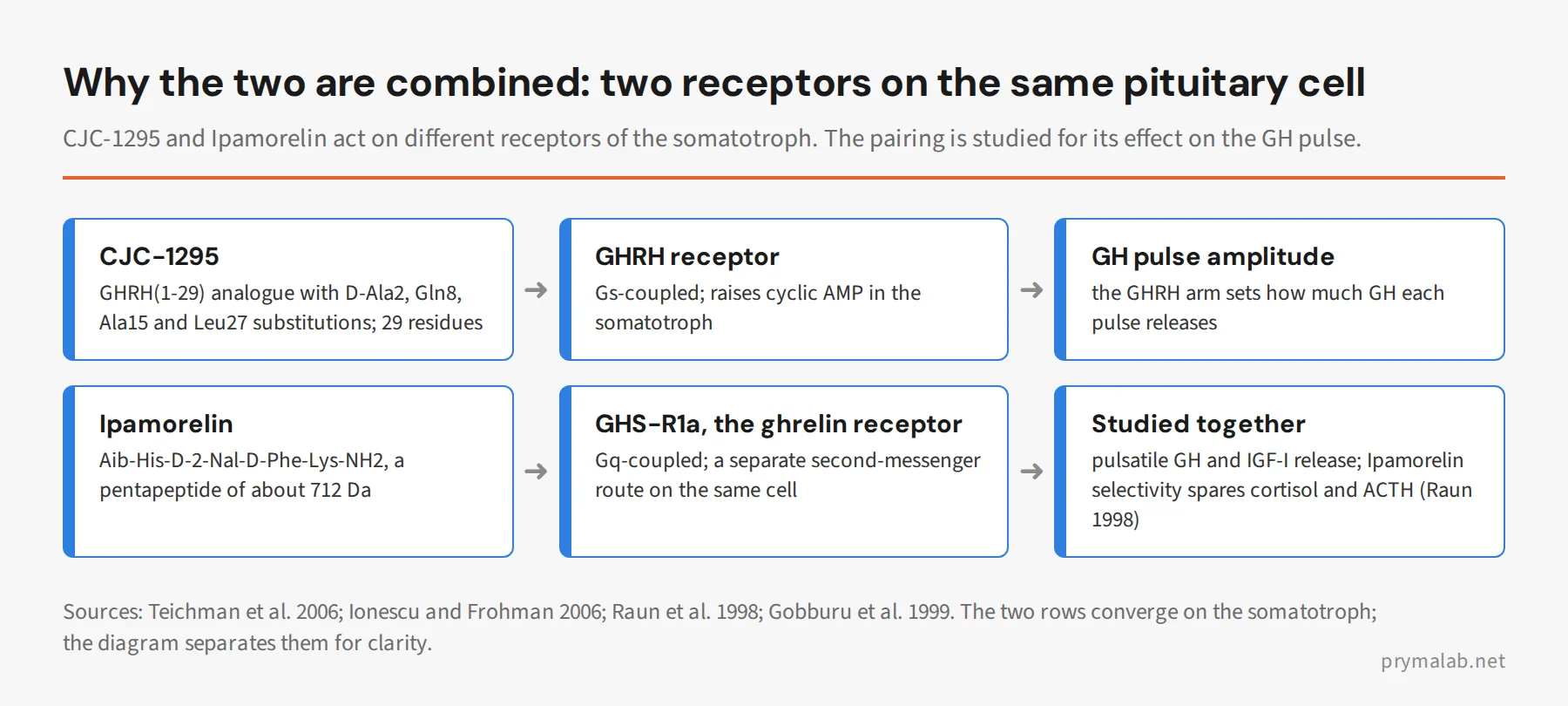
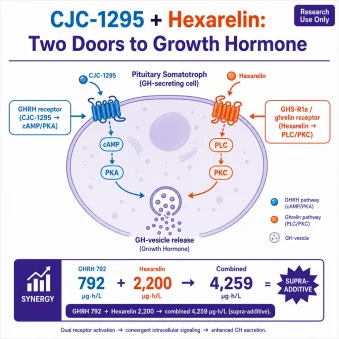
The two receptors sit on the same somatotroph and signal through different second messengers. The GHRH receptor is a class B G-protein-coupled receptor linked to Gs: activation raises cyclic AMP, switches on protein kinase A, and drives both GH gene transcription and release of stored GH. GHS-R1a is a class A receptor linked to Gq: activation turns on phospholipase C, generates inositol trisphosphate, and raises intracellular calcium, which triggers exocytosis of GH granules. Cyclic AMP and calcium converge on the same secretory machinery from different directions, and that convergence is the basis for pairing a compound from each class.
The synergy was measured before the receptor was cloned. In rat primary pituitary cell culture, Cheng et al. (Endocrinology, 1989) found that GHRP-6 and GRF at maximal concentrations together released more GH than either alone. GHRP-6 by itself did nothing to intracellular cyclic AMP, while GRF raised it about 3-fold, and the two together potentiated that GRF-driven rise. In normal men, Bowers et al. (JCEM, 1990) gave GHRP-6 and GHRH by intravenous bolus, alone and together; submaximal GHRP-6 doses combined with GHRH stimulated GH release synergistically. Hataya et al. (JCEM, 2001) repeated the experiment with ghrelin itself: at low doses that did little on their own, the combination with GHRH gave a mean GH response larger than the sum of the two separate responses.
A second reason runs the other way. Pandya et al. (JCEM, 1998) blocked endogenous GHRH in nine healthy men with a GHRH-receptor antagonist, and the peak GH response to a GHRP-6 bolus fell from 33.8 to 6.2 μg/L. A GHRP needs GHRH tone to work fully, so pairing it with a GHRH analogue removes the dependence on whatever GHRH the hypothalamus happens to be releasing at that moment. GHRPs are also reported to act on hypothalamic neurons, where they stimulate GHRH release and oppose somatostatin (Sigalos and Pastuszak, Sex Med Rev, 2018).
Why Ipamorelin rather than GHRP-6 or GHRP-2? Selectivity. Raun et al. (Eur J Endocrinol, 1998) compared the three in anaesthetised rats and conscious swine. All three released GH with comparable potency, but GHRP-6 and GHRP-2 also raised ACTH and cortisol, while Ipamorelin left ACTH and cortisol no higher than GHRH itself did, at doses more than 200-fold above its ED50 for GH release. In swine none of the secretagogues tested changed FSH, LH, prolactin or TSH. The paper's title calls it "the first selective growth hormone secretagogue".
Why the no-DAC form of CJC-1295? Timing. Ipamorelin's terminal half-life in human volunteers was about 2 hours (Gobburu et al., 1999), and the no-DAC form of CJC-1295 carries no albumin-binding group, so it is cleared on the timescale of the native peptide rather than over days. Both act inside a short window, so the pairing is expected to produce one amplified GH pulse before the axis returns to baseline. The DAC form delivers a GHRH signal that lasts for days, which is a different experimental question.
CJC-1295 with DAC vs without DAC
CJC-1295 began at ConjuChem in Montreal as an attempt to build a GRF(1-29) analogue that survived in circulation; Jetté et al. (Endocrinology, 2005) described the design. The first 29 residues of human GHRH carry the full receptor-binding activity, so the team started from GRF(1-29) and made four substitutions: D-alanine at position 2, which blocks cleavage by dipeptidyl peptidase IV; glutamine at position 8 in place of asparagine, which resists deamidation; alanine at position 15 in place of glycine, which stabilises the helix and improves receptor affinity; and leucine at position 27 in place of methionine, which resists oxidation. Jetté et al. measured the result indirectly: the derivatives resisted dipeptidyl peptidase IV in vitro, where native GHRH(1-29) does not. No human half-life for the unconjugated tetrasubstituted peptide has been published. The tetrasubstituted peptide is Mod GRF(1-29). Vendors label it "CJC-1295 no DAC", although strictly the CJC-1295 code was assigned to the conjugated version.
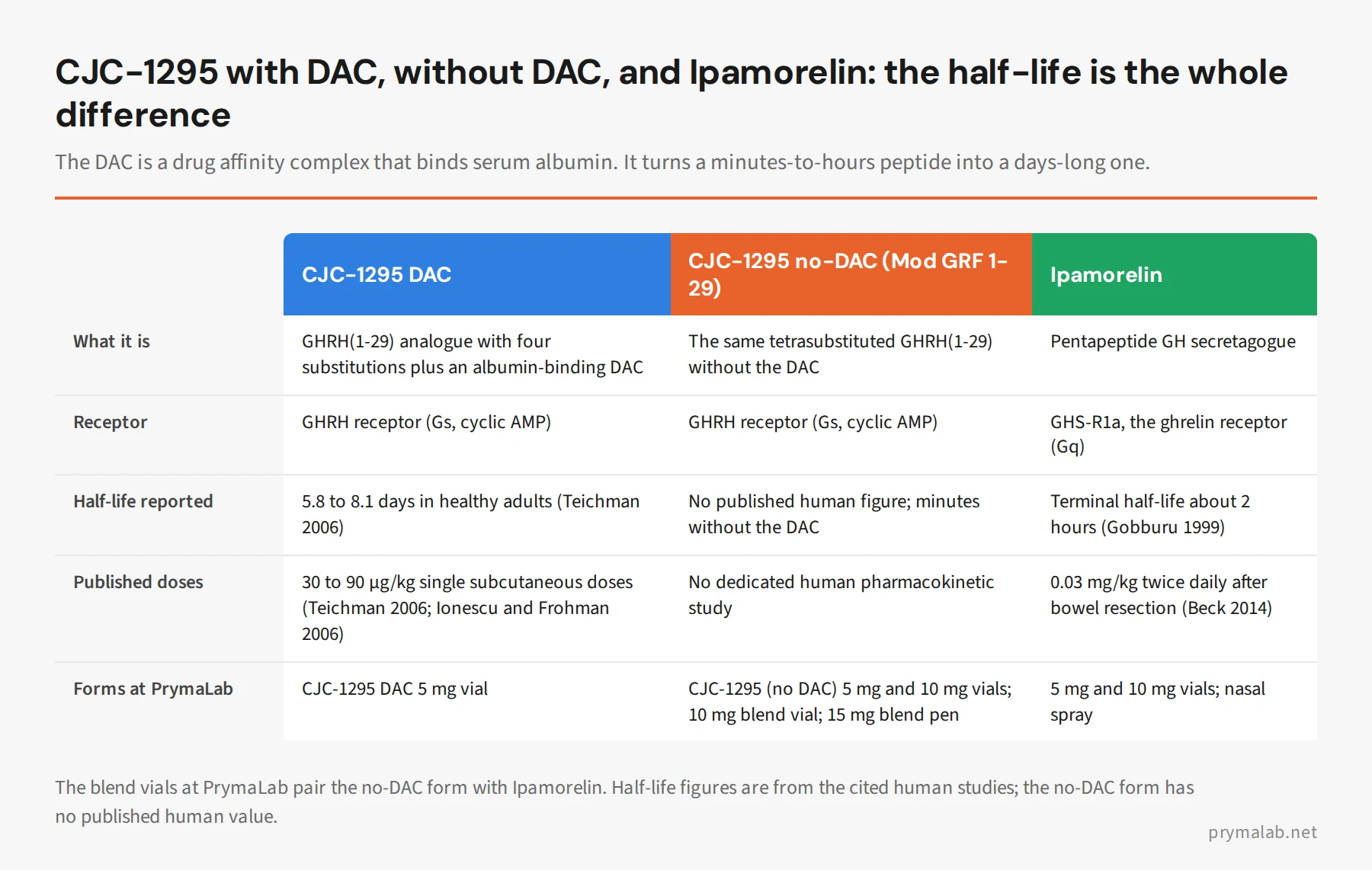
DAC stands for Drug Affinity Complex. A thirtieth residue, lysine, is added at the C-terminus, and its side chain carries a maleimidopropionic acid group. Maleimides react with free thiols, and the one free thiol on circulating serum albumin is cysteine 34. Within minutes of a subcutaneous injection, CJC-1295 DAC bonds covalently to albumin and from then on travels with it. Albumin is too large to pass the kidney filter and circulates for about three weeks, so the attached peptide is shielded from renal clearance and from peptidases. Jetté et al. showed that the conjugate still released GH from cultured rat anterior pituitary cells and raised plasma GH after subcutaneous injection in rats, with about 4 times the GH area under the curve of hGRF(1-29) over 2 hours. A Western blot put CJC-1295 on the albumin band from 15 minutes and beyond 24 hours, and the compound was still measurable in plasma past 72 hours.
Teichman et al. (JCEM, 2006) measured the result in healthy adults: single subcutaneous doses gave an estimated half-life of 5.8 to 8.1 days, with mean plasma GH raised 2- to 10-fold for 6 days or more and IGF-I raised 1.5- to 3-fold for 9 to 11 days after one injection. Ionescu and Frohman (JCEM, 2006) sampled GH every 20 minutes overnight in healthy men aged 20 to 40, before and a week after a single dose, and found GH still released in pulses: the frequency and the magnitude of the pulses were unchanged, while trough GH rose 7.5-fold, mean GH by 46 percent and IGF-I by 45 percent. That is the study usually cited to argue that a long-acting GHRH analogue does not flatten the GH rhythm.
For a blend with Ipamorelin, the two forms ask different questions. With Mod GRF(1-29), both peptides are cleared within hours and the experiment is about one amplified pulse. With CJC-1295 DAC, the GHRH signal persists for a week while the Ipamorelin component is gone within hours, so the two no longer act on the same timescale. The product names at PrymaLab settle which form is in the blend: the vial is CJC-1295 (no DAC), Ipamorelin 10mg (Blend) and the pen is Preloaded Autoinjector | CJC-1295 (No DAC) + Ipamorelin | 3ml Pen | 15mg, so both contain Mod GRF(1-29). The conjugated form is stocked separately as CJC-1295 DAC 5MG.
| CJC-1295 DAC | CJC-1295 no-DAC (Mod GRF 1-29) | Ipamorelin | |
|---|---|---|---|
| What it is | GHRH(1-29) analogue with four substitutions plus a Lys30 maleimidopropionic acid group that binds serum albumin | The same tetrasubstituted GHRH(1-29) analogue with no albumin-binding group | Pentapeptide GH secretagogue, Aib-His-D-2-Nal-D-Phe-Lys-NH2 |
| Receptor | GHRH receptor (Gs, cyclic AMP) | GHRH receptor (Gs, cyclic AMP) | GHS-R1a, the ghrelin receptor (Gq, calcium) |
| Half-life reported | 5.8 to 8.1 days in healthy adults, Teichman 2006 | No published human figure; with no albumin-binding group, clearance is on the scale of the native peptide | Terminal half-life about 2 hours in human volunteers, Gobburu 1999 |
| Forms at PrymaLab | CJC-1295 DAC 5MG vial | CJC-1295 (NO DAC) 5MG and 10MG vials; in the blend vial and pen | Ipamorelin 5mg and 10mg vials, Ipamorelin 10mg Nasal Spray; in the blend vial and pen |
CJC-1295 in GHRH knockout mice
The only animal growth study of CJC-1295 with DAC in this reference set used mice in which the GHRH gene had been deleted. Alba and colleagues had already found that, in these GHRH knockout mice, repeated treatment with a conventional short-acting GHRH analogue could not normalise growth, and they used the model to ask whether the albumin-binding analogue could (Alba et al. 2006). Knockout mice were treated from one week of age for five weeks, with placebo-treated knockouts and heterozygous mice as controls (Alba et al. 2006).
The outcome depended on the treatment schedule. Under one of the three schedules tested, body weight and length were normal; under the other two, the animals grew more than placebo-treated knockouts without reaching normal size (Alba et al. 2006). Femur and tibia lengths were normal under two schedules, and relative lean mass was normal in all treated groups (Alba et al. 2006). In the pituitary, CJC-1295 increased total RNA and growth hormone mRNA, and immunohistochemistry indicated proliferation of somatotroph cells (Alba et al. 2006). The authors read this as evidence that the analogue could maintain normal growth in a GHRH-deficient animal (Alba et al. 2006). The study did not test the no-DAC peptide.
What the CJC-1295 and Ipamorelin studies measured
No peer-reviewed trial has administered a fixed CJC-1295 (no DAC) and Ipamorelin blend. Every figure below comes from one peptide studied on its own, or from the GHRP-6 and GHRH work the pairing is modelled on. The table records the subjects, route and design of each study and what it measured. Ipamorelin on its own is covered in more depth in the Ipamorelin guide.
| Study | Subjects and route | Design and findings |
|---|---|---|
| Teichman et al. 2006, JCEM (CJC-1295 DAC, single-dose arm) | Healthy subjects aged 21 to 61, randomized, double-blind and placebo-controlled, subcutaneous | Four ascending single doses. Mean GH rose 2- to 10-fold for 6 days or more and IGF-I 1.5- to 3-fold for 9 to 11 days |
| Teichman et al. 2006, JCEM (CJC-1295 DAC, multiple-dose arm) | Healthy subjects, subcutaneous, 49-day trial | Repeated doses over the 49-day trial; mean IGF-I stayed above baseline for up to 28 days, with evidence of a cumulative effect |
| Ionescu and Frohman 2006, JCEM (CJC-1295 DAC) | Healthy men aged 20 to 40, subcutaneous, GH sampled every 20 minutes over a 12-hour overnight period | One of two single doses; pulse frequency and magnitude unchanged, trough GH up 7.5-fold, mean GH up 46 percent and IGF-I up 45 percent, with no difference between the two doses |
| Raun et al. 1998, Eur J Endocrinol (Ipamorelin) | Pentobarbital-anaesthetised rats, intravenous | Potency for GH release similar to GHRP-6; no ACTH or cortisol rise beyond the GHRH response, even at doses more than 200-fold above the GH ED50 |
| Raun et al. 1998, Eur J Endocrinol (Ipamorelin) | Conscious swine, intravenous | Potency for GH release comparable to GHRP-6 and GHRP-2; no FSH, LH, prolactin or TSH change from any secretagogue tested, and no ACTH or cortisol release from Ipamorelin |
| Johansen et al. 1999, Growth Horm IGF Res (Ipamorelin) | Adult female rats, subcutaneous, 15 days | Vehicle and three dose levels; proximal tibial longitudinal growth rate rose from 42 μm/day on vehicle to 44, 50 and 52 μm/day (P<0.0001), with a dose-dependent rise in body weight gain and no change in total IGF-I |
| Gobburu et al. 1999, Pharm Res (Ipamorelin) | Healthy male volunteers, intravenous, eight subjects per dose level | Five ascending 15-minute infusions; terminal half-life 2 hours, clearance 0.078 L/h/kg, GH response fitted with an indirect-response model |
| Beck et al. 2014, Int J Colorectal Dis (Ipamorelin) | Adults after bowel resection, multicentre, double-blind, placebo-controlled, intravenous, 117 enrolled and 114 analysed | Treatment from postoperative day 1 to day 7 or discharge; median time to a first tolerated solid meal 25.3 hours against 32.6 hours on placebo (p=0.15), and no significant difference in the key or secondary efficacy analyses |
| Bowers et al. 1990, JCEM (GHRP-6 with GHRH, the model for the pairing) | 18 normal men, intravenous bolus | GHRP-6 at three dose levels and GHRH(1-44)NH2, alone and combined; submaximal GHRP-6 doses plus GHRH stimulated GH release synergistically |
Two things stand out. The human CJC-1295 data are all for the DAC form, from four ascending single doses in one trial and a multiple-dose arm in the other. The one human Ipamorelin efficacy trial used intravenous administration in surgical patients for a gut-motility endpoint, not a GH endpoint. As for the no-DAC form, the human CJC-1295 record in PubMed consists of the two 2006 DAC studies by Teichman et al. and by Ionescu and Frohman; the rest of the indexed literature on the compound is animal work, narrative reviews and doping-control analytical chemistry, in which Mod GRF(1-29) appears as a detection target rather than as a trial drug.
Handling in the lab: dissolving the 10mg blend vial
The CJC-1295 (no DAC), Ipamorelin 10mg (Blend) vial holds 10mg of lyophilized peptide in total, the combined mass of both components, so a figure per component needs the ratio from the product page or the lot certificate. Concentration is the mass divided by the volume of diluent added, so 10mg in 2ml gives 5mg/ml, the same arithmetic as for a single-peptide vial.
The Preloaded Autoinjector | CJC-1295 (No DAC) + Ipamorelin | 3ml Pen | 15mg needs no reconstitution. Its 15mg in 3ml is 5mg/ml.
Steps for the vial: let the vial and the diluent reach room temperature; wipe the stopper with alcohol; add the diluent slowly down the inside wall of the vial rather than onto the powder; swirl gently and never shake; wait until the solution is clear and free of particles; label the vial with the date and the concentration.
Storage and handling
Lyophilized peptide is the stable form. Sealed vials are stored at -20°C, away from light and moisture. The Gln8 and Leu27 substitutions in Mod GRF(1-29) were chosen because the native asparagine and methionine at those positions deamidate and oxidise, and Ipamorelin's Aib residue and D-amino acids resist protease attack. Neither change protects against heat or humidity, so a dry vial in a freezer or refrigerator is the default condition until the day it is reconstituted.
Reconstituted solution is the fragile form. Bacteriostatic water (0.9% benzyl alcohol) supports the commonly cited window of about four weeks at 2 to 8°C; sterile water with no preservative shortens that window and suits solutions used within a day or two. Do not freeze reconstituted peptide, avoid repeated warming and cooling, and discard any solution that turns cloudy or shows particles.
The preloaded pen and the Ipamorelin 10mg Nasal Spray are already in solution and are stored refrigerated, capped and upright. PrymaLab supplies every product on this page for research use only, and the product page for each item carries its own storage note.
Frequently asked questions
What is the CJC-1295 and Ipamorelin blend?
It is a research combination of two peptides that act on different receptors of the pituitary somatotroph: CJC-1295, a 29-residue GHRH(1-29) analogue with four substitutions, and Ipamorelin, a pentapeptide agonist at the ghrelin receptor GHS-R1a. PrymaLab supplies the pairing as the CJC-1295 (no DAC), Ipamorelin 10mg (Blend) vial and a preloaded 15mg pen, both for research use only.
Why are CJC-1295 and Ipamorelin combined?
Because GHRH-receptor and GHS-receptor signalling converge on GH release through different second messengers, cyclic AMP and calcium. Bowers et al. 1990 showed in normal men that GHRP-6 and GHRH together released more GH than the sum of each alone, and Pandya et al. 1998 showed a GHRP needs GHRH present to act fully. Ipamorelin is chosen for its selectivity over ACTH, cortisol and prolactin.
What is the difference between CJC-1295 with DAC and without DAC?
Both share the same four amino-acid substitutions in GHRH(1-29). The DAC version adds a lysine carrying a maleimidopropionic acid group that bonds to cysteine 34 of serum albumin after injection, giving a half-life of 5.8 to 8.1 days in Teichman et al. 2006. Without DAC the peptide, Mod GRF(1-29), has no albumin anchor and is cleared quickly, although no human half-life for it has been published. The PrymaLab blend uses the no-DAC form.
What did the CJC-1295 and Ipamorelin studies measure?
No trial has administered the blend itself. For CJC-1295 DAC, Teichman et al. 2006 gave healthy adults four ascending single subcutaneous doses and measured GH and IGF-I over the following days, and Ionescu and Frohman 2006 measured overnight GH pulsatility after a single dose. For Ipamorelin, Raun et al. 1998 measured GH potency and selectivity in rats and swine, and Beck et al. 2014 tested it intravenously in surgical patients for recovery of gut function.
How is the 10mg blend reconstituted?
A suitable diluent is added to the lyophilized vial and the powder is dissolved by gentle swirling. Concentration is mass divided by volume, so 10mg in 2ml gives 5mg/ml. The dissolved vial is refrigerated at 2 to 8°C.
Key takeaways
- CJC-1295 acts at the GHRH receptor (Gs, cyclic AMP) and Ipamorelin at the ghrelin receptor GHS-R1a (Gq, calcium); the two pathways converge on GH release, which is the basis for combining them.
- The synergy was measured with GHRP-6 and GHRH in rat pituitary cells (Cheng 1989) and in normal men (Bowers 1990); Ipamorelin was chosen over GHRP-6 and GHRP-2 for its selectivity (Raun 1998).
- DAC is a lysine-linked maleimidopropionic acid group that binds serum albumin; it turns a rapidly cleared peptide into one with a 5.8 to 8.1 day half-life. The PrymaLab blend uses the no-DAC form.
- Human CJC-1295 data come from two 2006 studies of the DAC form; Ipamorelin was studied for selectivity in rats and swine and in one human surgical trial. No trial has tested the blend itself.
- 10mg of blend in 2ml gives 5mg/ml. Dry vials are stored at -20°C and dark; dissolved solution is refrigerated and used within weeks.
Related products
- CJC-1295 (no DAC), Ipamorelin 10mg (Blend)
- Preloaded Autoinjector | CJC-1295 (No DAC) + Ipamorelin | 3ml Pen | 15mg
- CJC-1295 (NO DAC) 5MG
- CJC-1295 (NO DAC) 10MG
- Ipamorelin 5mg
- Ipamorelin 10mg
- Ipamorelin 10mg Nasal Spray
References
- Raun K, Hansen BS, Johansen NL, Thøgersen H, Madsen K, Ankersen M, Andersen PH. Ipamorelin, the first selective growth hormone secretagogue. Eur J Endocrinol. 1998;139(5):552-561. PubMed 9849822
- Teichman SL, Neale A, Lawrence B, Gagnon C, Castaigne JP, Frohman LA. Prolonged stimulation of growth hormone (GH) and insulin-like growth factor I secretion by CJC-1295, a long-acting analog of GH-releasing hormone, in healthy adults. J Clin Endocrinol Metab. 2006;91(3):799-805. PubMed 16352683
- Ionescu M, Frohman LA. Pulsatile secretion of growth hormone (GH) persists during continuous stimulation by CJC-1295, a long-acting GH-releasing hormone analog. J Clin Endocrinol Metab. 2006;91(12):4792-4797. PubMed 17018654
- Jetté L, Léger R, Thibaudeau K, Benquet C, Robitaille M, Pellerin I, Paradis V, van Wyk P, Pham K, Bridon DP. Human growth hormone-releasing factor (hGRF)1-29-albumin bioconjugates activate the GRF receptor on the anterior pituitary in rats: identification of CJC-1295 as a long-lasting GRF analog. Endocrinology. 2005;146(7):3052-3058. PubMed 15817669
- Johansen PB, Nowak J, Skjaerbaek C, Flyvbjerg A, Andreassen TT, Wilken M, Orskov H. Ipamorelin, a new growth-hormone-releasing peptide, induces longitudinal bone growth in rats. Growth Horm IGF Res. 1999;9(2):106-113. PubMed 10373343
- Gobburu JV, Agersø H, Jusko WJ, Ynddal L. Pharmacokinetic-pharmacodynamic modeling of ipamorelin, a growth hormone releasing peptide, in human volunteers. Pharm Res. 1999;16(9):1412-1416. PubMed 10496658
- Beck DE, Sweeney WB, McCarter MD; Ipamorelin 201 Study Group. Prospective, randomized, controlled, proof-of-concept study of the ghrelin mimetic ipamorelin for the management of postoperative ileus in bowel resection patients. Int J Colorectal Dis. 2014;29(12):1527-1534. PubMed 25331030
- Bowers CY, Reynolds GA, Durham D, Barrera CM, Pezzoli SS, Thorner MO. Growth hormone (GH)-releasing peptide stimulates GH release in normal men and acts synergistically with GH-releasing hormone. J Clin Endocrinol Metab. 1990;70(4):975-982. PubMed 2108187
- Bowers CY, Momany FA, Reynolds GA, Hong A. On the in vitro and in vivo activity of a new synthetic hexapeptide that acts on the pituitary to specifically release growth hormone. Endocrinology. 1984;114(5):1537-1545. PubMed 6714155
- Cheng K, Chan WW, Barreto A Jr, Convey EM, Smith RG. The synergistic effects of His-D-Trp-Ala-Trp-D-Phe-Lys-NH2 on growth hormone (GH)-releasing factor-stimulated GH release and intracellular adenosine 3',5'-monophosphate accumulation in rat primary pituitary cell culture. Endocrinology. 1989;124(6):2791-2798. PubMed 2541999
- Howard AD, Feighner SD, Cully DF, et al. A receptor in pituitary and hypothalamus that functions in growth hormone release. Science. 1996;273(5277):974-977. PubMed 8688086
- Kojima M, Hosoda H, Date Y, Nakazato M, Matsuo H, Kangawa K. Ghrelin is a growth-hormone-releasing acylated peptide from stomach. Nature. 1999;402(6762):656-660. PubMed 10604470
- Pandya N, DeMott-Friberg R, Bowers CY, Barkan AL, Jaffe CA. Growth hormone (GH)-releasing peptide-6 requires endogenous hypothalamic GH-releasing hormone for maximal GH stimulation. J Clin Endocrinol Metab. 1998;83(4):1186-1189. PubMed 9543138
- Hataya Y, Akamizu T, Takaya K, Kanamoto N, Ariyasu H, Saijo M, Moriyama K, Shimatsu A, Kojima M, Kangawa K, Nakao K. A low dose of ghrelin stimulates growth hormone (GH) release synergistically with GH-releasing hormone in humans. J Clin Endocrinol Metab. 2001;86(9):4552. PubMed 11549707
- Sigalos JT, Pastuszak AW. The safety and efficacy of growth hormone secretagogues. Sex Med Rev. 2018;6(1):45-53. PubMed 28400207
Everything described on this page is laboratory research. Every compound PrymaLab supplies is for laboratory research use only and is not intended for human or veterinary use. Statements have not been evaluated by the FDA, and nothing here is medical advice.
Mechanistic descriptions are observations from cell and animal models, several from older literature, that may not generalize. Always verify the legal status of any research compound in your jurisdiction before purchase or use.