
Description
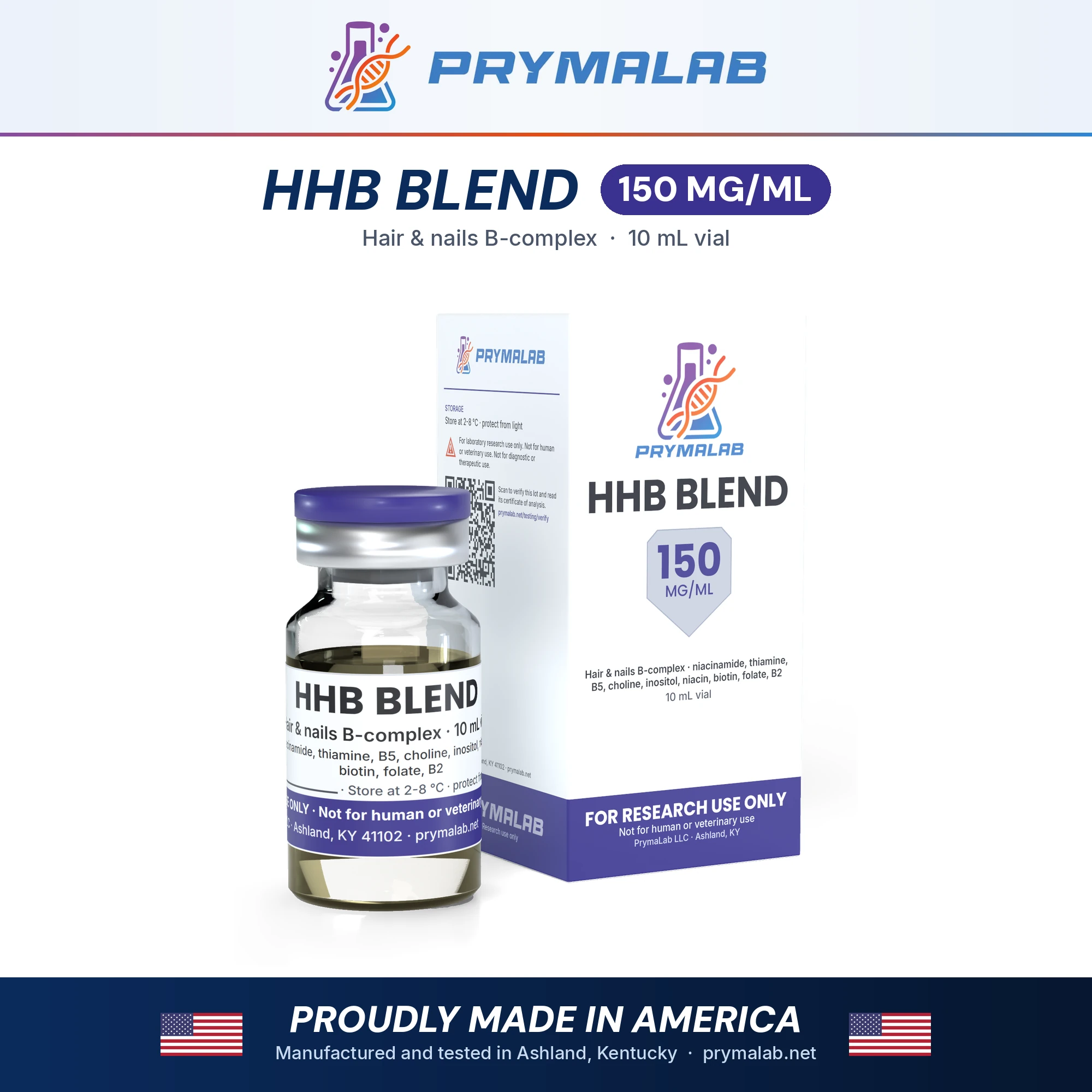
HHB is a nine-part blend of B-vitamins and lipotropic nutrients studied for their roles in hair, skin and nail biology, supplied as a ready-to-use sterile solution in a 10 mL vial at 150.3 mg per mL. It arrives already in solution, so there is no reconstitution step. Each milliliter carries the full 150.3 mg load, and the sealed vial holds 1,503 mg across the nine ingredients, including 1 mg of biotin. PrymaLab supplies HHB for laboratory research use only.
What is in each milliliter
Every vial is the same nine-ingredient formula. The amounts below are per milliliter and per full 10 mL vial.
| Ingredient | Per mL | Per 10 mL vial |
|---|---|---|
| Niacinamide (B3) | 50 mg | 500 mg |
| Thiamine HCl (B1) | 50 mg | 500 mg |
| Pantothenic acid (B5) | 25 mg | 250 mg |
| Choline | 10 mg | 100 mg |
| Inositol | 10 mg | 100 mg |
| Niacin (B3) | 5 mg | 50 mg |
| Biotin (B7) | 100 mcg | 1 mg |
| Folic acid (B9) | 100 mcg | 1 mg |
| Riboflavin (B2) | 100 mcg | 1 mg |
| Total actives | 150.3 mg | 1,503 mg |
| Specification | Detail |
|---|---|
| Format | Ready-to-use sterile solution |
| Fill volume | 10 mL |
| Concentration | 150.3 mg/mL |
| Presentation | Sterile aqueous solution |
| Preparation | None. Supplied ready to use. |
| Shelf life, sealed | 12 to 24 months (see storage) |
| Shelf life, punctured | 30 days refrigerated at 2 to 8°C |
| In the box | One 10 mL HHB vial |
| Lot certificate | Certificate for the current lot: in preparation; the safety data sheet is linked above. |
The nine actives, and what each one does
Niacinamide, 50 mg: circulation and NAD+
Niacinamide is the B3 form that does not cause the flush nicotinic acid can. In cells it converts to nicotinamide adenine dinucleotide (NAD+), a coenzyme used across hundreds of reactions. For the scalp its job is blood flow: wider vessels move more oxygen and nutrients to follicles and clear waste around them. Niacinamide also raises expression of keratin genes, the protein behind both hair shafts and nail plates, while promoting overall skin health. At 50 mg per mL it sits well above the standard adequate intake for dietary B3.
Thiamine HCl, 50 mg: energy for fast-dividing cells
Thiamine HCl is the stable, water-soluble form of B1 and an essential nutrient that acts as a cofactor for pyruvate dehydrogenase and alpha-ketoglutarate dehydrogenase, two enzymes that turn glucose into ATP. Hair-matrix cells divide every 24 to 48 hours during the growth phase, one of the fastest turnovers in the body, and that pace runs on ATP. Thiamine also feeds the pentose phosphate pathway, which makes the NADPH follicles use against oxidative stress. The hydrochloride form dissolves cleanly and keeps well in the vial.
Pantothenic acid, 25 mg: coenzyme A for keratin
Pantothenic acid (B5), often found in supplements as calcium pantothenate, is the precursor to coenzyme A, which cells use to build the ceramide, fatty acids, and amino acids that become keratin.
Low B5 slows keratin output, and hair and nails grow in weaker and more brittle. B5 also feeds adrenal hormone production, the stress axis tied to telogen effluvium, the shedding pattern that follows a stressful stretch of months. The 25 mg per mL keeps a steady supply reaching the follicle.
Choline, 10 mg: cell membranes and methylation
Choline is one of two lipotropic nutrients here. It builds phosphatidylcholine, the main phospholipid in every follicle-cell membrane, and acetylcholine, which helps set blood-vessel tone in the scalp. Choline also carries methyl groups through the methylation cycle that rapidly dividing follicle and nail-matrix cells use to copy DNA accurately. At 10 mg it works alongside the B-vitamins rather than on its own.
Inositol, 10 mg: cell signaling
Inositol: a cyclic polyol involved in phosphatidylinositol signalling. The published hair-and-nail literature on inositol concerns oral supplementation in specific populations; none of it studies an injectable blend.
Niacin, 5 mg: vasodilation
Niacin (nicotinic acid) is the flushing B3 form, kept low here at 5 mg on purpose. It triggers a prostaglandin release that widens blood vessels, adding to the circulation niacinamide already improves, while the small amount keeps the flush response reported in human niacin studies mild. Like niacinamide it tops up the NAD+ pool that follicle energy and DNA repair depend on.
Biotin, 100 mcg: the keratin catalyst
Biotin (B7) is the vitamin most people already connect with hair and nails. It is the cofactor for five carboxylase enzymes in fatty-acid and amino-acid metabolism, the raw materials for keratin, and it raises expression of keratin genes directly. A study in the Journal of the American Academy of Dermatology reported that 2.5 mg of daily biotin increased nail-plate thickness by 25% and cut splitting in people with brittle nail syndrome. The 100 mcg per mL here is above the 30 microgram daily adequate intake cited for adults, and parenteral delivery in the literature avoids the gut losses measured with oral biotin and biotin-rich foods. Biotin is often discussed for hair growth, though the strongest human data is for nail growth rather than hair.
Folic acid, 100 mcg: DNA and cell division
Folic acid (B9) carries the one-carbon units cells use to make the purines and thymidine in new DNA, so tissue that divides constantly, like the hair matrix and nail bed, depends on a steady supply. Folate also builds red blood cells, and low folate causes a megaloblastic anemia that, much like iron deficiency, starves follicles of oxygen.
At 100 mcg per mL it keeps DNA synthesis supplied at the follicle.
Riboflavin, 100 mcg: energy and antioxidant recycling
Riboflavin (B2) becomes FMN and FAD, the electron carriers in the chain that makes most of a cell’s ATP. It also regenerates glutathione, the antioxidant follicles lean on under oxidative load, and it activates B6 and helps process folate and niacin, so a B2 shortfall drags the others down with it. Riboflavin is also why urine turns bright yellow in B-complex supplementation studies: that color is excess B2 leaving the body.
How the nine work together
The B-complex vitamins share pathways, so a shortfall in one caps the rest. Riboflavin activates B6 and processes folate and niacin; thiamine and niacin both feed energy metabolism. Supplying them together keeps any single vitamin from becoming the limiting step. Choline and inositol pair for a stronger lipotropic effect than either gives alone. The two B3 forms split the work on circulation, niacinamide without flushing and niacin with mild vasodilation. Biotin and pantothenic acid cover the keratin-building side, while the rest supply the energy and DNA replication that keratin production runs on. Because it is one solution, all nine are present together in a fixed ratio.
Why these nutrients are studied for hair and nails
The research interest in B-vitamin blends comes from deficiency work. Lower biotin, riboflavin, folate and B12 show up in people with diffuse hair loss and brittle nails, and groups who absorb less from food (older adults, people on acid-reducing medication, vegans and vegetarians) run low more often. None of that literature studies a hair and nail injection as a product, and no B-vitamin acts on genetically driven hair loss.
What the literature covers
The nine actives in HHB are B vitamins, choline and inositol. The human data behind them are deficiency treatment and dietary studies, not a hair or nail injection protocol, so there is no published schedule for a blend like this one and this page does not give one. PrymaLab supplies HHB for laboratory research only.
Handling the vial
- Keep the vial refrigerated between uses and check that the solution is clear and free of particles.
- Nothing is added to the vial; it is a ready solution.
- Wipe the stopper with alcohol and let it dry before drawing from it.
Research behind the ingredients
Most trials test these nutrients one at a time, so read the evidence as support for the parts, not a study of this exact blend. Biotin has the clearest human data: the Journal of the American Academy of Dermatology report above measured a 25% gain in nail-plate thickness at 2.5 mg daily in brittle nail syndrome, which makes the biotin case stronger for nails than for hair in people who are not biotin deficient. In the International Journal of Trichology, patients with diffuse hair loss measured lower in riboflavin, folic acid and B12 than controls, and B-complex supplementation reduced shedding in many of them. In the Journal of Cosmetic Dermatology, topical niacinamide improved hair fullness, credited to circulation and keratin effects; this blend delivers niacinamide systemically instead. Animal and human work links B5 deficiency to shedding and early graying, though those studies pair it with other nutrients, so its solo contribution is hard to isolate.
Safety, storage and handling
The nine actives are water-soluble vitamins. In the clinical literature the body excretes excess in urine rather than storing it, and toxicity is rare even well above these amounts. Reported effects of parenteral B-complex products are mild: injection-site redness or tenderness for a few hours, and a niacin flush that scales with the nicotinic acid amount, which is why niacin is kept to 5 mg here.
Biotin interferes with assays built on biotin-streptavidin binding, including some thyroid, cardiac troponin and hormone immunoassays, pushing results falsely high or low; the FDA published a safety communication on this in 2017 and updated it in 2019. Laboratories running those assays on biotin-exposed samples need to account for it. Folate and the other B-vitamins also interact with methotrexate and anticonvulsants in the pharmacology literature.
Store vials refrigerated at 2 to 8°C and protected from light, and use by the date printed on the vial. Once a vial has been punctured, keep it refrigerated and use it within 30 days. Do not freeze. Inspect the solution before each draw and discard it if it turns cloudy, changes color, or shows particles. Draw with sterile, single-use needles and syringes.
Frequently asked questions
Does HHB need to be reconstituted, and how long does it keep?
No. HHB ships as a ready-to-use liquid, so there is no water to add and no mixing step. Keep the vial refrigerated at 2 to 8°C, and once it has been punctured use it within 30 days. Inspect it before each draw and discard it if it turns cloudy, changes color or shows particles.
Why is there no HHB dosage here?
Because HHB is sold as a research reagent. PrymaLab does not provide administration or dosing guidance for any product; the composition, lot and safety data sheet are published so a laboratory can design its own work.
What ships
HHB ships as one 10 mL vial, 150.3 mg/mL across nine actives, supplied as a ready-to-use sterile solution. Syringes are sold separately.
Related products: BPC-157 5mg, TB-500 10mg, BPC-157 + TB-500 blend, GHK-Cu 50mg.







10 reviews for HHB Peptide 10 mL (B-vitamin and lipotropic research blend)