

Selank peptide: origin, nasal spray vs vial, and research
Selank is a synthetic heptapeptide (Thr-Lys-Pro-Arg-Pro-Gly-Pro) derived from the tuftsin sequence with a Pro-Gly-Pro tail, developed at the Institute of Molecular Genetics in Moscow and studied for anxiety-related behaviour, cognition and immune markers. PrymaLab supplies it as a Selank 5mg vial, Selank 11mg vial, Selank 10mg Nasal Spray and preloaded Selank pen for research use.
- Sequence: Thr-Lys-Pro-Arg-Pro-Gly-Pro (TKPRPGP), seven residues, molecular weight about 751.9 g/mol.
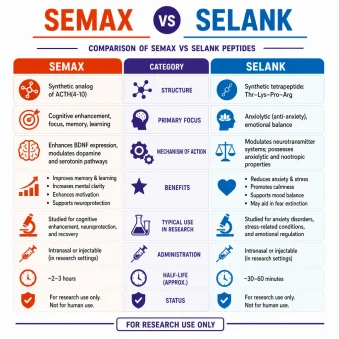
- Class: synthetic tuftsin analogue and a sibling of Semax; see the Semax vs Selank comparison.
- Studied for: anxiety-related behaviour, GABAergic gene expression, enkephalin degradation, BDNF, IL-6 and other immune markers.
- Storage: lyophilised vials frozen or refrigerated; spray and pen refrigerated, never frozen; reconstituted solution refrigerated.
- Forms and sizes at PrymaLab: Selank 5mg, Selank 11mg, Selank 10mg Nasal Spray, Preloaded Autoinjector | Selank | 3ml Pen | 1mg/ml.
- Reconstitution: the peptide reconstitution calculator turns vial size and diluent volume into mg per ml.
What Selank is and where it came from
Tuftsin is a four-residue peptide, Thr-Lys-Pro-Arg, that sits inside the heavy chain of immunoglobulin G. Najjar and Nishioka described it in 1970 at Tufts University, which is where the name comes from, as a fragment that stimulates phagocytosis in neutrophils and macrophages. By origin it is an immune peptide, and a short-lived one: free tuftsin is cut apart by aminopeptidases and carboxypeptidases within minutes of entering blood, which is one reason the natural fragment never became a drug in its own right.
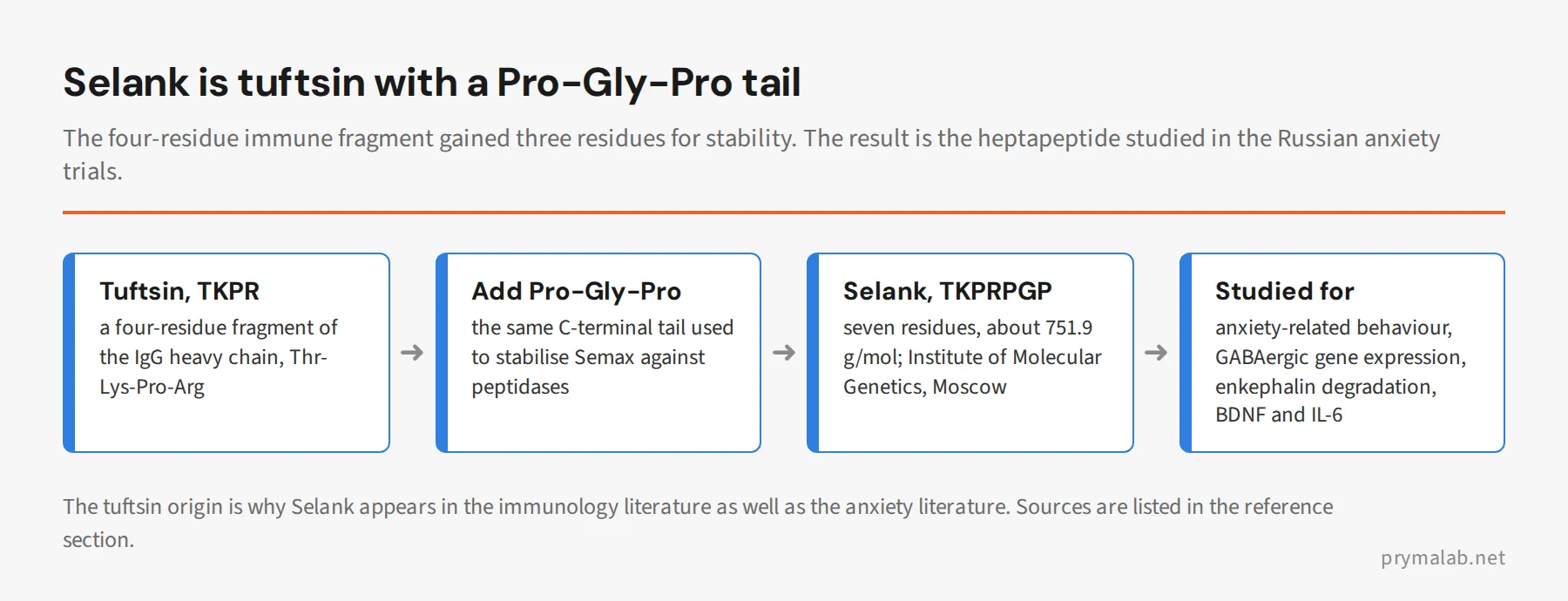
Selank keeps the tuftsin core and slows that cutting. Chemists at the Institute of Molecular Genetics of the Russian Academy of Sciences in Moscow, working with pharmacologists at the Zakusov Research Institute of Pharmacology, added the tripeptide Pro-Gly-Pro to the C-terminus, giving the heptapeptide Thr-Lys-Pro-Arg-Pro-Gly-Pro. Proline-rich tails are poor substrates for most peptidases, so the modified peptide survives longer in tissue than its parent. The same tail sits on Semax, the other peptide from the same laboratory, for the same reason.
Behavioural pharmacology at the Zakusov institute during the 1990s reported anxiolytic-type effects in mice and rats, and that work set the compound's direction. Russia went on to register Selank as a prescription nasal drop, a 0.15% solution containing 1.5 mg of peptide per millilitre, with anxiety states as the indication.
That registration is Russian only. Selank has no marketing approval from the FDA or the European Medicines Agency, and no regulator outside Russia has reviewed the trial data behind it. In the United States it is a research chemical, which is the basis on which PrymaLab supplies it: reference material for laboratory work, not a medicine.
Selank vs Semax
The two peptides get sold side by side and are often described as variations on one idea. They share a laboratory, a Pro-Gly-Pro tail and an intranasal route, and that is where the overlap ends. Semax is built on ACTH(4-7), a fragment of adrenocorticotropic hormone, and its research record is mostly about BDNF, NGF and ischaemic stroke. Selank is built on an immune peptide, and its record is mostly about anxiety-related behaviour and immune gene expression.
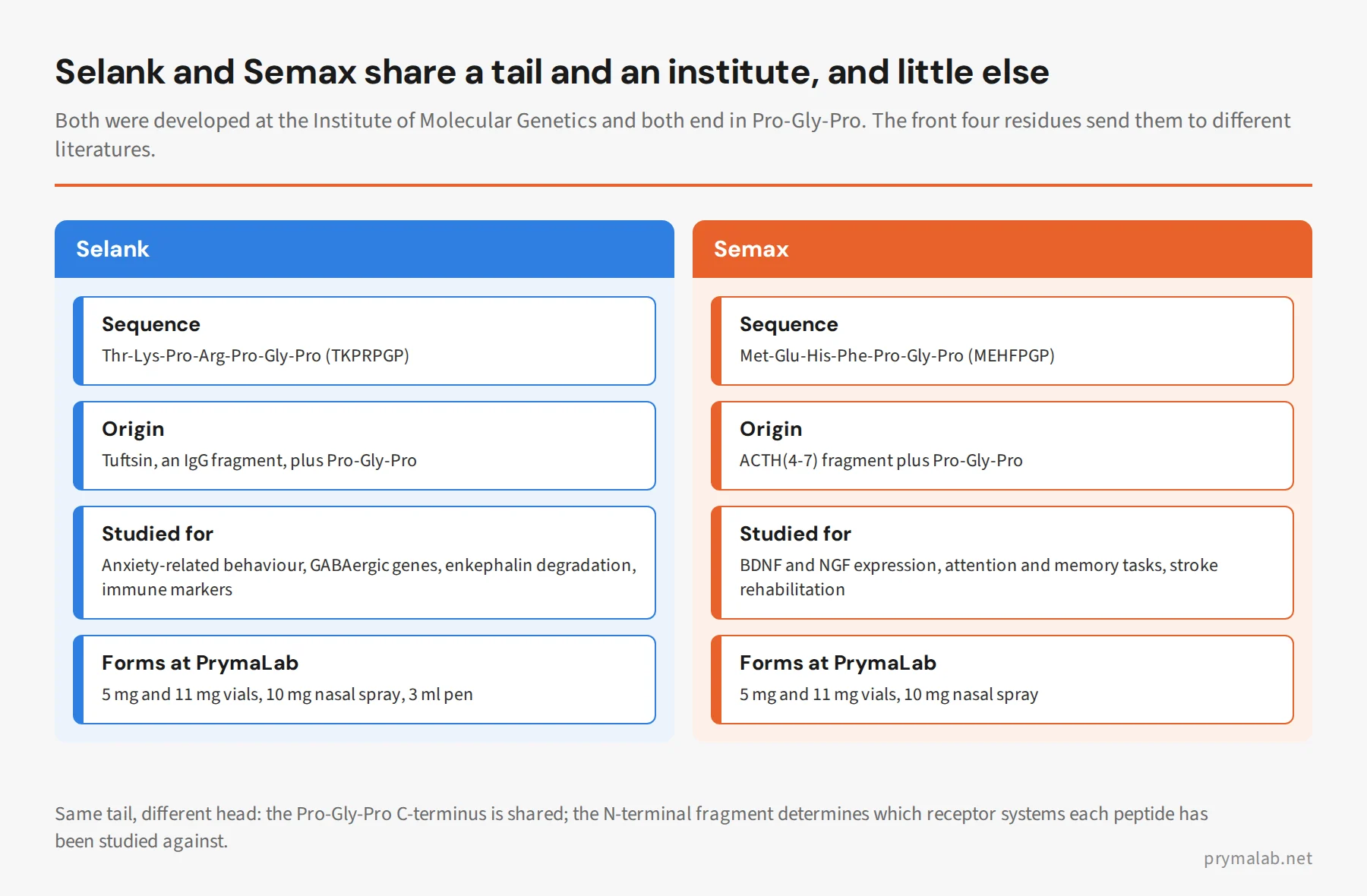
| Feature | Selank | Semax |
|---|---|---|
| Sequence | Thr-Lys-Pro-Arg-Pro-Gly-Pro | Met-Glu-His-Phe-Pro-Gly-Pro |
| Origin | Tuftsin (an IgG fragment) plus Pro-Gly-Pro; Institute of Molecular Genetics, Moscow | ACTH(4-7) plus Pro-Gly-Pro; Institute of Molecular Genetics, Moscow |
| Studied for | Anxiety-related behaviour, GABAergic gene expression, enkephalin degradation, IL-6 and other immune markers | BDNF and NGF expression, attention and memory models, ischaemic stroke in Russian clinical use |
| Forms at PrymaLab | Selank 5mg, Selank 11mg, Selank 10mg Nasal Spray, preloaded 1mg/ml pen | Semax 5mg, Semax 11mg, Semax 10mg Nasal Spray, preloaded 1mg/ml pen |
One practical difference does not show up in a sequence table. Semax begins with methionine, which oxidises in solution; Selank has no methionine, so it is the more forgiving of the two once reconstituted, although hydrolysis still applies and both are kept cold. The long-form Semax vs Selank comparison goes through the sequences, the amidate variants and the gap in accessible evidence between the two in detail.
What the research has looked at
Almost all of the Selank literature comes from two Moscow institutes, and much of it appears in Russian-language journals with English abstracts. That shapes how the findings should be read: samples are small, the clinical studies compared Selank with a benzodiazepine, and no group outside Russia has replicated the clinical results. With that in mind, the work falls into five threads.
GABAergic modulation
Volkova and colleagues (2016) gave rats a single intranasal dose of Selank and profiled 84 genes involved in neurotransmission in the frontal cortex. Forty-five of those genes had changed expression an hour after dosing and 22 at three hours, which the authors read as allosteric modulation of the GABAergic system. Kasian and colleagues (2017) ran rats through an unpredictable chronic mild stress protocol and reported that Selank combined with diazepam was the most effective condition for reducing anxiety in the elevated plus maze under stress, pointing at the same system. Vyunova and colleagues (2018) ran radioligand binding assays on brain cell membranes and reported that Selank acts on [3H]GABA binding as a positive allosteric modulator, and that it can block the modulatory activity of diazepam and olanzapine. The picture that emerges is of a peptide that modulates GABAergic signalling rather than acting as a direct agonist, which would fit the absence of sedation reported in the clinical work.
BDNF
Inozemtseva and colleagues (2008) reported that intranasal Selank raised BDNF expression in the rat hippocampus. This is the finding that connects Selank to the cognition claims found in vendor copy, and it is the same effect Semax is better known for. Beyond it, the cognition evidence for Selank is thin: a small number of rodent memory tasks, and human data that sit inside the anxiety trials as secondary measures.
Enkephalin degradation
Zozulya and colleagues (2001) showed that Selank inhibits enkephalin-degrading enzymes in human serum, and Kost and colleagues (2001) reported the same for Selank and Semax together. The proposed mechanism is simple: slower breakdown of leucine-enkephalin leaves more of the endogenous opioid peptide at its receptors, which could account for part of the anxiolytic-type effect. The 2008 clinical study measured leucine-enkephalin half-life in patient serum and reported that it rose during Selank treatment, most clearly in the patients with generalised anxiety disorder, the closest thing to a mechanistic marker in the human work.
IL-6 and immune findings
Selank's parent is an immune peptide, and the immune findings are the part of its record that Semax does not share. Uchakina and colleagues (2008) reported that Selank at 10-7 M suppressed interleukin-6 gene expression in peripheral blood cells from patients but not from healthy controls, while IL-6 protein in the same cultures rose, and that the Th1/Th2 cytokine balance in serum shifted over 14 days of treatment in patients with generalised anxiety disorder and neurasthenia. The effects run in more than one direction, which is why the authors describe the peptide as a cytokine regulator rather than an IL-6 blocker. Kolomin and colleagues (2011) profiled inflammation-related genes in mouse spleen after Selank and reported altered expression across a group of cytokine and chemokine genes. Whether those changes matter for any immune endpoint has not been tested in a controlled trial.
The Russian clinical trials in generalised anxiety
Zozulya and colleagues (2008) enrolled 62 patients with generalised anxiety disorder or neurasthenia and compared intranasal Selank with medazepam over 14 days. The paper reports no principal difference in overall therapeutic effect between the two arms, a measurable drop in drowsiness on Selank, and no withdrawal syndrome or signs of dependence once it was stopped, against adverse effects in 65% of the medazepam patients. Medvedev and colleagues (2014) compared Selank with phenazepam over 14 days in 60 patients with anxiety-phobic, hypochondriac and somatoform disorders, and reported a pronounced anxiolytic effect that lasted a week beyond the end of treatment. Medvedev and colleagues (2015) then gave Selank alongside phenazepam in 40 patients, against 30 on phenazepam alone, and reported that the combination lowered the rate of phenazepam side effects such as sedation and attention and memory impairment, both during treatment and after the benzodiazepine was withdrawn.
These trials are the whole of the clinical record. They were run by the developers, published in Russian, and have not been repeated by an independent group. That does not make the findings wrong; it makes them unconfirmed, which is the accurate position for a compound sold as reference material.
Selank among the tuftsin-family peptides
Selank was not the only tuftsin derivative its developers studied. Kozlovskaya and colleagues compared ten peptide compounds of the tuftsin family with Selank across several rodent populations: white laboratory male rats, inbred male C57BL/6 and BALB/c mice, and male Wistar rats, each divided beforehand by type of emotional reactivity (Kozlovskaya et al. 2003). Emotional stress was created by a conflict situation, and the peptides were compared on the behaviour it produced. The authors reported positive emotional and antistress effects, with individual, physiologically significant differences that they attributed to the molecular structure of each peptide and/or its degradation fragments (Kozlovskaya et al. 2003). They took this as evidence that peptides of this family could be designed with predictable directions of action (Kozlovskaya et al. 2003).
That result matters for how Selank's lineage is read. It places Selank inside a series of related molecules whose behavioural effects differed with structure, and it names breakdown fragments as part of the explanation, so the behavioural activity is not simply a property of the tuftsin core. On the immunological side, a 2017 review of 86 papers on tuftsin and its analogues grouped the analogues by anti-tumour, anti-inflammatory, antimicrobial and antiviral activity, found that most showed anti-tumour, anti-inflammatory or antibacterial effects, and counted eleven papers on tuftsin-based peptides in vaccines (Siebert et al. 2017). Neither paper measures immune and behavioural activity in the same Selank experiment, which is the comparison the lineage invites, and the behavioural abstract gives no effect sizes.
Selank nasal spray vs vial
Intranasal is the route in every Russian clinical study, in the registered Russian product and in the rat BDNF work, so a nasal spray is not a marketing invention; it follows the literature. The lyophilised vial is the reference form for bench work, where the concentration is set by the researcher. PrymaLab supplies both, plus a preloaded pen.
| Form | What it is | Research use | Handling |
|---|---|---|---|
| Selank 5mg and Selank 11mg vials | Lyophilised Selank powder in a sealed glass vial, 5mg or 11mg net peptide | In vitro assays and animal studies; any concentration can be prepared | Powder frozen or refrigerated, away from light; dissolved in a suitable diluent; solution refrigerated, not refrozen |
| Selank 10mg Nasal Spray | 10mg of Selank already in solution in a metered nasal spray bottle | Animal studies that follow the intranasal route used in the literature; no reconstitution step | Refrigerated, never frozen, tip kept clean, protected from light, discarded after the labelled period once opened |
| Preloaded Selank pen (3ml, 1mg/ml) | 3mg of Selank in 3ml of solution, loaded in an autoinjector pen | Laboratory work where a fixed 1mg/ml solution is convenient | Refrigerated, never frozen, protected from light |
The spray costs more per milligram than the vial because the dissolving and filling have been done already, and because the bottle meters the volume. For work that copies the intranasal route, that convenience is the point. For in vitro work, or any study that needs a concentration the spray does not provide, the vial is the better fit. The pen holds a fixed 1mg/ml solution. What intranasal delivery does and does not achieve in general is covered in our post on whether peptide nasal sprays work.
What the Selank studies measured
The published Selank studies are few. Zozulya et al. 2008 (Zh Nevrol Psikhiatr Im S S Korsakova) compared intranasal Selank with medazepam over 14 days in 62 adults with generalised anxiety disorder or neurasthenia, measuring therapeutic effect, drowsiness, withdrawal and leucine-enkephalin half-life. Medvedev et al. 2014 compared it with phenazepam over 14 days in 60 adults with anxiety-phobic, hypochondriac and somatoform disorders. In rats, Volkova et al. 2016 (Front Pharmacol) measured frontal-cortex gene expression one and three hours after a single intranasal dose, and Kasian et al. 2017 (Behav Neurol) measured elevated plus maze behaviour in a chronic mild stress model over 14 days, alone and combined with diazepam.
The human trials and the rat studies used different units and designs, and converting between them needs allometric assumptions the papers do not make. PrymaLab supplies Selank for laboratory research only.
Storage and handling
Lyophilised Selank is the stable form. Kept at -20°C, sealed and away from light, the powder holds for months; a refrigerator at 2 to 8°C is acceptable for shorter periods. Reconstitution uses a suitable diluent added slowly down the inside wall of the vial, then gentle swirling rather than shaking, since foaming shears peptide chains. The solution goes back in the refrigerator and is not refrozen: repeated freezing and thawing degrades peptides faster than steady cold storage.
The nasal spray and the pen arrive in solution, so they skip reconstitution but also give up the stability advantage of dry powder. Both are refrigerated, never frozen, and kept out of light. An opened spray has a shorter working life than a sealed vial, and the labelled period on the bottle is the limit.
Selank has no methionine, so the oxidation problem that shortens the life of reconstituted Semax does not apply here. Hydrolysis and residual peptidase activity still do, which is why cold storage matters even for a peptide with a protective Pro-Gly-Pro tail. For the vial maths, the peptide reconstitution calculator gives the concentration for any vial size and diluent volume: 11mg in 2ml is 5.5mg/ml, and 5mg in 1ml is 5mg/ml.
Frequently asked questions
What is Selank?
Selank is a synthetic heptapeptide, Thr-Lys-Pro-Arg-Pro-Gly-Pro, made by adding a Pro-Gly-Pro tail to tuftsin, a four-residue fragment of immunoglobulin G. It was developed at the Institute of Molecular Genetics in Moscow and is registered in Russia as an intranasal anxiolytic. Outside Russia it has no marketing approval. PrymaLab supplies it in vial, nasal spray and preloaded pen formats for research use only.
What is the difference between Selank and Semax?
Both are heptapeptides from the same Moscow institute and both end in Pro-Gly-Pro, but the parents differ. Semax is built on ACTH(4-7) and is studied for BDNF, NGF and stroke models. Selank is built on tuftsin, an immune peptide, and is studied for anxiety-related behaviour, GABAergic gene expression and immune markers. Semax also carries an oxidisable methionine that Selank lacks.
Does Selank come as a nasal spray?
Yes. Intranasal is the route used in the Russian clinical trials and in the registered Russian product, which is a nasal drop rather than a spray. PrymaLab supplies a Selank 10mg Nasal Spray, with the peptide already in solution, alongside 5mg and 11mg lyophilised vials and a preloaded 1mg/ml pen. All formats are for research use only.
What have the Selank studies measured?
The Russian clinical trials compared intranasal Selank with benzodiazepines over 14 days in adults with anxiety disorders. Rat studies from the Institute of Molecular Genetics measured gene expression after a single intranasal dose and anxiety-related behaviour over 14 days. PrymaLab supplies Selank for laboratory research only.
How should Selank be stored?
Lyophilised Selank vials are kept frozen at -20°C for long-term storage or refrigerated at 2 to 8°C, away from light. Once dissolved, the solution is refrigerated and not refrozen. The nasal spray and the preloaded pen are already in solution: refrigerate, do not freeze, and protect from light. Selank has no methionine, so oxidation is less of a concern than with Semax.
Key takeaways
- Selank is tuftsin (Thr-Lys-Pro-Arg) with a Pro-Gly-Pro tail, a seven-residue synthetic peptide from the Institute of Molecular Genetics in Moscow.
- Its research record covers GABAergic gene expression, BDNF, enkephalin-degrading enzymes, IL-6 and immune markers, plus Russian clinical trials in generalised anxiety disorder that no independent group has repeated.
- Registration as an intranasal anxiolytic is Russian only; there is no FDA or EMA approval, and the compound is a research chemical in the United States.
- Intranasal is the route in the clinical work, which is why a pre-dissolved nasal spray exists alongside the lyophilised vial and the 1mg/ml pen.
- The clinical trials and the rat studies both used the intranasal route; PrymaLab supplies every format for research use only.
Related products
- Selank 5mg
- Selank 11mg
- Selank 10mg Nasal Spray
- Preloaded Autoinjector | Selank | 3ml Pen | 1mg/ml
- Semax 10mg Nasal Spray
References
- Najjar VA, Nishioka K. "Tuftsin": a natural phagocytosis stimulating peptide. Nature. 1970;228(5272):672-673. PubMed
- Zozulya AA, Kost NV, Sokolov OY, et al. The inhibitory effect of Selank on enkephalin-degrading enzymes as a possible mechanism of its anxiolytic activity. Bull Exp Biol Med. 2001;131(4):315-317. PubMed
- Kost NV, Sokolov OY, Gabaeva MV, et al. Semax and Selank inhibit the enkephalin-degrading enzymes from human serum. Bioorg Khim. 2001;27(3):180-183 (in Russian). PubMed
- Zozulya AA, Neznamov GG, Syunyakov TS, et al. Efficacy and possible mechanisms of action of a new peptide anxiolytic Selank in the therapy of generalized anxiety disorders and neurasthenia. Zh Nevrol Psikhiatr Im S S Korsakova. 2008;108(4):38-48 (in Russian). PubMed
- Uchakina ON, Uchakin PN, Myasoedov NF, et al. Immunomodulatory effects of Selank in patients with anxiety-asthenic disorders. Zh Nevrol Psikhiatr Im S S Korsakova. 2008;108(5):71-75 (in Russian). PubMed
- Inozemtseva LS, Karpenko EA, Dolotov OV, et al. Intranasal administration of the peptide Selank regulates BDNF expression in the rat hippocampus in vivo. Dokl Biol Sci. 2008;421:241-243. PubMed
- Kolomin T, Shadrina M, Andreeva L, et al. Expression of inflammation-related genes in mouse spleen under tuftsin analog Selank. Regul Pept. 2011;170(1-3):18-23. PubMed
- Medvedev VE, Tereshchenko ON, Israelyan AY, et al. A comparison of the anxiolytic effect and tolerability of Selank and phenazepam in the treatment of anxiety disorders. Zh Nevrol Psikhiatr Im S S Korsakova. 2014;114(7):17-22 (in Russian). PubMed
- Medvedev VE, Tereshchenko ON, Kost NV, et al. Optimization of the treatment of anxiety disorders with Selank. Zh Nevrol Psikhiatr Im S S Korsakova. 2015;115(6):33-40 (in Russian). PubMed
- Volkova A, Shadrina M, Kolomin T, et al. Selank administration affects the expression of some genes involved in GABAergic neurotransmission. Front Pharmacol. 2016;7:31. PubMed
- Kasian A, Kolomin T, Andreeva L, et al. Peptide Selank enhances the effect of diazepam in reducing anxiety in unpredictable chronic mild stress conditions in rats. Behav Neurol. 2017;2017:5091027. PubMed
- Vyunova TV, Andreeva L, Shevchenko K, Myasoedov N. Peptide-based anxiolytics: the molecular aspects of heptapeptide Selank biological activity. Protein Pept Lett. 2018;25(10):914-923. PubMed
Everything described on this page is laboratory research. Every compound PrymaLab supplies is for laboratory research use only and is not intended for human or veterinary use. Statements have not been evaluated by the FDA, and nothing here is medical advice.
Mechanistic descriptions are observations from cell and animal models, several from older literature, that may not generalize. Always verify the legal status of any research compound in your jurisdiction before purchase or use.