

Cerebrolysin Peptide: Why a Porcine Brain Hydrolysate Cannot Have a Purity Number, and What the Trials Actually Found
Most pages selling or describing the cerebrolysin peptide treat it as one molecule with a sequence, a molecular weight and a purity figure. It has none of those. Cerebrolysin is EVER Pharma's enzymatic digest of pig brain, a mixture of short peptides and free amino acids defined by its manufacturing process, and the manufacturer does not publish the peptide-to-amino-acid ratio that every supplier page repeats. The clinical record is just as far from the summaries: the one adequately powered stroke trial was neutral, the one positive mid-sized trial failed to replicate, and Cochrane reports a roughly two-fold increase in non-fatal serious adverse events. I went through the primary documents, and this is what they say.
Research-use-only disclaimer: Cerebrolysin supplied for research is intended strictly for in-vitro and laboratory research use and is not intended for human or veterinary use. The clinical trial results described below concern a prescription drug product, EVER Pharma's Cerebrolysin, given by injection under medical supervision where it is authorised; they do not describe or support any use of research-grade material. Trial regimens are reported as study design facts. Nothing here is medical advice.
TL;DR
Cerebrolysin is a sterile solution containing 215.2 mg/mL of a porcine brain peptide fraction, made by EVER Neuro Pharma in Austria. It is a hydrolysate, not a cerebrolysin peptide: no sequence, no formula, no molecular weight, and the widely quoted 25/75 peptide to amino acid split appears in no manufacturer document. The largest randomised trial, CASTA, enrolled 1,070 acute stroke patients and was neutral on its primary endpoint; CARS-1 was positive on arm function and CARS-2 did not confirm it. Cochrane's 2023 review finds no effect on death and a non-fatal serious adverse event risk ratio of 2.39 (95% CI 1.10 to 5.23), which manufacturer-linked re-analyses dispute. It is not FDA approved; a 2016 orphan designation for frontotemporal dementia was later withdrawn or revoked. Because the product is a mixture, a certificate of analysis cannot honestly report a single purity percentage, only a fingerprint, a size distribution and a species-confirmed peptide profile. Research use only.
What it is: A process-defined porcine brain hydrolysate in solution, 215.2 mg/mL. No sequence, formula or molecular weight.
Composition: The 25/75 peptide to amino acid split is cited to a 2001 paper; the manufacturer publishes no ratio.
Stroke: CASTA, n=1,070, neutral. CARS-1 positive on ARAT; CARS-2 did not replicate it.
Safety signal: Cochrane 2023 non-fatal serious adverse events RR 2.39 (1.10 to 5.23), moderate certainty; industry-adjacent re-analyses find no excess.
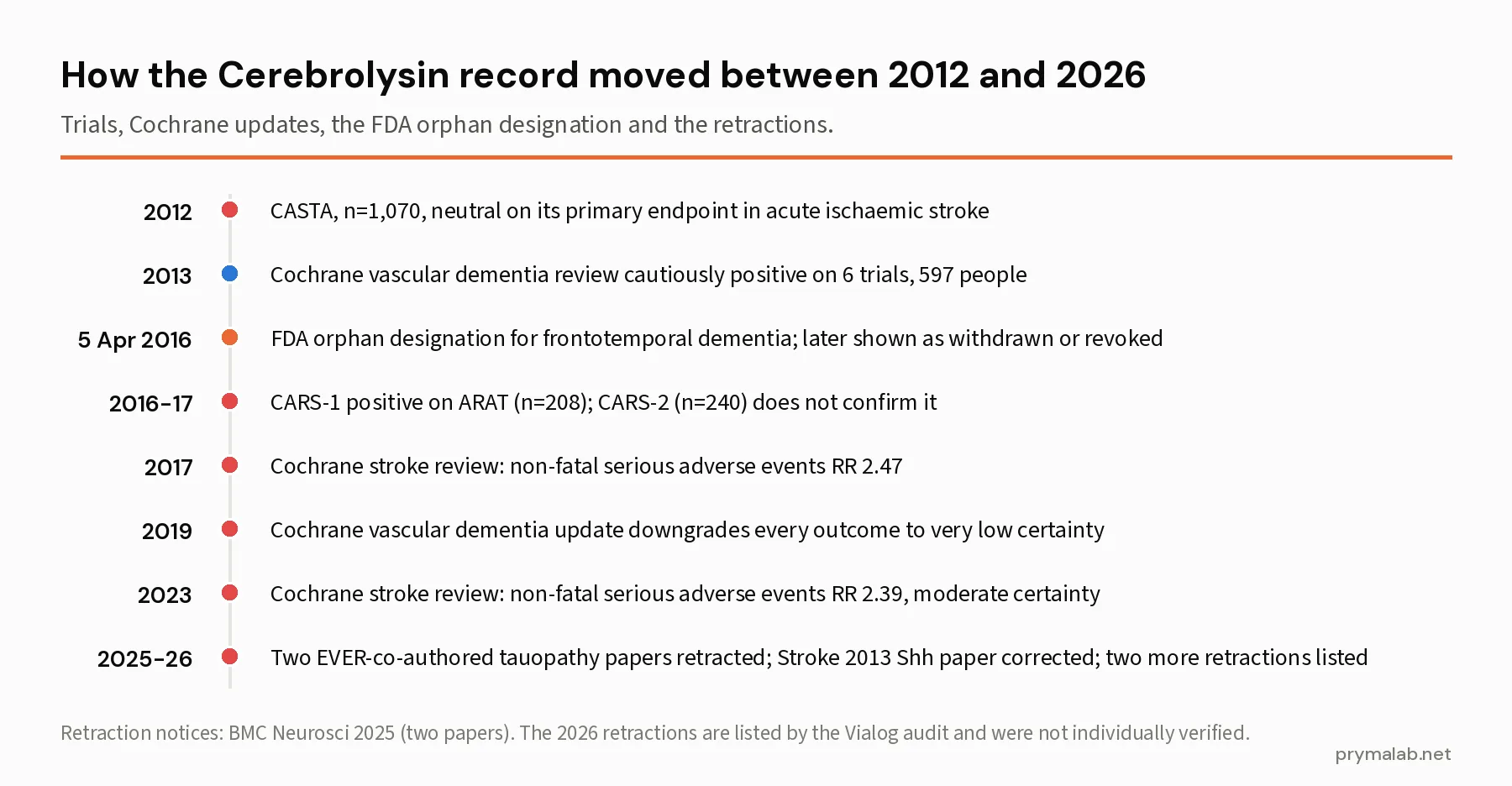
Regulatory: Not FDA approved; a 2016 orphan designation for frontotemporal dementia was withdrawn or revoked. Prescription drug in Austria; no EMA central authorisation.
Literature: Mechanistic animal work comes from one EVER-funded collaboration; two EVER-co-authored papers were retracted in 2025.
Analytics: A mixture cannot have a purity percentage. A batch fingerprint, a size distribution and a porcine LC-MS profile are the honest measures.
Status: research use only.
What the Cerebrolysin Peptide Actually Is: A Mixture Defined by Process
Cerebrolysin, made by EVER Neuro Pharma GmbH in Unterach am Attersee, Austria, is a sterile aqueous solution for injection containing 215.2 mg/mL of what its manufacturer calls "Cerebrolysin concentrate", a peptide fraction made by enzymatic digestion of pig brain, with sodium hydroxide and water for injection as the only listed excipients.[1] It is not a peptide in the sense that SS-31 or semaglutide is a peptide: there is no sequence, no molecular formula and no molecular weight, because there is no single molecule to carry them.
The phrase "cerebrolysin peptide" is a search term, not a chemical description. The Cochrane Stroke Group's wording is the accurate one: a "mixture of low-molecular-weight peptides and amino acids derived from porcine brain".[2] The FDA's orphan drug database, the only US regulatory record of the product, calls it a "peptide fraction derived from porcine brain protein".[3]
The 25/75 split that the manufacturer never states
Almost every supplier page gives about 25% low-molecular-weight peptides, under 10 kDa, and about 75% free amino acids. A 2025 review in Biomedicines attributes that figure to a 2001 cell-culture paper by Hartbauer and colleagues.[4] It appears in no EVER Pharma document I could find; the product page, handbook and FAQ give the 215.2 mg/mL figure and no ratio.[1] An independent audit notes that two incompatible ratios, 75/25 and 85/15 amino acid to peptide, circulate "without supporting characterization studies",[5] and the Alzheimer's Drug Discovery Foundation adds that amino acid content "may vary by manufacturer and by batch".[6] I report 25/75 as commonly cited, and I would not build a calculation on it.
| Attribute | What the record says | Source |
|---|---|---|
| Concentrate per mL | 215.2 mg of "Cerebrolysin concentrate"; excipients sodium hydroxide and water | EVER Treatment Handbook 2023 |
| Peptide to amino acid ratio | Commonly cited ~25/75; a 15/85 version circulates; no ratio published by the manufacturer | Biomedicines 2025; Vialog audit |
| Sequence, formula, molecular weight | None; a process-defined hydrolysate has no single molecule to carry them | Cochrane; FDA orphan database |
A product defined by how it is made
EVER's FAQ says it is "impossible to copy biological products 100%" and that any copy would need its own registration and efficacy studies.[7] EVER publishes no description of the enzymes, digestion conditions, purification steps or release tests anywhere I looked.[7] The only peer-reviewed analytical characterisation I could locate is a 2023 nanoLC-MS paper in the Journal of Chromatography B; I could not retrieve the abstract, so I cannot tell you how many peptides it found.[8]
The manufacturer has made the process-defines-product argument in print. An EVER-supported rat stroke study compared Cerebrolysin against Cognistar (cerebroprotein hydrolysate), Cerebrolysat and Cortexin, found the three "functionally equivalent to saline" while Cerebrolysin improved neurological outcome (p<0.002), and concluded that such preparations "should not be considered as being exchangeable".[9] It is the most useful sentence in the literature for anyone holding a vial marked cerebrolysin that did not come from EVER.
It is also not a defined synthetic nootropic like those in our Semax vs Selank reference; in our overview of peptides studied for brain and cognition it is the one entry with no mass to calculate.
The Neurotrophic Mechanism: What EVER Claims and What the Animal Work Shows
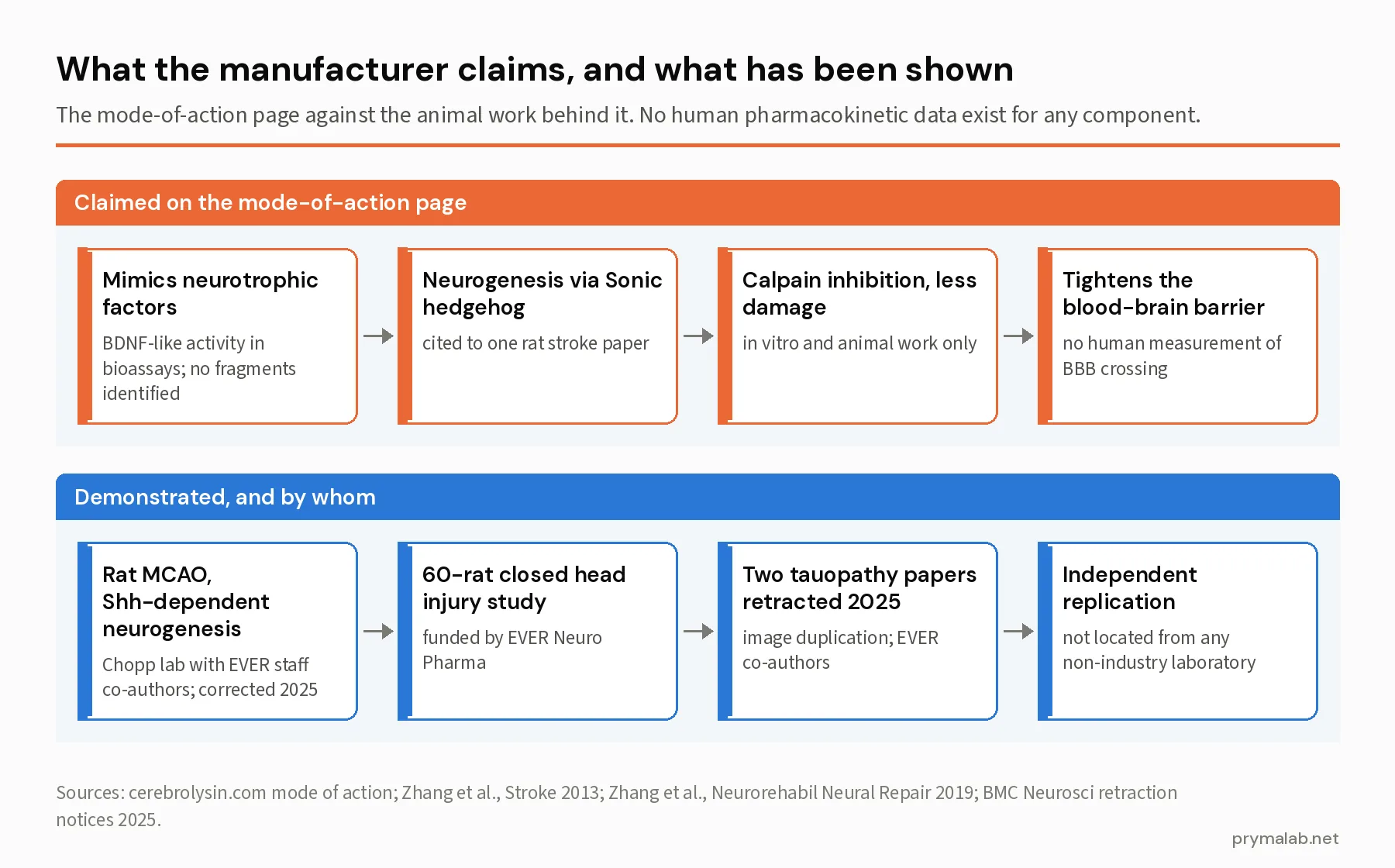
The claimed mechanism is that Cerebrolysin "mimics and modulates the level of" endogenous neurotrophic factors, from which the manufacturer's mode-of-action page derives neurogenesis through the Sonic hedgehog pathway, calpain inhibition, neuroplasticity, lower cytokine release and a tighter blood-brain barrier.[7] What has been demonstrated is narrower: neurotrophic-factor-like activity in bioassays and a set of rat findings, nearly all from one collaboration between Michael Chopp's laboratory at Henry Ford Hospital and EVER Neuro Pharma employees. No human pharmacokinetic data exist.
Neurotrophic-like is a bioassay result, not a list of ingredients
Neurotrophic-factor-like activity means that in assays such as neuronal survival in culture the mixture behaves the way a neurotrophic factor would. It does not mean fragments of BDNF, GDNF, NGF or CNTF have been identified in the vial, and the 2025 Biomedicines review cites only a possible effect on BDNF production.[4] I could not find mass-spectrometric identification of any neurotrophin-derived peptide in the product, and I treat the supplier-page fragment list as marketing.
The Sonic hedgehog finding, and who produced it
The strongest mechanistic paper is Zhang, Chopp and colleagues in Stroke in 2013: in rats with middle cerebral artery occlusion, Cerebrolysin increased neural progenitor proliferation and differentiation into neurons and oligodendrocytes, and cyclopamine, a Sonic hedgehog antagonist, abolished the effect.[10] Two authors were EVER Neuro Pharma staff, and a correction was published in Stroke on 27 January 2025 whose content I could not retrieve.[10] The same collaboration produced the closed head injury work, 60 rats at three dose levels, funded by EVER with three EVER-affiliated authors.[11] I found no replication from a laboratory with no industry link, which is a reason to hold the findings loosely rather than evidence they are wrong.
Two retractions, and two more listed
On 10 March 2025, BMC Neuroscience retracted a 2015 paper on Cerebrolysin in a tau transgenic model of Pick's disease and frontotemporal tauopathies after the editor found five overlapping image panels representing "tissues taken from animals which underwent different treatments"; the authors did not reply to the publisher, and three of them were EVER Neuro Pharma affiliates.[12] A second 2025 retraction covered a 2014 tauopathy paper from the same group, reportedly for band overlaps in the blots, which I have not verified against the notice.[12] An independent audit lists two further retractions in 2026, a 2008 Rett syndrome paper and a 2011 CNTF-peptide comparison, which I have not checked.[5] The human trials are untouched. Frontotemporal dementia, the indication named in the FDA orphan designation, is not: the sponsor-linked preclinical work in that disease is the tauopathy work now retracted.
No human pharmacokinetics
I could not find a human plasma concentration curve, a half-life or a brain-to-plasma ratio for any component, and neither could the audit I cross-checked against.[5] The 2025 review asserts the peptides "freely cross the blood-brain barrier" because of low molecular weight, citing a secondary source.[4] No marker peptide has been designated for measurement, so the barrier claim is an inference from size, not a measurement.
The Stroke Evidence: CASTA, the CARS Pair and the Cochrane Verdict
In acute ischaemic stroke, the one adequately powered randomised trial, CASTA, was neutral on its primary endpoint in 1,070 patients. The one clearly positive mid-sized trial, CARS-1, was not confirmed by its replication, CARS-2. Cochrane's current review finds no effect on death, no effect on total serious adverse events, and a moderate-certainty increase in non-fatal serious adverse events. Manufacturer-linked meta-analyses reach the opposite headline by asking a different question.
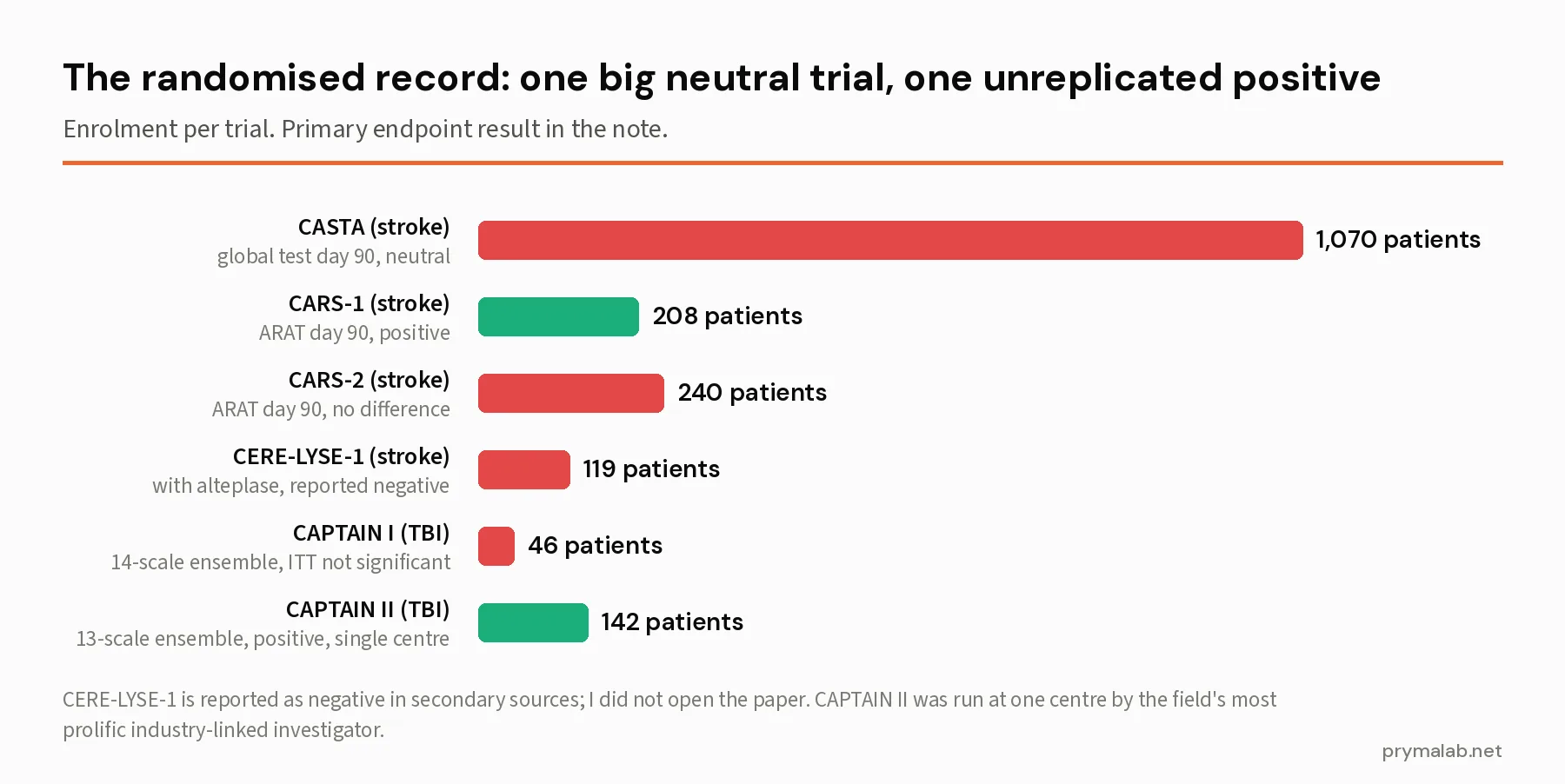
CASTA: 1,070 patients and a mean of 0.5
Heiss and colleagues, Stroke 2012: double-blind, placebo-controlled, Asian multicentre, acute hemispheric ischaemic stroke within 12 hours of onset, 30 mL/day intravenously for 10 days on top of aspirin, 529 patients on Cerebrolysin and 541 on placebo. The primary endpoint, a combined global test of the modified Rankin Scale, Barthel Index and NIHSS at day 90, returned a mean of 0.5, meaning no group difference; 90-day mortality was 5.3% against 6.6%.[13] The post hoc subgroup that keeps the trial alive in marketing, baseline NIHSS above 12, gave an odds ratio of 1.27 with a lower confidence bound of 0.97, so not significant, and 90-day mortality of 20.2% on placebo against 10.5% on Cerebrolysin.[13] No confirmatory trial in severe stroke has been published in the 14 years since.[5]
CARS-1 and CARS-2: a large effect that vanished on replication
CARS-1, Muresanu and colleagues, Stroke 2016: 208 patients randomised 24 to 72 hours after stroke to 30 mL/day for 21 days alongside standardised rehabilitation, primary endpoint the Action Research Arm Test at day 90, Mann-Whitney estimator 0.71 (95% CI 0.63 to 0.79; p<0.0001).[14] CARS-2, Guekht and colleagues 2017, same design, Russia, 240 patients: "Neither the primary ARAT score nor the secondary outcome measures showed a significant treatment difference on day 90", and "This study did not confirm the findings of the study CARS1".[15] The CARS-2 authors blamed a ceiling effect from milder patients, which is also the explanation Heiss offered for CASTA, where the median NIHSS was 9. Two trials, two ceilings. The pooled CARS analysis, 448 randomised, is driven by CARS-1, and its authors report grants, advisory board positions and speaker fees from EVER Neuro Pharma.[16]
| Trial | Design | n | Primary endpoint | Result |
|---|---|---|---|---|
| CASTA (Heiss 2012) | Double-blind, Asia, within 12 h, 10 days IV | 1,070 | Global test of mRS, Barthel and NIHSS at day 90 | Neutral; NIHSS >12 subgroup not significant |
| CARS-1 (Muresanu 2016) | Double-blind, multicentre, 21 days with rehabilitation | 208 | ARAT at day 90 | Positive, MW 0.71 (0.63 to 0.79) |
| CARS-2 (Guekht 2017) | Same design, Russia | 240 | ARAT at day 90 | No significant difference; did not confirm CARS-1 |
Cochrane's stroke review, version by version
The Cochrane review by Ziganshina and colleagues in Kazan has been updated four times, and the non-fatal serious adverse event signal has been present in every version since 2017.[2]
| Version | Trials / participants | All-cause death RR | Total SAE RR | Non-fatal SAE RR |
|---|---|---|---|---|
| 2016 (pub4) | 6 / 1,501 | 0.91 (0.61 to 1.35) | 1.37 (90% CI 1.01 to 1.86) | Not reported separately |
| 2017 (pub5) | 6 / 1,501 | 0.91 (0.61 to 1.35) | 1.16 (0.81 to 1.67) | 2.47 (1.09 to 5.58), p=0.03 |
| 2020 (pub6) | 7 / 1,601 | 0.90 (0.61 to 1.32) | 1.15 (0.81 to 1.65) | 2.15 (1.01 to 4.55), p=0.047 |
| 2023 (pub7) | 7 / 1,773, one Cortexin trial included | 0.96 (0.65 to 1.41) | 1.16 (0.81 to 1.66) | 2.39 (1.10 to 5.23); 30 mL for 10 days subgroup 2.87 (1.24 to 6.69) |
The 2023 conclusion, in the review's words, is that Cerebrolysin "probably has no beneficial effect on the total number of people with serious adverse events" and that moderate-certainty evidence "indicates a potential increase in non-fatal serious adverse events".[2] The 2023 update added a 272-participant Cortexin trial as a "Cerebrolysin-like agent", so the pooled population is no longer Cerebrolysin-only; the serious adverse event analysis, 3 trials and 1,335 participants, is Cerebrolysin-only and dominated by CASTA. Cochrane's primary outcomes are death and serious adverse events; it does not pool functional outcomes, which is exactly the space the manufacturer-affiliated meta-analyses occupy.
The meta-analyses that say the opposite, and who wrote them
Bornstein and colleagues, Neurological Sciences 2018, pooled 9 randomised trials and 1,879 patients, CASTA included: early NIHSS Mann-Whitney 0.60 (0.56 to 0.64), mortality 4.1% against 5.1%, adverse events 46.5% against 46.3%, and a conclusion that Cerebrolysin "has a beneficial effect on early global neurological deficits".[17] The primary outcome is an early neurological score, not 90-day disability. Strilciuc and colleagues, 2021, 12 trials, safety only: non-fatal serious adverse event RR 1.18 (0.75 to 1.86). Patel, 2025, 14 trials: mRS 0 to 2 RR 1.31 (0.90 to 1.91, not significant), serious adverse events RR 1.08 (0.84 to 1.40).[18] The one independent check I found is from Glasgow: Alsulaimani, Quinn and colleagues, 2021, found for Cerebrolysin a cognition standardised mean difference of −0.16 (−0.30 to −0.03), low to very low certainty, and effects "probably less than would be considered clinically relevant".[19]
Traumatic Brain Injury and the Postoperative Cognitive Dysfunction Question
In traumatic brain injury the entire randomised evidence base is 185 patients across two trials, with small-to-medium effects on composite neuropsychological ensembles; the multicentre trial's intention-to-treat analysis was not significant, and the positive trial was single-centre. For postoperative cognitive dysfunction, the search intent this section exists for, I located two papers by title, could not open either, and found no Cochrane review.
CAPTAIN I and CAPTAIN II
CAPTAIN I, Poon and colleagues, Neurological Sciences 2020: double-blind, placebo-controlled, Asian-Pacific multicentre, moderate to severe TBI, 50 mL/day for 10 days then two cycles of 10 mL/day for 10 days, primary endpoint an ensemble of 14 scales, 46 patients. The intention-to-treat result was not significant (Mann-Whitney 0.63, 95% CI 0.48 to 0.77); a completers-only analysis was (0.69, 0.53 to 0.85, p=0.024). It ran on an unrestricted grant from EVER Neuro Pharma.[20] CAPTAIN II, Muresanu and colleagues, same journal and year, same regimen at a single centre in Cluj-Napoca, Romania: 142 enrolled, 139 analysed, 13 scales, day-90 Mann-Whitney 0.59 (0.52 to 0.66; p=0.0119).[20] Vester and colleagues pooled the two in 2021, 185 patients, standardised mean differences of 0.31 at day 30 and 0.34 at day 90, and proposed "integration into clinical guidelines".[21]
The 2023 meta-analysis that is mostly not randomised
Jarosz and colleagues, Brain Sciences 2023, pooled 10 studies and 8,749 patients: Glasgow Outcome Scale mean difference 0.42 (0.26 to 0.58), no significant effect on GCS or mortality.[22] Only 3 of the 10 studies were randomised, heterogeneity ran from 70 to 94%, and there was no formal risk-of-bias assessment. I have seen it described as an individual patient data meta-analysis, and it is not one.
Cerebrolysin postoperative cognitive dysfunction clinical trials: what I could and could not find
On 13 September 2026 I ran a Europe PMC search for Cerebrolysin and postoperative cognitive dysfunction: 54 hits, and among the first 25 two are on point, a 2017 Russian-language paper on preventing postoperative cognitive dysfunction in cardiac surgery (Polushin and colleagues, PMID 29376982) and a 2025 paper in Medical Science Monitor on cognitive function and delirium after coronary artery bypass grafting (Stadnik and colleagues, PMC12083191).[23] I could not open either abstract, so I cannot tell you whether they were randomised, how many patients they enrolled or what they found. There is no Cochrane review, no multicentre trial I could identify, and surgery is not among the four indications EVER lists for the product.[1]
Alzheimer's and Vascular Dementia: The Cochrane Review People Misattribute
There is no Cochrane review of Cerebrolysin in Alzheimer's disease. The Cochrane review cited as if there were, Chen and colleagues 2013, concerns vascular dementia, and its 2019 update by Cui and colleagues downgraded every outcome to very low certainty. In Alzheimer's disease the evidence is a set of manufacturer-sponsored trials whose 4-week cognitive effect does not persist to 6 months in the manufacturer's own pooled analysis.
Alzheimer's disease: a 4-week effect that is gone at 6 months
The randomised trials are Ruether 1994 and 2001, Panisset 2002, Bae 2000, Xiao 2000 and the Alvarez 2006 dose-finding study, all manufacturer-sponsored. Gauthier and colleagues pooled the six in 2015: ADAS-cog standardised mean difference −0.40 (−0.66 to −0.13; p=0.0031) at 4 weeks but −0.37 (−0.90 to 0.16; p=0.17) at 6 months; clinician global impression odds ratios of 3.32 at 4 weeks and 4.98 at 6 months.[24] The author list includes an EVER Neuro Pharma scientist and the trial statistician. So the cognitive scale improves at 4 weeks and is not significantly different at 6 months, in the analysis the manufacturer's own people ran. The Alzheimer's Drug Discovery Foundation rates the dementia evidence 2 out of 4 and calls the findings unreplicated.[6]
Vascular dementia: from cautiously positive to very low certainty
Chen and colleagues at West China Hospital, 2013: 6 randomised trials, 597 participants, MMSE weighted mean difference 1.10 (0.37 to 1.82), ADAS-cog+ −4.01 (−5.36 to −2.66), global response RR 2.71 (1.83 to 4.00), and "still insufficient evidence to recommend Cerebrolysin as a routine treatment for vascular dementia".[25] The 2019 update found no new trials and re-graded the same six: cognition SMD 0.36 (0.13 to 0.58) from 3 studies and 420 people, global function RR 2.69 (1.82 to 3.98) from 2 studies and 379 people, both very-low-quality, "the included papers had high risk of bias", and "If there are benefits... the effects may be too small to be clinically meaningful".[25] A Medscape report gave the 2013 count as 507 participants; I have used the Cochrane abstract's 597.
Cerebrolysin benefits in dementia, then, come down to a 4-week cognitive signal in Alzheimer's disease that fades by 6 months and very-low-certainty evidence in vascular dementia. Frontotemporal dementia is the indication the FDA orphan designation named, and I could not find a human efficacy trial in it at all.
The Products It Gets Confused With, and the Nasal Spray Question
Cerebrolysin is one of several animal-tissue hydrolysates sold for neurological indications, and they are not interchangeable: Cortexin is bovine, Cerebrolysat contains phenol, and cerebroprotein hydrolysate (Cognistar) is a lyophilised powder. Only Cerebrolysin exists as EVER's 215.2 mg/mL solution. I could find no intranasal or oral Cerebrolysin trial; the oral product in the literature, N-PEP-12, is a different preparation sold as a dietary supplement.
| Product | Source tissue | Form | What the evidence says |
|---|---|---|---|
| Cerebrolysin (EVER Neuro Pharma, Austria) | Porcine brain, enzymatic digest | Aqueous solution, 215.2 mg/mL | The trials in this article |
| Cortexin (Russia) | Bovine brain | Lyophilised powder | One 272-patient trial in Cochrane 2023; equivalent to saline in the EVER-funded rat comparison |
| Cerebrolysat | Brain hydrolysate | Solution containing phenol | Equivalent to saline in the EVER-funded rat comparison |
| Cognistar, cerebroprotein hydrolysate (China, India) | Brain hydrolysate | Lyophilised powder | Equivalent to saline in the EVER-funded rat comparison |
The 2019 rat comparison, funded by EVER, is the source of the "equivalent to saline" entries, with the obvious conflict of a manufacturer testing its competitors; I cite it for the direction it cuts, against anyone treating the category as one thing.[9]
The nasal spray claim
I could not find a single trial, in humans or animals, of intranasal Cerebrolysin. EVER's product exists only as a solution for intravenous or intramuscular injection, and every trial in this article used those routes.[1] Any nasal-spray preparation is an untested research format, and the injected trial record does not transfer to it. Our reference on whether peptide nasal sprays work sets out the general delivery problem; for a product with no defined molecule, that problem has no denominator.
The oral question, and N-PEP-12
There is no oral Cerebrolysin. N-PEP-12, marketed as MemoProve, is a dietary supplement described by its seller as a patented blend of peptones containing neuropeptides and amino acids. The MemoProve site does not name EVER Pharma or Cerebrolysin; the link is asserted in the trial papers, and I could not confirm it from a primary source. The clinical data are small and academic: a 2020 pilot randomised trial of 90 mg/day for 90 days after ischaemic stroke reported a borderline MoCA effect (Cohen's d 0.49, p=0.010).[26]
Cerebrolysin Side Effects, the Serious Adverse Event Signal and Where It Is Legal
The most frequent adverse reactions reported for Cerebrolysin are dizziness, headache, sweating and nausea, trial adverse event rates sit close to placebo, and mortality is not increased in any analysis; the contested finding is Cochrane's moderate-certainty doubling of non-fatal serious adverse events. It is not approved by the FDA, it is a prescription drug in Austria and other national markets, and it has no EMA centralised authorisation.
Cerebrolysin side effects in the trial record
EVER's FAQ lists dizziness, headache, sweating and nausea and calls them "rare and of mild intensity".[7] The Alzheimer's Drug Discovery Foundation adds weight loss, anxiety, agitation and feeling hot.[6] Adverse event rates were 46.5% against 46.3% in Bornstein's nine trials and 46.0% against 41.5% in the pooled CARS analysis, Cochrane's 2023 total adverse event RR is 1.03 (0.92 to 1.14), and mortality risk ratios run from 0.83 to 0.96 across the four analyses.[2] The manufacturer's contraindications are hypersensitivity to any component, status epilepticus and severe renal failure, label facts rather than guidance.[1]
The non-fatal serious adverse event signal
Cochrane 2023: non-fatal serious adverse events RR 2.39 (1.10 to 5.23), moderate certainty, 2.87 (1.24 to 6.69) in the 30 mL for 10 days subgroup, total serious adverse events not increased at 1.16 (0.81 to 1.66).[2] Strilciuc's re-analysis gets 1.18 (0.75 to 1.86) and Patel's gets a total serious adverse event RR of 1.08 (0.84 to 1.40).[18] No abstract I could read says what the events were: no organ system, no event type. The honest statement is narrow: an independent review finds a two-fold increase at moderate certainty, manufacturer-adjacent re-analyses that add smaller trials do not, and nobody has said what the events were. Hypersensitivity is the first-listed contraindication for a reason: this is a heterologous porcine protein digest given intravenously, anaphylaxis appears in case reports without incidence estimates, and I could not find published anti-drug antibody data.[5]
Cerebrolysin FDA approval status: not approved, one orphan designation, since withdrawn
Cerebrolysin is not approved by the FDA for any indication. EVER's own disclaimer: "Cerebrolysin is not registered with the U.S. Food and Drug Administration (FDA) and is not approved for sale or distribution in the United States."[7] The one US record is Orphan Drug Designation 513315, granted on 5 April 2016 for "peptide fraction derived from porcine brain protein" for "Treatment of frontotemporal dementia, including all subvariants"; the database now shows "Designated/Designation Withdrawn or Revoked" and "Not FDA Approved for Orphan Indication", with no withdrawal date.[3] FDA Import Alert 66-41 does not name Cerebrolysin or EVER, and I found no product-specific import alert or warning letter; that is absence of evidence, not a verified absence.[3] Research-grade material in the United States is sold for laboratory use only.
Where it is a prescription drug, and where I could not confirm it
EVER describes Cerebrolysin as a prescription medication with listed indications of senile dementia of the Alzheimer type, vascular dementia, stroke and craniocerebral trauma; it is an Austrian prescription product.[1] The trials included by Cochrane ran across Central and Eastern Europe and Asia, which is indirect corroboration of national authorisations and nothing more.[2] There is no EMA centralised authorisation, and EVER's statement that "according to EMA classification, Cerebrolysin is in the SAFE category" has no basis I could identify. I read that as a marketing sentence.[7] Counts of 44 or more than 50 countries circulate; EVER publishes no list, and no count I found cites a regulator.[4] Germany is the surprise: EVER manufactures in Jena and secondary pages list Germany as an approving country, but a search of the Gelbe Liste, the German drug directory, on 13 September 2026 returned no product, no company and no active substance for cerebrolysin.[27] That is a directory inference, not a regulator's statement; a PharmNet.Bund check would settle it.
Why a Mixture Cannot Have a Purity Number, and What a Certificate Can Show
A standard research peptide certificate of analysis reports HPLC purity as the percentage of the main peak and a mass spectrometry result matching a calculated monoisotopic mass. Both presuppose one molecule. Cerebrolysin has no expected mass, no main peak and no public reference standard, so a certificate quoting "99% purity" for it is reporting a number with no definition.
Purity of what?
The product is, by the commonly cited figure, three-quarters free amino acids by mass, with the peptide fraction spread across many co-eluting species below 10 kDa.[4] Run it on a reversed-phase column at 214 nm and you get a forest, not a peak. This is why the only published analytical paper used nanoLC-MS/MS with a database search against the pig proteome rather than a purity assay.[8] EVER says the product is standardised by process, but it has published no release fingerprint, no bioassay and no batch-to-batch variability data on any page I could find.[7]
What a certificate can say about a hydrolysate
Five things, none of them a purity percentage: authenticity and form (for the EVER product, intact packaging, a batch number and a clear solution, never a powder); total peptide and amino acid nitrogen, which checks the 215.2 mg/mL claim; a molecular weight distribution by size-exclusion HPLC or MALDI, confirming peptides below 10 kDa and no intact proteins; a reversed-phase HPLC trace compared with a previous batch, which is similarity rather than purity; and LC-MS/MS peptide mapping searched against Sus scrofa, which confirms the species (porcine, not bovine as in Cortexin) and can detect substitution. What it cannot say: purity 99%; molecular weight confirmed; contains BDNF, CNTF, GDNF or NGF fragments; bioactive. The last would need a cell-based neurotrophic bioassay, and no public standard for one exists.
The two supply channels, and the label that cannot be right
Among North American research vendors I see two different things sold under one name. The first is diverted genuine product: EVER ampoules with a manufacturer batch number, offered without a third-party certificate on the honest ground that single-peptide purity testing does not apply to a complex preparation, and with a provenance no buyer can verify. The second is "cerebrolysin" as a lyophilised powder at a stated purity of 99% or better from an unnamed manufacturer. Genuine Cerebrolysin exists only as a solution, EVER says the product cannot be copied, and 99% has no meaning for a hydrolysate; a powder sold under that name is a different preparation, a cerebroprotein hydrolysate of the Cognistar type or a digest of unstated origin, and only its own characterisation can tell you which.[5]
That is the standard I would hold any vendor to, ourselves included. PrymaLab supplies Cerebrolysin for laboratory research use with HPLC purity and mass spectrometry identity on every lot, and for this material those two runs have to be read as a chromatographic fingerprint and a peptide mass profile rather than a single purity figure and a single confirmed mass. The general case for reading a certificate is in our reference on peptide purity testing; handling follows our references on peptide storage and stability and reconstitution, with one note: a whole-proteome digest contains every proteinogenic amino acid, so every degradation chemistry described there applies at once, and a solution of free amino acids is a growth medium, so sterility matters more than usual.
The starting material question
Brain is the highest-infectivity tissue category in the WHO's 2003 guidelines on transmissible spongiform encephalopathies, which name cattle, sheep and goats as species with natural TSEs and do not discuss pigs; the EMA's TSE guideline is framed around ruminant material.[28] No naturally occurring porcine TSE is known, which is the standard basis for treating pig brain as outside the BSE framework. I could not find a published TSE or adventitious-agent risk assessment for Cerebrolysin, and no EVER page I examined says where the pigs come from or what viral or prion clearance steps the process includes.[5] The argument implicitly relied on is that pigs do not get the disease naturally, which is true as far as anyone knows and is not a published clearance study.
What This Article Does Not Settle
Whether Cerebrolysin improves stroke outcome on any pre-specified primary endpoint in an adequately powered trial. CASTA, 1,070 patients, was neutral. CARS-1's arm function result was not reproduced by CARS-2. The positive meta-analytic findings rest on early neurological scores and composite statistics from authors with manufacturer ties.
Whether the non-fatal serious adverse event excess is real. Cochrane finds RR 2.39 at moderate certainty, and the signal has survived four versions of the review. Re-analyses by authors close to the manufacturer find none. No one has published what the events were.
What is in the vial. The 25/75 ratio is a secondary attribution the manufacturer does not repeat. The number and identity of the peptides, the presence of any neurotrophin-derived fragment, the manufacturing conditions and batch-to-batch variability are all unpublished.
Whether anything crosses the blood-brain barrier. No human pharmacokinetic measurement exists for any component. The barrier claim is an inference from molecular size.
Whether the mechanism holds up outside one collaboration. The Sonic hedgehog and neurogenesis findings come from EVER-funded rat work with EVER co-authors; the Shh paper carries a 2025 correction I could not read, and two related tauopathy papers were retracted in 2025.
The postoperative cognition papers, the country count and the orphan withdrawal. Two postoperative cognition papers exist by title and I could not open them. The "44 countries" and "50+" figures have no regulator behind them. The orphan designation's withdrawal date and reason are not published.
What is well established: the product's form and concentrate figure, the CASTA result, the CARS pair, the Cochrane numbers version by version, the Gauthier 6-month result, the FDA orphan record, EVER's own US disclaimer, and the two 2025 retraction notices.
Frequently Asked Questions
What is Cerebrolysin?
A porcine brain hydrolysate in aqueous solution, 215.2 mg/mL, made by EVER Neuro Pharma in Austria: a mixture of short peptides and free amino acids, not one molecule.
Is Cerebrolysin a peptide?
No. It is a mixture of many short peptides and free amino acids with no single sequence or molecular weight; cerebrolysin peptide is a search term, not a chemical description.
Is Cerebrolysin FDA approved?
No. It has never been FDA approved for any indication; a 2016 orphan designation for frontotemporal dementia was later withdrawn or revoked.
What are the Cerebrolysin side effects reported in trials?
Dizziness, headache, sweating and nausea most often, with adverse event rates near placebo and no increase in mortality. Cochrane 2023 reports a 2.39-fold rise in non-fatal serious adverse events that industry-linked re-analyses dispute.
What did the Cochrane reviews conclude about Cerebrolysin?
Stroke, 2023: no benefit on death and a possible rise in non-fatal serious adverse events (RR 2.39). Vascular dementia, 2019: very-low-quality evidence, benefit possibly too small to matter. None exists for Alzheimer's disease.
Are there Cerebrolysin postoperative cognitive dysfunction clinical trials?
Two papers exist by title, a 2017 Russian cardiac surgery study and a 2025 CABG study, and I could not open either. No Cochrane review and no multicentre trial that I could find.
What is the difference between Cerebrolysin and Cortexin?
Different species and different products: Cerebrolysin is a porcine brain digest in solution; Cortexin is a bovine brain powder from Russia. The manufacturer's own rat comparison found them non-equivalent.
Is a Cerebrolysin injection the only form, or does a nasal spray or oral version exist?
Injection is the only authorised and the only trialled route. I found no intranasal trial, and the oral product in the literature, N-PEP-12, is a different preparation sold as a supplement.
Why does a Cerebrolysin certificate of analysis not show a single purity number?
Purity of a main peak presupposes one molecule, and Cerebrolysin is a mixture with no expected mass. A certificate can show a batch fingerprint, a size distribution, an amino acid profile and a porcine peptide map instead.
What are the claimed cerebrolysin peptide benefits, and what do the trials actually show?
Claimed: stroke and TBI recovery and better cognition in dementia. Shown: a neutral 1,070-patient stroke trial, an unreplicated positive one, small TBI effects in 185 patients, and dementia effects that fade by 6 months or rate very low certainty.
References
- EVER Neuro Pharma GmbH. Cerebrolysin Treatment Handbook 2023, and the EVER Pharma product page. Handbook (PDF); product page
- Ziganshina LE, et al. Cerebrolysin for acute ischaemic stroke. Cochrane Database Syst Rev. 2016 (pub4), 2017 (pub5), 2020 (pub6; PMID 32662068), 2023 (pub7; PMID 37818733). 2023; 2020; 2017; 2016
- US Food and Drug Administration. Orphan Drug Designation 513315, "peptide fraction derived from porcine brain protein", 5 April 2016; Import Alert 66-41. Orphan record; Import Alert 66-41
- Review of Cerebrolysin. Biomedicines. 2025;13(7):1661. Source of the 25/75 figure, attributed to Hartbauer et al. 2001. MDPI
- Vialog. Cerebrolysin evidence and retraction audit. Vialog
- Alzheimer's Drug Discovery Foundation. Cognitive Vitality report and rating on Cerebrolysin. Full report (PDF); rating
- EVER Neuro Pharma, cerebrolysin.com: mode of action, FAQs, about and adverse events pages. Mode of action; FAQs; About; Adverse events
- Yang et al. Optimized approach for active peptides identification in Cerebrolysin by nanoLC-MS. J Chromatogr B. 2023;1225:123755. DOI 10.1016/j.jchromb.2023.123755; PMID 37220681. Abstract not retrieved.
- Zhang L, Chopp M, et al. Cerebrolysin against Cognistar, Cerebrolysat and Cortexin in a rat stroke model. J Neurol Sci. 2019. Supported by EVER Pharma. JNS
- Zhang L, Chopp M, Meier DH, Winter S, et al. Sonic hedgehog dependence of Cerebrolysin effects after rat MCAO. Stroke. 2013;44(7). DOI 10.1161/STROKEAHA.111.000831. Correction: Stroke. 2025;56(2):e99, PMID 39869713; content not retrieved.
- Zhang Y, Chopp M, et al. Cerebrolysin in a rat closed head injury model. Neurorehabil Neural Repair. 2019. Funded by EVER Neuro Pharma GmbH. SAGE
- Retraction notes, BMC Neurosci. 2025: Rockenstein E, et al., tau transgenic model of Pick's disease (2015), retracted 10 March 2025; Rockenstein E, et al., tauopathy model and mitochondrial structure (2014), retracted 2025. First note; second note
- Heiss WD, Brainin M, Bornstein NM, Tuomilehto J, Hong Z. CASTA, n=1,070. Stroke. 2012;43(3):630-636. PMID 22282884. Stroke; conference report: Medscape
- Muresanu DF, et al. CARS-1, n=208. Stroke. 2016;47(1):151-159. PMID 26564102. Stroke
- Guekht A, et al. CARS-2, n=240. J Neurol Sci. 2017. JNS
- Guekht A, Vester J, Heiss WD, et al. Pooled analysis of CARS-1 and CARS-2. Neurol Sci. 2017. Springer
- Bornstein NM, Guekht A, Vester J, Heiss WD, et al. Meta-analysis of nine randomised Cerebrolysin stroke trials. Neurol Sci. 2018;39:629-640. Springer
- Strilciuc S, et al. Safety meta-analysis of 12 randomised trials. Pharmaceuticals. 2021;14(12):1297. MDPI. Patel K. Meta-analysis of 14 randomised controlled trials. Cureus. 2025. Cureus
- Alsulaimani RA, Quinn TJ, et al. Animal-derived nootropics in cognitive disorders: systematic review and meta-analysis. Cereb Circ Cogn Behav. 2021. PMID 36324709.
- Poon WS, et al. CAPTAIN I. Neurol Sci. 2020;41:281-293. Springer. Muresanu DF, et al. CAPTAIN II. Neurol Sci. 2020;41:1171-1181. Springer
- Vester JC, et al. Prospective meta-analysis of the CAPTAIN trials. Neurol Sci. 2021. Springer
- Jarosz K, et al. Cerebrolysin in traumatic brain injury: meta-analysis of 10 studies. Brain Sci. 2023;13(3):507. MDPI
- Polushin AY, et al. The efficacy of prevention of postoperative cognitive dysfunction in cardiac surgeries with the use of the cerebrolysin (in Russian). Zh Nevrol Psikhiatr Im S S Korsakova. 2017. PMID 29376982. Stadnik A, et al. Effect of Cerebrolysin on Cognitive Function and Delirium in Coronary Artery Bypass Graft Patients. Med Sci Monit. 2025. PMCID PMC12083191. Located by title only; abstracts not retrieved.
- Gauthier S, Proaño JV, Jia J, Froelich L, Vester JC, Doppler E. Cerebrolysin in mild-to-moderate Alzheimer's disease, pooled analysis. Dement Geriatr Cogn Disord. 2015;39:332-347. Karger
- Chen N, et al. Cerebrolysin for vascular dementia. Cochrane Database Syst Rev. 2013 (pub2); Cui S, et al. 2019 update (pub3), PMID 31710397. 2013; 2019
- N-Pep-12 pilot randomised trial after ischaemic stroke. Neurol Sci. 2020. Springer. MemoProve: memoprove.com
- Gelbe Liste Pharmindex, search for "cerebrolysin", 13 September 2026. Gelbe Liste
- World Health Organization. WHO Guidelines on Transmissible Spongiform Encephalopathies in relation to Biological and Pharmaceutical Products, 2003. WHO (PDF). European Medicines Agency, Note for Guidance EMA/410/01. EMA
Figures are taken from published abstracts, Cochrane summaries, manufacturer documents and regulatory databases as cited, current to 13 September 2026; where a figure rests on an abstract or a secondary summary, the text says so. The US regulatory position is federal; the status of Cerebrolysin varies by country.
Final disclaimer: This article is an educational research reference on the composition, claimed mechanism, clinical trial record and regulatory status of Cerebrolysin. Compounds supplied by PrymaLab are sold and studied for laboratory research use only and are not approved by any regulatory authority for human or veterinary use. Statements have not been evaluated by the FDA. Nothing here is medical advice, administration guidance, or a treatment claim.
The prescription product Cerebrolysin, authorised in some countries and not in the United States, is described for scientific and regulatory context only; its inclusion does not describe or support any use of research-grade material. Always verify the legal status of any research compound in your jurisdiction before purchase or use.