
Description
PrymaLab · Research use only
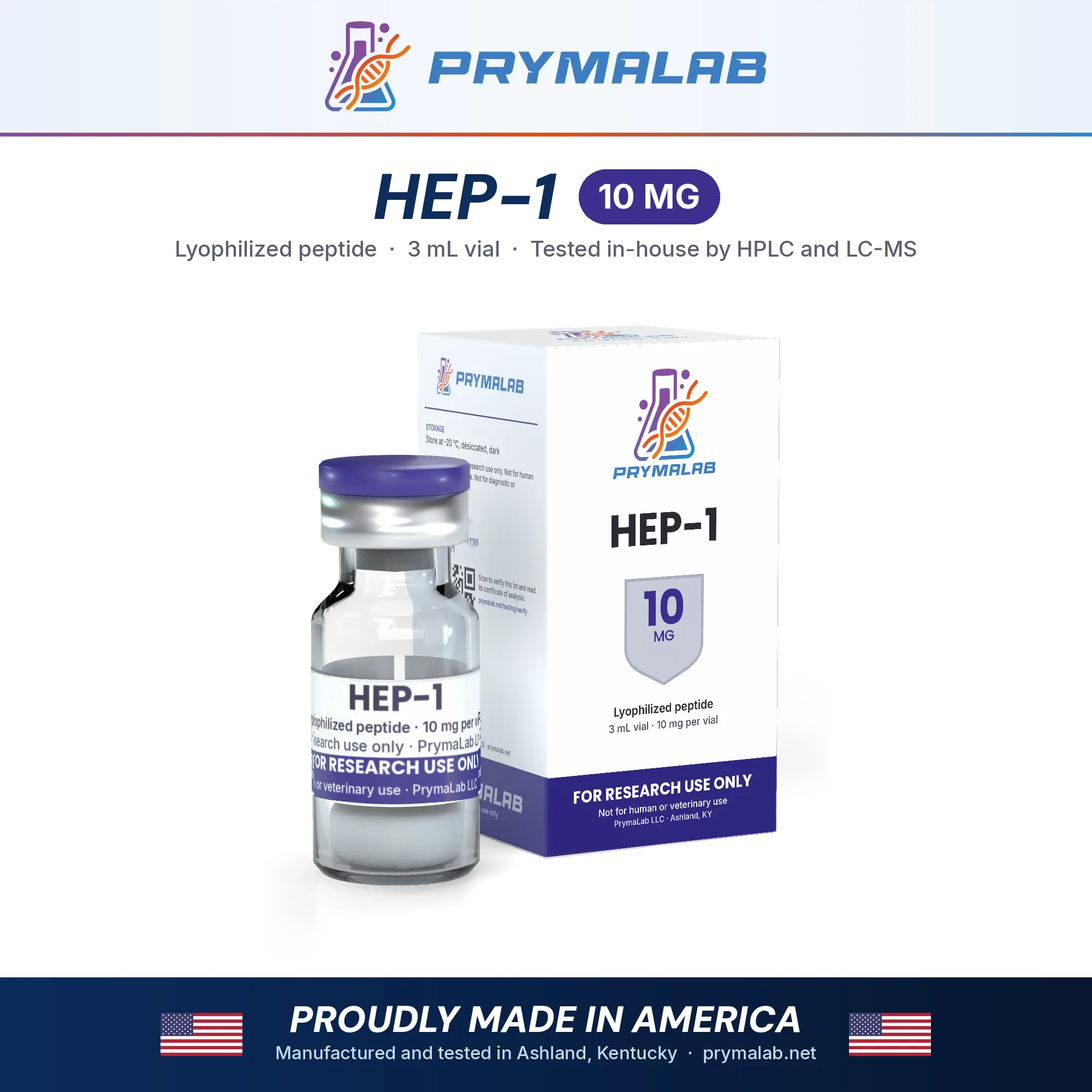
HEP-1 (Human Ezrin Peptide) 10mg
Human Ezrin Peptide One, the 14-residue ezrin fragment TEKKRRETVEREKE, 10 mg freeze-dried
HEP-1 is Human Ezrin Peptide One: a 14-amino-acid copy of a stretch of the alpha domain of human ezrin, a membrane-cytoskeleton linker protein. It is the active ingredient of Gepon, an immunomodulator registered in Russia since 2001. This listing is the 10 mg vial of freeze-dried powder, the main fill; a 5 mg vial is also sold. Despite the name, HEP-1 has nothing to do with the liver: HEP stands for Human Ezrin Peptide.
Specifications
| Property | Value |
|---|---|
| Compound | HEP-1 (Human Ezrin Peptide One), ezrin 324-337; synthetic immunomodulatory tetradecapeptide |
| CAS number | 174641-44-2 |
| Molecular formula | C74H132N26O27 |
| Theoretical mass | 1818.0 Da |
| Sequence / structure | H-TEKKRRETVEREKE-OH; 14 residues, linear, all L, free N- and C-termini, no disulfides. |
| Label claim | 10 mg per vial |
| Form | Lyophilized (freeze-dried) powder or cake in a sealed glass vial with a rubber stopper and aluminium crimp cap |
| Storage, sealed | −20 °C, desiccated, dark |
| Purity specification | 99.0% or higher by RP-HPLC |
| Lot certificate | Certificate for the first lot: in preparation. Published certificates appear on the results page and can be checked on the verify page. |
Fills in this range
HEP-1 is sold in 2 fills. The compound and the testing are the same in every fill; only the amount in the vial changes.
| Fill | Listing |
|---|---|
| 5 mg | HEP-1 (Human Ezrin Peptide) 5mg |
| 10 mg | HEP-1 (Human Ezrin Peptide) 10mg (this page) |
What the structure is
The sequence is Thr-Glu-Lys-Lys-Arg-Arg-Glu-Thr-Val-Glu-Arg-Glu-Lys-Glu (TEKKRRETVEREKE), linear, all L-amino acids, free at both ends, with no disulfides or other modifications. Formula C74H132N26O27, theoretical mass 1818.0 Da (PubChem CID 25078222, CAS 174641-44-2). Five glutamates and six basic residues make it one of the more water-soluble peptides in the catalogue. In the current UniProt numbering of human ezrin (P15311) the segment sits at residues 325-338; the developers’ papers call it 324-337.
A certificate that shows a mass far from 1818 Da is not HEP-1. The pentapeptide Tyr-Pro-Lys-Pro-Glu that some vendor pages attach to this name has no record in PubChem or the literature, and HEP-1 is not Livagen (Lys-Glu-Asp-Ala), the Khavinson liver tetrapeptide.
What the research covers
Origin and proposed mechanism
HEP-1 reproduces a 14-residue stretch of the alpha domain of human ezrin described by its developers as a zipped pair of anti-parallel helices with alternating charged side chains (the ‘Hep-receptor’)4. The developers report that ezrin peptides of 5 to 14 residues from this region reduce expression of IL-6 and other inflammatory cytokines, act as adjuvants of B- and T-cell responses, and are active against a range of viruses in cell culture and mice, largely in Russian-language publications summarised in their 2021 review4. A defined receptor has not been identified, and the mechanistic account rests mainly on work from the originating group4.
Anti-inflammatory activity in mouse colitis
Chulkina et al. gave pharmaceutical-grade HEP-1 (Gepon) by intraperitoneal injection to C57BL/6 mice with dextran sulphate sodium (DSS) colitis3. Treated mice had less colonic pathology, bloody diarrhoea and weight loss; colon transcription of Il1b, Il6 and Nos2 fell while Tgfb1, Il10 and Arg1 were unchanged3. Flow cytometry showed fewer infiltrating Ly6G+ granulocytes and Ly6C+ monocytes, with reduced pro-inflammatory gene expression in those sorted cells but not in CD64+ macrophages; in vitro, the peptide reduced IL-1beta and IL-6 mRNA in cultured Ly6C+ monocytes3.
Fibroblast signalling in vitro
In NIH/3T3 mouse embryonic fibroblasts, TEKKRRETVEREKE induced morphological and biochemical features of fibroblast differentiation, including alpha-SMA-containing stress fibres2. Unlike TGF-beta1, which activated both SMAD and non-canonical pathways, the peptide activated only ERK1/2 phosphorylation without SMAD signalling, and the response was unchanged in CD44-knockout cells, indicating the hyaluronan receptor CD44 is not required2. The authors link this to the clinical use of Gepon on wounds and ulcers, but the study itself is a cell-culture signalling study2.
Clinical reports in Russia
Salamov et al. reported two small open-label studies of oral HEP-1 monotherapy in HIV-infected patients with hepatitis C (18 and 10 patients, no placebo or comparator arm)1. They describe reductions in HCV RNA in most patients, an average fall of about 2 log10 across 37 patients, undetectable HCV RNA in a minority, normalisation of serum liver enzymes and no adverse reactions1. These are uncontrolled, developer-authored observations from 2007 and have not been followed by registration trials outside Russia1,4. The developers’ 2021 review also describes mouse adjuvant experiments (higher haemagglutinin and haemolysin titres after HEP-1 pre-treatment), a Moscow study in which oral HEP-1 raised antibody titres after hepatitis B vaccination, and preliminary inhaled use in acute respiratory viral illness and COVID-19, which the authors themselves state must be replicated in large randomised placebo-controlled trials4.
What is not established
Almost all pharmacology comes from the peptide’s developers (Holms, Ataullakhanov and colleagues) and from Russian-language journals; no independent replication in Western journals was found1,2,3,4. Human data are open-label or small randomised studies without blinding, and the hepatitis C reports predate direct-acting antivirals and had no control arm1,4. The molecular target (‘Hep-receptor’ mimicry, cytokine suppression) is a proposal, not an identified receptor4. The hepatoprotective pentapeptide identity suggested for this product name is unsupported. None of the published work used material from this supplier, and no pharmacokinetic data for the lyophilized research material exist.
Clinical and regulatory status
Approved only in Russia: HEP-1 is the active ingredient of Gepon, registered for human use in the Russian Federation since 2001 as an immunomodulator for topical and internal use4, and listed by Deigin et al. among the 14 original peptide drugs registered in Russia, classed as an antiviral agent5. No FDA or EMA authorisation and no registered Western clinical trial were found in the sources opened. This listing is a research-grade synthetic peptide, not the pharmaceutical product.
Related listings: Thymosin Alpha-1 5mg, Thymalin 10mg, Thymogen Peptide 20mg, KPV (5mg). The healing and recovery peptides category lists the rest of the range.
How each lot is tested
Every lot is tested in PrymaLab’s own laboratory in Ashland, Kentucky before release: RP-HPLC for purity, LC-MS for identity, Karl Fischer titration for water, LAL for endotoxin and USP <71> for sterility. Published certificates are listed on the results page and can be checked by number and key on the verify page. These are in-house results from PrymaLab Analytical, not an independent test, and the lab is not accredited to ISO 17025. The third-party testing guarantee on this page still applies: if any independent laboratory finds the wrong compound, or less than the stated purity or amount, the order is refunded and the cost of the test is reimbursed.
Frequently asked questions
What exactly is HEP-1?
HEP-1 (Human Ezrin Peptide One) is the synthetic 14-amino-acid peptide TEKKRRETVEREKE, copied from the alpha domain of human ezrin. It is the active ingredient of the Russian drug Gepon. PubChem CID 25078222, CAS 174641-44-2, C74H132N26O27, about 1818 Da.
Is HEP-1 a liver (hepato-) peptide?
No. ‘HEP’ stands for Human Ezrin Peptide and the brand name Gepon/Hepon is a transliteration, not a reference to the liver. The only hepatic connection in the literature is an open-label report of oral HEP-1 in hepatitis C in HIV-positive patients. It is not Khavinson’s liver bioregulator Livagen (Lys-Glu-Asp-Ala).
What models has HEP-1 been tested in?
Mouse DSS colitis (intraperitoneal; colon histology, cytokine transcripts, infiltrating myeloid cells), NIH/3T3 fibroblast culture (ERK1/2 vs SMAD signalling, alpha-SMA), mouse immunisation and lethal virus-challenge models summarised by the developers, and small uncontrolled or lightly controlled human studies in Russia.
How does HEP-1 differ from RepG3 and other ezrin peptides?
RepG3 (GEKKRRETVEREGG) is a later derivative with glycine substitutions that the developers report as more anti-inflammatory in the mouse colitis model; shorter 5- to 12-residue fragments of the same ezrin region have also been tested. HEP-1 is the original, registered 14-mer.
How should HEP-1 be stored and dissolved?
Lyophilized: −20 °C, sealed and desiccated, protected from light. It is very hydrophilic (five glutamates, six basic residues) and dissolves readily in water or buffer; keep solutions at 2 to 8 °C and use within a few days, or aliquot and freeze once. It contains no Met, Cys or Trp, so it is comparatively resistant to oxidation. Supplier-standard guidance.
Is HEP-1 approved anywhere?
As the drug Gepon it has been registered in the Russian Federation since 2001. No approval in the United States or European Union was found. The research material sold here is not the pharmaceutical product and is for laboratory use only.
References
- Salamov G, Holms R, Bessler WG, Ataullakhanov R Treatment of hepatitis C virus infection with human ezrin peptide one (HEP1) in HIV infected patients. Arzneimittelforschung. 2007;57(7):497-504. DOI · PubMed
- Chulkina M, Negmadjanov U, Lebedeva E, Pichugin A, Mazurov D, Ataullakhanov R, Holmuhamedov E Synthetic peptide TEKKRRETVEREKE derived from ezrin induces differentiation of NIH/3T3 fibroblasts. European Journal of Pharmacology. 2017;811:249-259. DOI · PubMed
- Chulkina MM, Pichugin AV, Ataullakhanov RI Pharmaceutical grade synthetic peptide Thr-Glu-Lys-Lys-Arg-Arg-Glu-Thr-Val-Glu-Arg-Glu-Lys-Glu ameliorates DSS-induced murine colitis by reducing the number and pro-inflammatory activity of colon tissue-infiltrating Ly6G+ granulocytes and Ly6C+ monocytes. Peptides. 2020;132:170364. DOI · PubMed
- Holms RD, Ataullakhanov RI Ezrin Peptide Therapy from HIV to COVID: Inhibition of Inflammation and Amplification of Adaptive Anti-Viral Immunity. International Journal of Molecular Sciences. 2021;22(21):11688. DOI · PubMed
- Deigin VI, Poluektova EA, Beniashvili AG, Kozin SA, Poluektov YM Development of Peptide Biopharmaceuticals in Russia. Pharmaceutics. 2022;14(4):716. DOI · PubMed
Research use only
For laboratory research use only. HEP-1 (Human Ezrin Peptide) 10mg is not a drug, food, cosmetic or dietary supplement, is not approved by the FDA or any comparable authority for human or veterinary use, and must not be given to people or animals. It is sold to qualified researchers and institutions, and the buyer is responsible for lawful handling and disposal.








Reviews
There are no reviews yet.