
Description
PrymaLab · Research use only
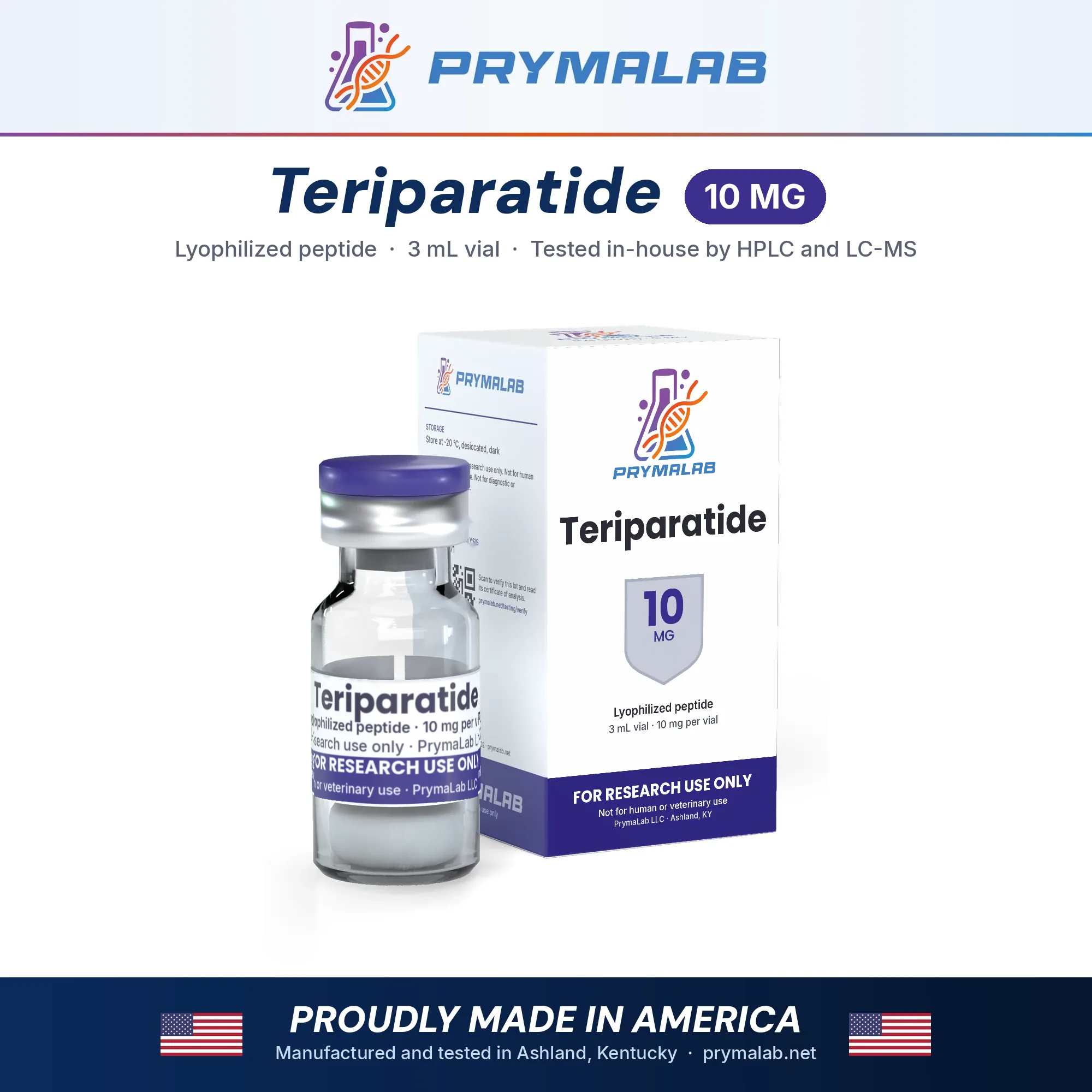
Teriparatide (PTH 1-34) 10mg
Human parathyroid hormone fragment 1-34, hPTH(1-34), 10 mg freeze-dried
Teriparatide is the first 34 amino acids of human parathyroid hormone, the fragment that carries essentially the whole receptor-activating activity of the 84-residue hormone. Work from the 1970s fixed PTH(1-34) as the minimum fully active piece, a 1980 study first showed it adding trabecular bone in people, and Eli Lilly turned the recombinant peptide into the drug Forteo in 2002. This listing is the 10 mg vial of freeze-dried powder, the main fill; a 5 mg and a 20 mg vial are also sold. This listing is a research-grade synthetic peptide, not the pharmaceutical pen.
Specifications
| Property | Value |
|---|---|
| Compound | Teriparatide, human PTH(1-34) (LY333334); PTH1 receptor agonist |
| CAS number | 52232-67-4 |
| Molecular formula | C181H291N55O51S2 |
| Theoretical mass | 4117.7 Da |
| Sequence / structure | H-SVSEIQLMHNLGKHLNSMERVEWLRKKLQDVHNF-OH; 34 residues, Met8, Met18, Trp23, no cysteines. |
| Label claim | 10 mg per vial |
| Form | Lyophilized (freeze-dried) powder or cake in a sealed glass vial with a rubber stopper and aluminium crimp cap |
| Storage, sealed | −20 °C, desiccated, dark |
| Purity specification | 99.0% or higher by RP-HPLC |
| Lot certificate | Certificate for the first lot: in preparation. Published certificates appear on the results page and can be checked on the verify page. |
Fills in this range
Teriparatide is sold in 3 fills. The compound and the testing are the same in every fill; only the amount in the vial changes.
| Fill | Listing |
|---|---|
| 5 mg | Teriparatide (PTH 1-34) 5mg |
| 10 mg | Teriparatide (PTH 1-34) 10mg (this page) |
| 20 mg | Teriparatide (PTH 1-34) 20mg |
What the structure is
Ser-Val-Ser-Glu-Ile-Gln-Leu-Met-His-Asn-Leu-Gly-Lys-His-Leu-Asn-Ser-Met-Glu-Arg-Val-Glu-Trp-Leu-Arg-Lys-Lys-Leu-Gln-Asp-Val-His-Asn-Phe (SVSEIQLMHNLGKHLNSMERVEWLRKKLQDVHNF), linear, free at both ends, no cysteines, no modifications. Formula C181H291N55O51S2, theoretical mass 4117.7 Da (PubChem CID 16133850, CAS 52232-67-4). Two methionines (Met8, Met18) and one tryptophan (Trp23) make it oxidation- and light-sensitive; methionine oxidation is a known degradation route for PTH peptides and shows as +16 Da species on LC-MS.
The pharmaceutical is made recombinantly in E. coli; research lots are made by solid-phase synthesis to the same sequence and are usually acetate or trifluoroacetate salts, which the certificate states. Abaloparatide is a PTHrP(1-34) analogue with a different sequence, and PTH(1-84) is the full hormone; neither is this product.
What the research covers
The 1-34 fragment carries the hormone’s activity
Working with synthetic fragments of the amino-terminal region of bovine PTH, Tregear and colleagues found that the 1-34 peptide retained about 80% of the natural hormone’s molar activity in a rat renal adenylyl cyclase assay and about 130% in a chick hypercalcaemia assay in vivo1. Removing the N-terminal alanine markedly reduced activity and removing the second residue abolished it, whereas the C-terminus tolerated shortening to residue 271. These data established PTH(1-34) as the minimum fully active fragment and are the structural basis for teriparatide1,6.
Receptor pharmacology
PTH(1-34) acts through the type-1 PTH receptor (PTH1R), a family B G-protein-coupled receptor that also binds PTH-related protein and is expressed on bone and kidney cells6. Ligand binding follows a ‘two-site’ model in which the C-terminal part of the peptide docks on the receptor’s extracellular domain and the N-terminal residues engage the transmembrane core to activate Gs/cAMP signalling; certain PTH analogues form unusually stable receptor complexes that continue to signal from endosomes6. Native PTH and PTH(1-34) have been compared with PTHrP-based ligands in this framework, which informs the design of newer anabolic agents6.
Intermittent exposure is anabolic: osteoblast survival in mice
Daily PTH injections in mice with normal bone mass, and in mice with osteopenia due to defective osteoblastogenesis, increased bone formation without increasing the generation of new osteoblasts3. Instead, PTH prolonged the lifespan of mature osteoblasts by preventing their apoptosis, an effect sufficient to account for the gain in bone mass and reproduced in vitro in rodent and human osteoblasts and osteocytes3. This work is one of the mechanistic explanations for why intermittent (once-daily) PTH builds bone whereas continuous exposure, as in hyperparathyroidism, is catabolic3,6.
Early human evidence of trabecular bone gain
In a 1980 multicentre study, 21 patients with osteoporosis received once-daily subcutaneous human PTH(1-34) for 6-24 months2. Iliac crest biopsies showed a mean 70% increase in trabecular bone volume above baseline, confirmed by repeat blinded measurement; the new bone was histologically normal and no hypercalcaemia occurred, although group calcium balance did not change significantly2. The authors interpreted the findings as a dissociation of formation from resorption confined to trabecular bone2.
Fracture reduction in postmenopausal osteoporosis (registration trial)
The Fracture Prevention Trial randomised 1,637 postmenopausal women with prior vertebral fractures to daily subcutaneous PTH(1-34) 20 or 40 micrograms or placebo for a median of 21 months4. New vertebral fractures occurred in 14% of placebo recipients versus 5% and 4% in the 20- and 40-microgram groups (relative risks 0.35 and 0.31), and new non-vertebral fragility fractures in 6% versus 3% in each active group4. Lumbar spine bone mineral density rose 9 and 13 percentage points more than placebo; the 40-microgram dose reduced radial shaft BMD slightly more and produced more nausea and headache without additional fracture benefit4. This trial underpinned the 2002 approval of Forteo4.
Head-to-head versus an oral bisphosphonate (VERO)
VERO was a 24-month, double-blind, double-dummy trial in 1,360 postmenopausal women with severe osteoporosis comparing daily teriparatide 20 micrograms with weekly oral risedronate 35 mg7. New radiographic vertebral fractures occurred in 5.4% of the teriparatide group versus 12.0% with risedronate (risk ratio 0.44), and clinical fractures in 4.8% versus 9.8% (hazard ratio 0.48); non-vertebral fragility fractures were numerically lower (4.0% vs 6.1%) but not statistically different7.
Rat osteosarcoma and human surveillance
In a 2-year study, Fischer 344 rats given daily subcutaneous rhPTH(1-34) at 5, 30 or 75 micrograms/kg developed marked increases in bone mass and dose-dependent bone proliferative lesions, including osteosarcoma in 3, 21 and 31 males and 4, 12 and 23 females per group respectively5. The authors attributed the tumours to the long duration and exaggerated skeletal response of the growing rat and judged them unlikely to predict risk in skeletally mature adults treated for a limited time5. A 15-year US surveillance study (2003-2016) interviewing 1,173 adult osteosarcoma patients found three with prior teriparatide use, a standardised incidence ratio of 0.72 (90% CI 0.20-1.86), i.e. no excess over background8. FDA subsequently removed the boxed warning from the US label in November 2020 (see regulatory status).
What is not established
Clinical evidence for teriparatide comes from regulated trials of the recombinant pharmaceutical product; no study used research-grade synthetic material from this or any other research supplier, and synthetic lots may differ in salt form, purity and net peptide content. The anti-apoptotic osteoblast mechanism was demonstrated mainly in mice and cell culture and is one of several proposed mechanisms that are not fully settled3,6. Fracture benefit has been shown in postmenopausal women and, by extension of BMD data, in men and glucocorticoid-treated patients, but head-to-head fracture trials exist only against risedronate7. Human osteosarcoma surveillance is reassuring but limited by the rarity of the tumour, incomplete case ascertainment (24% of expected cases interviewed) and few data beyond 2 years of exposure8. Preclinical reports on fracture healing, dental and tendon applications are outside the approved indications and were not reviewed here.
Clinical and regulatory status
Approved prescription drug in its pharmaceutical forms; the product offered here is a research-grade lyophilized peptide, not the pharmaceutical. Forteo (teriparatide [rDNA origin] injection, Eli Lilly) was approved by FDA on 26 November 2002 for osteoporosis in patients at high risk of fracture, and Forsteo received EU marketing authorisation on 10 June 2003 (EMA Forsteo EPAR page). Indications in the EU cover postmenopausal women, men at increased fracture risk and glucocorticoid-induced osteoporosis (EMA Terrosa EPAR page). The original US label carried a boxed warning for osteosarcoma based on the rat study5 and advised against more than 2 years of lifetime use; effective 16 November 2020 FDA removed the boxed warning and relaxed the 2-year limit after clinical, observational and surveillance data showed no excess human osteosarcoma (Krege JH et al., JBMR Plus 2022;6(9):e10665, doi 10.1002/jbm4.10665)8. Follow-on products: Bonsity (Pfenex/Alvogen) was approved by FDA on 4 October 2019 via the 505(b)(2) pathway with Forteo as reference; FDA approved generic teriparatide injection (0.56 mg/2.24 mL) from Apotex and Teva on 16 November 2023 and from Amphastar on 12 December 2025 (Drugs.com generic-availability page). In the EU, biosimilars Terrosa (Gedeon Richter, authorised 4 January 2017) and others reference Forsteo (EMA Terrosa EPAR page). Teriparatide is a small peptide regulated as a drug (NDA/ANDA) in the US rather than under the biosimilar pathway.
Related listings: Cartalax 20mg Peptide, TB-500 (Thymosin Beta-4) 5mg, BPC-157 5MG, IGF1 LR3 1MG. The healing and recovery peptides category lists the rest of the range.
How each lot is tested
Every lot is tested in PrymaLab’s own laboratory in Ashland, Kentucky before release: RP-HPLC for purity, LC-MS for identity, Karl Fischer titration for water, LAL for endotoxin and USP <71> for sterility. Published certificates are listed on the results page and can be checked by number and key on the verify page. These are in-house results from PrymaLab Analytical, not an independent test, and the lab is not accredited to ISO 17025. The third-party testing guarantee on this page still applies: if any independent laboratory finds the wrong compound, or less than the stated purity or amount, the order is refunded and the cost of the test is reimbursed.
Frequently asked questions
What is teriparatide and how does it relate to parathyroid hormone?
Teriparatide is the first 34 amino acids of human parathyroid hormone (PTH), the 84-residue hormone that regulates blood calcium. Work in the 1970s showed the 1-34 fragment carries essentially the full receptor-activating activity of the hormone, and the N-terminal residues are indispensable. It activates the PTH1 receptor on bone and kidney cells.
Why is intermittent PTH anabolic when chronic PTH excess causes bone loss?
Continuous elevation of PTH, as in hyperparathyroidism, favours resorption, but brief daily exposure increases bone formation. In mice, daily PTH injections extended the lifespan of mature osteoblasts by preventing apoptosis without increasing osteoblast production, which was sufficient to explain the gain in bone mass. Additional mechanisms are discussed in the receptor pharmacology literature.
How does teriparatide differ from abaloparatide and from PTH(1-84)?
Teriparatide is the native human PTH(1-34) sequence. Abaloparatide is a synthetic analogue of PTH-related protein (PTHrP) residues 1-34 with several substitutions and a different receptor-binding profile. PTH(1-84) is the full-length hormone. All act on PTH1R, but they are different molecules with different masses and should not be substituted for each other.
Is this product the same as Forteo or Bonsity?
No. Forteo, Forsteo, Bonsity and generic teriparatide injection are sterile, formulated pen products manufactured under GMP and approved by FDA/EMA for osteoporosis. This listing is a research-grade lyophilized peptide for laboratory use only; it has not been evaluated for human use and is not interchangeable with those drug products.
What is the osteosarcoma story?
In a 2-year study, Fischer 344 rats given daily rhPTH(1-34) developed dose-dependent osteosarcomas, which the authors attributed to prolonged exaggerated bone formation in a growing rodent skeleton. A 15-year US postmarketing surveillance study found no excess of adult osteosarcoma in teriparatide users (SIR 0.72), and FDA removed the boxed warning in 2020. The rodent finding remains relevant when designing long-duration rat studies.
How should the lyophilized peptide be stored and handled?
Keep sealed vials at −20 °C or colder, desiccated and in the dark. The sequence has two methionines (Met8, Met18) and a tryptophan (Trp23), so it is prone to oxidation and photodegradation; reconstitute in degassed sterile water or dilute acidic buffer, keep solutions at 2 to 8 °C for short-term use, and aliquot and freeze for longer storage, avoiding repeated freeze-thaw. Methionine oxidation is a recognised degradation route for PTH peptides, so solution age matters in bioassays.
References
- Tregear GW, Van Rietschoten J, Greene E, Keutmann HT, Niall HD, Reit B, Parsons JA, Potts JT Jr Bovine parathyroid hormone: minimum chain length of synthetic peptide required for biological activity. Endocrinology. 1973;93(6):1349-1353. DOI · PubMed
- Reeve J, Meunier PJ, Parsons JA, Bernat M, Bijvoet OL, Courpron P, Edouard C, Klenerman L, Neer RM, Renier JC, Slovik D, Vismans FJ, Potts JT Jr Anabolic effect of human parathyroid hormone fragment on trabecular bone in involutional osteoporosis: a multicentre trial. British Medical Journal. 1980;280(6228):1340-1344. DOI · PubMed
- Jilka RL, Weinstein RS, Bellido T, Roberson P, Parfitt AM, Manolagas SC Increased bone formation by prevention of osteoblast apoptosis with parathyroid hormone. Journal of Clinical Investigation. 1999;104(4):439-446. DOI · PubMed
- Neer RM, Arnaud CD, Zanchetta JR, Prince R, Gaich GA, Reginster JY, Hodsman AB, Eriksen EF, Ish-Shalom S, Genant HK, Wang O, Mitlak BH Effect of parathyroid hormone (1-34) on fractures and bone mineral density in postmenopausal women with osteoporosis. New England Journal of Medicine. 2001;344(19):1434-1441. DOI · PubMed
- Vahle JL, Sato M, Long GG, Young JK, Francis PC, Engelhardt JA, Westmore MS, Linda Y, Nold JB Skeletal changes in rats given daily subcutaneous injections of recombinant human parathyroid hormone (1-34) for 2 years and relevance to human safety. Toxicologic Pathology. 2002;30(3):312-321. DOI · PubMed
- Gardella TJ, Vilardaga JP International Union of Basic and Clinical Pharmacology. XCIII. The parathyroid hormone receptors – family B G protein-coupled receptors. Pharmacological Reviews. 2015;67(2):310-337. DOI · PubMed
- Kendler DL, Marin F, Zerbini CAF, Russo LA, Greenspan SL, Zikan V, Bagur A, Malouf-Sierra J, Lakatos P, Fahrleitner-Pammer A, Lespessailles E, Minisola S, Body JJ, Geusens P, Moricke R, Lopez-Romero P Effects of teriparatide and risedronate on new fractures in post-menopausal women with severe osteoporosis (VERO): a multicentre, double-blind, double-dummy, randomised controlled trial. Lancet. 2018;391(10117):230-240. DOI · PubMed
- Gilsenan A, Midkiff K, Harris D, Kellier-Steele N, McSorley D, Andrews EB Teriparatide did not increase adult osteosarcoma incidence in a 15-year US postmarketing surveillance study. Journal of Bone and Mineral Research. 2021;36(2):244-251. DOI · PubMed
Research use only
For laboratory research use only. Teriparatide (PTH 1-34) 10mg is not a drug, food, cosmetic or dietary supplement, is not approved by the FDA or any comparable authority for human or veterinary use, and must not be given to people or animals. It is sold to qualified researchers and institutions, and the buyer is responsible for lawful handling and disposal.








Reviews
There are no reviews yet.