
Description
PrymaLab · Research use only
IGF1 LR3 1MG
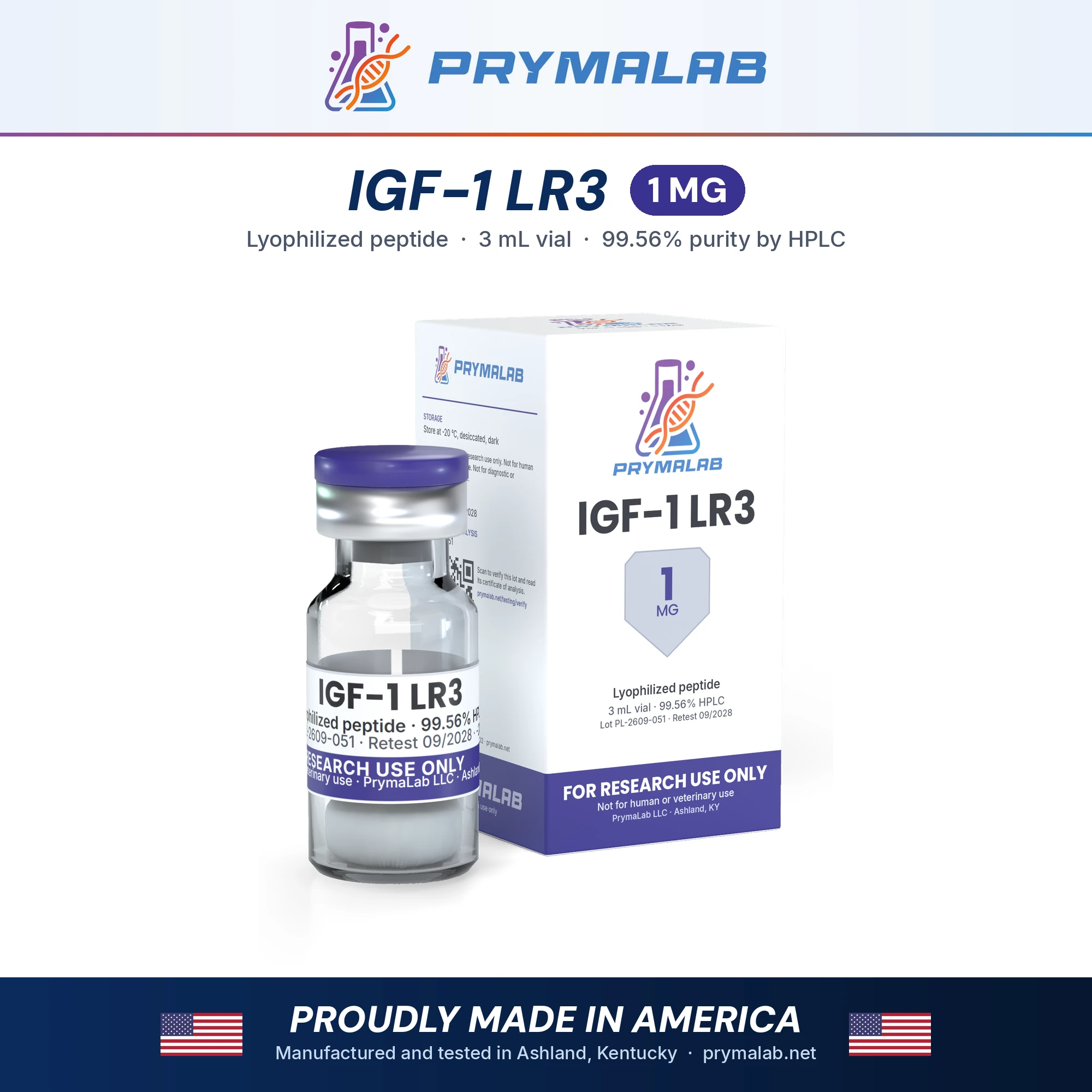
Long R3 IGF-1, the 83-residue IGF-1 analogue, freeze-dried in a 1 mg vial
IGF-1 LR3, or Long R3 IGF-1, is a recombinant analogue of human insulin-like growth factor 1: 83 residues, made up of a 13-residue N-terminal extension followed by IGF-1 with arginine in place of glutamate at position 3. This listing is a sealed vial with 1 mg of the protein as freeze-dried powder. Research on it has centred on how those changes weaken binding to IGF-binding proteins and raise potency in cultured myoblasts and in rats.
Specifications
| Property | Value |
|---|---|
| Compound | IGF-1 LR3 Long R3 IGF-1; recombinant human IGF-1 analogue with a 13-residue N-terminal extension and Glu3→Arg |
| CAS number | 143045-27-6 |
| Molecular formula | C 400 H 625 N 111 O 115 S 9 (reduced-chain calculation) |
| Theoretical mass | 9117.6 Da (reduced-chain calculation; 9111.6 Da with the three disulfides formed) |
| Sequence / structure | H-MFPAMPLSSLFVNGPRTLCGAELVDALQFVCGDRGFYFNKPTGYGSSSRRAPQTGIVDECCFRSCDLRRLEMYCAPLKPAKSA-OH (83 residues; three intrachain disulfides; free N- and C-termini) |
| Label claim | 1 mg/vial |
| Form | Lyophilized (freeze-dried) powder or cake in a sealed glass vial with a rubber stopper and aluminium crimp cap |
| Storage, sealed | −20 °C, desiccated, dark; avoid freeze–thaw |
| Purity specification | 99.0% or higher by RP-HPLC |
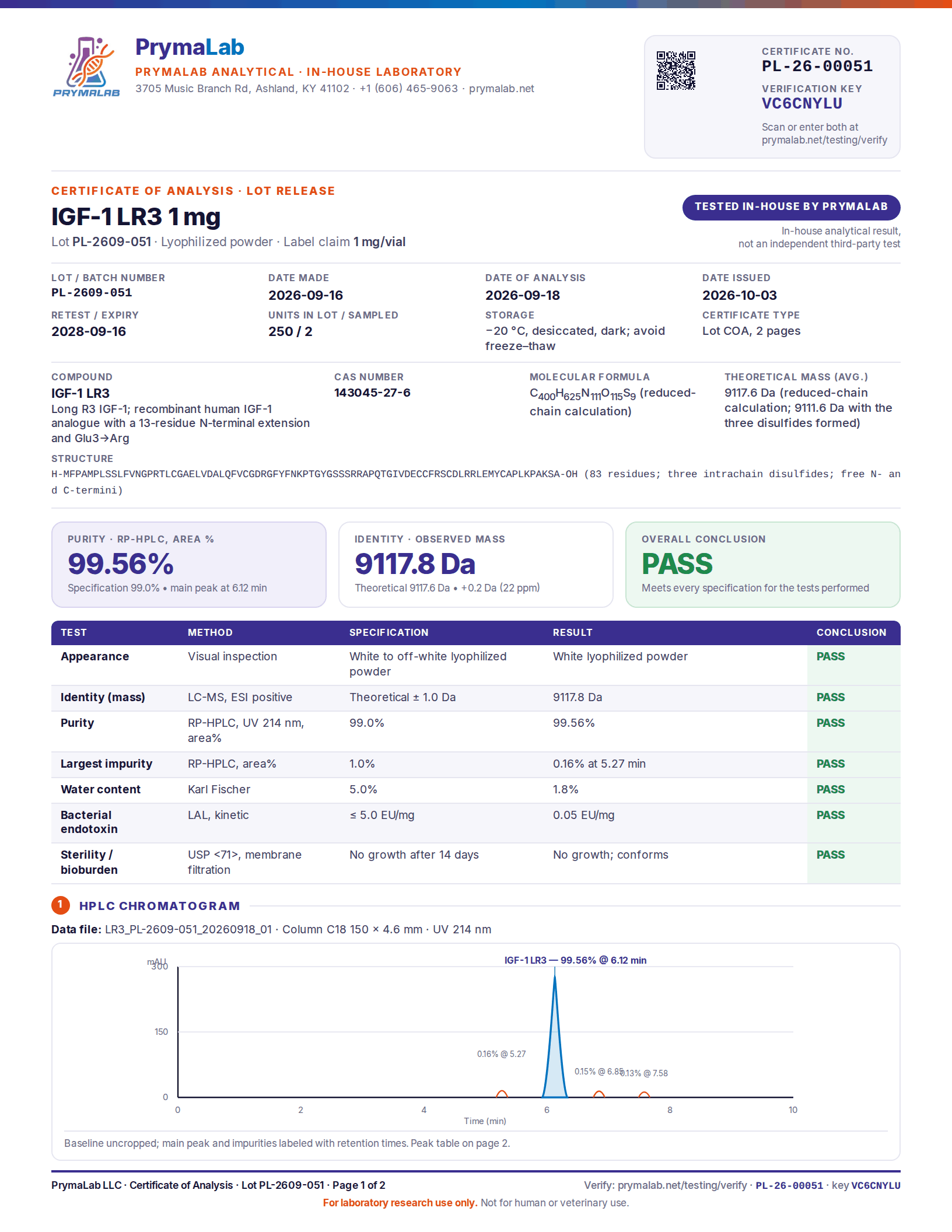
| Lot certificate | Results for the lot now shipping are in the certificate panel on this page |
| Safety data sheet | PL-SDS-087 |
A folded protein with two theoretical masses
At 83 residues with three intrachain disulfides, IGF-1 LR3 is a small folded protein rather than a short linear peptide. The certificate prints the full sequence, MFPAMPLSSLFVN followed by GPRTL and the rest of the IGF-1 chain, and gives two theoretical masses: 9117.6 Da calculated for the reduced chain and 9111.6 Da with the three disulfides formed. The 6 Da gap is the six hydrogen atoms lost when the three bonds close. The formula C400H625N111O115S9 is the reduced-chain calculation, and the CAS number is 143045-27-6. At 9111.6 Da the 1 mg fill corresponds to about 0.11 µmol, a little less once the water content on the certificate is allowed for. The same protein is sold in solution, in a preloaded IGF-1 LR3 pen and an IGF-1 LR3 nasal spray.
What the research covers
How Long R3 IGF-I was built
IGF-1 LR3 began as one of a set of fusion proteins made as tools for studying IGF-I action1. Francis and colleagues expressed them in Escherichia coli with the first 11 amino acids of methionyl porcine growth hormone and a Val-Asn pair ahead of the IGF-I sequence, and in one of them replaced glutamate 3 of human IGF-I with arginine, naming it Long [Arg3]-IGF-I1. The hydrophobic N-terminal extension appeared to help the reduced, denatured chain fold correctly, giving very high yields of active product1. In L6 rat myoblasts all of the long analogues were more potent than authentic IGF-I1. The sequence on this vial’s certificate follows that design: thirteen extension residues, then IGF-I with arginine at position 3.
Binding proteins and potency
The changes are aimed at the IGF-binding proteins. Baxter described six homologous IGFBPs that bind IGF-I and IGF-II with high affinity; all six can inhibit IGF action, although IGFBP-1, -3 and -5 can also stimulate it under some conditions2. Firth and Baxter put the inhibition down to sequestration, the binding proteins holding IGFs away from the type I IGF receptor3. Work on the N-terminus of IGF-I showed why the first residues matter. Bagley and colleagues found that removing the first three residues raised potency in L6 myoblasts far more than it changed receptor binding, and traced the difference to a binding protein secreted by the cells that strongly preferred the longer forms4. Long R3 IGF-I reaches a similar end by extending the N-terminus and replacing glutamate 3, and Tomas and colleagues described it as binding IGF-binding proteins very weakly5.
Animal studies
In growing female rats, IGF-I delivered over 14 days by implanted osmotic pumps increased body weight gain, nitrogen retention and food conversion efficiency5. LR3IGF-I was substantially more potent than IGF-I in the same study, and both peptides generally kept organ weights and carcass composition in the proportions present at the start5. Muscle protein synthesis and myofibrillar protein breakdown both rose slightly, so protein accretion rates calculated from them could not explain the gain in nitrogen retention, and growth hormone infused for comparison did not stimulate growth5. The authors concluded that IGF variants binding less well to IGF-binding proteins were more active than IGF-I in growing animals5.
What is not established
The evidence here is cell culture and rodent work. Reviews of the IGF system also tie it to cancer biology: the IGF-I receptor is commonly overexpressed in cancers, and signalling from it affects cancer cell proliferation, adhesion, migration and cell death6. No study cited here tested IGF-1 LR3 in people, and none used this product. The IGF-1 LR3 guide covers the wider literature and compares LR3 with IGF-1 DES.
How each lot is tested
Every lot is tested in PrymaLab’s own laboratory in Ashland, Kentucky before release: RP-HPLC for purity, LC-MS for identity, Karl Fischer titration for water, LAL for endotoxin and USP <71> for sterility. The results for the lot now shipping are in the certificate panel on this page, and the certificate number, key and QR code can be checked on the verify page. These are in-house results from PrymaLab Analytical, not an independent test, and the lab is not accredited to ISO 17025. The third-party testing guarantee on this page still applies: if any independent laboratory finds the wrong compound, or less than the stated purity or amount, the order is refunded and the cost of the test is reimbursed.
Frequently asked questions
How does IGF-1 LR3 differ from native IGF-1?
It has thirteen extra residues at the N-terminus, MFPAMPLSSLFVN, and arginine instead of glutamate at position 3 of the IGF-1 sequence, so it is 83 residues long rather than 70. Both changes were made to weaken binding to the IGF-binding proteins that hold native IGF-1 away from its receptor.
How is it different from IGF-1 DES?
IGF-1 DES is native IGF-1 with its first three residues, Gly-Pro-Glu, removed, leaving 67 residues. LR3 lengthens the chain and changes residue 3 instead. Both bind IGF-binding proteins weakly, but they are different molecules with different masses, sold under separate certificates.
How should the vial be stored?
Sealed at −20 °C, desiccated and dark, and kept from repeated freezing and thawing, as the certificate specifies. Let the vial reach room temperature before opening. Once reconstituted, hold the solution at 2 to 8 °C away from light, for no longer than your laboratory has validated.
Where is the certificate for my vial?
The certificate panel on this page shows the lot now shipping: RP-HPLC purity, LC-MS identity, water, endotoxin and sterility. Check that its lot number matches the vial label; any certificate can also be confirmed by number and key on the verify page.
What does the research show?
In rat myoblasts the long analogues were more potent than IGF-I, and in growing rats LR3 was substantially more potent than IGF-I on weight gain and nitrogen retention. These are cell and rodent results from the early 1990s, and no study cited here tested the protein in people.
Is it approved for human use?
No. IGF-1 LR3 is sold for laboratory research only. It is not approved by the FDA or any other authority for human or veterinary use and must not be given to people or animals.
References
- Francis GL, Ross M, Ballard FJ, et al. Novel recombinant fusion protein analogues of insulin-like growth factor (IGF)-I indicate the relative importance of IGF-binding protein and receptor binding for enhanced biological potency. J Mol Endocrinol. 1992;8(3):213-23. DOI · PubMed
- Baxter RC. Insulin-like growth factor (IGF)-binding proteins: interactions with IGFs and intrinsic bioactivities. Am J Physiol Endocrinol Metab. 2000;278(6):E967-76. DOI · PubMed
- Firth SM, Baxter RC. Cellular actions of the insulin-like growth factor binding proteins. Endocr Rev. 2002;23(6):824-54. DOI · PubMed
- Bagley CJ, May BL, Szabo L, et al. A key functional role for the insulin-like growth factor 1 N-terminal pentapeptide. Biochem J. 1989;259(3):665-71. DOI · PubMed
- Tomas FM, Knowles SE, Chandler CS, et al. Anabolic effects of insulin-like growth factor-I (IGF-I) and an IGF-I variant in normal female rats. J Endocrinol. 1993;137(3):413-21. DOI · PubMed
- LeRoith D, Roberts CT Jr. The insulin-like growth factor system and cancer. Cancer Lett. 2003;195(2):127-37. DOI · PubMed
Research use only
For laboratory research use only. IGF1 LR3 1MG is not a drug, food, cosmetic or dietary supplement, is not approved by the FDA or any comparable authority for human or veterinary use, and must not be given to people or animals. It is sold to qualified researchers and institutions, and the buyer is responsible for lawful handling and disposal.
Other formats of IGF1 LR3
IGF1 LR3 is also stocked as IGF-1 DES Nasal Spray, IGF-DES 1mg/ml preloaded 3ml pen and IGF-DES 2mg. Each listing states its own quantity and concentration, and the pen and vial comparison explains what changes between formats.








1 review for IGF1 LR3 1MG