SUPER Human Blend peptide: what is in it and what each amino acid does
SUPER Human Blend is a blend of eight free amino acids (790 mg per vial, no peptide bonds) studied for fatty acid transport, nitric oxide synthesis and collagen metabolism. It is an amino acid mixture, not a peptide; "superhuman blend peptide" is a search term, not a chemical description. PrymaLab supplies it as Pryma SUPER Human Blend for research use.
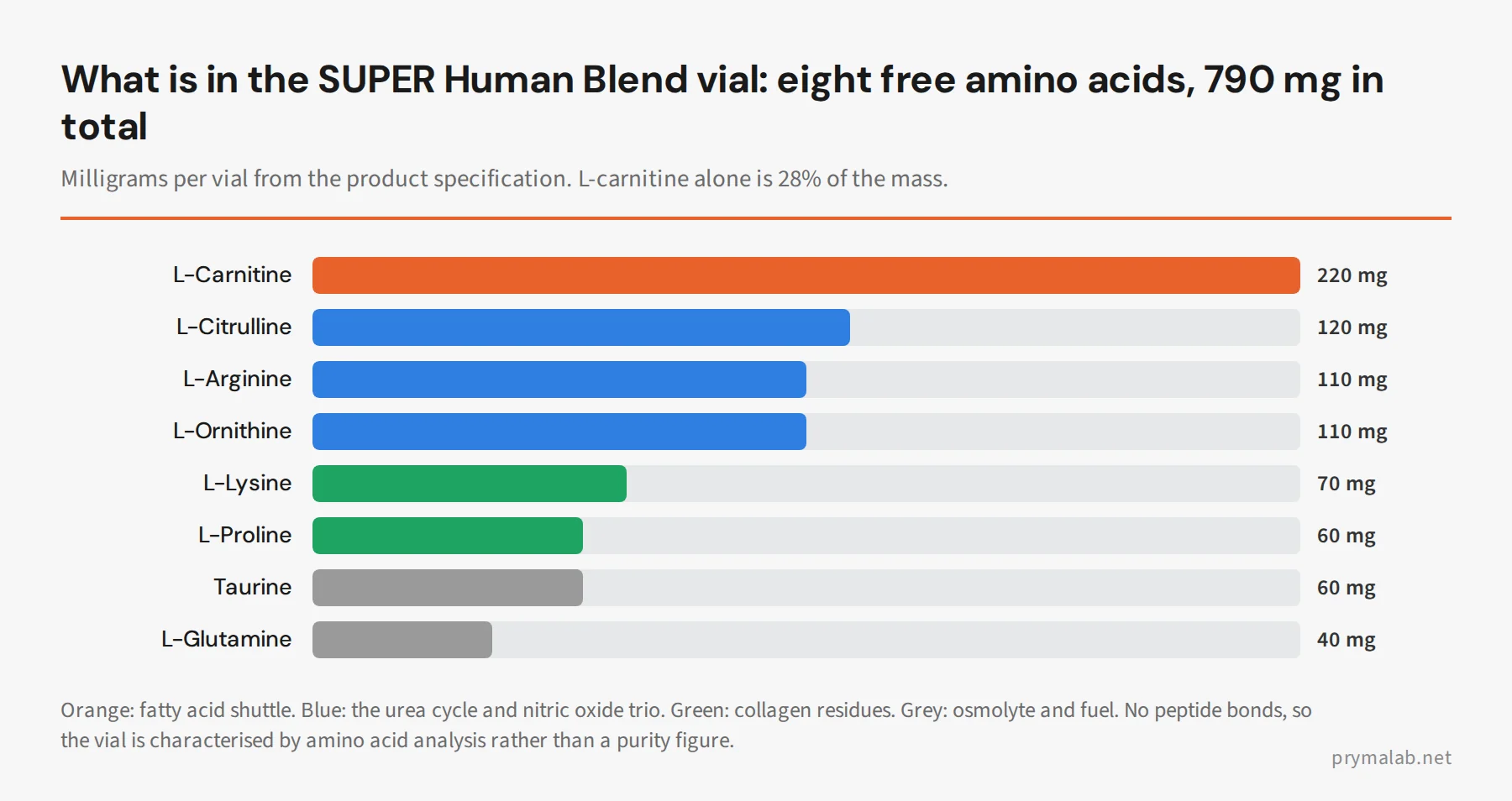
- Composition (mg): L-carnitine 220, L-citrulline 120, L-arginine 110, L-ornithine 110, L-lysine 70, L-proline 60, taurine 60, L-glutamine 40.
- Class: free amino acid blend, no peptide bonds; characterised by amino acid analysis, not by a purity figure.
- Studied for: fatty acid transport, nitric oxide and the urea cycle, collagen synthesis, osmoregulation, immune cell fuel.
- Studies cited: per component, including a crossover study of oral L-citrulline and L-arginine in 20 healthy volunteers (Schwedhelm 2008).
- Storage: lyophilised, sealed at minus 20 °C; reconstituted solution at 2 to 8 °C, prepared fresh.
- Forms and sizes at PrymaLab: Pryma SUPER Human Blend, 790 mg vial; L-Carnitine 500mg single-component vial.
The peptide reconstitution calculator handles concentration per component; what counts as a peptide covers the boundary itself.
What is in the SUPER Human blend
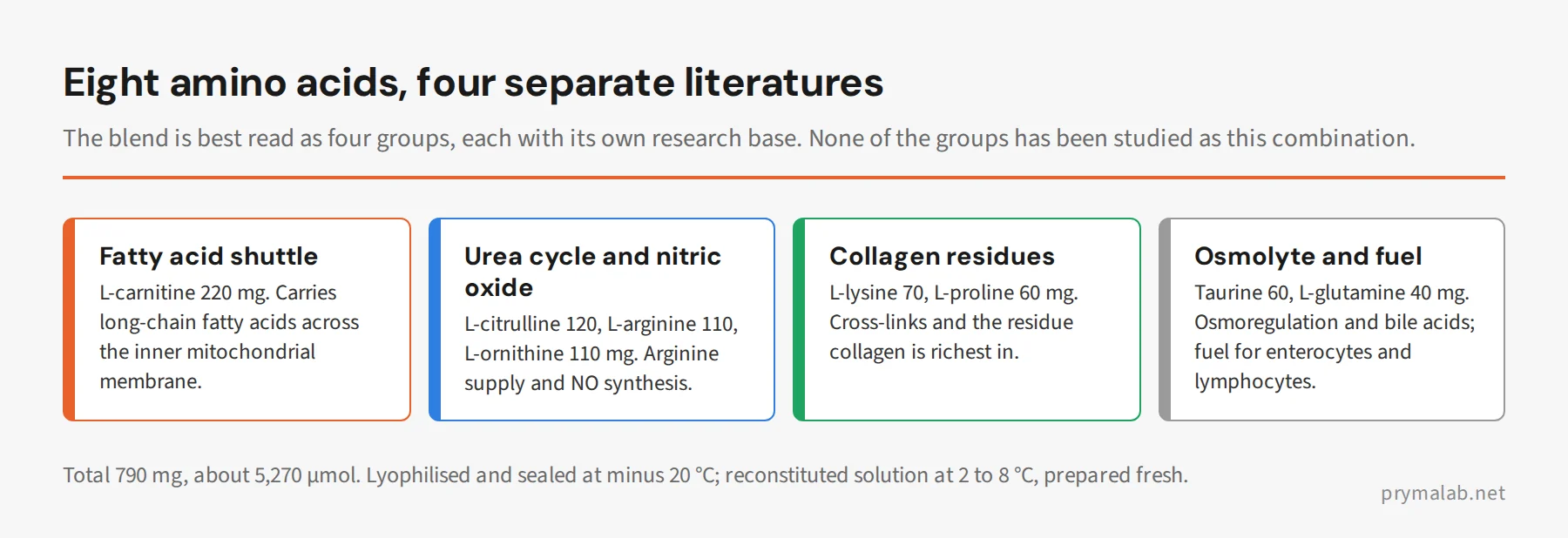
The masses below sum to 790 mg. Four components are proteinogenic, two (citrulline, ornithine) are urea cycle intermediates that no codon encodes, and two are amino acids by habit only: carnitine is a quaternary ammonium compound, taurine a sulfonic acid. Moles reorder the list; ornithine, the lightest, is second by molecule count.
| Amino acid | mg per vial | Approx. µmol | What it is studied for |
|---|---|---|---|
| L-Carnitine (161.20 g/mol) | 220 | 1,365 | Transport of long-chain fatty acids into mitochondria |
| L-Citrulline (175.19 g/mol) | 120 | 685 | Arginine precursor that bypasses hepatic arginase |
| L-Arginine (174.20 g/mol) | 110 | 632 | Substrate of nitric oxide synthase |
| L-Ornithine (132.16 g/mol) | 110 | 832 | Urea cycle intermediate; polyamine precursor |
| L-Lysine (146.19 g/mol) | 70 | 479 | Collagen cross-links; carnitine synthesis |
| L-Proline (115.13 g/mol) | 60 | 521 | Collagen residue; stress metabolism |
| Taurine (125.15 g/mol) | 60 | 479 | Osmoregulation, bile acid conjugation, calcium handling |
| L-Glutamine (146.14 g/mol) | 40 | 274 | Fuel for enterocytes and lymphocytes |
| Total | 790 | about 5,270 | Eight separate literatures |
L-carnitine: the fatty acid shuttle
Carnitine is the largest component at 220 mg, about 1,365 µmol. Long-chain fatty acids cannot cross the inner mitochondrial membrane on their own: carnitine palmitoyltransferase I attaches them to carnitine, a translocase carries the acylcarnitine across, and carnitine palmitoyltransferase II releases them for beta-oxidation (Longo and colleagues, reference 1). The body makes carnitine from lysine and methionine, and most of the pool sits in skeletal muscle, which is why the exercise studies reviewed by Fielding and colleagues examine it for markers of muscle damage (reference 2).
L-citrulline, L-arginine and L-ornithine: the urea pathway trio
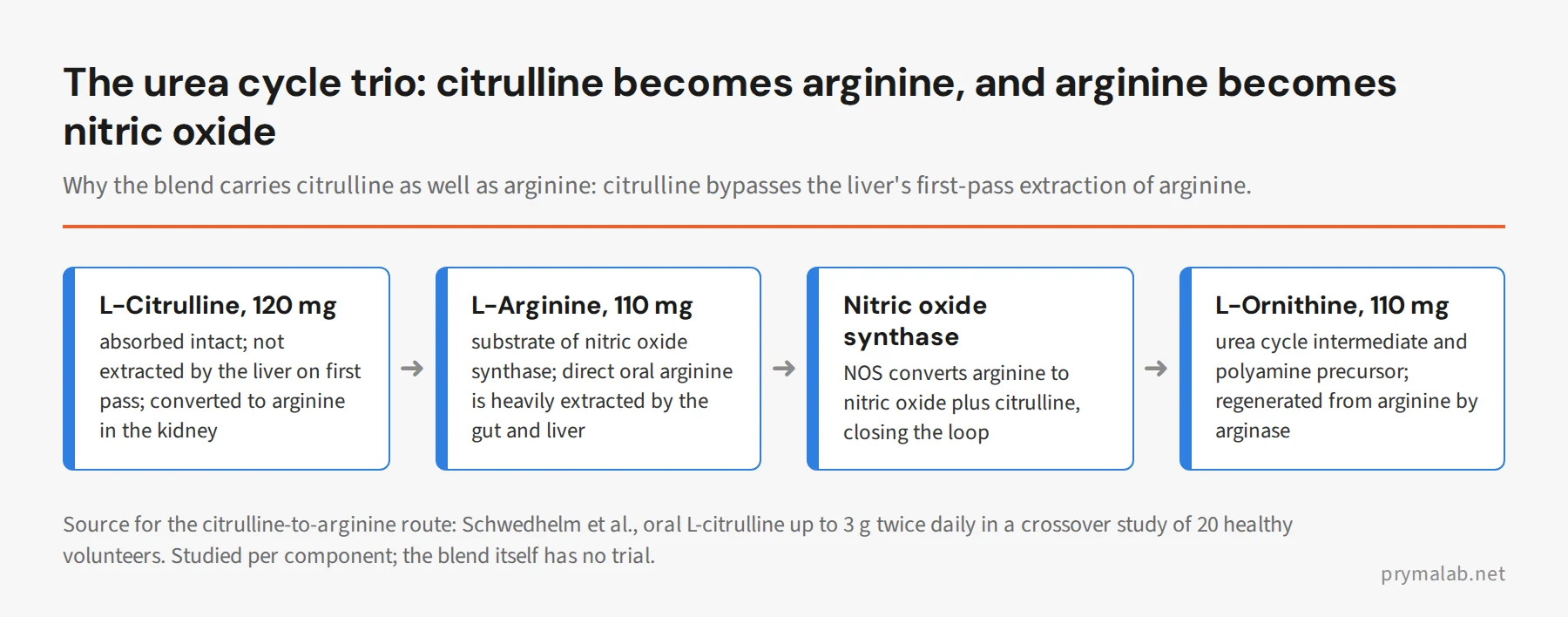
These three are 340 mg together, about 2,150 µmol. Arginine is the substrate of nitric oxide synthase, which releases nitric oxide and citrulline, and of arginase, which releases urea and ornithine (Wu and Morris, reference 3). Citrulline is recycled to arginine and escapes the gut and liver arginase that removes much of oral arginine at first pass (Curis and colleagues, reference 5); in Schwedhelm's double-blind crossover study in 20 healthy volunteers, oral citrulline raised the area under the curve and the peak plasma arginine concentration more than oral arginine did, and the highest citrulline dose lifted the plasma arginine to ADMA ratio from 186 to 278 (reference 4). Ornithine is the substrate of ornithine decarboxylase, the first step of polyamine synthesis. Sugino's group gave 17 healthy volunteers L-ornithine hydrochloride in a placebo-controlled crossover design and reported lower subjective fatigue after a two-hour cycle ergometer task, with the significant effects on rated fatigue and on pedalling speed confined to the female subjects (reference 6).
L-lysine and L-proline: the collagen residues
Proline plus hydroxyproline make up close to a quarter of collagen by residue count, and hydroxylation of proline stabilises the triple helix (Wu and colleagues, reference 7). Lysine is hydroxylated and then oxidised by lysyl oxidase to form the cross-links that give mature collagen its tensile strength. It is also the first substrate of carnitine synthesis and the limiting essential amino acid in cereal proteins (Tome and Bos, reference 8). Outside collagen, proline oxidation by proline dehydrogenase is studied as a redox and stress signal (Phang and colleagues, reference 9).
Taurine and L-glutamine: osmolyte and fuel
Taurine is 2-aminoethanesulfonic acid: no carboxyl group, never built into proteins, abundant in heart, retina and leukocytes. Huxtable's review lists osmoregulation, bile acid conjugation and calcium handling as its established roles (reference 10). Singh and colleagues reported in 2023 that circulating taurine falls with age in mice, monkeys and humans, and that reversing that decline by supplementation increased health span and life span in mice and health span in monkeys (reference 11). Glutamine is the most abundant free amino acid in plasma and the preferred fuel of enterocytes and dividing lymphocytes (Cruzat and colleagues, reference 12); it cyclises to pyroglutamate in solution, which is why this blend is prepared fresh (reference 13).
How the blend is characterised
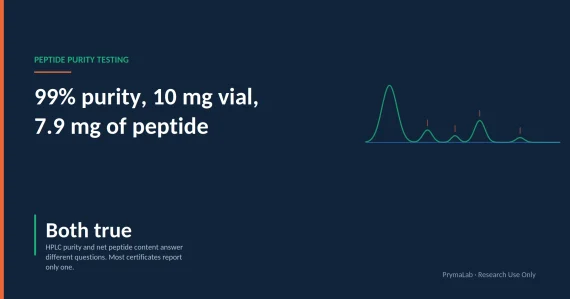
A certificate for a single peptide reports purity: the share of the HPLC trace under one main peak, meaningful because there is one intended molecule. This vial has eight, so a peptide method gives eight peaks by design, and a single purity figure would say nothing about the ratio between them. The assay that fits is amino acid analysis, by ion exchange chromatography with ninhydrin detection or by pre-column derivatisation and reverse phase HPLC, giving one measured content per component against the label (Rutherfurd and Gilani, reference 14). Carnitine has no primary amine, so neither method sees it, and it needs its own LC-MS or HPLC determination. Salt form and water content belong on the certificate too, because hydrochlorides and carnitine tartrate add mass without adding compound. Documentation status is on the trust and verification page.
Handling and storage
The vial is supplied lyophilised. Dry free amino acids are among the least reactive materials a peptide laboratory holds: no aggregation, no surface adsorption. Sealed, dry and dark at minus 20 °C keeps the powder stable. Let the vial reach room temperature before opening, because cold glass condenses water onto a hygroscopic cake, then run the diluent down the wall, as set out in how to reconstitute peptides and the bacteriostatic water guide. Keep the solution at 2 to 8 °C and prepare it fresh, because glutamine cyclises in water and the composition drifts from the label; the storage and stability guide covers shelf life. Everything here is for laboratory research use only.
Frequently asked questions
What is the SUPER Human blend?
SUPER Human Blend is a lyophilised mixture of eight free amino acids totalling 790 mg per vial: L-carnitine, L-citrulline, L-arginine, L-ornithine, L-lysine, L-proline, taurine and L-glutamine. Each has its own research literature. PrymaLab supplies it as Pryma SUPER Human Blend for research use only.
Is the super human blend a peptide?
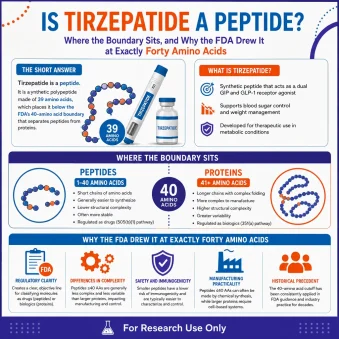
No. A peptide is amino acids joined by amide bonds in a defined order, with one sequence and one molecular weight. The super human blend has no bonds between its components, no sequence and eight molecular weights. It shares only the vial format with a peptide.
What is in the superhuman blend peptide?
The product found under the search term "superhuman blend peptide" contains, per vial, L-carnitine 220 mg, L-citrulline 120 mg, L-arginine 110 mg, L-ornithine 110 mg, L-lysine 70 mg, L-proline 60 mg, taurine 60 mg and L-glutamine 40 mg: 790 mg in total. There is no peptide in it.
What are superhuman peptides?
"Superhuman peptides" is a search phrase, not a compound class. It usually points to the SUPER Human amino acid blend, which contains no peptides, or loosely to research peptides marketed for performance. A listing for a peptide states a sequence and a molecular weight; this one states a composition table.
How is the SUPER Human blend stored?
Store the sealed lyophilised vial at minus 20 °C, dry and dark. Bring it to room temperature before opening so water does not condense on the cake. After reconstitution keep the solution at 2 to 8 °C and prepare it fresh, because glutamine converts to pyroglutamate in water and the composition drifts from the label.
Key takeaways
- SUPER Human Blend is eight free amino acids, 790 mg per vial; "superhuman blend peptide" is a search term.
- No peptide bonds means no sequence, no single molecular weight and no purity figure; amino acid analysis is the assay.
- Carnitine leads by mass at 220 mg; ornithine is second by molecule count because it is the lightest component.
- Each component has its own literature, from the carnitine shuttle and the urea cycle to collagen and immune fuel.
- Store lyophilised at minus 20 °C; reconstitute fresh and keep at 2 to 8 °C, because glutamine cyclises in solution.
Related products
- Pryma SUPER Human Blend, 790 mg lyophilised vial, from $74.99
- L-Carnitine 500mg, single-component vial, from $38.24
References
- Longo N, Frigeni M, Pasquali M. Carnitine transport and fatty acid oxidation. Biochim Biophys Acta. 2016;1863(10):2422-2435. PubMed 26828774
- Fielding R, Riede L, Lugo JP, Bellamine A. L-Carnitine supplementation in recovery after exercise. Nutrients. 2018;10(3):349. PubMed 29534031
- Wu G, Morris SM Jr. Arginine metabolism: nitric oxide and beyond. Biochem J. 1998;336(Pt 1):1-17. PubMed 9806879
- Schwedhelm E, Maas R, Freese R, et al. Pharmacokinetic and pharmacodynamic properties of oral L-citrulline and L-arginine: impact on nitric oxide metabolism. Br J Clin Pharmacol. 2008;65(1):51-59. PubMed 17662090
- Curis E, Nicolis I, Moinard C, et al. Almost all about citrulline in mammals. Amino Acids. 2005;29(3):177-205. DOI 10.1007/s00726-005-0235-4
- Sugino T, Shirai T, Kajimoto Y, Kajimoto O. L-ornithine supplementation attenuates physical fatigue in healthy volunteers by modulating lipid and amino acid metabolism. Nutr Res. 2008;28(11):738-743. PubMed 19083482
- Wu G, Bazer FW, Burghardt RC, et al. Proline and hydroxyproline metabolism: implications for animal and human nutrition. Amino Acids. 2011;40(4):1053-1063. PubMed 20697752
- Tomé D, Bos C. Lysine requirement through the human life cycle. J Nutr. 2007;137(6 Suppl 2):1642S-1645S. PubMed 17513440
- Phang JM, Liu W, Zabirnyk O. Proline metabolism and microenvironmental stress. Annu Rev Nutr. 2010;30:441-463. PubMed 20415579
- Huxtable RJ. Physiological actions of taurine. Physiol Rev. 1992;72(1):101-163. PubMed 1731369
- Singh P, Gollapalli K, Mangiola S, et al. Taurine deficiency as a driver of aging. Science. 2023;380(6649):eabn9257. PubMed 37289866
- Cruzat V, Macedo Rogero M, Noel Keane K, Curi R, Newsholme P. Glutamine: metabolism and immune function, supplementation and clinical translation. Nutrients. 2018;10(11):1564. PubMed 30360490
- Purwaha P, Silva LP, Hawke DH, Weinstein JN, Lorenzi PL. An artifact in LC-MS/MS measurement of glutamine and glutamic acid: in-source cyclization to pyroglutamic acid. Anal Chem. 2014;86(12):5633-5637. DOI 10.1021/ac501451v
- Rutherfurd SM, Gilani GS. Amino acid analysis. Curr Protoc Protein Sci. 2009;58(1):11.9.1-11.9.37. DOI 10.1002/0471140864.ps1109s58
Everything described on this page is laboratory research. Every compound PrymaLab supplies is for laboratory research use only and is not intended for human or veterinary use. Statements have not been evaluated by the FDA, and nothing here is medical advice.
Mechanistic descriptions are observations from cell and animal models, several from older literature, that may not generalize. Always verify the legal status of any research compound in your jurisdiction before purchase or use.