15% SUMMER DISCOUNT APPLIED AUTOMATICALLY AT CHECKOUT FREE USA SHIPPING OVER $100  FREE WORLDWIDE SHIPPING OVER $200

15% SUMMER DISCOUNT APPLIED AUTOMATICALLY FREE USA SHIPPING OVER $100  FREE WORLDWIDE SHIPPING OVER $200

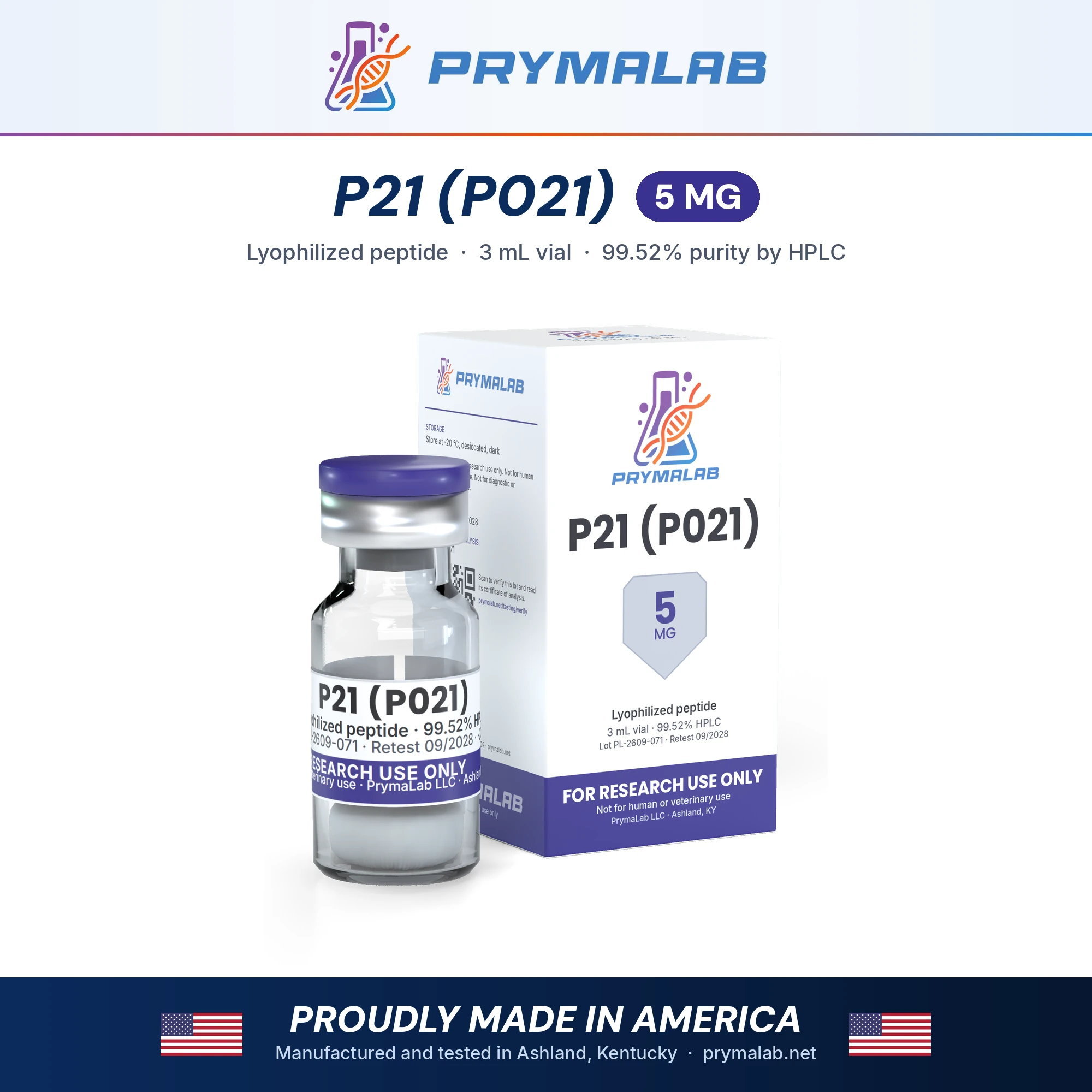
P21 (P021) 5mg

$89.99 or subscribe for $75.99/mo

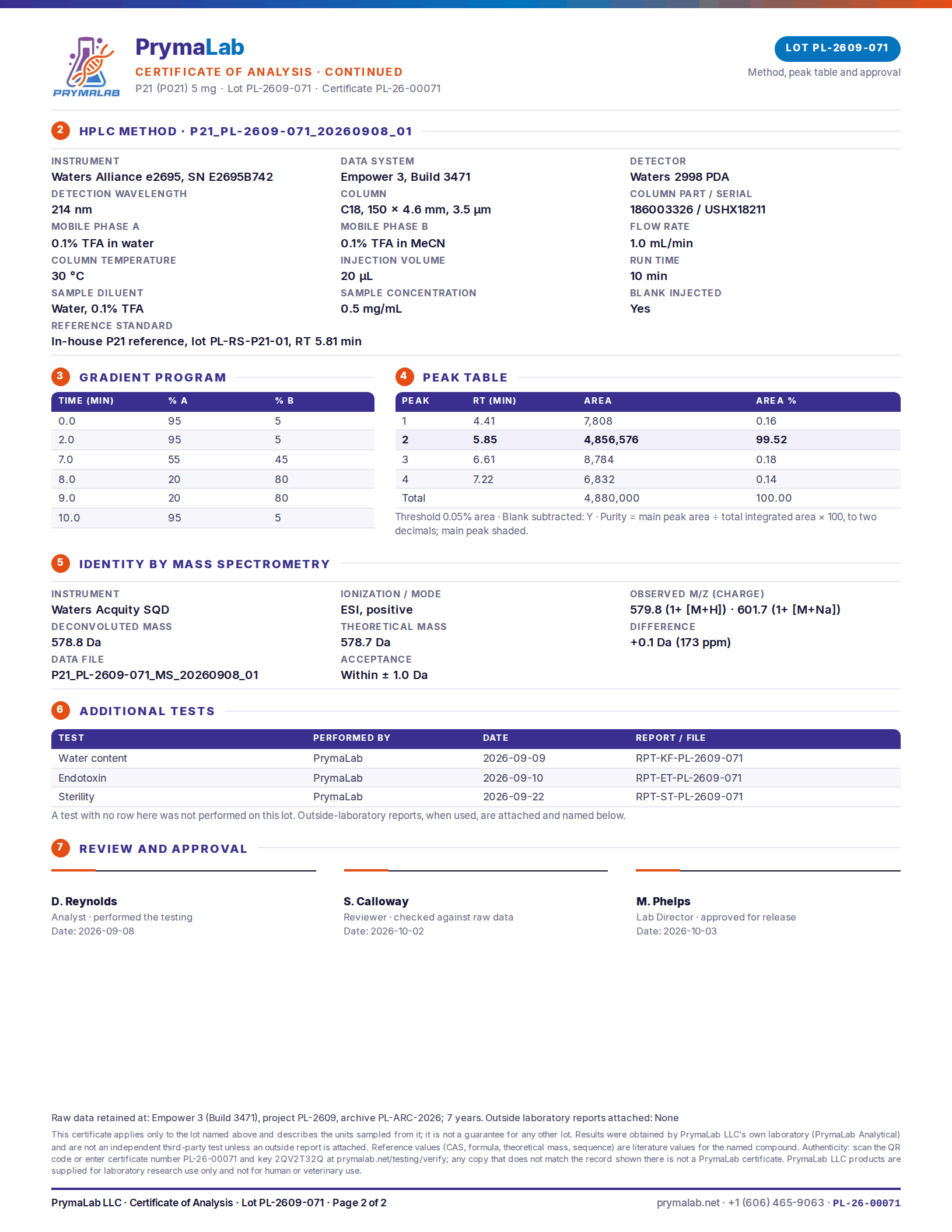
P21 peptide 5mg is a lyophilized vial of P021, an adamantylated peptide mimetic derived from ciliary neurotrophic factor residues 148 to 151.

  • Structure Ac-DGGLAG-NH2 with an adamantylated C-terminal glycine
  • Core tetrapeptide Asp-Gly-Gly-Leu · acetylated N-terminus, amidated C-terminus
  • Adamantane group raises lipophilicity and slows exopeptidase degradation
  • Soluble in water and dilute aqueous buffers · store at -20°C · purity per lot-specific COA

Research use only. Not for human or veterinary use, food, or household application.

Description

PrymaLab · Research Use Only

P21 (P021) 5mg

CNTF-derived peptide mimetic · adamantylated · Ac-DGGLAG-NH2

P21 peptide 5mg is a lyophilized vial of P021, a modified short peptide derived from the biologically active region of ciliary neurotrophic factor, residues 148 to 151. The core tetrapeptide Asp-Gly-Gly-Leu carries an acetylated amino terminus and an amidated carboxy terminus bearing an adamantylated glycine.

Specification Table

P021 verified structural and handling data, 5mg format
Property Value
Compound P021
Vial content 5 mg lyophilized powder
Common designation P21
Structure Ac-DGGLAG-NH2 with an adamantylated C-terminal glycine
Core sequence origin Ciliary neurotrophic factor (CNTF), residues 148 to 151
Core tetrapeptide Asp-Gly-Gly-Leu (DGGL)
N-terminal modification Acetylation
C-terminal modification Amidation, with adamantylated glycine
Purpose of adamantane group Raises lipophilicity and blood-brain barrier permeability, reduces exopeptidase degradation
Reported mechanism Competitive inhibition of leukemia inhibitory factor (LIF) signalling
Reported downstream findings Increased BDNF expression, reduced GSK3β activity
Reported model readouts Dentate gyrus neurogenesis, dendritic and synaptic complexity in rodent models
Originating group Khalid Iqbal and colleagues, New York State Institute for Basic Research
Oral activity Reported as orally bioavailable in the primary literature
Appearance White lyophilized powder
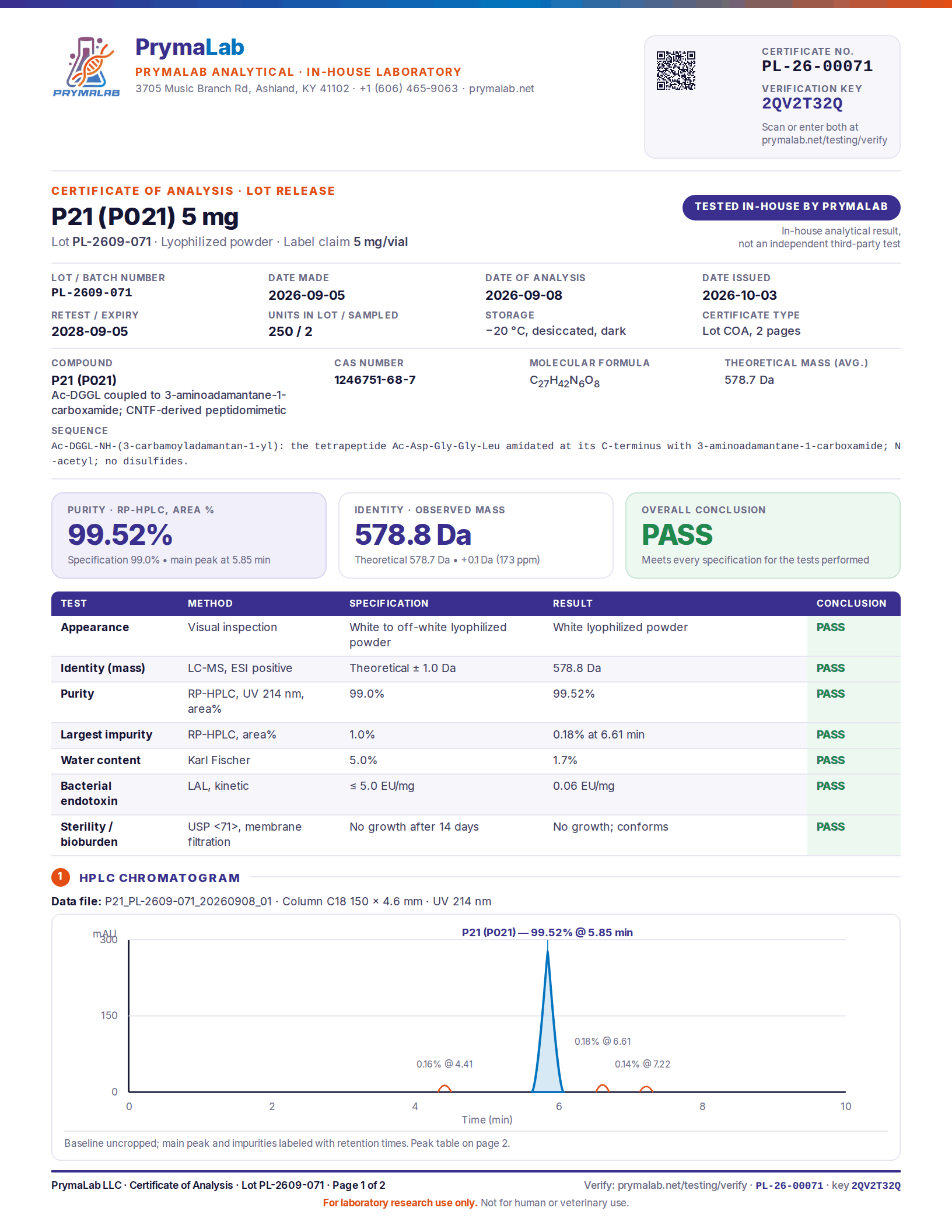
Purity Per lot-specific certificate of analysis
Solubility Soluble in water and in dilute aqueous buffers
Storage, lyophilized -20°C, protected from light and moisture
Storage, reconstituted 2-8°C, protected from light
Human clinical data None published
Regulatory status No approved human or veterinary formulation in any jurisdiction

Why Attach an Adamantane Group to a Peptide?

The adamantane group on P21 peptide 5mg material is a rigid cage-shaped hydrocarbon, three fused cyclohexane rings sharing atoms in a diamond-like arrangement. Attaching one to a peptide is an unusual move and the reasons are specific.

Lipophilicity is the first. A short peptide made of polar amino acids partitions poorly into lipid membranes, which limits how much reaches the central nervous system. Adamantane is strongly hydrophobic and its addition shifts the partition coefficient substantially, which the primary literature describes as improving blood-brain barrier permeability.

Protease resistance is the second. Exopeptidases work inward from peptide termini, and a bulky non-natural group at the C-terminus is poorly accommodated in the active site of enzymes that evolved to process ordinary amino acids.

Rigidity is the third and least discussed. A conformationally locked group at one end restricts the flexibility of a short chain, which reduces the entropic penalty paid on binding.

The approach appears elsewhere in medicinal chemistry, notably in amantadine and memantine, where the same cage confers membrane permeability and metabolic stability. Applying it to a peptide terminus is a deliberate borrowing of a known strategy.

What Does LIF Signalling Inhibition Mean?

Leukemia inhibitory factor belongs to the interleukin-6 cytokine family and signals through a receptor complex incorporating gp130, and despite the name, which reflects the context of its discovery, its biology extends well beyond haematopoiesis.

In neural tissue, LIF signalling acts to restrain the formation of neural progenitor cells from stem cells. It holds the stem cell pool in a less differentiated state, and reducing that signal permits progenitor formation to proceed.

Published work reports that P021 competitively inhibits LIF signalling, and that this is the proposed route by which it influences neurogenesis in the models studied (Chohan et al., Neurobiology of Aging, 2011).

The competitive framing matters mechanistically. A competitive inhibitor occupies the same site as the natural ligand, meaning its effect can be overcome by raising ligand concentration. That is a testable prediction and it gives a design a way to confirm the mechanism rather than assume it.

CNTF itself signals through a related receptor complex also using gp130, which is why a CNTF-derived fragment interacting with LIF signalling is mechanistically coherent rather than coincidental.

What Has Been Reported Downstream?

Two downstream observations recur across the published work and are worth separating from the primary mechanism.

Increased BDNF expression is the first. Brain-derived neurotrophic factor supports neuronal survival and synaptic plasticity through the TrkB receptor, and published work associates P021 exposure with raised BDNF in rodent brain tissue.

Reduced glycogen synthase kinase-3β activity is the second. GSK3β phosphorylates a wide range of substrates and sits downstream of several signalling routes including the BDNF pathway, and published work proposes that raised BDNF expression is what reduces GSK3β activity, making it a consequence rather than an independent effect.

Model readouts reported include neurogenesis in the hippocampal dentate gyrus and increased dendritic and synaptic complexity. Kazim and colleagues examined these in rodent models (Kazim et al., Neurobiology of Disease, 2014).

All of this is rodent and cell-system work, and no human clinical study of P021 has been published.

What Should P21 Peptide 5mg Research Control For?

The competitive-inhibition mechanism makes several controls both possible and necessary.

A LIF concentration-response arm tests the competitive claim directly. If P021 competes with LIF at the same site, raising LIF concentration should progressively overcome the effect, and failure to see that shift argues against competitive inhibition as described.

A CNTF comparator arm is worth including. The core sequence derives from CNTF, so running the parent protein alongside establishes whether the fragment reproduces, opposes or acts independently of the source molecule.

An adamantane-free control addresses the modification rather than the sequence. A peptide with the same core lacking the adamantylated glycine separates what the sequence contributes from what the lipophilic group contributes, and the two are frequently conflated.

For neurogenesis readouts, BrdU or EdU incorporation with appropriate chase periods remains the standard, paired with markers distinguishing proliferation from survival and from differentiation. Those three are separate events and a single-timepoint measurement cannot distinguish them.

What Distinguishes a Peptide Mimetic From a Peptide Fragment?

P021 is routinely described as a peptide, and the term obscures a design distinction that matters for how the compound should be handled and interpreted.

A peptide fragment is a contiguous stretch of a parent sequence, unmodified. Tuftsin, GHRH (1-29) and GLP-1 (7-36) are all fragments in that sense: cut the parent, keep a piece, and the piece is chemically identical to the corresponding region of the whole.

A mimetic reproduces a functional feature using chemistry the parent does not contain. P021 keeps four residues of the ciliary neurotrophic factor active region and then departs from natural peptide chemistry entirely, with terminal capping and a hydrocarbon cage.

The consequence is that the mimetic is not a subset of the parent molecule and cannot be assumed to reproduce its behaviour. It was designed to engage one interaction while acquiring properties the parent lacks, particularly membrane permeability and protease resistance.

That design intent also means comparisons to ciliary neurotrophic factor itself are informative rather than redundant. Where the mimetic and the parent diverge, the divergence is attributable to the modifications rather than to the shared four residues.

Handling follows the same logic. This molecule behaves like a small modified organic compound with peptide character rather than like a plain short peptide, which is why its solubility profile surprises people expecting the latter.

How Should Neurotrophic Findings Be Read Critically?

This research area has methodological pitfalls that recur across compounds, and knowing them helps in reading both the primary literature and any new data.

Neurogenesis measurement is the first. Thymidine analogue incorporation labels cells in S phase, so a raised signal can reflect more proliferation, better survival of labelled cells, or altered division timing. Only a design with multiple timepoints and lineage markers separates these.

Dendritic complexity measurement is the second. Sholl analysis and spine counting are sensitive to tissue processing, to the labelling method and to sampling, and blinded analysis with predetermined sampling criteria is necessary rather than advisable.

Expression changes are the third. Both BDNF and glycogen synthase kinase-3-beta activity respond to a wide range of interventions including handling stress, which means a change in either is weak evidence for a specific mechanism without a pathway-blocking arm.

None of this is specific to P021. It applies across the neurotrophic literature, and a compound is not weakly supported because these pitfalls exist, only because a given study did or did not address them.

Reading the methods before the abstract is the practical version of all of the above.

What Does P21 Peptide 5mg Support Experimentally?

Five milligrams of a modified short peptide covers more ground than the same mass of a larger construct, and the arithmetic favours it.

Cell-based signalling work consumes very little. A full concentration series across four orders of magnitude, run in triplicate with vehicle and comparator arms, uses a small fraction of the vial.

That leaves room for the controls the compound actually needs. An adamantane-free comparator, a ciliary neurotrophic factor arm and a LIF concentration-response series together triple the material budget of a naive design, and P21 peptide 5mg absorbs that.

Rodent work is where the fill becomes limiting rather than generous, since animal studies consume orders of magnitude more per experiment than culture work does.

For a first pass in cells, this size is sensible, and for a sustained in vivo programme it is not.

Reconstitution and Storage in Laboratory Practice

The adamantane group changes the solubility picture relative to an unmodified short peptide. The core sequence is polar while the adamantyl group is strongly hydrophobic, giving the molecule amphipathic character.

In practice this means dissolution may be slower than a plain tripeptide and that a small amount of organic co-solvent is sometimes used, though water and dilute aqueous buffers are generally sufficient. Add diluent slowly and allow time rather than agitating vigorously.

Amphipathic molecules also adsorb to surfaces more readily than fully polar ones, so low-binding consumables are worth using at working concentrations.

Dry material sits at -20°C, sealed against light and moisture. Solution sits at 2-8°C in the dark and should be divided before it is ever frozen. Record lot, diluent, volume, concentration and date, and note whether any co-solvent was used since that becomes a vehicle-control requirement downstream.

Published Literature

All references verified against the publisher record or a primary index. The work originates predominantly from one research group, which is worth noting when reading it.

  1. Chohan MO, Li B, Blanchard J, Tung YC, Heaney AT, Rabe A, Iqbal K, Grundke-Iqbal I. Neurobiology of Aging. 2011;32(8):1420-1434.
  2. Kazim SF, Blanchard J, Dai CL, Tung YC, LaFerla FM, Iqbal IG, Iqbal K. Neurobiology of Disease. 2014;71:110-130.
  3. Bolognin S, Buffelli M, Puoliväli J, Iqbal K. Neurobiology of Aging. 2014;35(9):2134-2146.
  4. Baazaoui N, Iqbal K. Journal of Alzheimer’s Disease. 2017;58(1):215-230.
  5. Khatoon S, Chalbot S, Bolognin S, Puoliväli J, Iqbal K. Journal of Alzheimer’s Disease. 2015;47(2):373-386.

Frequently Asked Questions

What is P21 peptide 5mg?

A lyophilized vial of P021, a modified short peptide derived from ciliary neurotrophic factor residues 148 to 151. The core tetrapeptide carries an acetylated amino terminus and an amidated carboxy terminus bearing an adamantylated glycine. Laboratory research use only.

Why is adamantane attached to the peptide?

Three reasons. Lipophilicity, since adamantane is strongly hydrophobic and shifts the partition coefficient to improve blood-brain barrier permeability, then protease resistance, because a bulky non-natural group at the terminus is poorly accommodated by exopeptidases. And conformational rigidity.

Where else is that strategy used?

Amantadine and memantine both use the same adamantane cage to confer membrane permeability and metabolic stability. Applying it to a peptide terminus is a deliberate borrowing of an established medicinal chemistry approach rather than a novel invention.

What is LIF and why does it matter here?

Leukemia inhibitory factor is an interleukin-6 family cytokine signalling through a receptor complex incorporating gp130. In neural tissue it restrains formation of neural progenitor cells from stem cells, holding the pool in a less differentiated state.

What does competitive inhibition predict?

That the effect can be overcome by raising ligand concentration, since a competitive inhibitor occupies the same site as the natural ligand. That is a testable prediction, and a LIF concentration-response arm confirms or refutes the proposed mechanism directly.

Why is a CNTF connection to LIF coherent?

Because CNTF itself signals through a related receptor complex also using gp130. A fragment derived from CNTF interacting with LIF signalling is therefore mechanistically sensible rather than coincidental, and the shared receptor component is the reason.

What downstream findings are reported?

Increased BDNF expression and reduced glycogen synthase kinase-3-beta activity, with published work proposing the second follows from the first rather than occurring independently. Model readouts include dentate gyrus neurogenesis and increased dendritic and synaptic complexity in rodents.

What control isolates the adamantane contribution?

A version of the same core sequence lacking the adamantylated glycine. That separates what the peptide sequence contributes from what the lipophilic modification contributes, and the two are frequently conflated in descriptions of this compound.

How should neurogenesis be measured?

BrdU or EdU incorporation with appropriate chase periods, paired with markers distinguishing proliferation from survival and from differentiation. Those are three separate events, and a single-timepoint measurement cannot tell them apart regardless of how carefully it is performed.

Does the adamantane affect handling?

Yes. It gives the molecule amphipathic character, with a polar core and a strongly hydrophobic group. Dissolution may be slower than a plain short peptide, and amphipathic molecules adsorb to surfaces more readily, so low-binding consumables are worth using.

Compliance Statement

P21 peptide 5mg is sold exclusively for laboratory research use. It is not a drug, food, or cosmetic product, and it is not a dietary product of any kind. It is not approved by the FDA or any comparable authority for human or veterinary use, and no human clinical study of this compound has been published. This product is not intended to diagnose, treat, cure, or prevent any disease. It must not be given to humans or animals. Purchase is restricted to qualified researchers and institutions operating within applicable laws. All handling is the responsibility of the purchasing laboratory.

Additional information

Weight N/A
Dimensions N/A

Reviews

There are no reviews yet.

Only logged in customers who have purchased this product may leave a review.

Peptide Research Articles

Bacteriostatic Water Peptide Science: Why It Matters in Reconstitution & Research

Bacteriostatic water peptide science is the foundation of safe, accurate peptide reconstitution. This 2026 guide covers bacteriostatic water composition, how to reconstitute peptides using a peptide reconstitution calculator and peptide dosage calculator, bacteriostatic water vs sterile water differences, peptide storage best practices, and a 10-step reconstitution protocol. Expert insights from PrymaLab.

Peptides for Injury Recovery: The Wolverine Stack Peptide Guide (BPC-157 + TB-500)

The Wolverine stack peptide combines BPC-157 and TB-500 for research into tendon, ligament, and joint recovery. This 2026 guide covers BPC-157 peptide where to buy responsibly, BPC 157 peptide side effects, peptides for tendon repair, peptides for joint recovery, peptides for elbow pain, and the BPC-157 TB-500 peptide blend scientific research. Expert insights from PrymaLab.

Are Peptides Good for You? A Complete 2026 Guide

Are peptides good for you? This comprehensive 2026 guide explores peptide therapy benefits, safety, side effects, and how peptides work in the body. Learn about peptide health benefits, research findings, and what you need to know before considering peptide therapy. Expert insights from PrymaLab.

Ovagen peptide capsules for liver health with dosage cycling chart showing 10-20 day protocols repeated 2-3 times per year

Ovagen Peptide Guide: Uses, Research, Safety & Buying Info

Ovagen peptide is a short-chain liver bioregulator developed at the St. Petersburg Institute of Bioregulation and Gerontology under Professor Vladimir Khavinson. It contains the AC-3 peptide complex (glutamic acid and aspartic acid) designed to target hepatocyte gene expression for liver cell repair, bile production, and detoxification. This guide covers dosing protocols, cycling schedules, side effects, a head-to-head comparison with NAC, milk thistle, TUDCA, and BPC-157, cost analysis ($120-360 per year), and how to verify genuine Ovagen products online.

GHK-Cu peptide vial and syringe with dosage chart showing injection protocols for skin rejuvenation and hair growth

GHK-Cu Peptide: Benefits, Dosage, Side Effects & Complete Research Guide (2026)

GHK-Cu peptide is a naturally occurring copper tripeptide that modulates over 4,000 human genes involved in collagen synthesis, wound healing, and tissue regeneration. This comprehensive guide covers injection dosage protocols, clinical research on skin rejuvenation and hair growth, side effects, safety data, and how to reconstitute GHK-Cu 50mg vials. Includes dosage charts, comparison tables, and 10 frequently asked questions answered by a peptide research specialist.

Sermorelin dosage guide for anti-aging muscle growth and weight loss showing GHRH analog pituitary stimulation

Sermorelin Dosage Guide 2025: Complete Protocol for Anti-Aging, Muscle Growth & Weight Loss

Sermorelin acetate is a growth hormone-releasing hormone (GHRH) analog that stimulates natural GH production from the pituitary gland. This comprehensive dosage guide covers protocols for anti-aging, muscle growth, weight loss, and sleep optimization — along with side effects, before-and-after timelines, and comparisons to HGH and ipamorelin.

24/7 Online support

support@prymalab.net info@prymalab.net

Money back guarantee

30 Day return window. Satisfaction guaranteed or your money back.

FREE shipping and return

All orders over %150 in value will receive free shipping.