Description
PrymaLab · Research use only
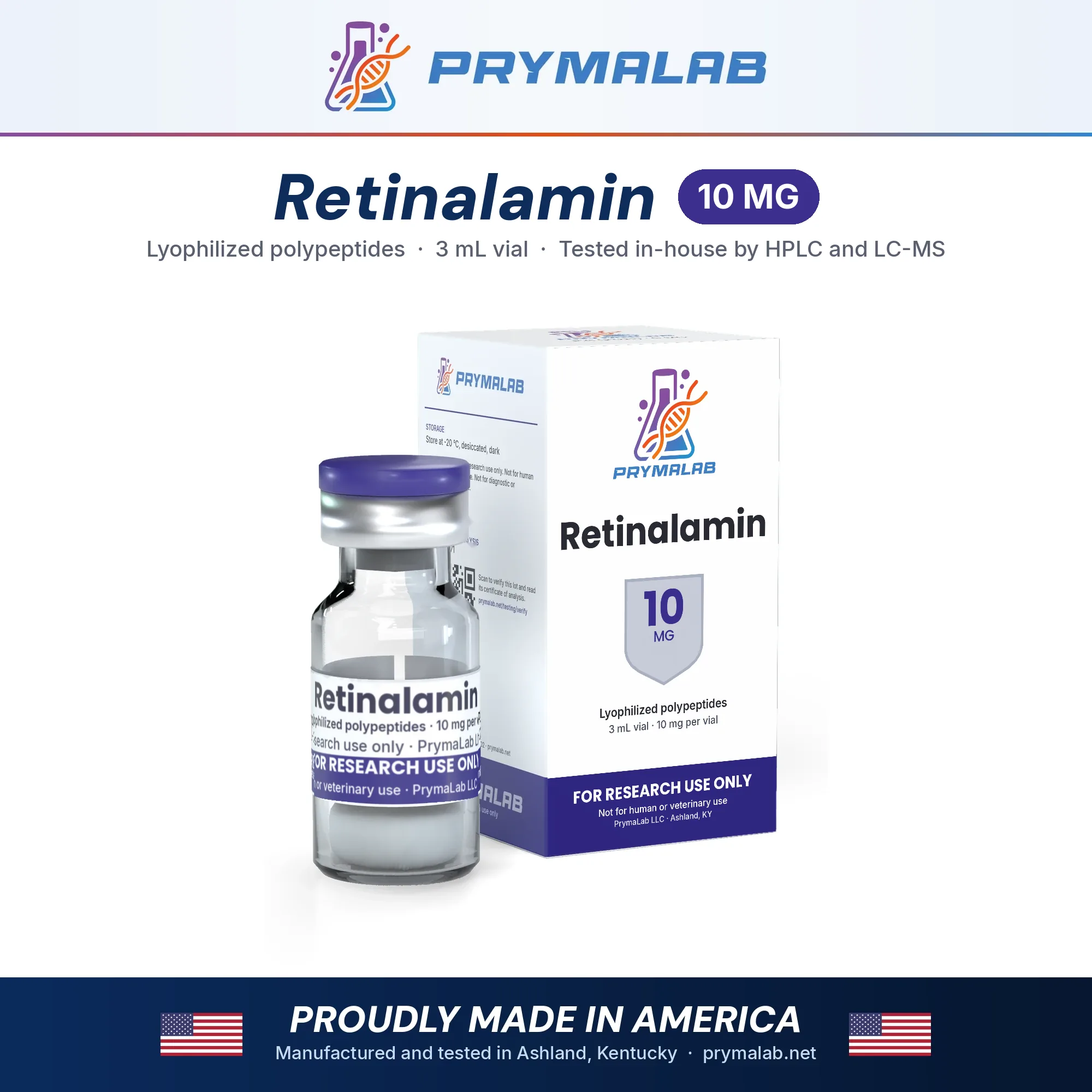
Retinalamin (Retina Peptide Bioregulator) 10mg
Retina peptide bioregulator: the cattle-retina polypeptide complex listed by some suppliers as Retilanamin, 10 mg freeze-dried
Retinalamin is a complex of water-soluble polypeptide fractions extracted from cattle retina, with components below about 10 kDa. It is a Russian ‘cytomedine’ bioregulator of the type developed in St Petersburg from the 1970s, used there in ophthalmology by injection. Some supplier lists spell it Retilanamin; no compound of that name exists, so this page uses the correct one. This listing is the 10 mg vial of freeze-dried powder, the only fill. Because it is an extract, it has no single sequence, formula or molecular weight.
Specifications
| Property | Value |
|---|---|
| Compound | Retinalamin (listed by some suppliers as Retilanamin): complex of water-soluble cattle-retina polypeptides, ≤10 kDa |
| CAS number | None (tissue extract) |
| Molecular formula | Not applicable (mixture) |
| Theoretical mass | Not applicable (polypeptide mixture, components ≤10 kDa) |
| Sequence / structure | Heterogeneous water-soluble polypeptide fractions from cattle retina; no single sequence. |
| Label claim | 10 mg per vial |
| Form | Lyophilized (freeze-dried) polypeptide complex in a sealed glass vial with a rubber stopper and aluminium crimp cap |
| Storage, sealed | −20 °C, desiccated, dark |
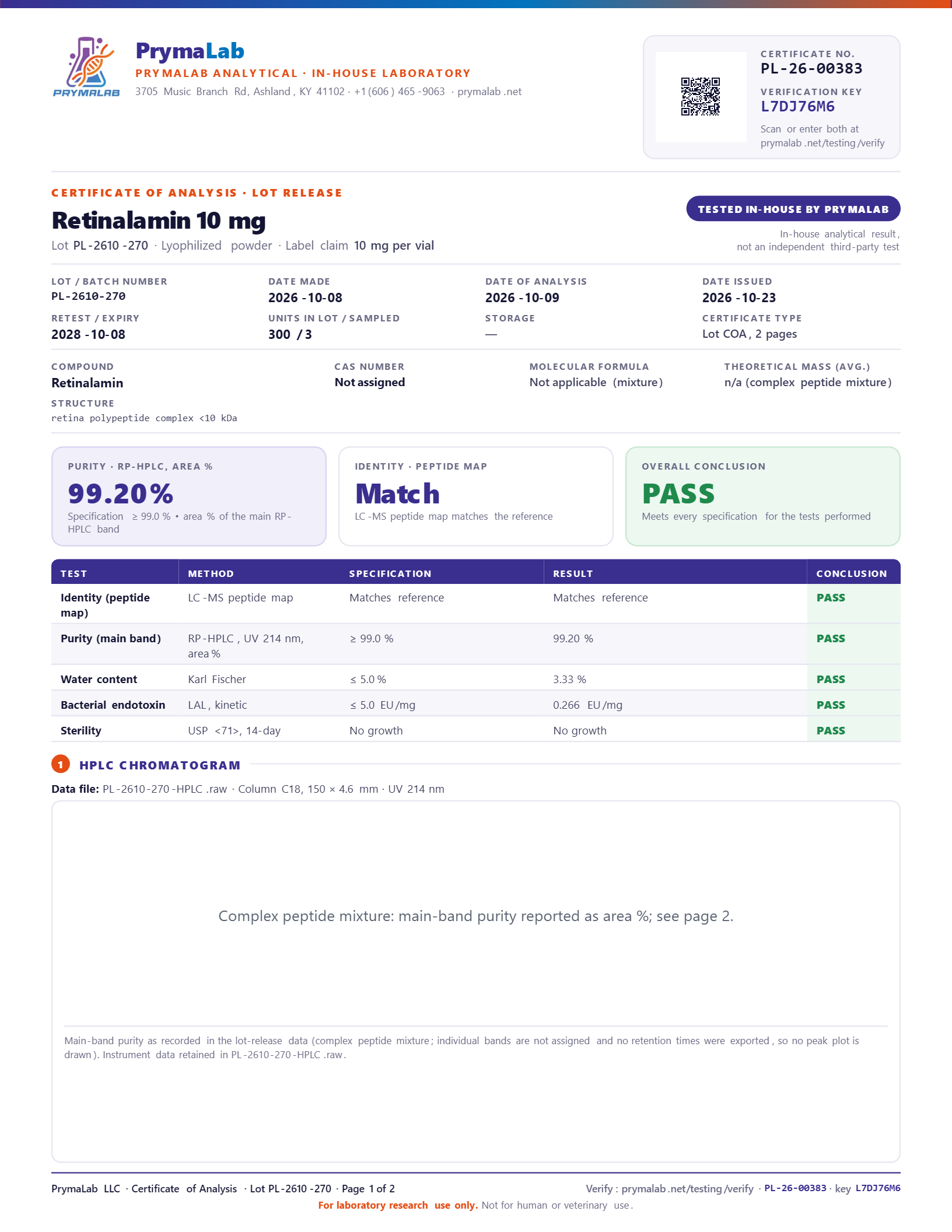
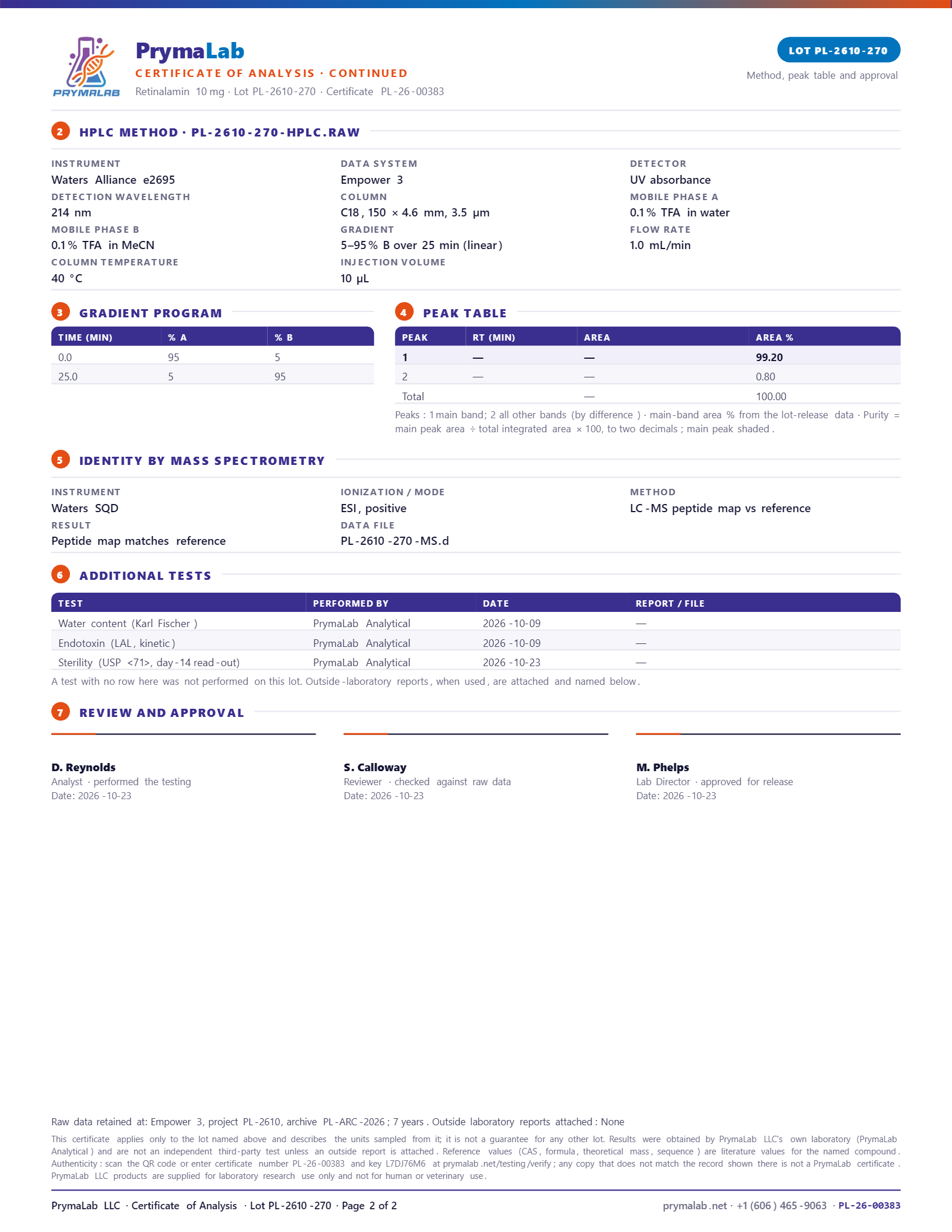
| Purity specification | Lot profile by RP-HPLC and LC-MS (polypeptide mixture; a single-compound purity figure does not apply) |
| Lot certificate | Certificate for the first lot: in preparation. Published certificates appear on the results page and can be checked on the verify page. |
What it is
A mixture, not a molecule. The registered Russian medicine is a lyophilisate of retinal polypeptides (5 mg) with 17 mg glycine as a bulking agent per vial; research material sold by weight may count peptide, total solids or a non-pharmaceutical preparation, which is why the lot certificate for this product reports a polypeptide profile by RP-HPLC and LC-MS rather than a single purity figure. The US National Library of Medicine lists Retinalamin as a MeSH supplementary concept with registry number 0, meaning no defined substance.
It is chemically unrelated to the single synthetic retina peptides from the same school, Retiget (Asp-Ala) and Normoftal, and to the pineal tetrapeptide Epitalon, even though all four are marketed for the retina.
What the research covers
What Retinalamin is and how it is given
Retinalamin is registered in Russia as a complex of water-soluble polypeptide fractions from cattle retina (mass <=10 kDa), supplied as a 5 mg lyophilisate with 17 mg glycine for intramuscular and parabulbar injection, in the pharmacological class ’tissue-repair stimulant’ for retinal disease5,6. Its manufacturer-stated action is to stimulate retinal photoreceptors and cells, improve the interaction of the retinal pigment epithelium with photoreceptor outer segments, modulate vascular permeability and support reparative processes6. These are label descriptions from the marketing-authorisation holder, not independent trial endpoints5,6.
Early experimental characterisation (developer group)
Khavinson and colleagues reported that Retinalamin, applied to multipotent ectodermal cells of the early Xenopus laevis gastrula, influenced neuronal differentiation of the ectoderm (brain, retina, pigment epithelium) in a concentration-dependent way, which they interpreted as ‘inductive’ activity2. In cell culture, Retinalamin and the synthetic tetrapeptide Epitalon (Ala-Glu-Asp-Gly) were each said to tissue-specifically stimulate proliferation of retinal and pigmented epithelial cells at certain concentrations3. Both reports are short Bull Exp Biol Med papers from the developing group2,3.
Receptor-binding and biodistribution study
An in vitro competitive radioligand screen of a cattle-retina polypeptide drug reported interaction with several glutamate-receptor subtypes (AMPA, NMDA, mGluR1); a parallel radiolabelled-biodistribution study in mice found measurable uptake in brain and eye tissue after intravenous, intramuscular and parabulbar dosing, with renal excretion7. The authors frame the glutamate-receptor binding as a possible basis for a neuroprotective effect on retinal ganglion cells7.
Clinical reports in glaucoma and retinopathy (mixed, mostly Russian, developer-adjacent)
Most clinical literature consists of Russian ophthalmology studies in primary open-angle glaucoma and diabetic retinopathy reporting structural/functional stabilisation (e.g. OCT nerve-fibre-layer and perimetry measures) with repeated Retinalamin courses, generally small, open-label and without blinding8. These should be read with caution. Notably, a controlled animal study in a rabbit model of photochemical retinal damage found no significant functional or morphological neuroprotective effect of Retinalamin on any measured parameter (multifocal and flicker ERG, TUNEL apoptosis), a negative result that tempers the positive clinical reports9.
What is not established
Retinalamin is a heterogeneous tissue extract with no defined structure, so claims of a specific peptide sequence, formula or exact molecular weight are unsupported5,6. The efficacy evidence is dominated by small, open-label, mostly Russian-language studies, several from or adjacent to the developing group, and a controlled rabbit study found no neuroprotective effect in photochemical retinal damage8,9. There are no large, blinded, registered international trials; no entry for Retinalamin, Retilanamin or cattle retinal polypeptides was found on ClinicalTrials.gov (November 2026). Being an animal-derived biological, batch-to-batch composition and quality are not standardised across suppliers, and none of the published work used this supplier’s material.
Clinical and regulatory status
Approved as a medicine only in Russia and some neighbouring markets: GEROPHARM holds the marketing authorisation (registration ЛП-N(000519) / former ЛС-000684) for a 5 mg lyophilisate for intramuscular and parabulbar injection, class ’tissue-repair stimulant’, ATC S01XA (other ophthalmologicals), prescription-only5,6. It has no FDA or EMA approval and no INN. It is listed as a MeSH supplementary concept but with registry number 0 (no defined substance)4. This listing is a research-grade material, not the registered pharmaceutical.
Related listings: Epitalon 10mg, Pinealon 10mg, Cerebrolysin 60mg, Vesugen 20mg. The peptide bioregulators category lists the rest of the range.
How each lot is tested
Every lot is tested in PrymaLab’s own laboratory in Ashland, Kentucky before release: RP-HPLC for purity, LC-MS for identity, Karl Fischer titration for water, LAL for endotoxin and USP <71> for sterility. Published certificates are listed on the results page and can be checked by number and key on the verify page. These are in-house results from PrymaLab Analytical, not an independent test, and the lab is not accredited to ISO 17025. The third-party testing guarantee on this page still applies: if any independent laboratory finds the wrong compound, or less than the stated purity or amount, the order is refunded and the cost of the test is reimbursed.
Frequently asked questions
Is ‘Retilanamin’ the same as Retinalamin?
Almost certainly yes – it is a misspelling. Retinalamin (Ретиналамин) is a complex of water-soluble polypeptide fractions from cattle retina used in Russian ophthalmology; no compound named ‘Retilanamin’ exists in any database.
What is its sequence or molecular weight?
It has none in the usual sense. Retinalamin is a tissue extract – a mixture of retinal polypeptides below about 10 kDa, stabilised with glycine – so no single sequence, formula or exact mass applies. A certificate of analysis should show a polypeptide profile, not a single peak.
How does it differ from Epitalon or from the ‘retina’ get-peptides?
Epitalon (AEDG) and Retiget (Asp-Ala) and Normoftal are single synthetic peptides; Retinalamin is a multi-component animal extract. They are chemically unrelated even though all are marketed for retinal indications.
What does the evidence actually show?
Label claims of retinal repair, early developer cell-culture ‘inductive’ effects, glutamate-receptor binding in vitro, and mostly small open-label Russian clinical reports in glaucoma and diabetic retinopathy. A controlled rabbit study of photochemical retinal damage found no neuroprotective effect, so the picture is mixed.
Why might a vial say 10 mg?
The registered drug is 5 mg of peptide plus 17 mg glycine (22 mg total lyophilisate) per vial. A ’10 mg’ research vial does not match the medicine and could refer to total solids or a non-pharmaceutical preparation; confirm with the supplier’s COA.
How is the lyophilisate stored?
The registered product is stored protected from light at 2 to 25 °C and reconstituted immediately before use, with no storage of the made-up solution. As a protein complex it should be kept cold, dry and dark; freeze-thaw cycling of reconstituted material should be avoided.
References
- Khavinson V, Linkova N, Kozhevnikova E, Dyatlova A, Petukhov M. Transport of Biologically Active Ultrashort Peptides Using POT and LAT Carriers. Int J Mol Sci. 2022;23(14):7733. DOI · PubMed
- Khavinson VKh, Malinin VV, Trofimova SV, Zemchikhina VN. Inductive activity of retinal peptides. Bull Exp Biol Med. 2002;134(5):482-484. DOI
- Khavinson VKh, Zemchikhina VN, Trofimova SV, Malinin VV. Effects of peptides on proliferative activity of retinal and pigmented epithelial cells. Bull Exp Biol Med. 2003;135(6):597-599. DOI
- U.S. National Library of Medicine. Retinalamin (MeSH Supplementary Concept, Unique ID C503555). Medical Subject Headings (MeSH). 2005;record C503555.
- GEROPHARM LLC. Retinalamin – registered product information (lyophilisate 5 mg; cattle retinal polypeptides + glycine 17 mg; reg. LP-N(000519)/LS-000684). Russian State Register of Medicines / manufacturer product page. 2022;monograph.
- Vidal / RLS drug reference. Retinalamin (Ретиналамин) – lyophilisate for IM and parabulbar injection, composition and pharmacological action. Vidal.ru / RLSnet.ru drug monograph. 2022;monograph.
- Verlov NA, Dorotenko AR, Gulina LS, Kalatanova AV, Trashkov AP, Burdakov VS. [Investigation of ligand-receptor interaction and biodistribution of a drug containing cattle retinal polypeptides in various administration routes] (Russian). Vestn Oftalmol. 2021;137(5):94-101. DOI · PubMed
- Strakhov VV, Egorov EA, Erichev VP, Yartsev AV, Petrov SY, Dorofeev DA. [The influence of long-term retinal protective therapy on glaucoma progression according to structural and functional tests] (Russian). Vestn Oftalmol. 2020;136(5):58-66. DOI · PubMed
- Suetov AA, Alekperov SI, Odinokaya MA, Kostina AA. [Retinoprotective effects of Retinalamin studied in an experimental model of photochemical damage to rabbit retinas] (Russian). Vestn Oftalmol. 2021;137(5):57-67. DOI · PubMed
Research use only
For laboratory research use only. Retinalamin (Retina Peptide Bioregulator) 10mg is not a drug, food, cosmetic or dietary supplement, is not approved by the FDA or any comparable authority for human or veterinary use, and must not be given to people or animals. It is sold to qualified researchers and institutions, and the buyer is responsible for lawful handling and disposal.







Reviews
There are no reviews yet.