
Description
PrymaLab · Research use only
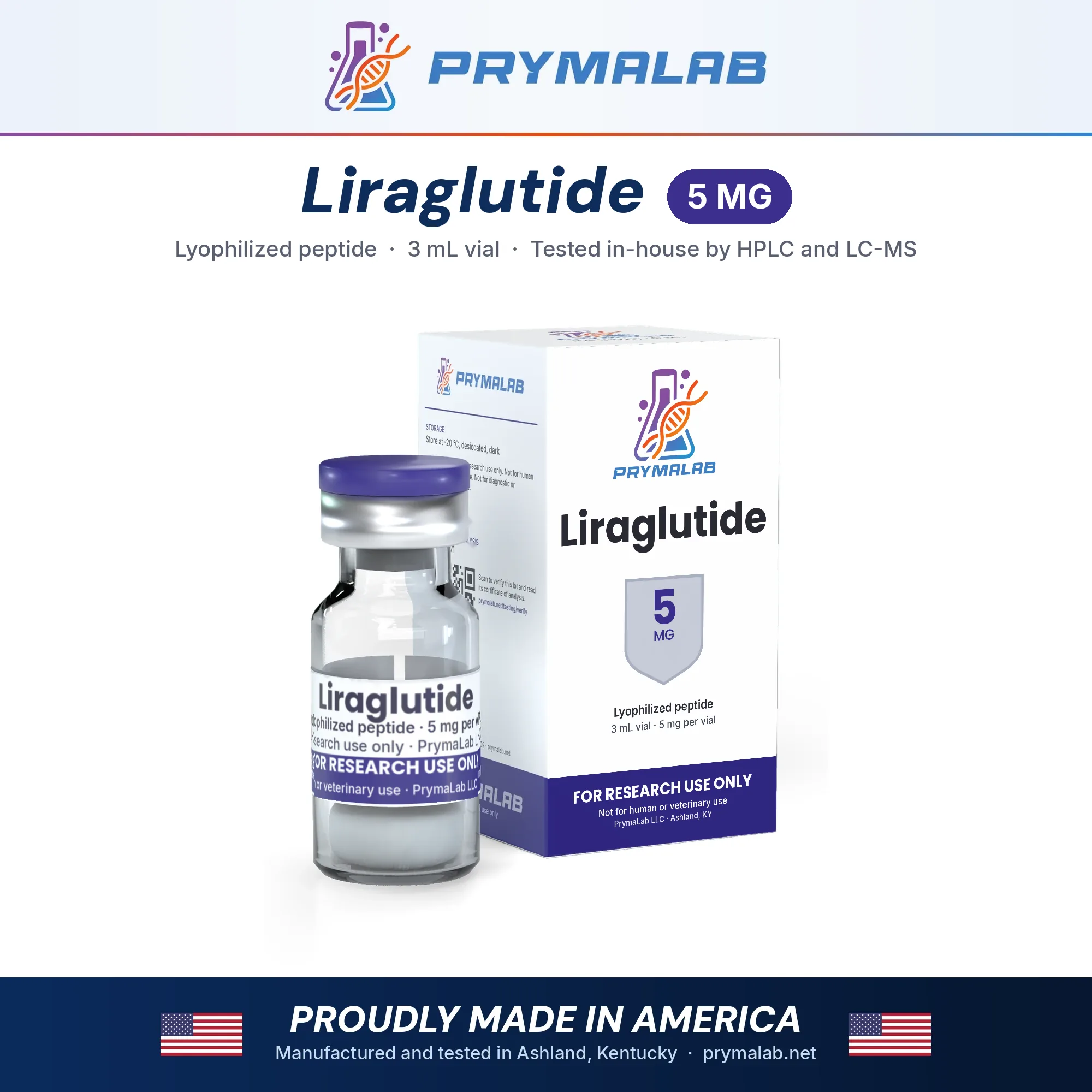
Liraglutide 5mg
The acylated GLP-1(7-37) analogue (Arg34, Lys26-palmitoyl), 5 mg freeze-dried
Liraglutide is a 31-residue analogue of human GLP-1(7-37) with two changes: lysine 34 becomes arginine, and lysine 26 carries a C16 palmitoyl chain on a gamma-glutamyl spacer. The fatty acid binds serum albumin and stretches the hormone’s half-life from minutes to about 13 hours. This listing is the 5 mg vial of freeze-dried powder, the main fill; a 2 mg vial is also sold. In its pharmaceutical forms it is the drug sold as Victoza and Saxenda; this listing is a research-grade lyophilized peptide, not a medicine.
Specifications
| Property | Value |
|---|---|
| Compound | Liraglutide (NN2211), Arg34, Lys26-(N-ε-(γ-L-glutamyl(N-α-hexadecanoyl)))-GLP-1(7-37) |
| CAS number | 204656-20-2 |
| Molecular formula | C172H265N43O51 |
| Theoretical mass | 3751.2 Da |
| Sequence / structure | H-HAEGTFTSDVSSYLEGQAAK(γ-Glu-palmitoyl)EFIAWLVRGRG-OH; 31 residues, Lys34→Arg, no disulfides. |
| Label claim | 5 mg per vial |
| Form | Lyophilized (freeze-dried) powder or cake in a sealed glass vial with a rubber stopper and aluminium crimp cap |
| Storage, sealed | −20 °C, desiccated, dark |
| Purity specification | 99.0% or higher by RP-HPLC |
| Lot certificate | Certificate for the first lot: in preparation. Published certificates appear on the results page and can be checked on the verify page. |
Fills in this range
Liraglutide is sold in 2 fills. The compound and the testing are the same in every fill; only the amount in the vial changes.
| Fill | Listing |
|---|---|
| 2 mg | Liraglutide 2mg |
| 5 mg | Liraglutide 5mg (this page) |
What the structure is
HAEGTFTSDVSSYLEGQAAKEFIAWLVRGRG, with Arg at position 34 and the palmitoyl-gamma-Glu side chain on Lys26; free N-terminal His7 and free C-terminal Gly37 acid, no amide, no disulfides. Formula C172H265N43O51, theoretical mass 3751.2 Da (PubChem CID 16134956, CAS 204656-20-2). One tryptophan (Trp31) makes it light-sensitive; there is no Met or Cys. Acylated GLP-1 analogues form oligomers in solution and stick to glass and ordinary polypropylene, so low-binding labware matters in assays.
Semaglutide, from the same Novo Nordisk programme, uses a different fatty-acid and linker combination and a different mass; the two are not substitutes for each other in an experiment. Research lots may be the free peptide or an acetate or trifluoroacetate salt, which the certificate states.
What the research covers
Design: albumin binding protracts a short-lived hormone
Liraglutide came out of a structure-activity series in which GLP-1 was derivatised with fatty acids so that the peptide would bind reversibly to serum albumin1. In that series native GLP-1 had an EC50 of about 55 pM at the cloned human GLP-1 receptor and many acylated analogues retained similar potency despite the large substituent; fatty acids of 12 carbons or longer gave markedly protracted exposure in pigs, whereas two fatty-acid substituents or simultaneous N-terminal modification lost potency1. The chosen design (C16 fatty acid on Lys26 through a gamma-glutamyl spacer, Lys34 changed to Arg) is described in the later discovery review6.
Pharmacokinetics in humans
In a first-in-human, double-blind, placebo-controlled dose-escalation study in healthy men, subcutaneous NN2211 (liraglutide) had a half-life of about 12.6 h, dose-proportional exposure and an accumulation index of 1.4-1.5 after seven daily doses4. No significant changes in 24-h glucose or insulin profiles were seen in these normoglycaemic volunteers; dizziness and gastrointestinal adverse events were more frequent than with placebo4. The approximately 13-h half-life is what supports once-daily administration of the pharmaceutical product4,6.
Central mechanism of weight loss in rodents
In rats, liraglutide-induced body-weight loss was independent of GLP-1 receptors in the vagus nerve, area postrema and paraventricular nucleus, and the drug did not activate hindbrain GLP-1-producing neurons5. Peripherally injected fluorescently labelled liraglutide reached circumventricular organs and bound neurons of the hypothalamic arcuate nucleus in mice; binding was absent in Glp1r knockout mice, and in the arcuate nucleus the peptide was internalised in POMC/CART neurons5. Electrophysiology in mouse brain slices showed GLP-1 directly stimulates POMC/CART neurons and indirectly inhibits NPY/AgRP neurons via GABA-dependent signalling, leading the authors to propose arcuate POMC/CART neurons as the main site mediating liraglutide weight loss5.
Cardiovascular outcomes in type 2 diabetes (LEADER)
LEADER randomised 9,340 patients with type 2 diabetes and high cardiovascular risk to liraglutide or placebo added to standard care, with median follow-up of 3.8 years2. The primary composite of cardiovascular death, non-fatal myocardial infarction or non-fatal stroke occurred in 13.0% of the liraglutide group versus 14.9% with placebo (hazard ratio 0.87, 95% CI 0.78-0.97)2. Cardiovascular death (4.7% vs 6.0%) and all-cause death (8.2% vs 9.6%) were also lower with liraglutide; gastrointestinal events were the commonest reason for discontinuation2.
Body weight in adults without diabetes (SCALE)
In a 56-week, double-blind trial of 3,731 adults without type 2 diabetes with a BMI of at least 30 (or at least 27 with dyslipidaemia or hypertension), daily subcutaneous liraglutide 3.0 mg plus lifestyle counselling produced a mean weight loss of 8.4 kg versus 2.8 kg with placebo (difference -5.6 kg)3. 63.2% of liraglutide-treated participants versus 27.1% of placebo participants lost at least 5% of body weight; nausea and diarrhoea were the most frequent adverse events, and serious adverse events occurred in 6.2% vs 5.0%3.
Liver histology in non-alcoholic steatohepatitis (LEAN, phase 2)
In a 48-week, multicentre, double-blind phase 2 trial of 52 overweight patients with biopsy-confirmed NASH, 9 of 23 liraglutide-treated patients with end-of-treatment biopsies (39%) had resolution of definite NASH without worsening of fibrosis, versus 2 of 22 (9%) on placebo (relative risk 4.3, 95% CI 1.0-17.7)8. Fibrosis progression occurred in 2 of 23 versus 8 of 22; gastrointestinal adverse events were more common with liraglutide8. The study was small and designed as a single-group A’Hern design, and the authors called for larger, longer trials8.
Thyroid C-cell findings are rodent-specific
Long-term liraglutide exposure in rodents was associated with thyroid C-cell hyperplasia and tumours7. Mechanistic work localised the GLP-1 receptor to rodent C-cells and showed GLP-1 receptor agonists stimulate calcitonin release, calcitonin gene expression and C-cell hyperplasia in rats and, to a lesser extent, mice7. Human and cynomolgus monkey C-cells expressed little GLP-1 receptor, agonists did not raise cAMP or calcitonin in primate C-cells, and 20 months of liraglutide at more than 60 times human exposure did not cause C-cell hyperplasia in monkeys; the authors nonetheless noted that long-term consequences in the human thyroid remain unknown7. This rodent finding is the basis of the boxed warning on the pharmaceutical products7.
What is not established
Liraglutide is among the most extensively studied peptides in medicine, but almost all of the human evidence concerns the pharmaceutical products (Victoza, Saxenda) at defined doses within regulated trials; none of it used research-grade lyophilized material from this or any other research supplier. The precise mechanism of the cardiovascular benefit seen in LEADER is not established2,6. The NASH histology data come from a single 52-patient phase 2 study and have not led to an approved liver indication8. The long-term relevance of rodent C-cell tumours to humans remains formally unresolved7. Rodent and cell data on central mechanisms (arcuate POMC/CART neurons) come largely from one group at the originator company5.
Clinical and regulatory status
Approved prescription drug in its pharmaceutical forms; the product offered here is a research-grade lyophilized peptide, not the pharmaceutical. Victoza (liraglutide 1.2/1.8 mg, Novo Nordisk) received EU marketing authorisation on 30 June 2009 (EMA Victoza EPAR page) and US FDA approval on 25 January 2010 for glycaemic control in type 2 diabetes (later extended to patients aged 10 and older and to cardiovascular risk reduction). Saxenda (liraglutide 3.0 mg) was FDA-approved on 23 December 2014 for chronic weight management in adults with BMI >= 30, or >= 27 with a weight-related comorbidity. Both carry a boxed warning for thyroid C-cell tumours based on rodent data7. US compound patent protection has lapsed: FDA approved the first generic of Victoza (liraglutide injection 18 mg/3 mL) on 23 December 2024. Liraglutide is not a biosimilar-pathway product in the US (it is a synthetic/rDNA peptide regulated as a drug under the NDA/ANDA route).
Related listings: Semaglutide 5mg, Tirzepatide 5mg, Retatrutide 10mg, GLP-1 (7-36) Amide 5mg, Survodutide 10mg. The weight-loss and metabolic peptides category lists the rest of the range.
How each lot is tested
Every lot is tested in PrymaLab’s own laboratory in Ashland, Kentucky before release: RP-HPLC for purity, LC-MS for identity, Karl Fischer titration for water, LAL for endotoxin and USP <71> for sterility. Published certificates are listed on the results page and can be checked by number and key on the verify page. These are in-house results from PrymaLab Analytical, not an independent test, and the lab is not accredited to ISO 17025. The third-party testing guarantee on this page still applies: if any independent laboratory finds the wrong compound, or less than the stated purity or amount, the order is refunded and the cost of the test is reimbursed.
Frequently asked questions
What exactly is liraglutide, and how does it differ from native GLP-1?
Liraglutide is a 31-residue analogue of human GLP-1(7-37) with two changes: Lys34 is replaced by Arg, and Lys26 carries a C16 palmitoyl chain through a gamma-glutamyl spacer. The fatty acid lets the peptide bind reversibly to serum albumin, which protracts its action and gives a human half-life of roughly 13 hours, whereas native GLP-1 is eliminated within minutes.
How is liraglutide different from semaglutide?
Both are acylated GLP-1 analogues from the same discovery programme, but semaglutide uses a different fatty-acid and linker combination selected for stronger albumin binding, which is what allows once-weekly rather than once-daily administration of the drug product. They are different molecules with different masses (liraglutide 3751 Da) and should not be substituted for each other in an experiment.
Is this the same as Victoza or Saxenda?
No. Victoza and Saxenda are sterile, preservative-containing injectable drug products manufactured under GMP by Novo Nordisk and approved by FDA and EMA. This listing is a research-grade lyophilized peptide intended for in-vitro and laboratory research only; it is not a pharmaceutical, has not been evaluated for human use, and is not interchangeable with the drug products.
What does the literature show, and what does it not show?
Randomised trials of the pharmaceutical product show lower rates of major cardiovascular events in type 2 diabetes (LEADER), reductions in body weight in adults without diabetes (SCALE), and, in one small phase 2 study, histological improvement of NASH. Rodent studies point to arcuate-nucleus POMC/CART neurons as the site of weight-loss action. None of these studies used research-supplier material, and the mechanism of cardiovascular benefit is not established.
How should the lyophilized peptide be stored and reconstituted?
Store the sealed lyophilized vial at −20 °C (or colder), protected from light and moisture. Reconstitute with sterile water or an appropriate buffer, gently swirling rather than shaking, and keep the solution at 2 to 8 °C; liraglutide self-associates in solution and acylated peptides can adsorb to plastics, so aliquot into low-binding tubes and avoid repeated freeze-thaw. The peptide contains one Trp residue (position 31) and is sensitive to light and oxidation.
Why do the rodent thyroid findings matter?
In rats and mice, GLP-1 receptors on thyroid C-cells respond to agonists with calcitonin release and C-cell proliferation, and lifetime rodent studies showed C-cell tumours. Primate C-cells express little GLP-1 receptor and did not respond, and clinical calcitonin data were unremarkable, but the finding is the reason for the boxed warning on the drug products and is a relevant consideration when designing rodent studies.
References
- Knudsen LB, Nielsen PF, Huusfeldt PO, Johansen NL, Madsen K, Pedersen FZ, Thogersen H, Wilken M, Agerso H Potent derivatives of glucagon-like peptide-1 with pharmacokinetic properties suitable for once daily administration. Journal of Medicinal Chemistry. 2000;43(9):1664-1669. DOI · PubMed
- Marso SP, Daniels GH, Brown-Frandsen K, Kristensen P, Mann JF, Nauck MA, Nissen SE, Pocock S, Poulter NR, Ravn LS, Steinberg WM, Stockner M, Zinman B, Bergenstal RM, Buse JB; LEADER Steering Committee Liraglutide and cardiovascular outcomes in type 2 diabetes. New England Journal of Medicine. 2016;375(4):311-322. DOI · PubMed
- Pi-Sunyer X, Astrup A, Fujioka K, Greenway F, Halpern A, Krempf M, Lau DC, le Roux CW, Violante Ortiz R, Jensen CB, Wilding JP; SCALE Obesity and Prediabetes NN8022-1839 Study Group A randomized, controlled trial of 3.0 mg of liraglutide in weight management. New England Journal of Medicine. 2015;373(1):11-22. DOI · PubMed
- Agerso H, Jensen LB, Elbrond B, Rolan P, Zdravkovic M The pharmacokinetics, pharmacodynamics, safety and tolerability of NN2211, a new long-acting GLP-1 derivative, in healthy men. Diabetologia. 2002;45(2):195-202. DOI · PubMed
- Secher A, Jelsing J, Baquero AF, Hecksher-Sorensen J, Cowley MA, Dalboge LS, Hansen G, Grove KL, Pyke C, Raun K, Schaffer L, Tang-Christensen M, Verma S, Witgen BM, Vrang N, Bjerre Knudsen L The arcuate nucleus mediates GLP-1 receptor agonist liraglutide-dependent weight loss. Journal of Clinical Investigation. 2014;124(10):4473-4488. DOI · PubMed
- Knudsen LB, Lau J The discovery and development of liraglutide and semaglutide. Frontiers in Endocrinology. 2019;10:155. DOI · PubMed
- Bjerre Knudsen L, Madsen LW, Andersen S, Almholt K, de Boer AS, Drucker DJ, Gotfredsen C, Egerod FL, Hegelund AC, Jacobsen H, Jacobsen SD, Moses AC, Molck AM, Nielsen HS, Nowak J, Solberg H, Thi TD, Zdravkovic M, Moerch U Glucagon-like peptide-1 receptor agonists activate rodent thyroid C-cells causing calcitonin release and C-cell proliferation. Endocrinology. 2010;151(4):1473-1486. DOI · PubMed
- Armstrong MJ, Gaunt P, Aithal GP, Barton D, Hull D, Parker R, Hazlehurst JM, Guo K, Abouda G, Aldersley MA, Stocken D, Gough SC, Tomlinson JW, Brown RM, Hubscher SG, Newsome PN; LEAN trial team Liraglutide safety and efficacy in patients with non-alcoholic steatohepatitis (LEAN): a multicentre, double-blind, randomised, placebo-controlled phase 2 study. Lancet. 2016;387(10019):679-690. DOI · PubMed
Research use only
For laboratory research use only. Liraglutide 5mg is not a drug, food, cosmetic or dietary supplement, is not approved by the FDA or any comparable authority for human or veterinary use, and must not be given to people or animals. It is sold to qualified researchers and institutions, and the buyer is responsible for lawful handling and disposal.








Reviews
There are no reviews yet.