
Description
PrymaLab · Research use only
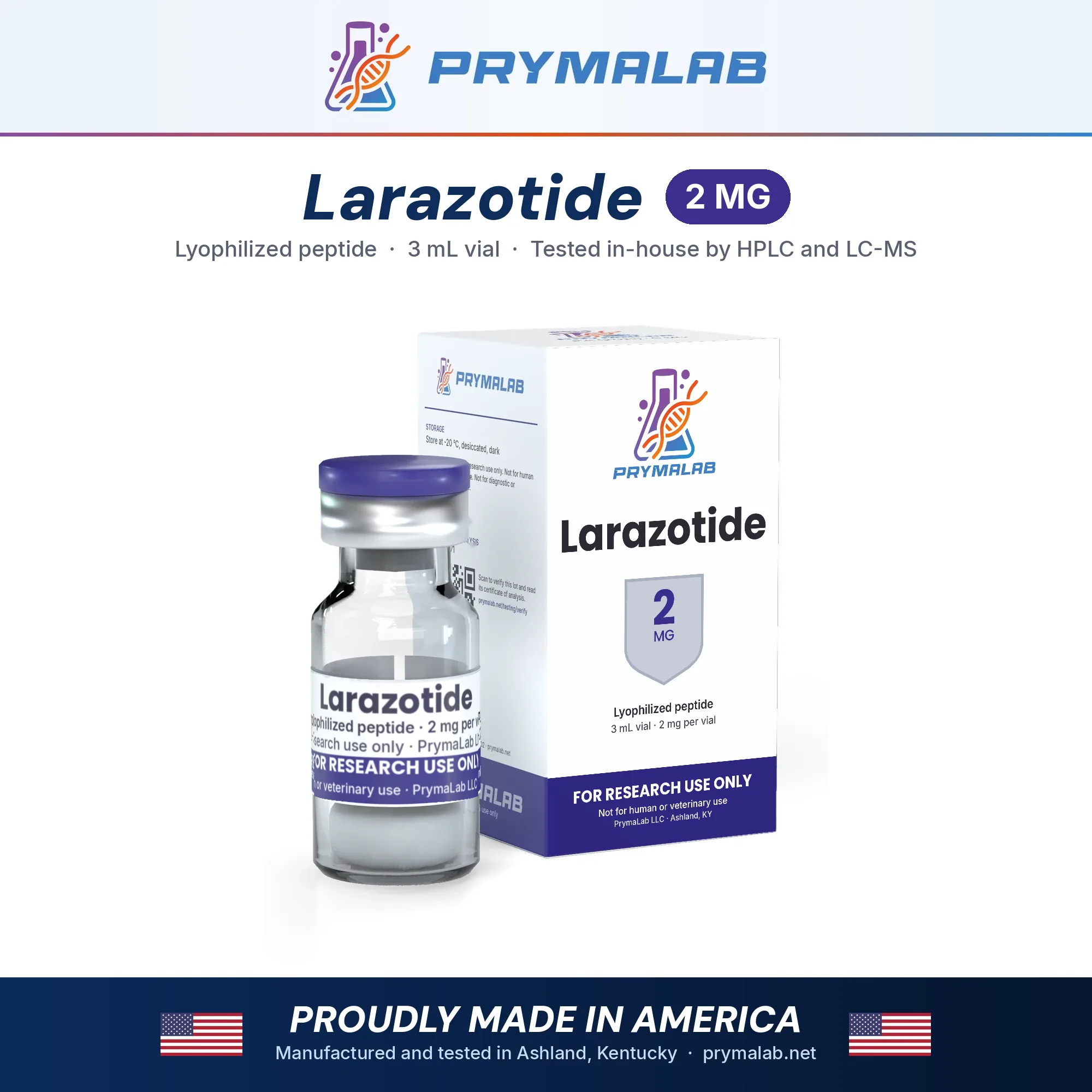
Larazotide Acetate 2mg
Larazotide acetate (AT-1001), the octapeptide tight-junction regulator GGVLVQPG, 2 mg freeze-dried
Larazotide acetate (AT-1001) is a synthetic eight-residue peptide, Gly-Gly-Val-Leu-Val-Gln-Pro-Gly, developed by Alba Therapeutics from Alessio Fasano’s work on zonulin, the human counterpart of the Vibrio cholerae toxin that opens intestinal tight junctions. It was built to do the opposite: keep the junctions closed. This listing is the 2 mg vial of freeze-dried powder, the only fill. It reached phase 3 for coeliac disease and was stopped for futility in 2022; there is no approved product.
Specifications
| Property | Value |
|---|---|
| Compound | Larazotide acetate (AT-1001), Gly-Gly-Val-Leu-Val-Gln-Pro-Gly; tight-junction regulator octapeptide |
| CAS number | 258818-34-7 (larazotide); 881851-50-9 (larazotide acetate) |
| Molecular formula | C32H55N9O10 (free peptide); C34H59N9O12 (acetate) |
| Theoretical mass | 725.8 Da (free peptide); 785.9 Da (mono-acetate) |
| Sequence / structure | H-GGVLVQPG-OH; 8 residues, all L, free termini, acetate salt. |
| Label claim | 2 mg per vial |
| Form | Lyophilized (freeze-dried) powder or cake in a sealed glass vial with a rubber stopper and aluminium crimp cap |
| Storage, sealed | −20 °C, desiccated, dark |
| Purity specification | 99.0% or higher by RP-HPLC |
| Lot certificate | Certificate for the first lot: in preparation. Published certificates appear on the results page and can be checked on the verify page. |
What the structure is
H-Gly-Gly-Val-Leu-Val-Gln-Pro-Gly-OH (GGVLVQPG), all L-amino acids, free at both ends, no cysteine, methionine or tryptophan. Free peptide C32H55N9O10, 725.8 Da (PubChem CID 9810532, CAS 258818-34-7); the mono-acetate is C34H59N9O12, 785.9 Da (CID 44146842, CAS 881851-50-9). The Val-Leu-Val core makes it only moderately water-soluble at neutral pH, and the Gly-Gly N-terminus can slowly cyclise to a diketopiperazine in solution, so solutions are made fresh.
Larazotide is not AT-1002, the Zot-derived hexapeptide that opens tight junctions and was studied as an absorption increaser, and it is not zonulin, which is a protein. The odd PubChem synonym on the acetate record (‘Zot protein 288-293’) does not describe an eight-residue peptide and is not repeated here.
What the research covers
Background: zonulin and tight-junction permeability
Fasano and colleagues identified zonulin as a human protein analogous to the Vibrio cholerae zonula occludens toxin that induces tight-junction disassembly and increased permeability in non-human primate intestinal epithelium1. Zonulin expression was raised in intestinal tissue during the acute phase of coeliac disease, a condition in which tight junctions are open and permeability is increased1. This pathway is the rationale for a peptide that blocks tight-junction opening1,8.
In-vitro mechanism: preserving tight-junction structure
In Caco-2 and IEC6 intestinal epithelial cells, larazotide acetate inhibited the redistribution of zonula occludens-1 (ZO-1) and actin, the fall in transepithelial electrical resistance and the increase in tight-junction permeability caused by the Zot-derived hexapeptide AT-1002 and by gliadin fragments3. It also inhibited translocation of a gliadin 13-mer peptide across Caco-2 monolayers and, when applied apically, blocked the permeability increase induced by basolaterally applied cytokines3. In a separate study, larazotide acetate promoted de novo tight-junction assembly in MDCK calcium-switch assays, promoted junctional localisation of ZO-1, occludin, claudins and E-cadherin, and decreased paracellular permeability in ‘leaky’ Caco-2 cells4. A 2021 review adds that larazotide has more recently been linked to inhibition of myosin light-chain kinase, which would reduce tension on actin filaments and favour junction closure8.
In-vivo preclinical data
In gliadin-sensitised HLA-HCD4/DQ8 double-transgenic mice, larazotide acetate inhibited gliadin-induced macrophage accumulation in the intestine and preserved normal tight-junction structure3. According to the 2021 review, rodent and porcine studies have also examined larazotide in non-coeliac settings such as collagen-induced arthritis in mice and intestinal ischaemic injury in pigs8; those primary studies were not reviewed here.
Proof-of-concept and gluten-challenge trials in coeliac disease
In an inpatient, double-blind, placebo-controlled single-dose study, AT-1001 12 mg was well tolerated in coeliac subjects given a gluten challenge; the placebo group showed a 70% increase in intestinal permeability (lactulose/mannitol excretion) after gluten, whereas no increase was seen with AT-1001, and gastrointestinal symptoms and interferon-gamma elevations were less frequent2. In an outpatient dose-ranging study of 86 patients (0.25-8 mg three times daily with or without 2.4 g/day gluten for 14 days), lactulose/mannitol ratios were too variable to show a drug effect, but some lower doses appeared to limit gluten-induced worsening of symptom scores5. In a 184-patient, 6-week gluten-challenge study (1, 4 or 8 mg three times daily with 2.7 g gluten/day), there was again no difference in lactulose/mannitol ratio, but the 1-mg dose limited gluten-induced symptoms and all doses blunted the rise in anti-tissue transglutaminase IgA (mean ratio over baseline 19.0 with placebo versus 5.78, 3.88 and 7.72)6.
Phase 2b in symptomatic patients on a gluten-free diet
A multicentre, randomised, double-blind trial enrolled 342 adults with coeliac disease who remained symptomatic despite at least 12 months on a gluten-free diet, and compared larazotide acetate 0.5, 1 or 2 mg three times daily with placebo over 12 weeks7. The primary endpoint (Celiac Disease Gastrointestinal Symptom Rating Scale) was met only at the 0.5-mg dose, which also reduced symptomatic days and abdominal pain scores; the 1- and 2-mg doses did not differ from placebo on any endpoint, and safety was comparable with placebo7. The authors described the results as mixed but supportive of a tight-junction-targeted approach7.
Phase 3 (CedLara) and discontinuation
On the basis of the phase 2b result, 9 Meters Biopharma ran the phase 3 CedLara trial (NCT03569007; started May 2019) of larazotide 0.25 mg and 0.5 mg versus placebo in adults with persistent coeliac symptoms on a gluten-free diet, with the CeD PRO abdominal-domain score as primary endpoint8. In June 2022 the sponsor announced that an interim analysis showed the number of additional patients needed to detect a significant difference from placebo was too large to justify continuing, and the trial was terminated (ClinicalTrials.gov status: terminated by sponsor, completion 21 July 2022, 307 enrolled). No positive phase 3 result for larazotide exists.
What is not established
Larazotide never demonstrated a benefit on its intended objective biomarker (urinary lactulose/mannitol ratio) in outpatient trials5,6, and the clinical signal was confined to symptom scores, typically at the lowest dose with no dose-response5,6,7; the confirmatory phase 3 trial was stopped for futility in 2022 and the sponsor has since left the field. The molecular target is not definitively identified: ‘zonulin antagonist’ is a working description, and the proposed myosin light-chain kinase mechanism rests on limited data summarised in a review co-authored by sponsor-affiliated scientists8. The in-vitro and mouse mechanistic work comes almost entirely from the originator company’s laboratories3,4. Oral bioavailability is expected to be minimal (the peptide was designed to act locally in the gut lumen), so systemic effects should not be assumed. Reports of use in non-coeliac conditions (for example collagen-induced arthritis in mice and intestinal ischaemic injury in pigs, as summarised in8) are preliminary and the primary studies were not reviewed here. None of this work used research-grade material from this or any other research supplier.
Clinical and regulatory status
Investigational; not approved anywhere. Larazotide acetate (AT-1001) was developed by Alba Therapeutics, then Innovate Biopharmaceuticals, then 9 Meters Biopharma for coeliac disease, and completed phase 1-2b trials between 2007 and 20152,5,6,7. The phase 3 CedLara trial (NCT03569007, 9 Meters Biopharma, started 29 May 2019) was terminated by the sponsor after an interim analysis in June 2022. Development has not resumed and there is no pharmaceutical product, brand name or approved indication. There is therefore no pharmaceutical reference product; this listing is a research-grade lyophilized peptide for laboratory use only.
Related listings: BPC-157 5MG, KPV (5mg), VIP5 5MG (Vasoactive Intestinal Peptide). The healing and recovery peptides category lists the rest of the range.
How each lot is tested
Every lot is tested in PrymaLab’s own laboratory in Ashland, Kentucky before release: RP-HPLC for purity, LC-MS for identity, Karl Fischer titration for water, LAL for endotoxin and USP <71> for sterility. Published certificates are listed on the results page and can be checked by number and key on the verify page. These are in-house results from PrymaLab Analytical, not an independent test, and the lab is not accredited to ISO 17025. The third-party testing guarantee on this page still applies: if any independent laboratory finds the wrong compound, or less than the stated purity or amount, the order is refunded and the cost of the test is reimbursed.
Frequently asked questions
What is larazotide acetate and where does it come from?
Larazotide (AT-1001) is a synthetic octapeptide, Gly-Gly-Val-Leu-Val-Gln-Pro-Gly, supplied as the acetate salt. It was developed by Alba Therapeutics from Alessio Fasano’s work on zonulin, the human counterpart of the Vibrio cholerae zonula occludens toxin that opens intestinal tight junctions. It was designed to do the opposite of the toxin: to keep tight junctions closed.
How does larazotide differ from AT-1002 and from zonulin?
AT-1002 is a hexapeptide derived from the V. cholerae zonula occludens toxin (Zot) that opens tight junctions; larazotide blocks the effects of AT-1002 in cell monolayers. Zonulin is a human protein analogous to Zot, not a short peptide. Larazotide is a different sequence from both and acts as an antagonist of tight-junction opening.
What did the clinical trials show?
Phase 1-2 trials in coeliac disease showed good tolerability and, in some arms, less gluten-induced symptom worsening and smaller rises in anti-tissue-transglutaminase antibodies, but no consistent effect on the lactulose/mannitol permeability biomarker. A phase 2b trial met its symptom endpoint only at the lowest dose (0.5 mg), with no dose-response. The phase 3 CedLara trial was stopped at interim analysis in 2022 because a benefit over placebo was not emerging. Larazotide is not approved for any use.
Was larazotide ever an approved drug?
No. It reached phase 3 for coeliac disease but the confirmatory trial was terminated in 2022 and development ended. There is no brand-name product, so this research-grade peptide has no pharmaceutical counterpart. It was intended for local action in the gut lumen after oral administration, and systemic activity has not been characterised.
What in-vitro systems have been used with larazotide?
Published mechanistic work used Caco-2 and IEC6 intestinal epithelial monolayers (transepithelial electrical resistance, ZO-1/actin immunostaining, gliadin-peptide translocation, cytokine-induced permeability) and MDCK calcium-switch assays of tight-junction assembly. In vivo, gliadin-sensitised HLA-DQ8 transgenic mice were used. These are the systems in which the peptide has documented activity.
How should the lyophilized peptide be stored and dissolved?
Store sealed at −20 °C, dry and in the dark. The sequence has no Met, Cys or Trp, so it is comparatively stable, but Gln and the Gly-Gly N-terminus can undergo slow deamidation or diketopiperazine formation in solution, so make fresh solutions. It is a small, fairly hydrophobic peptide (Val-Leu-Val core) with limited water solubility at neutral pH; dissolve in water or PBS, with a small proportion of DMSO if needed, and keep solutions at 2 to 8 °C for short-term use or frozen in aliquots.
References
- Fasano A, Not T, Wang W, Uzzau S, Berti I, Tommasini A, Goldblum SE Zonulin, a newly discovered modulator of intestinal permeability, and its expression in coeliac disease. Lancet. 2000;355(9214):1518-1519. DOI · PubMed
- Paterson BM, Lammers KM, Arrieta MC, Fasano A, Meddings JB The safety, tolerance, pharmacokinetic and pharmacodynamic effects of single doses of AT-1001 in coeliac disease subjects: a proof of concept study. Alimentary Pharmacology & Therapeutics. 2007;26(5):757-766. DOI · PubMed
- Gopalakrishnan S, Durai M, Kitchens K, Tamiz AP, Somerville R, Ginski M, Paterson BM, Murray JA, Verdu EF, Alkan SS, Pandey NB Larazotide acetate regulates epithelial tight junctions in vitro and in vivo. Peptides. 2012;35(1):86-94. DOI · PubMed
- Gopalakrishnan S, Tripathi A, Tamiz AP, Alkan SS, Pandey NB Larazotide acetate promotes tight junction assembly in epithelial cells. Peptides. 2012;35(1):95-101. DOI · PubMed
- Leffler DA, Kelly CP, Abdallah HZ, Colatrella AM, Harris LA, Leon F, Arterburn LA, Paterson BM, Lan ZH, Murray JA A randomized, double-blind study of larazotide acetate to prevent the activation of celiac disease during gluten challenge. American Journal of Gastroenterology. 2012;107(10):1554-1562. DOI · PubMed
- Kelly CP, Green PH, Murray JA, Dimarino A, Colatrella A, Leffler DA, Alexander T, Arsenescu R, Leon F, Jiang JG, Arterburn LA, Paterson BM, Fedorak RN; Larazotide Acetate Celiac Disease Study Group Larazotide acetate in patients with coeliac disease undergoing a gluten challenge: a randomised placebo-controlled study. Alimentary Pharmacology & Therapeutics. 2013;37(2):252-262. DOI · PubMed
- Leffler DA, Kelly CP, Green PH, Fedorak RN, DiMarino A, Perrow W, Rasmussen H, Wang C, Bercik P, Bachir NM, Murray JA Larazotide acetate for persistent symptoms of celiac disease despite a gluten-free diet: a randomized controlled trial. Gastroenterology. 2015;148(7):1311-1319.e6. DOI · PubMed
- Slifer ZM, Krishnan BR, Madan J, Blikslager AT Larazotide acetate: a pharmacological peptide approach to tight junction regulation. American Journal of Physiology – Gastrointestinal and Liver Physiology. 2021;320(6):G983-G989. DOI · PubMed
Research use only
For laboratory research use only. Larazotide Acetate 2mg is not a drug, food, cosmetic or dietary supplement, is not approved by the FDA or any comparable authority for human or veterinary use, and must not be given to people or animals. It is sold to qualified researchers and institutions, and the buyer is responsible for lawful handling and disposal.










Reviews
There are no reviews yet.