


Description
PrymaLab · Research use only
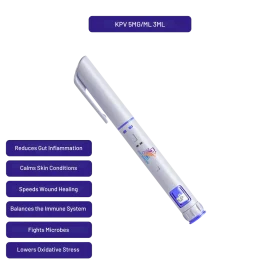
Preloaded Autoinjector | HGH Fragment 176-191 | 3ml Pen | 10mg
Native hGH 176-191, phenylalanine first, 10 mg in a 3 mL preloaded pen
HGH fragment 176-191 is the last sixteen residues of human growth hormone, FLRIVQCRSVEGSCGF, with the cysteines at hormone positions 182 and 189 joined by a disulfide. This listing is a preloaded autoinjector pen holding 10 mg of the native fragment dissolved in 3 mL of bacteriostatic water. Most research filed under this name was in fact done with AOD-9604, a close tyrosine-led analogue, and concerns fat metabolism and insulin sensitivity in obese rodents; the native sequence itself has barely been studied.
Specifications
| Property | Value |
|---|---|
| Compound | hGH fragment 176-191 (Human growth hormone fragment 176-191 (FLRIVQCRSVEGSCGF; Cys182-Cys189 disulfide)) |
| CAS number | 66004-57-7 |
| Molecular formula | C78H123N23O22S2 |
| Contents | hGH fragment 176-191: 10 mg per 3 mL pen (0.33% w/v) |
| Form | Sterile aqueous solution in bacteriostatic water (0.9% benzyl alcohol), supplied in a 3 mL glass cartridge inside a preloaded autoinjector pen fitted with a needle |
| Storage, sealed | Store at 2–8 °C in the original carton, protected from light |
| Safety data sheet | PL-SDS-080 |
Which peptide is in this pen
The pen contains the native sequence, phenylalanine first, exactly as the stretch sits in the hormone: H-Phe-Leu-Arg-Ile-Val-Gln-Cys-Arg-Ser-Val-Glu-Gly-Ser-Cys-Gly-Phe-OH, formula C78H123N23O22S2, CAS 66004-57-7, about 1,799 Da. It is not AOD-9604. That peptide is hormone residues 177 to 191 with a tyrosine added at the N-terminus, so it has tyrosine where this pen’s peptide has phenylalanine 176. The swap adds one oxygen atom, about 16 Da, and gives AOD-9604 its own formula and CAS number (221231-10-3). Sellers often use the two names interchangeably, so the first residue of the sequence and the observed mass are the details to check on any certificate. The HGH fragment 176-191 and AOD-9604 guide sets the two side by side, and peptide purity testing explains why mass spectrometry, not an HPLC purity figure alone, tells them apart.
What is in the pen
Each pen holds a 3 mL glass cartridge of sterile solution: 10 mg of the fragment at 0.33% w/v, about 3.3 mg/mL, in bacteriostatic water containing 0.9% benzyl alcohol as a preservative. The safety data sheet does not classify the peptide. It lists benzyl alcohol as harmful if swallowed or inhaled, a serious eye irritant and a possible skin sensitiser. Keep the pen at 2 to 8 °C in its carton, out of the light and capped between uses, and never let it freeze; discard a pen whose solution has frozen, discoloured or turned cloudy. The light warning has a basis in the sequence. Kerwin and Remmele list phenylalanine and cysteine or cystine among the residues that undergo primary photooxidation in proteins1, and this fragment has a phenylalanine at each end and a disulfide between them. General trade-offs between ready-made solutions and freeze-dried vials are covered in peptide pen vs vial.
What the research covers
Almost everything published under the fragment 176-191 name was done with AOD-9604. Ng and colleagues described that peptide as a synthetic analogue of the lipolytic domain of growth hormone and tested it in obese Zucker rats2. Over a 19-day oral study, treated rats gained less than half as much weight as controls, and their adipose tissue showed higher lipolytic activity2. Euglycaemic clamps found no adverse effect on insulin sensitivity, which set it apart from chronic treatment with intact growth hormone2.
Heffernan and colleagues then looked at mechanism in obese mice treated for 14 days3. Growth hormone and AOD-9604 both reduced body weight and body fat, and both brought the depressed beta-3 adrenergic receptor RNA of obese mice up to lean levels3. In beta-3 receptor knockout mice the long-term effects on body weight and lipolysis did not appear, yet in an acute experiment AOD-9604 still raised energy expenditure and fat oxidation3. The authors concluded that the lipolytic action was not mediated directly through the beta-3 receptor, though higher receptor expression might add to it3.
None of this work used the native phenylalanine sequence that fills this pen. The site’s guide to the fragment finds no animal fat-metabolism study and no human study of the native sequence, so the idea that it behaves like AOD-9604 is an assumption rather than a finding. No study looked at either peptide held in bacteriostatic water. The HGH fragment 176-191 guide covers the developer’s human trials of AOD-9604, its metabolism and the regulatory position of both peptides.
How each lot is tested
Every lot is tested in PrymaLab’s own laboratory in Ashland, Kentucky before release: RP-HPLC for purity, LC-MS for identity, Karl Fischer titration for water, LAL for endotoxin and USP <71> for sterility. Published certificates are listed on the results page and can be checked by number and key on the verify page. The certificate covers the peptide lot used to fill the pen, not the finished solution. These are in-house results from PrymaLab Analytical, not an independent test, and the lab is not accredited to ISO 17025. The third-party testing guarantee on this page still applies: if any independent laboratory finds the wrong compound, or less than the stated purity or amount, the order is refunded and the cost of the test is reimbursed.
Frequently asked questions
Is this pen HGH fragment 176-191 or AOD-9604?
The native fragment. Its sequence begins with phenylalanine, FLRIVQCRSVEGSCGF, and the safety data sheet gives CAS 66004-57-7 and the formula C78H123N23O22S2. AOD-9604 begins with tyrosine instead, weighs about 16 Da more and has its own CAS number, even though sellers often use one name for both.
Why must the pen stay cold, dark and unfrozen?
Those are the conditions on the safety data sheet: 2 to 8 °C in the carton, protected from light, never frozen, and discarded if the solution freezes, discolours or clouds. The fragment's phenylalanines and its disulfide are among the groups that light can oxidise in peptides and proteins.
Does the published research apply to this pen?
Only as background. The rodent studies of fat metabolism and insulin sensitivity used AOD-9604, not the native fragment, and none tested a peptide in solution. The native sequence has no human study, so nothing here describes a demonstrated effect of this product.
What does the certificate cover?
The lot of peptide used to fill the pen, not the finished solution in the cartridge. The testing section on this page lists the methods used, and any published certificate can be checked by its number and key on the verify page.
Is the pen intended for human use?
No. It is sold for laboratory research only, is not approved by the FDA or any other regulator for human or veterinary use, and must not be given to people or animals. It is not a drug, food or supplement.
References
- Kerwin BA, Remmele RL Jr. Protect from light: photodegradation and protein biologics. J Pharm Sci. 2007;96(6):1468-79. DOI · PubMed
- Ng FM, Sun J, Sharma L, et al. Metabolic studies of a synthetic lipolytic domain (AOD9604) of human growth hormone. Horm Res. 2000;53(6):274-8. DOI · PubMed
- Heffernan M, Summers RJ, Thorburn A, et al. The effects of human GH and its lipolytic fragment (AOD9604) on lipid metabolism following chronic treatment in obese mice and beta(3)-AR knock-out mice. Endocrinology. 2001;142(12):5182-9. DOI · PubMed
Research use only
For laboratory research use only. This product is not a drug, food, cosmetic or dietary supplement, is not approved by the FDA or any comparable authority for human or veterinary use, and must not be given to people or animals. It is sold to qualified researchers and institutions, and the buyer is responsible for lawful handling and disposal.
Other formats of HGH Fragment 176-191
HGH Fragment 176-191 is also stocked as AOD9604 5MG, AOD9604 10mg Nasal Spray and AOD-9604 6mg preloaded 3ml pen. Each listing states its own quantity and concentration, and the pen and vial comparison explains what changes between formats.







Reviews
There are no reviews yet.