Description
PrymaLab · Research use only
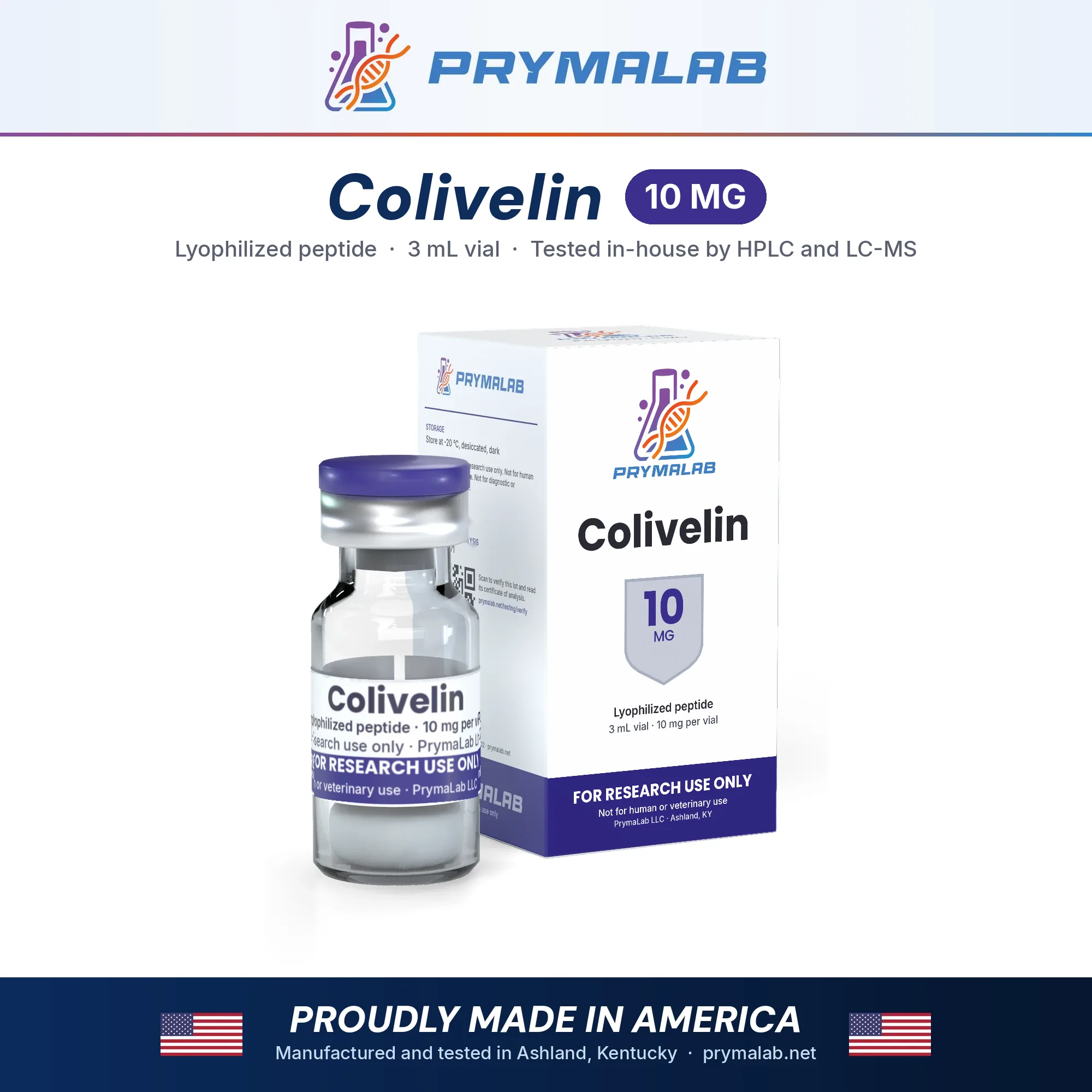
Colivelin 10mg
The ADNF-9 / humanin hybrid SALLRSIPAPAGASRLLLLTGEIDLP, 10 mg freeze-dried
Colivelin is a 26-residue synthetic hybrid built in 2005 at Keio University: the nine-residue ADNF core SALLRSIPA fused to the front of a 17-residue, four-times-substituted humanin fragment. In the group’s neuronal assays it was fully protective at 100 femtomolar, against 10 nM for Humanin G and about 10 µM for humanin. This listing is the 10 mg vial of freeze-dried powder, the main fill; a 100 mg vial is also sold. Much of the recent literature uses colivelin as an off-the-shelf STAT3 activator in unrelated models.
Specifications
| Property | Value |
|---|---|
| Compound | Colivelin (CLN), ADNF-9 fused to AGA-(C8R)HNG17; synthetic neuroprotective hybrid peptide |
| CAS number | 867021-83-8 |
| Molecular formula | C119H206N32O35 |
| Theoretical mass | 2645.1 Da |
| Sequence / structure | H-SALLRSIPAPAGASRLLLLTGEIDLP-OH; 26 residues, no Cys/Met/Trp, no disulfides. |
| Label claim | 10 mg per vial |
| Form | Lyophilized (freeze-dried) powder or cake in a sealed glass vial with a rubber stopper and aluminium crimp cap |
| Storage, sealed | −20 °C, desiccated, dark |
| Purity specification | 99.0% or higher by RP-HPLC |
| Lot certificate | Certificate for the first lot: in preparation. Published certificates appear on the results page and can be checked on the verify page. |
Fills in this range
Colivelin is sold in 2 fills. The compound and the testing are the same in every fill; only the amount in the vial changes.
| Fill | Listing |
|---|---|
| 10 mg | Colivelin 10mg (this page) |
| 100 mg | Colivelin 100mg |
What the structure is
Ser-Ala-Leu-Leu-Arg-Ser-Ile-Pro-Ala-Pro-Ala-Gly-Ala-Ser-Arg-Leu-Leu-Leu-Leu-Thr-Gly-Glu-Ile-Asp-Leu-Pro, linear, all L-amino acids, free at both ends. Residues 1-9 are ADNF-9; residues 10-26 are humanin Pro3-Pro19 carrying R4A, F6A, C8R and S14G. Formula C119H206N32O35, theoretical mass 2645.1 Da (PubChem CID 90477169, CAS 867021-83-8). It contains no cysteine, methionine or tryptophan, and biophysical work found it stable and monomeric in phosphate-buffered saline, unlike humanin.
Colivelin does not contain the full humanin sequence, so it is not interchangeable with humanin or Humanin G. The usual commercial form is the trifluoroacetate salt; the certificate reports purity and net peptide content separately.
What the research covers
Design and in vitro potency
Colivelin was built by fusing ADNF-9 to the N-terminus of AGA-(C8R)HNG17, a humanin derivative in which the S14G, R4A/F6A and C8R changes each add potency1,4. In F11 cells and primary cortical neurons, colivelin completely suppressed death caused by overexpressed familial AD genes (V642I-APP, M146L-PS1) and by Abeta1-43 at 100 fM, versus 10 pM for AGA-(C8R)HNG17, 10 nM for HNG and about 10 uM for wild-type humanin1,4. Protection depended on two pathways: the ADNF component signalled through Ca2+/calmodulin-dependent protein kinase IV and the humanin component through STAT3, and only combined dominant-negative CaMKIV plus STAT3 reduced colivelin’s effect1. Colivelin also protected against glutamate excitotoxicity at 100 fM-1 nM, which the humanin component alone did not1.
Memory models in mice and rats
Intracerebroventricular colivelin (10-100 pmol every 6 days) prevented the loss of spontaneous alternation produced by repeated central Abeta25-35 or Abeta1-42 in mice and prevented CA1 neuronal loss after hippocampal Abeta1-42 injection; intraperitoneal colivelin reduced memory impairment caused by the muscarinic antagonist 3-quinuclidinyl benzilate, which the authors interpreted as evidence of blood-brain-barrier passage1. Intranasal colivelin reached the brain via the olfactory bulb and improved memory performance dose-dependently in mouse AD models, with increased septohippocampal STAT3 phosphorylation and preservation of ChAT-positive medial septal neurons3. In rats, intrahippocampal colivelin (0.2 nmol) prevented Abeta25-35-induced deficits in Morris water-maze performance and hippocampal LTP, and chronic intranasal colivelin in 9-month-old APP/PS1 mice improved object recognition, working and spatial memory, restored in vivo LTP and reduced hippocampal Abeta deposition6.
ALS model and ischaemic stroke in mice
In G93A-SOD1 transgenic mice, i.c.v. colivelin improved motor performance dose-dependently, prolonged survival and increased spinal motor neuron counts at 120 days compared with saline- or ADNF-treated mice; ADNF alone had previously improved motor performance without extending survival2. After 60 min transient focal cerebral ischaemia in mice, colivelin reduced neurological deficits and infarct size, limited axonal damage and neuronal death, increased anti-apoptotic gene expression and axonal growth over two weeks, and activated JAK/STAT3 signalling7.
Sepsis and endothelial injury in mice
In cecal ligation and puncture sepsis in male C57BL/6 mice, a single intraperitoneal dose of colivelin (100-200 ug/kg) 1 h after surgery reduced lung injury and neutrophil infiltration of lung, liver and kidney, lowered plasma syndecan-1, TNF-alpha, MIP-1alpha and IL-10, and preserved aortic glycocalyx density and mitochondrial structure8. In this model colivelin treatment was associated with inhibition (not activation) of STAT3 and activation of AMPK in aorta and lung, and colivelin plus antibiotics reduced 7-day disease severity scores relative to antibiotics alone8.
Biophysical properties
Circular dichroism and analytical ultracentrifugation showed that colivelin’s secondary structure resembles ADNF-9 rather than humanin, and that colivelin is stable and monomeric in phosphate-buffered saline, whereas humanin shows a strong tendency to self-associate5. Reviews from the originating group summarise the femtomolar in vitro activity and the mouse AD and ALS data4.
What is not established
The femtomolar potency figures and most of the behavioural and ALS data come from the Keio University group that designed the peptide (Chiba, Matsuoka, Nishimoto and colleagues); independent replication is limited to a handful of Chinese and US laboratories using rodent AD, stroke and sepsis models, with small groups. Blood-brain-barrier penetration was inferred from behaviour after intraperitoneal dosing, not measured directly. The direction of the STAT3 effect differs between studies (activation in neuronal models, inhibition in the sepsis model), and the large body of recent papers that use colivelin as a generic ‘STAT3 activator’ does not characterise the compound itself. No pharmacokinetic, toxicology or human data exist. None of the published work used material from this supplier.
Clinical and regulatory status
Not an approved drug anywhere; no clinical trial of colivelin was found on ClinicalTrials.gov and no investigational programme has been disclosed since the originating group proposed it as an Alzheimer’s/ALS drug candidate in 2005-20101,2,4. It remains a preclinical research peptide. This listing is a research-grade synthetic peptide for laboratory use only.
Related listings: Humanin 10mg, Humanin G (HNG) 10mg, Semax 5mg, P21 (P021) 10mg, Cerebrolysin 60mg. The cognitive, sleep and mood peptides category lists the rest of the range.
How each lot is tested
Every lot is tested in PrymaLab’s own laboratory in Ashland, Kentucky before release: RP-HPLC for purity, LC-MS for identity, Karl Fischer titration for water, LAL for endotoxin and USP <71> for sterility. Published certificates are listed on the results page and can be checked by number and key on the verify page. These are in-house results from PrymaLab Analytical, not an independent test, and the lab is not accredited to ISO 17025. The third-party testing guarantee on this page still applies: if any independent laboratory finds the wrong compound, or less than the stated purity or amount, the order is refunded and the cost of the test is reimbursed.
Frequently asked questions
What is colivelin made of?
It is a 26-residue synthetic hybrid: the nine-residue ADNF core SALLRSIPA fused to a 17-residue humanin derivative, AGA-(C8R)HNG17 (humanin residues 3-19 with R4A, F6A, C8R and S14G). The full sequence is SALLRSIPAPAGASRLLLLTGEIDLP.
How does colivelin differ from humanin and Humanin G?
Humanin and HNG are 24-residue peptides that differ at one position (Ser14 vs Gly14). Colivelin is longer (26 residues), lacks humanin’s first two and last five residues, carries four substitutions in the humanin region, and adds the ADNF-9 segment. In the same neuronal assays, full protection required about 10 uM humanin, 10 nM HNG, 10 pM AGA-(C8R)HNG17 and 100 fM colivelin.
Why is colivelin called a STAT3 activator?
The humanin-derived half signals through STAT3 in neuronal cells, and colivelin increased STAT3 phosphorylation in brain in the memory and stroke studies. Many later papers use it simply as a pharmacological STAT3 activator in unrelated models; note that in a mouse sepsis study it was associated with reduced STAT3 activation in aorta and lung.
Which animal models have been reported?
Mouse Abeta-infusion and anticholinergic memory models, APP/PS1 and other transgenic AD mice, rat intrahippocampal Abeta, G93A-SOD1 ALS mice, transient focal cerebral ischaemia in mice, and polymicrobial sepsis in mice. There are no human studies.
How should lyophilized colivelin be stored?
Sealed at −20 °C or below, desiccated and protected from light. Colivelin contains no cysteine, methionine or tryptophan, so it is less oxidation-prone than humanin, and it is reported to be stable and monomeric in PBS. Reconstituted solutions should be kept at 2 to 8 °C for short-term use or frozen in single-use aliquots.
What does the TFA salt mean for the certificate of analysis?
Synthetic peptides are usually supplied as trifluoroacetate salts; the free-peptide mass is 2645.1 Da (C119H206N32O35) while the salt adds TFA counter-ions bound to the two arginines and the N-terminus. Purity and net peptide content should be read separately on the certificate.
References
- Chiba T, Yamada M, Hashimoto Y, et al. Development of a femtomolar-acting humanin derivative named colivelin by attaching activity-dependent neurotrophic factor to its N terminus: characterization of colivelin-mediated neuroprotection against Alzheimer’s disease-relevant insults in vitro and in vivo. J Neurosci. 2005;25(44):10252-10261. DOI · PubMed
- Chiba T, Yamada M, Sasabe J, et al. Colivelin prolongs survival of an ALS model mouse. Biochem Biophys Res Commun. 2006;343(3):793-798. DOI · PubMed
- Yamada M, Chiba T, Sasabe J, et al. Nasal Colivelin treatment ameliorates memory impairment related to Alzheimer’s disease. Neuropsychopharmacology. 2008;33(8):2020-2032. DOI · PubMed
- Matsuoka M, Hashimoto Y, Aiso S, Nishimoto I Humanin and colivelin: neuronal-death-suppressing peptides for Alzheimer’s disease and amyotrophic lateral sclerosis. CNS Drug Rev. 2006;12(2):113-122. DOI · PubMed
- Arakawa T, Niikura T, Arisaka F, Kita Y Activity-dependent neurotrophic factor, ADNF, determines the structure characteristics of Colivelin, a fusion protein of ADNF9 and Humanin analog. J Pept Sci. 2008;14(5):631-636. DOI · PubMed
- Wu M, Shi H, He Y, et al. Colivelin ameliorates impairments in cognitive behaviors and synaptic plasticity in APP/PS1 transgenic mice. J Alzheimers Dis. 2017;59(3):1067-1078. DOI · PubMed
- Zhao H, Feng Y, Wei C, et al. Colivelin rescues ischemic neuron and axons involving JAK/STAT3 signaling pathway. Neuroscience. 2019;416:198-206. DOI · PubMed
- Urban C, Hayes HV, Piraino G, et al. Colivelin, a synthetic derivative of humanin, ameliorates endothelial injury and glycocalyx shedding after sepsis in mice. Front Immunol. 2022;13:984298. DOI · PubMed
Research use only
For laboratory research use only. Colivelin 10mg is not a drug, food, cosmetic or dietary supplement, is not approved by the FDA or any comparable authority for human or veterinary use, and must not be given to people or animals. It is sold to qualified researchers and institutions, and the buyer is responsible for lawful handling and disposal.







Reviews
There are no reviews yet.