
Description
PrymaLab · Research use only
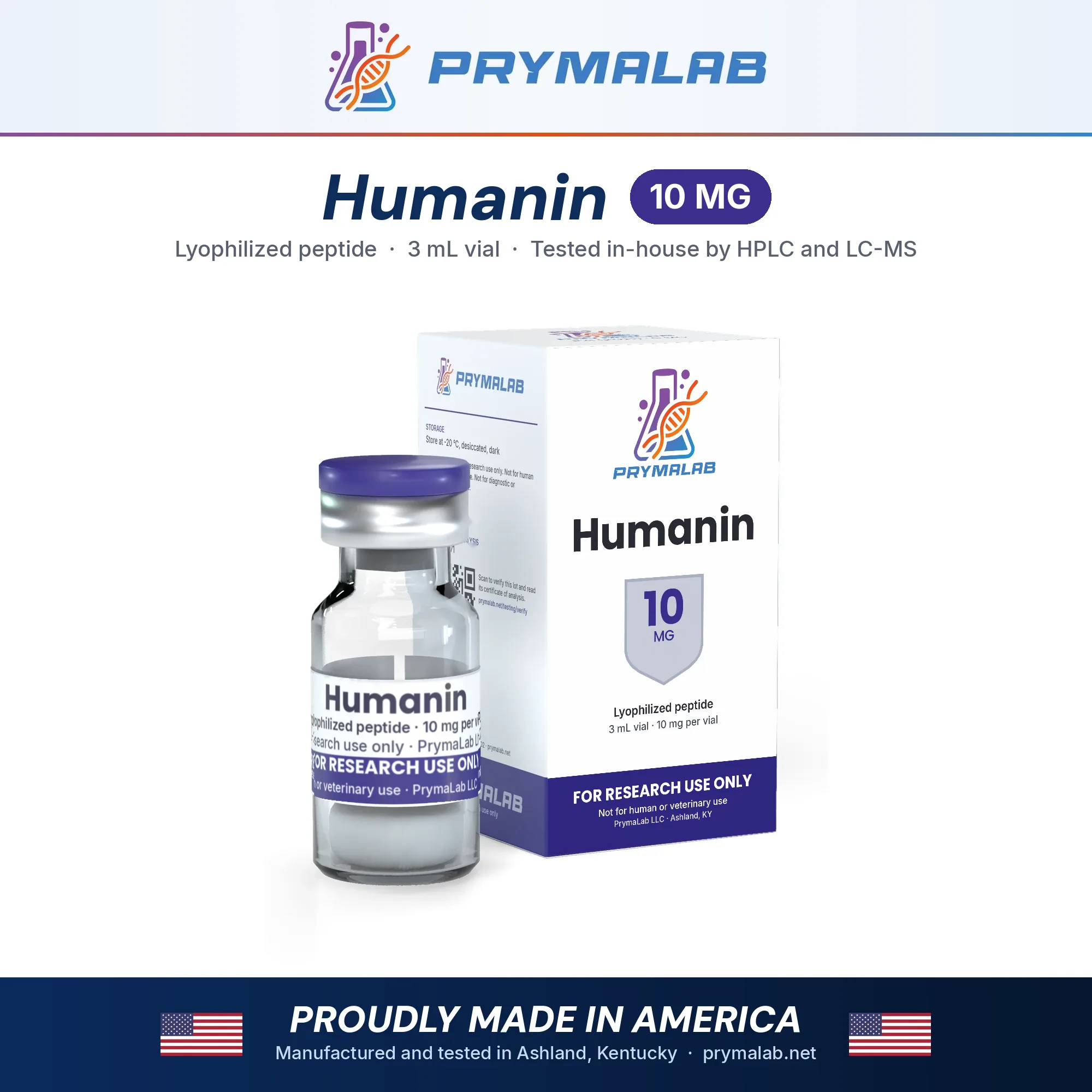
Humanin 10mg
The 24-residue mitochondrial-derived peptide MAPRGFSCLLLLTSEIDLPVKRRA, 10 mg freeze-dried
Humanin is a 24-amino-acid peptide encoded by a short open reading frame inside the mitochondrial 16S rRNA gene (MT-RNR2). It was cloned in 2001 from an Alzheimer’s disease brain cDNA library as a factor that stopped neuronal cell death in culture, and it is usually described as the first mitochondrial-derived peptide. This listing is the 10 mg vial of freeze-dried powder, the main fill; a 5 mg vial is also sold. This is the wild-type Ser14 sequence; the far more potent Gly14 analogue is sold separately as Humanin G.
Specifications
| Property | Value |
|---|---|
| Compound | Humanin (HN), wild-type 24-residue sequence; mitochondrial-derived peptide |
| CAS number | 330936-69-1 |
| Molecular formula | C119H204N34O32S2 |
| Theoretical mass | 2687.2 Da |
| Sequence / structure | H-MAPRGFSCLLLLTSEIDLPVKRRA-OH; 24 residues, free Cys8, no disulfides, no modifications. |
| Label claim | 10 mg per vial |
| Form | Lyophilized (freeze-dried) powder or cake in a sealed glass vial with a rubber stopper and aluminium crimp cap |
| Storage, sealed | −20 °C, desiccated, dark |
| Purity specification | 99.0% or higher by RP-HPLC |
| Lot certificate | Certificate for the first lot: in preparation. Published certificates appear on the results page and can be checked on the verify page. |
Fills in this range
Humanin is sold in 2 fills. The compound and the testing are the same in every fill; only the amount in the vial changes.
| Fill | Listing |
|---|---|
| 5 mg | Humanin 5mg |
| 10 mg | Humanin 10mg (this page) |
What the structure is
Met-Ala-Pro-Arg-Gly-Phe-Ser-Cys-Leu-Leu-Leu-Leu-Thr-Ser-Glu-Ile-Asp-Leu-Pro-Val-Lys-Arg-Arg-Ala, linear, all L-amino acids, free at both ends. Formula C119H204N34O32S2, theoretical mass 2687.2 Da (PubChem CID 16131438, CAS 330936-69-1, UniProt Q8IVG9). One free cysteine (Cys8) and an N-terminal methionine make it oxidation-prone, and the four consecutive leucines make it hydrophobic and inclined to self-associate in buffer.
The certificate distinguishes it from its look-alikes by mass: Humanin G (S14G) is 30 Da lighter at 2657.2 Da, and HNGF6A carries a second substitution. A 21-residue form appears if the reading frame is translated with the mitochondrial code; the 24-residue peptide is the one studied and sold.
What the research covers
Discovery and neuroprotection in vitro
Humanin was cloned as a secreted factor that prevented death of F11 neuronal hybrid cells caused by familial Alzheimer’s disease mutants of APP, presenilin-1 and presenilin-2 and by amyloid-beta 1-43, without protecting against polyglutamine (Q79) or mutant SOD1 toxicity1. Synthetic wild-type humanin gave complete protection at 1-10 micromolar, whereas the Cys8-to-Ala mutant was inactive at 100 micromolar, showing the activity depends on the primary structure1. Protection extended to primary neurons and to multiple other FAD mutants and Abeta species1.
Intracellular binding partners: Bax and IGFBP-3
In cell-free and cellular assays, humanin bound the pro-apoptotic protein Bax, prevented Bax translocation from cytosol to mitochondria and suppressed cytochrome c release; siRNA knockdown of endogenous humanin sensitised cells to Bax2. A yeast two-hybrid screen identified humanin as a high-affinity binding partner of insulin-like growth factor-binding protein 3 (IGFBP-3); the F6A mutant lost IGFBP-3 binding, and the interaction was synergistic in some cell types (potentiation of rescue from Abeta in primary neurons) and antagonistic in others (inhibition of IGFBP-3-induced apoptosis in A172 glioblastoma cells)3.
Cell-surface receptors
Two receptor systems have been proposed. Synthetic humanin induced chemotaxis of human monocytes through the G-protein-coupled formyl peptide receptor-like 1 (FPRL1; mouse FPR2), a receptor also used by Abeta42, and competitively blocked Abeta42 cytotoxicity in neuroblast cells4. Separately, loss-of-function experiments in neuronal cells showed that gp130, CNTF receptor alpha and WSX-1 (IL-27 receptor alpha) were each required for humanin-mediated protection, and humanin induced hetero-oligomerisation of these three subunits in reconstituted binding assays, placing it upstream of JAK/STAT3 signalling5.
Metabolic actions in rodents
In rats studied with hyperinsulinaemic clamps, continuous intracerebroventricular humanin improved whole-body insulin sensitivity, an effect associated with hypothalamic STAT3 activation and abolished by hypothalamic STAT3 inhibition; intravenous potent analogues (HNGF6A) reproduced the effect and a single dose lowered blood glucose in Zucker diabetic fatty rats6. The same study reported that tissue humanin in rodents and circulating humanin in humans and mice decline with age6.
Ageing, lifespan and circulating levels
Humanin overexpression extended lifespan in C. elegans in a daf-16/FOXO-dependent manner; humanin-transgenic mice showed increased resistance to toxic insults, and twice-weekly HNG (the S14G analogue, not wild-type humanin) given to middle-aged mice improved metabolic healthspan markers and reduced inflammatory markers7. Circulating humanin was higher in children of centenarians than in age-matched controls, was stable with age in the naked mole-rat, and was lower in Alzheimer’s disease and MELAS patients7. Reviews place humanin within a wider family of mitochondrial-derived peptides acting as retrograde signals8.
What is not established
Most of the primary literature comes from a small number of groups (Nishimoto/Matsuoka at Keio; Cohen, Barzilai and Muzumdar in the US) and from analogues rather than the wild-type peptide; many of the in vivo neuroprotection, cardioprotection and healthspan results were obtained with HNG or HNGF6A, which are 10^2-10^3-fold more potent, and have not been reproduced with wild-type humanin at comparable doses. The receptor question is unresolved: the FPRL1 and CNTFR/WSX-1/gp130 models come from different groups and have not been reconciled, and the mitochondrial vs nuclear translation site of endogenous humanin is still debated. Human data are limited to observational associations of circulating humanin with age and disease; there are no interventional human studies of exogenous humanin. None of the published work used material from this supplier.
Clinical and regulatory status
Not an approved drug anywhere; no investigational new drug programme or interventional clinical trial of exogenous humanin was found. ClinicalTrials.gov lists only observational studies measuring endogenous humanin as a biomarker (e.g. NCT03431844, NCT06105229). This listing is a research-grade synthetic peptide for laboratory use only.
Related listings: Humanin G (HNG) 10mg, Colivelin 10mg, MOTS-C 10MG, Epitalon 10mg. The anti-aging and longevity peptides category lists the rest of the range.
How each lot is tested
Every lot is tested in PrymaLab’s own laboratory in Ashland, Kentucky before release: RP-HPLC for purity, LC-MS for identity, Karl Fischer titration for water, LAL for endotoxin and USP <71> for sterility. Published certificates are listed on the results page and can be checked by number and key on the verify page. These are in-house results from PrymaLab Analytical, not an independent test, and the lab is not accredited to ISO 17025. The third-party testing guarantee on this page still applies: if any independent laboratory finds the wrong compound, or less than the stated purity or amount, the order is refunded and the cost of the test is reimbursed.
Frequently asked questions
What exactly is humanin and where does the sequence come from?
Humanin is a 24-amino-acid peptide (MAPRGFSCLLLLTSEIDLPVKRRA) encoded by a short open reading frame inside the mitochondrial 16S rRNA gene (MT-RNR2). It was cloned in 2001 from an Alzheimer’s disease brain cDNA library as a factor that prevented neuronal cell death in culture. The synthetic product is the full-length wild-type sequence with a free C-terminal acid.
How is humanin different from Humanin G (HNG) and colivelin?
HNG is humanin with Ser14 replaced by Gly; it is about 1000-fold more potent in neuronal-rescue assays and was used in most of the in vivo work. Colivelin is a 26-residue hybrid of the ADNF-9 peptide fused to a 17-residue humanin derivative and is active at femtomolar concentrations in vitro. Wild-type humanin typically requires 1-10 micromolar for full protection in the original assays.
What signalling pathways have been linked to humanin in cell studies?
Published mechanisms include binding to Bax and IGFBP-3 inside the cell, activation of the GPCR FPRL1/FPR2, and engagement of a CNTFR/WSX-1/gp130 cytokine receptor complex with downstream STAT3 activation. These models come from different laboratories and are not fully reconciled.
Is there human clinical data for humanin?
Only observational data: circulating humanin levels have been measured in relation to age, centenarian offspring, Alzheimer’s disease and mitochondrial disease. No interventional trial of exogenous humanin has been registered or published.
How should the lyophilized peptide be stored and reconstituted?
Store sealed at −20 °C (or colder), desiccated and protected from light. Humanin carries a free cysteine (Cys8) and an N-terminal methionine, both prone to oxidation, and the peptide tends to self-associate in buffer, so use freshly prepared solutions, avoid repeated freeze-thaw, and keep reconstituted aliquots at 2 to 8 °C for short periods only.
What solvent is used to dissolve humanin?
The peptide is hydrophobic (four consecutive leucines) and is usually dissolved first in a small volume of sterile water or dilute aqueous acid, or in DMSO for cell work, then diluted into buffer. Biophysical work shows humanin self-associates in phosphate-buffered saline, so concentrated aqueous stocks may not be fully monomeric.
References
- Hashimoto Y, Niikura T, Tajima H, et al. A rescue factor abolishing neuronal cell death by a wide spectrum of familial Alzheimer’s disease genes and Abeta. Proc Natl Acad Sci U S A. 2001;98(11):6336-6341. DOI · PubMed
- Guo B, Zhai D, Cabezas E, et al. Humanin peptide suppresses apoptosis by interfering with Bax activation. Nature. 2003;423(6938):456-461. DOI · PubMed
- Ikonen M, Liu B, Hashimoto Y, et al. Interaction between the Alzheimer’s survival peptide humanin and insulin-like growth factor-binding protein 3 regulates cell survival and apoptosis. Proc Natl Acad Sci U S A. 2003;100(22):13042-13047. DOI · PubMed
- Ying G, Iribarren P, Zhou Y, et al. Humanin, a newly identified neuroprotective factor, uses the G protein-coupled formylpeptide receptor-like-1 as a functional receptor. J Immunol. 2004;172(11):7078-7085. DOI · PubMed
- Hashimoto Y, Kurita M, Aiso S, Nishimoto I, Matsuoka M Humanin inhibits neuronal cell death by interacting with a cytokine receptor complex or complexes involving CNTF receptor alpha/WSX-1/gp130. Mol Biol Cell. 2009;20(12):2864-2873. DOI · PubMed
- Muzumdar RH, Huffman DM, Atzmon G, et al. Humanin: a novel central regulator of peripheral insulin action. PLoS One. 2009;4(7):e6334. DOI · PubMed
- Yen K, Mehta HH, Kim SJ, et al. The mitochondrial derived peptide humanin is a regulator of lifespan and healthspan. Aging (Albany NY). 2020;12(12):11185-11199. DOI · PubMed
- Lee C, Yen K, Cohen P Humanin: a harbinger of mitochondrial-derived peptides?. Trends Endocrinol Metab. 2013;24(5):222-228. DOI · PubMed
Research use only
For laboratory research use only. Humanin 10mg is not a drug, food, cosmetic or dietary supplement, is not approved by the FDA or any comparable authority for human or veterinary use, and must not be given to people or animals. It is sold to qualified researchers and institutions, and the buyer is responsible for lawful handling and disposal.







Reviews
There are no reviews yet.