Description
PrymaLab · Research use only
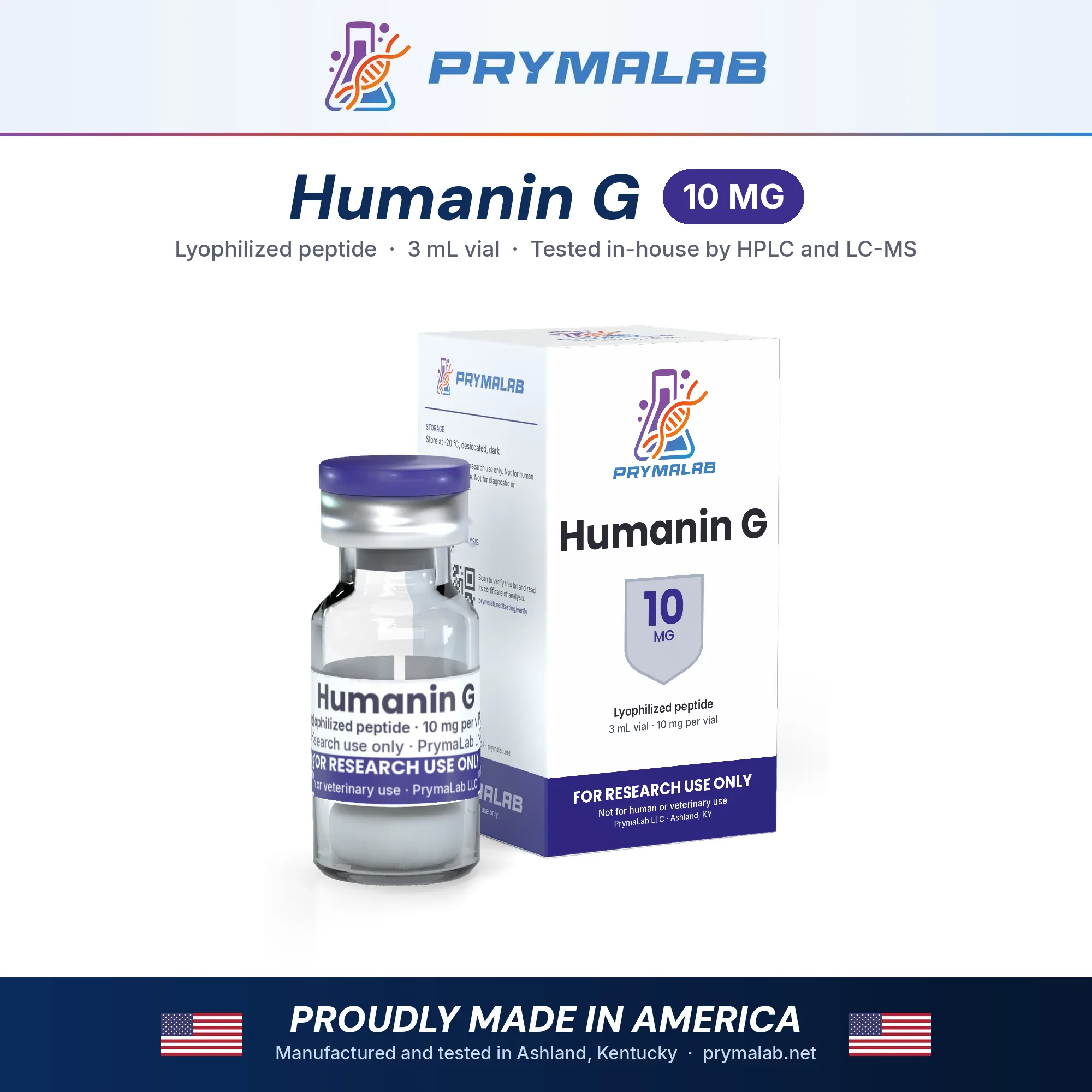
Humanin G (HNG) 10mg
[Gly14]-humanin (HNG), the serine-14-to-glycine analogue of humanin, 10 mg freeze-dried
Humanin G (HNG, S14G-humanin) is humanin with glycine in place of serine at position 14. The substitution came out of the original 2001 scanning work at Keio University, where 10 nM of the synthetic analogue did what 1 to 10 µM of wild-type humanin did in neuronal-rescue assays. Most of the in vivo rodent work published under the name humanin was in fact done with HNG. This listing is the 10 mg vial of freeze-dried powder, the main fill; a 2 mg vial is also sold.
Specifications
| Property | Value |
|---|---|
| Compound | Humanin G (HNG, S14G-humanin, [Gly14]-humanin); humanin analogue |
| CAS number | 330936-70-4 (vendor-reported; not in the PubChem record) |
| Molecular formula | C118H202N34O31S2 |
| Theoretical mass | 2657.2 Da |
| Sequence / structure | H-MAPRGFSCLLLLTGEIDLPVKRRA-OH; 24 residues, Ser14 replaced by Gly, free Cys8, no disulfides. |
| Label claim | 10 mg per vial |
| Form | Lyophilized (freeze-dried) powder or cake in a sealed glass vial with a rubber stopper and aluminium crimp cap |
| Storage, sealed | −20 °C, desiccated, dark |
| Purity specification | 99.0% or higher by RP-HPLC |
| Lot certificate | Certificate for the first lot: in preparation. Published certificates appear on the results page and can be checked on the verify page. |
Fills in this range
Humanin G is sold in 2 fills. The compound and the testing are the same in every fill; only the amount in the vial changes.
| Fill | Listing |
|---|---|
| 2 mg | Humanin G (HNG) 2mg |
| 10 mg | Humanin G (HNG) 10mg (this page) |
What the structure is
Met-Ala-Pro-Arg-Gly-Phe-Ser-Cys-Leu-Leu-Leu-Leu-Thr-Gly-Glu-Ile-Asp-Leu-Pro-Val-Lys-Arg-Arg-Ala: identical to humanin except Gly14. Formula C118H202N34O31S2, theoretical mass 2657.2 Da (PubChem CID 155887372). The CAS number 330936-70-4 is quoted by chemical vendors but is not in the PubChem record, so it is reported here as vendor-sourced. Like humanin it keeps a free Cys8 and an N-terminal Met, so it oxidises and dimerises if left in solution.
Two neighbours to rule out on the certificate: wild-type humanin at 2687.2 Da, and HNGF6A, which adds a Phe6-to-Ala change and was the analogue used in several insulin-sensitivity studies. Colivelin is a separate 26-residue hybrid, not an HNG product.
What the research covers
Origin and potency relative to humanin
In the original humanin screen, synthetic S14G-humanin (HNG) fully protected F11 neuronal cells from V642I-APP and Abeta toxicity at 10 nM or above, whereas wild-type humanin required 1-10 uM, and the authors noted that the reason for the higher potency was unclear1. Structure-function work mapped the active core to Pro3-Pro19 and showed that Cys8 and Ser14 are essential: alanine substitution at Ser14 (S14A) inactivates the peptide, while the glycine substitution increases it2,4. Later papers describe HNG as roughly 1000-fold more potent than humanin in vitro4.
Memory and amyloid models in mice
Intracerebroventricular [Gly14]-humanin (1000 pmol) reversed scopolamine-induced impairment of spontaneous alternation in the Y-maze in mice without changing arm entries, the first in vivo study of the analogue3. In mice given Abeta25-35 centrally, as little as 50 pmol i.c.v. S14G-HN prevented impairment of short-term spatial working memory and latent learning and preserved cholinergic neuron counts in the basal forebrain, whereas 5 nmol of the inactive S14A mutant did not; the tyrosine kinase inhibitor genistein blocked the effect4. Three months of intranasal S14G-HN in triple-transgenic (APPswe/tauP301L/PS1M146V) mice improved cognitive performance in males and lowered brain Abeta levels in both sexes, with increased hippocampal neprilysin expression5.
Cerebral and myocardial ischaemia-reperfusion in mice
In a mouse middle cerebral artery occlusion model (75 min occlusion, 24 h reperfusion), HNG given i.c.v. 30 min before ischaemia reduced infarct volume from 56% to 26%, post-treatment up to 4 h after reperfusion and intraperitoneal pre-treatment were also effective, and HNG reduced neuronal apoptosis, PARP activation and ERK phosphorylation6. In a mouse model of 45 min coronary occlusion and 24 h reperfusion, intraperitoneal HNG reduced infarct size relative to area at risk in a dose-dependent manner, preserved left-ventricular ejection fraction at 1 week, increased AMPK and eNOS phosphorylation and reduced Bax; HNG also reduced daunorubicin-induced cardiomyocyte apoptosis in vitro7.
Mitochondrial protection in retinal cell models
In transmitochondrial ARPE-19 cybrids carrying mitochondria from age-related macular degeneration donors, HNG improved mitochondrial parameters, reduced pro-apoptotic gene and protein expression, up-regulated gp130 (a component of the proposed humanin receptor complex) and increased resistance to Abeta-induced damage, compared with untreated AMD cybrids8. This is an in vitro model only.
What is not established
The ~1000-fold potency gain of HNG over humanin is an in vitro figure from the originating laboratory and its collaborators; independent head-to-head potency comparisons are scarce, and why a glycine at position 14 increases activity while alanine abolishes it is not mechanistically explained. Almost all in vivo work is in mice and rats, much of it from a few groups, with small group sizes and no formal replication across laboratories; the intranasal transgenic-mouse study reported a sex difference in behavioural outcome. There are no human pharmacokinetic, safety or efficacy data for HNG; the human evidence for the humanin family is limited to measurements of endogenous humanin. Effects reported for HNGF6A (the F6A/S14G double mutant) are often cited as ‘HNG’ effects but are a different molecule. None of the published work used material from this supplier.
Clinical and regulatory status
Not an approved drug anywhere; no investigational new drug application or clinical trial of HNG/S14G-humanin was found on ClinicalTrials.gov. It remains a preclinical research peptide. This listing is a research-grade synthetic peptide for laboratory use only.
Related listings: Humanin 10mg, Colivelin 10mg, MOTS-C 10MG, Epitalon 10mg. The anti-aging and longevity peptides category lists the rest of the range.
How each lot is tested
Every lot is tested in PrymaLab’s own laboratory in Ashland, Kentucky before release: RP-HPLC for purity, LC-MS for identity, Karl Fischer titration for water, LAL for endotoxin and USP <71> for sterility. Published certificates are listed on the results page and can be checked by number and key on the verify page. These are in-house results from PrymaLab Analytical, not an independent test, and the lab is not accredited to ISO 17025. The third-party testing guarantee on this page still applies: if any independent laboratory finds the wrong compound, or less than the stated purity or amount, the order is refunded and the cost of the test is reimbursed.
Frequently asked questions
What is the difference between Humanin G and humanin?
A single residue: Humanin G (HNG) has glycine instead of serine at position 14 (MAPRGFSCLLLLTGEIDLPVKRRA vs MAPRGFSCLLLLTSEIDLPVKRRA). In neuronal-rescue assays HNG was fully active at about 10 nM versus 1-10 uM for humanin, roughly a 1000-fold difference. Molecular weight falls from ~2687 Da to ~2657 Da.
Is Humanin G the same as HNGF6A or colivelin?
No. HNGF6A adds a second substitution (Phe6 to Ala) that removes IGFBP-3 binding and was the analogue used in several insulin-sensitivity studies. Colivelin is a 26-residue hybrid of the ADNF-9 peptide and a shortened, further-modified humanin core (AGA-(C8R)HNG17); it is active at femtomolar concentrations and is a different product.
Which studies used Humanin G rather than wild-type humanin?
Most of the in vivo rodent work: the scopolamine and Abeta memory studies, the triple-transgenic intranasal study, the stroke and myocardial ischaemia-reperfusion studies, and the AMD cybrid work. Papers titled ‘humanin’ often used HNG in the methods, so check the peptide stated in each paper.
What has the research measured in animals?
Behavioural endpoints (Y-maze alternation, water-finding, object recognition), infarct volume and neurological scores after cerebral ischaemia, myocardial infarct size and echocardiographic function, brain Abeta levels, cholinergic neuron counts, and signalling readouts (ERK, AMPK, eNOS, STAT3). All findings are preclinical and no human studies exist.
How should lyophilized Humanin G be stored and handled?
Store sealed at −20 °C or below, desiccated and protected from light. The peptide keeps the free Cys8 and Met1 of humanin, so it is oxidation-sensitive; prepare solutions fresh, avoid repeated freeze-thaw, and keep reconstituted aliquots at 2 to 8 °C only for short periods.
How do I confirm I have HNG and not humanin?
Check the certificate of analysis: the monoisotopic mass of HNG is ~2656.5 Da (average ~2657.2) versus ~2685.5/2687.2 for humanin, a 30 Da difference corresponding to Ser to Gly. The formula should read C118H202N34O31S2.
References
- Hashimoto Y, Niikura T, Tajima H, et al. A rescue factor abolishing neuronal cell death by a wide spectrum of familial Alzheimer’s disease genes and Abeta. Proc Natl Acad Sci U S A. 2001;98(11):6336-6341. DOI · PubMed
- Hashimoto Y, Niikura T, Ito Y, et al. Detailed characterization of neuroprotection by a rescue factor humanin against various Alzheimer’s disease-relevant insults. J Neurosci. 2001;21(23):9235-9245. DOI · PubMed
- Mamiya T, Ukai M [Gly14]-Humanin improved the learning and memory impairment induced by scopolamine in vivo. Br J Pharmacol. 2001;134(8):1597-1599. DOI · PubMed
- Tajima H, Kawasumi M, Chiba T, et al. A humanin derivative, S14G-HN, prevents amyloid-beta-induced memory impairment in mice. J Neurosci Res. 2005;79(5):714-723. DOI · PubMed
- Niikura T, Sidahmed E, Hirata-Fukae C, Aisen PS, Matsuoka Y A humanin derivative reduces amyloid beta accumulation and ameliorates memory deficit in triple transgenic mice. PLoS One. 2011;6(1):e16259. DOI · PubMed
- Xu X, Chua CC, Gao J, Hamdy RC, Chua BH Humanin is a novel neuroprotective agent against stroke. Stroke. 2006;37(10):2613-2619. DOI · PubMed
- Muzumdar RH, Huffman DM, Calvert JW, et al. Acute humanin therapy attenuates myocardial ischemia and reperfusion injury in mice. Arterioscler Thromb Vasc Biol. 2010;30(10):1940-1948. DOI · PubMed
- Nashine S, Cohen P, Chwa M, et al. Humanin G (HNG) protects age-related macular degeneration (AMD) transmitochondrial ARPE-19 cybrids from mitochondrial and cellular damage. Cell Death Dis. 2017;8(7):e2951. DOI · PubMed
Research use only
For laboratory research use only. Humanin G (HNG) 10mg is not a drug, food, cosmetic or dietary supplement, is not approved by the FDA or any comparable authority for human or veterinary use, and must not be given to people or animals. It is sold to qualified researchers and institutions, and the buyer is responsible for lawful handling and disposal.







Reviews
There are no reviews yet.