Melanotan 2 (MT2) vs Melanotan 1: receptors, evidence and risks
Melanotan 2 (MT2) is a cyclic heptapeptide analog of alpha-MSH (Ac-Nle-cyclo[Asp-His-D-Phe-Arg-Trp-Lys]-NH2) studied for pigmentation and melanocortin receptor pharmacology at MC1, MC3, MC4 and MC5, while Melanotan 1 is the linear 13-residue analog that became afamelanotide. PrymaLab supplies MT-2 (Melanotan 2 Acetate) 10mg, a Melanotan II 10mg Nasal Spray and MT-1 (Melanotan 1) 10mg for research use.
- Sequences: MT-2 is cyclic, 7 residues, lactam-bridged between Asp and Lys; MT-1 is linear, 13 residues ([Nle4, D-Phe7]-alpha-MSH).
- Class: alpha-MSH analogs; MT-2 is nonselective at MC1, MC3, MC4 and MC5 receptors, MT-1 acts mainly at MC1.
- Studied for: MT-2 for pigmentation (three men, 1996, University of Arizona) and erectile response; MT-1 became afamelanotide for EPP.
- Key results in the literature: pigmentation in 2 of 3 men in a 1996 MT-2 pilot; erection in 17 of 20 men in a 2000 MT-2 crossover; afamelanotide (MT-1) trials in erythropoietic protoporphyria.
- Storage: lyophilized vials at -20°C and protected from light, as the lot certificates state; reconstituted solution refrigerated.
- Forms and sizes at PrymaLab: MT-2 10mg vial, Melanotan II 10mg Nasal Spray, Melanotan 2 pen, MT-1 10mg vial.
- Regulatory: MT-2 has no approval anywhere; MT-1 as afamelanotide (Scenesse) was FDA approved in October 2019 for EPP.
| Feature | Melanotan 1 (MT1, afamelanotide) | Melanotan 2 (MT2) |
|---|---|---|
| Structure | Linear, 13 residues | Cyclic, 7 residues, lactam bridge |
| Receptors | Mainly MC1R | MC1, MC3, MC4 and MC5 |
| Regulatory status | Scenesse implant, FDA approved October 2019 for erythropoietic protoporphyria | Never completed clinical development for any indication |
| Human tanning evidence | Afamelanotide trials in EPP and other photodermatoses | Three men in 1996 (pilot study) |
| Forms at PrymaLab | MT-1 (Melanotan 1) 10mg | MT-2 vial, nasal spray, pen |
The peptide reconstitution calculator converts a 10 mg vial into mcg per unit volume. Bremelanotide, the MT-2 metabolite that became Vyleesi, is covered in the PT-141 guide.
Also known as: MT2, MT-2, MT-II, Melanotan II
The most common framing of Melanotan 1 and Melanotan 2 is that one is the mild version and the other the strong version of the same tanning peptide. That framing is wrong at the level of chemistry. They are different molecules: a linear 13-residue peptide that became an FDA-approved implant in October 2019, and a cyclic 7-residue peptide that has never completed clinical development for tanning anywhere. Melanotan 2 is also the weaker of the two at the pigment receptor, and the whole published human tanning record for it is a 1996 pilot study in three men. I have marked every place where I could not open the primary source.
Research-use-only disclaimer: Melanotan 1 and Melanotan 2 supplied as research chemicals are intended strictly for in-vitro and laboratory research use and are not intended for human or veterinary use. The clinical trials, approved products and case reports described below concern regulated prescription drug products or unregulated consumer use, and they do not describe or support any use of research-grade material. No dosing or administration guidance appears in this article; studies are described by design and outcome. Nothing here is medical advice.

TL;DR
Melanotan 1 (afamelanotide) and Melanotan 2 are different molecules, not different strengths: a linear 13-residue peptide of 1646.85 g/mol against a cyclic 7-residue lactam of 1024.18 g/mol. Afamelanotide is FDA approved as SCENESSE (8 October 2019), an implant for erythropoietic protoporphyria, and its label says it binds predominantly to MC1R. Melanotan 2 binds MC1R, MC4R, MC3R and MC5R within a roughly 70-fold affinity window, so every pigmenting concentration is also an appetite, erection and blood pressure concentration, and a 2023 review calls it weaker than melanotan I for melanogenesis. Its closest approved relative is bremelanotide (VYLEESI, 21 June 2019), the free-acid form of the same ring, approved for hypoactive sexual desire disorder rather than tanning. The entire published human tanning evidence for Melanotan 2 is one 1996 pilot in three men. Five national regulators have warned against it, and laboratory analyses of unregulated product found purity anywhere from 30% to 98.5%. Research use only.
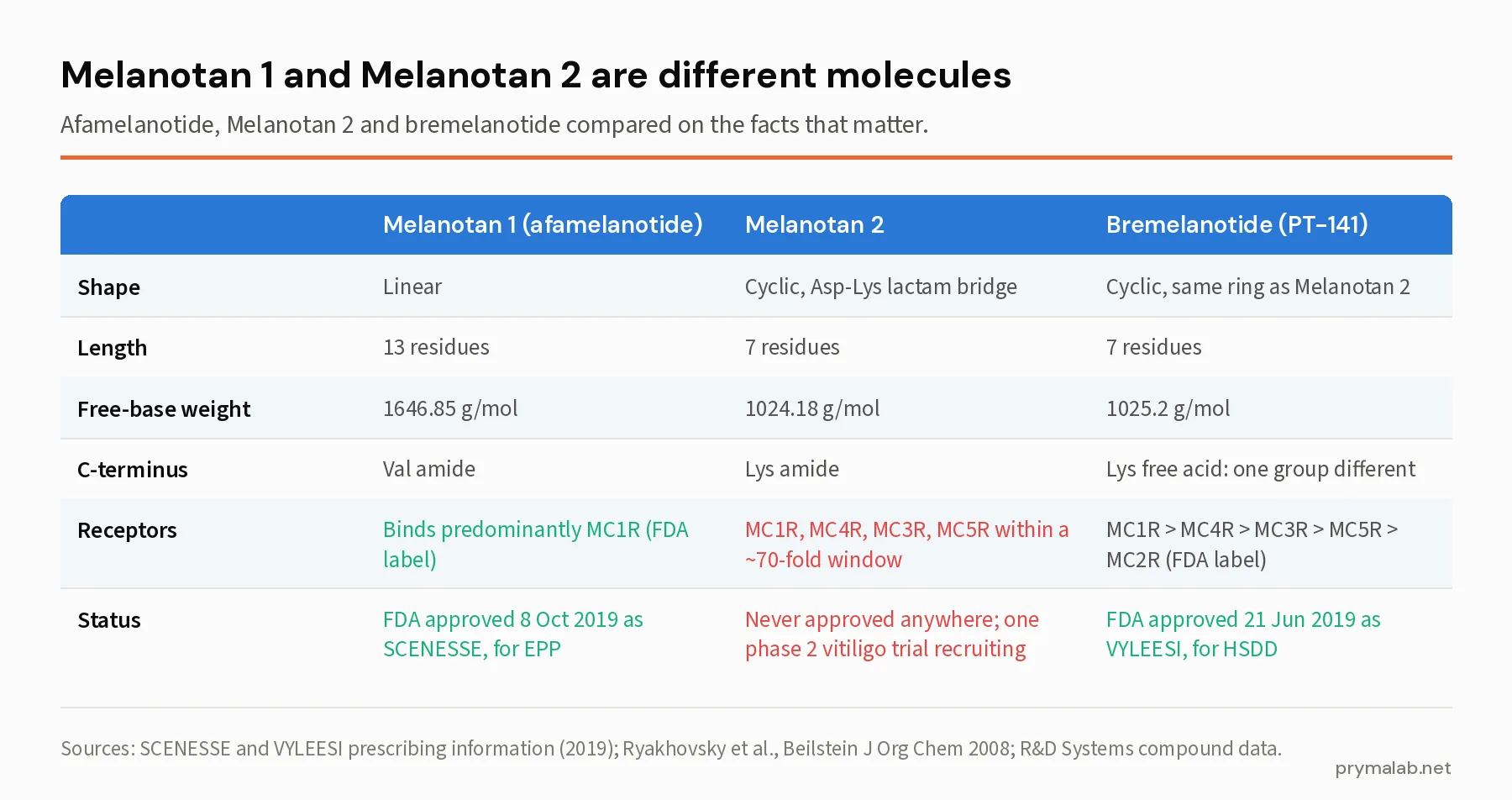
Two molecules: Afamelanotide is linear, 13 residues, 1646.85 g/mol. Melanotan 2 is cyclic, 7 residues, 1024.18 g/mol. They share two substitutions and nothing else.
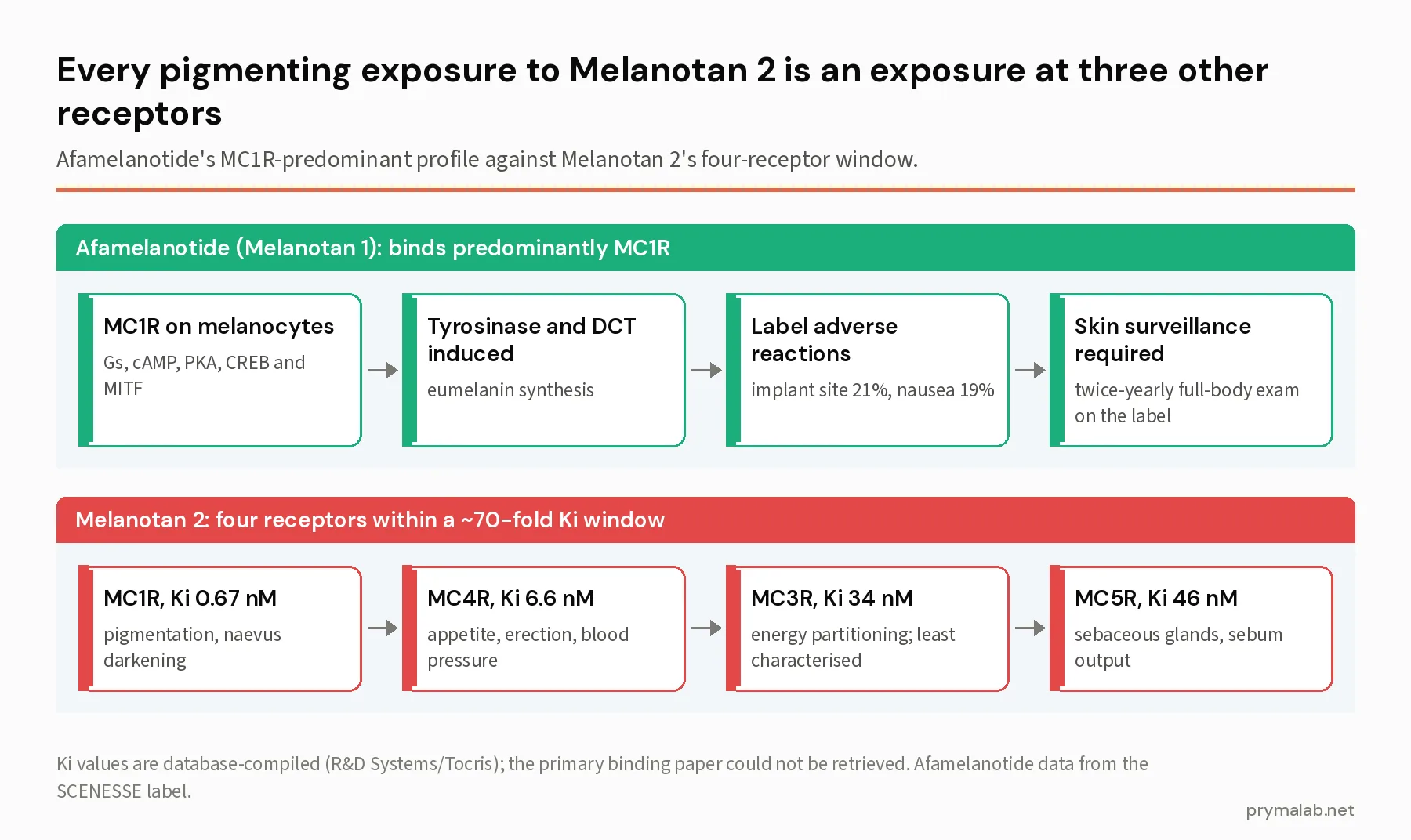
Four receptors: MT-2 Ki values run from 0.67 nM at MC1R to 46 nM at MC5R. That window is not selectivity; the nausea, erections and appetite loss are on-target.
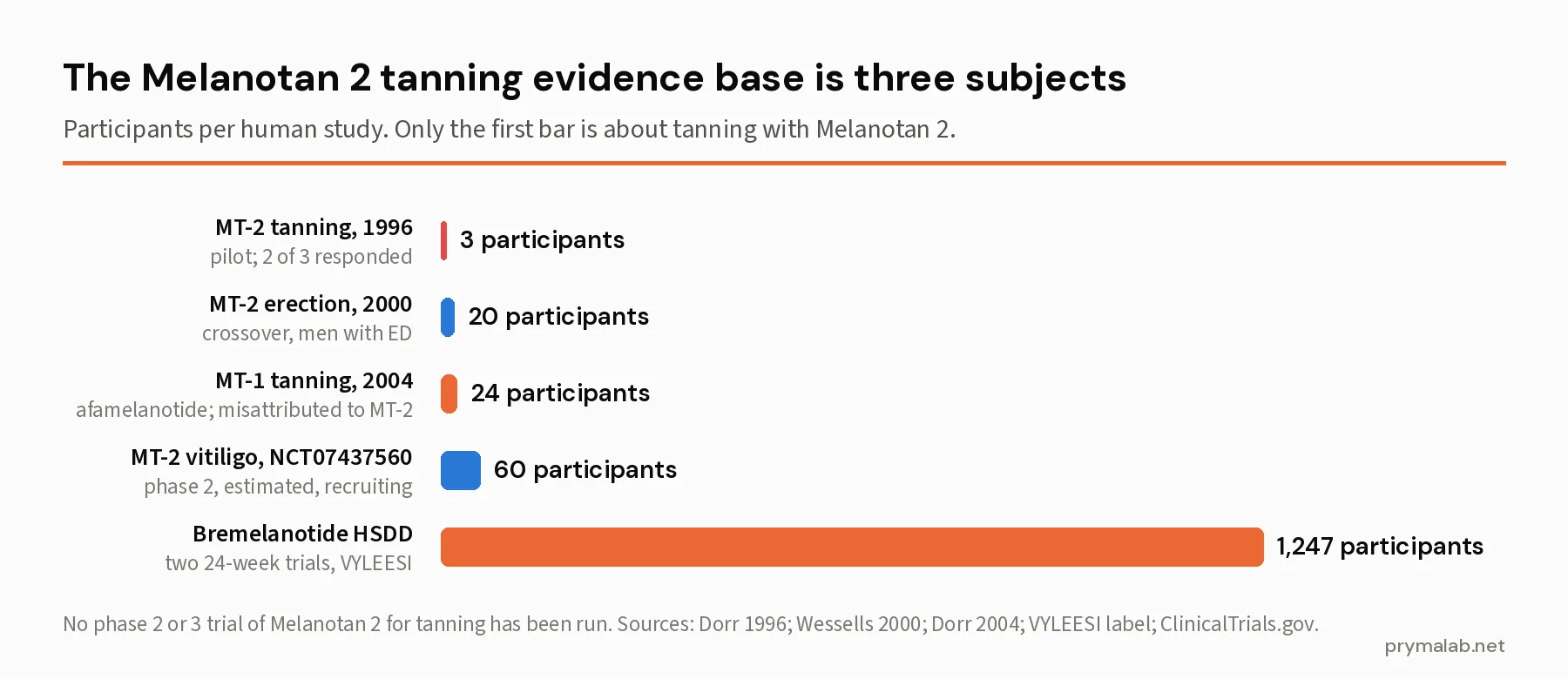
Three subjects: The published human tanning record for Melanotan 2 is Dorr 1996: three men, two responders. No phase 2 or 3 tanning trial has ever been run.
Weaker, not stronger: A 2023 pharmacology review describes MT-2 as weaker than melanotan I for melanogenesis, with stronger sexual effects.
Approved relatives: SCENESSE (afamelanotide) approved 8 October 2019 for EPP. VYLEESI (bremelanotide) approved 21 June 2019 for HSDD. Neither is a tanning approval.
Unknown contents: Four laboratory analyses of unregulated product: 43% to 88% of label, 98.5% purity, 30% purity, and 22 to 54 mg per bottle in the TGA's 2026 testing.
No half-life: The 33 to 34 hour half-life on vendor pages has no peer-reviewed human source. I could not find one.
Status: research use only.
Melanotan 1 and Melanotan 2 are not two grades of the same compound
Melanotan 1 and Melanotan 2 are different molecules. Melanotan 1 is a linear 13-residue analogue of alpha-MSH, now the approved drug afamelanotide. Melanotan 2 is a cyclic 7-residue lactam built on the middle of the same hormone. They share two amino acid substitutions and nothing else structurally.
Both came out of one structure-based design program, run by Victor Hruby and Mac Hadley at the University of Arizona in the 1980s. The defining 1989 paper used molecular dynamics to find a bioactive conformation of alpha-MSH and locked it with a side-chain-to-side-chain lactam bridge; the most potent analogue was about 100-fold more potent than native alpha-MSH in frog and lizard skin bioassays.[1]
Melanotan 1, the linear one
Afamelanotide is [Nle4, D-Phe7]-alpha-MSH: the full 13-residue backbone with methionine 4 replaced by norleucine, which removes an oxidation-prone thioether, and phenylalanine 7 replaced by its D-enantiomer, which resists enzymatic cleavage and stabilises the active turn. The FDA label gives the sequence as Ac-Ser-Tyr-Ser-Nle-Glu-His-(D)Phe-Arg-Trp-Gly-Lys-Pro-Val-NH2, formula C78H111N21O19, molecular weight 1646.85 as the anhydrous free base, and describes it as a melanocortin receptor agonist that "binds predominantly to MC1-R."[2]
Melanotan 2, the cyclic one
MT-2 keeps only residues 4 through 10 of the hormone, which contain the His-Phe-Arg-Trp message sequence that activates melanocortin receptors, and closes them into a ring: Ac-Nle-cyclo[Asp-His-D-Phe-Arg-Trp-Lys]-NH2. The lactam forms between the epsilon-amino group of lysine and the gamma-carboxyl of aspartic acid, and the cyclisation "locks the linear peptide sequence in its biologically active conformation."[3] Formula C50H69N15O9, molecular weight 1024.18 as the free base, CAS 121062-08-6.[4]
| Change from alpha-MSH | What it does |
|---|---|
| Met4 to Nle4 | Removes the oxidation-labile thioether. Shared with afamelanotide |
| Phe7 to D-Phe7 | Resists enzymatic degradation, stabilises the active turn, raises potency. Shared with afamelanotide |
| Glu5 to Asp5 | Supplies the gamma-carboxyl for the bridge |
| Gly10 to Lys10 | Supplies the epsilon-amino group for the bridge |
| Asp5 to Lys10 lactam bridge | Conformational constraint; the source of the potency and the prolonged action |
That locked ring makes MT-2 long-acting in the bioassays, and promiscuous: the constrained pharmacophore fits four melanocortin receptors rather than one.
Melanotan 2 and bremelanotide differ by one functional group
The VYLEESI label gives bremelanotide as Ac-Nle-cyclo-(Asp-His-D-Phe-Arg-Trp-Lys-OH), formula C50H68N14O10, molecular weight 1025.2 as the free base.[5] Against MT-2's C50H69N15O9, the difference is one NH lost and one O gained: MT-2 ends in a carboxamide, bremelanotide in a free carboxylic acid. That is hydrolytic deamidation of the C-terminus and nothing else.
A 2023 pharmacology review calls bremelanotide "an acid derivative of melanotan II."[6] Secondary sources call it an MT-2 metabolite; the likely primary paper, Molinoff and colleagues in 2003, I could not retrieve, so the metabolite framing is reported here, not confirmed.
The commercial lineage follows the same fork. Competitive Technologies licensed the Arizona technology to Palatin in June 2000, and Hadley and Dorr's 2006 history records that MT-1 went to EpiTan, later Clinuvel, for photoprotection, while PT-141, "a new MTII analog," went to Palatin.[7] One branch produced an approved photoprotection drug; the other an approved drug for sexual desire. Neither produced a cosmetic tanning product.
The receptor difference is the whole story
Melanotan 2 is a non-selective agonist at four melanocortin receptors, and the spread between its tightest and loosest target is about 70-fold. In drug development terms that is not selectivity. Every concentration that produces pigmentation through MC1R also activates MC4R, MC3R and MC5R, and the effects reported by people who inject it are on-target pharmacology at receptors they did not intend to hit.
| Receptor | MT-2 Ki | What that receptor does |
|---|---|---|
| MC1R | 0.67 nM | Melanocyte cAMP signalling, eumelanin synthesis, darkening of naevi |
| MC4R | 6.6 nM | Food intake, energy expenditure, blood pressure, erectile function |
| MC3R | 34 nM | Energy partitioning, growth and development; least characterised in humans |
| MC5R | 46 nM | Sebaceous and lacrimal gland function, sebum production |
One flag first. Those Ki values come from two compound databases that agree to the decimal, but I could not retrieve the primary binding paper, so treat them as database-compiled.[4] The rank order matches the FDA's description of bremelanotide, which "nonselectively activates several receptor subtypes" in the order MC1R, MC4R, MC3R, MC5R, MC2R.[5]
MC1R, where the tanning comes from
MC1R is a Gs-coupled receptor on melanocytes. Agonist binding separates the G-alpha-s subunit, adenylyl cyclase raises cAMP, protein kinase A activates the CREB and MITF networks, and those drive expression of tyrosinase and dopachrome tautomerase, the enzymes of melanin synthesis.[6] That is the entire mechanism of the tan.
Melanotan 2 vs 1 on pigmentation: the weaker one is the popular one
The compound people reach for because they believe it tans harder is the one that tans less. The same 2023 review states that melanotan II "has been shown to activate melanocytes as an MC1R agonist, but it is weaker than melanotan I," and that it "was proven to have a stronger sexual effect."[6] More receptor coverage produces more effects in total; the pigment-specific effect is not where the extra activity goes.
MC4R, and the industry's repeated failure here
A 2026 review of the melanocortin obesity programs documents that pharmaceutical companies tried non-selective agonism repeatedly and stopped for the same reasons.[8] LY2112688 produced sustained blood pressure increases of 4.0 to 8.5 mmHg against placebo in humans and was discontinued for cardiac effects. MC4-NN2-0453 was terminated at days 14 and 49 because of skin pigmentation. Sexual stimulation was a class effect: stretching, yawning and erection with LY2112688, sexual arousal in 27% of MC4-NN2-0453 participants, sexual events in 23% of males on setmelanotide. That stretching-and-yawning complex is exactly what the first human MT-2 study recorded in 1996.
MC5R, and the sebum nobody connects to the mechanism
MC5R is expressed in sebaceous and lacrimal glands and has a central role in sebogenesis; MC5R antagonists are being pursued as sebum-suppressing treatments for acne, and MC5R-deficient mice show exocrine gland dysfunction.[9] Increased oiliness in MT-2 users is the fourth receptor working. MC3R is the honest gap: its contribution to MT-2's effects in humans is essentially uncharacterised.[8]
How selective is afamelanotide, really?
Less cleanly than the comparison usually implies. The FDA label says afamelanotide "binds predominantly to MC1-R," and predominantly is not exclusively.[2] The 2023 review calls melanotan I "an early analog of alpha-MSH that acts as a non-selective agonist."[6] What the record supports without qualification: the approved afamelanotide product's adverse reaction table lists no sexual or cardiovascular reactions, and MT-2's human record is dominated by erections and nausea.
The human tanning evidence base for Melanotan 2 is three men in 1996
The entire published human tanning evidence base for Melanotan 2 is one pilot study: three male volunteers, two of whom developed measurable pigmentation, published in 1996. There is no phase 2 trial, no phase 3 trial, no dose-response curve and no controlled comparison against UV exposure alone. Every tanning claim in the consumer market rests on that pilot plus user testimony.
It was a single-blind, placebo-controlled, dose-escalation pilot in three normal men at the University of Arizona, comparing MT-2 with saline over two weeks. Two of the three showed increased pigmentation of the face, upper body and buttocks a week after treatment ended. Adverse effects were grade II somnolence and fatigue in one subject at the highest level reached, mild nausea "at most MT-II dose levels," and a "stretching and yawning complex" that correlated with spontaneous erections lasting one to five hours.[10]
| Study | Compound | Design | n | Endpoint | Result |
|---|---|---|---|---|---|
| Dorr et al., Life Sci 1996 | MT-2 | Single-blind, placebo-controlled pilot | 3 | Pigmentation | 2 of 3 responded; nausea, somnolence, erections |
| Wessells et al., Int J Impot Res 2000 | MT-2 | Double-blind, placebo-controlled crossover | 20 | Erection, sexual desire | Erection in 17 of 20; severe nausea in 12.9% |
| Dorr et al., Arch Dermatol 2004 | MT-1, not MT-2 | Three open-label phase 1 studies | 24 | Tanning with solar UV | 47% fewer sunburn cells; routinely misattributed to MT-2 |
| NCT07437560 | MT-2 plus NB-UVB | Randomised, double-blind, placebo-controlled phase 2 | 60 (estimated) | Repigmentation in vitiligo | Recruiting; no results |
A citation error worth avoiding
A widely circulated 2004 Archives of Dermatology paper reporting 47% fewer sunburn cells at irradiated sites, and controls needing 50% more sun exposure for equivalent tanning, is regularly attributed to MT-2. It is about melanotan-1: three open-label phase 1 studies in 24 volunteers of Fitzpatrick types III and IV.[10]
The MT-2 human data that does exist is about erections
A double-blind, placebo-controlled crossover in 20 men with psychogenic and organic erectile dysfunction produced erection in 17 of 20 without sexual stimulation, with a mean of 41 minutes of RigiScan tip rigidity above 80%. Increased sexual desire followed 13 of 19 MT-2 doses (68%) against 4 of 21 placebo doses (19%), p<0.01, and 12.9% of subjects had severe nausea.[11] That is a real, placebo-controlled human effect, and it is the one the same scaffold was eventually approved for.
The first registered trial, and it is not for tanning
No sponsor ever ran a tanning trial: EpiTan and Clinuvel took the linear compound toward photoprotection, and Palatin took the MT-2 scaffold toward sexual dysfunction.[7] MT-2 is now, for the first time, in a registered trial of any kind. NCT07437560 is a phase 2 randomised, double-blind, placebo-controlled study of Melanotan II as an adjunct to narrowband UV-B phototherapy in adults with stable nonsegmental vitiligo, sponsored by Hudson (Tianjin) Biotechnology, estimated enrolment 60, 24 weeks of treatment, recruiting as of early 2026.[12] The registry mirror I could open gave the arms but not the dose, route or schedule, so I will not characterise them. The accurate statement is now: never developed for tanning, never approved anywhere, one phase 2 trial in a condition that is the opposite of a tan.
What afamelanotide became, and what the MT-2 ring became
Melanotan 1 became SCENESSE, an FDA-approved implant for a rare photosensitivity disease, on 8 October 2019. The Melanotan 2 ring became VYLEESI, an FDA-approved injection for low sexual desire in premenopausal women, on 21 June 2019. Neither approval concerns tanning or research-grade material.
SCENESSE, and the label line that reframes the case reports
Approved under NDA 210797, sponsor Clinuvel Pharmaceuticals. The indication, verbatim:
SCENESSE is indicated to increase pain free light exposure in adult patients with a history of phototoxic reactions from erythropoietic protoporphyria (EPP).[2]
The product is a bioresorbable implant. Adverse reactions on the label: implant site reaction 21%, nausea 19%, oropharyngeal pain 7%, cough 6%, fatigue 6%, skin hyperpigmentation 4%.[2] One warning in that label does more work than anything else in this article:
SCENESSE may lead to generalized increased skin pigmentation and darkening of pre-existing nevi and ephelides because of its pharmacologic effect. A full body skin examination (twice yearly) is recommended to monitor pre-existing nevi and new skin pigmentary lesions.[2]
The FDA required twice-yearly skin examination for the regulated, MC1R-predominant agonist and called naevus darkening an expected pharmacologic effect. That reframes the MT-2 case reports below: predicted pharmacology, observed in a population nobody is examining.
VYLEESI, and what the regulated version of the ring achieved
VYLEESI was approved under NDA 210557 for acquired, generalised hypoactive sexual desire disorder in premenopausal women; it is not indicated for postmenopausal women or men. The mechanism section says the drug "nonselectively activates several receptor subtypes" and that the mechanism by which it improves HSDD is unknown.[5]
Adverse reactions: nausea 40%, flushing 20.3%, injection site reactions 13.2%, headache 11.3%, vomiting 4.8%. Blood pressure rose transiently, with maximal increases of 6 mmHg systolic and 3 mmHg diastolic peaking 2 to 4 hours after a dose. Focal hyperpigmentation occurred in 1% of patients, and "resolution of the focal hyperpigmentation was not confirmed in all patients."[5]
The efficacy data are modest. Two 24-week trials enrolled 1,247 premenopausal women; about 25% of bremelanotide patients against 17% on placebo reached a 1.2-point increase on the desire score, 35% against 31% reached a 1-point decrease in distress, and there was no significant difference in the number of satisfying sexual events.[5] Our reference on PT-141 covers the same molecule family; this is that family with a control arm.
| SCENESSE (afamelanotide) | VYLEESI (bremelanotide) | |
|---|---|---|
| Molecule | Linear 13-mer; Melanotan 1 | Cyclic 7-mer; free-acid form of Melanotan 2 |
| FDA approval | 8 October 2019, NDA 210797 | 21 June 2019, NDA 210557 |
| Indication | Increase pain free light exposure in adults with EPP | Acquired, generalised HSDD in premenopausal women |
| Product form | Bioresorbable implant | Prefilled autoinjector |
| Most common adverse reactions | Implant site reaction 21%, nausea 19% | Nausea 40%, flushing 20.3% |
| Pigment warning | Naevus darkening; twice-yearly full-body skin examination | Focal hyperpigmentation 1%; resolution not confirmed in all patients |
Why no regulator has been asked to approve a tanning peptide
Four strands. Afamelanotide's MC1R-predominant profile let a defined benefit be isolated and measured; with MT-2, any tanning trial is also an appetite, sexual-function and cardiovascular trial. SCENESSE was approved for a painful metabolic disease where a pigment-inducing drug with mandatory skin surveillance is tolerable, and no sponsor has put the equivalent case for healthy people wanting a tan to a regulator. The owner of the MT-2 scaffold judged its sexual effect the more valuable asset.[7] And blood pressure alone ended several non-selective industry programs.[8]
The afamelanotide trials in erythropoietic protoporphyria
The controlled human evidence for the linear compound comes from photodermatology, not tanning. Langendonk and colleagues reported two multicentre, randomised, double-blind, placebo-controlled trials of afamelanotide in erythropoietic protoporphyria, a severe photodermatosis in which exposure to light causes acute phototoxicity, excruciating pain and a markedly reduced quality of life (Langendonk et al. 2015). Patients were assigned 1:1 to an implant containing afamelanotide or a placebo implant: 74 in the European Union study and 94 in the United States study (Langendonk et al. 2015).
Over study periods of 180 days (EU) and 270 days (US), the investigators recorded the type and duration of sun exposure, the number and severity of phototoxic reactions and adverse events, and assessed quality of life with validated questionnaires; a subgroup of US patients also underwent photoprovocation testing (Langendonk et al. 2015). The primary efficacy end point was the number of hours of direct exposure to sunlight without pain. In the US study, the median pain-free time after six months was 69.4 hours in the afamelanotide group against 40.8 hours with placebo (P=0.04) (Langendonk et al. 2015). These trials used a solid implant formulation, so their results describe that product in that disease. They say nothing about melanotan I supplied as a freeze-dried research powder, and nothing about tanning.
What the Melanotan side effects literature contains
The published melanotan side effects literature is case reports and reviews of case reports, with no cohort study, no registry and no long-term follow-up behind any of it. What it contains is consistent with the receptor pharmacology: eruptive and darkening naevi, a few melanomas the reviewers decline to call causal, priapism, rhabdomyolysis, a hypertensive encephalopathy and a renal infarction.
Eruptive and dysplastic naevi
The earliest reports, Cousen and colleagues and Cardones and Grichnik, both in 2009, described eruptive melanocytic naevi after melanotan injection.[13] A 25-year-old man of phototype II, a regular sunbed user, used MT-2 for four weeks and developed more than 100 new naevi, mostly on the back; about 10 were excised, 3 showed severe dysplasia, and a pigmented basal cell carcinoma was found on his shoulder.[14] A 24-year-old bodybuilder, also a sunbed user, presented within 24 hours of a single subcutaneous injection with bronzed skin and more than 100 moles on the trunk and face.[15]
For denominator context, a 2019 review of eruptive melanocytic naevi covered 179 cases across 93 articles and found immunosuppressants, chemotherapy or melanotan suspected in 41%.[13] Further reports I could not open in full include a teenager with familial atypical multiple mole-melanoma syndrome (Sivyer 2012), two 2013 reports of atypical and dysplastic naevi, a 2024 nasal-spray case, and a 2026 JAAD Case Reports patient with five synchronous melanomas in situ after sunbeds, melanotan and anabolic steroids.
Melanoma case reports, and the honest verdict
Four melanoma reports are well established: Paurobally and colleagues in Br J Dermatol 2011, Ong and Bowling in Australas J Dermatol 2012, Javed and colleagues in Int J Surg 2013, and Hjuler and Lorentzen in Dermatology 2014. The Hjuler case is a 20-year-old woman, Fitzpatrick II, with a black gluteal lesion and universal darkening, who had self-injected MT-2 for three to four weeks alongside sunbeds three months before excision; histology confirmed melanoma. The authors chose their words with care: "the melanocyte stimulation of MT-II in combination with the use of sun tanning beds coincided with cutaneous melanoma," and "as the drug is unlicensed and incompletely tested, the extent and types of adverse effects are unknown."[16]
Coincided. Not caused. The most recent systematic appraisal, a 2017 review in the International Journal of Dermatology, counted four case reports of melanomas emerging from existing moles during or shortly after melanotan use and concluded that "conclusive evidence linking these phenomena is lacking."[17] That remains the published verdict. Four reports across two decades of unregulated use is a weak signal; with nobody collecting these cases systematically, it is also close to the strongest signal this kind of use could produce.
Priapism, and a permanent injury
A 55-year-old man who had used MT-2 presented after 30 hours of priapism. Intracavernosal phenylephrine and saline irrigation failed; he needed surgical penoscrotal decompression, and at 15 weeks had new erectile dysfunction with rigidity 4 out of 10, corporal fibrosis and no response to PDE5 inhibitors.[18] A permanent injury from a cosmetic tanning compound after a single exposure. The same paper cites two further priapism cases, one with systemic toxicity and rhabdomyolysis, reported in Clinical Toxicology in 2012, and one needing a Winter's shunt.
Encephalopathy and renal infarction
Posterior reversible encephalopathy syndrome after melanotan was reported in the Annals of Internal Medicine in 2013 and indexed as the first PRES report with Melanotan II; I could not open the full case and report only that it exists and fits the class's MC4R blood pressure effect.[19] The renal case is open access: a 45-year-old previously healthy man who had used MT-2 bought online over six months presented with a right renal infarction affecting about 50% of the kidney, blood pressure 165/95 mmHg, CRP 152 mg/L, creatinine 102 µmol/L, and a measured clearance of 81 mL/min/1.73 m2 at two months.[20]
That paper also holds the best denominator data anywhere: the Swedish Poisons Information Centre registered 215 enquiries about Melanotan II side effects between 1 January 2008 and 20 May 2019, 93% concerning adults.[20] The MHRA received 16 UK Yellow Card reports for Melanotan II from 2012 to 2022, and cautions that inclusion does not establish causation and that reporting rates are unknown.[21] Both are passive systems, and under-reporting is worse than usual for a compound used illicitly.
What is in an unregulated MT-2 vial
The MT2 peptide sold online has been measured in four published laboratory analyses, and the results are mixed rather than uniformly bad: peptide content from 43% of label upward, purity from 30% to 98.5%, and more than a twofold spread between identically labelled bottles. The usable conclusion is not that every vial is adulterated. It is that a buyer cannot know which vial they have.
| Study | Samples | Finding |
|---|---|---|
| Breindahl et al., Drug Test Anal 2015[22] | 3 vials from 3 online shops, each labelled 10 mg | Measured MT-2 4.32 to 8.84 mg per vial, as low as 43% of label. Unknown impurities 4.1% to 5.9% in two shops' products; below quantification in the third |
| Janvier et al., Talanta 2018[23] | 2 MT-2 preparations among 27 illicit peptide products from suspected illegal internet pharmacies | Purity 98.5% for both. Related impurities 0.1% to 0.4%. No endotoxin or microbiological testing performed |
| Deville and Charlier, J Forensic Sci 2024[24] | 2 samples seized in a police raid, one powder vial and one liquid | Powder vial held 8.7 mg against a 10 mg label, but purity was 30%, or 2.61 mg of peptide. No organic impurity peaks; the bulk is inferred to be inorganic buffers or salts |
| TGA laboratory testing, alert dated 17 August 2026[25] | 5 bottles of one nasal spray sold as 30 mg | 22 mg to 54 mg of MT-2 per bottle. Identically labelled bottles differing by more than twofold |
Janvier found 98.5% purity from two illegal vendors, and that result belongs in the table, because the honest conclusion is narrower than "black-market melanotan is universally adulterated." Two analyses found substantial non-peptide bulk, one found identically labelled product varying 2.5-fold, one found clean material, and nothing on the outside of a vial says which.
Two caveats on the Australian figures. The alert page sits behind a robots block I could not get past, so the bottle count, label basis and range come from the Reactions Weekly index and RACGP's newsGP coverage, which agree on 5 bottles, a 30 mg label and 22 to 54 mg; "180% of label" is therefore arithmetic on a secondary source. And no published analysis has tested any of these products for sterility or bacterial endotoxin. For why a purity percentage and a content figure differ, see our reference on peptide purity testing.
The regulatory record on Melanotan II, country by country
In the United States, Melanotan II is an unapproved new drug under the Federal Food, Drug, and Cosmetic Act, and the FDA has prosecuted a company for selling it for human use; research-grade material is supplied for laboratory research only. Four other national agencies have taken enforcement action and issued warnings, and status varies by country; our reference on whether peptides are legal covers the general framework.
United States. The FDA sent a warning letter to Melanocorp Inc. of Tennessee on 30 August 2007 over the sale of Melanotan II. Melanocorp said it would stop, then "continued to ship MII in interstate commerce" through April 2009. Its owner pleaded guilty to two conspiracy counts on 11 March 2015, and on 5 August 2016 the FDA proposed his permanent debarment, stating that "MII constituted a new drug under the FDCA that could not be introduced or delivered for introduction into interstate commerce without an FDA approved application."[26]
United Kingdom. The MHRA states that it "has repeatedly taken action to remove Melanotan products from the market for over 10 years." Products containing Melanotan II are medicines if injectable or in pens, but a nasal spray "will be determined as a medicine only if sold with claims to treat or prevent disease."[21] That sentence is the gap the Chartered Trading Standards Institute described on 16 May 2025: the nasal tanning sprays are sold cosmetically, so medicines law does not reach them, and "they are not covered by UK cosmetics regulations" either; CTSI listed nausea, vomiting, high blood pressure and changes in mole shape and size among reported harms.[21] Intranasal MT-2 has no bioavailability or respiratory data; our reference on peptide nasal sprays covers the general evidence.
Australia. The TGA's safety alert of 17 August 2026 warned that consumers "cannot be certain of the ingredients, strength or quality of these products." Separately, 27 infringement notices totalling AUD $101,412 were issued to a New South Wales individual for alleged unlawful supply of Melanotan II and were paid in May 2026. No Melanotan II product is entered on the Australian Register of Therapeutic Goods, and the TGA's earlier consumer warning listed headache, nausea, vomiting, facial redness, increased moles and freckles, kidney dysfunction and brain swelling among reported effects.[25]
Ireland. The HPRA removed more than 500 social media and e-commerce listings for Melanotan 2 products between January 2020 and June 2022, named stroke, muscle tremors, anaphylaxis, new moles, darkening of existing moles and freckles, and vision loss among reported effects, and stated: "There is no data to support any safe use in any form and anyone using it is taking huge personal risks."[27]
Denmark. The Danish Medicines Agency first warned on 11 August 2008 and updated the warning on 20 June 2011, describing melanotan as an illegal product that "is not authorised in Denmark, Europe or the United States," because "its effect is not documented and because of the absence of studies of its potential side effects."[27]
Five agencies, one position: none has assessed a Melanotan II product for quality, safety or efficacy.
How the MT-2 peptide is characterised
Melanotan 2 is characterised by reversed-phase HPLC for purity and mass spectrometry for identity, and its cyclic lactam makes the second half of that job harder than for a linear peptide. Janvier's group said so directly: "the cyclic structure of melanotan II resulted in the difficult identification of these related impurities."[23] A constrained ring and its ring-opened or incompletely cyclised failure products can sit close together on a reversed-phase column with small mass differences.
Three things follow from the structure. Tryptophan absorbs far more strongly than a peptide bond at 214 nm, so area-percent purity is distorted in whichever direction the impurities have kept or lost the Trp. There is no methionine, so the most common oxidation liability of alpha-MSH analogues is absent. And the C-terminal carboxamide is the one group whose hydrolysis product is a different named drug: deamidate MT-2 there and you have bremelanotide. I have not seen a stability study quantifying that conversion, so treat it as a structural inference.
Handling follows the general case in our references on peptide storage and stability and reconstitution. PrymaLab supplies Melanotan 2 for laboratory research use with HPLC purity and mass spectrometry identity on every lot, and supplies Melanotan 1 on the same terms. Given Table 5, a lot-specific certificate showing measured content is the difference between the two ends of that table.
Preformulation data and an identification method for melanotan II
Two analytical papers describe melanotan II as a molecule rather than as a product. In 1994 Lan and colleagues determined its dissociation constants by potentiometric and ultraviolet spectrophotometric measurement, estimating the pKa of the histidine at 6.54 and of the arginine at 11.72 (Lan et al. 1994). They measured the apparent partition coefficient at three pH values against both n-octanol and isooctane; at pH 7.35 the octanol value was 2.82 and the delta log P 1.05 (Lan et al. 1994). Together with a bioavailability of 4.6% observed in the rat, these data led the authors to suggest the peptide might suit oral delivery (Lan et al. 1994).
Breindahl and colleagues developed and validated methods to establish the identity, content and purity of melanotan II, using liquid chromatography with ultraviolet detection at 218 nm and tandem mass spectrometry after collision-induced fragmentation of the doubly charged [M+2H]2+ precursor ion at m/z 513 (Breindahl et al. 2015). Identity was confirmed by chromatographic retention time and the relative abundance of five qualifying fragment ions, and UV detection was used to quantify both melanotan II and its impurities (Breindahl et al. 2015). Validation followed the guidelines used for active substances in authorised medicinal products (Breindahl et al. 2015). The results the method gave for vials bought online are covered in the section on unregulated products.
What this article does not settle
Whether the naevi findings reflect causation or surveillance bias. Against pure bias: the pharmacology predicts naevus darkening, the FDA wrote it into the SCENESSE label with mandatory skin checks, and the 24-hour and 4-week case timelines are hard to explain by ascertainment. For bias: MT-2 users self-select for fair skin, heavy sunbed use and appearance concern, and nearly every published case involves concurrent sunbed use. No study has been designed to separate the two.
Whether MC1R agonism promotes or protects against melanoma. Two 2023 reviews disagree in emphasis. One documents that most melanomas overexpress MC1R and overproduce alpha-MSH in an autocrine loop, and states that synthetic MC1R agonists "could lead to proliferation of melanocytic cells in predisposed patients."[28] The other stresses that MC1R activation "can actually stimulate DNA repair processes that have the potential to prevent the disease."[6] Which arm dominates in a sunbed user injecting an uncharacterised dose is not known.
Human pharmacokinetics. The 33 to 34 hour half-life for Melanotan 2 that appears on vendor and consumer pages has no peer-reviewed human source that I could find. The Arizona pharmacokinetic paper often cited for it, Ugwu and colleagues in 1997, is about melanotan-1. I have not repeated the number.
Dose-response and exposure. No human dose-response curve for MT-2 pigmentation exists beyond three subjects over two weeks, and real-world exposure is unmeasurable when identically labelled products vary 2.5-fold.
Long-term outcomes, sterility and the nasal route. There is no cohort study, no registry and no long-term follow-up; every safety signal above is a case report. No published analysis has tested unregulated MT-2 for sterility or bacterial endotoxin. And intranasal MT-2 has no bioavailability or respiratory data at all, while the sprays fall between medicines and cosmetics regulation in the UK.
What is well established: the two sequences and molecular weights, the one-functional-group relationship to bremelanotide, the two FDA labels and their dates, the three-subject size of the human tanning record, the receptor rank order, and the regulatory chronology in five countries. Those are checkable in the documents cited.
MT2 (Melanotan II): what the abbreviation refers to
MT2, MT-2, MT-II and Melanotan 2 all refer to the same molecule: Melanotan II, the cyclic lactam heptapeptide Ac-Nle-cyclo[Asp-His-D-Phe-Arg-Trp-Lys]-NH2 developed at the University of Arizona in the late 1980s as a potent, long-acting analog of alpha-melanocyte-stimulating hormone. The "II" separates it from Melanotan I (MT1), the linear 13-residue analog [Nle4, D-Phe7]-alpha-MSH that later became afamelanotide and the Scenesse implant. Product listings, including PrymaLab's MT-2 (Melanotan 2 Acetate) 10mg vial, the Melanotan II 10mg Nasal Spray and the Melanotan 2 autoinjector pen, use the abbreviations interchangeably; the acetate in the name is the counter-ion of the lyophilized salt, not a different peptide.
Two unrelated things share the letters. The melatonin MT2 receptor (MTNR1B) is a G protein-coupled receptor for melatonin with no connection to melanocortins, and metallothionein-2 (MT-2 or MT2A) is a metal-binding protein. A search for "MT2 peptide" almost always means Melanotan II. One relative is worth naming: bremelanotide (PT-141) is Melanotan II with the C-terminal amide replaced by a free acid. It was identified as an MT-II metabolite, went on to FDA approval as Vyleesi in 2019 for hypoactive sexual desire disorder in premenopausal women, and is the reason the MT2 literature and the PT-141 literature overlap; the PT-141 guide covers it separately.
Frequently asked questions
What is MT2?
MT2 is the abbreviation for Melanotan II, a cyclic seven-residue analog of alpha-melanocyte-stimulating hormone developed at the University of Arizona. It acts on four melanocortin receptors (MC1, MC3, MC4 and MC5) and has been studied for pigmentation and erectile response, but it never completed clinical development. PrymaLab supplies it as the MT-2 (Melanotan 2 Acetate) 10mg vial, a nasal spray and a pen for research use.
Is MT2 the same as Melanotan II?
Yes. MT2, MT-2, MT-II, Melanotan 2 and Melanotan II are five spellings of one molecule, Ac-Nle-cyclo[Asp-His-D-Phe-Arg-Trp-Lys]-NH2. It is not the melatonin MT2 receptor and not metallothionein-2, which share the letters by coincidence. It is also a different molecule from Melanotan I (MT1), the linear 13-residue peptide that became afamelanotide.
What is the difference between Melanotan 1 and Melanotan 2?
They are different molecules, not two strengths of one compound. Melanotan 1 is linear, 13 residues, acts mainly at the MC1 pigment receptor and became the FDA-approved Scenesse implant in October 2019. Melanotan 2 is cyclic, 7 residues, acts at MC1, MC3, MC4 and MC5, is the weaker of the two at MC1, and never completed clinical development. PrymaLab supplies MT-1 (Melanotan 1) 10mg and MT-2 vials separately.
Is Melanotan 2 FDA approved?
No. Melanotan 2 has never completed clinical development for tanning or any other indication and has no approval in any country. Its linear relative afamelanotide (Melanotan 1) is approved as Scenesse, an implant, for adults with erythropoietic protoporphyria, and its metabolite bremelanotide is approved as Vyleesi. Melanotan 2 itself is supplied for research use only.
What do lab analyses show about unregulated Melanotan 2 vials?
Breindahl et al. (Drug Testing and Analysis, 2015) measured three vials from three online shops, each labelled 10 mg, and found 4.32 to 8.84 mg of MT-2 per vial, as low as 43 percent of label. Other analyses reported both under- and over-filled vials, so the labelled amount cannot be assumed; the peptide reconstitution calculator only works from a verified content figure.
What is the difference between Melanotan 1 and Melanotan 2?
Different molecules, not different strengths: a linear 13-mer that binds predominantly MC1R against a cyclic 7-mer that activates four melanocortin receptors.
Is Melanotan 2 stronger than Melanotan 1 for tanning?
No. On MT1 vs MT2 for pigmentation, a 2023 review describes MT-2 as weaker than melanotan I, with stronger sexual effects. More receptors, not more tan.
How reliable is the labelling on unregulated Melanotan 2 products?
Unpredictably. Four analyses found 43% of label, 98.5% purity, 30% purity, and 22 to 54 mg in bottles carrying one label.
Is Melanotan 2 FDA approved?
No, and never anywhere. Its relatives afamelanotide (SCENESSE) and bremelanotide (VYLEESI) were approved in 2019 for EPP and HSDD, neither for tanning.
Is afamelanotide FDA approved, and for what?
Yes, since 8 October 2019, as SCENESSE for erythropoietic protoporphyria only. The label recommends twice-yearly full-body skin examinations because it darkens naevi.
What is the relationship between Melanotan 2 and PT-141?
Bremelanotide is MT-2 with the C-terminal amide replaced by a free acid: one functional group. It was approved as VYLEESI in June 2019 for HSDD.
How much human tanning evidence exists for Melanotan 2?
Three men in 1996, two responders. The 2004 paper with the 47% figure is about melanotan-1, not MT-2.
What are the Melanotan 2 side effects reported in the literature?
Nausea, somnolence, yawning and erections in the controlled studies; eruptive naevi, melanomas, priapism, rhabdomyolysis, PRES and renal infarction in case reports.
Has Melanotan 2 been linked to melanoma?
Four case reports, and a 2017 review that says conclusive evidence is lacking. Naevus darkening, by contrast, is on the FDA label of the approved relative.
Is Melanotan 2 legal in the United States?
An unapproved new drug in the US; selling it for human use has been prosecuted. Research-grade material is for laboratory use only, and status varies elsewhere.
Related reading
References
- Al-Obeidi F, de L Castrucci AM, Hadley ME, Hruby VJ. Potent and prolonged acting cyclic lactam analogues of alpha-melanotropin: design based on molecular dynamics. J Med Chem. 1989;32(12):2555-2561. The Arizona design paper. University of Arizona
- SCENESSE (afamelanotide) Prescribing Information, NDA 210797, approved 8 October 2019. Sequence, mechanism, indication, adverse reactions, skin-examination warning. FDA label; approval history
- Ryakhovsky VV, Khachiyan GA, Kosovova NF, et al. The first preparative solution phase synthesis of melanotan II. Beilstein J Org Chem. 2008;4:39. Beilstein Journals
- Melanotan II compound data (formula, molecular weight, CAS, Ki values) as compiled by R&D Systems/Tocris and AdooQ; the primary binding paper could not be retrieved. R&D Systems
- VYLEESI (bremelanotide) Prescribing Information, NDA 210557, approved 21 June 2019. FDA label; responder percentages from the FDA approval announcement, PR Newswire
- Mun Y, Kim W, Shin D. Melanocortin 1 Receptor (MC1R): Pharmacological and Therapeutic Aspects. Int J Mol Sci. 2023;24(15):12152. The "weaker than melanotan I" comparison. MDPI
- Hadley ME, Dorr RT. Melanocortin peptide therapeutics: historical milestones, clinical studies and commercialization. Peptides. 2006;27(4):921-930. PMID 16412534. Licence announcement: Competitive Technologies, 26 June 2000, GlobeNewswire
- Prindle CR, Bennett TL, Rajewski BH, et al. The melanocortin receptors as targets for general obesity: contextualizing clinical failures and analyzing future perspectives. Front Endocrinol. 2026;17:1797586. Frontiers
- Xu Y, Guan X, Zhou R, Gong R. Melanocortin 5 receptor signaling pathway in health and disease. Cell Mol Life Sci. 2020;77(19):3831-3840. Knockout data: Chen W, et al. Cell. 1997, PMID 9413988. Springer
- Dorr RT, Lines R, Levine N, et al. Evaluation of melanotan-II, a superpotent cyclic melanotropic peptide in a pilot phase-I clinical study. Life Sci. 1996;58(20):1777-1784. PMID 8637402. Not to be confused with Dorr RT, Ertl G, Levine N, et al. Arch Dermatol. 2004;140(7):827-835, PMID 15262693, the melanotan-1 study. JAMA Dermatology (2004)
- Wessells H, Levine N, Hadley ME, Dorr R, Hruby V. Melanocortin receptor agonists, penile erection, and sexual motivation: human studies with Melanotan II. Int J Impot Res. 2000;12(Suppl 4):S74-S79. Earlier report: J Urol. 1998, PMID 9679884. Nature
- NCT07437560. Phase 2 study of Melanotan II as an adjunct to narrowband UV-B phototherapy in stable nonsegmental vitiligo. Sponsor Hudson (Tianjin) Biotechnology. ClinicalTrials.gov
- Burian EA, Jemec GBE. Eruptive Melanocytic Nevi: A Review. Am J Clin Dermatol. 2019;20(5):669-682. Covers Cousen P, et al. Br J Dermatol. 2009;161(3):707-708 and Cardones AR, Grichnik JM. Arch Dermatol. 2009;145(4):441-444. Springer
- Hueso-Gabriel L, Mahiques Santos L, Terrádez Mas L, Santonja López N. Eruptive Dysplastic Nevi Following Melanotan Use. Actas Dermosifiliogr. 2012;103:329-331. Actas Dermo-Sifiliográficas
- Schulze M, et al. Eruptive naevi and darkening of pre-existing naevi 24 h after a single mono-dose injection of melanotan II. Eur J Dermatol. 2014;24(1). PMID 24334249. John Libbey Eurotext
- Hjuler KF, Lorentzen HF. Melanoma Associated with the Use of Melanotan-II. Dermatology. 2014;228(1):34-36. Karger
- Habbema L, Halk AB, Neumann M, Bergman W. Risks of unregulated use of alpha-melanocyte-stimulating hormone analogues: a review. Int J Dermatol. 2017. doi:10.1111/ijd.13585. Other melanoma reports named in the text: Paurobally D, et al. Br J Dermatol. 2011;164(6):1403-1405; Ong S, Bowling J. Australas J Dermatol. 2012, PMID 22724573; Javed A, et al. Int J Surg. 2013;11(8). Erasmus repository
- Mallory CW, Lopategui DM, Cordon BH. Melanotan tanning injection: A rare cause of priapism. Sex Med. 2021;9(1):100298. PMID 33460908. Cites Nelson ME, et al. Clin Toxicol. 2012;50(10):1169-1173, PMID 23121206. Oxford Academic
- Kaski D, et al. Melanotan and the posterior reversible encephalopathy syndrome. Ann Intern Med. 2013;158(9):707-708. PMID 23648958. Indexed in Reactions Weekly 2013;1455:24. Springer
- Peters B, Hadimeri H, Wahlberg R, Afghahi H. Melanotan II: a possible cause of renal infarction: review of the literature and case report. CEN Case Rep. 2020;9(2):159-161. PMC
- MHRA. Freedom of Information response FOI 24/274, 17 April 2024. GOV.UK. Chartered Trading Standards Institute. Nasal tanning sprays linked with skin cancer and serious respiratory problems, 16 May 2025. CTSI
- Breindahl T, Evans-Brown M, Hindersson P, et al. Identification and characterization by LC-UV-MS/MS of melanotan II skin-tanning products sold illegally on the Internet. Drug Test Anal. 2015;7(2):164-172. Aalborg University
- Janvier S, Cheyns K, Canfyn M, et al. Impurity profiling of the most frequently encountered falsified polypeptide drugs on the Belgian market. Talanta. 2018;188:795-807. Sciensano
- Deville M, Charlier C. Barbie drug identification: Not a child's play. J Forensic Sci. 2024. doi:10.1111/1556-4029.15633. ORBi
- Therapeutic Goods Administration. Melanotan II tanning peptide products found to be inconsistently dosed. Safety alert, 17 August 2026, indexed in Reactions Weekly. 2026;2125:5. Figures as reported by RACGP newsGP, 18 August 2026. Reactions Weekly; newsGP; TGA infringement notices; TGA consumer warning
- FDA. Notice of Opportunity for Hearing on a Proposal to Debar Edward Manookian, 5 August 2016. FDA; docket FDA-2015-N-4169, FDA
- Health Products Regulatory Authority (Ireland) warning, June 2022, as reported by TheJournal.ie. Danish Medicines Agency. Warning against the tanning product Melanotan, 11 August 2008, updated 20 June 2011. Lægemiddelstyrelsen
- Dall'Olmo L, Papa N, Surdo NC, et al. Alpha-melanocyte stimulating hormone (alpha-MSH): biology, clinical relevance and implication in melanoma. J Transl Med. 2023;21:562. Springer
Case report details, trial figures and regulatory findings are taken from the published sources cited, current to 13 September 2026. Where a figure could not be verified against a primary source, that is stated in the text rather than omitted. Regulatory positions described are those of the named national agencies and should not be assumed to apply elsewhere.
Final disclaimer: This article is an educational research reference on the chemistry, pharmacology, clinical record and regulatory history of Melanotan 1 and Melanotan 2. Compounds supplied by PrymaLab are sold and studied for laboratory research use only and are not approved by any regulatory authority for human or veterinary use. Statements have not been evaluated by the FDA. Nothing here is medical advice, administration guidance, or a treatment claim.
The approved medicines SCENESSE and VYLEESI are described for scientific and regulatory context only, and their inclusion does not describe or support any use of research-grade material. Study dose arms and case report exposures are reported as facts about those studies. Always verify the legal status of any research compound in your jurisdiction before purchase or use.