

The semax peptide is a synthetic heptapeptide, Met-Glu-His-Phe-Pro-Gly-Pro, built from residues 4 to 7 of adrenocorticotropic hormone with a proline-glycine-proline tail attached. It was developed in Moscow in the 1980s and is registered as a medicine in Russia. PrymaLab stocks it for laboratory research only, including the Semax 11 mg vial.
- The sequence is Met-Glu-His-Phe-Pro-Gly-Pro, seven residues, PubChem CID 9811102, CAS 80714-61-0.
- The origin is the Institute of Molecular Genetics of the Russian Academy of Sciences, under I. P. Ashmarin and N. F. Myasoedov.
- The human record is open Russian clinical work, mostly in stroke and optic nerve disease, with no randomised placebo-controlled trial published in English.
- The registration is Russian only. Semax has never been approved in the United States or the European Union, and it has zero entries on ClinicalTrials.gov.
| Semax | ACTH(4-10) | |
|---|---|---|
| Length | 7 residues | 7 residues |
| C-terminal tail | Pro-Gly-Pro | Gly-Lys-Pro-Val |
| Corticotropic activity | Not reported | Not reported |
| Registered as a medicine | Russia only | No |
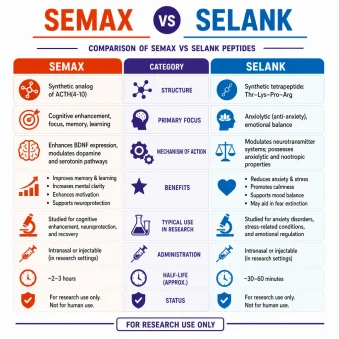
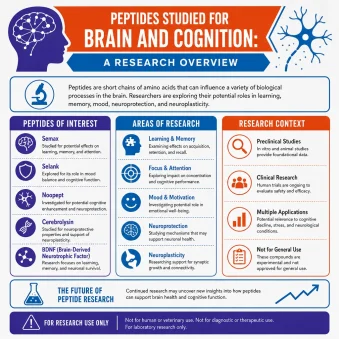
See the peptides for brain and cognition overview for how Semax sits beside the other cognition-focused compounds, and the Semax and Selank comparison for the two side by side.
Also known as: MEHFPGP, ACTH(4-7)PGP, ACTH(4-10) analogue, Semax acetate, CAS 80714-61-0.
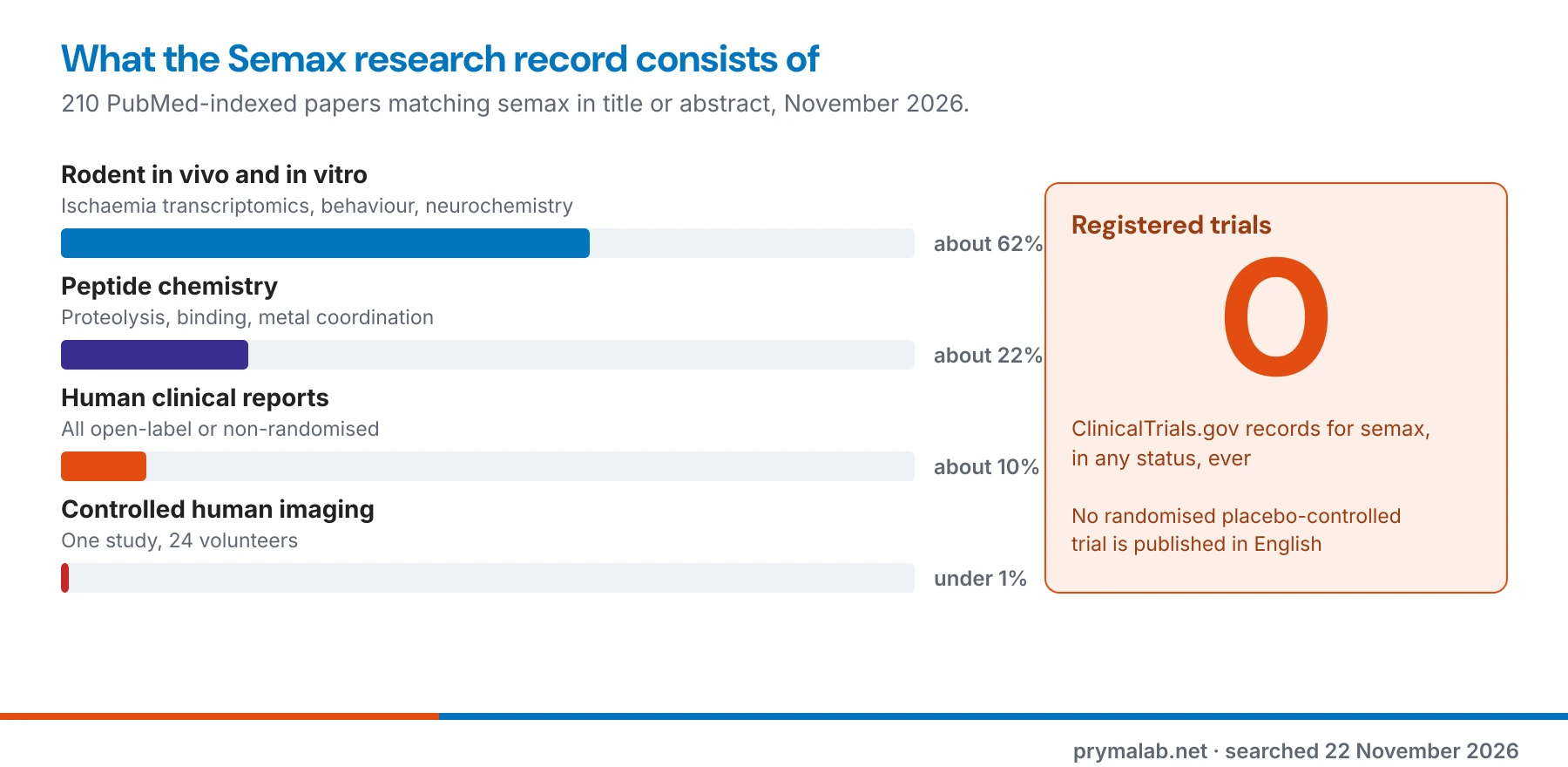
I sell this compound, which is a reason to read me sceptically. I went through all 210 papers PubMed holds for it, and the gap between what the literature contains and what the English-language internet says about it is wide. The research record is real, large and forty years deep. It is also almost entirely Russian, almost entirely preclinical or open-label, and it has produced no randomised placebo-controlled trial in English and no registered clinical trial anywhere. Four decades of work have not identified what the molecule binds to.
Research-use-only disclaimer: Semax is sold for laboratory research only. It is not approved as a medicine in the United States or the European Union, it is not a supplement, and it is not for human or veterinary use. This article describes published study designs and reported results. It contains no dosing, reconstitution or administration guidance and makes no treatment or benefit claims.

TL;DR
Semax is seven amino acids: the ACTH(4-7) fragment with a Pro-Gly-Pro tail bolted on to slow degradation. Soviet researchers at the Institute of Molecular Genetics built it in the 1980s to keep the behavioural effects of an ACTH fragment without the hormonal ones. It is registered as a nootropic medicine in Russia and nowhere else.
The literature runs to 210 PubMed-indexed papers. Most of it is rodent work on gene expression after cerebral ischaemia. The human studies are open-label Russian clinical reports, one small fMRI study in healthy volunteers, and nothing registered on ClinicalTrials.gov. A tritium-labelling study found that intranasal dosing put 0.093 per cent of the administered radioactivity per gram into rat brain at two minutes, and only about 80 per cent of that was still intact Semax.
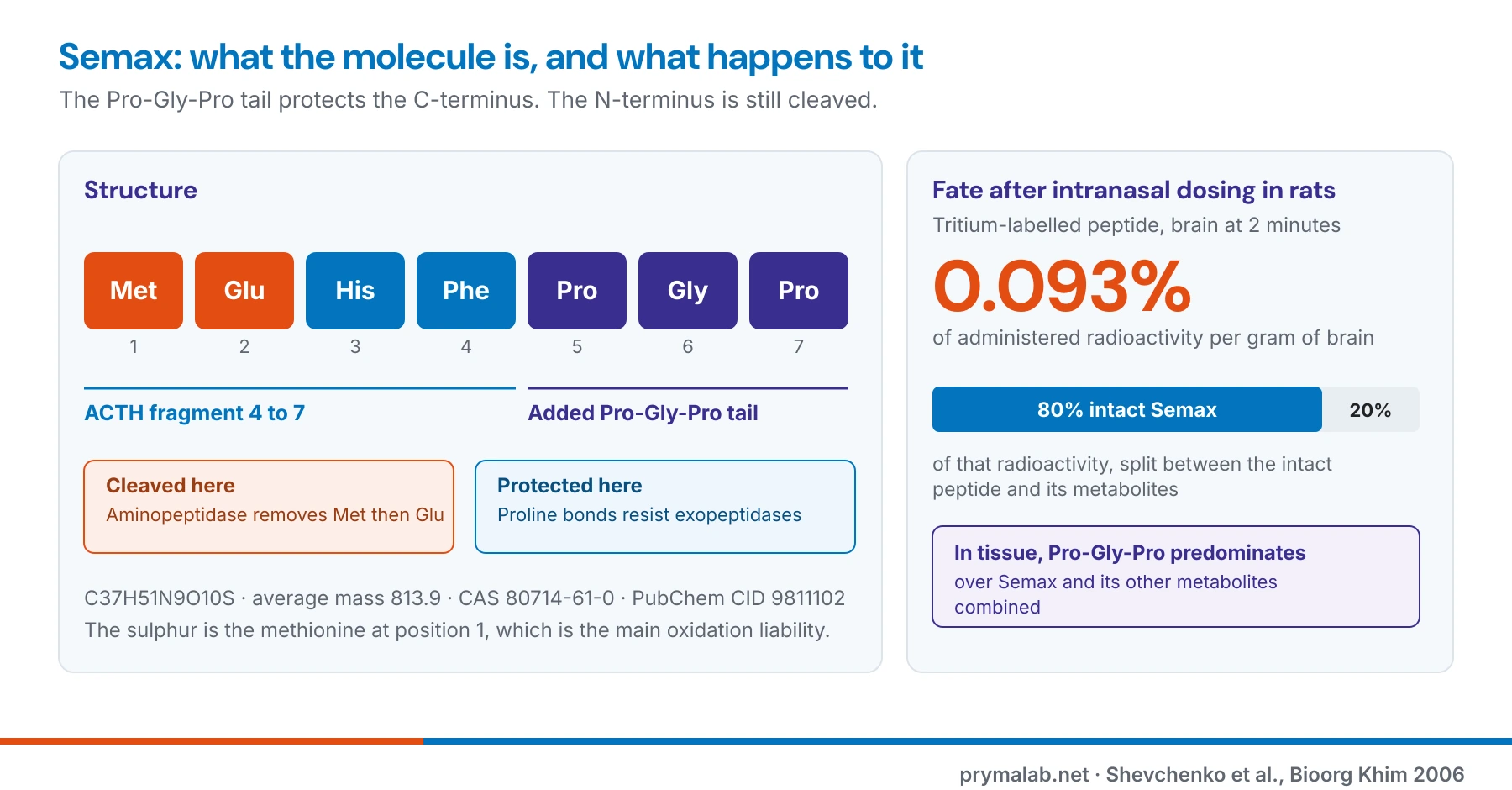
Identity is Met-Glu-His-Phe-Pro-Gly-Pro, CAS 80714-61-0, PubChem CID 9811102, formula C37H51N9O10S, average mass 813.9.[1]
Best evidence is a large and consistent rodent transcriptomic literature on cerebral ischaemia from one Moscow group.[20][22]
Weakest link is the target. A measured binding constant exists for rat forebrain membranes, and the site it binds has never been identified.[7]
Zero is the number of Semax studies registered on ClinicalTrials.gov.[52]
Status is research use only outside Russia, where it is registered as a nootropic medicine.[3]
What is the semax peptide?
The semax peptide is a synthetic heptapeptide with the sequence Met-Glu-His-Phe-Pro-Gly-Pro. The first four residues are positions 4 to 7 of adrenocorticotropic hormone. The last three are a proline-glycine-proline tripeptide that does not occur in ACTH at all and was added deliberately.
PubChem holds it as CID 9811102, CAS 80714-61-0, UNII I5FAL2585H, molecular formula C37H51N9O10S, average mass 813.9 and monoisotopic mass 813.3480, InChIKey AFEHBIGDWIGTEH-AQRCPPRCSA-N.[1] The sulphur in that formula is the methionine at position one, which matters for storage because methionine oxidises.
The naming is a mess that trips up literature searches. Russian papers call it ACTH(4-7)PGP. English-language papers call it an ACTH(4-10) analogue, which is historically accurate and chemically misleading, because Semax is not ACTH(4-10) with modifications. ACTH(4-10) is Met-Glu-His-Phe-Arg-Trp-Gly. Semax keeps the first four residues and replaces the last three entirely. Half the sequence is different.
Who made it, and why that shape?
Semax was synthesized at the Institute of Molecular Genetics of the Russian Academy of Sciences, under the direction of two academicians, I. P. Ashmarin and N. F. Myasoedov.[3] Myasoedov's name appears on a large share of the 210 papers, spanning from the early 1990s to 2025.
The design problem was specific. ACTH fragments had known behavioural effects in animals, and ACTH(4-10) in particular had been studied for attention and memory effects in humans through the 1970s and 1980s. The fragments were useless as drugs because serum enzymes destroyed them within minutes. The Moscow approach was to keep the behaviourally active part, residues 4 to 7, and protect the C-terminus with a proline-containing tail.
Proline is the trick. Peptide bonds adjacent to proline resist most exopeptidases, so Pro-Gly-Pro acts as a chemical cap. The same logic produced Selank, which carries the identical tail on a different parent fragment, and that shared design is covered in the Semax and Selank comparison and the Selank reference.
How well the cap works is a question the Moscow group answered themselves, and the answer is partial. A 1991 study in rat blood and serum found that a bestatin-sensitive aminopeptidase cleaves the first two residues, methionine then glutamate, from the N-terminus, producing intermediates stable enough that the authors suggested those fragments might contribute to the effects of the parent peptide. Semax was more stable than ACTH(4-10) against the other degrading enzymes they tested.[10] So the tail protects one end. The other end is still chewed off quickly.
A 2022 review of Russian peptide biopharmaceuticals lists Semax as one of 14 peptide drugs registered in the Russian Federation, classified as a nootropic drug.[3] I come back below to what I could and could not verify about that registration.
Does anything bind it?
Yes, and nobody knows what. This is the largest hole in forty years of Semax research and the one I would most want filled.
The binding itself is well characterised. A 2004 study incubated uniformly tritium-labelled Semax with plasma membranes from rat forebrain basal nuclei and found binding that was time-dependent, specific, reversible and calcium-dependent, with a dissociation constant of 2.41 plus or minus 1.02 nanomolar and a binding site concentration of 33.5 plus or minus 7.9 femtomoles per milligram of protein.[7] A nanomolar dissociation constant is a real, respectable affinity. A 2006 follow-up found specific binding in different regions of the rat brain.[8]
What has never happened is identification of the receptor. No Semax receptor has been cloned, named, sequenced or structurally resolved in any of the 210 papers. The binding site is defined by the fact that a labelled peptide sticks to it in a membrane preparation. Melanocortin receptors are the obvious candidate given the ACTH parentage, and the literature does not establish that Semax acts through them.
Compare that with how the field usually works. For a compound with a nanomolar binding constant measured in 2004, twenty-two years is a long time to go without a target. It is not evidence that the binding is artefactual. It does mean every mechanistic claim downstream rests on gene-expression and behavioural readouts rather than on receptor pharmacology.
One recent paper proposes a specific molecular target for the first time in years. A 2025 study in British Journal of Pharmacology reports that Semax acts on the mu opioid receptor gene Oprm1, promoting deubiquitination and functional recovery after spinal cord injury.[27] That work was done in female mice only, and it is a single paper. I flag it because it is the most serious attempt at a molecular target in the recent literature and because it appeared in a journal with real standards, not because it settles anything.
Which enzymes break it down, and what is left?
Aminopeptidases take the N-terminus apart from the methionine end, carboxypeptidases work on the other end more slowly because of the prolines, and the fragment that accumulates in tissue is the Pro-Gly-Pro tail itself. The degradation products are not inert, which complicates every interpretation downstream.
The 1991 rat blood study identified a bestatin-sensitive aminopeptidase responsible for a third to a half of serum degrading activity, cleaving methionine and then glutamate and leaving relatively stable intermediates.[10] A 1993 inhibitor study in rat serum followed the same question with enzyme inhibitors.[11] A 2006 study using a peptide labelled at every residue, incubated with plasma membranes and with glial and neuronal cultures from rat basal forebrain, found that loss of the N-terminal Met-Glu pair and the C-terminal Gly-Pro pair, with accumulation of pentapeptides, were the dominant processes in every preparation tested.[12] Later work examined proteolysis of Semax analogues carrying different N-terminal residues, by aminopeptidases[13] and by carboxypeptidases[14].
The delivery number is the one worth memorising. A tritium-labelled Semax study in rats found that at two minutes after intranasal administration, 0.093 per cent of the total administered radioactivity per gram was present in brain, and about 80 per cent of that radioactivity was intact Semax with the remainder being metabolites. In biological samples, the tripeptide Pro-Gly-Pro predominated over Semax and its other metabolites combined.[9]
Semax also inhibits enzymes rather than only being a substrate for them. A 2001 study reported that Semax and Selank inhibit enkephalin-degrading enzymes from human serum.[50] If that holds in vivo, some of the observed behavioural effects could come from slowing the breakdown of endogenous opioid peptides rather than from Semax acting at a receptor of its own. Nobody has tested that alternative directly, and the 2025 Oprm1 finding sits interestingly alongside it.[27]
What is actually known about how it works?
The best-supported statement is that Semax changes gene expression in rodent brain, quickly and across a lot of genes, with the largest and most consistent effects after experimental ischaemia. The weaker statement, the one that gets repeated as fact, is that it raises brain-derived neurotrophic factor to a degree that would matter.
Take the neurotrophin numbers literally, because the gap between them is the point. In cultured rat glial cells from newborn basal forebrain, BDNF messenger RNA rose about eightfold and nerve growth factor messenger RNA about fivefold, peaking at 30 minutes.[5] Those are large fold-changes, measured in vitro, on transcripts. In live rat hippocampus a single application produced a 1.4-fold increase in BDNF protein, a 1.6-fold increase in trkB tyrosine phosphorylation, a threefold rise in exon III BDNF messenger RNA and a twofold rise in trkB messenger RNA.[4] The same group separately reported specific binding and increased BDNF protein in rat basal forebrain.[6]
A 40 per cent rise in a protein is a real biological effect. It is not the step-change that eightfold transcript induction implies, and the two numbers get quoted interchangeably by pages that have read neither paper. Messenger RNA and protein are different measurements and in this literature they differ by a factor of about five.
The gene-expression work is where the volume is. Semax altered neurotrophin and receptor transcription in rat brain,[18] with different time-courses in hippocampus, frontal cortex and retina.[19] Genome-wide analysis after permanent middle cerebral artery occlusion found the peptide predominantly raised expression of immune-system genes.[20] Subsequent work reported effects on immune response genes during ischaemic brain injury,[21] on the transcriptome after ischaemia-reperfusion,[22] on transcripts encoding proinflammatory mediators,[23] on immune genes in the early post-stroke period,[24] on transcriptomic activity in brain cells,[25] and on genes in brain regions with differing degrees of ischaemic damage.[26]
That is an unusually deep and internally consistent body of transcriptomic work. It is also almost entirely from one laboratory group in Moscow, using a small number of related models. The honest reading is that Semax does something reproducible to inflammatory gene expression in the ischaemic rat brain, and that no independent group outside Russia has replicated it.
Why is the Pro-Gly-Pro tail contested?
Because two published experiments disagree about whether the tail does anything on its own, and the disagreement has never been resolved.
On one side, a 2005 study tested the C-terminal Pro-Gly-Pro tripeptide by itself in rats with incomplete global cerebral ischaemia. It did not modulate neurological deficit or mortality. The authors concluded that the neuroprotective effects of Semax are mainly determined by the ACTH(4-7) fragment.[16]
On the other, a 2010 study looked at transcription after permanent middle cerebral artery occlusion and reported that both Semax and Pro-Gly-Pro activated transcription of neurotrophins and their receptors in rat cortex, with partly overlapping profiles.[17]
Both results can be true. A fragment can change gene transcription without changing whether an animal survives or recovers function, and that gap between molecular and functional readouts is exactly where a lot of neuroprotection research has come unstuck over the years. But it means the common claim that Pro-Gly-Pro is purely a stability device is not established, and neither is the claim that it is an active moiety.
There is a third consideration that neither paper addresses. Pro-Gly-Pro is the fragment that accumulates in tissue after dosing, predominating over the parent peptide in biological samples.[9] If the tail has activity of its own, then after administration you are studying a mixture whose most abundant component is not the compound named on the vial.
What does the copper chemistry add?
An independent line of work, from a group in Catania rather than Moscow, that nobody selling this compound mentions. It is also the only part of the Semax literature where chemical modification has been shown to change the molecule's measurable behaviour.
The histidine at position three gives Semax a metal-binding site. A 2015 study found high affinity for copper(II) and reported protective ability against metal-induced cell toxicity.[28] A 2022 follow-up examined how Semax affects copper-induced amyloid-beta aggregation and amyloid formation in artificial membrane models.[30]
The 2016 paper is the one that matters for anyone buying variants. It compared Semax with N-terminally acetylated Semax and found that acetylation changes the copper coordination chemistry outright. At physiological pH, acetylated Semax forms a complex with a distorted CuN3O chromophore and a weak apical interaction from the methionine sulphur, where unmodified Semax forms a CuN4 chromophore.[29] Blocking the N-terminal amine removes a nitrogen donor from the coordination sphere, which is chemistry you would predict, and somebody went and measured it.
Whether copper binding has anything to do with the behavioural effects is unknown. What it does establish, with direct experimental evidence rather than inference, is that acetylating the N-terminus produces a molecule with different physical properties. That is worth holding onto for the variants question below.
What do the animal studies cover?
Hypoxia and ischaemia first, then learning and memory, then a long tail of stress, pain, dopaminergic and developmental work. The models are overwhelmingly rat and mouse, and the compound has been given by several routes.
The oldest thread is tolerance of low oxygen, reported in 1992.[38] Cerebral ischaemia came next and became the dominant model: neuroprotective and antiamnesic effects during experimental ischaemic infarction of the cortex,[41] and the whole transcriptomic programme described above.
The dopaminergic work is a separate strand. Semax showed protective effects against MPTP-induced damage to the brain dopaminergic system,[39] and a 2005 microdialysis study found it activates dopaminergic and serotoninergic systems in rodents.[40] A 2008 study examined effects on rat basal forebrain cholinergic neurons.[42]
Behaviour and development have been studied repeatedly, often with an unusual design: administering the peptide to neonatal animals and measuring effects in adulthood. One study corrected long-lasting negative effects of neonatal isolation in white rats,[43] another looked at behavioural and neurochemical changes after early-life fluvoxamine exposure,[44] and a 2024 paper reported antidepressant-like and antistress effects in a chronic unpredictable stress model, comparing Semax against Melanotan II.[45] A 2025 study tested Semax and a derivative in an animal model of Alzheimer's disease.[46]
That neonatal design deserves a closer look, because it is unusual and it is where some of the stronger behavioural claims originate. The pattern is to dose newborn rats or mice and then test the adult animal weeks or months later, long after the peptide and its fragments have cleared. Effects reported this way include changes in open-field behaviour, pain thresholds, audiogenic seizure susceptibility and hippocampal cell proliferation, and several papers report that the direction of the effect depends on the mouse strain used. Read generously, that is evidence of a durable developmental change from brief early exposure. Read sceptically, strain-dependent outcomes in neonatal dosing studies are exactly the pattern you get when an effect is small relative to genetic background. Both readings are available in the published data and the authors themselves repeatedly flag the genotype dependence.
Route comparisons exist, which is rarer than it should be for a compound usually studied intranasally. A 2010 paper compared nootropic and analgesic effects following different routes of administration.[49] Toxicity work is thin but not absent: a 2017 study examined toxic effects of several biologically active peptides using mouse embryonic stem cells,[47] and a 2019 paper used human induced pluripotent stem cells to test neuroprotective activity of pharmacological compounds including Semax.[48]
What is missing from this list is as informative as what is in it. I found no non-rodent in vivo work, no primate study, and no independent Western laboratory reproducing the central ischaemia findings.
What do the Russian clinical studies report?
Benefit in stroke and optic nerve disease, from study designs that would not be accepted as registrational evidence anywhere. I want to be careful here, because dismissing Russian clinical research wholesale is lazy and the work is real. It is also not randomised, not placebo-controlled, and not reported to modern standards.
The foundational stroke study is Gusev and Skvortsova in 1997. It studied 30 patients in the acute period of hemispheric ischaemic stroke, with a control group of 80 patients matched for severity and lesion location who received conventional therapy, and it used clinical rating scales alongside EEG mapping and somatosensory evoked potentials.[31] Thirty treated patients against eighty non-randomised controls is not a randomised controlled trial, and the paper does not describe blinding. A 1999 companion paper examined mechanisms of the neuroprotective effect in acute ischaemic stroke.[32]
The most recent clinical paper is from 2018 and is larger. It enrolled 110 post-stroke patients, 43 men and 67 women with a mean age of 58.0 plus or minus 9.7 years, divided into early rehabilitation (89 plus or minus 9 days after stroke) and late rehabilitation (214 plus or minus 22 days) groups, each subdivided into those who received Semax and those who did not. Endpoints were plasma BDNF, motor performance on the British Medical Research Council scale, and the Barthel index.[33] Again, subgroup comparison rather than randomisation, and no placebo.
Ophthalmology is the second clinical area. A 2000 study in optic nerve disease divided patients by route of administration with a control group, adding Semax to existing neurotrophic and anti-inflammatory therapy.[36] A 2001 study looked at glaucomatous optic neuropathy in patients whose intraocular pressure had been normalised.[37] Both are open-label add-on designs.
A 2026 expert council resolution in a Russian neurology journal discusses adjunctive pharmacotherapy for attention deficit hyperactivity disorder in children and adolescents.[57] An expert council resolution is a consensus document rather than trial evidence, and I mention it because it shows where Semax sits in current Russian clinical practice rather than because it adds data.
Where this sits in current Russian practice is a separate question from where it sits in the evidence. The 2026 expert council resolution on adjunctive pharmacotherapy for attention deficit hyperactivity disorder in children and adolescents is a consensus statement from a national specialty body rather than a trial, and documents of that kind carry real weight in clinical practice while carrying none in a systematic review.[57] The same gap runs through the whole Russian record for this compound: domestic clinical acceptance is high and the kind of evidence that travels across borders is absent.
I want to be careful not to let that slide into dismissing the work. Thirty patients studied with EEG mapping and evoked potentials in 1997 was serious clinical neurophysiology for its time and place, and the 2018 study measured plasma BDNF alongside functional scales, which is more mechanistic effort than most rehabilitation trials make. The problem is structural rather than one of competence. Without randomisation and blinding, a study cannot separate the compound from the attention, the expectation and the rest of the rehabilitation programme, and no amount of careful measurement downstream fixes that.
That absence is the single most useful fact about Semax's clinical evidence, and it is the one least likely to appear on a page selling it. Decades of Russian clinical use have generated no trial registered in the registry that Western regulators, journals and systematic reviewers use.
What has been measured in healthy volunteers?
Very little, and the one modern imaging study is small. If you are looking for evidence that Semax does something measurable in a healthy human brain, this section is the whole of it.
The earliest human measurement I found is a 1996 report on the effect of the heptapeptide on the human electroencephalogram.[35] It is a two-page note in a Russian bulletin and it predates any modern standard for reporting.
The 2018 study is better and still small. Twenty-four healthy volunteers, 11 men and 13 women with a mean age of 43.9 plus or minus 9.5 years, underwent resting-state functional MRI three times: immediately before, and at 5 and 20 minutes after, intranasal administration of Semax in 14 subjects or placebo in 10. The finding was a greater volume of the rostral subcomponent of the default mode network, in medial frontal cortex, in the Semax group compared with controls.[34]
Read what that is carefully. It is a topographic change in a resting-state network, detected in 14 people against 10 controls, 5 to 20 minutes after dosing. It demonstrates that the compound reaches the brain in humans and does something to network organisation, which is not nothing and is a long way from a cognitive outcome. No measure of attention, memory, reaction time or any task performance appears in it.
A forensic analysis published in 2020 states the position from outside the field: the authors describe Selank and Semax as research peptides which, to their knowledge, have not completed any clinical trials.[51] That is a Belgian government laboratory writing in a peer-reviewed analytical journal, with no commercial interest either way.
What is known about safety and tolerability?
Less than the length of the research record suggests. There is no published toxicology package in English, no human safety trial, and no pharmacovigilance data I could reach. What exists is cell-model work and a set of assertions in review articles.
The cell work is specific and it found no toxicity signal. A 2017 study tested several peptide preparations including Semax on proliferation and survival of mouse embryonic stem cells and their derivatives. Semax significantly increased the survival rate of those cells under serum deprivation at both concentrations tested, and the study peptides had little effect on the formation of neuronal precursors.[47] That is a protective result in a stress model rather than a toxicity finding, which is informative in one direction only. A 2019 paper describes the use of human induced pluripotent stem cells as a screening platform for neuroprotective compounds, with Semax among the compounds tested.[48]
The assertions come from the 2022 Russian review, which states that Semax has low toxicity, does not depress the central nervous system, does not adversely affect cardiovascular parameters, does not affect the metabolism of other drugs, does not reduce resistance to mental or physical stress, and does not cause dependence, addiction or a withdrawal syndrome.[3] I report that list because it is what a peer-reviewed source says, and I would be misleading you if I presented it as trial-derived. The review cites no safety study for those statements, and I found none behind them.
The one human observation here is indirect. The 2018 imaging study dosed 14 healthy volunteers and reported no safety concerns, though safety was not what it set out to measure and 14 people cannot establish much.[34] Route-comparison work in rodents exists.[49]
For a compound this widely sold, the absence of a reachable safety dataset is the finding, and it is a different kind of gap from the absence of efficacy trials. Efficacy you can argue about. Safety data either exist in a form outsiders can check or they do not.
What the studies measured, and what they cannot support
The Semax literature is wide and shallow in a specific pattern: molecular readouts are abundant and well done, functional human outcomes are almost absent. This table maps measurement to claim.
| What was measured | Where | What it supports | What it cannot support |
|---|---|---|---|
| BDNF and NGF messenger RNA | Cultured rat glial cells; rat brain regions | Rapid, large transcript induction in vitro[5][19] | Protein-level or functional consequences; protein rose far less than transcript[4] |
| BDNF protein and trkB phosphorylation | Rat hippocampus, single application | A roughly 1.4-fold protein increase with receptor activation[4] | Any claim of large or sustained neurotrophin elevation |
| Genome-wide expression after ischaemia | Rat cortex, occlusion models | Reproducible modulation of immune and inflammatory gene programmes[20][22][23] | Clinical benefit; all of it is rodent, nearly all from one group |
| Radiolabelled distribution | Rat brain and blood, intranasal | A measurable but small brain fraction, mostly intact at two minutes[9] | Human pharmacokinetics, which have not been published |
| Membrane binding | Rat forebrain basal nuclei | Specific, reversible, nanomolar-affinity binding[7] | Identification of a receptor; the site remains uncharacterised |
| Clinical scales after stroke | Open Russian studies, non-randomised controls | Reported improvement alongside standard therapy[31][33] | Efficacy; no randomisation, no placebo, no blinding described |
| Resting-state fMRI | 24 healthy volunteers | A change in default mode network topography within 20 minutes[34] | Cognitive enhancement; no cognitive task was measured |
| Copper coordination | Solution chemistry, artificial membranes | High-affinity copper binding and a coordination change on acetylation[28][29] | Any in vivo relevance; this has not been tested in animals |
The row I would stare at is the fMRI one. It is the only modern, controlled human measurement in the whole corpus, and what it measured is network topography rather than anything a person would notice.
Where the common claims part company with the record
The pages that rank for this compound are mostly clinic and vendor pages, with two journal abstracts and an encyclopaedia entry among them. Reading their claims against the primary literature, the same half-dozen errors recur. I am describing claim patterns here rather than individual businesses, because the pattern is what matters and because I have not audited every page making each claim.
| The claim | What the record shows | Verdict |
|---|---|---|
| "Clinically proven for stroke recovery" | Russian clinical studies are open-label or use non-randomised controls, one comparing 30 treated patients with 80 controls[31][33] | Overstated |
| "Dramatically increases BDNF" | BDNF protein rose about 1.4-fold in rat hippocampus; the large fold-changes are messenger RNA in cell culture[4][5] | Conflates transcript with protein |
| "Proven nootropic for focus and memory" | No randomised controlled cognitive trial in humans exists in any indexed language; the one controlled human study measured network topography[34] | Unsupported |
| "Acts on melanocortin receptors" | Binding to rat forebrain membranes is measured at 2.41 nM; no receptor has been identified in 210 papers[7][8] | Not established |
| "The Pro-Gly-Pro tail makes it stable" | The tail protects the C-terminus; an aminopeptidase still removes the N-terminal residues rapidly[10][12] | Half right |
| "N-acetyl semax is a distinct, stronger version" | Public databases index that name to the amidate record; comparative pharmacology against the parent peptide is unstudied[2][29] | Not established |
| "Approved and used in Russia for decades" | Registration is supported by a peer-reviewed review; the state register was unreachable, so no number or date is given here[3] | Broadly right, poorly sourced online |
| "Not banned in sport" | Absent from the 2026 and 2027 Lists by name, but class S0 turns on approval status and the question is unresolved[53][54] | Incomplete |
Two things the ranking pages leave out entirely are worth stating plainly, because they are the most checkable facts about this compound. The trial registry contains nothing.[52] And the brain-delivery figure from the only labelled distribution study is under a tenth of one per cent per gram, with the Pro-Gly-Pro fragment outnumbering the parent peptide in tissue.[9] Neither fact requires interpretation, and neither appears on a page selling the compound.
Are N-acetyl semax and the amidate the same compound?
In the public chemical databases they are one record. That is not the same as saying the two materials are identical, and the gap between those two statements is where buyers get into trouble.
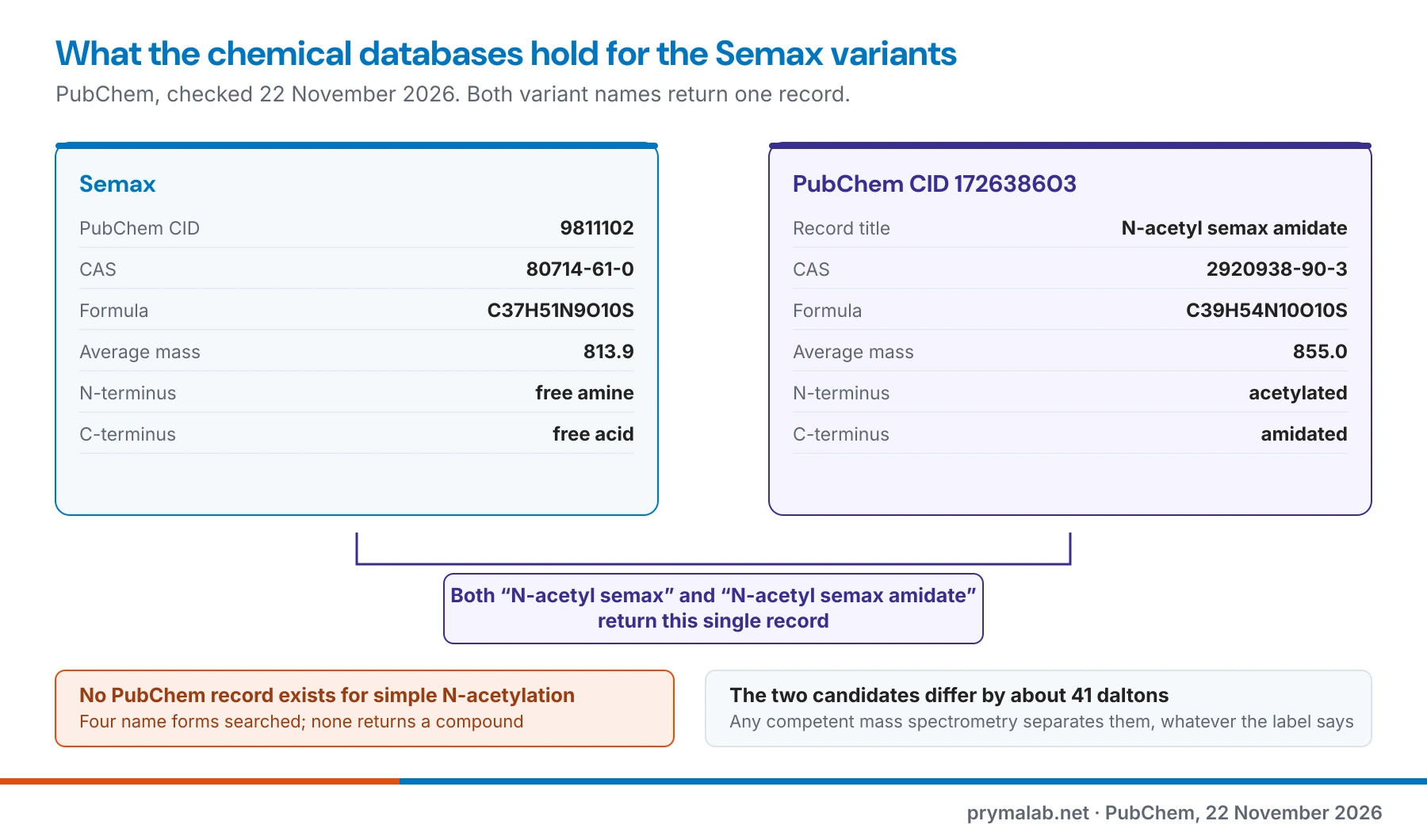
Here is what the database actually contains. PubChem CID 172638603 carries the record title "N-acetyl semax amidate", CAS 2920938-90-3, molecular formula C39H54N10O10S, average mass 855.0 and monoisotopic mass 854.3745. Its synonym list includes both "N-acetyl semax amidate" and "N-acetyl semax", so a lookup for either name returns the same compound.[2]
Work the formula out against Semax at C37H51N9O10S. Acetylation adds C2H2O. Amidation of the C-terminus swaps an oxygen for an NH. Apply both and you land exactly on C39H54N10O10S. Apply only acetylation and you would get C39H53N9O11S, which is a different formula with nine nitrogens rather than ten. The indexed record describes the doubly modified peptide.
I then searched for a record describing simple N-acetylation on its own, under four name forms: Acetyl-Semax, N-acetylsemax, Ac-Met-Glu-His-Phe-Pro-Gly-Pro-OH and Ac-MEHFPGP. All four returned no compound.[2]
So what should you conclude? Not that the two products sold under those names are the same material, because PubChem indexes names, not inventory, and a synthesis house can certainly make a mono-acetylated heptapeptide whether or not PubChem has catalogued it. The conclusion is narrower and more useful: the public chemical record does not distinguish these two names, so the name on a label does not establish which molecule is in the vial. Identity for any given lot comes from that lot's own mass spectrometry, and the two candidates differ by about 41 daltons, which any competent analysis will separate without difficulty.
What is firmly established is that acetylating the N-terminus changes the molecule's physical chemistry. The copper coordination work measured it directly: acetylated Semax forms a different copper complex geometry from unmodified Semax.[29] A proteolysis study of acetylated Semax in various biological media exists, though PubMed carries no abstract for it and I have not read its contents.[15] Beyond that, the comparative pharmacology of the variants against the parent peptide is close to unstudied.
What is its regulatory status?
Registered as a medicine in Russia, not approved in the United States or the European Union, and absent from the FDA's compounding lists entirely. Research use only everywhere outside Russia.
On the Russian registration I have to be straight with you about sourcing. The authoritative record is the state register of medicines at grls.rosminzdrav.ru, and on 22 November 2026 that site would not load for me from either a data-centre connection or an ordinary browser. I could not retrieve a registration number, a registration date or a marketing authorisation holder from the register itself, so I am not going to quote any.
What I can cite is a 2022 peer-reviewed review of peptide biopharmaceutical development in Russia, published in Pharmaceutics. It states that 14 peptide products are registered in the Russian Federation and lists Semax, by sequence, as the third of them, classified as a nootropic drug. The same paper records that it was synthesized under Ashmarin and Myasoedov at the Institute of Molecular Genetics.[3] A peer-reviewed review is weaker than the register, and it is what I have.
In the United States there is no approval and no pending application. Semax does not appear anywhere in the FDA's list of bulk drug substances nominated for compounding under section 503A, in the version updated 14 May 2026.[56] Note what that means: it is not in category 1, not in category 2 and not in category 3. It was never nominated. For context on how that regime is moving, a 2026 analysis in the International Journal of Pharmaceutical Compounding reviews the Pharmacy Compounding Advisory Committee recommendations on synthetic peptides.[55]
In the European Union there is no marketing authorisation and no orphan designation. Semax has no EMA record.
Across both regions the practical position is the same as for most of the catalogue, and the general picture is in are peptides legal.
Is semax prohibited in sport?
Semax is not named anywhere in the WADA Prohibited List for 2026 or for 2027. I searched both official documents and the word does not appear in either.[53][54] What happens next depends on a clause whose application to this compound has not, as far as I can find, ever been decided publicly.
Class S0 covers non-approved substances, and its text reads: any pharmacological substance which is not addressed by any of the subsequent sections of the List and with no current approval by any governmental regulatory health authority for human therapeutic use is prohibited at all times.[53] That class names BPC-157 explicitly as an example.
Now put the two facts together. S0 turns on whether a substance has current approval by a governmental regulatory health authority for human therapeutic use. Semax is registered as a medicine in Russia, and the Russian Ministry of Health is a governmental regulatory health authority.[3] Read literally, that is a reason S0 might not reach it. Whether anti-doping authorities read it that way is a different question, and I could not find a published decision, explanatory note or case that resolves it.
If you compete under the World Anti-Doping Code, the answer that counts comes from your own anti-doping organisation, and asking them costs nothing. The structural point worth taking away is that the absence of a name from the List does not settle anything by itself, in either direction.
How does it compare with the other cognition-focused peptides?
On volume of published research Semax is near the top of the shelf. On registered clinical evidence it sits with everything else at zero.
| Semax | Selank | Noopept | Cerebrolysin | |
|---|---|---|---|---|
| Type | Synthetic heptapeptide | Synthetic heptapeptide | Dipeptide | Porcine brain-derived peptide mixture |
| Shares the Pro-Gly-Pro tail | Yes | Yes | No | Not applicable |
| Registered as a medicine in Russia | Yes[3] | Yes[3] | Yes | Registered in several countries |
| Approved in the US or EU | No | No | No | No US approval |
| Records on ClinicalTrials.gov | Zero[52] | Zero[52] | A small number | Numerous, including randomised trials |
| Molecular target identified | No | No | Disputed | Not applicable to a mixture |
The pattern in that table is the one worth carrying away. Within the Russian nootropic family, registration at home and absence from international registries go together. Cerebrolysin is the counter-example in the group, because it has been through randomised trials that are indexed and citable, and it is covered in the Cerebrolysin reference. For the small-molecule comparison the nearest neighbour is Noopept and omberacetam, and for the bioregulator approach to cognition, Pinealon. Compounds working through entirely different mechanisms on synaptic growth include Dihexa and P21.
What turned up in forensic analyses?
Semax has been found in seized pharmaceutical preparations in Europe, and the laboratory that identified it published the case in an analytical journal. It is the only genuinely independent assessment of what is actually in circulation under this name.
At the end of 2017 and again in 2018, two unknown suspicious preparations were sent to Sciensano, the Belgian public health institute, for identification. Analysis found that they contained Selank and Semax. The authors note that these peptides have not, to their knowledge, completed any clinical trials, and that an online search excluding the dark web showed them freely available either as lyophilised powder or in nasal sprays. They wrote the paper as a warning to controlling laboratories that they should be prepared to identify these compounds.[51]
I include this for two reasons and neither is comfortable for a supplier. The first is that it documents what the compound is actually used for by some buyers, which is not laboratory research. The second is that it is a reminder of what analytical identification is for. The samples in that study were unlabelled and unknown until a government laboratory ran them. Any vial from any supplier, including mine, is an unknown until somebody with a mass spectrometer says otherwise.
That is the argument for third-party testing rather than for trusting a label, and the method questions are in the peptide purity testing reference.
What do the different names refer to?
Most of them refer to the same heptapeptide. Two of them refer to chemically modified versions, and one common usage is simply inaccurate.
- Semax is the Russian trade and research name for Met-Glu-His-Phe-Pro-Gly-Pro, CAS 80714-61-0.[1]
- ACTH(4-7)PGP is the precise descriptive name and the one used in most recent Russian papers. It is the clearest of the lot because it says what the molecule is.
- ACTH(4-10) analogue is the conventional English description and it is loose. Semax shares four of seven residues with ACTH(4-10) and replaces the other three.
- MEHFPGP is the single-letter sequence, and it is a useful search term because it is unambiguous.
- N-acetyl semax and N-acetyl semax amidate both resolve to PubChem CID 172638603, whose record title is the amidate and whose formula matches acetylation plus amidation.[2]
- Semax acetate means the acetate salt of unmodified Semax, which is a different thing from acetylated Semax. Salt form affects the mass you will see on an analysis and does not change the peptide.
If you are searching the literature yourself, MEHFPGP is the term that behaves best. Semax returns 210 records and catches nearly everything. ACTH(4-10) returns 408 and buries the relevant work under melanocortin pharmacology from the 1980s that concerns a different peptide. ACTH(4-7)PGP returns the recent Moscow output and misses the older English-language papers. Running all three and merging the results is the only way to see the whole record, which is one reason the compound is so often summarised from secondary sources instead.
That last distinction causes genuine confusion and it is worth being blunt about. An acetate salt is Semax paired with acetic acid as a counter-ion. Acetylated Semax has an acetyl group covalently bonded to the N-terminal amine. The words look similar, the molecules are not, and the masses differ.
What can a certificate of analysis settle?
Whether the vial holds the peptide named on it, and what fraction of the contents that peptide is. Nothing about whether it works.
For a seven-residue peptide, identity normally comes from mass spectrometry and purity from reversed-phase HPLC with ultraviolet detection. Two features of this sequence shape what the analysis sees. The methionine at position one is an oxidation liability, and methionine sulphoxide shows up 16 daltons heavier than the parent, which is an easy flag to look for on a mass spectrum. The free N-terminal amine means Semax, unlike a pyroglutamate-capped peptide, is accessible to Edman sequencing if anyone wants residue-level confirmation.
The variant question makes mass spectrometry more useful here than it is for most compounds. Semax is 813.9 average mass and the acetylated amidate is 855.0.[1][2] A gap of roughly 41 daltons is large and unmistakable, so an analysis that reports a parent mass settles immediately which of the two you have, regardless of what the label says. If you are buying any variant, the mass on the certificate is the single most informative number on the page.
Our own third-party position on this compound is narrow and I would rather state it than imply more. The only independent report we hold is Janoshik report 96920, covering a Semax 11 mg lot. Everything else is in-house. Storage handling is covered in the storage and stability guide, and the methionine point above is the reason it matters more for this peptide than for most.
Where PrymaLab fits
We stock Semax for laboratory research. It is synthesized in the United States and tested in our Ashland lab, which is not ISO 17025 accredited. We do not name our suppliers.
Formats are the Semax 5 mg vial, the Semax 11 mg vial, the Semax nasal spray and the Semax autoinjector. Lot testing through a third party is available separately as Semax testing, and given how much of the market sells variants under names the chemical databases do not separate, I think it is the most useful thing on that list. Format trade-offs are covered in the pen versus vial comparison and the delivery question in do peptide nasal sprays work.
The rest of the compound references are indexed in the research hub.
What this article does not settle
Six things, and after reading 210 papers I am more confident about the list of unknowns than about anything on the other side of the ledger.
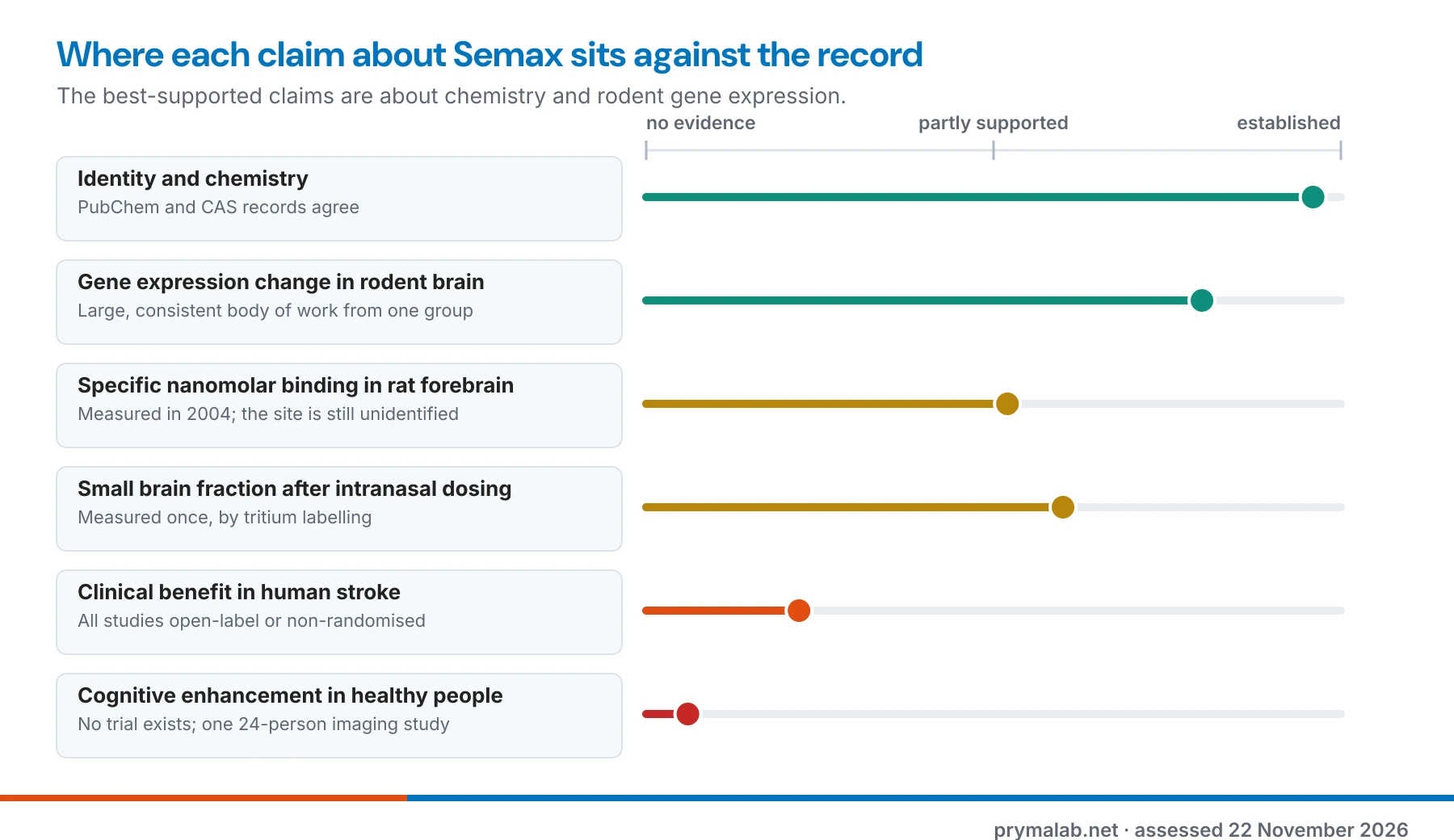
The target. Specific nanomolar binding was measured in 2004 and the site has never been identified.[7] One 2025 paper proposes the mu opioid receptor gene as a route, in female mice, and it stands alone.[27]
Human pharmacokinetics. The brain distribution figure everyone cites is a rat study.[9] I found no published human pharmacokinetic data at all, for any route.
Clinical efficacy. Every human clinical study I found is open-label or uses non-randomised controls.[31][33][36][37] There is no randomised placebo-controlled trial of Semax in English, and no registered trial anywhere.[52]
Cognitive effects in healthy people. The single controlled human study measured resting-state network topography in 24 volunteers and no cognitive task.[34] The claims that dominate search results for this compound have nothing behind them.
The Russian registration details. The state register would not load, so the registration number, date and holder are absent from this article rather than guessed.[3]
The variants. Comparative pharmacology of acetylated and amidated Semax against the parent peptide is essentially unstudied. What exists is solution chemistry showing that acetylation changes copper coordination[29] and a proteolysis paper with no abstract available.[15]
Frequently asked questions
Is semax an ACTH(4-10) analogue or something else?
Loosely an analogue, precisely not. ACTH(4-10) is Met-Glu-His-Phe-Arg-Trp-Gly. Semax is Met-Glu-His-Phe-Pro-Gly-Pro. It keeps the first four residues and replaces the last three with a proline-glycine-proline tail that does not occur in ACTH.[1] Russian papers use the more accurate name ACTH(4-7)PGP. The looser label matters for literature searches, because most ACTH(4-10) papers are about a different molecule.
Has semax ever been in a registered clinical trial?
No. A ClinicalTrials.gov search on 22 November 2026 returned a total count of zero records for semax, in any status.[52] That is despite roughly forty years of research and registration as a medicine in Russia. Russian clinical work on the compound exists and is published, but none of it was registered in the trial registry that journals, regulators and systematic reviewers use.
What receptor does semax act on?
Nobody knows. A 2004 study measured specific, reversible, calcium-dependent binding to rat forebrain basal nuclei membranes with a dissociation constant of 2.41 nanomolar.[7] In the twenty-two years since, no receptor has been cloned, named or structurally identified in any of the 210 indexed papers. A 2025 study proposes the mu opioid receptor gene as a route of action, in female mice.[27]
How much semax reaches the brain after intranasal dosing in rats?
A tritium-labelling study found 0.093 per cent of the total administered radioactivity per gram of brain tissue at two minutes, with about 80 per cent of that radioactivity being intact Semax and the rest metabolites.[9] In biological samples, the Pro-Gly-Pro fragment predominated over the parent peptide and its other metabolites combined. No equivalent human measurement has been published.
Is semax a registered medicine in Russia?
A 2022 peer-reviewed review of Russian peptide biopharmaceuticals lists it among 14 peptide products registered in the Russian Federation, classified as a nootropic drug.[3] That is the strongest source I could verify. It is not approved in the United States or the European Union, and it holds no EMA record of any kind.
Why does this article not give a Russian registration number?
Because I could not open the register. The state register of medicines at grls.rosminzdrav.ru failed to load on 22 November 2026 from both a data-centre connection and an ordinary browser, so I have no registration number, date or authorisation holder from the primary record. Rather than copy a number from a vendor page, I have left it out and cited a peer-reviewed review instead.[3]
Does the neurotrophin research support claims about memory?
Not in humans. The neurotrophin work is rodent and cell-culture: roughly eightfold BDNF messenger RNA induction in cultured glial cells,[5] and about a 1.4-fold rise in BDNF protein with a 1.6-fold rise in trkB phosphorylation in rat hippocampus.[4] Transcript and protein numbers differ by about fivefold and get quoted interchangeably. No human cognitive trial exists.
Is N-acetyl semax a different compound from the amidate?
The public chemical databases do not separate them. PubChem CID 172638603 has the record title "N-acetyl semax amidate" and lists "N-acetyl semax" as a synonym, so both names return the same record, and its formula corresponds to acetylation plus C-terminal amidation.[2] No separate record for simple N-acetylation exists under any of four name forms I searched. That makes the mass on a lot's own analysis, not the label, the thing that settles identity.
What is the difference between semax acetate and acetylated semax?
A counter-ion versus a covalent bond. Semax acetate is the peptide paired with acetic acid as a salt, and the peptide itself is unchanged. Acetylated Semax has an acetyl group bonded to the N-terminal amine, which removes a nitrogen donor and measurably alters its copper coordination chemistry.[29] The two terms look alike, describe different things, and give different masses on analysis.
Does the Pro-Gly-Pro tail do anything on its own?
The literature disagrees. A 2005 study found the tripeptide alone had no effect on neurological deficit or mortality in rats with incomplete global cerebral ischaemia, concluding the effects come mainly from the ACTH(4-7) portion.[16] A 2010 study found both Semax and the tripeptide activated neurotrophin transcription after occlusion.[17] Both can be true, since transcription and functional recovery are different readouts.
Is semax named on the WADA Prohibited List?
No. The word does not appear in the official 2026 or 2027 documents.[53][54] Class S0 covers substances with no current approval by any governmental regulatory health authority for human therapeutic use, and Semax has a Russian registration, which makes its position under that clause genuinely unclear.[3][53] I could find no published decision resolving it. Competitors should ask their own anti-doping organisation.
Has semax been found in seized products?
Yes. Two suspicious preparations seized in Belgium at the end of 2017 and in 2018 were analysed by Sciensano and found to contain Selank and Semax. The authors noted the peptides were freely available online as lyophilised powder or in nasal sprays, and published the work so that controlling laboratories could identify them in future.[51]
Why does semax contain sulphur, and does it matter?
The methionine at position one carries the sulphur, which is why the formula is C37H51N9O10S.[1] It matters for analysis because methionine oxidises to the sulphoxide, which appears 16 daltons heavier on a mass spectrum. That makes oxidation one of the more easily detected degradation routes for this peptide, provided someone runs the analysis.
Has any Western laboratory replicated the Russian ischaemia findings?
Not that I could find. The transcriptomic ischaemia programme is large, internally consistent and overwhelmingly from one group at the Institute of Molecular Genetics in Moscow.[20][22][23][24][25][26] Independent work on Semax exists in other areas, notably the copper chemistry from a group in Catania[28][29] and the 2025 spinal cord injury work from China,[27] but not on the core stroke findings.
What did the imaging study in healthy volunteers find?
A change in network topography, not a change in performance. Twenty-four healthy volunteers, 14 on Semax and 10 on placebo, had resting-state functional MRI before and at 5 and 20 minutes after intranasal administration. The Semax group showed a greater volume of the rostral subcomponent of the default mode network in medial frontal cortex.[34] No attention, memory or reaction-time measure was included.
Is semax on any FDA compounding list?
No. It does not appear in the FDA's list of bulk drug substances nominated for compounding under section 503A, in the version updated 14 May 2026.[56] It is not in category 1, 2 or 3. It was never nominated, which is a different situation from being evaluated and placed low, and it means the agency has published no assessment of it at all.
What happens to semax in blood?
A bestatin-sensitive aminopeptidase removes the N-terminal methionine and then glutamate, leaving relatively stable intermediates that the original authors suggested may contribute to the parent peptide's effects.[10] Work with uniformly labelled peptide found that loss of the terminal Met-Glu and Gly-Pro pairs, with accumulation of pentapeptides, dominated in membranes and in glial and neuronal cultures.[12] Semax was more stable than ACTH(4-10) against other serum enzymes.[10]
What would change the evidence picture for semax?
Two things, in order of value. Identifying what the molecule binds to would convert forty years of gene-expression correlations into pharmacology. A registered, randomised, placebo-controlled trial with a pre-specified clinical endpoint would convert the Russian clinical literature into evidence other regulators could read. Neither is under way as far as any registry shows.[52]
References
- National Center for Biotechnology Information. PubChem Compound Summary for CID 9811102, Semax. PubChem CID 9811102
- National Center for Biotechnology Information. PubChem Compound Summary for CID 172638603, N-acetyl semax amidate. Record checked 22 November 2026, including synonym list and name lookups for Acetyl-Semax, N-acetylsemax, Ac-Met-Glu-His-Phe-Pro-Gly-Pro-OH and Ac-MEHFPGP. PubChem CID 172638603
- Deigin VI, Poluektova EA, Beniashvili AG, et al. Development of peptide biopharmaceuticals in Russia. Pharmaceutics. 2022;14(4):716. PMID 35456550
- Dolotov OV, Karpenko EA, Inozemtseva LS, et al. Semax, an analog of ACTH(4-10) with cognitive effects, regulates BDNF and trkB expression in the rat hippocampus. Brain Res. 2006;1117(1):54-60. PMID 16996037
- Shadrina MI, Dolotov OV, Grivennikov IA, et al. Rapid induction of neurotrophin mRNAs in rat glial cell cultures by Semax, an adrenocorticotropic hormone analog. Neurosci Lett. 2001;308(2):115-8. PMID 11457573
- Dolotov OV, Karpenko EA, Seredenina TS, et al. Semax, an analogue of adrenocorticotropin (4-10), binds specifically and increases levels of brain-derived neurotrophic factor protein in rat basal forebrain. J Neurochem. 2006;97 Suppl 1:82-6. PMID 16635254
- Dolotov OV, Zolotarev IuA, Dorokhova EM, et al. The binding of Semax, ACTH 4-10 heptapeptide, to plasma membranes of the rat forebrain basal nuclei and its biodegradation. Bioorg Khim. 2004;30(3):241-6. PMID 15344653
- V'yunova TV, Shevchenko KV, Shevchenko VP, et al. Specific binding of semax in different regions of the rat brain. Dokl Biol Sci. 2006;410:376-7. PMID 17278839
- Shevchenko KV, Nagaev IIu, Alfeeva LIu, et al. Kinetics of Semax penetration into the brain and blood of rats after its intranasal administration. Bioorg Khim. 2006;32(1):64-70. PMID 16523722
- Potaman VN, Alfeeva LY, Kamensky AA, et al. N-terminal degradation of ACTH(4-10) and its synthetic analog semax by the rat blood enzymes. Biochem Biophys Res Commun. 1991;176(2):741-6. PMID 1851003
- Potaman VN, Alfeeva LY, Kamensky AA, et al. Degradation of ACTH/MSH(4-10) and its synthetic analog semax by rat serum enzymes: an inhibitor study. Peptides. 1993;14(3):491-5. PMID 8392718
- Zolotarev YA, Dolotov OV, Inozemtseva LS, et al. Degradation of the ACTH(4-10) analog Semax in the presence of rat basal forebrain cell cultures and plasma membranes. Amino Acids. 2006;30(4):403-8. PMID 16773243
- Shevchenko KV, V'iunova TV, Nagaev IIu, et al. Proteolysis of semax analogues with different N-terminal amino acids by aminopeptidases. Bioorg Khim. 2011;37(4):475-82. PMID 22096989
- Shevchenko KV, Nagaev IY, Andreeva LA, et al. Study of proteolysis of Semax analogues with different N-terminal amino acids by carboxypeptidases. Dokl Biol Sci. 2013;450:146-8. PMID 23821053
- Shevchenko KV, Nagaev IY, Andreeva LA, et al. Stability of Semax acetyl to proteolysis in various biological media. Dokl Biol Sci. 2013;449:110-2. No abstract available in PubMed; contents not independently read for this article. PMID 23652441
- Fadyukova OE, Kadi A, Bai O, et al. C-terminal Pro-Gly-Pro tripeptide in contrast to full-length neuropeptide semax exhibits no neuroprotective effect in experimental cerebral ischemia. Bull Exp Biol Med. 2005;139(4):421-3. PMID 16027870
- Dmitrieva VG, Povarova OV, Skvortsova VI, et al. Semax and Pro-Gly-Pro activate the transcription of neurotrophins and their receptor genes after cerebral ischemia. Cell Mol Neurobiol. 2010;30(1):71-9. PMID 19633950
- Agapova TY, Agniullin YV, Shadrina MI, et al. Neurotrophin gene expression in rat brain under the action of Semax, an analogue of ACTH 4-10. Neurosci Lett. 2007;417(2):201-5. PMID 17353092
- Shadrina M, Kolomin T, Agapova T, et al. Comparison of the temporary dynamics of NGF and BDNF gene expression in rat hippocampus, frontal cortex, and retina under Semax action. J Mol Neurosci. 2010;41(1):30-5. PMID 19662538
- Medvedeva EV, Dmitrieva VG, Povarova OV, et al. The peptide semax affects the expression of genes related to the immune and vascular systems in rat brain focal ischemia: genome-wide transcriptional analysis. BMC Genomics. 2014;15:228. PMID 24661604
- Medvedeva EV, Dmitrieva VG, Limborska SA, et al. Semax, an analog of ACTH(4-7), regulates expression of immune response genes during ischemic brain injury in rats. Mol Genet Genomics. 2017;292(3):635-653. PMID 28255762
- Filippenkov IB, Stavchansky VV, Denisova AE, et al. Novel insights into the protective properties of ACTH(4-7)PGP (Semax) peptide at the transcriptome level following cerebral ischaemia-reperfusion in rats. Genes (Basel). 2020;11(6):681. PMID 32580520
- Dergunova LV, Dmitrieva VG, Filippenkov IB, et al. The peptide drug ACTH(4-7)PGP (Semax) suppresses mRNA transcripts encoding proinflammatory mediators induced by reversible ischemia of the rat brain. Mol Biol (Mosk). 2021;55(3):402-411. PMID 34097675
- Filippenkov IB, Remizova JA, Stavchansky VV, et al. Synthetic adrenocorticotropic peptides modulate the expression pattern of immune genes in rat brain following the early post-stroke period. Genes (Basel). 2023;14(7):1382. PMID 37510287
- Filippenkov IB, Glazova NY, Sebentsova EA, et al. Changes of transcriptomic activity in rat brain cells under the influence of synthetic adrenocorticotropic hormone-like peptides. Biochemistry (Mosc). 2024;89(9):1643-1656. PMID 39418522
- Filippenkov IB, Shpetko YY, Ales DA, et al. Genes that associated with action of ACTH-like peptides with neuroprotective potential in rat brain regions with different degrees of ischemic damage. Int J Mol Sci. 2025;26(13):6256. PMID 40650034
- Liu R, Chen Y, Huang H, et al. Semax peptide targets the mu opioid receptor gene Oprm1 to promote deubiquitination and functional recovery after spinal cord injury in female mice. Br J Pharmacol. 2025;182(22):5489-5516. PMID 40692165
- Tabbi G, Magri A, Giuffrida A, et al. Semax, an ACTH4-10 peptide analog with high affinity for copper(II) ion and protective ability against metal induced cell toxicity. J Inorg Biochem. 2015;142:39-46. PMID 25310602
- Magri A, Tabbi G, Giuffrida A, et al. Influence of the N-terminus acetylation of Semax, a synthetic analog of ACTH(4-10), on copper(II) and zinc(II) coordination and biological properties. J Inorg Biochem. 2016;164:59-69. PMID 27586814
- Sciacca MFM, Naletova I, Giuffrida ML, et al. Semax, a synthetic regulatory peptide, affects copper-induced abeta aggregation and amyloid formation in artificial membrane models. ACS Chem Neurosci. 2022;13(4):486-496. PMID 35080861
- Gusev EI, Skvortsova VI, Miasoedov NF, et al. Effectiveness of semax in acute period of hemispheric ischemic stroke: a clinical and electrophysiological study. Zh Nevrol Psikhiatr Im S S Korsakova. 1997;97(6):26-34. PMID 11517472
- Miasoedova NF, Skvortsova VI, Nasonov EL, et al. Investigation of mechanisms of neuro-protective effect of semax in acute period of ischemic stroke. Zh Nevrol Psikhiatr Im S S Korsakova. 1999;99(5):15-9. PMID 10358912
- Gusev EI, Martynov MY, Kostenko EV, et al. The efficacy of semax in the treatment of patients at different stages of ischemic stroke. Zh Nevrol Psikhiatr Im S S Korsakova. 2018;118(3 Pt 2):61-68. PMID 29798983
- Lebedeva IS, Panikratova YR, Sokolov OY, et al. Effects of Semax on the default mode network of the brain. Bull Exp Biol Med. 2018;165(5):653-656. PMID 30225715
- Koroleva MV, Meizerov EE, Nezavibat'ko VN, et al. Effect of the heptapeptide Semax on the human electroencephalogram. Biull Eksp Biol Med. 1996;121(1):116-7. PMID 8679991
- Polunin GS, Nurieva SM, Baiandin DL, et al. Evaluation of therapeutic effect of new Russian drug semax in optic nerve disease. Vestn Oftalmol. 2000;116(1):15-8. PMID 10741256
- Kurysheva NI, Shpak AA, Ioileva EE, et al. Semax in the treatment of glaucomatous optic neuropathy in patients with normalized ophthalmic tone. Vestn Oftalmol. 2001;117(4):5-8. PMID 11569188
- Kaplan AIa, Koshelev VB, Nezavibat'ko VN, et al. Increased resistance to hypoxia effected by the neuropeptide preparation SEMAX. Fiziol Cheloveka. 1992;18(5):104-7. PMID 1335426
- Levitskaya NG, Sebentsova EA, Andreeva LA, et al. The neuroprotective effects of Semax in conditions of MPTP-induced lesions of the brain dopaminergic system. Neurosci Behav Physiol. 2004;34(4):399-405. PMID 15341218
- Eremin KO, Kudrin VS, Saransaari P, et al. Semax, an ACTH(4-10) analogue with nootropic properties, activates dopaminergic and serotoninergic brain systems in rodents. Neurochem Res. 2005;30(12):1493-500. PMID 16362768
- Romanova GA, Silachev DN, Shakova FM, et al. Neuroprotective and antiamnesic effects of Semax during experimental ischemic infarction of the cerebral cortex. Bull Exp Biol Med. 2006;142(6):663-6. PMID 17603664
- Grivennikov IA, Dolotov OV, Zolotarev YA, et al. Effects of behaviorally active ACTH(4-10) analogue Semax on rat basal forebrain cholinergic neurons. Restor Neurol Neurosci. 2008;26(1):35-43. PMID 18431004
- Volodina MA, Sebentsova EA, Glazova NY, et al. Correction of long-lasting negative effects of neonatal isolation in white rats using semax. Acta Naturae. 2012;4(1):86-92. PMID 22708068
- Glazova NY, Manchenko DM, Volodina MA, et al. Semax, synthetic ACTH(4-10) analogue, attenuates behavioural and neurochemical alterations following early-life fluvoxamine exposure in white rats. Neuropeptides. 2021;86:102114. PMID 33418449
- Inozemtseva LS, Yatsenko KA, Glazova NY, et al. Antidepressant-like and antistress effects of the ACTH(4-10) synthetic analogs Semax and Melanotan II on male rats in a model of chronic unpredictable stress. Eur J Pharmacol. 2024;984:177068. PMID 39442746
- Radchenko AI, Kuzubova EV, Apostol AA, et al. The potential of the peptide drug Semax and its derivative for correcting pathological impairments in the animal model of Alzheimer's disease. Acta Naturae. 2025;17(4):110-120. PMID 41479572
- Kobylyanskii AG, Zolotarev YA, Andreeva LA, et al. Studying the toxic effects of some biologically active peptides on the model of mouse embryonic stem cells. Bull Exp Biol Med. 2017;163(6):731-736. PMID 29063333
- Novosadova EV, Arsenyeva EL, Antonov SA, et al. The use of human induced pluripotent stem cells for testing neuroprotective activity of pharmacological compounds. Biochemistry (Mosc). 2019;84(11):1296-1305. PMID 31760919
- Manchenko DM, Glazova NIu, Levitskaia NG, et al. Nootropic and analgesic effects of Semax following different routes of administration. Ross Fiziol Zh Im I M Sechenova. 2010;96(10):1014-23. PMID 21268834
- Kost NV, Sokolov OIu, Gabaeva MV, et al. Semax and selank inhibit the enkephalin-degrading enzymes from human serum. Bioorg Khim. 2001;27(3):180-3. PMID 11443939
- Vanhee C, Francotte A, Janvier S, et al. The occurrence of putative cognitive enhancing research peptides in seized pharmaceutical preparations. Drug Test Anal. 2020;12(3):371-381. PMID 31667971
- US National Library of Medicine. ClinicalTrials.gov registry search for semax, conducted 22 November 2026, returning a total count of zero studies. clinicaltrials.gov
- World Anti-Doping Agency. The 2026 Prohibited List, in force 1 January 2026. Class S0 and class S2 text. WADA 2026 Prohibited List (PDF)
- World Anti-Doping Agency. The 2027 Prohibited List, in force 1 January 2027. Copy hosted by the Athletics Integrity Unit. 2027 Prohibited List (PDF); index at wada-ama.org
- Willis J, Vu N. Synthetic peptides in pharmacy compounding: analysis of PCAC recommendations and industry safety standards. Int J Pharm Compd. 2026;30(4):329-336. PMID 42752426
- US Food and Drug Administration. Bulk drug substances nominated for use in compounding under section 503A of the FD&C Act, updated 14 May 2026. Semax does not appear in any category. fda.gov/media/94155/download
- Lapochkin OL, Zykov VP, Zavadenko NN, et al. Expert council resolution: adjunctive pharmacotherapy for hyperkinetic disorders in children and adolescents. Zh Nevrol Psikhiatr Im S S Korsakova. 2026;126(9 Pt 2):126-135. PMID 42910684
Final disclaimer: This article describes published research on Semax for an audience of laboratory researchers. Semax is not approved for human or veterinary use in the United States or the European Union. Nothing here is medical advice, and nothing here describes how to prepare or administer any substance.
PrymaLab sells research chemicals for laboratory use only. Products are synthesized in the United States and tested in our Ashland lab, which is not ISO 17025 accredited. Where this article states that something could not be verified, including the Russian state register entry, that statement is as accurate as the public record allowed on 22 November 2026, and I will correct it if a primary source becomes reachable.