15% fall discount applied automatically at checkoutFree USA shipping over $100Free worldwide shipping over $200Credit/debit checkout disabled for updates
Sign in 0

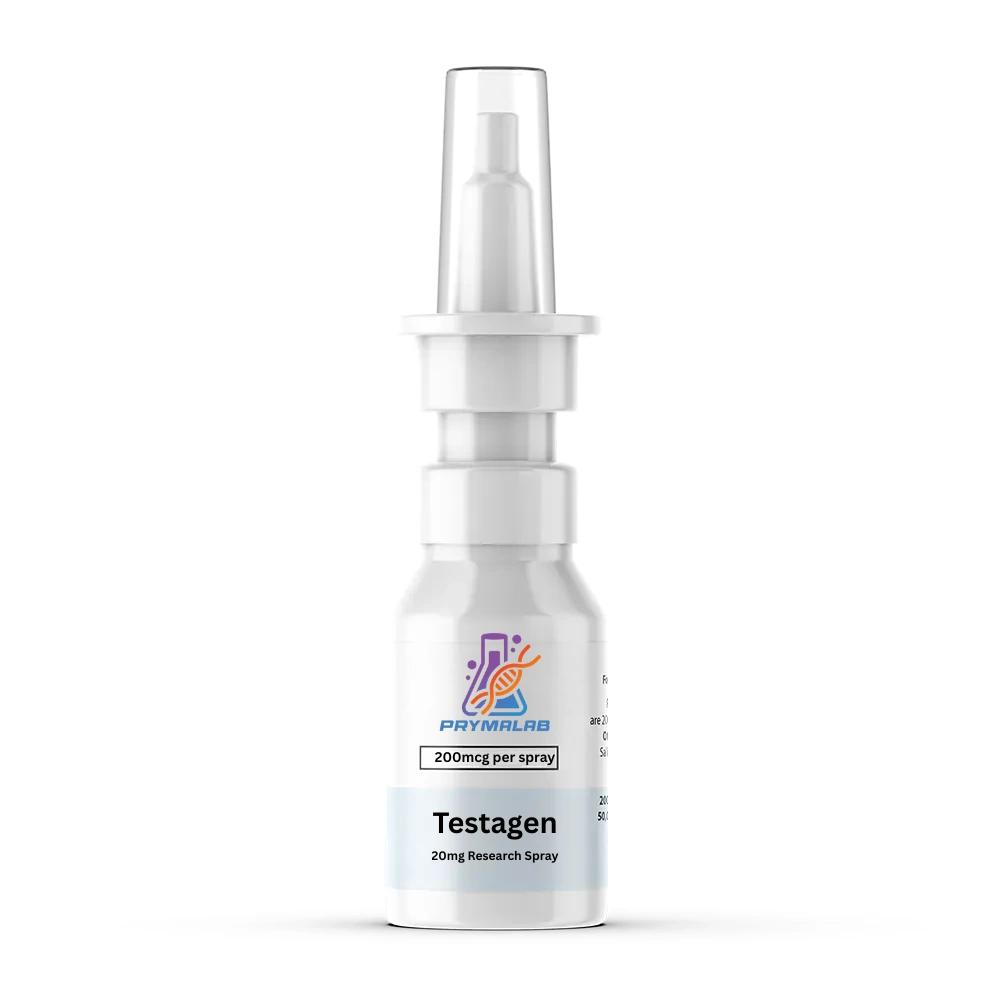
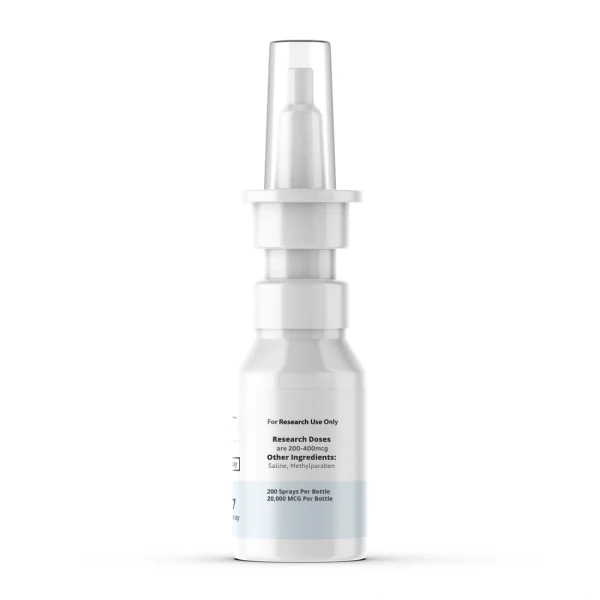
Testagen 20mg Nasal Spray

(7 customer reviews)

$119.99 or subscribe for $101.99/mo

Testagen nasal spray supplies the tetrapeptide Lys-Glu-Asp-Gly in a metered solution format. Its glycine terminus is the least protected in the bioregulator family, which becomes a live concern the moment an aqueous bottle is contaminated. Laboratory research use only.

Description

PrymaLab · Research Use Only

Testagen Nasal Spray

Lys-Glu-Asp-Gly tetrapeptide · 447.5 Da · glycine terminus

Testagen nasal spray supplies the tetrapeptide Lys-Glu-Asp-Gly in a metered aqueous solution at roughly 447.5 daltons. It ends in glycine, the smallest residue available and the one that offers a degradative enzyme the least resistance, which is a dormant problem in a sealed bottle and an active one in an opened contaminated one.

Specification Table

Testagen nasal spray format and handling data
Property Value
Compound Testagen
Sequence designation KEDG
Amino acid sequence Lysine-Glutamate-Aspartate-Glycine
Sequence provenance Secondary sources, converging. Not traced to a single primary citation. Confirm against the lot certificate before relying on it for calculation
Residue count 4
Molecular weight, calculated Approximately 447.5 g/mol, computed from standard residue masses plus water
Terminal residue Glycine, the least sterically hindered residue available
Most protease-resistant relatives Prostamax and Cortagen, both proline-terminating
Near-isobaric compounds here Livagen at roughly 447.5 and Bronchogen at roughly 446.5
Labile motif Asp-Gly at positions 3 and 4
Net charge at neutral pH Near neutral. One basic residue against two acidic residues
Chromophore None. Concentration cannot be determined by 280 nm absorbance
Format Metered nasal spray, solution state
Physical state Aqueous solution, supplied ready to use
Purity Per lot-specific certificate of analysis
Storage 2-8°C, protected from light. Do not freeze
Regulatory status No approved human or veterinary formulation in any jurisdiction

Why Is the Glycine Terminus the Least Protected?

Four compounds in this family end in different residues, and testagen nasal spray drew the one that offers no resistance at all.

Glycine has a single hydrogen where every other coded residue carries a side chain. It is the smallest and least sterically demanding option available.

Carboxypeptidases work inward from the carboxy end and have to accommodate that terminal residue in an active site. A glycine fits without obstruction.

Compare Prostamax and Cortagen, both ending in proline, whose ring geometry the same enzymes handle badly and which are consequently the most resistant members of the family.

So within a group sharing three of four residues, this compound sits at the exposed end of the spectrum and those two at the protected end.

In a sterile sealed solution none of that matters, because no protease is present to exploit the opening.

It becomes live the moment a bottle is contaminated, and an opened aqueous container in ordinary laboratory use is not a sterile environment for long.

That makes aseptic handling a more consequential instruction for this compound than for its proline-terminating relatives, which is a real difference rather than a boilerplate one.

The same residue makes a small contribution on the manufacturing side that is worth noting.

Glycine couples faster than any other residue, since it has no side chain to obstruct the reacting centre.

As the first residue loaded onto the resin that is a modest advantage, and it means terminal deletion is less likely here than for a bulky terminal residue.

So the residue that leaves the finished molecule most exposed also makes the finished molecule slightly easier to build correctly.

What Does Contamination Actually Do Here?

The concern with testagen nasal spray is specific rather than general, and worth setting out so it can be judged rather than assumed.

Microbial growth in an opened aqueous container introduces proteases, since bacteria and fungi secrete them as a matter of course.

Those enzymes act on whatever peptide is available. A terminal glycine is among the easiest substrates on offer.

The degradation product would be Lys-Glu-Asp, which is Vesugen, another compound sold in this same catalogue at roughly 390.4.

So contamination of this product does not merely destroy it. It converts it into a different named compound at a mass 57 daltons lighter.

That is an unusually concrete way to describe a contamination risk, and it gives a checkable signature rather than a vague warning.

A bottle showing a species near 390 has been degraded rather than merely aged. The two are worth distinguishing.

Visible cloudiness is the cruder indicator and it arrives later, which makes the mass check the more sensitive one where an instrument is available.

One qualification belongs alongside that, so the risk is not overstated.

A sealed bottle stored correctly and opened a handful of times under clean conditions is unlikely to develop meaningful microbial growth.

The concern applies to bottles kept for months, opened frequently, or handled without attention to the nozzle contacting surfaces.

That is an ordinary standard rather than a demanding one. Meeting it removes this entire category of risk, and it costs nothing beyond the attention any aqueous laboratory reagent deserves.

How Does This Compound Sit Among the Near-Isobaric Group?

Two other products in this catalogue sit within about a dalton of this one. Each raises a different question.

Livagen at roughly 447.5 differs from this compound only in its terminal residue, alanine against glycine. That is a single methyl group.

Bronchogen at roughly 446.5 differs at two positions and arrives at a nearly identical mass by coincidence rather than by similarity.

For the Livagen pair the discriminator is amino acid analysis, which returns an alanine to glycine ratio and settles it unambiguously.

The Bronchogen pair needs chromatography instead. A leucine terminus is far more hydrophobic than a glycine one, so retention differs substantially where mass does not.

Two near neighbours needing two different methods is worth stating, because a supplier who ran one check may believe they have covered both.

High-resolution mass separates all three. But only when the operator is looking for a distinction rather than confirming an expected value.

A vendor stocking all three should be able to show a single chromatogram with three resolved peaks, and that trace answers the question for the whole group at once.

It is worth naming why three compounds converged on nearly the same mass, since it is not coincidence in the ordinary sense.

All three share the Glu-Asp core that runs through fourteen of the sixteen compounds in this family, so two of four positions were fixed before any variation began.

With only the first and last positions varying, and with the available residues clustered in a narrow mass range, near-collisions are close to inevitable.

That is a design consequence of building a product family from permutations of a short shared core, and it is worth understanding rather than treating as bad luck.

What Does the Asp-Gly Motif Add?

The terminal glycine creates a second problem alongside the enzymatic one, and this one proceeds without any contamination at all.

The aspartate at position three is followed directly by that glycine. That is the classic arrangement for succinimide formation.

The aspartate side chain attacks the following backbone nitrogen, closes a five-membered ring, and the ring reopens to give either aspartate or isoaspartate.

Isoaspartate is a rearranged molecule with the backbone running through the side-chain carboxyl, one carbon longer through that residue.

Its mass is identical to the parent, so mass spectrometry cannot detect it at any resolution and a purity chromatogram may not separate it either.

The reaction needs water, which means this is a solution-state problem specifically and a powder is largely protected from it.

Chonluten and Epitalon share this motif and this compound joins them, making three products in the range where elapsed time in solution is the variable to control.

For those three the fill date carries more information than the purity figure, and it is worth asking for explicitly.

How Does 447 Daltons Sit for Nasal Delivery?

Size is favourable and unremarkable, which is true across this family.

The route between epithelial cells stops carrying useful quantities somewhere near 1,000 daltons, and this compound sits at less than half that.

At roughly 447.5 daltons it is mid-range for the family, above Ovagen at roughly 375.4 and below Prostamax at roughly 487.5.

Four residues with no aromatic side chain gives low hydrophobicity. So paracellular passage does the work and the transcellular route contributes little.

One basic residue against two acidic ones leaves the molecule near neutral, so it is neither held by the mucosal surface nor repelled from it.

That neutrality also drives adsorption onto container walls at the low concentrations typical of a spray, which is a loss no label reflects.

No published study characterises this compound given nasally, so all of this is structural argument.

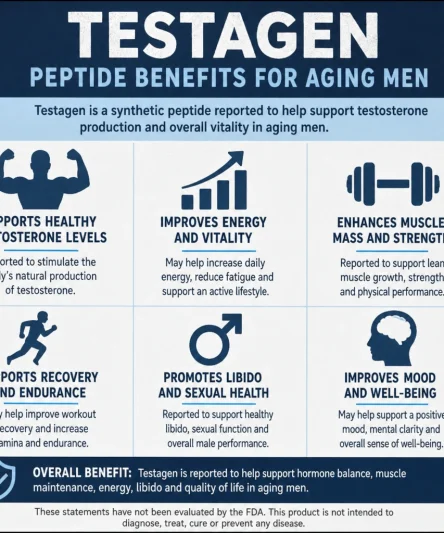
Does Testagen Contain or Raise Testosterone?

No. This is the single most important thing on the page and it deserves the plainest possible answer.

Testagen is Lys-Glu-Asp-Gly, four amino acids and nothing else. It contains no testosterone, no androgen, and no steroid of any kind.

No published study shows that it raises testosterone, lowers it, or changes androgen levels in any direction in any species.

The name carries the implication and the chemistry does not support it. That is worth saying directly rather than leaving to inference.

The confusion is understandable, because an approved testosterone nasal spray does exist and it is a genuinely different product.

Natesto is a testosterone nasal gel, applied into the nostril, approved for testosterone replacement therapy in men with hypogonadism confirmed by laboratory testing.

Natesto delivers actual testosterone. It is a Schedule III controlled substance in the United States, it requires a prescription, and it comes with prescribing information running to many pages.

That prescribing information is where the safety vocabulary attached to this search space comes from, and none of it describes this compound.

Testosterone replacement therapy carries documented risks that a peptide page has no business borrowing. TRT is associated with raised haematocrit and polycythemia, with blood clots, and with cardiovascular events including heart attack and stroke.

Labelled warnings for testosterone products also cover worsening heart failure, high blood pressure, sleep apnea, reduced sperm count, and effects in men with an enlarged prostate or a history of prostate cancer or breast cancer.

Local effects reported with a testosterone nasal gel specifically include a runny nose, nasal congestion, nose bleed, nasal scabbing, sinus problems and nasal discomfort, and it is contraindicated after a broken nose or in a mucosal inflammatory disorder such as Sjogren’s syndrome.

Systemic side effects in that record run to headache, mood swings, depression, acne, edema, dizziness, chest pain, shortness of breath, loss of appetite and liver problems.

Prostate specific antigen monitoring, dose titration, drug interactions including warfarin, and what to do about a missed dose are all part of managing that drug under supervision.

Every item in the two paragraphs above belongs to testosterone. None of it describes Testagen, because Testagen is not a testosterone product and does not act on the same axis.

Anyone with low testosterone, testosterone deficiency, symptoms of hypogonadism, or questions about whether TRT is appropriate needs a physician and a blood test, because TRT is a monitored therapy rather than a purchase. This compound answers none of those questions and is not a substitute for testosterone therapy.

It is sold for laboratory research only and must not be given to humans or animals.

What Does the Published Work on Testagen Actually Cover?

The record for this compound is thin, and setting out what is in it is more useful than implying more.

The originating programme assigned this tetrapeptide to reproductive tissue, and the assignment came from the tissue the original extract was drawn from rather than from measured endocrine activity.

What was published is rodent histology and markers of tissue-associated gene expression in aged animals.

No hormone panel result appears in that work in a form that would support a claim about circulating androgen, and no human study of any kind exists.

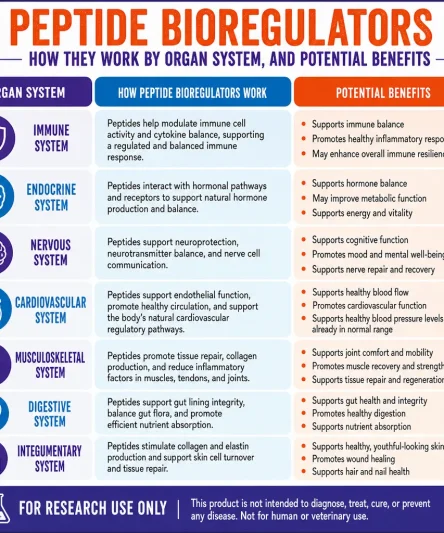
Peptide bioregulators as a class have never been shown to alter steroid hormone levels, and this compound has never been tested for it properly.

Obesity and its relationship to low testosterone levels appear in the surrounding search vocabulary because they belong to the clinical literature on hypogonadism, not because they have been studied here.

The honest position is that the chemistry is settled, the record is small, and the name is the only thing connecting this molecule to an androgen.

What Research Position Applies?

What has been published belongs to the compound and not to this format.

Observations in aged rodent models were published by the St Petersburg group, assessed by histology and by markers of tissue-associated gene expression.

Those studies used parenteral routes without exception. The nasal route does not appear in the published record for this compound.

Cell-culture work across the family reporting chromatin decondensation supports the DNA-binding hypothesis rather than any organ-specific claim.

No receptor has been identified for any member of this family, and no binding constant appears anywhere in the literature, which leaves the mechanism resting on the DNA-binding hypothesis alone.

No adequately powered independent Western trial has been conducted on this compound or on any of its relatives.

The sequence comes from converging secondary sources rather than one traced primary citation, and the specification table records that directly.

How Should Testagen Nasal Spray Be Stored and Recorded?

Two structural features drive the handling of testagen nasal spray, and both point the same way.

Keep the bottle refrigerated between 2 and 8 degrees Celsius, out of the light, and never frozen.

Aseptic handling matters more for this compound than for its proline-terminating relatives, because a contaminating protease has an easy substrate at the carboxy terminus.

Minimise the number of times the bottle is opened, and avoid contact between the nozzle and any surface that has not been cleaned.

The Asp-Gly rearrangement proceeds without contamination and is temperature and pH dependent. So a periodic pH check adds information a visual inspection cannot.

Because that rearrangement is invisible on appearance and on mass, elapsed time in solution is the practical variable to control alongside sterility.

Record the lot, the fill date if the supplier will state it, the date first opened, the storage temperature, the container type and the actuation count.

Where an instrument is available, a check for a species near 390 daltons distinguishes microbial degradation from ordinary ageing, and those two failure modes call for different responses.

Published Literature

Selected references. The bioregulator literature originates almost entirely from one research programme and used parenteral routes.

  1. (‘Khavinson VK, Malinin VV. Gerontological Aspects of Genome Peptide Regulation. Basel: Karger; 2005.’, ‘https://doi.org/10.1159/isbn.978-3-318-01193-6’)
  2. (‘Geiger T, Clarke S. Deamidation, isomerization, and racemization at asparaginyl and aspartyl residues in peptides. J Biol Chem. 1987;262(2):785-794.’, ‘https://doi.org/10.1016/S0021-9258(19)75855-4’)
  3. (‘Anisimov VN, Khavinson VK. Peptide bioregulation of aging. Biogerontology. 2010;11(2):139-149.’, ‘https://doi.org/10.1007/s10522-009-9249-8’)

Frequently Asked Questions

What is Testagen nasal spray?

A metered aqueous solution of the tetrapeptide Lys-Glu-Asp-Gly at roughly 447.5 daltons. Supplied for laboratory research only. No jurisdiction grants it approval of any kind.

Why is the glycine terminus significant?

Because glycine carries a single hydrogen where every other coded residue has a side chain. Carboxypeptidases working inward from that end meet no obstruction at all.

How does that compare across the family?

Prostamax and Cortagen both end in proline, whose ring geometry those enzymes handle badly, making them the most resistant. This compound sits at the exposed end of the same spectrum.

Does that matter in a sealed bottle?

No. It is dormant while the solution is sterile, since no protease is present, and it becomes live the moment an opened aqueous container is contaminated.

What would contamination produce?

Lys-Glu-Asp, which is Vesugen, another compound sold in this catalogue at roughly 390.4. Contamination converts this product into a different named compound 57 daltons lighter.

Is that checkable?

Yes. A bottle showing a species near 390 has been degraded rather than merely aged. Visible cloudiness is the cruder indicator and arrives later.

What sits near its mass?

Livagen at roughly 447.5, differing only by a methyl group at the terminus, and Bronchogen at roughly 446.5, differing at two positions and arriving nearby by coincidence.

Do those need the same check?

No, and that is worth knowing. Amino acid analysis settles the Livagen pair through an alanine to glycine ratio. Chromatography settles the Bronchogen pair, since leucine is far more hydrophobic than glycine.

What does the Asp-Gly motif add?

A second degradation route that needs no contamination. The aspartate attacks the following backbone nitrogen, forming a succinimide that reopens to aspartate or to mass-identical isoaspartate.

Can that be detected?

Not by mass at any resolution, since isoaspartate and aspartate are isomers. Elapsed time in solution is the practical proxy, which makes the fill date more informative than the purity figure.

How does its size sit for delivery?

At roughly 447.5 daltons it is mid-range for this family, above Ovagen at roughly 375.4 and below Prostamax at roughly 487.5, all well under the transition weight.

Does Testagen raise testosterone?

No. It is Lys-Glu-Asp-Gly, four amino acids, containing no testosterone and no androgen. No published study shows it changing androgen levels in any species. The name carries the implication and the chemistry does not support it.

Is this the same as Natesto?

No. Natesto is an approved testosterone nasal gel applied with a nasal applicator, prescribed for hypogonadal men and classed as a controlled substance. Natesto delivers actual testosterone. This is an unapproved research peptide that delivers none.

What are the side effects of Testagen?

Unknown. No safety study of this compound in humans exists, so no side effects profile can be quoted. The side effects widely listed against searches like this one belong to testosterone products, not to this molecule.

What side effects does TRT carry?

Testosterone replacement therapy is associated with raised haematocrit and blood clots, with heart problems including heart attack, stroke and worsening heart failure, and with high blood pressure and sleep apnea. TRT is also cautioned in liver disease and in men with BPH or a history of prostate cancer.

What local effects does a testosterone nasal gel cause?

The labelled record for that dosage form includes runny nose, nasal congestion, sneezing, nose bleed and nasal scabbing, with allergic reaction and hives reported systemically. It is contraindicated after a broken nose. None of that record describes this compound.

Does it help erectile dysfunction or low testosterone?

No. Nothing in the record measures erectile function, benign prostatic hyperplasia, or testosterone deficiency. Anyone with those concerns needs a physician and a blood test, and questions about dosage forms, dose titration or overdose belong to a prescribing clinician.

Compliance Statement

Testagen nasal spray is sold exclusively for laboratory research use. It is not a drug, food, or cosmetic product, and it is not a dietary product of any kind. It is not approved by the FDA or any comparable authority for human or veterinary use, its proposed mechanism has not been independently established, no published study characterises this compound delivered intranasally, and two other compounds in this catalogue sit within about one dalton of its calculated mass. This product is not intended to diagnose, treat, cure, or prevent any disease. It must not be given to humans or animals. Purchase is restricted to qualified researchers and institutions operating within applicable laws. All handling is the responsibility of the purchasing laboratory.

Other formats of Testagen

Testagen is also stocked as Testagen 10mg preloaded 3ml pen and Testagen Peptide 20mg. Each listing states its own quantity and concentration, and the pen and vial comparison explains what changes between formats.
Additional information

Weight N/A
Dimensions N/A

7 reviews for Testagen 20mg Nasal Spray

  1. Spencer Sanders
    August 2, 2026
    Tested good
    Had this order sent off to Janoshik for testing and it just came back with a perfect on the endotoxin testing and a purity of 99.97%. I will be shoppi...More
    Had this order sent off to Janoshik for testing and it just came back with a perfect on the endotoxin testing and a purity of 99.97%. I will be shopping here from now on, no vendor that I trust has better pricing.
    Helpful? 0 0
    Damon Gray
    August 2, 2026
    Thanks.
    Shipping was slow but everything came as it should.
    Helpful? 0 0
    Omar Bradley
    August 2, 2026
    Happy with it
    Def a good buy, already notice a difference. Quality was there for sure. Also a different vendor ghosted me after payment but these guys kept me updat...More
    Def a good buy, already notice a difference. Quality was there for sure. Also a different vendor ghosted me after payment but these guys kept me updated the whole way.
    Helpful? 0 0
    Emma Cook
    August 1, 2026
    Good
    Great product slow shipping
    Helpful? 0 0
    Paula Harper
    August 1, 2026
    quality on point!
    test came back 99.71%. Will be back fs
    Helpful? 0 0
    Beverly Jones
    August 1, 2026
    Already seeing results!
    Shipping was slow but after only a week I am already seeing amazing results. Thank you.
    Helpful? 0 0
    Curtis Harper
    July 30, 2026
    will be back
    thanks
    Helpful? 0 0

Only logged in customers who have purchased this product may leave a review.

Peptide Research Articles

Bacteriostatic water depiction

Bacteriostatic Water Peptide Science: Why It Matters in Reconstitution & Research

Bacteriostatic water peptide science is the foundation of safe, accurate peptide reconstitution. This 2026 guide covers bacteriostatic water composition, how to reconstitute peptides using a peptide reconstitution calculator and peptide dosage calculator, bacteriostatic water vs sterile water differences, peptide storage best practices, and a 10-step reconstitution protocol. Expert insights from PrymaLab.

wolverine blend article vial

Peptides for Injury Recovery: The Wolverine Stack Peptide Guide (BPC-157 + TB-500)

The Wolverine stack peptide combines BPC-157 and TB-500 for research into tendon, ligament, and joint recovery. This 2026 guide covers BPC-157 peptide where to buy responsibly, BPC 157 peptide side effects, peptides for tendon repair, peptides for joint recovery, peptides for elbow pain, and the BPC-157 TB-500 peptide blend scientific research. Expert insights from PrymaLab.

are peptides healthy

Are Peptides Good for You? A Complete 2026 Guide

Are peptides good for you? This comprehensive 2026 guide explores peptide therapy benefits, safety, side effects, and how peptides work in the body. Learn about peptide health benefits, research findings, and what you need to know before considering peptide therapy. Expert insights from PrymaLab.

Ovagen peptide capsules for liver health with dosage cycling chart showing 10-20 day protocols repeated 2-3 times per year

Ovagen Peptide Guide: Uses, Research, Safety & Buying Info

Ovagen peptide is a short-chain liver bioregulator developed at the St. Petersburg Institute of Bioregulation and Gerontology under Professor Vladimir Khavinson. It contains the AC-3 peptide complex (glutamic acid and aspartic acid) designed to target hepatocyte gene expression for liver cell repair, bile production, and detoxification. This guide covers dosing protocols, cycling schedules, side effects, a head-to-head comparison with NAC, milk thistle, TUDCA, and BPC-157, cost analysis ($120-360 per year), and how to verify genuine Ovagen products online.

GHK-Cu peptide vial and syringe with dosage chart showing injection protocols for skin rejuvenation and hair growth

GHK-Cu Peptide: Benefits, Dosage, Side Effects & Complete Research Guide (2026)

GHK-Cu peptide is a naturally occurring copper tripeptide that modulates over 4,000 human genes involved in collagen synthesis, wound healing, and tissue regeneration. This comprehensive guide covers injection dosage protocols, clinical research on skin rejuvenation and hair growth, side effects, safety data, and how to reconstitute GHK-Cu 50mg vials. Includes dosage charts, comparison tables, and 10 frequently asked questions answered by a peptide research specialist.

Sermorelin dosage guide for anti-aging muscle growth and weight loss showing GHRH analog pituitary stimulation

Sermorelin Dosage Guide 2025: Complete Protocol for Anti-Aging, Muscle Growth & Weight Loss

Sermorelin acetate is a growth hormone-releasing hormone (GHRH) analog that stimulates natural GH production from the pituitary gland. This comprehensive dosage guide covers protocols for anti-aging, muscle growth, weight loss, and sleep optimization — along with side effects, before-and-after timelines, and comparisons to HGH and ipamorelin.

Customer reviews

4.57
Based on 7 reviews
5
57%
4
4
43%
3
3
0%
0
2
0%
0
1
0%
0
Spencer Sanders
August 2, 2026
Tested good
Had this order sent off to Janoshik for testing and it just came back with a perfect on the endotoxin testing and a purity of 99.97%. I will be shoppi...More
Had this order sent off to Janoshik for testing and it just came back with a perfect on the endotoxin testing and a purity of 99.97%. I will be shopping here from now on, no vendor that I trust has better pricing.
Helpful? 0 0
Damon Gray
August 2, 2026
Thanks.
Shipping was slow but everything came as it should.
Helpful? 0 0
Omar Bradley
August 2, 2026
Happy with it
Def a good buy, already notice a difference. Quality was there for sure. Also a different vendor ghosted me after payment but these guys kept me updat...More
Def a good buy, already notice a difference. Quality was there for sure. Also a different vendor ghosted me after payment but these guys kept me updated the whole way.
Helpful? 0 0
Emma Cook
August 1, 2026
Good
Great product slow shipping
Helpful? 0 0
Paula Harper
August 1, 2026
quality on point!
test came back 99.71%. Will be back fs
Helpful? 0 0
Beverly Jones
August 1, 2026
Already seeing results!
Shipping was slow but after only a week I am already seeing amazing results. Thank you.
Helpful? 0 0
Curtis Harper
July 30, 2026
will be back
thanks
Helpful? 0 0
24/7 Online support

support@prymalab.net info@prymalab.net

Money back guarantee

30 Day return window. Satisfaction guaranteed or your money back.

FREE shipping and return

All orders over %150 in value will receive free shipping.