
Description
PrymaLab · Research use only
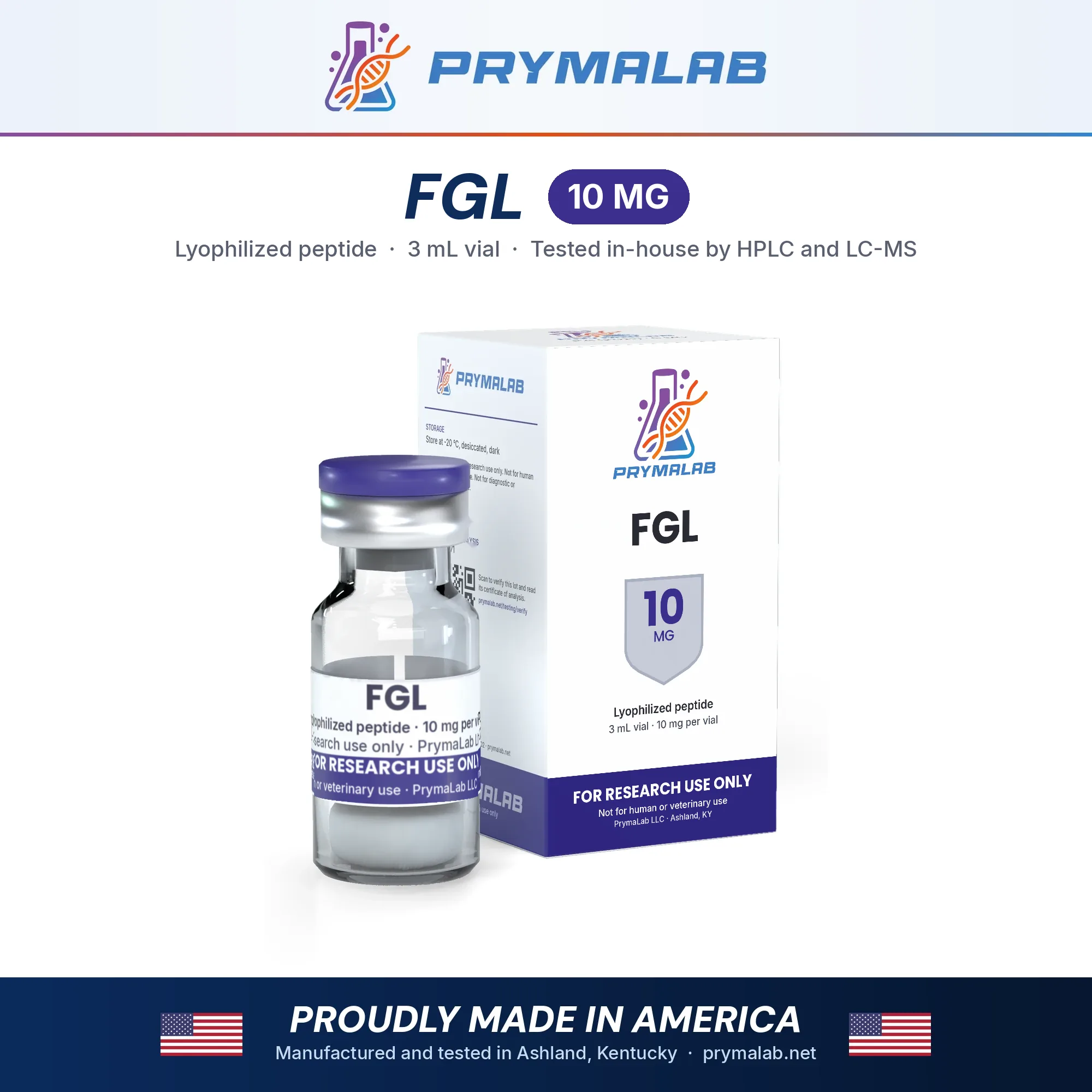
FGL Peptide 10mg
The NCAM FG-loop peptide EVYVVAENQQGKSKA, an FGFR1-binding mimetic, 10 mg freeze-dried
FGL stands for FG loop. It is a 15-residue peptide, EVYVVAENQQGKSKA, copied from residues 681 to 695 of the second fibronectin type III module of the neural cell adhesion molecule NCAM, the part of NCAM that contacts fibroblast growth factor receptor 1. On its own the peptide binds and phosphorylates FGFR without NCAM first binding another NCAM. This listing is the 10 mg vial of freeze-dried powder, the main fill; a 30 mg vial is also sold. It is one of the more ambiguous names in peptide research, so the sequence on the certificate is what counts.
Specifications
| Property | Value |
|---|---|
| Compound | FGL (FGLoop) peptide, NCAM fibronectin type III module 2 FG-loop sequence, residues E681-A695 |
| CAS number | 499993-62-3 (PubChem-sourced) |
| Molecular formula | C71H116N20O25 |
| Theoretical mass | 1649.8 Da (monomer, free acid) |
| Sequence / structure | H-EVYVVAENQQGKSKA-OH; 15 residues, monomer, no disulfides. |
| Label claim | 10 mg per vial |
| Form | Lyophilized (freeze-dried) powder or cake in a sealed glass vial with a rubber stopper and aluminium crimp cap |
| Storage, sealed | −20 °C, desiccated, dark |
| Purity specification | 99.0% or higher by RP-HPLC |
| Lot certificate | Certificate for the first lot: in preparation. Published certificates appear on the results page and can be checked on the verify page. |
Fills in this range
FGL is sold in 2 fills. The compound and the testing are the same in every fill; only the amount in the vial changes.
| Fill | Listing |
|---|---|
| 10 mg | FGL Peptide 10mg (this page) |
| 30 mg | FGL Peptide 30mg |
What the structure is
Glu-Val-Tyr-Val-Val-Ala-Glu-Asn-Gln-Gln-Gly-Lys-Ser-Lys-Ala, linear, no cysteine, methionine or tryptophan. Formula C71H116N20O25, theoretical mass 1649.8 Da for the monomer as the free acid (PubChem CID 16200289, CAS 499993-62-3), which is exactly what the sequence gives with free termini. Asn8 and Gln9-Gln10 can deamidate in warm or alkaline solution, which is the main stability concern.
Three things share the name and are not this peptide: FGL1 and FGL2, the fibrinogen-like proteins of immunology; plannexin and the other NCAM mimetics from the same Copenhagen laboratory; and the dimeric FGL used in most of the published pharmacology, two monomers joined at their N-termini through an iminodiacetic acid linker. Research-grade FGL sold by weight is the 15-residue monomer, and this listing is the monomer unless the lot certificate says otherwise.
What the research covers
Origin: the NCAM-FGFR1 interaction
NCAM promotes axonal outgrowth, and surface plasmon resonance demonstrated a direct interaction between NCAM fibronectin type III modules 1-2 and FGFR1 immunoglobulin modules 2-3; NMR determined the structure of NCAM FnIII module 2 and showed it interacts with FGFR1 Ig module 3 and with ATP at overlapping sites, with ATP inhibiting NCAM-FGFR binding and the module itself able to induce FGFR phosphorylation and neurite outgrowth1. The FGL peptide is the FG-loop segment of that module, isolated so that it can bind and activate FGFR without requiring prior homophilic NCAM binding1,2.
Neurite outgrowth and neuronal survival in culture
In primary cultures of three FGFR1-expressing rat neuronal types – dopaminergic, hippocampal and cerebellar granule neurons – FGL induced neurite outgrowth through direct interaction with FGFR and promoted survival when cell death was induced; both effects required FGFR activation and the MAPK and PI3K-Akt pathways, since inhibiting any of the three kinases abolished them2. The peptide acts without prior homophilic NCAM binding, which is what distinguishes it from NCAM-mediated adhesion as a stimulus2.
Memory and synaptic effects in rodents
Intracerebroventricular administration of FGL to rats immediately after fear-conditioning or water-maze training produced a long-lasting improvement in memory retention, and in primary hippocampal cultures the peptide increased presynaptic function via FGFR1 activation and promoted synapse formation3. A mechanistic follow-up found that FGL triggers a long-lasting increase in synaptic transmission in hippocampal CA1 neurons, mediated by facilitated synaptic delivery of AMPA receptors and accompanied by increased NMDA-receptor-dependent long-term potentiation, with both the potentiation and the behavioural increasement depending on an initial PKC activation followed by persistent CaMKII activation7.
Injury and neuroinflammation models
In dissociated rat hippocampal neurons and hippocampal slice cultures subjected to oxygen-glucose deprivation, FGL reduced damage and maintained or restored metabolic and presynaptic activity whether applied before or only after the insult; a single suboccipital injection 24 hours before transient global ischaemia in gerbils reduced CA1 neuron death4. In rats given intracerebroventricular pre-aggregated oligomeric amyloid-beta 25-35, FGL prevented or reduced amyloid immunoreactivity, tau phosphorylation, microglial activation, astrocytosis, neuronal loss, brain atrophy and the short-term memory deficit, and did so by intracisternal, intranasal and subcutaneous routes; the proposed mechanism was inhibition of GSK3-beta through increased Ser9 phosphorylation5. In aged rats, FGL attenuated markers of activated microglia, the rise in interleukin-1-beta and the impairment of long-term potentiation, apparently by raising neuronal CD200 downstream of glial interleukin-4 and ERK signalling6.
Brain penetration and emotionality
A pharmacokinetic and behavioural study in rats and non-human primates found that peripherally administered NCAM peptide mimetics reach the brain: cisternal cerebrospinal fluid levels correlated with blood plasma levels in both species, and CSF-to-blood ratios for the FGL preparations were comparable across species8. Behaviourally, the preparation designated FGL-L was acutely anxiogenic and chronically antidepressant-like in rats, while FGL-S produced antidepressant-like effects without changing anxiety-like behaviour, and those effects were blocked by an AMPA receptor antagonist – consistent with the AMPA-receptor mechanism identified earlier7,8. Note that the two preparations behaved differently, so results are not transferable between FGL forms8.
What is not established
The great majority of FGL work originates with, or involves, the Berezin and Bock laboratory in Copenhagen and its collaborators1,2,3,4,5,6,7, so independence across the literature is limited even though several laboratories contributed behavioural, electrophysiological and pharmacokinetic data. There is a reproducibility flag in the corpus itself: a 2008 Neurochemical Research paper on FGL-induced dendritic spine and synapse morphology is indexed as withdrawn (PMID 18338259, title prefixed “WITHDRAWN” in the PubMed/Europe PMC record), so morphological claims should be sourced carefully. Results are form-dependent in ways that are not fully resolved – the published pharmacology used an N-terminally linked dimer7, and two FGL preparations tested side by side (FGL-L and FGL-S) gave different behavioural profiles8 – so “FGL” is not a single well-defined pharmacological entity in the way a small molecule would be. FGFR agonism is a broad, pleiotropic action, and NCAM contains more than one FGFR-binding motif, so FGL should not be read as the unique NCAM-FGFR site. There is no published human efficacy or safety data and no registered clinical trial (ClinicalTrials.gov queries for “FGL peptide” and “FGLL” on 4 Nov 2026 returned no relevant studies); the strongest forward-looking statement in the cited literature is that one FGL preparation “may be a candidate for further development” for major depressive disorder8, which is a statement of potential, not of demonstrated clinical effect. All in vivo work used intracerebroventricular, intracisternal, suboccipital, intranasal or subcutaneous administration in rodents and non-human primates. None of the cited work used material from this supplier.
Clinical and regulatory status
No clinical development found on the public record. FGL is not approved in any jurisdiction, and ClinicalTrials.gov queries for “FGL peptide” and “FGLL” on 4 Nov 2026 returned no relevant registered studies. The peptide family is covered by patents including US 8,470,964 (“Peptides derived from NCAM (FGLs)”, issued 25 June 2013), which claims shorter FGL-derived variants and cites EVYVVAENQQGKSKA as prior art; the compound was developed as a drug candidate by ENKAM Pharmaceuticals, the Copenhagen spin-out associated with the Berezin and Bock laboratory. The furthest the cited peer-reviewed record goes is a pharmacokinetic and behavioural study concluding that one FGL preparation “may be a candidate for further development as a novel treatment for major depressive disorder in humans”8. This material is a research-grade peptide with no approved pharmaceutical form.
Related listings: Cerebrolysin 60mg, P21 (P021) 10mg, Semax 11mg, Selank 11mg. The cognitive, sleep and mood peptides category lists the rest of the range.
How each lot is tested
Every lot is tested in PrymaLab’s own laboratory in Ashland, Kentucky before release: RP-HPLC for purity, LC-MS for identity, Karl Fischer titration for water, LAL for endotoxin and USP <71> for sterility. Published certificates are listed on the results page and can be checked by number and key on the verify page. These are in-house results from PrymaLab Analytical, not an independent test, and the lab is not accredited to ISO 17025. The third-party testing guarantee on this page still applies: if any independent laboratory finds the wrong compound, or less than the stated purity or amount, the order is refunded and the cost of the test is reimbursed.
Frequently asked questions
What is FGL, and what does the name mean?
FGL stands for FG loop. It is a 15-residue peptide, EVYVVAENQQGKSKA, corresponding to residues E681-A695 of the second fibronectin type III module of the neural cell adhesion molecule (NCAM) – the part of NCAM that contacts fibroblast growth factor receptor 1. Because the peptide carries that contact motif on its own, it can bind and phosphorylate FGFR without NCAM first binding another NCAM molecule.
Is ‘FGL’ the same as FGL1 or FGL2?
No, and this is the single most common identity error with this name. FGL1 and FGL2 are fibrinogen-like proteins studied in immunology and oncology; they are unrelated to this NCAM-derived peptide. If a supplier lists ‘FGL’ without a sequence, confirm it is EVYVVAENQQGKSKA.
Monomer or dimer – does it matter?
It matters. In the published pharmacology FGL was used as a dimer, two monomers joined at their N-termini through an iminodiacetic acid linker, and one study compared two preparations (FGL-L and FGL-S) that gave different behavioural profiles in rats. Research-grade ‘FGL’ supplied by weight is most often the 15-residue monomer, which is what PubChem CID 16200289 and the formula C71H116N20O25 describe. If you need to match a published protocol, check which form that protocol used and what the certificate of analysis says.
How does FGL differ from other NCAM-derived peptides?
FGL is one of several FGFR-binding motifs in NCAM, not the only one, and the same laboratory produced a family of NCAM-derived mimetic peptides rather than a single compound. In the one head-to-head pharmacokinetic and behavioural study, a related NCAM mimetic (plannexin) and two FGL preparations (FGL-L and FGL-S) all gave different behavioural profiles in rats. So “an NCAM mimetic peptide” is not a pharmacological identity; the sequence and the physical form are.
What does the literature show, and what are its limits?
In rodents it shows FGFR1-, MAPK- and PI3K-dependent neurite outgrowth and survival in primary neurons, post-training memory increasement after intracerebroventricular dosing, AMPA-receptor-dependent increase in CA1 synaptic transmission and LTP, protection in oxygen-glucose deprivation and gerbil global ischaemia, reduction of amyloid-beta 25-35-induced pathology and memory deficit via GSK3-beta inhibition, and suppression of microglial activation in aged rats via CD200 and interleukin-4. The limits: most of this comes from one research network, one morphological paper in the corpus was withdrawn, effects differ between FGL preparations, there is no human data, and no clinical trial has been registered.
Which residues make it sensitive during handling?
FGL has one tyrosine and no cysteine, methionine or tryptophan, so it lacks disulfide bonds and the most oxidation-prone side chains. The practical concern is the asparagine at position 8 and the two glutamines at positions 9-10, which can deamidate in aqueous solution, particularly at non-neutral pH or elevated temperature; keep solutions cold, near neutral and freshly prepared.
References
- Kiselyov VV, Skladchikova G, Hinsby AM, Jensen PH, Kulahin N, Soroka V, Pedersen N, Tsetlin V, Poulsen FM, Berezin V, Bock E Structural basis for a direct interaction between FGFR1 and NCAM and evidence for a regulatory role of ATP. Structure. 2003;11(6):691-701. DOI · PubMed
- Neiiendam JL, Kohler LB, Christensen C, Li S, Pedersen MV, Ditlevsen DK, Kornum MK, Kiselyov VV, Berezin V, Bock E An NCAM-derived FGF-receptor agonist, the FGL-peptide, induces neurite outgrowth and neuronal survival in primary rat neurons. Journal of Neurochemistry. 2004;91(4):920-935. DOI · PubMed
- Cambon K, Hansen SM, Venero C, Herrero AI, Skibo G, Berezin V, Bock E, Sandi C A synthetic neural cell adhesion molecule mimetic peptide promotes synaptogenesis, enhances presynaptic function, and facilitates memory consolidation. Journal of Neuroscience. 2004;24(17):4197-4204. DOI · PubMed
- Skibo GG, Lushnikova IV, Voronin KY, Dmitrieva O, Novikova T, Klementiev B, Vaudano E, Berezin VA, Bock E A synthetic NCAM-derived peptide, FGL, protects hippocampal neurons from ischemic insult both in vitro and in vivo. European Journal of Neuroscience. 2005;22(7):1589-1596. DOI · PubMed
- Klementiev B, Novikova T, Novitskaya V, Walmod PS, Dmytriyeva O, Pakkenberg B, Berezin V, Bock E A neural cell adhesion molecule-derived peptide reduces neuropathological signs and cognitive impairment induced by Abeta25-35. Neuroscience. 2007;145(1):209-224. DOI · PubMed
- Downer EJ, Cowley TR, Lyons A, Mills KH, Berezin V, Bock E, Lynch MA A novel anti-inflammatory role of NCAM-derived mimetic peptide, FGL. Neurobiology of Aging. 2010;31(1):118-128. DOI · PubMed
- Knafo S, Venero C, Sanchez-Puelles C, Pereda-Perez I, Franco A, Sandi C, Suarez LM, Solis JM, Alonso-Nanclares L, Martin ED, Merino-Serrais P, Borcel E, Li S, Chen Y, Gonzalez-Soriano J, Berezin V, Bock E, Defelipe J, Esteban JA Facilitation of AMPA receptor synaptic delivery as a molecular mechanism for cognitive enhancement. PLoS Biology. 2012;10(2):e1001262. DOI · PubMed
- Turner CA, Lyons DM, Buckmaster CL, Aurbach EL, Watson SJ, Schatzberg AF, Akil H Neural cell adhesion molecule peptide mimetics modulate emotionality: pharmacokinetic and behavioral studies in rats and non-human primates. Neuropsychopharmacology. 2019;44(2):356-363. DOI · PubMed
Research use only
For laboratory research use only. FGL Peptide 10mg is not a drug, food, cosmetic or dietary supplement, is not approved by the FDA or any comparable authority for human or veterinary use, and must not be given to people or animals. It is sold to qualified researchers and institutions, and the buyer is responsible for lawful handling and disposal.







Reviews
There are no reviews yet.