
Description
PrymaLab · Research use only
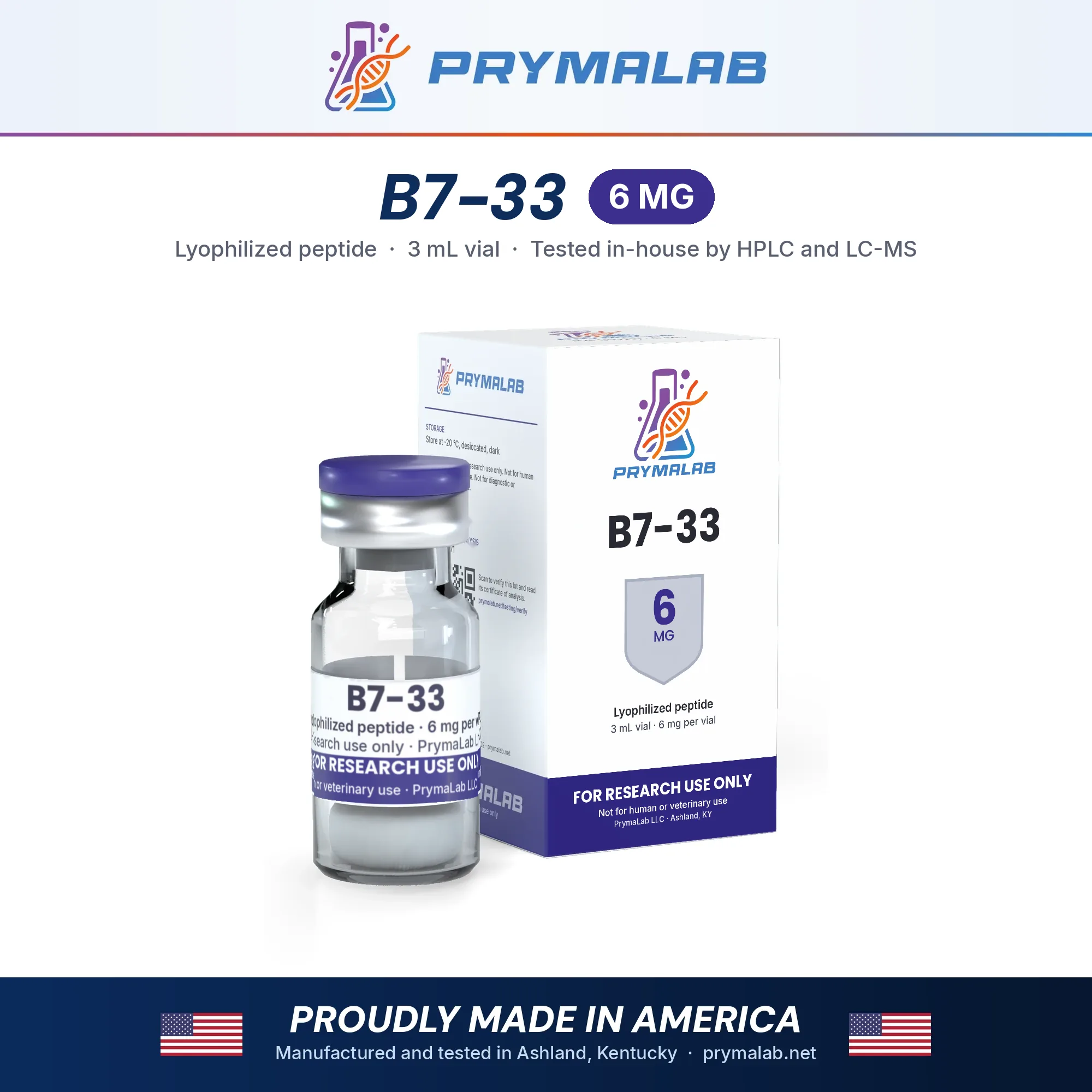
B7-33 6mg
The single-chain relaxin-2 B-chain analogue VIKLSGRELVRAQIAISGMSTWSKRSL, 6 mg freeze-dried
B7-33 is a 27-residue, single-chain peptide designed in 2016 at the Florey Institute in Melbourne as a minimal stand-in for human relaxin-2, a two-chain, three-disulfide hormone that is awkward and expensive to make. This is the 6 mg vial of freeze-dried powder, a smaller fill than the 10 mg main listing, made and tested as its own lot. The research summary, references and full FAQ are on the B7-33 10mg page.
Specifications
| Property | Value |
|---|---|
| Compound | B7-33, [Ser11,Ser23]-H2 relaxin B-chain(7-33); single-chain relaxin-2 analogue |
| CAS number | None assigned |
| Molecular formula | Not in a public registry |
| Theoretical mass | Not in a public registry; confirmed by LC-MS on the lot certificate |
| Sequence / structure | H-VIKLSGRELVRAQIAISGMSTWSKRSL-OH; 27 residues, Cys11→Ser and Cys23→Ser, no disulfides. |
| Label claim | 6 mg per vial |
| Form | Lyophilized (freeze-dried) powder or cake in a sealed glass vial with a rubber stopper and aluminium crimp cap |
| Storage, sealed | −20 °C, desiccated, dark |
| Purity specification | 99.0% or higher by RP-HPLC |
| Lot certificate | Certificate for the first lot: in preparation. Published certificates appear on the results page and can be checked on the verify page. |
Other fills
This is the 6 mg fill. The B7-33 10mg page is the main listing for this compound, with the full research summary and every fill side by side. Other fills: 2 mg, 10 mg.
What the structure is
Val-Ile-Lys-Leu-Ser-Gly-Arg-Glu-Leu-Val-Arg-Ala-Gln-Ile-Ala-Ile-Ser-Gly-Met-Ser-Thr-Trp-Ser-Lys-Arg-Ser-Leu (VIKLSGRELVRAQIAISGMSTWSKRSL), linear, all L-amino acids. It keeps the RXFP1 contact residues Arg13, Arg17 and Ile20 of the relaxin B-chain and drops the A-chain and all three disulfides. The name encodes residues 7 through 33 but says nothing about the two cysteine-to-serine substitutions, which are what keep a linear peptide from dimerising, so the sequence is the real identifier. No PubChem record, CAS number or registry formula exists; identity rests on the sequence and the measured mass on the lot certificate.
What the research covers
The literature on B7-33 is summarised, with references, on the B7-33 10mg page: Design and receptor pharmacology; Fibrosis in rodent heart and lung models; Kidney fibrosis. The RXFP1 bias claim rests on comparisons made in different cell systems – weak binding and weak cAMP potency in HEK cells overexpressing RXFP1 versus relaxin-equivalent pERK1/2 potency in renal myofibroblasts – rather than on a single matched system, and the originating paper’s own language about cAMP agonism is not internally consistent. None of the published work used PrymaLab material.
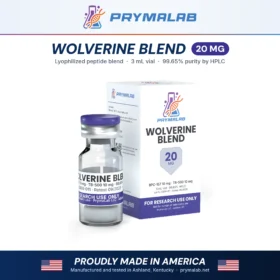
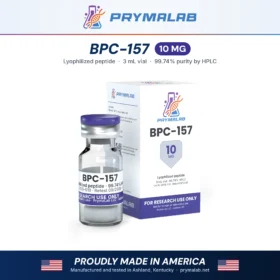
Related listings: TB-500 (Thymosin Beta-4) 10mg, BPC-157 10MG, BPC-157 + TB500 (10mg/10mg) “Wolverine Blend”, ARA-290 10mg. The healing and recovery peptides category lists the rest of the range.
How each lot is tested
Every lot is tested in PrymaLab’s own laboratory in Ashland, Kentucky before release: RP-HPLC for purity, LC-MS for identity, Karl Fischer titration for water, LAL for endotoxin and USP <71> for sterility. Published certificates are listed on the results page and can be checked by number and key on the verify page. These are in-house results from PrymaLab Analytical, not an independent test, and the lab is not accredited to ISO 17025. The third-party testing guarantee on this page still applies: if any independent laboratory finds the wrong compound, or less than the stated purity or amount, the order is refunded and the cost of the test is reimbursed.
Frequently asked questions
Is the 6 mg vial the same compound as the 10 mg?
Yes. Both hold B7-33, the 27-residue peptide VIKLSGRELVRAQIAISGMSTWSKRSL. Only the amount differs; each fill is made and tested as its own lot with its own certificate.
How should the vial be stored?
Sealed at −20 °C, desiccated and protected from light. Let it reach room temperature before opening, and keep any reconstituted solution at 2 to 8 °C, away from light.
Research use only
For laboratory research use only. B7-33 6mg is not a drug, food, cosmetic or dietary supplement, is not approved by the FDA or any comparable authority for human or veterinary use, and must not be given to people or animals. It is sold to qualified researchers and institutions, and the buyer is responsible for lawful handling and disposal.







Reviews
There are no reviews yet.