
Description
PrymaLab · Research use only
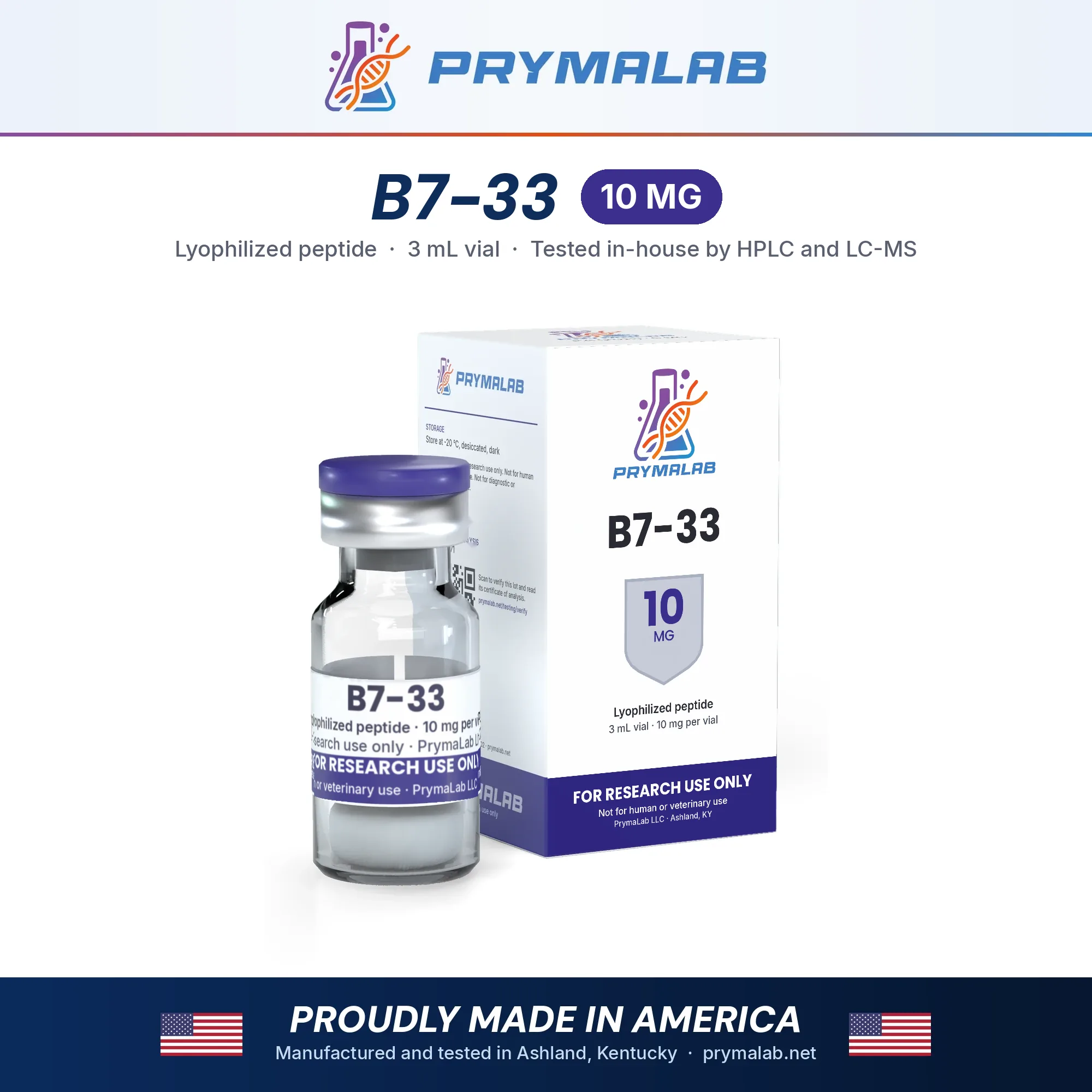
B7-33 10mg
The single-chain relaxin-2 B-chain analogue VIKLSGRELVRAQIAISGMSTWSKRSL, 10 mg freeze-dried
B7-33 is a 27-residue, single-chain peptide designed in 2016 at the Florey Institute in Melbourne as a minimal stand-in for human relaxin-2, a two-chain, three-disulfide hormone that is awkward and expensive to make. It is B-chain residues 7 to 29 with a KRSL extension for solubility and both cysteines swapped for serine. This listing is the 10 mg vial of freeze-dried powder, the main fill; a 2 mg and a 6 mg vial are also sold. The group describes it as a functionally selective agonist of the relaxin receptor RXFP1.
Specifications
| Property | Value |
|---|---|
| Compound | B7-33, [Ser11,Ser23]-H2 relaxin B-chain(7-33); single-chain relaxin-2 analogue |
| CAS number | None assigned |
| Molecular formula | Not in a public registry |
| Theoretical mass | Not in a public registry; confirmed by LC-MS on the lot certificate |
| Sequence / structure | H-VIKLSGRELVRAQIAISGMSTWSKRSL-OH; 27 residues, Cys11→Ser and Cys23→Ser, no disulfides. |
| Label claim | 10 mg per vial |
| Form | Lyophilized (freeze-dried) powder or cake in a sealed glass vial with a rubber stopper and aluminium crimp cap |
| Storage, sealed | −20 °C, desiccated, dark |
| Purity specification | 99.0% or higher by RP-HPLC |
| Lot certificate | Certificate for the first lot: in preparation. Published certificates appear on the results page and can be checked on the verify page. |
Fills in this range
B7-33 is sold in 3 fills. The compound and the testing are the same in every fill; only the amount in the vial changes.
| Fill | Listing |
|---|---|
| 2 mg | B7-33 2mg |
| 6 mg | B7-33 6mg |
| 10 mg | B7-33 10mg (this page) |
What the structure is
Val-Ile-Lys-Leu-Ser-Gly-Arg-Glu-Leu-Val-Arg-Ala-Gln-Ile-Ala-Ile-Ser-Gly-Met-Ser-Thr-Trp-Ser-Lys-Arg-Ser-Leu (VIKLSGRELVRAQIAISGMSTWSKRSL), linear, all L-amino acids. It keeps the RXFP1 contact residues Arg13, Arg17 and Ile20 of the relaxin B-chain and drops the A-chain and all three disulfides. The name encodes residues 7 through 33 but says nothing about the two cysteine-to-serine substitutions, which are what keep a linear peptide from dimerising, so the sequence is the real identifier. No PubChem record, CAS number or registry formula exists; identity rests on the sequence and the measured mass on the lot certificate.
One methionine (position 19 of the peptide, B25 in relaxin numbering) and one tryptophan make it oxidation- and light-sensitive. Lipidated and stapled derivatives from the same programme are different compounds, and serelaxin, the recombinant full-length hormone, is not what this is.
What the research covers
Design and receptor pharmacology
Native relaxin-2 acts at the G protein-coupled receptor RXFP1 and stimulates a combination of cAMP and ERK1/2 pathways; the authors’ concern was that strong cAMP signalling has been linked to tumour-promoting actions that could limit long-term use1. B7-33 was designed by truncating the B-chain, appending KRSL for solubility, and replacing both cysteines, and was reported to bind RXFP1 and to preferentially activate pERK1/2 over cAMP in cells that express RXFP1 endogenously1. In HEK cells overexpressing RXFP1 its affinity and cAMP potency are poor relative to relaxin-2, whereas in fibroblasts natively expressing RXFP1 it matched relaxin-2’s potency – a cell-system-dependent comparison that the group itself describes plainly as ‘poor affinity and potency in HEK cells overexpressing RXFP1’ alongside equivalence in native fibroblasts1,7. The proposed mechanism involves RXFP1-angiotensin II type 2 receptor heterodimers driving pERK1/2 and matrix metalloproteinase-21.
Fibrosis in rodent heart and lung models
In the originating study B7-33 prevented or reversed fibrosis and organ dysfunction in three rodent models with potency similar to relaxin-2: a rat myocardial infarction model (left ventricular collagen by picrosirius red, left ventricular end-diastolic pressure), an isoprenaline-induced cardiac fibrosis model in mice (interstitial collagen, left ventricular hydroxyproline, with no change in blood pressure), and an ovalbumin-induced chronic allergic airway disease model in mice (epithelial thickness, subepithelial and total lung collagen, airway hyperresponsiveness)1. In a separate mouse isoprenaline cardiomyopathy study with subcutaneous dosing from day 7 to day 14 after injury, B7-33 and relaxin equivalently reduced left ventricular fibrosis and normalised inflammation and cardiomyocyte hypertrophy while restoring blood vessel density and aortic contractility, without changing body weight or systolic blood pressure; the ACE inhibitor perindopril in the same experiment lowered blood pressure and inflammation but did not reduce fibrosis or hypertrophy over that window5.
Kidney fibrosis
In mice with unilateral ureteric obstruction treated for 7 days by subcutaneous micro-osmotic pump, B7-33 (0.25 mg/kg/day) and relaxin (0.5 mg/kg/day) both reduced collagen fibre thickness and the collagen-to-tissue cross-reticulation ratio while increasing collagen fibre counts, measured by stain-free second-harmonic generation imaging; both also increased renal matrix metalloproteinase-2 and reduced tissue inhibitor of metalloproteinase-14. That paper’s primary purpose was to validate the imaging platform, and it notes that conventional Masson’s trichrome staining and collagen I immunohistochemistry did not resolve these drug effects – so the antifibrotic readout here is method-dependent4.
Acute cardioprotection after ischaemia-reperfusion
In adult male CD1 mice subjected to 30 minutes of left anterior descending artery ligation followed by reperfusion, B7-33 reduced infarct size (21.99% versus 45.32% of the risk area, p = 0.02) and preserved fractional shortening at 24 hours (29% versus 23%, p = 0.02), with the difference in fractional shortening larger at 7 days (29% versus 20%)3. In isolated adult cardiomyocytes subjected to simulated ischaemia-reoxygenation, 50 and 100 nmol/L improved cell survival and reduced the endoplasmic reticulum stress marker GRP78; the reduction of tunicamycin-induced GRP78 was ERK1/2-dependent3. This is an independent group (Virginia Commonwealth University) using peptide supplied by the originating laboratory3.
Vascular effects
A single tail-vein bolus in male Wistar rats (13.3 ug/kg B7-33 versus 26.6 ug/kg serelaxin, equimolar) selectively increased bradykinin-mediated endothelium-dependent relaxation in mesenteric artery three hours later by increasing endothelium-derived hyperpolarisation, with no overall effect in small renal artery or abdominal aorta2. In an ex vivo model, co-incubation of virgin female mouse mesenteric arteries with placental trophoblast conditioned medium plus B7-33 or serelaxin (15 and 30 nM) prevented the endothelial dysfunction that the conditioned medium otherwise induced2. The authors frame this as relevant to preeclampsia research; it is an isolated-vessel experiment, not a pregnancy model.
Stability is a known limitation
B7-33 has a short in vitro half-life in human serum of roughly 6 minutes, and conjugating a fatty acid with an appropriate spacer length extended that to about 60 minutes in the same assay; the lipidated lead had not yet been tested in animals at the time of publication6. Further medicinal-chemistry work on the scaffold using alpha-aminoisobutyric acid substitution and hydrocarbon stapling, aimed at restoring the helicity present in native relaxin-2, is reported as attempts rather than successes7. These are relevant to any in vitro design: the parent peptide is not serum-stable.
What is not established
The RXFP1 bias claim rests on comparisons made in different cell systems – weak binding and weak cAMP potency in HEK cells overexpressing RXFP1 versus relaxin-equivalent pERK1/2 potency in renal myofibroblasts – rather than on a single matched system, and the originating paper’s own language about cAMP agonism is not internally consistent1,7. Most of the in vivo fibrosis work comes from the Hossain/Bathgate/Samuel collaboration1,4,5; the mouse ischaemia-reperfusion study is the clearest independent replication, and it used peptide supplied by the originating laboratory3. The renal result depends on a non-standard imaging method that resolved effects conventional staining did not4. Effects are reported with continuous or repeated parenteral dosing in rodents; the parent peptide’s human-serum half-life of about 6 minutes6 means exposure in any experiment is short-lived. There is no human data on B7-33 and no registered clinical trial (a ClinicalTrials.gov query for “B7-33” on 4 Nov 2026 returned no studies). Separately, the full-length hormone it mimics failed its large acute heart failure trial, so relaxin-2 pathway activation is not an established clinical benefit8. None of the cited work used material from this supplier.
Clinical and regulatory status
Investigational preclinical; no clinical development found. B7-33 is not approved anywhere and a ClinicalTrials.gov query for “B7-33” on 4 Nov 2026 returned no registered studies; published work is in rodent models and cell systems1,2,3,4,5. For context on the parent hormone: serelaxin, recombinant human relaxin-2, reached large-scale clinical evaluation but RELAX-AHF-2 (NCT01870778, 6,545 patients) found no reduction in cardiovascular death at 180 days (8.7% versus 8.9%; hazard ratio 0.98, 95% CI 0.83-1.15) or in worsening heart failure at 5 days versus placebo, and serelaxin has no marketing authorisation for acute heart failure8. This material is a research-grade peptide with no approved pharmaceutical form.
Related listings: TB-500 (Thymosin Beta-4) 10mg, BPC-157 10MG, BPC-157 + TB500 (10mg/10mg) “Wolverine Blend”, ARA-290 10mg. The healing and recovery peptides category lists the rest of the range.
How each lot is tested
Every lot is tested in PrymaLab’s own laboratory in Ashland, Kentucky before release: RP-HPLC for purity, LC-MS for identity, Karl Fischer titration for water, LAL for endotoxin and USP <71> for sterility. Published certificates are listed on the results page and can be checked by number and key on the verify page. These are in-house results from PrymaLab Analytical, not an independent test, and the lab is not accredited to ISO 17025. The third-party testing guarantee on this page still applies: if any independent laboratory finds the wrong compound, or less than the stated purity or amount, the order is refunded and the cost of the test is reimbursed.
Frequently asked questions
What is B7-33 and how does it relate to relaxin-2?
It is a 27-residue single-chain peptide, VIKLSGRELVRAQIAISGMSTWSKRSL, built from residues 7-29 of the human relaxin-2 B-chain plus a KRSL extension taken from the B1-33 isoform, with both B-chain cysteines replaced by serine. Native relaxin-2 is a two-chain, three-disulfide insulin-like hormone; B7-33 keeps the RXFP1 contact residues ArgB13, ArgB17 and IleB20 but drops the A-chain and all disulfides, which is why it can be made by straightforward solid-phase synthesis.
How does B7-33 differ from serelaxin?
Serelaxin is recombinant full-length human relaxin-2 – both chains, all three disulfides. B7-33 is a synthetic single B-chain fragment analogue. Functionally, relaxin-2 drives both cAMP and ERK1/2 through RXFP1, while B7-33 is reported to favour pERK1/2 over cAMP in cells natively expressing the receptor. In one rodent experiment B7-33, unlike relaxin-2, did not increase prostate tumour growth.
What does ‘functionally selective’ or ‘biased agonist’ mean here, and how solid is it?
It means the peptide is reported to engage one downstream pathway at the same receptor more than another – here pERK1/2 over cAMP. The caveat matters: the comparison that supports it was made across different cell systems (HEK cells overexpressing RXFP1 versus fibroblasts expressing it natively), not in one matched system, and the originating paper’s own characterisation of cAMP activity is not fully consistent. Treat the bias as a working hypothesis supported by the group’s data rather than a settled pharmacological parameter.
Is it stable in serum?
Not very. Its measured in vitro half-life in human serum is about 6 minutes; fatty-acid conjugation with an appropriate spacer extended that to roughly 60 minutes in the same assay, and that lipidated analogue is a separate compound from B7-33 itself. This is worth planning around in any in vitro or ex vivo design using serum-containing media.
What does the literature actually show, and what does it not?
It shows reductions in collagen and improvements in functional measures in rodent models of myocardial infarction, isoprenaline cardiomyopathy, allergic airway disease and unilateral ureteric obstruction, plus acute infarct-size reduction in mouse ischaemia-reperfusion and increased bradykinin-mediated relaxation in isolated rat mesenteric artery. It does not show anything in humans: there is no clinical trial of B7-33, and the full-length hormone it mimics missed both primary endpoints in a 6,545-patient acute heart failure trial.
Does it contain residues that need special handling?
Yes. The sequence contains one methionine (B25) and one tryptophan (B28), both prone to oxidation and, for Trp, photodegradation, so light protection and avoidance of oxidising conditions matter. It has no cysteines (both were replaced by serine), so there is no disulfide to scramble and no thiol-driven dimerisation.
References
- Hossain MA, Kocan M, Yao ST, Royce SG, Nair VB, Siwek C, Patil NA, Harrison IP, Rosengren KJ, Selemidis S, Summers RJ, Wade JD, Bathgate RAD, Samuel CS A single-chain derivative of the relaxin hormone is a functionally selective agonist of the G protein-coupled receptor, RXFP1. Chemical Science. 2016;7(6):3805-3819. DOI · PubMed
- Marshall SA, O’Sullivan K, Ng HH, Bathgate RAD, Parry LJ, Hossain MA, Leo CH B7-33 replicates the vasoprotective functions of human relaxin-2 (serelaxin). European Journal of Pharmacology. 2017;807:190-197. DOI · PubMed
- Devarakonda T, Mauro AG, Guzman G, Hovsepian S, Cain C, Das A, Praveen P, Hossain MA, Salloum FN B7-33, a functionally selective relaxin receptor 1 agonist, attenuates myocardial infarction-related adverse cardiac remodeling in mice. Journal of the American Heart Association. 2020;9(8):e015748. DOI · PubMed
- Bhuiyan S, Shen M, Chelvaretnam S, Tan AY, Ho G, Hossain MA, Widdop RE, Samuel CS Assessment of renal fibrosis and anti-fibrotic agents using a novel diagnostic and stain-free second-harmonic generation platform. FASEB Journal. 2021;35(5):e21595. DOI · PubMed
- Alam F, Gaspari TA, Kemp-Harper BK, Low E, Aw A, Ferens D, Spizzo I, Jefferis AM, Praveen P, Widdop RE, Bathgate RAD, Hossain MA, Samuel CS The single-chain relaxin mimetic, B7-33, maintains the cardioprotective effects of relaxin and more rapidly reduces left ventricular fibrosis compared to perindopril in an experimental model of cardiomyopathy. Biomedicine & Pharmacotherapy. 2023;160:114370. DOI · PubMed
- Praveen P, Wang C, Handley TNG, Wu H, Samuel CS, Bathgate RAD, Hossain MA A lipidated single-B-chain derivative of relaxin exhibits improved in vitro serum stability without altering activity. International Journal of Molecular Sciences. 2023;24(7):6616. DOI · PubMed
- Handley TNG, Praveen P, Tailhades J, Wu H, Bathgate RAD, Hossain MA Further developments towards a minimal potent derivative of human relaxin-2. International Journal of Molecular Sciences. 2023;24(16):12670. DOI · PubMed
- Metra M, Teerlink JR, Cotter G, Davison BA, Felker GM, Filippatos G, et al. (RELAX-AHF-2 Committees Investigators) Effects of serelaxin in patients with acute heart failure. New England Journal of Medicine. 2019;381(8):716-726. DOI · PubMed
Research use only
For laboratory research use only. B7-33 10mg is not a drug, food, cosmetic or dietary supplement, is not approved by the FDA or any comparable authority for human or veterinary use, and must not be given to people or animals. It is sold to qualified researchers and institutions, and the buyer is responsible for lawful handling and disposal.








Reviews
There are no reviews yet.